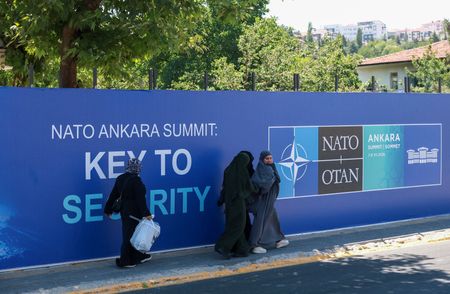

NATO leaders are preparing to convene next week in Ankara, Turkey, as European members of the alliance look to put recent conflicts with U.S. President Donald Trump behind them and demonstrate their commitment to defending the continent amid reduced American involvement.
NATO Secretary General Mark Rutte says the Tuesday and Wednesday gathering will serve as proof that European nations are following through on pledges to boost defense spending as a deterrent against any Russian aggression. Tens of billions of dollars in arms agreements are expected to be signed at the summit.
Leaders are also anticipated to reaffirm their commitment to financing weapons for Ukraine as it continues to fight off Russia’s invasion. Ukrainian President Volodymyr Zelenskiy is scheduled to attend a dinner hosted by Turkish President Tayyip Erdogan, who will also hold one-on-one talks with Trump.
European officials say they are counting on Trump’s close relationships with both Erdogan and Rutte to help the summit go smoothly — though they acknowledge there are no guarantees, given ongoing transatlantic friction over the Iran conflict and Trump’s repeated criticism of the alliance.
Just this past Thursday, Trump took to Truth Social to complain that the United States was spending money to protect NATO members “without getting any benefit from so doing.”
Rutte and other NATO leaders have pushed back on that claim, arguing the alliance serves American security interests as well, and that European nations have been answering Trump’s longstanding calls to invest more in their own defense.
Speaking in Berlin on Wednesday, Rutte outlined the summit’s priorities: “The summit next week will focus on turning extra spending into combat-ready capabilities, and significantly scaling up our defence industries.”
He went on to say, “NATO is, and will always be, a transatlantic alliance but we need to rebalance it for the better. Working closely with the United States, European allies and Canada are taking greater responsibility for conventional defence in Europe.”
Rutte revealed last month that NATO’s European members and Canada collectively spent $90 billion more on defense in 2025 compared to the previous year, bringing the total to more than $570 billion.
At last year’s summit in The Hague, NATO leaders agreed to raise defense spending to 3.5% of GDP on core military items — such as weapons and troops — by 2035, up from a previous target of 2%. They also committed to investing an additional 1.5% of GDP on broader defense-related areas, including cybersecurity.
European officials are hoping this year’s Ankara summit mirrors the success of The Hague gathering, where Trump reaffirmed the U.S. commitment to the 32-member alliance and its Article 5 mutual defense clause, while also offering praise for fellow leaders.
However, the past year has put significant strain on the alliance. Trump threatened to seize Greenland from fellow NATO member Denmark, launched a war against Iran without consulting European allies — a conflict that rattled global markets — and the U.S. has since announced troop withdrawals from Europe and reduced the forces it contributes to NATO’s defense plans, including an aircraft carrier, refueling planes, fighter jets, and drones. Washington has also begun a six-month review of its overall military presence on the continent.
“The alliance is alive and kicking but a bit bruised,” one European diplomat said, speaking anonymously.
European officials are also concerned the Iran conflict could cast a shadow over the summit — particularly if fighting flares up again during what is currently a fragile ceasefire, or if Trump publicly criticizes European nations for not doing more to support U.S. military efforts.
Trump has suggested that European reluctance to assist in the Iran war could affect the U.S. obligation to come to the aid of a NATO ally under attack. NATO officials, however, note that the vast majority of member nations did allow the U.S. to use their airspace and military bases, even though the war was broadly unpopular across Europe and many European leaders opposed it.
The conflict also damaged personal relationships between Trump and European leaders including Italian Prime Minister Giorgia Meloni and outgoing British Prime Minister Keir Starmer — raising the possibility that those tensions could re-emerge at the summit.
One senior NATO diplomat expressed cautious optimism: “I’m optimistic (that won’t happen) because I think the leaders know what is at stake. And if something like that does occur, then we always have the ultimate marriage counsellor, Mark Rutte, to smooth things over.”