
JAKARTA, Indonesia — A group of Indonesians is working to halt a massive German cement company’s plans to build a mine and factory, using a first-of-its-kind legal approach that experts say could have far-reaching consequences for European companies doing business across Asia.
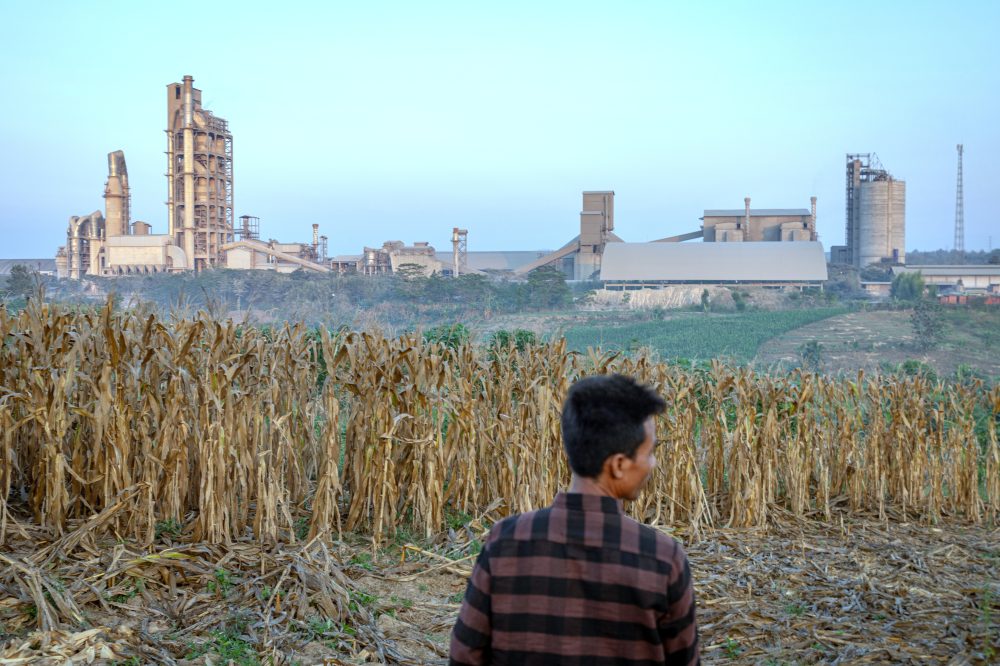
Heidelberg Materials, among the largest cement producers on the planet, is accused by critics of failing to thoroughly evaluate and address the potential damage its proposed limestone mine and cement factory could cause in Central Java’s Kendeng Mountains. Opponents of the project warn it could devastate a rare karst ecosystem and strip away the livelihoods of Indigenous communities living in the area.
“If the project is implemented, we face an ecological catastrophe, impoverishment, and violations of our human rights,” said Bambang Sutikyo, one of the people who filed the complaint.
A senior sustainability communication manager for Heidelberg Materials, Katharina Plonsker, said local residents had opportunities to raise concerns with the company’s Indonesian subsidiary, PT Indocement Tunggal Prakarsa, during the permitting process, and that their input shaped the project’s planning. She added that so far, “no decision on the implementation of the project has been taken.”
The complaint, lodged with Germany’s Federal Office for Economic Affairs and Export Control against both Heidelberg Materials and Indocement, is the first time Indonesia has invoked Germany’s supply chain law — a regulation designed to hold large corporations accountable for human rights conditions throughout their supply chains.
Annabell Brüggemann of the Berlin-based European Center for Constitutional and Human Rights noted that other European Union countries are preparing to introduce similar rules, drawing on Germany’s experience as a model. She said that makes the current complaints especially meaningful, adding, “complaints filed at this moment are quite significant.”
This case is part of a broader global trend. Plaintiffs in Cambodia, Pakistan, the Philippines, and other parts of Indonesia are pursuing legal action against major European firms — including apparel company Adidas and energy giant Shell — in comparable disputes.
According to Jameela Joy Reyes of the London-based Grantham Research Institute on Climate Change and the Environment, these cases create mounting financial risk for European companies that may have set up operations in Asia to benefit from less strict regulations. “The transboundary harm element of these cases is quite interesting, and we might be seeing that more in the future,” she said.
The current complaint was brought by 10 individuals, backed by local and international nonprofits including Inclusive Development and Watch Indonesia. They allege that Heidelberg Materials did not fully examine the potential harm to the Kendeng Mountains — a significant natural carbon sink and underground water reservoir.
Opposition to mining projects in the Kendeng region is nothing new. Plaintiff Gunretno, a member of the Indigenous farming community known as the Samin, or Sedulur Sikep, said the stakes go beyond the environment. Like many Indonesians, he uses only one name. “It’s not just the environmental impact, the loss of land taken by the cement industry will result in our brothers and sisters having no land left,” he said.
Gunretno also framed the issue in broader terms: “When it comes to environmental destruction of any kind, we, as global citizens, have a responsibility to figure out how we can work together to protect our one and only Earth.”
A lawyer with the Semarang Legal Aid Institute, Syamsuddin Arief, which supports the Samin community, expressed hope that the complaint would “achieve the shared goal of upholding citizens’ rights to a sustainable life, a healthy and good environment, and ensuring the sustainability of the Kendeng Mountains.”
The Grantham Research Institute, which monitors nearly 3,000 climate-related lawsuits across 60 countries, counted at least 226 such cases filed in 2024 alone.
In a separate but related matter, four fishing community members from Indonesia’s Pari Island filed a legal complaint in 2023 against Swiss construction company Holcim, claiming the firm’s climate-altering emissions threaten their homes and way of life. Holcim disputes those claims and says it intends to appeal a Swiss court’s decision to hear the case — a move that could make it one of the first climate lawsuits ever brought against a Swiss corporation.
In the Philippines, nearly 70 survivors of a devastating 2021 super typhoon filed a complaint last year against Shell, arguing that the company’s historical emissions worsened the storm and seeking compensation for deaths and losses. Shell maintains it bears no legal responsibility.
Around 40 farmers in Pakistan filed a similar complaint against Heidelberg Materials and German energy company RWE last year, arguing that those corporations’ emissions intensified the catastrophic 2022 floods — the worst in Pakistan’s history at the time. That effort was inspired by a parallel case from Peru targeting RWE.
Reyes of the Grantham Institute said these cases are part of a larger conversation about accountability. “All of these factors are coming into play in this bigger conversation about reparations and what this might mean for those in the Global South, whose land and whose resources many of these corporations have been profiting off of,” she said.
Laurie Parsons of Royal Holloway, University of London and author of “Carbon Colonialism,” said Germany’s supply chain law has fundamentally shifted what communities affected by corporate activity around the world can do to push back. “It also changed the mindsets of companies and governments about what’s possible,” he said.
With regulations similar to Germany’s expected to roll out across all 27 EU member nations by 2028, Brüggemann of the ECCHR said more cases are unavoidable. The Indonesian cement case, she said, “shows how strong the movement is for corporate accountability and how big the need is for regulation of the globalized economy.”