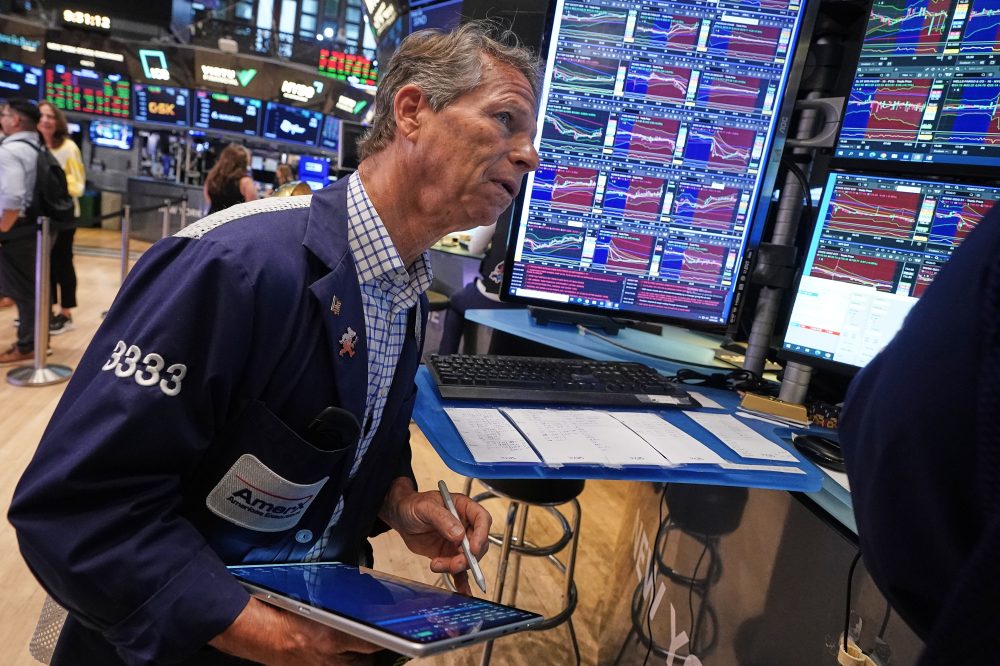

Stock markets across Asia moved higher on Friday, riding momentum from a record-breaking performance by the Dow Jones Industrial Average, even as artificial intelligence stocks sent mixed signals to investors.
South Korea’s Kospi index, which had tumbled nearly 8% the day before, clawed back some of those losses with a 2.8% gain, finishing at 7,863.22. Samsung Electronics, the nation’s largest company and a significant producer of computer chips, surged 7%. Smaller competitor SK Hynix also climbed, rising 4.9%.
Japan’s Nikkei 225 moved up 0.9% to close at 69,368.30. Chipmaker Tokyo Electron slid 2.5%, while memory manufacturer Kioxia jumped 6.6%.
Hong Kong’s Hang Seng index advanced 1.7% to 23,444.45, and China’s Shanghai Composite rose 0.7% to 4,056.81. Taiwan’s Taiex bucked the regional trend, slipping 0.6%. Australia’s S&P/ASX 200 gained 1.3%, settling at 8,834.90.
U.S. futures pointed modestly higher, and oil prices also ticked up. American markets were shut Friday for the Independence Day holiday.
Back on Thursday, the Dow led U.S. markets with a 1.1% gain, reaching a new record of 52,900.07. However, the broader market told a more complicated story. The S&P 500 ended the day barely changed, edging up less than 0.1% to close at 7,483.24 — even though roughly seven out of every ten stocks within the index finished higher. The Nasdaq composite fell 0.8% to 25,382.67, dragged down by continued weakness in chip stocks.
One piece of economic data gave markets a lift: a report showing U.S. employers added 57,000 jobs last month. While that figure fell short of the 100,000 jobs economists had anticipated and represented a slowdown from May’s hiring pace, it carried a silver lining. A softer job market could ease pressure on inflation, which has been rising globally due to oil price spikes tied to the war with Iran. With oil prices now retreating below pre-war levels, slower inflation in the coming months could reduce the need for the Federal Reserve to raise interest rates multiple times this year.
Lower interest rates are generally welcomed by investors because they make borrowing cheaper for households and businesses, which can fuel economic activity. They also tend to push stock and investment prices higher.
Cryptocurrency-related stocks also had a strong session after bitcoin’s price climbed roughly 2%, rebounding from near its lowest point since 2024. Robinhood Markets gained 3.8%, and Coinbase Global rose 3.9%.
Meanwhile, computer chip companies continued to struggle. Concerns have mounted that chip stocks were bid up too aggressively during the AI frenzy, and that the massive investments in chips and data centers may not generate the profits and productivity gains investors originally hoped for.
Memory chip maker Micron Technology reversed an early gain to finish down 5.5%, one day after plunging 10.6%. Nvidia declined 1.4%, and Lam Research dropped 10.2%. These companies carry extra weight on the S&P 500 because of how large they’ve grown during the AI boom. Nvidia alone carries a total market value of nearly $4.7 trillion, giving its stock movements an outsized influence on the broader index.
In currency and commodity markets, Brent crude, the international oil benchmark, rose 0.6% to $72.26 per barrel. U.S. benchmark crude gained 0.5% to $69.05 per barrel. The dollar weakened against the Japanese yen, falling to 161.17 yen from 161.97. The euro strengthened slightly against the dollar, rising to $1.1439 from $1.1431.