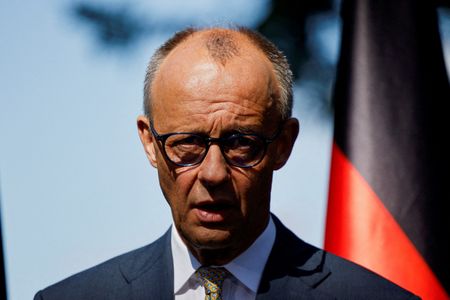

German Chancellor Friedrich Merz stood his ground Friday against criticism from U.S. President Donald Trump, saying Germany has every right to be proud of its efforts to boost military spending.
When reporters asked about Trump’s recent comments calling Germany’s past defense spending record “ridiculous,” Merz was direct in his response.
“Germany is doubling its defence budget within four years. This is the greatest effort we have ever made to strengthen our defence capabilities. In this respect, we have no reason to shy away from anyone,” Merz told reporters.
He added: “We will state this, with all due modesty, and we are doing so as the European Union’s largest member state, bearing a responsibility within Europe.”
Trump had taken to his Truth Social platform earlier this week to blast NATO allies over their defense spending. In one post, he wrote: “Ridiculous for the U.S.A. to continue along this one sided path when the relationship is not reciprocal.” In a separate post, he claimed Germany’s spending between 2014 and 2025 was “MUCH LOWER” than that of the United States or other NATO allies, ending with the word “Ridiculous!”
The dispute comes as NATO leaders prepare to meet next week in Ankara. European nations are hoping to show Trump they are serious about shouldering more of the continent’s defense burden, even as tensions simmer over disagreements involving Iran and Greenland.
Last year in The Hague, NATO members agreed to raise defense spending to 3.5% of their gross domestic product on core military items — including weapons and troops — by 2035. That goal replaced a previous target of 2%.
Merz made his comments while hosting leaders from the Baltic states in Berlin. “We, too, take the Russian threat very seriously, and we are arming ourselves against it,” he said. “We will reach the 3.5% benchmark set in The Hague as early as 2029, well ahead of the agreed deadline.”
The past year has been a turbulent one for the NATO alliance. Trump threatened to seize Greenland from fellow NATO member Denmark and launched military action against Iran without consulting European partners — a move that shook global markets and strained relationships with European leaders, including Merz, who publicly said the U.S. was being humiliated by Iran.