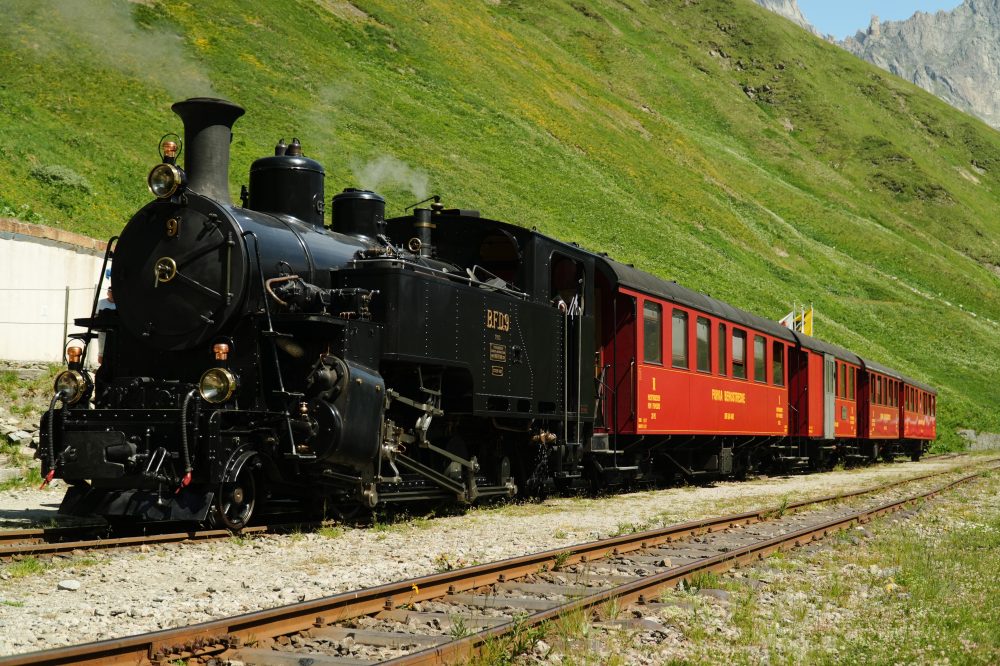

REALP, Switzerland — Train lovers are gathering this weekend to mark the 100th anniversary of a legendary Swiss mountain railway, with vintage steam-powered locomotives carrying passengers through breathtaking Alpine landscapes as part of the centennial festivities.
The Furka Pass, sitting at an elevation of 2,431 meters — roughly 7,976 feet above sea level — ranks among the highest mountain passes in Switzerland. The route is also well-known to movie fans as the location of a thrilling car chase scene in the 1964 James Bond film “Goldfinger,” featuring actor Sean Connery. Long before Hollywood came calling, however, a steam locomotive completed its first full journey along the steep, winding route on July 3, 1926, establishing an essential rail connection between the Swiss regions of Uri and Valais that would serve the area for decades.
The line’s story took a difficult turn in the early 1980s when a newly constructed tunnel at the foot of the Alps redirected rail traffic, leading to the closure of the beloved mountain route. The railway’s survival came down to volunteers — hundreds of them, affectionately known as the railway’s “pioneers” — who poured countless hours into restoring, maintaining, and operating the historic tracks and equipment to keep the experience as authentic as it was a century ago.
The first portion of the revived heritage line reopened in 1992, and by 2010, the full 18-kilometer, or 11-mile, stretch was once again ready for passengers. Today, the steam trains operate as a warm-weather tourist attraction, running between the stations of Realp and Oberwald during summer months. Riders board old-fashioned carriages and take in sweeping views of rivers, Alpine meadows, and green pastures still dusted with patches of snow.
Last month, passengers traveling through the German-speaking region enjoyed rides aboard what locals call the “dampflokomotive.” Traveler Stephan Willareth described his experience as “wonderful,” while Kurt Guldemann, who previously worked for the Swiss national railway system, praised the historical significance of the locomotives.
Bernhard Lang, one of many volunteers who operate the steam engines, noted that learning to drive one is no quick task.
“It’s something like a living machine, so you have to get kind of the feeling for it,” he said. “To feel how it behaves, how it moves, how it smells, how it sounds.”
Jacob Kallert, a 21-year-old German student studying transport engineering and the youngest train manager on the line, emphasized the importance of truly listening to the locomotives.
“You hear every sound, you hear if everything is right,” he said. “You can pretty much feel how it was then and how it is now.”
Fellow volunteer Sergio Rovelli said that everyone who gives their time to the project ends up completely devoted to it.
“We say, in German, that everyone who works here has the ‘Furka Virus, the Furka disease,’” he joked. “Once you come here, you like it, and you stay.”
A single one-way ticket begins at 46 Swiss francs — approximately $56.82 — for a ride that lasts just under two and a half hours. The centennial celebration kicked off Friday and runs through the weekend.