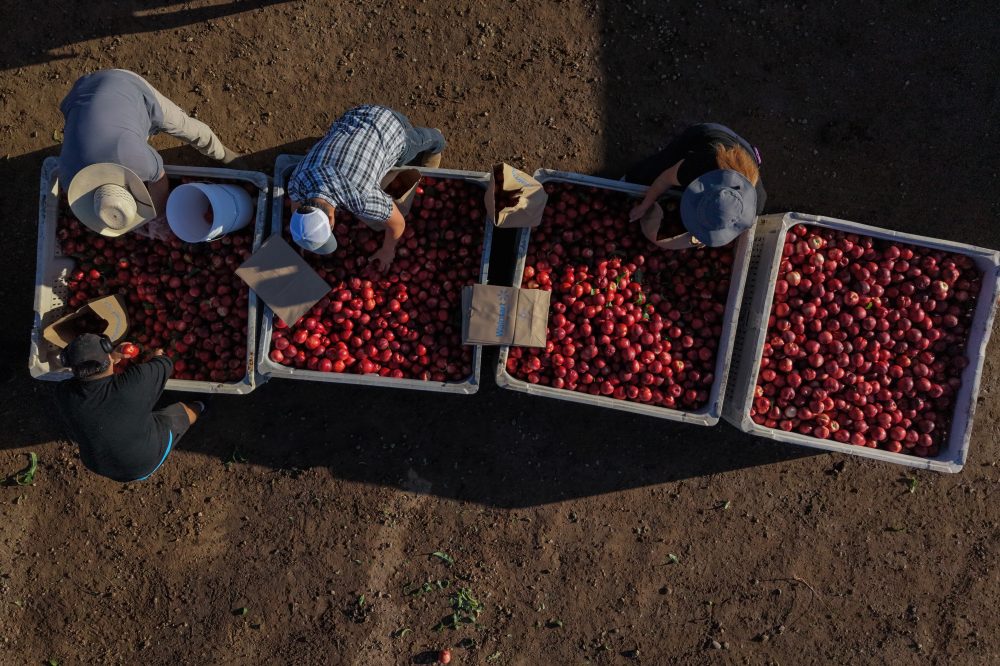

Thousands of people have made their way to a farm in central California this week to pick up free nectarines — and the farmer giving them away says he would rather share his harvest than watch it spoil while he fights a legal battle over the right to sell it.
Cesar Mora, a third-generation farmer in the agricultural community of Reedley in California’s Central Valley, has been distributing his crop at no charge since Monday. By mid-week, he had already given away more than 100,000 pounds — roughly 45,359 kilograms — of the fruit.
“It was really just a thought of not wasting a perfectly good product,” Mora said. “It does make a grower feel good, being able to share my fruit with people and see their immediate reaction that they love it. It’s a little bit of good in this tough situation that I’ve been dealing with.”
At the center of the dispute is a legal fight Mora has been waging since 2023 against Giumarra Brothers Fruit Co. The company filed a lawsuit against him, claiming he violated a contract by selling a specific variety of white nectarine to other fruit packers — a variety the company says it holds exclusive rights to sublicense. A trial is scheduled for later this month.
Giumarra released a statement through one of its attorneys, saying: “At its heart, this is a disagreement involving two written agreements, and it is being resolved the right way — in court and on the facts.” Mora, for his part, has accused the company of unfair and fraudulent business practices.
The nectarine at the heart of the dispute is a variety called “Monalise,” known for its sweeter, less tart flavor. According to Giumarra’s court filings, all rights to the Monalise variety are owned by Star Fruits Diffusion, a French company involved in plant breeding programs, while Giumarra holds the right to sublicense the variety for testing, growing, and selling. Star Fruits Diffusion did not respond to a request for comment.
The case reflects a broader tension in American agriculture between farmers and the plant breeders or large food marketing companies that develop new crop varieties and secure exclusive rights over them. Bradley Rickard, a professor of food and agricultural economics at Cornell University, noted that fruit patents are becoming increasingly common, allowing breeders to collect royalties on the trees they sell, the fruit those trees produce, or both.
Plant breeding has a long history in the U.S. Washington State University developed the Rainier cherry in the 1950s, and the University of Minnesota introduced the Honeycrisp apple in the 1990s. Both varieties are now in the public domain and can be grown and sold freely. In 2010, more than a dozen apple growers sued the University of Minnesota after it awarded exclusive rights to its SweeTango apple to a single cooperative of orchards. That case was eventually settled, allowing additional Minnesota orchards to lease the trees.
California’s Central Valley, which spans roughly 20,000 square miles, is one of the most productive farming regions in the country, estimated to produce about 40% of the nation’s fruits, nuts, and other table foods — including the vast majority of its nectarines.
Court documents show Mora signed a sublicensing agreement with Giumarra in 2017 to grow and sell the Monalise nectarine, and then entered a separate marketing agreement in 2019 requiring the fruit to be packed and sold exclusively through Giumarra. He says the company recruited him to grow the variety in the first place.
Under the terms of those agreements, Mora was required to pay Giumarra a royalty of $2.50 per tree, a 4% production royalty based on gross sales of the fruit, and a sales commission.
“They sold me hope and a big dream that I thought I could participate in with them,” he said.
Mora claims that in 2020, up to half of the nectarines he delivered to Giumarra were discarded, cutting into his profits. The company disputes that claim, and the judge overseeing the case ruled that the deadline to pursue those allegations had already passed. Mora also alleges that in 2022, Giumarra sold his nectarines to buyers in Taiwan, which he says violated the contract’s requirement that the fruit be marketed and sold only in the U.S. and Canada. Giumarra denies that allegation as well.
After seeking to end his relationship with the company, Mora sold his nectarines to a different fruit packer in 2023. That decision prompted Giumarra to sue him for breach of contract, leaving him unable to sell his nectarine crop at all while the legal proceedings continue.
Mora’s legal team has argued that Giumarra failed to provide documentation proving it actually holds a license to the nectarine variety. The company stated in court filings that the Monalise is not covered by a U.S. plant patent. Mora’s attorneys counter that Giumarra represented the nectarine as an exclusive variety with patent protection and promised that exclusivity would allow the fruit to command premium prices.
Fresno County Superior Court Judge Jon Skiles ruled in May that Giumarra’s breach of contract claim can proceed, finding that the agreement between the two parties is valid regardless of whether a patent exists for the fruit. “The sublicense agreement does not expressly state that its validity is dependent on the existence or issuance of a patent for the fruit,” the judge wrote. He further noted that Giumarra “does not have to prove the existence of the underlying license agreement in order to prove that it has a valid contract with defendant regarding growing and selling the fruit.”
Mora said the years of legal fighting have left him feeling worn down and without recourse. While he also grows peaches and plums that are not tied to any agreement with Giumarra, he estimates he has lost a quarter of his income by being unable to sell his nectarine harvest. He says he hopes his case ultimately leads to stronger legal protections for farmers in similar situations.
“It’s been discouraging to even want to go out and farm,” he said.
On Wednesday, community members showed up wearing T-shirts that read “No Nectarines Wasted” as they bagged up the free fruit. Some stayed to help Mora manage the large crowds. He has also raised more than $17,000 through a GoFundMe campaign.
“The only saving grace through all this is being able to share it with the public,” Mora said, “and having everybody enjoy it.”