
CARABALLEDA, Venezuela — In the middle of unimaginable loss, an unexpected source of comfort emerged inside a fast-food restaurant now being called “Hospital McDonald’s.”
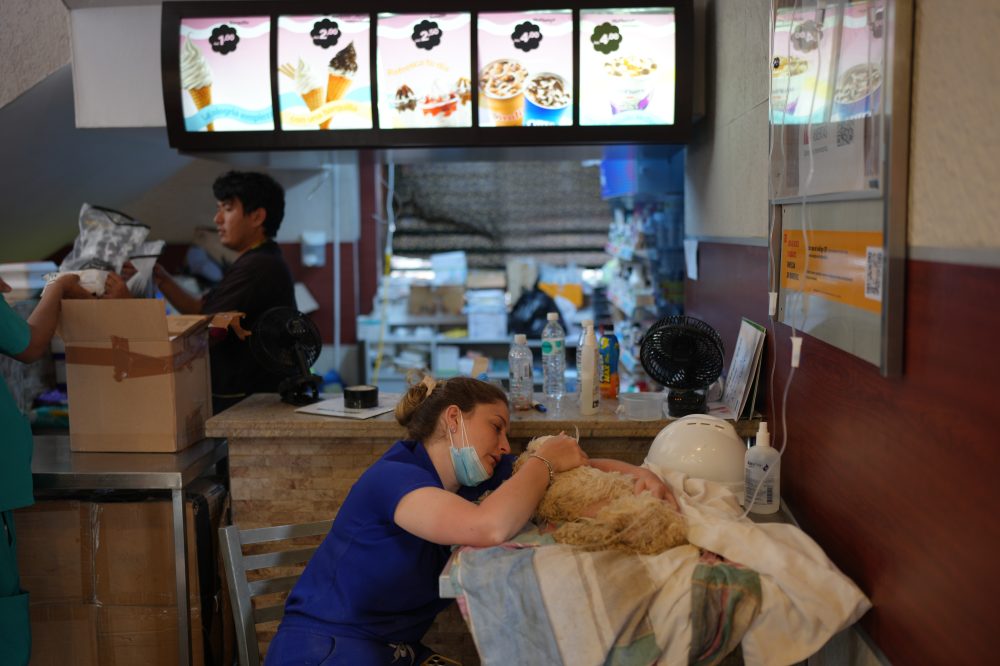
Gabriela Alves spent more than a week desperately searching for her 6-year-old dog, Buddy, after two catastrophic earthquakes rocked Venezuela on June 24. On Thursday, she finally found the white pup — alive — at that very restaurant, where she wrapped her arms around him as he lay on a table with an IV in one of his legs, just feet away from workers selling soft-serve ice cream.
“This is a miracle,” Alves said. “We’ve lost everything material, but at least we’re both alive.”
The McDonald’s location, situated beside the collapsed ruins of government housing complexes in the seaside city of Caraballeda, has transformed into an informal medical center for earthquake survivors and a reunification point for families searching for lost pets.
The makeshift operation got started just one day after the back-to-back quakes, which Venezuelan officials say killed at least 2,295 people and left 11,000 others injured. Countless families were left sifting through rubble in search of missing loved ones — including their cats and dogs.
Angel Matute, along with 70 other volunteers — including veterinarians, medical students, doctors, and civilians — made the journey from the western city of Barquisimeto. When the group arrived, they needed a place to sleep, store their supplies, and take cover from the heavy tropical rainfall. One of the few functioning facilities they could find was the local McDonald’s, complete with working air conditioning.
The team moved in and began caring for both human patients and injured animals, while also helping desperate owners track down missing pets.
“For us, a pet is one more human life,” said Matute, who now coordinates the rescue effort out of the restaurant, where volunteers also sleep at night. “There are animals that are more human than humans themselves.”
By Thursday, Matute and his fellow volunteers were busy treating dogs and cats in the same space where search teams were ordering hamburgers and french fries. The group has already rescued 140 animals and treated 60 more, and they say they plan to keep working until their help is no longer needed.
Alves had been visiting the makeshift animal center daily, checking whether any white dogs had been brought in before heading back to the ruins of her home to call out Buddy’s name, hoping for a bark in return. For over a week, there was only silence.
She had been away at a relative’s house when the earthquakes struck northern Venezuela. She immediately jumped on her motorcycle and raced home, only to find her house reduced to rubble with no sign of Buddy.
“We’re all living one day at a time,” she said Thursday. “Today, I returned and I truly can tell you I had lost all hope.”
But she kept searching. While picking through the debris and pulling her mother’s belongings from the only part of the home still reachable, she heard a faint bark. Looking down, she spotted Buddy’s white ear poking through a crack in the concrete.
She screamed for help, and nearby rescue workers rushed over. They broke through the wall and pulled the dust-covered dog from the wreckage. Alves broke down in tears as she held Buddy, who was wrapped in a pink blanket and licking her arm. Hours later, veterinarians at Hospital McDonald’s examined the dog for injuries after he had spent eight days buried in the rubble.
“Right now, with all the tragedy of the earthquake, it’s one positive thing in all the bad,” Alves said, still holding her dog close. “He’s like my doggie Band-Aid.”