
The remains of Iran’s Supreme Leader Ayatollah Ali Khamenei were placed on public display Friday in a large ceremonial hall in Tehran, drawing clerics, government officials, foreign dignitaries, and thousands of grieving supporters following his 37-year reign.
Iran has organized a full week of large-scale funeral processions for Khamenei, who was killed in February during U.S. and Israeli airstrikes at the outset of a four-month war. The elaborate ceremonies are being presented as a demonstration of public loyalty to Iran’s Islamic Republic and its revolutionary principles.
Khamenei’s body is expected to travel to Qom, Najaf, and Kerbala — major Shi’ite holy centers in Iran and Iraq — before his final burial next Thursday in Mashhad, the site of Iran’s most sacred pilgrimage shrine.
His coffin was first unveiled late Thursday to a crowd of weeping supporters who swayed and beat their heads in rhythm with a sung lament while flowers were tossed from the funeral bier into the gathering. By Friday, the coffin — along with those of family members who perished alongside him — had been moved into the grand prayer hall constructed in honor of his predecessor, Ayatollah Ruhollah Khomeini.
The funeral is unfolding at a pivotal time for Iran. The country’s clerical leadership, backed by the Islamic Revolutionary Guard Corps, has emerged emboldened after what it viewed as a battle for survival against its most powerful enemies. Yet nearly five decades after the 1979 revolution, the Islamic Republic finds itself deeply divided internally, even as officials publicly proclaim national unity.
Analysts say support for the clerical leadership is extremely thin. The new Supreme Leader, Khamenei’s son Mojtaba Khamenei, has not appeared publicly since being wounded in the same strike that killed his father.
Years of heavy economic sanctions have crippled the country’s economy, and waves of nationwide protests have been suppressed by security forces with growing brutality — reaching a peak with the killing of thousands of demonstrators in January.
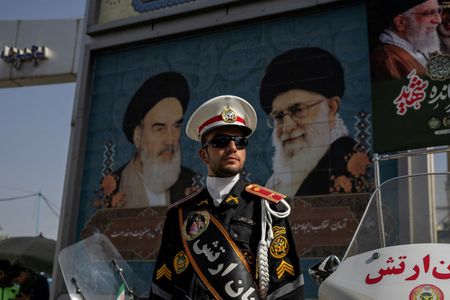
Those underlying tensions have been set aside this week as authorities mount a display of state power, hoping to mobilize millions of mourners for the funeral events. Tehran’s streets were heavily secured, with military and police vehicles positioned along major roads and members of the black-shirted Basij paramilitary force patrolling on motorcycles. Iran also issued a warning to the United States and Israel against conducting any attacks during the funeral period.
When the coffins arrived Friday, carried above the outstretched hands of a waiting crowd, they were placed on a white, tiered platform inside the prayer hall, framed by intricately tiled arched walls and flanked by national and black mourning flags. A black turban — worn by clerics who claim descent from Islam’s Prophet Mohammed — rested on the coffin alongside a folded checkered scarf, a symbol in Iran of revolutionary ideals and solidarity with Palestinians.
Delegations from Lebanon, Iraq, and Yemen — home to some of the strongest groups within Iran’s regional network — filed through the hall to pay their respects. Representatives from Russia and China were also expected to attend. Iraqi President Abdul Latif Rashid, Armenian Prime Minister Nikol Pashinyan, and Pakistani Interior Minister Syed Mohsin Naqvi all traveled to Tehran for the occasion.
Family members of Hezbollah leader Hassan Nasrallah and senior commander Imad Mughniyeh, both Lebanese allies of Iran who were killed in Israeli strikes, also attended the ceremony.
Within Iran’s theocratic system, Khamenei held a unique position — not only as head of state and leader of a revolutionary movement, but as the earthly representative of Shi’ite Islam’s 12th imam, who vanished in the ninth century. His death at the hands of an enemy feeds into a deep Shi’ite tradition of martyrdom and mourning, in which processions of the faithful beat their chests or backs in grief.
That powerful symbolism has been on display throughout Tehran and beyond, with black funeral flags referencing the seventh-century martyrdom of Shi’ism’s third imam, Hossein, hanging over city streets since Khamenei’s death.
Overnight in central Tehran, crowds gathered sobbing and chanting, led by a Basij member, while others distributed posters of the late leader.