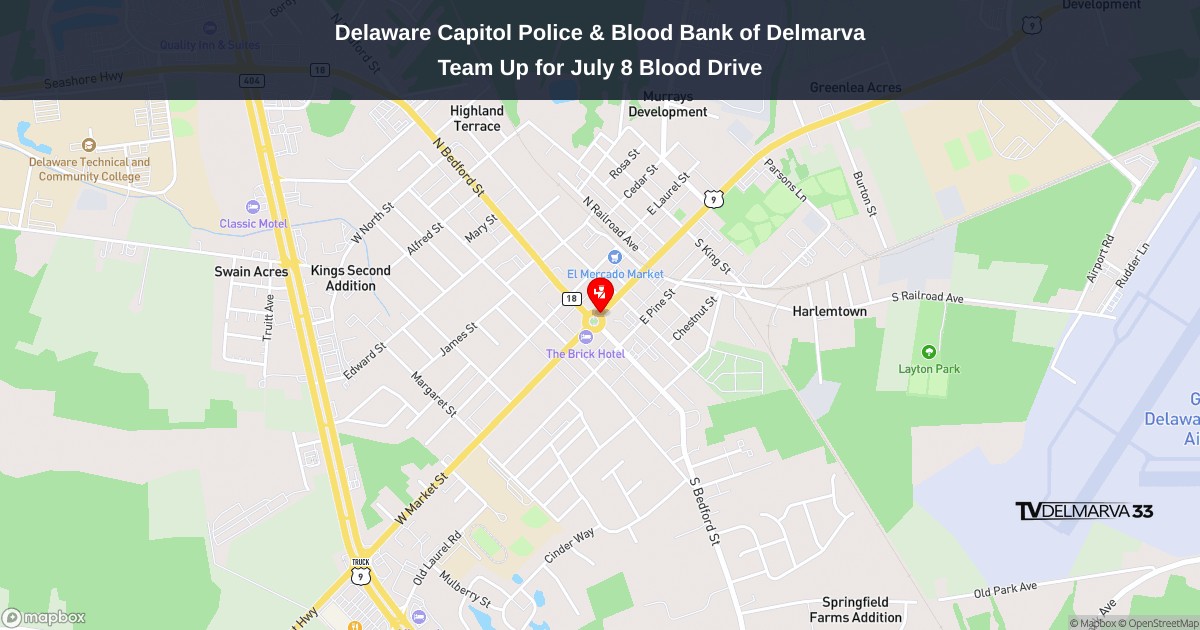
The Delaware Capitol Police and the Blood Bank of Delmarva are coming together to host a community blood drive next Wednesday in Georgetown, with the goal of addressing critically low blood supplies across the region.
The event is also being held in recognition of Concerns of Police Survivors, known as C.O.P.S., an organization that provides support to the families and colleagues of law enforcement officers who have lost their lives in the line of duty.
The blood drive is scheduled for Wednesday, July 8, from 10:00 a.m. to 2:00 p.m. at Sussex County Family Court, located at 100 Market Street in Georgetown, Delaware 19947.
Community members are encouraged to stop by and donate during the four-hour event to help meet the urgent need for blood donations.
Soccer fans flooded venues in Santa Clara and throughout the San Francisco Bay Area on July 1, 2026, to watch the United States take on Bosnia-Herzegovina in a high-stakes FIFA World Cup group stage matchup.
The electric atmosphere at watch parties across the region reflected the growing excitement surrounding the tournament, as supporters donned red, white, and blue to rally behind the American squad.
The effort paid off — the U.S. earned a convincing 2-0 victory over Bosnia-Herzegovina, securing their spot in the Round of 16 and keeping their World Cup dreams very much alive.
South African grocery retailer Pick n Pay unveiled an artificial intelligence-powered shopping assistant on Thursday, giving customers a new way to place grocery orders without having to manually search for products. The tool accepts voice notes, typed messages, and photographs as input.
The launch is a key piece of Pick n Pay’s effort to revitalize its business after a prolonged period of sluggish sales and declining market share. The company, South Africa’s second-largest retailer by revenue, has been working to strengthen its digital presence as it tries to close the gap with bigger rival Shoprite.
Shoprite’s Checkers Sixty60 platform has established a commanding lead in South Africa’s rapidly expanding on-demand grocery delivery market, compelling competitors to pour resources into digital technology and services.
The trend extends beyond South Africa — retailers worldwide are exploring generative AI as a way to personalize product suggestions, improve search capabilities, and make online shopping easier, driven by advances in large language model technology.
Pick n Pay’s assistant, called “Penny,” is built on Google’s Gemini AI models and is scheduled to roll out beginning July 6, the company announced.
Penny can handle grocery orders in multiple languages and accepts a range of inputs, including voice recordings, written prompts, and photographs — even pictures of handwritten shopping lists, recipes, or items a customer wants to purchase. Beyond ordering, the assistant can propose recipes, suggest alternative ingredients, assist with meal planning, and offer budget-friendly shopping guidance along with tailored product recommendations.
Enrico Ferigolli, omnichannel retail executive at Pick n Pay, spoke at the launch event and framed the development as a fundamental shift in consumer behavior.
“On-demand delivery changed how people shop. AI is now changing how they order,” Ferigolli told reporters. “Consumers no longer just want speed, they want shopping apps to think for them … By helping customers, our sales will grow,” he added.
Ferigolli also indicated that additional AI-driven features are in the pipeline and will be introduced over the coming months.
Shoprite has also been moving in this direction. Earlier this year, the retail giant expanded its own AI investment by launching an assistant designed to recommend restocking purchases, surface new products, and deliver personalized deals to shoppers.
Hockey’s all-time leading goal scorer is lacing up his skates once more. Alex Ovechkin officially re-signed with the Washington Capitals on Thursday, committing to a 22nd NHL season.
Ovechkin kept his announcement simple and enthusiastic: “I’m back!”
The new contract carries a base salary of $1 million, with bonus opportunities that could bring his total earnings to $9 million. He receives a $3.25 million signing bonus upfront, along with an additional $4.75 million if he appears in at least 10 games. Due to the contract’s structure, only $4.25 million will count against the salary cap. Ovechkin will turn 41 years old in September.
The Russian star now sits at 929 career goals after netting 32 during last season. In April 2025, he shattered Wayne Gretzky’s long-standing record of 894 goals, bringing the widely followed “GR8 Chase” to a historic conclusion.
For several months, Ovechkin had kept fans and the organization in suspense, saying he would wait until after the season to weigh retirement against returning. The Capitals’ front office had been preparing for either outcome.
In a statement accompanying the signing, Ovechkin expressed gratitude for the patience shown during his decision-making process. “Thank you to everyone for giving me and my family the time to make this decision,” he said. “I’m healthy. I love playing hockey and competing to win. I’m excited to come back and join my teammates so we can fight for a playoff spot and have a chance to win.”
Washington missed the postseason this past spring, though the franchise had been a playoff fixture for nearly two decades — qualifying 16 times over an 18-year stretch. The team’s lone Stanley Cup championship came in 2018, a run in which Ovechkin earned playoff MVP honors.
A Newark man will spend the rest of his life behind bars after being sentenced for the 2024 killing of Tracy Nyariki.
Nobert Matara, 33, received a life sentence on June 26, 2026, after entering a guilty plea to a first-degree murder charge in New Castle County Superior Court. The conviction stems from the December 2024 death of 33-year-old Tracy Nyariki.
The Delaware Department of Justice announced the sentence, crediting the outcome to the dedicated efforts of those involved in building the case.
An Extreme Heat Warning has been issued by the National Weather Service office in Mount Holly, New Jersey, covering a dangerous stretch of weather that will run from Wednesday, July 2nd at 1:30 PM Eastern Time through Friday, July 4th at 8:00 PM Eastern Time.
The warning signals that potentially life-threatening heat conditions are expected during this period, which coincides with the Fourth of July holiday weekend — a time when many people are likely to be spending time outdoors.
Residents are strongly encouraged to limit time outside during the hottest parts of the day, stay hydrated, and check on elderly neighbors, young children, and pets. Air-conditioned spaces such as libraries, shopping centers, and cooling centers can provide relief during the most intense heat of the day.
Those who must be outdoors should wear lightweight, light-colored clothing, apply sunscreen, and take frequent breaks in the shade or indoors. Never leave children or pets unattended in parked vehicles, as temperatures inside a car can rise to deadly levels within minutes.
Residents should monitor local forecasts closely and follow any additional guidance issued by the National Weather Service as the holiday weekend approaches.
The National Weather Service office in Mount Holly, New Jersey has issued an Extreme Heat Warning covering the area, running from 1:30 PM Eastern Time on Wednesday, July 2nd through 8:00 PM Eastern Time on Friday, July 4th.
An Extreme Heat Warning is the highest level of heat alert issued by the National Weather Service, reserved for dangerously hot conditions that pose a serious risk to public health. Residents should take the threat seriously and take steps to stay cool and hydrated throughout the holiday weekend.
Health officials generally advise people to stay indoors in air-conditioned spaces during the hottest parts of the day, check on elderly neighbors and relatives, and never leave children or pets in parked vehicles. Those who must be outdoors should drink plenty of water, wear lightweight clothing, and take frequent breaks in the shade.
The warning covers the July 4th holiday, when many people are expected to be outside for celebrations and fireworks events. Officials encourage the public to plan outdoor activities for the cooler morning hours and monitor local updates from the National Weather Service for any changes to the alert.
A highly anticipated clinical trial testing two potential Ebola treatments got underway Thursday in eastern Congo, with the World Health Organization confirming that the first patient has been enrolled in the study.
The current outbreak is being caused by a strain of the virus known as Bundibugyo, which is rarer than other Ebola-causing strains and has no approved treatments or vaccines targeting it specifically. WHO Director-General Tedros Adhanom Ghebreyesus reported Thursday that the outbreak has already infected more than 1,400 people and killed 438.
While standard supportive care — particularly when administered early — has helped more than 200 people recover, health officials say there is an urgent need for more effective treatment options.
Tedros said the trial “offers real hope that we can deliver concrete results for – and with – the communities at the heart of the outbreak.”
The study will examine whether two drugs can improve patients’ chances of survival. The first is remdesivir, made by Gilead Sciences — a broad-spectrum antiviral that was approved to treat COVID-19 and has shown some early laboratory indications that it may also be effective against the Bundibugyo strain. The second is an experimental drug called MBP134, developed by Mapp Biopharmaceutical, which uses engineered antibodies designed to target Ebola viruses including Bundibugyo.
Every patient enrolled in the trial will receive the best currently available standard care, and will then be randomly assigned to also receive remdesivir, MBP134, both drugs together, or neither, according to WHO research adviser Dr. Vasee Moorthy. Researchers will monitor each patient’s survival for 28 days following the start of treatment.
Moorthy cautioned that the process could take months and may require up to 1,000 participants before scientists can determine whether either drug is effective — though he noted that a particularly strong result from one of the drugs could become apparent sooner and with fewer patients.
For now, the trial is only being offered at a single Ebola treatment facility in Congo’s Ituri province. The area has faced serious security challenges, including violence directed at healthcare workers battling a virus that spreads through contact with the bodily fluids of infected individuals. Health officials say they plan to expand the trial to additional sites once conditions allow.
Moorthy confirmed that sufficient quantities of both drugs have been secured for the trial — remdesivir donated by Gilead, and MBP134 doses provided by the U.S. government, which has funded the drug’s development and holds ownership of those supplies. Should either treatment prove effective, officials say the next priority will be ensuring continued patient access beyond the scope of the study.
The trial is backed by the WHO and represents a partnership among Congo’s national biomedical research institute INRB, Britain’s Oxford University, Antwerp’s Institute of Tropical Medicine, and several other international health organizations.
PARIS (AP) — Devastating wildfires swept through southern France on Thursday, driven by weeks of dry conditions and record-high temperatures that have left the landscape parched and vulnerable to flames.
The largest blaze broke out across the Aude and Herault regions, where local authorities deployed as many as 800 firefighters and 150 vehicles to battle fires that had already burned through more than 900 hectares — roughly 2,200 acres. Separate fires also ignited in the neighboring Marseille region, where two blazes were brought under control Thursday, though they had not been fully extinguished.
French Prime Minister Sebastien Lecornu reported that nearly 7,000 fires have erupted since the beginning of the summer season, scorching approximately 8,700 hectares of land. “The situation is fairly tense,” he said.
Four water-bomber aircraft were called in to assist ground crews in the Aude region. Aude prefect Alain Bucquet stressed the urgency of the response, telling France Info channel: “The idea is to bring the fire under control quickly because temperatures are rising and the wind is growing stronger.”
The Aude region has a long history with wildfires. Just last year, firefighters successfully contained what was described as France’s largest wildfire in decades in that same area.
Further south, fires raging near the seaside resort of Canet-en-Roussillon forced the evacuation of 1,500 residents from three campsites and destroyed hundreds of mobile homes. Regional prefect Pierre Regnault de la Mothe described firefighters as engaged in “a fierce struggle” to stop the flames from spreading into a nearby industrial zone.
Forecasters offer little relief, with no rain expected in the coming days. The fires follow heat waves that struck in May and again at the end of June. Vegetation across the Mediterranean region is under severe water stress, and strong winds continue to fan the danger.
The top FBI official overseeing the Chicago field office is abruptly departing his role after sources say he was pressured to retire. Douglas DePodesta sent a farewell message to fellow bureau employees, and multiple individuals with knowledge of the situation — speaking anonymously because of the sensitive nature of personnel matters — confirmed he had been pushed out.
DePodesta has served as special agent in charge of the Chicago office, one of the largest in the FBI, for close to two years. He originally joined the bureau in Chicago back in 2002, working drug cases before moving on to senior positions at FBI headquarters in Washington, as well as offices in Detroit and Memphis. He was appointed to lead the Chicago field office in August 2024.
In his farewell note, DePodesta hinted at an internal conflict that he said led to his exit, though he did not spell out the specifics. “I’ve never backed down from a fight, as long as it meant our personnel could continue serving the FBI’s mission,” he wrote. “Unfortunately, that has proved unpopular over time and my departure is a consequence of that.”
His exit is part of a broader wave of departures at the FBI, as Director Kash Patel has moved to push out both rank-and-file agents and supervisors who are viewed as not aligned with the Trump administration’s priorities. The shake-up also comes during a period of significant turbulence in Chicago’s federal law enforcement community. The city’s top federal prosecutor, Andrew Boutros, announced this week a sweeping review of more than 1,000 grand jury presentations made by Illinois prosecutors, following the dismissal of a high-profile case tied to alleged misconduct.
The FBI did not offer a comment on Thursday. However, the bureau’s official rapid response account on the social media platform X responded to a post about DePodesta’s departure, stating: “It’s simple: Anyone who is not on board with THIS FBI under the leadership of President Trump — which has achieved the lowest murder rate ever — is free to leave.”
In his farewell note, DePodesta also included a passage from a message written by former FBI Director Chris Wray, Patel’s predecessor, who reminded agents that “you have been who the American people have turned to in their darkest moments” and praised the workforce for having “stayed true to the values that define who we are, and to the qualities for which we stand: Fidelity, Bravery and Integrity.”
A newly released United Nations report concludes that all sides involved in the deteriorating conflict in eastern Congo are breaking the terms of a peace agreement and committing serious abuses, according to a document reviewed by the Associated Press on Thursday.
U.N. experts say the Congolese army, the M23 rebel group, and M23’s Rwandan supporters have all failed to follow through on a peace deal reached in December — an agreement that was initiated by the Trump administration with the goal of ending a conflict that has dragged on for decades.
Among the violations cited, the experts noted that the Congolese army has continued to work alongside a Hutu rebel group known by the acronym FDLR. That group includes fighters who took part in the 1994 genocide in Rwanda and later fled to Congo. The government in Kinshasa had specifically pledged to end that cooperation as part of the December agreement.
Rwanda has repeatedly sent military forces into eastern Congo, claiming it was necessary to neutralize Hutu fighters and protect its own national security. However, both Congo and the U.S. government have accused Rwanda of using those rebel groups as a cover to gain control over the region’s valuable mineral resources.
The report also found that the Rwandan-backed M23 group — which captured the city of Goma and other eastern cities in a rapid offensive earlier last year — has not pulled back as it agreed to do. Instead, M23 has strategically repositioned its forces and continues to pursue its goal of overthrowing the government in Kinshasa.
M23 now controls large portions of territory in eastern Congo and has been identified as the primary perpetrator of conflict-related sexual violence in the region, the report stated.
Rwanda maintains substantial influence over M23, and by late 2025, Rwandan troops inside Congo were “conservatively estimated at 8,000 to 10,000 elements in South Kivu and 6,000 to 8,000 in North Kivu, with no evidence of significant withdrawals thereafter,” the panel of experts reported — a direct violation of the peace agreement.
The United Nations has described the situation in eastern Congo as “one of the most protracted, complex, serious humanitarian crises on Earth.”
Just last week, Congo announced it had filed a case against Rwanda at the International Court of Justice, accusing its neighbor of bearing legal responsibility for the devastation caused by the ongoing violence.
The U.N. experts also reported that minerals from Rubaya and other mining operations in the Masisi region of eastern Congo are being smuggled into Rwanda by M23, which is building a parallel economy in the areas it controls. That economy is largely dominated by Rwandan-linked companies that export minerals extracted from Congolese soil.
Also last week, the United States imposed sanctions on a gold refinery based in Rwanda, describing it as part of “a network working in coordination” with M23 in eastern Congo. The sanctions against Gasabo Gold Refinery were described as part of broader U.S. and Qatari peace efforts in the region.
NEW YORK — A man who makes a habit of scaling skyscrapers told police he and his girlfriend climbed to the very top of the Empire State Building’s antenna because he wanted to do something extraordinary to pop the question, prosecutors revealed Thursday during the couple’s arraignment on felony charges.
The pair, known publicly as Angela Nikolau and Ivan Beerkus, said almost nothing as they exited the courthouse. However, when a reporter asked Beerkus about the daring stunt, he offered a brief response: “We believe in love.”
Prosecutors charged the two with felony reckless endangerment, burglary, and additional offenses. Authorities say the couple — who were featured in a 2024 Netflix documentary called “Skywalkers: A Love Story,” which documented their “rooftopping” adventures and growing relationship — didn’t just create a spectacle on Wednesday. They also put lives at risk by scaling the iconic skyscraper’s broadcast antenna.
Once they reached the summit, standing 1,454 feet (443 meters) above midtown Manhattan, the climbers held up a black banner bearing the message: “When the power of love beats the love of power the world knows peace.” The moment was captured by news helicopters circling overhead.
After rolling up the banner, the couple moved down to a slightly lower ledge, where Beerkus apparently proposed — and Nikolau said yes. She later shared photos from the adventure on her social media pages, including a striking image showing an engagement-style ring held up against a sweeping aerial view of Manhattan below.
According to the court complaint, police waited roughly 30 minutes for the antenna to be powered down before Emergency Services Unit officers began their own ascent. They eventually caught up with the climbers on their way back down. Officers climbed approximately 1,250 feet (381 meters) above street level — a detail the complaint highlighted as evidence of the danger involved. Court documents listed the couple’s legal names as Angelina Nikolau and Ivan Kuznetsov.
The Netflix documentary portrays Beerkus, now 32, and Nikolau, 33, climbing tall structures around the world — often without permission — and occasionally disguising themselves as construction workers to gain entry.
Investigators found a broken lock on a restricted security door on the building’s 104th floor, which is the access point for the antenna. The highest floor open to the public is the 102nd, which features an observation deck. Reaching any floor above that requires a key card, according to the complaint.
Empire State Building management has described the climb as “unauthorized” but has declined to address questions about whether the couple had any contact with security personnel before making their ascent. The building screens all visitors and prohibits large packages, sports equipment, costumes, and masks, among other items.
Both Beerkus and Nikolau were released without bail, consistent with New York state laws that limit when bail can be imposed. Their attorney, Jason Krinsky, said outside the courthouse that once the defense receives the prosecution’s evidence, the team will review it and decide how to proceed.
Krinsky also had a bit of praise for his client’s romantic ambitions. “What a way to propose — something you can only dream of,” he said. “So you’ve got to, you know, give him some credit for that.”
The Empire State Building has seen other unauthorized climbs over the years, including ascents of the antenna and other sections of the structure. One notable exception came in 2023, when actor and musician Jared Leto was given permission to climb to the base of the antenna from the 86th floor as part of a tour promotion.
A federal appeals court in Boston ruled Thursday that the Trump administration does not have to immediately restore dozens of exhibits that were pulled from national parks across the country.
A three-judge panel of the 1st U.S. Circuit Court of Appeals placed a hold on an earlier ruling that had ordered the National Park Service to put the displays back in place. The exhibits had been removed following a Trump administration directive aimed at eliminating content that it said “inappropriately disparage Americans past or living.”
The removed exhibits addressed subjects including slavery and climate change.
ECONE, Switzerland — A rebel Catholic organization that was excommunicated after ordaining four bishops without Church approval is showing no signs of remorse, with members accusing the Catholic Church of abandoning the true faith and claiming Pope Leo never gave their concerns a proper hearing.
Gathered at their seminary in the small Swiss village of Econe in the country’s southwest, members of the Society of St. Pius X — including both clergy and laypeople — said they intend to continue operating as they always have, with a focus on upholding traditional Catholic practices.
“We are at peace with what has happened as you can see from all the faces,” said a Mexican deacon, gesturing toward a small group of people kneeling to receive blessings from one of the newly ordained bishops in a parking area following an outdoor Mass. The deacon asked to remain anonymous, saying he did not hold a senior enough position to speak on behalf of the group.
The Vatican’s chief doctrinal authority, the Dicastery for the Doctrine of the Faith, declared the Swiss-based society to be in schism with the broader Catholic Church and issued a warning to Catholics that the group’s sacraments are now performed unlawfully.
Under the warm sun, group members gathered — some with beers in hand — while a nun played songs on a recorder in the vineyard-lined Alpine hamlet where the controversial ordinations took place the day before.
One society priest described the Vatican’s ruling as both unjust and without merit.
“We do respect the pope. We will keep praying for him,” said Father Benedict, who chose not to share his full name. “It hurts to be punished by your dad,” he continued, using the term to refer to the pope, “because you know you didn’t do anything wrong.”
Father Benedict said the Society had been attempting to arrange a meeting with Pope Leo for over a year to present its position, and expressed disappointment that the pope only responded at the “very last minute.”
“This sanction shows that, I mean, we did not close the door to the Holy Father, to the Holy See,” Benedict said. “They shut it in our face.”
The Vatican countered that opportunities for dialogue had been extended to the society, even if not through a face-to-face meeting with the pope himself.
“The Holy Father did not excommunicate the Lefebvrists. They excommunicated themselves,” said Nicholas Cafardi, dean emeritus of Duquesne University School of Law in Pittsburgh. The term “Lefebvrists” refers to followers of Marcel Lefebvre, who founded the group.
The ultra-traditionalist organization, established in 1970, rejects several core Church teachings. The Vatican stated the group cannot lawfully perform marriages or hear confessions. Church officials noted that ordaining bishops without papal approval is considered so serious an offense that excommunication occurs automatically.
The society’s roots lie in opposition to the sweeping changes introduced by the Second Vatican Council, which ran from 1962 to 1965. Those reforms included replacing the traditional Latin Mass and opening the door to dialogue with non-Catholics. Traditionalists within the group hold the modernizing Council responsible for what they view as a decline in the Church, pointing to the drop in the number of men and women choosing religious life.
Jean-Yves Cottard, a visiting French priest and society member, pushed back on the label being applied to the group.
“The pope is kind with everyone and why not also with us?” he said, rejecting the characterization of members as “schismatics.”
LONDON — Amanda Anisimova dug deep at Wimbledon on Thursday, overcoming a shaky stretch in the deciding set to defeat compatriot Sofia Kenin 6-2, 4-6, 7-6(10-3) in a spirited all-American second-round battle.
The match pitted two American players in their twenties — both born to Russian immigrant families — against each other in a contest that proved far more dramatic than many anticipated. Anisimova, seeded sixth, appeared to be on the verge of a painful upset when she lost her serve and found herself trailing 3-1 in the third set.
It was a difficult moment for a player who made history a year ago for the wrong reasons, becoming the first competitor in over a century to lose a Wimbledon final by a 6-0, 6-0 scoreline. Another crushing defeat seemed possible as Kenin — now ranked 105th in the world and far removed from the form that earned her the Australian Open title in 2020 — began to gain momentum.
But Anisimova channeled her frustration vocally on court, and that emotional release appeared to reignite her game. She clawed back to level the set at 3-3, then dominated the tiebreak from start to finish, clinching the match when Kenin sent a service return into the net to end it 10-3 in the breaker.
Speaking courtside after the match, Anisimova reflected on the emotional rollercoaster she had just endured. “Some moments were really awful and I’m really glad to be in the third round. Sofia is such a tough opponent and she’s such a fighter,” she said.
Anisimova will next face 26th seed Madison Keys, another American, with a berth in the fourth round on the line.
European authorities are escalating their efforts against a network of tankers that have been fraudulently flying Cameroon’s flag while secretly hauling Russian oil, with naval forces now boarding vessels at sea and Cameroon removing 39 ships from its official registry in response, according to officials and documents reviewed by Reuters.
On June 8, the European Union expanded the authority of Operation IRINI, its naval mission operating in the Mediterranean Sea, giving it the power to stop, board, detain, and inspect ships suspected of being part of Russia’s so-called “shadow fleet.” Russia publicly condemned the expanded mission.
These shadow fleet vessels are typically older ships that lack recognized Western insurance or safety certification. Russia has used them to dodge international sanctions by sailing under the flags of various countries, making it difficult to trace their true ownership, cargo, and routes.
According to two European military sources, three tankers recently boarded and inspected by Operation IRINI — the Nelsa, the Oneiroi, and the Sandhya — were found to be carrying fraudulent Cameroonian registration documents.
Beyond those three, nine additional ships have been seized by French, Belgian, British, and Swedish naval forces since the beginning of 2026, with five of those vessels having flown Cameroonian flags.
Cameroon had already raised alarms in recent months about the misuse of its flag registry by tankers moving Russian oil. In a letter dated June 16 sent to the United Nations shipping agency — a copy of which was obtained by Reuters — Cameroon’s government reported that an official investigation found multiple vessels were illegally operating under its flag, and that two fraudulent websites were being used to assign that flag to ships without authorization. The government said it had removed 39 vessels from its registry as a result.
The central African nation has become one of the largest sources of fraudulent shipping registrations in recent years. The situation became serious enough that the United Arab Emirates banned Cameroon-flagged ships from its ports in 2024 unless they could show top-level safety certification.
This week, Cameroon’s transport ministry issued a statement saying the country is “cooperating with international authorities and organisations to enforce maritime rules, protect the credibility of its naval registry, and fight against irregular registrations.” The ministry also noted that Cameroon cannot be held responsible for the actions of any vessel after it has been removed from the registry.
The most recent seizure involved a tanker called the Deliver, which was detained by the French navy on June 25 after being intercepted near Sicily. The vessel was still flying a Cameroonian flag even though it had already been removed from that country’s registry.
The EU is now preparing another round of sanctions expected in mid-July, with the shadow fleet among the primary targets. EU foreign policy chief Kaja Kallas explained the reasoning last month, saying, “The idea is to change the best practices, what different countries are doing with those ships, because it is really posing a danger, and of course also the idea is to curb Russia from the funding of this war.”
The upcoming sanctions package, which could be formally adopted in July, would add 30 more vessels to the shadow fleet sanctions list and broaden the criteria to include ships involved in refueling sanctioned vessels or offloading their cargo, according to European officials.
Officials have also highlighted the broader dangers these ships pose — including threats to the safety of crew members and to the environment if vessels are poorly maintained or fall apart at sea, as happened with two Russian coastal oil tankers in the Black Sea in late 2024.
KYIV — When a Russian missile tore through a nine-story apartment building in Ukraine’s capital on Thursday, a graphic designer named Max was already on the scene before the air-raid alert had even been lifted — helping search for survivors before clocking in for his regular workday.
Max is one of roughly 700 volunteers serving with the Ukrainian Red Cross emergency rescue operation. He described the emotional toll of responding to such scenes, saying, “Mentally, it’s a lot easier now because years have gone by and we’ve adapted a bit. But of course it’s hard.”
Max, 43, identifiable by his close-cut mohawk and bold black wing tattoos on either side of his neck, joined fellow volunteers on team leader Taras Didenko’s crew as they moved through darkened, dust-covered hallways in search of anyone who might still be alive.
Didenko, 46, serves as a deputy unit commander for the Ukrainian Red Cross. He described how his team must think on their feet during chaotic situations. “We’re always planning,” he said. “We see all kinds of situations and have to make decisions on the spot.”
Thursday’s assault was enormous in scale. Russia launched 496 drones and 74 missiles during the overnight attack, which killed at least 21 people and wounded approximately 90 others. It marked the worst destruction in Kyiv this year and the deadliest attack since at least May.
Dispatched by the State Emergency Service, Ukrainian Red Cross teams typically assess multiple locations during large-scale attacks before focusing on wherever the need is greatest. Max explained their approach: “First we do a general check: who needs help, what kind. We go apartment to apartment, because people might be stuck inside, or unconscious.”
Working alongside firefighters and other emergency responders, the volunteers helped carry injured residents — young and old, men and women alike — through piles of rubble, broken glass, and debris. Meanwhile, uninjured building residents anxiously scanned the faces of those being brought out on stretchers, searching for people they knew.
The Ukrainian Red Cross maintains around two dozen volunteer teams like this one stationed throughout the country. Their members come from a wide range of backgrounds, including IT professionals and kindergarten teachers. When they are not responding to air strikes, these teams can be found at car accident scenes or providing support at community events like music festivals.
On Thursday alone, the teams treated 35 people across Kyiv, according to a spokesperson.
Another volunteer, a 21-year-old project manager named Anet, was on the scene wearing a bright red armored vest and a helmet-mounted camera. She noted that every strike site presents its own set of challenges. “Since there’s very serious damage here to a residential building, there’s a lot of work, and it’s difficult,” she said.
As Russian air attacks continue to grow in intensity, volunteer rescue teams like Didenko’s have become increasingly skilled at responding to mass-casualty events — all while many of them hold down regular jobs on the side.
Motorists traveling eastbound on Fieldsboro Road should plan for a lane closure currently in effect between Driver Street and Avon Bridge Drive.
The closure is the result of ongoing construction in the area and is expected to last until 5 p.m. Drivers are encouraged to allow extra travel time or consider alternate routes to avoid potential delays.
A dangerous heat wave is gripping much of the Eastern United States, and while scorching daytime temperatures are grabbing headlines, health experts are sounding the alarm about something else: the nights are not cooling down either.
Across a wide stretch of the country, from the Midwest all the way to the East Coast, temperatures are expected to climb past 100 degrees — with up to 90 million Americans feeling the effects of the extreme heat.
But the problem does not end when the sun goes down. Nighttime temperatures are staying unusually elevated, and that is creating a serious health concern. When the body cannot cool itself overnight, it never fully recovers from the stress of the daytime heat — and that can become life-threatening, especially for vulnerable populations.
Experts say this combination of relentless daytime highs and warm overnight lows is what makes this particular heat event especially dangerous for millions of people.
Canada is working toward a major announcement at next week’s NATO summit in Turkey, where it hopes to reveal around 10 founding nations for a newly proposed global defence financing institution, according to the country’s lead negotiator.
Canadian Prime Minister Mark Carney has been championing the Defence, Security and Resilience Bank, known as the DSRB, as a cornerstone of his broader push to unite what he describes as “middle powers” in response to what he views as the breakdown of the traditional U.S.-led international order.
“We gave ourselves the NATO summit as a deadline … What we are aiming to announce is the list of founding members,” said Isabelle Hudon, Canada’s chief negotiator for the multilateral initiative and CEO of the Business Development Bank of Canada, in a recent interview.
The proposed bank would support the defense capabilities of allied nations by securing up to £100 billion — roughly $133 billion — in affordable financing.
Hudon indicated that the initial group of founding members would likely consist of Canada and several European nations, though she declined to identify them specifically. She also noted that the announcement was not a certainty, as final talks with potential allies — including discussions about how much capital each country would contribute — were still ongoing. Despite that uncertainty, she said the effort had gained significant momentum.
“My prime minister said we should not aim for perfection before launching this initiative, that we should rally the countries that are ready to be called founding members, and then the membership will stay open,” Hudon said.
The bank’s long-term viability still faces questions, particularly regarding whether it can attract the key national backers needed to achieve a triple-A credit rating.
Hudon noted that the DSRB has held encouraging discussions with South Korea, estimating roughly a 50-50 chance that the country could eventually join — though possibly at a later stage. She added that no other G7 nations appear close to signing on at this time. South Korea’s Finance Ministry has previously confirmed to Reuters that it was evaluating the proposal.
Canada’s Finance Ministry had not responded to a request for comment at the time of reporting.
Harrington Raceway hosted the second leg of Delaware Standardbred Breeders’ Fund (DSBF) stakes competition for 3-year-old trotters on Wednesday, bringing the field one step closer to a $110,000 championship final.
Four divisions worth $20,000 each were run as part of a packed 15-race program at the Sussex County track. The results from these elimination rounds will determine which horses move on to compete for the top prize.
The eight horses that accumulate the most points across the elimination legs will earn their spots in the $110,000 final, setting up what promises to be a marquee event for Delaware harness racing fans.
Among the standout performers was Topflight Champion, guided by driver Eddie Dennis, who secured his third straight victory on Wednesday, July 1, further establishing himself as a horse to watch heading into the championship round.
A former White House ethics lawyer is sounding the alarm over President Trump’s involvement in cryptocurrency, saying it amounts to a “clear conflict of interest” at the highest level of the federal government.
Richard Painter, who previously served as an ethics attorney in the White House, stated that Trump “stands alone” when it comes to having significant financial conflicts of interest in the executive branch.
Painter went further, saying that “for every other executive branch official, it would be a violation” — suggesting that Trump’s crypto holdings represent a standard that no other government official would be permitted to maintain.
The concerns come as Trump has been connected to cryptocurrency ventures, including a dinner he held at his golf club in Virginia for top investors in his $TRUMP cryptocurrency.
Drivers heading northbound on I-95 between Newark and Wilmington should be aware of an active trash removal operation currently underway along the shoulder of the highway.
Workers are expected to remain in the area until 1 p.m. Motorists traveling through this stretch are encouraged to slow down and stay alert for crew members and equipment near the roadway.
NOAA announced on July 2, 2026, a series of region-specific priorities designed to breathe new life into the American seafood industry. The plan focuses on cutting red tape for domestic fishermen, boosting production, expanding access, and improving the financial bottom line for the fishing sector.
The effort, coordinated through the Department of Commerce via NOAA Fisheries, comes in direct response to a presidential executive order titled “Restoring American Seafood Competitiveness,” which called for increasing the sustainable harvest of seafood and supporting American fishermen and women.
“These regional priorities are a critical step in our efforts to fulfill the President’s vision of making the United States the world’s dominant seafood leader,” said NOAA Administrator Neil Jacobs, Ph.D. “We look forward to partnering with the councils to advance seafood competitiveness and support our American fishermen.”
The process began in August 2025, when NOAA Fisheries asked stakeholders — including regional fishery management councils — to weigh in on how to better manage fisheries and science. The goal was to stabilize markets, widen access, boost profitability, and prevent fishery closures. More than 700 individuals and organizations submitted comments, and each regional council provided a detailed action plan.
After reviewing input from councils, the fishing industry, and the general public, NOAA identified priority actions for each region. Here is a breakdown of what each area can expect:
In the New England region, NOAA will focus on easing the financial burden of industry-funded monitoring, modernizing fleet capacity, and re-examining static area closures to restore fishing yields and economic health.
In the Mid-Atlantic region — which covers waters relevant to Delmarva-area fishermen — the priorities are modernizing fleet capacity and improving how fishing quotas are distributed.
In the South Atlantic region, the focus will be on improving access and flexibility while building state-led data partnerships.
In the Caribbean region, NOAA will review the effectiveness of marine protected areas, evaluate the role of territories in managing spiny lobster and queen conch, and work to significantly increase economic returns to island communities.
In the Gulf of America region, priorities include defending the domestic shrimp fleet from trade imbalances and making Individual Fishing Quota access more efficient.
In the Pacific region, NOAA will look at reducing redundancies in trawl observer requirements and review the science and management of Pacific sardines.
In the North Pacific region, the agency will review Steller sea lion closure boundaries, work to eliminate unnecessary requirements, and increase operational flexibility.
In the Western Pacific region, NOAA aims to open up commercial fishing opportunities that were previously blocked by what it describes as punitive monument closures, while also considering additional management changes consistent with the Endangered Species Act.
For Highly Migratory Species, NOAA’s priorities include pursuing international quota increases and maximizing the retention of targeted catch.
A full list of priority actions is available on the NOAA Fisheries website. Media inquiries can be directed to Rachel Hager at [email protected].
Prospective homebuyers are getting a small break this week as the average rate on a 30-year fixed mortgage dropped to its lowest point in nearly two months.
Freddie Mac reported Thursday that the benchmark 30-year fixed mortgage rate slipped to 6.43%, down from 6.49% the previous week. At this same time last year, that rate stood at 6.67%.
For much of the period since the conflict between the United States and Iran broke out in late February, the average rate has largely stayed near 6.5%. The war has disrupted crude oil shipments out of the Persian Gulf, pushing oil prices sharply upward and contributing to higher inflation, rising bond yields, and elevated mortgage rates.
Even with this week’s modest dip, the current rate is the lowest recorded since May 14, when it sat at 6.36%.
Rates on 15-year fixed mortgages — a popular option for homeowners looking to refinance — also moved lower. That average fell to 5.79% from 5.84% last week. One year ago, it was at 5.8%, Freddie Mac noted.
Several factors shape where mortgage rates land, including decisions made by the Federal Reserve on interest rate policy and expectations among bond market investors about inflation and the broader economy. Mortgage rates tend to track closely with the 10-year Treasury yield, which lenders rely on when setting home loan prices.
By midday Thursday, the 10-year Treasury yield had dipped to 4.46%, down slightly from 4.48% the evening before.
Growing optimism that the U.S. and Iran could eventually reach a resolution to end their conflict — and reopen the Strait of Hormuz to oil tankers — has helped bring oil prices down somewhat, easing some of the upward pressure on bond yields. Still, yields remain well above where they were in late February, when the 10-year Treasury yield was around 3.97%.
Just before the war began in late February, the 30-year mortgage rate had briefly dipped below 6% for the first time since late 2022. It has not returned to that level since. Five weeks ago, the rate climbed to 6.53%, its highest point since August 28.
Although long-term mortgage rates are still lower than they were a year ago, the uncertainty created by the ongoing conflict has kept many potential buyers from moving forward with a home purchase.
Sales of previously owned homes across the country fell during the first quarter of this year compared to the same period a year ago, continuing a housing slowdown that has persisted since 2022, when rates began rising from their pandemic-era lows. April sales were essentially unchanged, but May saw a pickup — the fastest pace of sales since December.
Even so, existing home sales are still hovering near an annual rate of 4 million — well below the historical norm of around 5.2 million.
CATIA LA MAR, Venezuela — Eight days after a series of devastating earthquakes tore through Venezuela, rescue teams held onto a sliver of hope Thursday as smoke from burning wreckage and the odor of decomposing remains hung over the ruins of the northern La Guaira region.
That hope turned into a moment of celebration when rescuers managed to pull a 43-year-old man alive from the debris. Hernán Alberto Gil Flores had been buried beneath the remains of a collapsed shopping mall for nearly eight days, surviving in an air pocket while rescue workers passed him water and food through the rubble.
Teams from across the Americas worked approximately 100 hours to free him. As he was carried out on a stretcher and loaded into an ambulance, crowds gathered nearby erupted in cheers — a brief but powerful moment of relief amid the widespread devastation.
For thousands of others, there was no such outcome.
As of Wednesday, Venezuela’s government reported at least 2,295 people had been killed and more than 11,000 injured. Countless others remain missing, and many survivors are sleeping in overcrowded shelters or out in the open as family members continue searching through the wreckage. Medical workers have raised alarms that the crisis could spiral further, with untreated injuries and the spread of infectious diseases threatening an already fragile healthcare system.
Acting President Delcy Rodríguez has faced sharp criticism from Venezuelans who say the government’s response has been woefully inadequate. Civilian volunteers and international rescue teams have largely taken the lead, overshadowing the official government effort.
The criticism comes at a particularly sensitive time — just one day before the expiration of Rodríguez’s 180-day mandate as acting leader. She had served as deputy to former President Nicolás Maduro before he was removed by the United States in January, at which point she assumed the interim leadership role with the backing of the Trump administration.
Venezuelan officials have provided little transparency about what will happen once that deadline passes Thursday. Under the country’s constitution, a vice president can fill in temporarily for up to 90 days, with the national assembly able to extend that term by an additional 90 days. The National Assembly, which is controlled by Rodríguez’s party, also has the authority to call a snap election if it formally declares the position permanently vacant.
The United States pushed back against critics on Wednesday, reaffirming its support for Rodríguez’s government and noting that roughly 900 American military personnel are currently on the ground assisting with relief and rescue efforts.
John M. Barrett, the U.S. chargé d’affaires to Venezuela, rejected claims that Rodríguez was using the disaster response for political gain. Speaking on a call with reporters, Barrett said the U.S. effort “does require a high level of coordination with local authorities to be successful.”
“And what I can say with confidence is that the local authorities have fully complied with our requests and have accelerated this massive humanitarian response,” Barrett said.
Gen. Francis Donovan, the head of U.S. Southern Command, also weighed in, saying that “decades of poor investment in the people of Venezuela” had “made this even more challenging for the current government.” He added, “It is a big problem for any leader to deal with a challenge of this magnitude.”
WASHINGTON (AP) — As the United States marks a quarter-millennium of existence, many Americans are choosing to block out the partisan noise and the endless scroll of social media outrage, and instead reconnect with what the country personally means to them.
In the days leading up to the Fourth of July, the Associated Press sat down with everyday citizens to get a sense of the national mood. What emerged was not the chest-thumping patriotism often associated with American celebrations, but something more measured — a blend of gratitude, worry, and a desire for common ground.
In Topeka, Kansas, auto technician Joe Fuqua-Bejarano said the strength of this country lies not in its politics but in its people. Speaking from a fireworks stand where he runs a busy side business, he pointed to resilience as the defining American quality. “We’ve just all got to find unity somewhere, whether that’s in laughter or perseverance, and keep everybody cool,” he said.
Christina Zhou, a 25-year-old research assistant from Cambridge, Massachusetts, acknowledged the divisions but refused to dwell on them. “There are lots of points of contention going around,” she said, “yet there are still a lot of beautiful things that are happening.” Her approach: focus on what’s close to home. “What I’m trying to do is think about just things that are happening locally. It feels a little bit more like within our own personal control.”
In Mont Vernon, New Hampshire, 50-year-old farmer Mindy Dean said the big anniversary has barely registered in her household. She and her family will spend Saturday milking goats and possibly catching some local fireworks. “We’re just happy Americans,” she said. “We kinda do our own thing and just enjoy our freedom as Americans.”
Meanwhile, 81-year-old retiree Neil Casey of Nashua, New Hampshire, and his friend Maureen Regan of Cambridge are taking a more active approach, touring Boston’s historic landmarks — including Paul Revere’s house — and attending as many Fourth of July events as they can. Regan drew inspiration from international soccer fans who visited the country for the World Cup. “They love everything we have,” she said, “and I want people to not forget that and remember how lucky we are.” Her message to fellow Americans: “Just enjoy the moment. Enjoy that we’ve been here for 250 years.”
For others, the celebration is harder to embrace. Some find it difficult to separate the holiday from President Donald Trump’s decision to tie the National Mall festivities to what he said would culminate in a Trump rally on Saturday.
“When you’re celebrating the Fourth of July right now, it feels like that’s like a Republican thing to do,” said Madeline Capodilupo, a 26-year-old special-education teacher from Boston, who planned to spend the weekend at her fiancé’s family beach house in Maine. “It’s just hard to celebrate something when it doesn’t feel like we should be celebrating anything.”
At Detroit’s Eastern Market, Ronald Hall — an Air Force veteran who served 18 months near the end of the Vietnam War — and his wife Karen, who spent two years in the Army and participated in Operation Desert Storm, reflected on what the holiday has always meant to them. As a Black man, Ronald said the celebration was never about the country as it was, but about its promise. “I grew up remembering the promise,” he said. “That’s what we celebrated: the promise, not the country.”
Veterans were well-represented in the conversations. At the New Hampshire Veterans Home in Tilton, residents are anticipating an upcoming community celebration featuring a National Guard Black Hawk helicopter, a World War II ambulance, food trucks, live music, and even Uncle Sam on stilts.
Leo LeClerc, 83, an Air Force veteran who served in Vietnam, said his faith in America runs deep — but it is being tested. “I believe this country is the greatest that ever existed,” he said. “Our democracy is strong and it will continue to be strong as long as people participate in it.” Still, he added, “I don’t like what’s going on in this country” and “I don’t feel very good about the 250th.” An independent who voted for Trump in 2016, LeClerc said he now believes a “cult of personality has taken over” around the president.
Tom Gaumont, 74, an Army veteran and former history teacher, looked back at the 1976 bicentennial as a more optimistic moment, even in the shadow of President Richard Nixon’s resignation under threat of impeachment. “I’m kinda sad at this point with what I anticipate,” he said. “I’ve seen and taught about how these things kind of crumble, so I’m concerned.” He added: “We’ve lasted this long, and this is a very existential time in our history.”
Allan Bailey, 83, a Republican and Vietnam veteran who later owned a motel, echoed that concern. “I’m worried about how the country is going, I really am,” he said. “I don’t know what we’re going to leave our children, and that bothers me a lot.”
In Dearborn, Michigan, a more hopeful voice came from Nabeel Mawari, 38, an immigrant from Yemen who is now a U.S. citizen. While he planned to work his security guard job on Saturday as his wife and two young sons celebrated with relatives, Mawari spoke warmly about his adopted homeland from his backyard. “My life is here,” he said. “We try to make the U.S.A. the greatest. That’s why I’m here. I love this country. The Fourth of July, it is very important.”
Perhaps the most straightforward sentiment came from Gary MacGrath, 77, a caricaturist who has worked a suburban Philadelphia fair for 14 years. This year, his booth happened to be squeezed directly between the local Democratic and Republican Party clubs. A former bartender, MacGrath said he long ago learned to “never talk about religion or politics” — a rule he was sticking to. But he allowed himself one brief observation: “It’s 250 years. Let’s keep democracy going.”
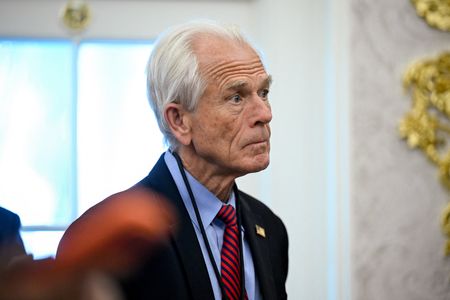
WASHINGTON — The federal government is taking steps to ease regulations on the nation’s fishing industry, including unlocking the northern edge of Georges Bank — a well-known fishing ground off New England — for scallop fishing, according to White House trade and manufacturing adviser Peter Navarro.
Navarro announced the two actions on Thursday, saying they grew out of a meeting held in the Oval Office between President Donald Trump and scallop fishermen. He described the moves as part of a wider initiative to breathe new life into the U.S. seafood sector.
The announcements build on an executive order Trump signed in April 2025, which directed the Commerce Department to roll back fishing regulations and open marine monuments to commercial fishing operations — all with the goal of boosting American seafood production.
The U.S. fishing industry, valued at $320 billion, is overseen in large part by the National Oceanic and Atmospheric Administration, a federal agency responsible for managing coastal fisheries.
Under a law passed in 1976, NOAA’s National Marine Fisheries Service is tasked with creating management plans for 45 different fisheries. That includes setting catch quotas and determining when fishing seasons begin and end, a process that involves input from federal scientists and local fishermen.
CF Montreal bolstered its midfield Thursday, landing veteran Dani Pereira from Austin FC in a deal valued at up to $2.35 million in general allocation money.
The 25-year-old from Venezuela first arrived at Austin as the top overall selection in the 2021 MLS Draft. Over the course of six seasons, he tallied six goals and 23 assists in 165 total appearances, placing him third all-time in club appearances and tied for second in franchise assists.
Austin interim head coach Davy Arnaud spoke warmly about Pereira’s contributions to the organization. “Dani has meant a great deal to this club since joining as its first-ever draft pick,” Arnaud said. “He represented Austin with pride and established a genuine connection with the community here. We’re proud of his development over the last six years and we wish Dani nothing but success in this next phase of his career.”
Arnaud also addressed the difficulty of letting a key player go, framing the move as part of a larger strategic plan. “This type of decision is always difficult for both the club and the player. While emotionally we are sad to see him go, coming into the season, we knew we would only let go of a player of Dani’s caliber if doing so positioned the club for even greater long-term success. I, and our ownership team, felt that this move met that threshold and we executed a plan that was established at the start of the season.”
Under the financial terms, Austin FC will receive $1.4 million in 2026, followed by $700,000 in 2027, with an additional $250,000 available in conditional allocation money. The club also retains a sell-on percentage should Pereira be transferred again in the future.
Pereira expressed deep gratitude to the Austin community in a heartfelt farewell statement. “I want to say thank you to everyone that has been part of this journey here in Austin in the last six years: all the teammates that I’ve shared the locker room with, the coaching staffs, everyone in the front office, and the owners,” he said. “Everyone helped make me who I am today. Austin FC as a whole changed the life of a kid from Caracas, and I will always be grateful for it.”
He also directed special thanks to the fanbase: “I want to share a special thank you to the fans for their unconditional love toward me and my family. You guys welcomed us to Austin with open arms since the first moment I got drafted. You all are the best in the league and please don’t ever change that. Thank you and I’m going to miss the 512.”
Before turning professional, Pereira played college soccer at Virginia Tech. He has represented the Venezuelan national team 10 times since earning his first cap in 2023.
The first patient has been enrolled in a clinical trial aimed at finding a treatment for the Bundibugyo strain of Ebola currently spreading through the Democratic Republic of Congo, the head of the World Health Organization announced Thursday.
WHO Director-General Dr. Tedros Adhanom Ghebreyesus made the announcement to reporters, calling it a significant step forward in the fight against the outbreak. However, he also pointed to an attack on an Ebola treatment center in Ituri province that left two people dead, underscoring the ongoing obstacles facing health workers on the ground.
“Despite all this progress, we continue to face significant challenges, including mistrust and violence,” Dr. Tedros said.
The Bundibugyo strain of Ebola currently has no approved vaccines or treatments. So far, the outbreak has produced more than 1,400 cases in the DRC, resulting in 438 deaths. Over the past two weeks, the country has seen an average of 38 new confirmed cases every day.
The trial, which may take several months to complete, is designed to enroll more than 1,000 patients. It will test Mapp Biopharmaceutical’s experimental antibody treatment, known as MBP134, both on its own and in combination with Gilead Sciences’ antiviral medication remdesivir, according to the WHO.
The WHO said there are sufficient drug supplies to carry out the trials. The organization noted it is in ongoing discussions with the United States — which donated the MBP134 supplies — and with Gilead Sciences to ensure patients can continue accessing the drugs after the trials conclude, provided they are proven safe and effective.
Dr. Tedros also highlighted areas where the response is gaining ground. Ten laboratories are now capable of testing for Ebola, and health officials are successfully following up with four out of every five known contacts of infected individuals, though he noted that more contacts still need to be identified for each confirmed case.
Treatment capacity has grown as well, with 650 beds now available across treatment facilities — approximately 96% of which are currently in use. The WHO and its partners are working to add another 300 beds to that total.
In a separate development, the WHO declared an end to a hantavirus outbreak that had been connected to a cruise ship, after the final identified contact of an exposed individual completed quarantine and tested negative for the virus. That outbreak, which sickened 13 people and killed three, was caused by the Andes virus — a rare hantavirus strain that typically circulates in Argentina and Chile.
Irish amateur golfer David Howard had to pinch himself when he woke up Wednesday morning to confirm that his improbable qualification for this year’s Open Championship was actually real — not a dream.
The 27-year-old from County Cork, who was diagnosed with cystic fibrosis at the age of seven, only left his full-time career as a mechanic 18 months ago to pursue golf seriously. Currently ranked 1,456th in the world amateur standings, he punched his ticket to one of golf’s four major championships after coming through final qualifying on Tuesday.
“Very surreal and it probably hasn’t sunk in fully yet. It’s mad,” Howard said the following day, calling in from a petrol station near Cork at the end of a lengthy trip home from Scotland.
Howard made the journey to and from the Dundonald Links course in Scotland alongside his father, John, who served as his caddie. The two traveled by ferry in a camper van they purchased last year and affectionately named the ‘Wanderly Wagon,’ a nod to a classic Irish children’s television program.
Howard attributes recent advances in medical treatments for giving him what he calls a “new lease on life.” As a young teenager, after researching his condition online, he had feared he might not survive to see his 27th birthday.
Cystic fibrosis is a genetic disorder most prevalent in northern Europe that primarily attacks the lungs and digestive system, and can cause life-threatening lung infections. Modern treatments have dramatically changed the outlook for CF patients, shifting it from a disease with a median age of death around 30 years to a condition that can now be managed long-term.
Ireland has the highest rate of cystic fibrosis in the world, with approximately 1,400 children and adults living with the condition, according to CF Ireland, a mutual help organization that has named Howard as one of its ambassadors.
“With CF, I don’t want to regret anything down the line. I don’t know how much time I’m going to have,” Howard said.
“The main reason I do a few bits for CF Ireland is to show kids that it’s not the end of the world to get CF … It puts a different perspective in life, which I think probably helps towards my golf,” he added.
Howard only reached a low enough handicap to compete in major Irish amateur tournaments three years ago. He posted rounds of 69 and 71 to finish tied for second at Dundonald, earning his spot at the Royal Birkdale Golf Club for the July 16-19 championship.
He described going from “cruising to being under serious pressure” after recording a double bogey on the 16th hole Tuesday, and said he didn’t know for certain he had done enough until his father found him on the 18th green, told him the news, and embraced him.
Howard is among 10 amateurs who have qualified for the championship so far. He will be in contention for the Silver Medal, awarded to the top finishing amateur — a prize previously claimed by Tiger Woods, Rory McIlroy, and Justin Rose.
“A Silver Medal would be nice,” Howard said, “but we’ll try to aim higher and see how far we can go.”
A Canadian court has ordered a near-total blackout on media coverage surrounding an alleged plot by an anti-government militia to seize land near Quebec City, and the move is drawing sharp criticism from press-freedom advocates and legal experts who say citizens deserve to know about threats to their safety.
The Quebec Superior Court issued the publication ban in February, according to court documents reviewed by Reuters. The order came just days after a lower court had released more than a thousand pages of police investigation records related to four men — including two active-duty soldiers — who were arrested last summer. Three of the men face accusations of taking “concrete actions to facilitate terrorist activity,” while the fourth faces weapons charges.
Legal experts say publication bans are sometimes used to shield sensitive investigative details or protect vulnerable victims, but one expert described this particular ban as unusually sweeping.
“Rights, including freedom of the press, are not absolute. But restrictions need to be reasonable,” said Wayne MacKay, emeritus professor of law at Dalhousie University. “The broader the ban and the more sweeping it is, the harder it is to justify.”
The judge’s order offered no explanation for the decision, and a spokeswoman for the Quebec Superior Court said the court and its judges are not permitted to comment on rulings.
Reuters was unable to establish why the ban was put in place. The prosecution and two of the four defense attorneys involved in the cases told Reuters they had not sought to restrict public access to information about the proceedings.
James Turk, director of the Centre for Free Expression at Toronto Metropolitan University, said the court’s refusal to explain its reasoning makes it nearly impossible to evaluate whether the ban is appropriate or legally defensible.
“The problem in this case,” he said, “is that we can’t assess whether this ban is legitimate or not without knowing why it was imposed.”
Attorney Maxime Chevalier, who represents defendant Marc-Aurèle Chabot, said the court issued the ban “of its own volition.” Jean-Marc Fradette, the lawyer for defendant Matthew Forbes, said his team not only never requested the ban but had actually been pushing for more court documents to be made available without redactions. The other two defense attorneys did not respond to requests for comment.
Reuters has joined a coalition of media organizations challenging the publication ban at Quebec’s second-highest court. The news organization declined to make further comment. The coalition’s attorney, Marc-André Nadon, also declined to comment. A hearing on the coalition’s request to lift the ban is scheduled for September 23 at the Quebec Superior Court.
Peter Jacobsen, a lawyer with expertise in media, defamation, and constitutional law, warned that the ban puts public safety at risk by keeping citizens uninformed about a far-right militia group facing criminal charges.
“Keeping that information secret means Canadians won’t have a full understanding of how the far right is operating in the country,” he said.
The Royal Canadian Mounted Police announced last July that they had arrested and charged three men — Chabot, Simon Angers-Audet, and Raphaël Lagacé — with terrorism-related offenses connected to an alleged plan to take over land near Quebec City for militia purposes. Authorities alleged the group had stockpiled weapons and “took part in military-style training, as well as shooting, ambush, survival and navigation exercises.” Forbes was separately charged with weapons offenses.
Police said searches carried out in January 2024 turned up a massive arsenal: 16 explosive devices, 83 firearms, roughly 11,000 rounds of ammunition, nearly 130 magazines, four pairs of night-vision goggles, and various military equipment.
Both Chabot and Forbes are members of the Canadian Armed Forces. Chabot is believed to be the first active-duty Canadian military member ever charged with terrorism offenses under the country’s criminal code.
Earlier police press releases and news coverage published before the publication ban took effect remain accessible online. After the charges were announced in July 2025, several Canadian news outlets filed for access to thousands of pages of police documents, which a lower Quebec City court released last August to those who requested them.
Following the release of a second batch of documents earlier this year, Quebec Superior Court Judge François Huot issued an order on February 2 — effective immediately — “prohibiting the media or anyone else from publishing in any form whatsoever, information regarding the facts of this case, regardless of whether or not such information has already been disclosed.”
The Delaware Department of Transportation is warning drivers about upcoming lane and road closures at the intersection of US 40, Glasgow Drive, and Salem Church Road in New Castle as crews prepare to carry out roadway reconstruction work.
Starting Friday, July 10 through Sunday, July 12, the westbound right turn from US 40 onto Glasgow Drive will be shut down. Glasgow Drive will also be completely closed at its US 40 junction during that same period to allow for full-depth roadway construction, which includes work on pedestrian islands.
A second phase of closures is set to begin Monday, July 20 and run through Thursday, July 30. During that time, northbound Salem Church Road will be closed for approximately 300 feet from the US 40 intersection as part of what officials are calling Phase 1A construction.
Drivers are encouraged to allow extra travel time and seek alternate routes while the work is underway.
A flagging operation is currently in effect at the intersection of Galewood Road and Wilson Road, according to traffic officials.
The operation is expected to remain active until 6:00 PM. A flagger is directing traffic in the area, which may cause slowdowns for drivers passing through.
Motorists are encouraged to allow extra travel time or consider using an alternate route until the flagging operation concludes.
While the Maryland Department of Natural Resources is primarily focused on protecting the environment, its role as caretaker of more than half a million acres means it is also guardian of the state’s deep historical roots.
Nearly every Maryland state park contains some piece of history, but several offer visitors the rare opportunity to literally walk the same ground as figures who shaped the American story.
One starting point is St. Clement’s Island State Park, located in the Potomac River off Colton’s Point in St. Mary’s County. This is where the Ark and the Dove arrived on March 25, 1634, carrying Maryland’s first English settlers. Like those original arrivals, today’s visitors can only reach the island by boat.
Jumping ahead to the French and Indian War era, Savage River State Forest in Garrett County features an unimproved trail with signage tracing the 1755 Braddock Military Road Expedition. That original road was constructed under British General Edward Braddock, with support from the Virginia Militia — which included a then-young officer named George Washington — in an effort to push the French out of Western Pennsylvania and gain access to the Ohio Valley. The mission ultimately failed, and the conflict dragged on for several more years.
As that war continued, Maryland’s colonial government erected the stone-walled Fort Frederick in 1756 to shield settlers from attack. The fort later served as a prison for British soldiers during the American Revolution and was used by Union troops to guard the C&O Canal during the Civil War. Its stone wall and two barracks have since been restored to their 1758 appearance, and the park regularly hosts historical reenactments and educational programming.
Maryland played a significant role in the American Revolution. Smallwood State Park is home to Smallwood’s Retreat, the plantation estate of Major General William Smallwood — a Continental Army officer who later served as governor of Maryland. The surrounding outbuildings reflect what is known or believed to have stood on the property, offering a window into daily life on an 18th-century tidewater plantation.
Earlier this year, the department accepted a land donation that included a historic African American cemetery — the final resting place of enslaved, skilled laborers at the Catoctin Furnace in Frederick County. The furnace was founded in 1776 by Thomas Johnson and three of his brothers; Johnson would go on to become Maryland’s first elected governor. The furnace produced iron goods for George Washington’s army, including cannonballs used in the Revolutionary War’s closing battle at Yorktown, Virginia. The site is now managed as part of Cunningham Falls State Park, with a commitment to honor this ground with dignity and share these stories truthfully.
During the War of 1812, British forces targeted Maryland communities throughout the Chesapeake Bay region. North Point State Park, located north of Baltimore, is home to the Defenders Trail — the same path soldiers traveled during that conflict.
In the early years of the United States, the ability to move people and goods was critical to the nation’s expansion, and Maryland was at the center of that effort. The National Road became the first highway built entirely with federal dollars, with construction kicking off in Cumberland in 1811. The road eventually stretched through central Ohio and Indiana before reaching Vandalia, Illinois in the 1830s, where funding ran dry, according to the National Park Service. One well-preserved remnant of that road is the Casselman River Bridge, now part of the state park that bears the same name. When it was built, its 80-foot span was the largest of its kind in the country. The bridge is currently being refurbished by the department and is expected to reopen within the next few years.
Maryland’s seafaring heritage is on display at the historic lighthouses found at Turkey Point within Elk Neck State Park and at Point Lookout State Park in St. Mary’s County.
The nation’s first major steam railroad — the Baltimore and Ohio — was responsible for building the Thomas Viaduct, which is still in use today. Completed in 1835, it holds the distinction of being the world’s largest multiple-arched stone railroad bridge with an arc. The structure played a strategic role during the Civil War and today stands above Patapsco Valley State Park near Ellicott City.
Civil War history is woven throughout Maryland’s landscape. South Mountain State Battlefield marks the site of the first major Civil War battle fought in Maryland — three days before Antietam. The Union victories there in September 1862 helped create the conditions that led President Abraham Lincoln to issue the Emancipation Proclamation. The battlefield is also the only major Civil War site that crosses the Appalachian National Scenic Trail.
In Southern Maryland, Point Lookout State Park stands on the site of a camp that held as many as 52,264 Confederate prisoners of war during the Civil War. Its serene surroundings today contrast sharply with the suffering that took place there.
Many of the state’s public lands also grapple with the history of slavery — what historians have called America’s “original sin” for the way it shaped the nation’s economy, culture, and politics. Several parks share the stories of enslaved Marylanders and their struggles, while also honoring those who fought for freedom and the African Americans who lived through emancipation.
On the Eastern Shore, the Harriet Tubman Underground Railroad and Visitor Center brings to life the courageous journeys of Tubman and others who risked everything in pursuit of freedom.
One of the state’s newest parks tells the story of an African American family that rose from enslavement to become a prosperous and respected presence in northern Montgomery County. At Freedman’s State Park, visitors can explore the story of emancipation through the life of Enoch George Howard, his family’s resilience, and the community that formed around them. Their legacy stands as an inspiring chapter in the state’s stewardship of natural, historical, and cultural heritage.
These are only a handful of the countless historical moments preserved across Maryland’s public lands. Walking where history happened, these places remind us of how far the nation has come in its pursuit of liberty — and how much work remains.
As Secretary Josh Kurtz puts it, America’s story isn’t only etched in stone and marble — it is still very much alive and continuing to grow.
Josh Kurtz is Secretary of the Maryland Department of Natural Resources.
COLORADO SPRINGS, Colo. — Salisbury University’s swimming program reached a milestone this week, shattering its own record for academic achievement on the national stage.
A total of 10 student-athletes from the Salisbury swim teams earned Division III Scholar All-America recognition from the College Swimming and Diving Coaches Association of America (CSCAA) for the 2025-26 academic year — more than tripling the program’s previous best mark for such honors.
Adding to the achievement, both the women’s and men’s squads each earned CSCAA All-America team recognition for the spring 2026 semester, marking a strong showing across the entire program.
The CSCAA Scholar All-America designation recognizes college swimmers and divers who demonstrate excellence both in the pool and in the classroom at the Division III level.
Delaware’s Auditor of Accounts, Lydia E. York, has launched a new online resource designed to give residents a closer look at how state money is being spent.
The Delaware State Budget Tracker, now available on the State Auditor’s official website, is an interactive visual tool that allows Delawareans to explore general fund budget appropriations for state agencies and divisions spanning from fiscal year 2015 all the way through fiscal year 2027.
The tool is intended to make budget information more accessible and transparent to the public, giving everyday residents the ability to track funding trends across various parts of state government over more than a decade of spending data.
Hog Range Road is closed between Hickman Road and Cattail Branch Road following a crash, according to transportation officials.
Drivers in the area should plan for delays and find alternate routes while crews work to clear the scene. No additional details about the crash have been released at this time.
Motorists are urged to use caution near the affected area and watch for emergency personnel on scene.
TIRANA, Albania — Albanian law enforcement officers and demonstrators clashed Thursday when an anti-government protest in the nation’s capital descended into violence, with roots in opposition to a luxury coastal development connected to Jared Kushner, son-in-law of U.S. President Donald Trump.
Officers deployed tear gas, pepper spray, and a water cannon against demonstrators who were throwing rocks, eggs, and other items at police. Officials reported that 12 officers sustained injuries and 18 protesters were taken into custody.
Thursday’s unrest is part of a series of daily demonstrations that have been ongoing for more than a month. The movement, known as the “flamingo revolution,” began as opposition to a planned upscale resort development along the country’s Adriatic coast that has been linked to Kushner.
Although the protests originated over environmental concerns surrounding the proposed development, they have since expanded into a broader political movement directed against the government and Socialist Prime Minister Edi Rama.
In recent weeks, thousands of demonstrators have filled the streets, blowing whistles and carrying cardboard flamingo cutouts — a nod to the protected migratory bird species whose coastal habitats could be threatened by the proposed resort near Narta Lagoon.
The Albanian government has argued the development would be a game-changer for the formerly communist country as it pursues entry into the European Union and works to attract high-end tourism. However, the project — which would span an abandoned island and a nearby section of shoreline — has faced strong pushback from environmental advocates and critics of Rama’s administration.
Several hundred protesters gathered outside the Albanian parliament on Thursday, calling for the prime minister’s resignation and chanting “Rama has to go to jail.” Some demonstrators hurled rocks, eggs, and plastic bottles at officers, and used a piece of metal barrier to shatter the windows of a police vehicle.
One protester, Agustela Thoma, explained the frustration driving the crowd: “The protesters want their voice to be heard inside (the parliament), as the prime minister for so many days has not heard them and has ignored them. But enough is enough.”
Interior Minister Besfort Lamallari condemned what he described as “the acts of vandalism and criminal violence” directed at police officers. “Police officers are public servants, citizens of the Republic, and family members just like everyone else. They serve the law, public order, and the safety of every citizen, without distinction. An attack against them is an attack against the state,” the minister stated.
BATABANÓ, Cuba (AP) — For nearly four years, Irisleydis Tristá has fought a tumor through two surgeries and multiple rounds of radiation therapy. But for the past seven months, she has been unable to get a CT scan to find out whether her cancer has grown or spread.
The CT scanner at Hermanos Ameijeiras Hospital in Havana — the country’s top medical facility — is out of service. Doctors have told Tristá, 34, that due to a lack of resources, they are unable to perform another surgery on her in Cuba.
“I feel like my life is in danger,” said Tristá, a mother of a 13-year-old who lives in Batabanó, a town about 70 kilometers (43 miles) south of Havana. “I don’t know if it has grown. We have no way of knowing.”
What was once a point of national pride — Cuba’s free, universal healthcare system — has deteriorated dramatically. Analysts say the crisis has been made worse by fuel shortages linked to tightened U.S. sanctions on the island’s energy sector, compounding an economy that had already been struggling for years.
The Trump administration has been pressuring Cuba’s socialist government to carry out significant economic reforms and change how it governs in exchange for sanctions relief.
Hospitals throughout the island are running short on basic supplies, including syringes, gauze, vaccines, and anesthetics. A lack of spare parts has left equipment such as hemodialysis and CT scan machines out of commission, cutting off patients like Tristá from essential care. Food shortages have also made it difficult for her to follow the diet her doctors prescribed.
Large numbers of medical specialists and technicians have left the country.
Cuba was already dealing with an economic crisis stemming from the COVID-19 pandemic and increasing U.S. sanctions. Conditions worsened after U.S. authorities captured then-Venezuelan President Nicolás Maduro in early January, cutting off one of Cuba’s most important allies. The White House then threatened countries that supplied fuel to the island and increased pressure on foreign companies and individuals to stop doing business with Havana.
The fallout has included power outages stretching more than 20 hours, gasoline rationing, and drops in both industrial and food production.
For a country whose health statistics have historically rivaled those of developed nations — including low mortality rates, high life expectancy, widespread vaccination, and broad prenatal care — the current situation “is shocking,” according to the Pan American Health Organization and World Health Organization representative on the island.
That representative said fuel shortages have caused “quite large” disruptions to health services, affecting not just care delivery but the entire chain of continuity around patient treatment.
He added that PAHO and the WHO themselves have struggled to distribute humanitarian aid. The United Nations, on which both organizations rely, launched a $94 million emergency plan in March to address the growing humanitarian crisis resulting from the energy blockade.
A government report released in June revealed that the survival rate for children with cancer had dropped to 65%, down from 85% before energy restrictions took effect in January.
“We have had children die. Two so far this year,” said a specialist at the National Institute of Oncology and Radiobiology in Havana, during a walk-through of the pediatric ward. “This situation is terrible.”
The specialist noted that some children — especially those from distant provinces — must return to the hospital every 21 days for treatment.
“Sometimes a week or even 15 days go by before they can come because of the fuel shortage,” she said.
One mother, whose 4-year-old daughter is receiving treatment at the hospital, described the ordeal as “very hard.” The family traveled roughly 350 kilometers (217 miles) from their home in Sancti Spíritus, east of Havana, to get care for their child.
CONCORD, N.H. — A suffocating heat wave is descending on the eastern United States just in time for the Fourth of July holiday weekend, forcing some communities to scrap, delay, or significantly change their Independence Day festivities.
The National Weather Service warned Thursday that dangerously high, record-breaking temperatures will persist across much of the central and eastern U.S. through Friday, with the heat continuing along the East Coast through the weekend. The Northeast is expected to see temperatures in the upper 90s Fahrenheit — around 30 degrees Celsius — while cities like Philadelphia and Boston could push past 100 degrees. High humidity will make conditions feel even more brutal, threatening to put a damper on celebrations commemorating 250 years of American independence.
Philadelphia officials responded by shortening the route of a Thursday morning parade, calling off an afternoon all-American Block Party, and pushing back start times for an evening picnic and concert at Independence Mall.
In Lower Windsor Township, Pennsylvania, an America 250 event that was to feature food trucks, games, and the highway department’s dump truck has been moved to July 8. Over in Norristown, Pennsylvania, a Saturday parade was called off due to concerns about the safety of residents, participants, and first responders. However, evening fireworks along with an afternoon gathering with games, food, and music are still expected to proceed.
“The parade is one of our community’s most beloved traditions, and we share in the disappointment of its cancellation, especially as we celebrate America’s 250th birthday,” said Interim Municipal Administrator Jayne Musonye.
Amtrak also announced Thursday that it was canceling certain train routes because of the extreme heat, including the Acela service between Boston and Washington. The rail service added that other trains may run at reduced speeds, causing delays through Saturday.
The culprit behind the miserable conditions is a heat dome — a high-pressure system that settles over a region and traps heat and humidity underneath it — that has been smothering areas from the Midwest to the East Coast. Beyond the impact on holiday events, local officials across many areas are opening cooling centers and taking other steps to protect residents. In Boston, several air-conditioned museums are opening their doors free of charge to city residents to help them escape the heat.
As temperatures soared in New York, Mayor Zohran Mamdani called on residents to set their air conditioners to 78 degrees to reduce strain on the power grid — a recommendation that past mayors, including former Mayor Rudy Giuliani, have also made during heat events. The appeal, however, drew sharp criticism from the Democratic mayor’s conservative opponents on social media.
Florida Gov. Ron DeSantis, a Republican who frequently takes jabs at the mayor on social media, fired back on X with the question, “Is this what was meant by the warmth of collectivism?” — turning a phrase the democratic socialist had used during his inaugural address back against him.
LOWELL, Mass. — An 82-year-old woman named Eileen Castle has a swimming pool in her yard — the only one for blocks in her neighborhood — that used to be a gathering spot for local children on hot days. But despite a heat wave this week, she says she has no plans to fill it, not with a data center sitting directly behind her home, its massive industrial air conditioning units humming constantly and its backup diesel generators kicking on without warning.
“I think about the air quality, the water, what effects it has on the kids in the area,” Castle said from her front stoop as children rode past on bicycles.
When temperatures spike across the eastern United States, data centers draw even more electricity, putting added pressure on power grids and degrading air quality in the communities that surround them. The situation in Lowell’s racially diverse Sacred Heart neighborhood illustrates why the artificial intelligence industry is facing mounting scrutiny over the rapid expansion of these facilities.
Across the country, data centers have been increasingly blamed for a range of environmental problems. Some voices in the tech industry argue the facilities have become stand-ins for broader anxieties about the economic and social disruption brought on by the AI boom.
But on a scorching day, the effects on Castle’s neighborhood are difficult to ignore. The state government has designated the area as one facing elevated environmental and health risks, partly because its population has historically been left out of political decision-making.
“It’s majority low-income and working family, family members who are working hard every day to just try to put food on the table,” said state Rep. Tara Hong, a Democrat representing a heavily Cambodian American district in Lowell, a city of roughly 115,000 people located northwest of Boston. “It’s an inclusive place there and that data center is just smack in the middle of everything,” she added.
A heat wave is “almost the worst situation for data center operation,” according to Shaolei Ren, a professor at the University of California, Riverside, who has spent years researching AI’s environmental impact. The racks of computer servers inside data centers generate enormous heat, creating simultaneous challenges for both the power grid and water supply, Ren explained.
There are essentially two ways to keep a data center running during extreme heat, Ren said: refrigeration-based cooling, which consumes large amounts of electricity, and evaporative cooling, which requires significant quantities of water.
Data centers sometimes fire up backup diesel generators as a precaution against outages, Ren noted. When the grid is under severe stress, grid operators may even ask data center operators to switch on those generators as “the last line of defense.” Diesel exhaust poses health risks even with brief exposure, and if too many generators run simultaneously during a heat wave, Ren warned it could be “a disaster for the local air quality.”
The Markley Group, which operates the Lowell data center, says it has planted more than 2,000 trees in the surrounding area to help improve air quality. CEO Jeff Markley said in a statement to the Associated Press that the company has activated its generators in a true emergency only a small number of times. “They are not run proactively or continuously; they engage only during an actual power disruption to keep critical systems online, plus brief weekly testing of about five minutes per unit, run one generator at a time,” he said.
Markley said he selected Lowell because of its plentiful water supply for cooling — drawn from the same Merrimack River that drove 19th century cotton mills during the Industrial Revolution. He said the facility uses approximately 118,000 gallons of water per day at the height of summer, which he described as a small fraction of the city’s total daily water consumption.
Castle, who has lived in Lowell her entire life, was actually among those who welcomed the Markley Group about a decade ago when construction began on the site of a long-shuttered Prince spaghetti factory that had given jobs to generations of neighborhood residents from 1939 to 1997. However, roughly two years ago, after the company installed a second cooling tank directly behind her above-ground pool and added a growing number of surveillance cameras, her support turned to opposition.
Reflecting the broader community frustration, Lowell’s City Council voted unanimously, 10-0, in February to impose a one-year moratorium blocking any further expansion of data centers in the city.
Jonathan Koomey, a researcher who has studied data centers for three decades, acknowledged that electricity use by these facilities has grown in recent years. But he characterized it as “very much a local phenomenon.” On a national scale, he said demand growth has been moderate and he does not expect that to change significantly. “This is not a national crisis. It’s not explosive growth nationally,” Koomey said. Still, he noted that communities near data centers face real environmental costs, local economic impacts, traffic concerns, and other issues that must be addressed.
When temperatures reach triple digits — as forecasters expected this week in New England — it becomes harder to expel heat from a data center, requiring even more power to maintain safe operating temperatures. That can strain power grids and create a “real risk” of outages, Koomey said.
That strain differs from the usual summer air conditioning surge. When individuals turn on home AC units, grid operators are managing many small, uncoordinated loads — which actually works in the system’s favor, Koomey explained. “One of the challenges that the data center operators face is that these data centers are pretty big loads. They are big enough that they have to think about how to coordinate them and make sure that they’re not all cutting off at the same time or coming on at the same time,” he said.
The North American Electric Reliability Corporation, a nonprofit that sets and enforces standards for the utility industry, recently issued an alert warning of “unprecedented challenges from a surge in large power consumers” and released guidelines aimed at reducing the “immediate risks posed” by AI data centers.
Tensions in Lowell boiled over this week when police briefly detained a 14-year-old girl who spoke out of turn during a city-organized community forum on data center zoning. “I’m not hurting anyone,” the girl shouted Monday evening as officers escorted her from a middle school auditorium. “We just don’t want data centers!”
A coalition opposing data center expansion has been clashing with electricians employed by the Markley Group and other supporters who argue the facility strengthens Lowell’s connection to the technology industry.
Lowell Mayor Erik Gitschier, whose office is nonpartisan, faced criticism for calling police to the tense meeting and for asking an officer to remove the girl. He told local talk radio station WCAP that he was unaware of her age at the time and defended his attempt to maintain order during a discussion he said warrants serious debate. “It was warm out,” he said. “You had people who had definite, passionate positions and they were screaming.”
Delaware Attorney General Jennings announced a pair of major legal wins after a federal court ruled against two Trump administration executive orders targeting elections.
The U.S. District Court for the District of Massachusetts issued summary judgment and permanent injunctions against both Executive Order 14248 and Executive Order 14399, effectively blocking them from taking effect.
Attorney General Kathy Jennings celebrated the rulings, emphasizing that the Constitution places election administration firmly in the hands of individual states.
“The Constitution is crystal clear: it is the authority of the states – not the federal government, and certainly not an out-of-control President – to administer elections,” Jennings said.
Southbound Interstate 95 is currently shut down at the point where it splits with Interstate 495, near Naamans Road, as crews work to remove a tree on an emergency basis.
Motorists traveling southbound through that corridor should plan for significant delays and are encouraged to find an alternate route until the roadway is cleared and reopened.
No estimated time for the closure to be lifted has been announced at this time. Drivers are urged to stay alert for updates as conditions change.
A Moscow car dealership is struggling to keep pace with a sudden surge in demand for electric vehicles, as Russian drivers look for ways to avoid a growing fuel crisis marked by long lines and rapidly rising prices.
Ukrainian attacks on Russian energy infrastructure have tightened gasoline and diesel supplies in recent weeks, leading to fuel restrictions across most of the country. Reuters calculations show that retail gasoline prices in some parts of Russia have climbed to among the highest levels found anywhere in Europe.
While Russia’s enormous geography, extreme weather, and sparse network of charging stations have historically slowed EV adoption, the ongoing fuel difficulties are pushing more drivers to consider making the switch.
EN Cars, a dealership specializing in Chinese vehicle brands, has seen its daily EV sales jump from two or three per month to two or three per day in just a matter of weeks. Founder Yevgeniy Zabelin shared those figures with Reuters on Wednesday.
“Since the fuel situation became complicated, demand has grown many times over,” Zabelin said, noting that buyers are showing interest in both affordable and high-end models.
Inside the showroom, potential buyers were browsing electric SUVs produced by Chinese automaker Geely.
The trend was already building before the latest crisis. Fuel prices rose more than 12% year-over-year between January and May, and EV interest was already climbing. According to analytical agency Autostat and Russia’s Ministry of Industry and Trade, about 24,600 new plug-in hybrids were sold in the first five months of the year — a 125% increase compared to the same period last year. Sales of fully electric vehicles rose 19% to 4,460 units.
The pace picked up even more in June as fuel shortages deepened. Autostat chief Sergei Tselikov reported that 1,754 new plug-in hybrids were registered in a single week last week — nearly a third more than the week before and roughly 50% above the average weekly rate seen so far this year.
The country’s charging infrastructure is also expanding. According to digital map service 2GIS, the number of charging stations in Russia grew by 20% in the year leading up to July 2026.
One dealership customer named Vasiliy said he was glad he had already purchased both a hybrid and a fully electric vehicle. “Especially in the current situation, I haven’t had any problems at all,” he said with a laugh, though he was skeptical that the broader wave of interest would hold for long.
“I live in a private house in the countryside. I have installed my own charging station and charge at home. In Moscow it is a real problem, to charge properly,” he added.
Despite the recent growth, EVs and plug-in hybrids combined made up just 4.3% of total car sales in Russia last year, according to Autostat.
PARIS — French lawmakers from the Green party filed a no-confidence motion on Thursday targeting the government’s response to a deadly heatwave that has gripped the country since late June, even as France prepares for a possible third round of extreme heat next week.
The motion has the backing of 32 Green party lawmakers, 25 hard-left France Unbowed lawmakers, and one Socialist lawmaker. A Green party spokesperson at the National Assembly told Reuters the motion is expected to come up for debate on July 6.
Despite the political pressure, the effort to bring down Prime Minister Sebastien Lecornu’s minority government is not expected to succeed. The National Rally party has already announced it will not support the motion, and the Socialists have declined to back any of the no-confidence motions brought against Lecornu since he took office last year.
Government spokesperson Maud Bregeon pushed back on the move even before the motion was formally filed. “There is a government managing the crisis and there are political forces fueling the crisis by introducing the motion,” she said on Wednesday.
While temperatures have begun to ease from their record peaks, much of France is still seeing readings around 30 degrees Celsius — about 86 degrees Fahrenheit — and national weather agency Meteo France has warned that heat will build again over the weekend.
France’s public health agency reported on Sunday that at least 1,000 excess deaths have been linked to the heatwave that has swept across Europe since June 20, cautioning that the actual toll is likely even higher.
During a session at the National Assembly on Tuesday, Green party leader Cyriele Chatelain argued that the government bears some responsibility for the deaths that occurred during the heat emergency.
Some Green lawmakers have gone further, suggesting the death toll could be as high as 10,000. Prime Minister Lecornu sharply rejected that figure, calling it “scandalous” and “undignified.”
A global nonprofit working on disease diagnostics says the effort to develop a rapid test for the rare Bundibugyo strain of Ebola has been narrowed to five potential manufacturers, with field trials in eastern Congo potentially beginning within weeks.
The Geneva-based organization FIND, which focuses on developing diagnostic tools, told Reuters that the five candidates were chosen from a pool of 21. The group includes two manufacturers based in West Africa, one in the United States, and two in South Korea.
A rapid antigen test would allow health workers in the field to get results immediately — a significant advantage over the current system, which can require waiting several days for laboratory results. Faster diagnosis could help officials identify infected individuals, isolate them more quickly, and slow the spread of the disease.
There is currently no rapid test approved for the Bundibugyo virus. While rapid tests have been used in past Ebola outbreaks, they were only applied to deceased patients. FIND’s head of business development, Kavi Ramjeet, said the goal this time is to develop tests that work on blood samples from living patients.
Ramjeet said the first tests could reach the field in mid-July. He noted that manufacturers were selected in part based on their ability to quickly scale up production to thousands of tests, though the exact timeline for a broader rollout would depend on the approval process, which he said was still too early to predict.
The outbreak was officially declared on May 15 and has since infected 1,406 people, killing 438 across the eastern Congolese provinces of Ituri, North Kivu, and South Kivu, according to government figures released Wednesday. Sources have also told Reuters that officials are tracking possible exposures in two additional provinces.
Health responders are facing major obstacles, including an underfunded medical system strained by widespread cuts to foreign aid, along with a population that has endured decades of conflict and holds deep distrust toward government officials and outside organizations.
Currently, 10 laboratories are equipped to test for Bundibugyo using three different testing methods. However, poor infrastructure — including unreliable electricity, unpaved roads, and ongoing security concerns — makes it difficult to deliver timely results from lab-based testing.
The International Pandemic Preparedness Secretariat, a global alliance focused on improving pandemic response, stated this week that rapid antigen tests “have the potential to dramatically accelerate case identification and isolation decisions – deployable at a cost, scale and speed that molecular testing, however decentralised, cannot match.”
FIND is also working to identify manufacturers capable of producing molecular tests in cartridge form — a format that requires less specialized training to operate and could be deployed closer to where patients are being treated.
Westbound travelers on Churchill Drive should be aware of intermittent lane restrictions currently in place between North Hillside Boulevard and Marsh Road.
The lane closure is the result of construction activity in the area and is expected to remain in effect until 5 PM.
Drivers are advised to use caution when passing through the construction zone and to budget additional travel time if their route takes them through that stretch of road.
Three University of Delaware ice hockey players have been honored for their outstanding work in the classroom, earning recognition from a prestigious national organization.
The American Hockey Coaches Association announced this week that Kaitlin Finnegan, Danica Mark, and Charlotte Payne have each been named AHCA/Krampade Division I All-American Scholars. The announcement was made in Boston.
All three Blue Hen student-athletes earned the distinction following exceptional academic performances during the past year.
The Delaware Department of Transportation (DelDOT) is warning drivers about upcoming traffic restrictions at the I-95 and SR 896 interchange in New Castle County.
During daytime hours on weekdays, the northbound SR 896 on-ramp to northbound I-95 will be narrowed. Drivers should expect reduced lane widths in that area Monday through Friday.
In addition, daytime shoulder closures are planned on both northbound and southbound SR 896, as well as on the northbound SR 896 on-ramp to northbound I-95 and the northbound I-95 off-ramp to SR 896. Those closures are being made to accommodate electrical work in the area.
Motorists traveling through this interchange on weekdays are encouraged to allow extra time and use caution in the work zones.
DAMASCUS, Syria — A deadly explosion rocked a cafe in the Syrian capital of Damascus on Thursday, leaving at least four people dead, according to Syria’s Interior Ministry.
A Health Ministry official, Dr. Ahmad al-Bakour, spoke to the state-run SANA news agency and confirmed that ten additional people suffered injuries in the blast, which took place near the main courthouse complex in the city.
As of Thursday, no group had stepped forward to take credit for the attack. Security personnel quickly descended on the scene, surrounding the cafe and blocking off the surrounding area while investigators work to determine what happened.
Video footage that spread across social media platforms showed multiple injured individuals on the ground, with law enforcement officers visible nearby.
Syria’s current leadership came to power following a rapid insurgency in December 2024 that ended the Assad dynasty’s long rule. Since taking control, the new government has moved aggressively against militants connected to the extremist Islamic State group, aiming to prevent attacks in and around Damascus.
Reporting from Tallinn, Estonia — A court in Belarus has found journalist Kiryl Pazniak guilty and handed him a three-and-a-half-year prison sentence, the latest move in an ongoing campaign against freedom of the press in that country, according to the Belarusian Association of Journalists, which announced the verdict Thursday.
Pazniak, 49, was well known for hosting a widely followed political program on YouTube. He was convicted on charges of discrediting Belarus and helping to form an extremist organization — charges that human rights observers say are routinely used by Belarusian authorities to silence critics. In addition to the prison term, Pazniak was ordered to pay a fine amounting to approximately $8,500.
He was taken into custody in September 2025. His former wife, Elena, has said that Pazniak became gravely ill while incarcerated, contracting both pneumonia and COVID-19, and that he was transferred to a prison hospital in serious condition. Human rights defenders have classified him as a political prisoner.
Belarus is governed by authoritarian president Alexander Lukashenko, who has ruled the nation of 9.5 million people with an iron grip for more than three decades. Western countries have repeatedly imposed sanctions on Belarus — both because of its human rights abuses and because Lukashenko allowed Russia to use Belarusian territory when Moscow launched its full-scale invasion of Ukraine on February 24, 2022.
Lukashenko’s hold on power was tested following a disputed 2020 presidential election, when hundreds of thousands of people flooded the streets to protest what they believed was a rigged vote. Authorities responded with a sweeping crackdown, detaining tens of thousands of people — many of whom were beaten by police. Key opposition leaders either fled the country or were thrown in prison.
Since U.S. President Donald Trump returned to the White House in January 2025, Lukashenko has freed hundreds of political prisoners under American-brokered agreements that resulted in the easing of some U.S. sanctions, as part of the isolated leader’s push to rebuild relationships with Western nations.
Despite those releases, human rights organizations say the Belarusian government has not stopped cracking down on dissent. According to the Viasna human rights center, Belarus still holds 863 political prisoners.
Andrei Bastunets, who leads the Belarusian Association of Journalists, condemned the conviction in strong terms. “Pazniak nearly died behind bars, but was convicted and is forced to continue suffering simply for fulfilling his professional duty,” he said. “Repressions against journalists in Belarus are not abating, and the situation with freedom of speech remains the worst in Europe.”
The Belarusian Association of Journalists says a total of 21 journalists are currently imprisoned in Belarus.
Separately, the Committee to Protect Journalists reported this week that six Belarusian media organizations operating in exile have been repeatedly hit with DDoS attacks — coordinated efforts to flood their websites with traffic and knock them offline.
“While it can be difficult to pinpoint those responsible for DDoS attacks, editors and journalists at the outlets targeted in the recent wave told CPJ they believed Belarusian authorities might have sought to squash reporting on particular political topics, including events linked to Belarus’ exiled opposition,” the Committee to Protect Journalists said in a statement published online.
CATIA LA MAR, Venezuela — A 43-year-old security guard was brought out alive from the rubble of a collapsed basement early Thursday morning, bringing an end to an exhausting multi-day rescue effort that captured the world’s attention following the destruction caused by two powerful earthquakes that hit Venezuela eight days ago.
Hernán Alberto Gil Flores had been trapped beneath the debris of the Galerías Playa Grande shopping center in the coastal community of La Guaira since June 24. Rescue teams first made contact with him over the weekend before successfully extracting him Thursday.
As rescuers carried Gil Flores out on a stretcher draped in an orange tarp, crowds cheered and waved flags from countries around the world. He was loaded into a Red Cross ambulance while members of the Costa Rican Red Cross team, dressed in red uniforms, embraced one another in tearful relief.
Gil Flores had been working the night shift at the shopping complex when the first earthquake hit. The concrete structure around him crumbled, but the small security cabin where he was stationed remained intact, protecting him from the falling debris and preserving a pocket of breathable air.
Costa Rican Red Cross rescuer Minyar Collado recalled a striking moment after making contact with the survivor. “When we found him, he asked us not to tell his wife that he was alive, just in case he wouldn’t make it,” Collado told the Associated Press.
The Costa Rican Red Cross team was the first to detect signs of life and establish communication with Gil Flores on Sunday.
His wife, Gusbimar González, described the anguish of the days before rescuers reached him. She told the AP that once she learned he had survived, “I saw a ray of light in the darkness.” The couple shares two children, aged 8 and 10.
The rescue operation was led by an urban search and rescue unit of Chilean firefighters, who worked continuously alongside specialized teams from the United States, Portugal, Mexico, and other nations.
“We (were) never going to leave him here,” Collado said prior to the successful extraction.
Rescue crews faced severe challenges throughout the operation, including unstable structural conditions, heavy rainfall, and ongoing aftershocks. They drilled a narrow shaft to reach Gil Flores, using a telescopic camera to stay in visual contact and passing water and liquid nutrients through the opening to keep him alive during the final three days of the extraction process.
Chilean firefighter María Paz Campos guided Gil Flores through the entire ordeal, helping him stay calm during the most difficult hours of Thursday’s rescue. In video footage released by the Chilean firefighters before the extraction, Gil Flores is seen drawing — apparently to pass the time — while Campos gently instructs him to face the camera and put on protective goggles.
“I need that you keep the goggles on, for the small particles that are falling, to avoid them getting into your eye,” Campos told him.
The shopping center collapsed after two back-to-back earthquakes struck on June 24, registering magnitudes of 7.2 and 7.5. The shallow tremors caused widespread destruction across northern Venezuela, damaging or destroying tens of thousands of buildings, killing more than 2,200 people, injuring over 11,000 others, and leaving La Guaira state as the most severely affected area in the country.
WASHINGTON — The U.S. Supreme Court has concluded a term marked by deeply divisive rulings on race and discrimination, with decisions that legal experts say could leave a lasting mark on American politics and society.
The justices found themselves at odds — sometimes sharply critical of one another — in a series of cases that stripped away key parts of a major voting rights law, permitted the government to end certain immigration protections, and took on the long-standing legal principle of birthright citizenship for children born in the United States to immigrant parents.
These rulings arrive at a time when national conversations about race, identity, immigration, and the fairness of anti-discrimination policies are intensifying across the country.
Kristen Clarke, general counsel for the NAACP and the former head of the Justice Department’s civil rights division during the Biden administration, told the Associated Press that the court has been moving aggressively. “This term, we saw a Supreme Court that is moving quickly to eradicate legal protections in ways that will leave vulnerable communities exposed to the harsh winds of discrimination and hatred that we continue to see across the country today,” she said.
Here is a closer look at the major decisions and what they could mean going forward:
Deportation Protections for Haitians and Syrians
The court gave the green light for the government to end deportation protections for Haitian and Syrian nationals who had come to the United States fleeing violence and natural disasters. President Donald Trump’s administration had revoked that temporary protected status last year.
Attorneys representing affected migrants argued that the cancellation of those protections was driven, at least in part, by racial bias. They pointed to Trump’s long record of making disparaging remarks about immigrants from Africa, Asia, Latin America, and the Middle East as evidence. Geoffrey Pipoly, a lawyer for the Haitian nationals in the case — known as Mullin v. Doe — made the argument directly during oral arguments in April. “The true reason for the termination is the president’s racial animus towards non-white immigrants and bare dislike of Haitians in particular,” Pipoly said. Attorneys also noted that Trump, during his second presidential campaign, claimed immigrants were “poisoning the blood of our country” and suggested in another instance that migrants have “bad genes.”
Federal officials denied that racial prejudice played any role, arguing that the temporary protected status program was always meant to be short-term but had stretched on for more than a decade in some instances.
Writing for the 6-3 conservative majority, Justice Samuel Alito concluded that none of the statements cited by the plaintiffs was “overtly racial,” reasoning that Trump’s actions could have been taken without racial motivation and characterizing the anti-immigrant remarks as “political discourse.”
The court’s liberal minority saw it very differently. In her dissent, Justice Elena Kagan wrote: “The references — of filth, disease, and primitiveness — are shot through with racial stereotypes and tropes. It is hard to imagine the statements being made today of any White community.”
Birthright Citizenship Upheld
In one of the most closely watched cases of the term, the court reaffirmed that the 14th Amendment guarantees citizenship to all people born on U.S. soil.
On his first day back in office last year, Trump signed an executive order attempting to limit birthright citizenship to the children of U.S. citizens. Civil rights organizations challenged the order as both unconstitutional and racially motivated.
Chief Justice John Roberts, writing for the majority, traced the history of birthright citizenship from its roots in English common law through its formal inclusion in the 14th Amendment. Roberts acknowledged that race and citizenship had been fiercely contested throughout American history — in courtrooms, in Congress, in public debate, and on battlefields — largely because of Black Americans’ struggle to be freed from slavery.
Freed Black Americans did not receive citizenship as a “reward,” Roberts wrote, but because “the Amendment recognized their rightful claim to birthright citizenship simply and solely by virtue of their having been born on American soil.”
The 6-3 ruling was a setback for the Trump administration, which has made restricting immigration a central priority. U.S. Solicitor General John Sauer had argued before the court in April that “the clause does not extend citizenship to the children of temporary visa holders or illegal aliens.”
Justice Clarence Thomas agreed with that position and wrote in his dissent that African descendants of enslaved people occupy a unique legal category separate from children born to tourists or those in the country without legal status. “Blacks were entitled to citizenship because they were Americans. They had no other homeland, owed no allegiance to any foreign power, and were subject to no other authority,” Thomas wrote.
In an unusual move, liberal Justices Ketanji Brown Jackson and Sonia Sotomayor jointly pushed back on Thomas’s reasoning. “The Reconstruction Amendments were an anticaste, antisubordination reset for the Nation, not a mere spot treatment for the dark stain of slavery,” they wrote together.
Voting Rights Act Weakened
In a ruling handed down in April, the court significantly weakened a key section of the Voting Rights Act — the law designed to protect minority voters from disenfranchisement. Among the tools that law had provided was the ability to require the creation of majority-minority congressional districts.
Justice Alito, writing for the majority, concluded that because race and partisan voting patterns are so closely linked, it would be unfair to automatically label a partisan redrawing of congressional maps as racially discriminatory, since other motivations could be at play.
Alito wrote that in states where both political parties have significant support and where race often tracks with party preference, partisan players can “easily exploit” laws designed to protect minority political participation for dishonest purposes.
The liberal justices rejected that logic and accused the conservative majority of undermining minority representation. Justice Kagan warned in her dissent that the consequences would be severe. “Today’s decision renders Section 2 all but a dead letter. In the states where that law continues to matter — the states still marked by residential segregation and racially polarized voting — minority voters can now be cracked out of the electoral process,” she wrote, adding that “the consequences are likely to be far-reaching and grave.”
The ruling has already had a significant impact, with nearly a dozen Southern states moving quickly to redraw their congressional maps and eliminate majority-Black districts.
WASHINGTON (AP) — This year’s World Cup has given American soccer fans plenty of reasons to celebrate, but a new survey reveals that most people in the United States are still watching from the sidelines.
Fresh polling data from Ipsos Sports, shared exclusively with The Associated Press, shows that while the World Cup has energized dedicated soccer fans and sparked some broader curiosity, the sport continues to face a steep climb toward mainstream popularity in America.
Despite that challenge, many U.S. adults were enthusiastic about the national team reaching the knockout stage. A majority of soccer fans expressed satisfaction with the U.S. men’s national team’s performance, and most are eager to see how the rest of the tournament plays out.
The survey was carried out between June 26 and June 28 — after the United States moved past the group stage but before the team’s victory over Bosnia-Herzegovina in the first knockout round.
Roughly 6 in 10 soccer fans described themselves as “extremely” or “very” excited about the U.S. reaching the knockout stage. That enthusiasm was far less widespread among the general American public, with only 25% saying the same.
Historically, the U.S. team has struggled in knockout rounds. Prior to their Wednesday win, the last time the Americans won a knockout game was back in 2002.
Even though the poll was completed before the U.S. beat Bosnia-Herzegovina, fans were already giving the men’s team high marks for their group stage play. Fifty-five percent of soccer fans said the team’s performance was going “extremely well” or “very well,” while about one-quarter felt it was going “somewhat well.”
Similarly, around half of soccer fans gave the United States’ role as a co-host of the World Cup strong marks, saying it was going at least “very” well.
FIFA, however, received a cooler reception. Only about one-third of soccer fans in the U.S. rated FIFA’s management of the tournament as “extremely” or “very” well. The governing body has drawn criticism during the tournament for enforcing mandatory hydration breaks — which some argue disrupt the flow of games — and for cooperating with travel restrictions and visa denials targeting Iran.
When it comes to overall opinions of FIFA, Americans and soccer fans are nearly evenly divided between favorable and unfavorable views. About 2 in 10 U.S. adults hold a positive opinion of FIFA, while 25% view it negatively. The majority — 55% — say they don’t have an opinion either way.
Winning over American sports fans isn’t easy, even when the World Cup is being played on home soil.
Just about 2 in 10 Americans identify as fans of soccer — either international or domestic — a figure that trails well behind the number of people who follow professional football, basketball, or baseball. About one-third of U.S. adults say they’ve seen or read “a lot” about the World Cup, though most have at least heard “a little” about it.
Approximately 17% of U.S. adults say they are “extremely” or “very” excited about the remainder of the World Cup. That’s a slight increase from Ipsos polling conducted in May, but it underscores just how far soccer still has to go to capture mainstream American attention.
Most Americans believe the World Cup will spark greater interest in soccer among their fellow citizens — but far fewer say they themselves have caught the bug. About 6 in 10 U.S. adults think Americans broadly will become more interested in soccer as a result of this tournament, while only 24% say their own interest has grown.
Soccer fans are considerably more optimistic on this front. Around three-quarters of soccer fans expect the World Cup to boost general American interest in the sport, compared to roughly half of non-soccer fans. About half of soccer fans say the tournament has deepened their own interest, while only 17% of non-fans say the same.
Beyond watching matches, Americans are engaging with the World Cup in other ways. About 4 in 10 U.S. adults — including roughly half of soccer fans — say they’ve used social media to follow teams and players.
Around one-quarter of Americans have gone to a bar or restaurant to catch a game, or plan to do so, and about 2 in 10 have attended a World Cup watch party. Approximately 2 in 10 U.S. adults — and 33% of soccer fans — say they’ve purchased official merchandise such as jerseys, posters, or scarves.
With sportsbooks reporting that World Cup betting has surpassed expectations alongside the U.S. men’s team’s strong run, about 1 in 10 Americans in the poll said they’ve placed an official wager on the games. Around 5% say they’ve traded on game outcomes through a prediction market.
And with watch parties springing up in host cities across the country, 8% say they’ve watched a game in person from one of those cities.
The Ipsos Sports poll surveyed 1,027 adults between June 26 and June 28, using a sample drawn from the Ipsos probability-based KnowledgePanel. The margin of sampling error for adults overall is plus or minus 3.5 percentage points.
LOS ANGELES (AP) — California is approaching the finish line on counting ballots from its June 2 primary election, a drawn-out process that stems largely from a series of reforms introduced over the years to make voting more accessible and increase participation.
However, state data and researchers who study voting behavior indicate those reforms have not produced any meaningful boost in turnout. Meanwhile, the state’s slow counting has drawn sharp criticism from President Donald Trump and become a focal point for those pushing baseless claims about election fraud.
Preliminary figures from the secretary of state’s office show turnout reached 40.8% in the June primary, with counties required to finish their counting by Thursday. While that figure was higher than the two previous primary elections, it fell short of participation levels seen in several primaries going back to 2000 — and was far below the 1970s, when primary turnout sometimes exceeded 70%.
According to the Center for Inclusive Democracy, a nonpartisan research organization, significant gaps in participation persist among younger voters and voters of color. The most reliable California voters continue to be older, white, wealthier homeowners.
Mindy Romero, director of the center, said the state has seen only modest progress from its election changes over the past decade or more.
“We haven’t seen significant jumps in turnout,” she said. “We still have very significant disparity in turnout with race and ethnicity. The numbers don’t lie.”
Over time, heavily Democratic California has introduced a range of measures aimed at increasing voter participation — but those changes have often come at a cost, adding to the time needed to tally ballots.
Every registered voter now receives a mail-in ballot, which can be accepted up to seven days after Election Day as long as it carries an Election Day postmark. Residents who missed the registration deadline or need to update their registration can also sign up on Election Day itself, with those ballots counted once their registration is confirmed.
Each mail ballot envelope must have a signature that matches the one on file — a time-consuming process. If signatures don’t match, election officials must give voters the opportunity to come in and verify their identity before their ballot can be counted, adding further delays.
In that way, California’s unusually lengthy counting timeline is largely self-created. A report released last month by the nonpartisan California Voter Foundation found that the share of California ballots counted within two days of Election Day has generally dropped over time — from 81% in 2004 to 66% in 2024.
That shift closely mirrors the steady growth of mail voting in the state. In a special statewide election held last year, nearly nine out of every ten voters cast their ballots by mail.
States like Florida and Texas finish their vote counting quickly. California lags far behind the rest of the nation, with close races sometimes remaining undecided for weeks.
While election officials maintain their focus is on getting the count right, the extended process has given losing candidates an opening to imply wrongdoing. Following the June primary, Trump used California’s reputation as the nation’s slowest vote-counter to revisit his longstanding attacks on the state’s elections, while his administration’s Department of Justice launched an investigation into Los Angeles County’s election operations.
Even Democratic Gov. Gavin Newsom’s office has expressed frustration with the pace of counting. The state’s newly approved budget sets aside $29 million to help accelerate the process.
“We wish the votes were counted faster, too,” Newsom’s press office posted on the social platform X last month.
One of the most significant reforms came in 2016 with the passage of what was known as the Voter’s Choice Act. The law was designed to make voting more convenient and increase participation, particularly among younger voters of color.
It set California on a path toward universal vote-by-mail and, in some counties, replaced traditional neighborhood polling places with community voting centers and ballot drop boxes — giving voters more flexibility in when and where they cast their ballots.
The law does not appear to have achieved what it set out to do.
A comparison of elections two decades apart tells the story clearly: Turnout in California’s 2024 presidential election was 71%, five percentage points lower than in the 2004 presidential race. The 2022 midterm turnout was 51%, identical to the midterm rate 20 years earlier.
A 2025 study by the nonpartisan Public Policy Institute of California concluded that “turnout did not consistently improve or worsen for any racial or ethnic group.”
“The effects of the (act) have generally fallen short of the reform’s original goal of a larger and more representative electorate,” the study stated.
Separate 2025 research from the same institute found that white residents make up 36% of California’s adult population but account for 50% of likely voters. Latinos represent 38% of adults but only 29% of likely voters. Black residents make up 5% of adults and 4% of likely voters.
“You can’t definitely, clearly say the (act) had an overall, positive impact on turnout,” said Romero, adding that more research is still needed.
A growing consensus is emerging that more must be done to reach and energize infrequent voters — many of them people of color who are often ignored by political campaigns.
U.S. Sen. Alex Padilla, a Democrat who served as the state’s top elections official when the Voter’s Choice Act was signed into law by Democratic Gov. Jerry Brown, said in a statement that while California leads on voting access, “candidates and political parties must do more to motivate voters to get out and vote.”
Kim Alexander, president of the California Voter Foundation, said part of California’s challenge is simply the enormous scale of its electorate. The state has more than 23 million registered voters — more than any other state — a number that has grown steadily over two decades even as turnout has not kept pace.
The state has made real progress in registering voters — nearly 85% of eligible residents are now registered, up from 70% two decades ago. But that also means more ballots to count, adding to the challenge of delivering timely results. California has roughly 7.5 million more registered voters than it did in 2006.
Alexander noted that a voter’s decision to actually submit a ballot involves many factors. Primary elections are often seen as optional, with the general election still months away. She also pointed to California’s notoriously long and complicated ballots — packed with dozens of races and ballot measures — as a potential deterrent that can overwhelm some voters.
Despite all the reforms California has enacted, experts say the method of voting may matter far less than the reasons people choose to vote in the first place.
“The public’s level of trust in government and institutions, who and what’s on the ballot and how well-financed their get-out-the-vote campaigns are, have a much greater impact on voter participation than the election model used,” said Bob Page, Orange County’s registrar of voters.
NEW YORK (AP) — For the second quarter in a row, Tesla has posted a rise in vehicle sales, raising hopes that the company may be turning a corner after a bruising period of consumer backlash and increased competition.
The electric automaker, led by Elon Musk, announced Thursday that it delivered 480,126 cars during the most recent three-month period — a dramatic jump from the 384,122 vehicles delivered during the same stretch a year ago. The company also built 451,758 vehicles during the second quarter. Analysts had projected around 401,000 deliveries, according to FactSet estimates, making the actual results a notable beat.
Despite the strong numbers, Tesla’s stock edged down slightly in early Thursday trading.
Tesla did not release a regional breakdown of its sales figures, but European automotive trade organizations had already reported significant gains on the continent in May, including a 300% surge in Germany. European consumers had been among the most vocal in their opposition to Musk, with anger tied to his support for far-right political figures — but those buyers appear to be returning to Tesla showrooms.
The Austin, Texas-based company is leaning heavily on lower-priced versions of its Model Y and Model 3, both introduced last year, to drive demand. Tesla is also counting on European expansion of its driver assistance technology, known as Full Self-Driving (Supervised), which has already received approval in the Netherlands, Estonia, Greece, and Lithuania.
The road to this recovery was rocky. Last year, Tesla faced protests outside dealerships in both Europe and the United States, a Musk effigy burned in Milan, and acts of vandalism directed at Tesla owners. Sales declined sharply during that period.
As those numbers fell, Musk worked to redirect attention away from vehicle sales and toward the company’s longer-term ambitions — including robotics, autonomous driving technology, and self-driving robotaxis.
That pivot appears to have won over Wall Street. Tesla’s share price has fully rebounded from a steep drop earlier last year, gaining more than 40% over the past 12 months.
More than 17 million people living across nine conflict-torn states in northern Nigeria are now struggling with severe hunger, the United Nations food agency warned on Thursday, saying the situation has deteriorated to its worst point in nearly ten years.
According to the World Food Programme (WFP), the most recent food security analysis revealed that the number of people experiencing crisis-level, emergency-level, or catastrophic hunger has climbed by nearly two million compared to earlier projections.
The alarming figures highlight the growing humanitarian toll in Africa’s most populous nation, where Islamist insurgents operating in the northeast and armed criminal groups in parts of the north have uprooted entire communities, prevented farmers from working their land, and blocked humanitarian organizations from delivering aid.
The situation is being made worse by the timing — the current lean season is a period when families typically run out of food stores before the next harvest comes in.
WFP identified Borno state, the center of a long-standing Islamist insurgency, as one of the hardest-hit areas, with more than 3 million residents facing acute food insecurity. Of those, more than 750,000 are enduring severe hunger conditions.
WFP regional director for West and Central Africa Kinday Samba stressed the broader dangers of the food crisis, saying: “When people lose access to food, the risks of displacement, exploitation and instability increase.” Samba also noted that violence is expanding into new areas, pushing more people off their farmland.
The agency disclosed that it is currently able to assist fewer than half of the 1.3 million people it helped last year in three northeastern states, where 6.2 million residents are now food insecure.
To sustain food assistance, nutrition programs, and logistics operations across northern Nigeria over the next six months, WFP said it requires $89 million in funding.
A more unsettled pattern is expected to develop across the Mid-Atlantic starting Friday and continuing into the holiday weekend, bringing the potential for afternoon and evening thunderstorms on top of the ongoing extreme heat.
A strong mid-level ridge responsible for the dangerous heat will begin to break down and shift back toward the south and west late this week. As that happens, troughiness will develop over the Northeast while several shortwaves ride over the top of the ridge and into the region. That pattern should support increasing chances for showers and thunderstorms Friday through Monday, with the greatest coverage currently expected Saturday through Monday.
Friday’s thunderstorm coverage is still expected to be somewhat limited, with storms mainly isolated to scattered during the afternoon and evening. However, the environment will be capable of producing strong to severe storms where development occurs. Temperatures near 100 degrees combined with dewpoints in the 60s will create strong instability, while large temperature and dewpoint spreads may allow storms to produce efficient damaging downburst winds. The Storm Prediction Center notes that clusters or linear segments could develop, especially across the northern Mid-Atlantic, where stronger flow aloft will be present.
By Saturday, storm coverage is expected to become more widespread as a cold front and surface trough provide better forcing. Strong heating of a very moist air mass may support 3,000+ J/kg of MLCAPE by the afternoon. Even with weaker wind shear, low-level inverted-v profiles will favor strong to severe downburst winds. The SPC has placed parts of the Mid-Atlantic in a Slight Risk, level 2 out of 5, for severe thunderstorms Saturday, with damaging winds again the primary concern.
Sunday may bring even higher storm coverage as modest mid-level height falls approach the region and the surface front stalls nearby. The SPC has added a 15% severe risk for the Mid-Atlantic on Sunday, with damaging wind gusts continuing to be the main hazard.
The timing of storms each day will favor the afternoon and evening hours, which could create problems for outdoor holiday weekend plans, including cookouts, beach trips, fireworks events and travel. Not everyone will see storms each day, but any storm that does develop could quickly become strong with damaging wind gusts, frequent lightning and heavy downpours.
This severe weather threat will also come during a period of extreme heat. The National Weather Service Mount Holly briefing shows high temperatures through Saturday generally ranging from 95 to 105 degrees for most areas, with daytime heat index values between 100 and 110 degrees and isolated values up to 115 degrees possible. Overnight lows only falling into the mid 70s to low 80s will provide little relief.
Residents and visitors across Delmarva and the broader Mid-Atlantic should have multiple ways to receive weather alerts through the weekend. Outdoor plans should include a heat safety plan and a thunderstorm safety plan. When thunder roars, move indoors, and never take shelter under trees, tents or open pavilions during a storm.
Forecast details will continue to change, especially regarding storm coverage and placement each day, so check for updates before heading out for holiday weekend events.
LEWES, Del. — Drivers heading through the Lewes area should expect a significant detour as the Delaware Department of Transportation has closed a stretch of Minos Conaway Road between SR 1 and SR 9/Lewes-Georgetown Highway.
The closure began Monday, July 13th and is expected to remain in effect through Monday, September 14th, weather permitting. The road is being shut down to allow construction of a new roundabout as part of the Minos Conaway Road Grade Separated Intersection Project.
Motorists heading southbound on SR 1 should continue past Minos Conaway Road, then turn right onto SR 9 Lewes-Georgetown Highway, and then make another right to get back onto Minos Conaway Road.
Drivers heading eastbound on SR 9 Lewes-Georgetown Highway should bypass Minos Conaway Road entirely, continue along SR 9, and then use the jug handle at the Five Points Intersection to head northbound on SR 1.
Drivers are encouraged to allow extra travel time and follow posted detour signs throughout the construction period.
Dover Police have released the most recent round of Megan’s Law sex offender notifications for the City of Dover.
The notifications, which include identifying images of registered sex offenders, are made available to help keep the public informed about individuals living in the community.
Residents who have questions or concerns regarding the notifications are encouraged to contact the Dover Police Sex Offender Enforcement Unit directly through the department’s official website.
NHL free agency rolled into Thursday with a handful of recognizable names still searching for new teams, chief among them a player who has hoisted the Stanley Cup three times.
Patrick Kane, now 37 years old, remains without a contract after spending the last three seasons in Detroit. A decade may have passed since he claimed the Hart Trophy as the league’s most valuable player and led the NHL in scoring, but Kane still brings three championship rings and playoff MVP experience to any team willing to sign him. Also still on the market are wingers Vladimir Tarasenko — a two-time Cup winner — and Anthony Mantha, who just wrapped up the best season of his career. Forward Claude Giroux, 38, is also still available as he continues his pursuit of an elusive championship.
The opening stretch of free agency — spanning more than 11 hours — saw upwards of 55 players land new deals worth a combined total exceeding $360 million. That figure doesn’t even account for defenseman Bowen Byram, who became the highest-paid blueliner in the league at an average annual salary of $12.5 million. His new deal with Chicago — following a trade from Buffalo — kicks in starting in 2027.
Byram may not hold that distinction for long. Colorado is working on a new contract for two-time Norris Trophy winner Cale Makar, which would also take effect in the 2027-28 season.
A record-setting salary cap increase to $104 million drove some significant spending, but it also meant fewer top players hit the open market — teams had enough financial flexibility to hold onto their key pieces. New Jersey locked up captain Nico Hischier with an extension, Florida brought back center Eetu Luostarinen, and Philadelphia gave goaltender Dan Vladar a long-term commitment.
New York Islanders general manager Mathieu Darche had hoped for a slower pace after the draft and free agency opening within the same week. Still, he says he’s not sitting still.
“We’ll have probably over $40 million of cap space next summer,” Darche said. “I’m still going to be working the rest of the summer, especially the next couple weeks. A lot of GMs, I won’t lie to you, they go on vacation and it goes pretty silent on the GM chat. But if I have opportunities to improve the team, I will. Every single day, it’s a relentless pursuit of trying to get better.”
Hischier’s Devils made a late Wednesday move by submitting an offer sheet for Utah center Barrett Hayton worth $4.775 million. Utah, who acquired Vincent Trocheck in a trade with the Rangers, has one week to match the offer or receive a second-round draft pick in return.
Dallas winger Jason Robertson also faces the possibility of an offer sheet. Robertson turned down a trade to Seattle last week and is still in need of a new deal. The Stars did add forward Joel Kiviranta on a one-year contract — he posted nine points in 51 games for Colorado last season.
Meanwhile, reigning Norris Trophy winner Zach Werenski isn’t going anywhere. Despite trade rumors that circulated briefly, Werenski made clear he’s content in Columbus, where he still has two years remaining on his current contract.
PHILADELPHIA — In a trade that blindsided the NBA world, Jaylen Brown is leaving the Boston Celtics and heading to the Philadelphia 76ers, according to a person familiar with the deal who spoke to the Associated Press on condition of anonymity because the trade still awaits required league approval.
The move creates an instant All-Star trio in Philadelphia, uniting Brown with center Joel Embiid and guard Tyrese Maxey — plus second-year standout VJ Edgecombe — and immediately restores the Sixers to title-contender status.
There’s just one wrinkle: Brown once publicly called Embiid a flopper during a livestream following an early playoff exit while he was still in Boston.
“Joel Embiid is a great player, one of the best bigs in (expletive) basketball history,” Brown said at the time. “Flops. He know it. This ain’t breaking news.”
Now the two will have to figure out how to be teammates.
In exchange for Brown, Boston receives Paul George along with a collection of draft picks that could amount to two first-round selections and two second-round picks, per the source.
Maxey wasted no time reacting to the news on social media Wednesday night, writing: “The nba is doing that THING AGAIN.”
The trade is seen as a major win for Philadelphia right out of the gate. New team president of basketball operations Mike Gansey — just one month into the job — managed to move George’s contract, which had two years and $110 million remaining, in exchange for a legitimate superstar. Brown, who is 29 years old, finished sixth in NBA MVP voting this past season and averaged career highs in points (28.7), rebounds (6.9), and assists (5.1) — numbers he put up largely while Jayson Tatum was limited to just 16 regular-season games recovering from a ruptured Achilles tendon.
George, 36, was suspended 25 games for failing a drug test and appeared in only 78 total games during his time with the Sixers. He has played more than 56 games in a season just once since 2019. His contract had widely been considered untradeable.
Brown still has three seasons and approximately $182 million left on a five-year, $304 million supermax contract he signed in 2023 — at the time the largest deal in league history.
The Celtics had originally shopped Brown in a failed attempt to acquire Giannis Antetokounmpo from Milwaukee. After the first round of the NBA draft, Boston’s president of basketball operations Brad Stevens stopped short of confirming how close that deal came to happening, but insisted Brown remained part of the team’s plans.
“Jaylen Brown is a big part of us. I don’t want to predict the future. I look at it as this is our team,” Stevens said.
That is no longer the case. Brown now becomes a central piece of Philadelphia’s championship pursuit — a franchise that was swept by the eventual NBA champion Knicks in the second round of the playoffs this past season, after rallying from a 3-1 deficit to eliminate Boston in the first round. By Wednesday night, the Sixers had climbed to third among sportsbooks to win the Eastern Conference.
Gansey had addressed the question of competing on two timelines at his introductory press conference last month, dismissing the framing entirely.
“I just don’t look at it as two timelines,” Gansey said. “They’re our four guys. They’re under contract. We’ve got to do the best to get them to their best selves. I think every night, at 7 o’clock, we’ve got to get them to their best to help us.”
Brown arrives in Philadelphia motivated and with something to prove. Before Antetokounmpo was eventually dealt to the Heat, Brown posted a video on Twitch previewing his mindset.
“To all the people that’s doubted me, that want me to do this, or want me, you’re turning me into a monster,” Brown said.
His arrival also gives the Sixers a reliable second option during the stretches when Embiid is sidelined with injuries — a recurring problem that has left Maxey trying to carry the team alone. With Brown now in the fold, Philadelphia has a safety net that previous superstar additions like Harden, Butler, and George never quite provided in the postseason.
The Sixers are betting that this time, the formula works — and that Brown, Embiid, and Maxey can do what the Knicks finally accomplished this season: win an NBA title for the first time in decades.
WASHINGTON — Americans seeking unemployment benefits filed slightly fewer applications last week, with layoffs continuing to hold at historically low levels across the country.
According to a Thursday report from the Labor Department, the number of people filing for jobless aid during the week ending June 27 dropped by 1,000, landing at 215,000. That figure came in below the 225,000 new filings that analysts surveyed by the data firm FactSet had anticipated.
Weekly unemployment filings are widely viewed as a close approximation of layoff activity nationwide and serve as a near real-time snapshot of how the job market is holding up.
In addition to the weekly claims data, the government also released its broader June jobs report on Thursday — one day ahead of its usual schedule because of the upcoming July 4 holiday.
That report painted a more cautious picture of the labor market. U.S. employers added just 57,000 jobs in June, which is less than half of what was gained the month before, suggesting businesses are continuing to hold back on hiring. The national unemployment rate declined to 4.2% from 4.3% in May, though that improvement is largely because many people who were out of work stopped searching for jobs and were therefore no longer counted among the unemployed.
June’s modest job gains follow a relatively strong three-month stretch of hiring, which had helped ease fears that the war in Iran would further destabilize an already fragile labor market.
Weekly unemployment filings have generally stayed within a range of 200,000 to 250,000 since the economy recovered from the pandemic recession. However, hiring has been gradually slowing for about two years, with the pace tapering further in 2025 due to President Donald Trump’s tariffs, his administration’s reduction of the federal workforce, and the ongoing effects of elevated interest rates that were put in place to fight inflation.
Among the major companies that have recently announced job cuts are Verizon, UPS, Amazon, Disney, Starbucks, and Walmart.
The four-week moving average of jobless claims — a measure that smooths out week-to-week fluctuations — fell by 2,500 to 222,000, according to Thursday’s report.
Meanwhile, the total number of people continuing to collect unemployment benefits for the week ending June 20 rose by 2,000 to 1.81 million, which also remains a historically low number.
The European Union’s highest court has thrown out Google’s attempt to overturn a landmark antitrust fine of 4.1 billion euros — roughly $4.5 billion — that was originally levied against the tech giant for using its Android mobile operating system to stifle competition and limit choices for consumers.
The case has been moving through the legal system since the European Commission first announced the penalty back in 2018. Thursday’s ruling by the European Court of Justice brings that lengthy process to a close.
In their decision, the Luxembourg-based judges wrote: “The appeal brought by Google and its parent company Alphabet against the judgment of the General Court is dismissed, thereby confirming the penalty imposed for Google Search’s abuse of a dominant position in the context of the Android operating system.”
Google had previously defended itself by arguing that Android — which is free and open-source — has helped drive down the cost of smartphones and fostered competition against its primary rival, Apple. Android remains the world’s most widely used mobile operating system, surpassing even Apple’s iOS in market share.
This fine is one of three separate antitrust penalties the European Commission handed down to Google between 2017 and 2019, with the combined total exceeding $8 billion. The actions placed the 27-nation European bloc at the center of worldwide efforts to hold powerful technology companies accountable.
In the years since those initial penalties, the commission has continued expanding its scrutiny of major digital players, launching additional antitrust investigations into Amazon, Apple, and Facebook, while also rolling out sweeping new regulations targeting the largest tech firms.
Agustín Reyna, director general of the European Consumer Organization, praised the ruling and called on the EU to pursue even more regulation similar to the Digital Markets Act in order to “nip unfair practices in the bud” and better protect consumers.
“Today’s judgment sends a very clear message: dominant companies cannot use their power to shut out competition and limit consumer choice,” Reyna said. “Today is a big win for Europe.”
CAPE CANAVERAL, Fla. — A last-ditch effort to save a NASA space telescope has hit yet another snag, this time due to a technical problem that surfaced at the worst possible moment.
Northrop Grumman’s specially equipped rocket-carrying aircraft lifted off from the Marshall Islands in the Pacific Ocean on Thursday, after being grounded by weather conditions throughout the week. However, once airborne, a malfunction prevented the crew from dropping the Pegasus rocket that was secured beneath the plane, NASA confirmed.
That Pegasus rocket is carrying a three-armed robotic vehicle, built by Katalyst Space Technologies, that was designed to latch onto the Swift Observatory and boost it back into a stable orbit. Without intervention, the aging telescope is expected to fall back to Earth by October. As of now, no new launch attempt has been scheduled.
NASA had already suspended Swift’s scientific operations earlier this year in an effort to keep the telescope in orbit as long as possible. Since its launch back in 2004, Swift has identified thousands of gamma ray bursts and stellar explosions, alerting other observatories to follow up with more in-depth study.
Eager to keep Swift’s cosmic surveillance going, NASA contracted Katalyst Space last September to carry out the $30 million rescue effort.
WASHINGTON — The Trump administration unveiled a proposed new regulation Thursday designed to prevent hospitals from profiting off discounted medications when billing Medicare patients. If enacted, officials say the rule could save consumers an estimated $1.1 billion in the coming year, according to figures obtained by the Associated Press ahead of the official announcement.
The proposal centers on the 340B program, a federal initiative that allows hospitals serving low-income patients to purchase outpatient prescription drugs at significantly reduced prices. However, under current rules, those same hospitals are often permitted to bill insurers — including Medicare — at rates far above what they paid for the drugs, pocketing the difference and driving up costs for patients.
To address this, the Centers for Medicare and Medicaid Services is proposing a new formula that would limit how much hospitals in the 340B program can be reimbursed through Medicare. The administration says the change is part of a broader effort to ease the financial burden of healthcare costs on American families.
The Republican administration has been working to demonstrate during an election year that it is taking meaningful action on affordability. However, experts note that the complexity of the U.S. healthcare system makes it difficult to predict how much of the projected savings will actually reach consumers.
According to a White House official who spoke on condition of anonymity ahead of the formal announcement, the projected savings over a decade could reach approximately $20 billion. The official also noted that hospital groups were not given advance notice of the proposed rule before its release.
To illustrate how the current system works, the administration pointed to the prostate cancer drug Lupron Depot as an example in a policy draft. Under the 340B program, a hospital can acquire a single dose of the drug for roughly $700. Yet that same hospital can receive around $4,000 in Medicare reimbursement for administering it, plus an additional $1,000 in co-payments from the patient.
The proposed rule would reduce the reimbursement amount hospitals in the program can receive through Medicare by approximately 40%. Specifically, it would cap reimbursement at the drug’s average sales price minus 33.4%, reflecting the discounted rate at which hospitals acquired the medications. If approved, the rule would take effect at the start of next year.
On average, an older adult enrolled in Medicare Part B who receives one of these drugs would save about $800 per year in out-of-pocket co-payments under the new structure, according to agency estimates.
This is not the first time the administration has attempted such a change. During President Donald Trump’s first term in 2018, his administration pursued a similar rule to reduce Medicare reimbursements to 340B hospitals. That effort was ultimately blocked when the Supreme Court ruled in 2022 that the government lacked the authority to implement a separate reimbursement structure for those hospitals.
The current push stems from an executive order the president signed in April 2025, which directed a survey of what hospitals actually pay to acquire drugs. The findings from that survey formed the basis for this new proposed rule.
There are potential downsides to the proposal. If hospital revenues decline as a result, facilities — particularly those in underserved communities — could face pressure to reduce services or cut jobs. The 340B program has long been a flashpoint between hospitals and pharmaceutical companies, with both sides lobbying lawmakers to protect or reshape the benefit in their favor.
WASHINGTON — The Trump administration is set to officially launch Trump Accounts on Saturday, timing the rollout to coincide with America’s 250th birthday. The goal of the program is to help build long-term financial security for children across the country.
Through the program, parents can open investment accounts for children born during President Trump’s second term and receive an automatic $1,000 contribution from the federal government. Accounts can also be opened for older children — provided they don’t turn 18 before the end of the current calendar year — though those children will not receive the $1,000 seed money.
Once deposited, that money — along with any additional contributions from employers, charitable organizations, or family members — is placed into the stock market through private investment firms. Children cannot access the funds until they reach age 18, and even then, withdrawals are limited to specific purposes such as paying for college tuition, starting a business, or making a down payment on a home.
The program has already attracted significant private donations beyond the government’s initial contribution. Michael Dell, founder of Dell Technologies, and his wife Susan pledged $6.25 billion to benefit children who don’t qualify for the government’s $1,000. On Wednesday, President Trump announced via Truth Social that Sanjay Mehrotra, CEO of Micron Technology, would contribute $250 million to the effort.
Trump wrote that the donation “will help jumpstart the American Dream for these fabulous children as we celebrate America’s 250th Anniversary! This MASSIVE Investment will help MILLIONS of American children and families get a strong start in life, and give them REAL Financial Security.”
The launch is happening at a time when many Americans are feeling financial pressure. The Federal Reserve’s preferred measure of inflation climbed to a three-year high in May, driven in part by rising gas prices during the conflict with Iran. Food prices have also gone up since the start of the current administration. At the same time, some Americans are concerned about potential reductions to programs like Medicaid and the Supplemental Nutrition Assistance Program, known as SNAP — both of which were trimmed under the same legislation that established Trump Accounts.
Families can already sign up at trumpaccounts.gov. After a parent or guardian opens an account, the U.S. Treasury Department will deposit $1,000 for qualifying newborns. Private banks and brokerages will manage the funds, which must be invested in U.S. equity index funds that track the broader stock market and charge no more than 0.10% in annual fees.
Parents can contribute up to $2,500 each year using pretax income — similar to how retirement accounts work. Employers, relatives, friends, local governments, and charitable organizations can also add money. Annual contributions are capped at $5,000, though donations from governments and charities do not count toward that limit.
“We’re doing something much better than giving the next generation a handout,” Trump said. “We’re giving them ownership of America’s future.”
To be eligible for the $1,000 from the government, a child must be a U.S. citizen, have a Social Security number, and be born between January 1, 2025, and December 31, 2028. Any parent can open an account for a qualifying child, regardless of the parent’s immigration status.
It’s worth noting that children cannot touch the money until they turn 18, except in rare situations, meaning the funds cannot help cover immediate household expenses. Withdrawals from the accounts will also be subject to taxes.
Some children who are too old to receive the $1,000 government contribution may still benefit from private donations. The Dells’ $6.25 billion pledge will provide $250 in seed money to some children age 10 or under whose parents live in ZIP codes with a median family income of $150,000 or less.
Hedge fund founder Ray Dalio and his wife Barbara pledged $75 million for children under age 10 in Connecticut, where Dalio lives. That funding would amount to $250 for roughly 300,000 children in qualifying areas.
In January, Trump announced that investor Brad Gerstner would donate $250 to Trump Accounts for every child under age 5 in Indiana.
Several major corporations — including Uber, Intel, IBM, Nvidia, and Steak ‘n Shake — have also announced plans to include Trump Account contributions as part of their employee benefits packages. The administration has been encouraging such corporate giving through what U.S. Treasury Secretary Scott Bessent refers to as the “50 State Challenge.”
Supporters of the program say it will introduce more Americans to the stock market and give children born into poverty a chance to build wealth. Backers also argue the accounts reinforce capitalism at a time when openly socialist political candidates are gaining popularity.
“The answer to more socialism is more capitalism,” investor Brad Gerstner said at a White House event in January. “This makes every child in America a capitalist from birth.”
According to the U.S. Securities and Exchange Commission, about 58% of American households owned stocks or bonds in 2022, though the wealthiest 1% held nearly half of all stock value that year.
Before Trump Accounts were created, California, Connecticut, and the District of Columbia had already been piloting similar so-called baby bond programs. Several other states, including Maryland, are weighing comparable efforts. However, those existing programs are targeted specifically at children growing up in poverty or foster care, as well as children who lost a parent to COVID-19 — and they are managed by state governments rather than private firms.
Critics of Trump Accounts argue the program does little to help children during their earliest and most financially vulnerable years. They also say the accounts don’t make up for cuts to programs like food assistance and Medicaid that benefit young children and their families — cuts that were included in the same legislation that created Trump Accounts.
Opponents also warn the program could widen the wealth gap. Families who can afford to make the maximum pretax contribution each year will see the greatest financial gains, while lower-income families who can’t set aside extra money will benefit the least. Based on a projected 7% annual return, the $1,000 in seed money alone would grow to roughly $3,570 over 18 years.
It has been one year since President Trump put his signature on the Working Families Tax Cuts legislation on July 4, 2025, and Republicans are wasting no time celebrating what they describe as a major victory for everyday Americans — while setting the stage for a political battle heading into the midterm elections.
The tax package, which passed through a Republican-controlled Congress without any Democratic support, has been credited by the GOP with delivering meaningful financial relief to millions of families and small business owners across the country. Republicans say average tax refunds climbed 11 percent this year, reaching more than $3,400.
Among the law’s key provisions are eliminations of federal taxes on overtime wages, tips, and Social Security benefits. According to Republicans, roughly 25 million taxpayers saw relief through the overtime provision, around six million benefited from the tip tax exemption, and approximately 27 million Americans gained from the Social Security tax break.
Small business owners also saw savings under the law, with average reductions of about $7,000 reported. Families with newborn children became eligible for government-funded accounts — called Trump Accounts — intended to help build long-term financial stability for those children.
To mark the one-year milestone, the National Republican Congressional Committee launched a fresh advertising campaign promoting the tax cuts as evidence that Republican economic policy is working. The group is also drawing attention to the fact that every House Democrat cast a vote against the legislation.
On the other side of the aisle, Democrats have pushed back against the law, with some calling for it to be repealed outright. Republicans counter that any repeal would drive up taxes and raise costs for households. With control of the House up for grabs, the GOP is banking on voters keeping their tax savings top of mind when they go to cast their ballots.
NEW YORK — The latest federal jobs report delivered a surprise miss in June, with U.S. employers adding just 57,000 nonfarm payroll jobs — roughly half of what economists had anticipated.
The Labor Department’s Bureau of Labor Statistics released the closely watched report Thursday, revealing that job growth not only fell short in June but that May’s numbers were also revised downward, from a previously reported 172,000 to just 129,000. Economists surveyed by Reuters had projected 110,000 new jobs for June.
On the positive side, the national unemployment rate declined to 4.2%, a signal that the broader labor market continues to hold steady.
Financial markets responded with cautious optimism. S&P E-minis moved up 27.5 points, or 0.37%. Treasury yields edged lower, with the benchmark 10-year note yield dropping 1.4 basis points to 4.461%. The U.S. dollar index weakened, falling 0.78% to 100.61.
Brian Jacobsen, Chief Economist at Annex Wealth Management in Menomonee Falls, Wisconsin, suggested the Federal Reserve has breathing room following the report. “(Fed Chairman) Warsh can wipe his brow. The labor market isn’t overheating. Inflation expectations are moderating. It means the Fed can take the whole summer off if it wants as it won’t have to hike or cut,” he said.
Robert Pavlik, Senior Portfolio Manager at Dakota Wealth in Fairfield, Connecticut, tied the softer hiring numbers to broader global uncertainty. “The weaker jobs number sort of speaks to the uncertainty that’s been going on because of the war involving the U.S., Israel, and Iran and you can see, you can understand why there’s been some difficulty in new hirings. I don’t think the economy is so weak that you have to start worrying about it. But rate cuts with lower oil prices, I think, is a good environment for stock investors right now.”
Pavlik added that markets are viewing the weak data as a potential path toward rate reductions. “It speaks to the fact that the market has taken this information as another step towards possibly getting a rate cut later this year. You get a weaker jobs number, which implies that the economy isn’t so strong, meaning that the Fed is less likely to raise rates and more likely to maybe cut rates going forward. It makes borrowing cheaper and it makes doing business less expensive and so the stock market welcomes the weaker data because it might lead to rate cuts.”
He also noted potential benefits for specific market sectors: “The consumer discretionary area, which is having a difficult time because of higher energy prices. It could also continue to benefit the technology space because so many of the hyperscalers are borrowing money and then trying to build out data centers and projects.”
Shawn Snyder, Economic Strategist at Potomac Fund Management in Bethesda, Maryland, pointed out a recurring seasonal trend in the data. “The headline gain of 57,000 jobs is clearly disappointing, but it follows a familiar pattern. In 2024 and 2025, job growth averaged about 124,000 per month between March and May before slowing to an average of just 34,000 jobs in June. That pattern was one of the reasons the Fed opted for a 50 basis point insurance rate cut in September 2024. Ironically, today’s report may be one reason the Fed does not deliver insurance rate hikes at the September FOMC meeting.”
Snyder also highlighted a notable weak spot in the report. “The most surprising element of the report was the loss of 61,000 jobs in the leisure and hospitality sector. That is the largest monthly decline since December 2020 and runs counter to expectations that the sector would receive a boost from the World Cup.”
Mark Hackett, Chief Market Strategist at Nationwide Investment Management Group in Philadelphia, described the report as slightly soft but not alarming. “Slightly weak, but the numbers have been somewhat unpredictable and volatile lately. The big delta versus consensus was leisure and hospitality, which many thought would jump because of the World Cup. Market reacting slightly positive because of the dovish implications for the Fed, but the relatively modest reaction is evidence that the payroll report is losing its grip on investor attention.”
Peter Cardillo, Chief Market Economist at Spartan Capital Securities in New York, called it a “Goldilocks” report. “What we’re seeing here is a report that certainly was a little bit cooler than market expectations and certainly cooler than we were looking for, but with the unemployment rate dropping to 4.2% and yearly hourly wages at 3.5%, this could be considered a Goldilocks report. It reinforces the notion that the Fed has to fight inflation, but not an overly heating jobs market. It buys time to hold off on raising interest rates at least in July.”
Cardillo added that while a rate hike remains possible, he sees it more likely in early 2027. “(A rate hike) is still on the table, but I am looking more towards the first quarter of 2027. But the market seems to be betting for at least one rate hike sometime this year that probably could take place in the last quarter of the year.”
Kay Haigh, Global Head and CIO of Fixed Income and Liquidity Solutions at Goldman Sachs Asset Management in London, said via email that the stable labor market likely shifts the Fed’s attention to upcoming inflation figures. “Ongoing labor market stability likely leaves the FOMC focusing on upcoming inflation data to determine its appetite for tightening policy. We still see a path for the Fed to stay on hold for the rest of the year, however any further upside surprises to inflation could convince the committee to hike sooner rather than later.”
Microsoft announced Thursday the formation of a brand-new company aimed at helping large businesses figure out how to make artificial intelligence actually work for them — and make money doing it.
The new entity, called Microsoft Frontier Company, is launching with $2.5 billion in backing from the tech giant. Among its first clients are major global companies including Unilever and Novo Nordisk.
The move comes as big corporations are stepping away from relying on a single AI provider and instead piecing together a variety of technologies — including open-source models — customized to fit their specific needs. That approach can be expensive and slow down the time it takes to see a financial return.
Microsoft Frontier Company will step in to help clients sort through and combine AI tools — whether they come from Microsoft or other companies — and connect them with that client’s own proprietary data. Importantly, whatever is built through that process stays with the client rather than being returned to Microsoft.
Microsoft is not alone in this space. Palantir Technologies is already doing similar work using Nvidia’s open-source models with large clients, and cloud competitor Amazon Web Services recently launched its own embedded-engineer program worth $1 billion.
Patrick Moorhead, CEO of the analyst firm Moor Insights & Strategy, noted that many large businesses are growing concerned that relying on AI models from companies like Anthropic and OpenAI could eventually give those AI labs enough knowledge to compete against them — particularly in areas like legal services and software coding.
Microsoft holds a partial ownership stake in OpenAI, the maker of ChatGPT, and earlier this year added models from Anthropic to its Copilot AI assistant, responding to strong demand from business customers for that technology.
Judson Althoff, CEO of Microsoft Commercial Business, said the idea for the new company grew in part from lessons Microsoft learned when AI models from China’s DeepSeek and Google’s Gemini began closing the gap with OpenAI’s offerings.
“Three years ago, when we built Copilot, we made a mistake by binding it to OpenAI models only,” Althoff told Reuters. “You wanted models to amplify your intelligence and be able to have that sort of swappability for state-of-the-art and fine-tuning.”
Althoff added that what matters most to customers is the combination of their own data with AI models — not any single model in particular — and that businesses need the ability to quickly switch between different AI options as the technology evolves.
MOSCOW — Russian authorities have detained a member of the liberal Yabloko party, which stands in opposition to the war in Ukraine, on suspicion of making donations to an organization that has been outlawed in the country, the party announced in a statement.
The detained member, Elena Perepelitsa, 60, was taken into custody just eight days after the party’s deputy leader, Maxim Kruglov, was found guilty of spreading false information about the Russian military and sentenced to seven years behind bars.
The arrests are unfolding as Russia prepares to hold elections for the State Duma — the lower chamber of its parliament — in September. The conflict in Ukraine is now in its fifth year, and drone attacks launched by Ukrainian forces have been increasingly affecting daily life within Russian borders.
Yabloko was once considered a major liberal political force during the post-Soviet era, but today holds only a small number of seats in regional legislatures and has no representation at the national level. While the party is unlikely to secure Duma seats in the upcoming vote given Russia’s tightly controlled political environment, its participation in the election provides a rare public platform for anti-war positions that Russian authorities have been working to suppress.
In a separate matter, the Russian edition of Forbes magazine reported the death of journalist Sergei Mingazov, 57, who had been involved in a lengthy legal battle over charges of spreading false information about the war in Ukraine. Forbes reported that Mingazov died of cancer.
Blue Owl Capital is holding firm on its 5% quarterly withdrawal cap for two of its private credit funds, even after investor redemption requests edged lower in the second quarter — though they remained far above that limit.
In letters to shareholders released Thursday, the New York-based investment firm disclosed that investors requested to pull $4.7 billion from the two funds during the second quarter, a decrease from the $5.4 billion in withdrawal requests seen the prior quarter.
Blue Owl shares climbed roughly 2% in premarket trading following the news, though the stock has still lost about 56% of its value over the past year.
Wealthy investors have been withdrawing billions of dollars from these types of non-traded private credit funds in recent months, driven by concerns over lending standards and fears that artificial intelligence could disrupt software companies that have borrowed from direct lenders.
Market watchers expect withdrawal requests to stay above the 5% threshold for several more quarters, but some analysts on Wall Street say the underlying trends point to the second quarter potentially being the high point for redemption pressure.
At the $4.9 billion technology-focused Blue Owl Technology Income Corp fund, known as OTIC, redemption requests dropped to 38.1% in the second quarter, down from 40.7% in the previous quarter.
The firm’s flagship $33.8 billion Blue Owl Credit Income Corp fund, known as OCIC, saw withdrawal requests decline to 18.8% from 21.9% in the prior quarter.
OCIC, the second-largest non-traded business development company of its kind, reported “modestly lower” tender requests coming from a broad range of investor types across different parts of the world.
About 90% of OCIC investors chose to remain in the fund. The fund noted that the group of shareholders seeking to exit remained largely the same, with only a “limited” number of investors making redemption requests for the first time.
“We believe OCIC’s strong performance over the past three months has reflected the quality of portfolio fundamentals and contributed to improved investor sentiment,” Blue Owl’s Craig Packer and Logan Nicholson wrote in the shareholder letter.
Non-traded business development companies, or BDCs, offer investors a way into private credit markets and typically allow investors to cash out through quarterly tender offers capped at 5% of shares.
Withdrawal levels at OTIC have stayed well above the broader industry average, something Blue Owl has attributed to the fund’s concentrated shareholder base and its specialized investment focus. While most of Blue Owl’s wealth products are centered on U.S. investors, the smaller OTIC fund has significant concentration in Asia, according to company executives.
At 38.1%, OTIC’s repurchase requests were considerably higher than the 9% to 17% range reported by the largest non-traded BDC managers that have released second-quarter tender offer results. Oaktree and Goldman Sachs were among the funds that went against the broader trend, reporting lower repurchase requests in the second quarter.
Blue Owl was formed through a 2021 merger between Owl Rock Partners and the Dyal Capital division of Neuberger Berman. The firm currently manages five BDCs and had $315 billion in assets under management as of March 31.
The company had previously announced plans to merge two of its private credit funds late last year but later scrapped the idea after the announcement triggered investor anxiety and sent the company’s stock into a sharp decline.
WASHINGTON (AP) — President Donald Trump and Republican leaders are ramping up a political attack against Democrats as midterm elections approach, labeling members of the party’s growing left wing as communists.
Over the past week alone, Trump has warned that rising figures within the Democratic Party are communists intent on trying to “completely destroy the traditional American way of life” and even carry out assassinations. Vice President JD Vance described communism as a political drift that is “something we haven’t seen in the U.S.” Meanwhile, House Speaker Mike Johnson condemned what he called “radical candidates” who are “self-described, self-identifying Marxists.”
The Republican strategy blurs the line between democratic socialism — a political philosophy generally focused on universal healthcare, higher taxes on the wealthy, and tighter regulations on corporations — and communism, which calls for the elimination of private ownership. This line of attack has been gaining steam since Zohran Mamdani, a democratic socialist, captured the Democratic nomination for New York City mayor last year.
The effort shifted into a higher gear after democratic socialists claimed several New York City congressional primary wins last week. A Tuesday primary victory by democratic socialist Melat Kiros for a Denver congressional seat signaled the trend may be spreading beyond New York City politics.
“The Democrats are making this easy for us,” said Rep. Richard Hudson, the North Carolina Republican who heads the House GOP’s strategy and fundraising operation. “They’re nominating extreme liberals, leftists who are out of touch even with mainstream Democrats.”
Republicans are pushing this message as they fight to maintain slim congressional majorities in November. The strategy, however, carries some risk — it could ignore growing public dissatisfaction, especially among younger voters, with unchecked capitalism at a time when income inequality is widening and everyday costs keep climbing.
At the same time, the approach gives Republicans a chance to steer the political conversation back to ground they find more favorable. The party has spent much of the year on the defensive following the fallout from Trump’s decision to launch a war against Iran, which contributed to widespread price increases.
Ralph Reed, a veteran conservative activist who welcomed Trump at a Faith and Freedom Coalition conference last week, admitted Republicans are facing strong headwinds this election cycle. Even so, he said the recent string of democratic socialist primary wins gives Republicans the ability to draw a contrast between “common sense and crazy.”
The renewed messaging could also expose fault lines within the Democratic Party. While Democrats are broadly united in their opposition to Trump, they are split over the party’s future direction. This year’s primaries are shaping up as a battle between centrists who want to pull back from what they see as progressive overreach earlier this decade and a left flank pushing for even bolder change.
“A lot of this anger has been boiling under the surface,” said Joseph Geevarghese, executive director of Our Revolution, the organization founded by U.S. Sen. Bernie Sanders, a Vermont independent who aligns with Democrats. “It’s coming to the fore in this moment in a very powerful way.”
Rep. Josh Gottheimer, a centrist Democrat from New Jersey, pushed back, characterizing the socialist victories in Colorado and New York as “aberrations.”
Trump returned to the theme on Wednesday during a visit to the newly constructed Theodore Roosevelt Presidential Library in North Dakota, where he praised the former president as a “ferocious opponent of a thing called communism.”
“It’s the biggest threat to our country, including World War I, World War II, Pearl Harbor, September 11,” Trump said. “It’s a bigger threat, potentially a bigger threat than that, because it’s like a cancer that spreads, and you better stop it fast.”
WASHINGTON (AP) — American companies slowed their hiring considerably last month, adding just 57,000 jobs — a figure that falls short of even half the previous month’s total and signals that businesses are still treading carefully when it comes to the economy.
According to the Labor Department, which released the data on Thursday, the national unemployment rate edged down to 4.2% from 4.3% in May. However, that improvement was largely driven not by more people finding work, but by workers growing discouraged and dropping out of the job search altogether — meaning they were no longer counted in the unemployment figures.
The report paints a picture of an economy where businesses remain hesitant. Inflation has climbed to its highest point in three years, and consumer confidence is hovering near its lowest levels since the pandemic era. Making matters worse, the stronger job numbers initially reported for April and May were revised downward.
Despite these headwinds, the overall economy is still expanding, though at a modest pace. Output grew at an annual rate of 2.1% during the first quarter of the year. Some economic forecasters, however, are predicting that growth will decelerate when figures for the April through June period are tallied.
Beneath the glowing lights of the Ocean City boardwalk’s Ferris wheel and Slingshot ride, thousands of prehistoric creatures made their way onto a quiet stretch of beach — a ritual they and their ancestors have performed for hundreds of millions of years.
Horseshoe crabs are considered participants in the oldest wildlife migration on Earth. Every year between May and July, these ancient arthropods return to beaches along Maryland and the East Coast to find mates — a journey they’ve made through mass extinctions and the shifting of continents, long before humans ever walked the planet.
“The horseshoe crabs are on,” said Steve Doctor, a Maryland Department of Natural Resources fisheries biologist, during one June spawning night. “It’s ‘Jurassic Park’ out there.”
Doctor has led Maryland’s horseshoe crab management program since 2003. Each summer, he takes a team of DNR biologists out to Ocean City spawning sites on eight separate nights to conduct counts. The creatures add to their mysterious character by spawning specifically on nights around the full moon and new moon, when tidal conditions are at their peak.
This counting effort is part of a broader, ongoing monitoring program involving biologists across Maryland and other coastal states focused on the Atlantic horseshoe crab in the Delaware Bay region — where the species is most densely concentrated. The eggs horseshoe crabs deposit in the sand each year serve as a vital food source for numerous shorebird species passing through the Mid-Atlantic during migration.
The large numbers of horseshoe crabs now appearing on Maryland beaches represent a genuine conservation turnaround. After populations in the Delaware Bay region fell sharply during the 1990s, a study published in October in Marine and Coastal Fisheries determined that the species had recovered in the region by 2023, following protective management steps taken by Maryland, Delaware, New Jersey, and Virginia.
An ancient creature facing modern pressures
With its rounded shell and rigid spike-like tail, a horseshoe crab resembles something out of a natural history museum exhibit. Despite the name, these creatures are not true crabs or crustaceans — they’re more closely related to spiders and scorpions. They belong to an order of arthropods called Xiphosura, which have inhabited the world’s oceans for roughly 450 million years.
Over that vast span of time, horseshoe crabs have changed remarkably little. Fossils from the Jurassic Period, dating back 148 million years, are nearly identical to the horseshoe crabs found on the East Coast today. Scientists have given them the label “stabilomorph” — a term describing their extraordinary evolutionary consistency. Horseshoe crabs are so well-adapted to their environment that they simply haven’t needed to change much.
Four species of horseshoe crabs exist today — three in Asia and the Atlantic horseshoe crab, which ranges from Nova Scotia, Canada, down to the Yucatán Peninsula in Mexico. Despite surviving for hundreds of millions of years, the species has struggled in modern times due to habitat loss and overharvesting. Some populations, such as the tri-spined horseshoe crab in Japan, are now considered critically endangered.
Trouble signs emerged in the 1990s, when shorebird counts around the Delaware Bay began to drop. At the same time, the Marine and Coastal Fisheries study noted, horseshoe crab harvests in the region had climbed significantly.
In the United States, horseshoe crabs are harvested mainly as bait for American eel and whelk fishing. Biomedical companies also collect a regulated number of horseshoe crabs, draw blood from them, and return them to the water. The crabs’ distinctive blue blood contains a protein capable of detecting bacterial contamination in medical devices, vaccines, and pharmaceuticals.
A surge in demand for eel and whelk sent horseshoe crab harvest numbers skyrocketing — nearly 600% coastwide between 1990 and 1997. The ripple effects were felt among shorebirds that rely heavily on the crabs’ protein- and fat-rich eggs during migration. Red knot sightings plummeted from around 50,000 birds in the late 1990s to roughly half that number just a decade later.
In response, the Atlantic States Marine Fisheries Commission launched a horseshoe crab management plan in 1998. Doctor noted that the framework was distinctive because it was designed to protect multiple species simultaneously — both red knots and horseshoe crabs.
A comeback story, with some unresolved questions
In the years that followed, New Jersey placed a complete ban on the commercial harvest of horseshoe crabs, while Maryland, Delaware, and Virginia established reduced harvest quotas for male crabs and prohibited the harvest of females altogether.
Those protections have paid off. The most recent stock assessment from the Atlantic States Marine Fisheries Commission estimated 16 million adult female and 40 million adult male horseshoe crabs in the Delaware Bay region. The Marine and Coastal Fisheries study concluded that overall population levels are now comparable to where they stood in 1990, before the heavy harvests and subsequent decline.
Data gathered from trawl surveys conducted in New Jersey, Delaware, Maryland, and Virginia showed that horseshoe crab numbers fell from the 1990s through 2005 and stayed low until around 2010, before climbing steadily through 2023 — when the population matched or possibly surpassed 1990 levels.
“When the population did recover, it did at a faster rate than we expected,” said Doctor, who was a co-author on the study. “Once it started to recover it just took off.”
However, the red knot population hasn’t followed the same upward trajectory. Red knot numbers have remained stable but haven’t grown. Scientists believe this could reflect a delayed response to the horseshoe crab recovery, or it may point to other factors independently affecting red knot populations.
The Atlantic States Marine Fisheries Commission currently considers the horseshoe crab stock to be in good shape in the Delaware Bay and in the southeast. The New England population is considered stable, while numbers in the New York region remain poor.
As part of Maryland’s obligations under its agreement with the commission, state biologists track horseshoe crab spawning each year through an annual survey in the Ocean City inlet area. DNR also carries out seine and trawl surveys, programs that have been running continuously since 1972.
“We try to keep a pretty tight rein on what’s going on with them,” Doctor said.
During the June new moon — the peak spawning period in Maryland — DNR biologists visited Skimmer Island in the inlet, a beach on Assateague, and a beach at the southern end of Ocean City to tally crab numbers. Working alongside a Maryland Coastal Bays Program scientist and volunteers, the team walked the shoreline, setting out measured sections and counting horseshoe crabs within each area to estimate the total population present.
As biologists carefully stepped around them, the horseshoe crabs stayed focused on their ancient mission. Males trailed behind larger females as the females searched for the right spot to nest. Once settled, each female buried thousands of eggs in the sand to be fertilized by nearby males — completing a cycle far older than recorded history, and adding another generation to the horseshoe crabs that have long called the beaches of Ocean City home.
As Maryland marks the 250th anniversary of the United States, communities throughout the state are welcoming a unique form of living history into their midst.
During the years leading up to the American Revolution, Liberty Trees served as vital gathering spots across the thirteen colonies. Groups like the Sons of Liberty would meet beneath their branches to debate rights, self-governance, and the future of colonial America.
Maryland’s own Liberty Tree — a tulip poplar once located near what is now St. John’s College in Annapolis — became one of the state’s most cherished historic landmarks. During the turmoil surrounding the Stamp Act of 1765, citizens and community leaders gathered beneath its branches, cementing it as a symbol of civic engagement and Maryland’s place in the nation’s founding story.
This year, the Maryland Liberty Tree Project is planting a genetically identical descendant of that original tree in each of the state’s 23 counties and in Baltimore City. With the majority of plantings now finished, residents across Maryland are encouraged to visit these trees and experience a living link to the state’s past.
For the Maryland Forest Service, the initiative represents a meaningful intersection of history, environmental care, and community investment.
“Foresters think in generations,” said Maryland State Forester Anne Hairston-Strang. “The trees we plant today will provide benefits for people and wildlife for decades to come. The Liberty Tree Project allows us to honor Maryland’s history while creating lasting community assets that future generations will enjoy and care for.”
Maryland’s original Liberty Tree stood for centuries, eventually reaching more than 120 feet in height and becoming one of the largest tulip poplars in the entire country — until it was toppled by Hurricane Floyd in 1999. Fortunately, a genetically identical cutting from the original tree had been preserved, keeping its legacy alive.
That legacy now stretches across the entire state, from the mountains of western Maryland to the Eastern Shore. Each newly planted tree honors the Old Line State’s role in the founding of the nation while also investing in the long-term health of Maryland’s communities. As they grow, these trees will offer shade, cleaner air, wildlife habitat, and gathering spaces for future generations.
The Liberty Tree Project is also part of the Maryland Forest Service’s larger mission to leave future generations with healthy, thriving forests. The agency is leading Maryland’s 5 Million Trees initiative, which aims to plant and maintain 5 million native trees by 2031. More than 1.5 million trees have already been planted, though reaching the full statewide goal will require continued public involvement and local partnerships.
There are several ways residents can participate. Marylanders can plant and register qualifying native trees on their own property, join local planting events, or take advantage of the Marylanders Plant Trees program, which offers discount coupons for native trees at participating nurseries. Community organizations, schools, municipalities, faith communities, and other groups interested in planting on public or community land can connect with the Maryland Forest Service through the Tree-Mendous Maryland program.
The Maryland Forest Service is also actively seeking additional public sites where native trees can be planted, with a particular focus on expanding tree coverage in urban underserved communities as part of a goal to plant 500,000 trees in those areas. Parks, school grounds, and other publicly accessible spaces are ideal candidates. Residents or organizations interested in suggesting a planting location are encouraged to reach out to their local tree planting specialist.
Former CIA Director John Brennan took legal action against the Trump administration Wednesday, filing a lawsuit that demands a court order compelling officials to preserve records tied to investigations he says are going after him for what he calls “phantom criminal conduct.”
According to the lawsuit, those records would help reveal why government officials are investigating Brennan and would serve as the foundation for any future legal defense aimed at getting a potential indictment thrown out on the grounds that the prosecution is being pursued out of spite.
Brennan’s attorneys argued that such a defense would be backed by more than 100 statements — both spoken and written — that President Donald Trump has made since 2017 attacking Brennan, as well as the president’s reported directives to his Justice Department to launch investigations of Brennan “without regard to factual or legal justification.”
The lawsuit further warns that if no court order is issued, those records face the real possibility of being lost or intentionally erased.
In other news from Washington, Trump’s most recent mandatory financial disclosure report revealed he brought in roughly $1.2 billion last year from various cryptocurrency holdings — a figure that dwarfs the income from the real estate empire that made him famous. The more than 900-page report showed the bulk of that crypto wealth was accumulated in just over a year, raising questions about whether the president is financially benefiting from his position in office.
The report also showed Trump collected tens of millions of dollars from new property holdings in foreign nations and from lawsuits against media companies. He also pulled in millions by licensing his name to products including Bibles, guitars, and watches — with watches alone generating $4.7 million.
Meanwhile, Trump traveled to North Dakota on Wednesday to visit the newly completed Theodore Roosevelt Presidential Library, a sprawling 96,000-square-foot facility dedicated to the life of America’s 26th president. The library sits in the rugged landscape where Roosevelt developed his well-known conservation values during the 1880s.
During a tour of the facility and a speech that followed, Trump praised Roosevelt and drew comparisons between himself and the former president, describing Roosevelt as the embodiment of the American spirit and applauding his toughness both as a leader and outdoorsman.
“He had a freakin’ wild life,” Trump told the crowd gathered at a Western-themed amphitheater. “He didn’t want to be quiet. He wanted to be great.”
The library’s official opening is scheduled for Saturday, timed to coincide with July 4th festivities marking the 250th anniversary of the signing of the Declaration of Independence.
On the southern border, the Trump administration is rapidly constructing what it has branded a “smart wall” — a combination of 30-foot steel fencing paired with advanced surveillance tools including sensors, cameras, and monitoring towers. The effort follows a significant infusion of funding from Congress.
The project has drawn criticism given that border crossings are currently at some of their lowest levels in decades. Opponents argue the U.S. is effectively militarizing the border region and that the technology is having a harmful effect on nearby communities.
“We are seeing a massive expansion of surveillance and surveillance technology across the borderlands,” said Ricky Garza, border policy counsel at the Southern Border Communities Coalition. “The wall in all its forms is harmful to communities.”
Federal officials have defended the approach, saying the technology works alongside the physical barrier and allows Border Patrol agents to focus on other duties. “It’s a smart wall. It’s not just a barrier,” Customs and Border Protection Commissioner Rodney Scott said during recent congressional testimony.
Boaters who use the George Island Landing Road boat ramp in Worcester County will need to make other arrangements starting this weekend.
According to an announcement from Worcester County, the boat ramp is scheduled to close beginning July 6 to allow for a rehabilitation project to take place.
Further details about the expected duration of the closure or the scope of the work were not included in the county’s announcement. Boaters are encouraged to plan accordingly and seek alternative launch sites during the closure period.
PHOENIX (AP) — For many years, little more than barbed wire stood between the United States and Mexico along much of their shared border.
That landscape is changing dramatically. Armed with a massive congressional funding boost, President Donald Trump’s administration is rapidly constructing what it calls a “smart wall” — a combination of 30-foot-tall steel fencing paired with an extensive array of high-tech tools including sensors, cameras, and surveillance towers that give Border Patrol broad visibility over the surrounding terrain.
The project is drawing significant criticism given that the tens of billions of dollars being spent come at a time when illegal border crossings have dropped to their lowest levels in decades. Opponents argue the effort amounts to a militarization of the border, with advanced surveillance systems increasingly affecting everyday life for people living in nearby communities.
“We are seeing a massive expansion of surveillance and surveillance technology across the borderlands,” said Ricky Garza, border policy counsel at the Southern Border Communities Coalition, an advocacy group. “The wall in all its forms is harmful to communities.”
Federal officials counter that the technology works hand-in-hand with the physical barrier, allowing agents to be deployed more effectively rather than stationed in front of monitors.
“It’s a smart wall. It’s not just a barrier,” Customs and Border Protection Commissioner Rodney Scott said during recent congressional testimony. “It maximizes the use of our most valuable resource, which is our agents.”
Completing the border wall has been a central goal for Trump since his first presidential campaign. During the administration of President Joe Biden, border crossings surged into the thousands daily, becoming a major political flashpoint. The numbers began declining shortly before Trump returned to the White House and have since slowed considerably, with his aggressive immigration enforcement acting as a deterrent for many would-be migrants.
With $46 billion now available following the congressional funding package for immigration enforcement, Customs and Border Protection is signing tens of billions of dollars in contracts to advance the president’s signature initiative.
Homeland Security Secretary Markwayne Mullin recently indicated that an initial phase of the wall would be completed “this time next year.” Commissioner Scott said his agency is currently installing 6 miles of fencing per week.
Hundreds of miles of wall were already standing before Trump’s return to office. As of mid-June 2026, CBP has added another 74 miles and is aiming to build hundreds more. Approximately 535 miles of the roughly 2,000-mile border will not receive a physical wall, as the rugged natural landscape already acts as a deterrent. Ground sensors and surveillance towers will cover those stretches instead.
CBP is also revisiting previously built sections of the wall to upgrade them with additional technology, lighting, and roads. Along the lengthy river stretches in Texas that form the border with Mexico, the agency is placing cylinder-shaped buoys — ranging from 12 to 15 feet in length — in the water to prevent migrants or smugglers from crossing.
Technology is taking on an ever-larger role in the administration’s border enforcement strategy. Critics warn this represents a concerning shift, arguing that surveillance tools can drive migrants toward more hazardous routes to avoid detection.
Garza also cautioned that the surveillance systems infringe on the privacy of border-area residents, noting that ground sensors meant to detect smuggler or migrant movement have been found placed on private property without the landowners’ knowledge or permission.
Nayda Alvarez, who owns land along the Rio Grande roughly 125 miles inland from the Gulf of Mexico with her relatives, said she has discovered cameras on her family’s property. Just last week, she spotted a surveillance tower about a quarter of a mile from her home.
“Are we expecting a war or something?” she said. “It doesn’t make me feel safer.”
Dave Maass, director of investigations for the Electronic Frontier Foundation — a nonprofit focused on civil liberties in the digital age — said the technology has turned the border region into “a hostile environment” for both local residents and migrants attempting to cross.
The foundation has released a guide to help border-area residents identify the various types of surveillance towers being used. These range from fixed structures equipped with video, infrared, and radar capabilities — with a range of about 8 miles — to portable systems mounted on trucks that can be relocated to different sections of the border. Some towers also feature cameras and spotlights.
Increasingly, these towers operate autonomously, using artificial intelligence to scan their surroundings, assess what they detect, and alert Border Patrol agents to suspicious activity. While supporters say this keeps agents in the field rather than behind screens, experts have raised concerns about AI-driven decision-making and its potential for bias or errors.
A major spending bill passed by Congress last summer requires CBP to purchase only autonomous towers going forward, and the agency is in the process of deploying an additional 95 of them.
Beneath the ground, buried fiber-optic cables can sense movement and feed that data to AI systems for analysis.
“We follow the contour of the land. We go through trees. We go down into the river banks. We can go absolutely everywhere,” said Magnus McEwen-King, CEO of Sintela, a company with a contract to install the cables for CBP. He made the remarks at a recent border security expo in Phoenix where some of the technology was showcased.
CBP also continues to rely on ground sensors and trail cameras to identify smuggling routes.
The nonpartisan watchdog group Taxpayers for Common Sense has raised questions about the enormous sums being spent and whether the public is receiving adequate value in return. The group pointed to a cautionary precedent: in 2011, under President Barack Obama, Homeland Security Secretary Janet Napolitano shut down a “virtual wall” project involving integrated radar, sensors, and cameras after it ran over budget, experienced technical failures, and fell behind schedule.
Josh Sewell, director of research and policy at Taxpayers for Common Sense, said his organization wants to see more thorough evaluation of the technologies being deployed to avoid repeating past mistakes. He also criticized the Trump administration for what he described as insufficient oversight of spending — a charge CBP has disputed, saying it has oversight mechanisms in place.
In the Big Bend area of southern Texas, plans to build a full 30-foot bollard wall generated strong bipartisan opposition, particularly in environmentally sensitive areas running through a state park, a national park, and a wildlife area. CBP has since announced it will not build that type of wall in those locations, opting instead for patrol roads, vehicle barriers, and detection technology.
Clara Benson, one of the founders of the No Big Bend Wall coalition, expressed concern that bright lights intended to illuminate the border could harm the area’s famously dark skies, which draw visitors from around the country for stargazing. Even without the towering steel wall, she said, anxiety remains high.
“There’s still a lot of fear and dread that the plan is still going to be quite damaging,” she said.
BRUSSELS — Belgium is preparing to make a major investment in its air defense capabilities, with plans to acquire 10 NASAMS surface-to-air missile launchers from Kongsberg and 20 Skyranger short-range air defense systems from Rheinmetall, according to a Belgian official who spoke with Reuters on Thursday.
The combined price tag for both purchases comes to 3.1 billion euros, though the official did not provide a breakdown of how the costs are divided between the two systems.
Before the deal can move forward, it must receive approval from Belgium’s council of ministers, which is expected to take place this week. If approved, an official announcement could be made at an upcoming NATO summit in Ankara next week.
To speed up the procurement process, Belgium intends to use existing Dutch framework contracts for both purchases, the official noted.
A record number of Americans are expected to travel this Fourth of July weekend, though rising fuel costs and soaring airfares are putting a damper on what could have been an even bigger surge in holiday movement.
According to AAA data, roughly 72.2 million Americans will travel at least 50 miles from home between June 27 and July 5 — up slightly from 71.8 million during the same period last year. However, that increase is smaller than the gains seen in recent years, as war-related spikes in crude oil and jet fuel prices push up costs and force many families to scale back their plans. An expected heat wave is also adding another layer of uncertainty for travelers.
“While the overall number of Independence Day travelers appears to be plateauing, we’re still expecting record volumes this year,” said Stacey Barber, vice president of AAA Travel.
AAA anticipates that road and air travel numbers will remain largely unchanged from last year, while travel by bus, train, and cruise ship is projected to climb sharply. John Grant of OAG Aviation noted that domestic flight capacity is flat compared to last year, suggesting demand will be on par with 2024 levels as well.
Two major events are helping sustain travel interest despite the financial pressures: the United States’ 250th anniversary and the ongoing FIFA World Cup. Major cities are bracing for heavy crowds, with AAA pointing to strong demand for destinations including New York, Chicago, and Boston, where fireworks and holiday events are drawing large numbers of visitors.
Washington, D.C., is seeing particularly dramatic interest — hotel bookings for the holiday weekend have jumped fivefold compared to last year, while average room rates have climbed 35%, according to online travel agency HotelPlanner.
“The notable anniversary is probably leading to less cancellations or changes even if heat is a concern for people,” said Steve Schawb, CEO of Casago, a vacation rental management company.
The World Cup is also driving a significant boost in certain host cities. Vacation rental demand in Miami has jumped 68% ahead of the high-profile knockout match featuring Lionel Messi’s Argentina against Cape Verde, according to data firm AirDNA.
Texas is another standout, benefiting from the rare combination of FIFA matches being held in both Dallas and Houston alongside 250th anniversary festivities across the state. The Lone Star State has also recorded the highest number of RV bookings on the RVshare platform for the July 4 weekend, the rental company reported.
MADRID — Spanish government officials announced Thursday that 609,737 undocumented migrants who applied for legal status through the country’s recent amnesty program have been issued temporary work permits, allowing them to enter the formal workforce while their applications are being processed.
The program, which ran from April 16 through June 30, offers a one-year renewable residence permit to undocumented migrants who can show they lived in Spain for at least five months before the close of 2025 and have no criminal history.
Officials from the Secretary of State for Migration and the Secretary of State for Social Security — Pilar Cancela and Borja Suárez, respectively — shared additional details about the program’s results on Thursday.
The total number of applications came in at more than 1.17 million, which is more than double the government’s original projection of 500,000. The majority of those applications came from migrants with roots in Latin American countries.
Of the roughly 610,000 people who have received temporary work authorization so far, approximately 160,000 had already secured jobs in the formal economy as of June 30. Additionally, 11,000 applicants have been fully approved and issued their one-year residence permits.
The Spanish government is also working alongside businesses in the construction, tourism, transportation, and caregiving industries to connect migrants with available job opportunities.
Demographic data released by officials shows that around 81% of the undocumented migrants who applied are under the age of 45, and 57% of all applicants are male.
BERLIN — Germany is working on landmark legislation that would dramatically expand what its intelligence agencies are allowed to do, giving them the ability to hack into foreign systems, spread disinformation, and disrupt hostile operations, according to a draft law reviewed by Reuters.
For decades, German spy agencies have operated under some of the tightest restrictions in the world. In the aftermath of World War Two, the country’s lawmakers deliberately prevented any single security body from accumulating too much power. As a result, the agencies have largely been confined to observing and reporting on threats rather than actively countering them.
The proposed legislation is being driven by what the German government describes as a growing threat environment, particularly from Russia. Officials want their services to be able to do more than simply watch — they want them to be able to act.
The draft law would rewrite the legal foundations governing both the domestic security agency and the foreign intelligence service, establishing a unified framework for covert activities, with a particular focus on operations carried out in cyberspace.
Under the interior ministry’s proposal, threats would be sorted into categories that would determine what level of response is permitted — ranging from basic surveillance all the way up to what the draft describes as “particularly serious” monitoring measures.
Most significantly, the agencies would gain the ability — for the first time — to interfere with the technical infrastructure of those attacking Germany, and to deliberately plant false information to mislead hostile actors.
In the digital realm, and under strict conditions, agents could break into the computer systems of adversaries, copy or erase data, and neutralize tools being used in foreign state-sponsored campaigns — including during large-scale cyber attacks.
The draft also addresses how government spyware may be used for online searches and for intercepting communications at the source. Companies operating in telecommunications, digital platforms, transportation, and financial services would be subject to secret, legally binding orders to hand over information. Failure to comply could result in fines reaching up to €1 million, and firms could face on-site inspections.
The legislation also spells out clearer rules around the use of confidential informants, including provisions that could, in the most serious threat scenarios, allow individuals as young as 16 years old to assist in investigations.
To ensure accountability, the draft proposes the creation of a new independent oversight body called the Independent Control Council. This single watchdog would replace the current patchwork of oversight agencies, combining authority over wiretap approvals and data protection. It would be required to pre-approve the most invasive intelligence activities, including extended undercover operations and surveillance conducted inside private homes.
DUBAI — Iran’s Revolutionary Guards announced Thursday that they had killed five members of the Democratic Party of Iranian Kurdistan, known as the PDKI, a banned organization, in the country’s northwestern region, according to state media reports.
The Guards stated that the group was caught in an ambush after crossing into Iranian territory through mountainous border areas near the city of Piranshahr in West Azerbaijan province. Officials did not provide a specific date for when the operation occurred.
The Norway-based Kurdish rights organization Hengaw reported that the confrontation took place Wednesday evening.
The PDKI has engaged in on-and-off armed conflict with Iran’s Islamic Republic for decades, and Tehran has long considered Kurdish armed factions to be separatist threats to the country’s territorial integrity.
During a recent period of conflict with Tehran, both U.S. and Israeli hopes that Kurdish fighters might serve a ground combat role against Iran quickly fell apart. Mixed signals from Washington and Israel, combined with Iranian military strikes and threats against Kurdish positions in Iraq, discouraged those groups from entering the fighting.
A comparable incident near Piranshahr had already been reported by Iranian state media on Tuesday, when the Revolutionary Guards claimed to have killed six members of what they called an “opposition and separatist group.”
Also on Tuesday, state media reported that two Revolutionary Guards members were killed and two others wounded during a shooting in Kermanshah province in western Iran, which occurred Monday evening. Hengaw reported that a newly formed Kurdish armed group claimed responsibility for that attack, saying it was carried out in retaliation for the Guards’ role in crushing a protest movement that took place between 2022 and 2023.
LeBron James Leaving Lakers, Heading Into Record 24th NBA Season
LeBron James will not return to the Los Angeles Lakers and is set to play a record-breaking 24th NBA season with a new team. His departure is considered the most significant move of the NBA’s offseason player movement period, which also includes Giannis Antetokounmpo being dealt from Milwaukee to Miami — a city where James once played. The Lakers issued a statement Tuesday expressing gratitude for James’ eight years with the franchise. James became eligible to speak with other teams at 6 p.m. EDT Tuesday when the league officially opened its free agency window, though he cannot formally sign with a new club until July 6.
Kawhi Leonard Returning to Toronto in Deal with Clippers
Kawhi Leonard is heading back to the Toronto Raptors, according to a person familiar with the trade. Toronto struck a deal with the Los Angeles Clippers to bring back the player who guided the Raptors to the 2019 NBA championship. In exchange for Leonard, Toronto is sending Brandon Ingram, Gradey Dick, two first-round draft picks, two second-round picks, and a pick swap to Los Angeles, according to the source, who spoke to The Associated Press on Tuesday on condition of anonymity because the trade has not yet received official league approval.
Mbappé Nets Two Goals, Ties Messi for World Cup Scoring Lead as France Tops Sweden 3-0
EAST RUTHERFORD, N.J. — Kylian Mbappé opened the scoring with a dazzling crossover move in the 45th minute and added another goal in the second half to break a World Cup knockout round scoring record, leading France to a 3-0 victory over Sweden and a round of 16 matchup against Paraguay. Bradley Barcola put France up further in the 53rd minute before Mbappé sealed it in the 74th minute, completing his third multi-goal performance in four games. The six-goal total matched Argentina’s Lionel Messi for the top spot in the tournament’s scoring race and pushed Mbappé’s career World Cup total to 18, just one behind Messi’s all-time record.
Serena Williams Loses Three-Set Match at Wimbledon in Singles Return at Age 44
LONDON — Serena Williams fell 6-3, 6-7 (6), 6-3 to 20-year-old Australian Maya Joint in the first round of Wimbledon, marking her first professional singles appearance in nearly four years. The 44-year-old Williams displayed the same powerful serve and heavy groundstrokes that earned her 23 Grand Slam singles titles — including seven at Wimbledon — but Joint proved capable of handling the pace and winning the critical points by moving Williams around Centre Court. Williams had played two doubles matches just before the tournament to signal her return to professional tennis, but had not competed in a singles match since the 2022 U.S. Open.
Alyssa Thomas Reports Death Threats and Racial Slurs Following Suspension
Phoenix Mercury forward Alyssa Thomas said she has been subjected to death threats and racial slurs online in the wake of her one-game suspension after she made fist contact with Caitlin Clark’s throat during last week’s game against Indiana. Thomas also took aim at WNBA Commissioner Cathy Engelbert on Tuesday, speaking to reporters at the team’s practice facility and criticizing her for not doing enough to protect players in the league. The incident occurred with 6:52 remaining in the second quarter of the game against Clark’s Indiana Fever on Wednesday and was ruled a non-basketball act. The league assessed Thomas a Flagrant Foul 2 penalty.
New York Liberty Defeat Las Vegas Aces 93-85 to Claim Commissioner’s Cup
NEW YORK — Sabrina Ionescu poured in 26 points and Breanna Stewart contributed 25 as the New York Liberty defeated the Las Vegas Aces 93-85 to capture the WNBA Commissioner’s Cup on Tuesday night. The Aces were without four-time MVP A’ja Wilson, who injured her right ankle Sunday during a win over Chicago. Las Vegas still gave the Liberty a tough battle, largely thanks to Jackie Young, who erupted for 25 of her 31 total points in the second half.
QB Brendan Sorsby Eligible for 2027 NFL Draft After Choosing Not to Sue League
NEW YORK — Brendan Sorsby’s path to the NFL will run through 2027. The league notified its teams that Sorsby, a quarterback who was banned by the NCAA for gambling, will not take legal action against the NFL. Sorsby, who played at Indiana and Cincinnati before transferring to Texas Tech, had sought entry into the NFL’s supplemental draft, but the league rejected that request over integrity concerns. He is now eligible for the 2027 draft and cannot sign an NFL contract before then. The league will not punish him for previously known misconduct but may conduct further investigation. The NCAA declared Sorsby ineligible after he wagered thousands of dollars on sporting events, including games involving his own team while at Indiana.
Shohei Ohtani Sitting Out Wednesday Start Against Athletics for Rest
WEST SACRAMENTO, Calif. — Los Angeles Dodgers two-way star Shohei Ohtani will not take the mound for his scheduled start Wednesday against the Athletics, manager Dave Roberts announced, giving the Japanese star some additional rest during a stretch of 13 games in 13 days. Ohtani is expected to pitch in San Diego on Friday instead. Roberts said Ohtani will serve as the team’s designated hitter for Wednesday’s series finale against Oakland. On the mound this season, Ohtani is 8-2 with a 1.58 ERA over 13 starts, tallying 82 strikeouts and 24 walks across 79 and two-thirds innings. He has won four MVP awards in his career.
Willson Contreras Ejected for Second Straight Game as Red Sox and Nationals Benches Clear
BOSTON — Boston Red Sox first baseman Willson Contreras was thrown out of a game for the second consecutive day after a confrontation with Washington Nationals pitcher Cade Cavalli. Cavalli struck out Contreras to lead off the fourth inning, then directed words at him, prompting Contreras to charge toward the mound and both dugouts to empty. Contreras hurled his helmet at Cavalli before teammates stepped in to restrain him. The altercation resulted in multiple ejections, including Contreras and Boston interim manager Chad Tracy. It marks the first time in the franchise’s 126-year history that a Red Sox player has been ejected in back-to-back games.
U.S. Soccer Faces Bosnia-Herzegovina in Round of 32 World Cup Clash
SAN JOSE, Calif. — The U.S. national team spent Monday watching from the sidelines as other World Cup drama unfolded, including a major upset when Germany lost to Paraguay, three matches that came down to the final moments, and two tense shootouts. Now attention turns back to the Americans, who face Bosnia-Herzegovina on Wednesday in a round of 32 matchup that could define how far this U.S. World Cup run goes.
A new audio series titled Faith and Freedom has been launched in honor of the United States’ 250th birthday.
The series, which is now in its 16th installment, is dedicated to exploring the relationship between faith and the freedoms that have shaped American history.
Each segment in the series marks a milestone in the nation’s quarter-millennium of history, offering listeners a closer look at how faith has played a role in the American story.
The head of the Palestinian political movement known as New Path, or Masar Jadid, says that upcoming Palestinian legislative elections could open the door to a major shift in leadership. Samer Sinijlawi announced that Palestinian Authority President Mahmoud Abbas is expected to declare later this month that the elections will take place on November 28. Sinijlawi called the anticipated vote a chance for new political voices to rise “after years of political stagnation.”
According to Sinijlawi, the expected announcement comes after sustained pressure from those who have been pushing for greater Palestinian democratic participation. If held, the vote would be the first Palestinian legislative election in more than two decades.
In mid-June, President Abbas issued an official decree calling for presidential elections in early 2027 and legislative elections later this year, according to the official Palestinian news agency Wafa. The decree did not indicate whether Abbas himself would seek the presidency again.
Abbas, who is 90 years old, last won a Palestinian presidential election in 2005. That victory came with a four-year mandate, which would have ended in 2009. His term was subsequently extended, and no presidential election has been held since. Abbas has governed through presidential decrees, a practice that has drawn criticism both within Palestinian territories and internationally.
Israelis are set to hold their own government elections no later than October 20, with Palestinian legislative elections anticipated shortly after.
“For the first time in more than two decades, there is a genuine opportunity for a new Palestinian leadership to emerge through the ballot box,” Sinijlawi said.
He projected that the established Fatah party would capture roughly 20% of the vote, with Islamist parties earning a comparable share. He suggested the remaining votes would likely be split among two or three newer parties, including New Path, which he characterized as moderate, democratic, and reform-focused alternatives to the current political establishment.
At the same time, Sinijlawi pointed out that significant hurdles still stand in the way of a truly level playing field. He noted that the Palestinian Authority has yet to pass a Political Parties Law that would ensure equal conditions for all competing political movements. He also accused Palestinian security forces of interfering with the activities of newer political groups.
“In recent days, several leaders of New Path in the West Bank were summoned for questioning by the Palestinian General Intelligence Service in what we view as attempts to intimidate and harass our movement,” he said.
Sinijlawi urged the international community to pay close attention to the situation and to stand behind what he described as the Palestinian people’s right to elections that are free, fair, and genuinely competitive.
“A new Palestinian leadership with democratic legitimacy would serve the interests of both Palestinians and Israelis,” he said.
Sinijlawi wrapped up his remarks by stressing that the outcome of these elections could shape the entire future course of Palestinian politics.
“Change is now within reach. We stand before two clear alternatives: either elections that open the door to a new era of moderation, partnership, and peace, or the continuation of the current reality, which will almost certainly produce another generation of wars and conflict.”
Southbound travelers on US-301 are facing a lane restriction near the Jamison Corner overpass as construction crews work in the area.
The left lane of US-301 southbound at the Jamison Corner overpass is currently closed, according to traffic officials. The closure is expected to remain in effect until 5 p.m.
Drivers in the area should anticipate possible slowdowns and allow extra travel time. Choosing an alternate route may help avoid delays during the construction period.
When Lulu Gribbin was 15 years old, she survived a terrifying shark attack off the Florida coast — but not without a devastating cost. The Alabama teen lost her left hand and part of her right leg in the incident.
What made the ordeal even harder to accept was learning afterward that another woman had been bitten by a shark just 90 minutes before her attack, only 3 miles — about 4.8 kilometers — down the same beach. Gribbin says if she had known about that earlier bite, she never would have gone into the water.
That realization has now driven a change in federal law. President Donald Trump recently signed legislation known as “Lulu’s Law,” which directs the Federal Communications Commission to permit emergency alert messages to be sent to mobile phones when a shark attack occurs nearby. The law classifies a shark attack as an event that qualifies for an emergency alert, similar to how Amber Alerts notify the public when a child is abducted. Individual states will be responsible for putting the warning systems into practice. Gribbin’s home state of Alabama had already established such a system last year.
“It’s really just common-sense legislation. It says that whenever there has been a shark attack in a certain area where you are near, it will send an alert to your phone, exactly like how an Amber Alert system works when a child is abducted,” Gribbin said.
She added that she is optimistic about what the law can accomplish. “I definitely see this law working in the future and I’m really excited to hopefully save lives,” she said.
Gribbin was one of three people bitten by sharks on June 7, 2024, off the Florida Panhandle. She had been on a mother-daughter trip to the area and was diving for sand dollars with a friend when the situation turned dangerous.
“All of the sudden my best friend yelled, ‘Shark!’ and so we all started swimming for our lives,” Gribbin recalled. Remembering that sharks are drawn to frantic movement, she called out for everyone to stay calm. Being the closest to the animal, she was the one who was bitten.
“The shark bit off my hand first, and I raised my arm out of the water, and there was just flesh and bone there,” Gribbin described. The shark then grabbed hold of her leg. A nearby man punched the animal to drive it away, and strangers on the beach rushed to assist her. She was airlifted by helicopter to a hospital.
Doctors managed to save her life, though they were forced to amputate part of her right leg.
During her hospital recovery, Gribbin made a conscious choice to embrace a positive outlook. She struggled at first with the reality that her body and her life had been permanently changed.
“I would cry, and I would ask my mom, ‘Why is it happening to me?’ And on that day, we put a Bible verse on my bedside table that said, ‘With God, all things are possible.’ And then she told me that what you look like doesn’t define you, it’s who you are on the inside. And so, I think that stuck with me throughout my whole recovery the past two years. It doesn’t matter what I look like, as long as I’m spreading positivity and inspiring others to stay strong and to never give up,” she said.
Gribbin was fitted with prosthetic limbs, regained her ability to walk relatively quickly, returned to playing sports, and earned her driver’s license. She has also returned to the ocean, learned to surf, and even met professional surfer Bethany Hamilton, who herself lost an arm in a shark attack.
U.S. Sen. Katie Britt, the Alabama Republican who championed the legislation in Congress, credited Gribbin’s determination for making the law a reality. “Because of her strength, lives will be changed. We should all be inspired by her,” Britt said, noting that the law came to be because of the teenager’s “courage, perseverance, and advocacy to protect future beachgoers.”
While sharks are a common presence in U.S. coastal waters, actual bites remain uncommon, according to Gavin Naylor, director of the Florida Museum of Natural History’s shark research program. He said there are between 60 and 80 documented unprovoked bites worldwide each year, and it is extremely unusual for multiple people to be bitten in the same area on the same day. A database known as the International Shark Attack File shows only a handful of such occurrences on record.
When clusters of bites do happen, Naylor said environmental conditions are usually to blame — such as sharks trailing schools of bait fish closer to shore, or murky water that causes a shark to confuse a person with a fish or seal.
In the area where Gribbin was attacked, Naylor noted that roughly 20 to 30 bull sharks are present about 1,312 feet — or 400 meters — offshore at any given time. Great white sharks have been spotted with increasing frequency in the colder waters off New England and Atlantic Canada, according to conservation groups. A smartphone application called Sharktivity also allows people to report shark sightings in real time.
Despite the attention those sightings can generate, Naylor emphasized that the threat is still quite low. “If sharks wanted to eat people, we’d have about 10,000 bites a day. The fact that we have so few is basically testament to the fact that the sharks are doing their level best to avoid people, not to target them,” he said.
Gribbin said her goal is simply to make sure people have access to information before they enter the water, rather than going in unaware of potential dangers nearby.
Braxton Rocha, who was bitten by a large tiger shark while spearfishing off the north shore of the Big Island of Hawaii in 2015, said he supports the idea of an alert system. He believes it is the kind of information that beachgoers — especially tourists — would want to have.
Rocha described the shark as enormous when he first spotted it. “Looked like a bus or submarine. She was the biggest thing I’d seen in the ocean at that time,” he said. As he headed toward shore and looked back, the shark was suddenly right in front of him. He tried to push it away, but the animal overpowered him and bit down on his leg. Rocha punched it in the nose, and the shark released him and swam off.
“Everything happened so fast. It was almost like being struck by lightning. I was still kind of out of it. I looked down and see giant clouds of blood just bursting out of my leg,” Rocha said.
It took nearly 100 staples to close the wound on his leg. Even so, the encounter did not shake his love of the ocean. “I’ve always loved sharks,” Rocha said.
Motorists traveling southbound on Edgemoor Road should plan for a lane restriction currently in effect.
The southbound right lane on Edgemoor Road, between Philadelphia Pike and Governor Printz Boulevard, is closed due to ongoing construction work. The closure is expected to remain in place until 3 p.m.
Drivers in the area are encouraged to allow extra travel time or consider alternate routes until the lane reopens.
WASHINGTON (AP) — With midterm elections on the horizon, President Donald Trump and Republican allies are dusting off a familiar political weapon: labeling Democrats as communists.
Over the past week alone, Trump has issued stark warnings that the growing left wing of the Democratic Party is made up of communists who seek to “completely destroy the traditional American way of life” and even carry out assassinations. Vice President JD Vance has labeled the ideological drift toward communism as “something we haven’t seen in the U.S.,” while House Speaker Mike Johnson has condemned “radical candidates” who are “self-described, self-identifying Marxists.”
The Republican Party’s ideological offensive has been building since democratic socialist Zohran Mamdani captured the Democratic nomination for New York City mayor last year. It has since accelerated after democratic socialists claimed several New York City congressional primary victories last week. Adding fuel to the fire, democratic socialist Melat Kiros won a Denver congressional primary on Tuesday, signaling the movement may not be confined to Manhattan.
“The Democrats are making this easy for us,” said Rep. Richard Hudson, the North Carolina Republican who oversees the House GOP’s strategy and fundraising efforts. “They’re nominating extreme liberals, leftists who are out of touch even with mainstream Democrats.”
The messaging campaign comes as Republicans fight to preserve narrow congressional majorities heading into November. The attacks blur the distinction between democratic socialism — which typically centers on universal healthcare, higher taxes on the wealthy, and tighter corporate oversight — and communism, a system in which private ownership is largely abolished.
The strategy also carries risks. Growing frustration with unchecked capitalism, especially among younger voters dealing with rising costs and widening income inequality, could make the attacks less effective than Republicans hope.
Still, the approach offers Republicans a chance to steer the political conversation away from uncomfortable ground. The party has spent much of the year on defense following fallout from Trump’s decision to launch a war against Iran, a move that contributed to broad price increases.
Ralph Reed, a longtime conservative activist who welcomed Trump at a Faith and Freedom Coalition conference last week, acknowledged Republicans face tough headwinds this year. But he said the recent wave of democratic socialist primary wins hands Republicans a clear contrast — one between “common sense and crazy.”
The renewed offensive could also deepen divisions within the Democratic Party. While Democrats are broadly unified in their opposition to Trump, they remain split over the party’s future direction. This year’s primaries are shaping up as a battle between centrists eager to pull back from what they view as progressive overreach earlier in the decade and a left flank pushing for more dramatic change.
“A lot of this anger has been boiling under the surface,” said Joseph Geevarghese, executive director of Our Revolution, which was founded by U.S. Sen. Bernie Sanders, a Vermont independent who caucuses with Democrats. “It’s coming to the fore in this moment in a very powerful way.”
Not everyone in the party sees the socialist surge as a defining shift. Rep. Josh Gottheimer, a centrist New Jersey Democrat, dismissed the wins in Colorado and New York as “aberrations.”
“We’ve got to fight like hell to keep our party from being hijacked by socialists,” he said. “Most of them are bomb throwers, not problem solvers.”
Nevada Attorney General Aaron Ford, who defeated a more progressive opponent earlier this year in his Democratic bid for governor, argued that candidates like those who triumphed in New York don’t speak for the broader party. He said the Democratic Socialists of America “is not the face of our party.”
Rep. Susan DelBene, a Washington Democrat who chairs the House Democratic campaign committee, said in a statement that Republicans were “resorting to desperate attacks that aren’t actually about the pocketbook issues.”
Public opinion data suggests the communist line may not land as hard as Republicans hope. According to an August Gallup poll, about 54% of U.S. adults view capitalism favorably — a drop from 61% in 2010. Among Democrats, only 42% hold a positive view of capitalism, while 66% view socialism favorably. Younger Democrats in particular have grown less enthusiastic about capitalism, though older Democrats showed little meaningful shift.
“Young voters, who I would argue are driving a lot of the electoral energy that we’re seeing, came of age politically in a post-Soviet world,” Geevarghese said. “The attacks don’t land in the same way when Donald Trump was politically of age.”
Hudson conceded the communist messaging may not connect equally with all voters, especially younger ones, and said Republicans need to tailor their pitch district by district. “I’ve never run cookie-cutter campaigns where we just say one thing over and over everywhere,” he said.
The issue was clearly still on Trump’s mind Wednesday when he visited the newly built Theodore Roosevelt Presidential Library in North Dakota, where he praised the former president as a “ferocious opponent of a thing called communism.”
“It’s the biggest threat to our country, including World War I, World War II, Pearl Harbor, September 11,” Trump said. “It’s a bigger threat, potentially a bigger threat than that, because it’s like a cancer that spreads, and you better stop it fast.”
Beverly Gage, a history professor at Yale University who has written about the rise and fall of Sen. Joe McCarthy, noted that earlier waves of anti-communism politics were fueled by a large, active Communist Party in the U.S. and the Soviet Union’s role as America’s chief adversary. She said Trump’s focus on the issue is particularly notable given his connections to Roy Cohn, a former Trump confidant who earlier worked alongside McCarthy.
“It’s not very many steps to get from McCarthy to Roy Cohn to Donald Trump,” she said.
California Gov. Gavin Newsom, a potential Democratic presidential candidate, dismissed Trump’s communist framing as “bunk.” He said the internal tensions playing out in the party are nothing new to him after decades in California politics.
“I governed in an environment where the DSA was otherwise known as progressives,” Newsom said. “This dialectic is so deeply familiar to me, and I don’t over read any of it.”
A right lane closure is currently in effect for westbound traffic along Vernon Road/Walt Messick Road, affecting the stretch between Farmington Road and Whiteleysburg Road.
The closure is the result of ongoing construction activity in the area and is expected to remain in place until 4 PM.
Drivers traveling through that corridor are encouraged to use caution, reduce speed near the work zone, and consider alternate routes if possible to avoid delays.
German federal prosecutors have formally charged a former Ukrainian military officer as a co-perpetrator of a war crime in connection with the 2022 explosions that struck the Nord Stream natural gas pipelines. The charges allege he was acting on behalf of Ukrainian government entities.
Prosecutors announced Thursday that charges had been filed against the man, identified only as Serhii K. under German privacy laws, in a regional court in Hamburg. He faces accusations of participating in a war crime by attacking civilian infrastructure, causing an explosion, destroying critical infrastructure, and disrupting public services.
Officials in Kyiv said Thursday they lacked sufficient information about the case to respond in detail to the German prosecutors’ allegations.
Ukrainian President Volodymyr Zelenskiy noted on Wednesday that he had not yet received the full details of the indictment, which had been formally served that same day. The complete list of charges was made public on Thursday.
“The relevant authorities of our countries will get in touch, and when we receive more details, we will probably be able to respond. For now, it is too early to speak,” Zelenskiy said.
According to prosecutors, the goal of the attack was to permanently cut off gas deliveries through the pipelines and deny Russia the natural gas revenue it was using to fund its military campaign.
Both Russia and Western nations have characterized the September 2022 blasts as deliberate sabotage. The explosions came after Russia had launched its full-scale invasion of Ukraine earlier that year. The blasts caused damage to the Nord Stream 1 pipeline — a key conduit for Russian gas flowing into Europe — and also struck the Nord Stream 2 branch, which had not yet begun operating.
At the time of the alleged attack, Russia had already suspended gas deliveries through Nord Stream 1, citing Western sanctions and technical problems. Europe, however, accused Moscow of using energy as a weapon.
The German indictment states that Serhii K. was a Ukrainian army officer in 2022 who, working with other military personnel and acting on behalf of Ukrainian state bodies, helped devise a plan to destroy both pipelines.
Prosecutors allege that Serhii K. led a team that included professional divers, a boat captain, and an explosives specialist. The group entered Germany using forged Ukrainian passports in September 2022 and boarded a yacht rented with falsified identification. They then transported large amounts of military-grade explosives through international waters to a site near the Danish island of Bornholm, where they attached the explosives to the pipelines on the Baltic Sea floor and set timed detonators.
Serhii K. was arrested in Italy in August and transferred to Germany in November. He has denied any involvement in the blasts. His German legal team was not immediately reachable for comment Thursday, but his Italian attorney said he welcomed the indictment.
“We do not fear the indictment — we demand that the facts be established, and in public,” said lawyer Nicola Canestrini in a written statement.
Under German law, a conviction for directing an attack on civilian objects carries a minimum sentence of three years in prison, or one year in less serious circumstances.
German courts have claimed jurisdiction in the case because the damaged pipelines terminate at Lubmin, located in the German state of Mecklenburg-Vorpommern, and their destruction was deemed a threat to Germany’s energy security and internal safety.
New York City is preparing to ring in the Fourth of July in a big way — and the heat is not slowing anyone down.
Despite temperatures expected to climb close to 100 degrees this weekend, the city has a full slate of Independence Day festivities planned. Among the highlights are fireworks shows, a gathering of tall ships, and the always-anticipated hotdog eating contest.
Organizers and city officials are moving forward with all events as the region braces for what could be one of the hottest Fourth of July weekends in recent memory.
Motorists traveling southbound on US 301 should plan for delays as construction crews have closed the right lane and right turn lane in the area between Bunker Hill Road and Warwick Road, also known as Levels Road (DE 299).
The lane restrictions are expected to remain in place until 12:00 p.m. Drivers are advised to allow extra travel time or consider alternate routes to avoid the construction zone.
Secretaries and administrative assistants were already watching their profession shrink before artificial intelligence entered the picture. Now, tools like ChatGPT and Claude are capable of handling parts of their daily workload with minimal effort — raising fresh questions about the future of the role.
Employment forecast data paints a tough picture for this largely female profession, which researchers say may face greater risk from AI-driven job losses than many other fields. Even so, a growing number of admins are not sitting on the sidelines — they are actively embracing the technology and using it to their advantage.
Deanna Danger, 43, has held administrative roles since 2003 and sees constant adaptation as central to the job. For her, AI is simply the latest shift to navigate.
“All you do is have to evolve,” she says.
Danger began incorporating AI into her professional life in 2022, learning the tools through trial and error alongside fellow admins. These days, she lets Copilot and ChatGPT handle meeting notes entirely, freeing her to be an active participant rather than a transcriptionist. As executive assistant to the chief information officer at Vanderbilt University, she says the impact has been dramatic. “Honestly, what used to take me hours I’m now done with in under five minutes,” she says.
The broader picture for the profession is sobering. Around 3.5 million people worked as secretaries or administrative assistants in 2004 — nearly 97% of them women, according to Current Population Survey figures. By 2024, that number had dropped to 2.1 million, even as the overall workforce expanded during the same stretch.
Economists at the U.S. Bureau of Labor Statistics project that decline will continue. The lone bright spot is medical secretaries and administrative assistants, a category expected to grow 4% by 2034 due to expansion in the healthcare sector.
“The overall story in office and admin occupations from the projection standpoint for the last several cycles has been one of productivity-enhancing technologies, limiting demand for employment,” said Emily Rolen, lead economist for the division of employment projections at the BLS. She noted that advances like word processing, speech-to-text tools, and scheduling apps have steadily reshaped the role over time.
A January report from the Brookings Institution found that clerical and administrative workers — about 6 million people, roughly 86% of them women — may be especially exposed to AI-related job displacement. The report cited factors including limited savings, older age, few local job alternatives, and narrower skill sets as reasons this group may struggle to adapt.
The numbers back that up: 34% of secretaries and administrative assistants are 55 or older, compared to 23% of the broader workforce. Median pay in the field sits at $47,460, below the national median of $49,500, and many entry-level positions require only a high school diploma.
Still, the Brookings report acknowledged that raw labor statistics cannot measure an individual’s ability to navigate change. Danger herself insists that admins “are way more capable than people think.”
She co-hosts a twice-monthly virtual coffee chat for peers through the American Society of Administrative Professionals, a group that says it serves around 132,000 members. At a recent May session, participants shared how they are putting AI to work — creating flyers, researching restaurant options for executive events, drafting social media captions, writing standard operating procedures, and more.
The mood was largely upbeat, though some attendees raised concerns about data security and the absence of AI regulation. Others stressed that the emotional intelligence and relationship-building skills that define a great admin are things AI simply cannot replicate.
Fiona Young, founder of Carve, a business that trains executive assistants on AI, says demand for her services has seen “a massive shift” since 2023. A former executive assistant herself, Young says she has delivered AI training to administrative professionals at major companies including Google, Amazon, Uber, Salesforce, and LinkedIn. In her experience, employers want staff who are genuinely weaving AI into their daily work — “not just loosely understanding it, but genuinely using it as an integral part of how people are working every day.”
Oana Manolache takes an even blunter position. The founder and CEO of Sequel.io, a platform that lets companies host webinars on their own websites, declared in a LinkedIn post last year: “I will fire anyone who doesn’t use AI.”
Even so, Manolache says AI could never replace her executive assistant, Stephanie Martinez. In Manolache’s view, Martinez uses AI to offload tasks like note-taking and meeting preparation so she can focus on the human side of the job — building team connections, exercising judgment, and managing relationships with stakeholders.
“It doesn’t replace what an executive assistant does now as the role has evolved,” Manolache says, adding that AI might replace the “traditional” assistant but not the modern one.
Martinez works remotely from El Salvador through Viva Talent, a service that trains and connects assistants from Latin and South America with primarily U.S.-based technology companies — itself a sign of how the role continues to evolve.
“The people who truly want to succeed in this role have a massive opportunity,” Manolache says. “This person has access to information across the entire organization.”
As one example, when Manolache’s company wanted to generate more customer reviews on a software review platform, Martinez — who handles most invoices and billing — used AI to comb through customer communications, identify strong candidates for outreach, and draft the emails. Without AI, Manolache says, “it would have taken her so long to do this,” and it also gave Martinez the space to “think creatively.”
That freedom to experiment with AI strategically matters just as much as formal training, says Melissa Peoples, an executive assistant coach and former C-suite executive assistant based in Austin, Texas. Many admins are eager to adopt AI but simply lack the time and space to do so, she says.
Gender dynamics add another layer of complexity in a field dominated by women who are often paired with male leaders, Peoples notes.
“You see those that are early adopters, and are crushing it, and are partnered with really empowering executives, and can do all of these things,” she says. “And then you see the other side of this, where literally assistants are being told, ‘You’re not smart enough to be in the room. Just bring me my coffee.’”
With the right AI training, Peoples says admins can “find their voice” and “have higher impact so they are protected against what is going to happen as agentic AI becomes more commonplace and more easily accessible.”
German federal prosecutors took a major step Thursday, filing formal charges against a former Ukrainian army officer accused of carrying out the underwater blasts that severely damaged the Nord Stream natural gas pipelines between Russia and Germany nearly four years ago.
Due to local privacy regulations, the suspect has been identified only as Serhii K. He faces a serious list of charges, including deliberately causing an explosion, destruction of property, disruption of public services, and serving as an “accomplice to war crimes” by targeting civilian infrastructure, according to a statement from prosecutors.
The underwater explosions occurred on September 26, 2022, destroying sections of the pipelines that were constructed to transport Russian natural gas beneath the Baltic Sea to Germany.
The blasts intensified already-high tensions surrounding Russia’s war against Ukraine, coming at a time when European nations were working to reduce their reliance on Russian energy following the Kremlin’s full-scale military invasion of Ukraine in February 2022.
According to prosecutors, the goal of the attack was to permanently cut off the flow of gas through the pipelines and block Russia from using natural gas revenues to fund its military campaign.
Serhii K. was taken into custody last August after authorities raided a bungalow in an Italian village where he had been staying with his family. Police reported he gave himself up without a struggle. He was subsequently extradited to Germany in November.
Investigators say Serhii K. and others allegedly departed from the German port city of Rostock aboard a yacht that had been rented from a German company using falsified identification documents and with assistance from intermediaries.
The explosions tore through the Nord Stream 1 pipeline, which had served as Russia’s primary route for delivering natural gas to Germany until Moscow halted those deliveries in August 2022. The blasts also caused damage to Nord Stream 2, a pipeline that never became operational after Germany put its certification on hold shortly before Russia launched its invasion.
Russia has repeatedly blamed the United States for orchestrating the explosions, an accusation that Washington has firmly rejected. Both pipelines had long drawn criticism from the U.S. and several of its allies, who argued they made Europe dangerously dependent on Russian energy supplies.