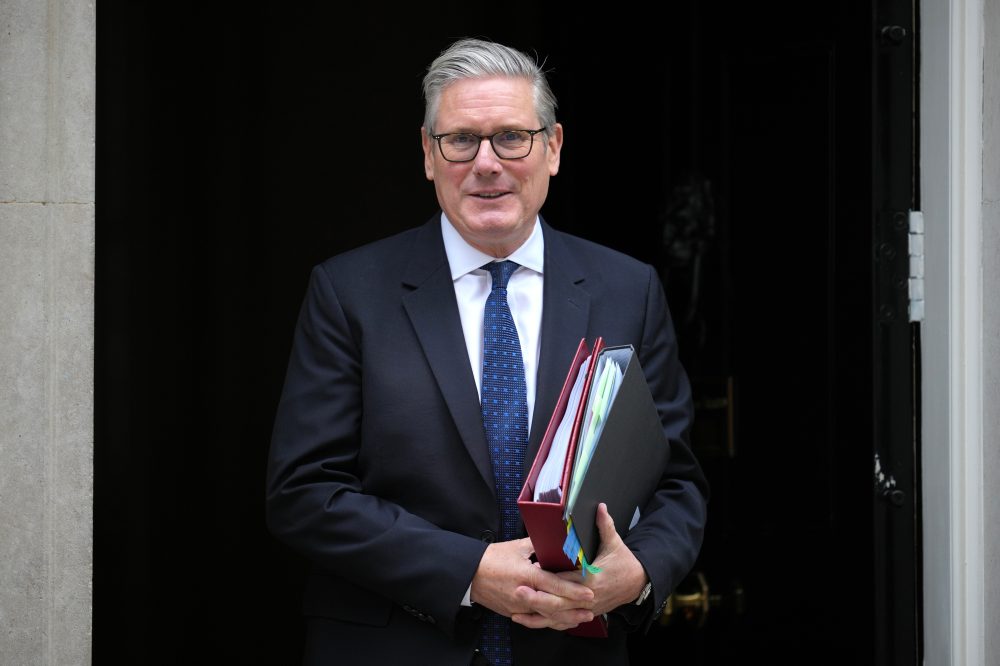
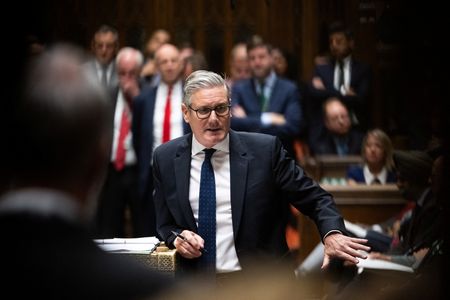
LONDON — The United Kingdom is preparing to announce major new restrictions on social media use for children under the age of 16, a move that could result in banning popular platforms and features considered too addictive for young users’ wellbeing.
Over recent years, Britain has steadily increased pressure on technology companies, pushing them to implement age verification systems, modify their recommendation algorithms, and — most recently — stop children from sharing nude images captured on mobile devices.
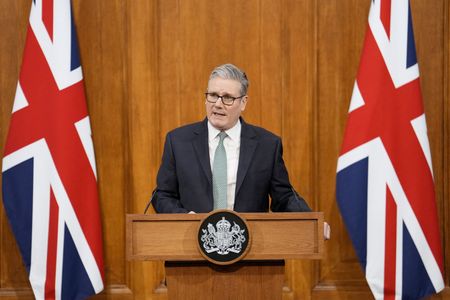
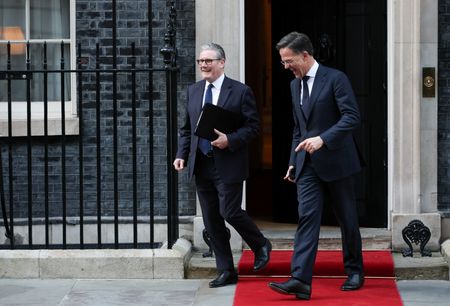
Now, amid rising concern about the mental health effects of excessive screen time on young people, Prime Minister Keir Starmer has decided to take things a step further. His decision came after conversations with parents and a review of evidence from Australia, which became the first nation to ban social media for under-16s last year.
Starmer, who is widely expected to face a leadership challenge in the weeks ahead, said the public rightfully demands action on this issue.
“That’s why we will call time on a system that’s failing our kids and take bold action to give every child the best possible start in life,” he said ahead of the Monday morning announcement.
According to The Guardian newspaper, Starmer is set to announce a full ban on all major social media platforms for anyone under 16. Digital products not covered by the ban — such as gaming apps — would face their own set of restrictions, including prohibitions on children communicating with strangers.
Australia led the way on this issue, becoming the first country in the world to block children under 16 from social media platforms. Starting in December, Australian users under that age were cut off from services including TikTok, Alphabet’s YouTube, and Meta’s Instagram and Facebook.
In the wake of Australia’s action, a number of other countries have signaled their own intentions to regulate children’s access to social media, driven by growing alarm over the effects on young people’s health and safety.
Britain’s government conducted a broad public consultation on potential new rules, gathering input from teachers, parents, and young people themselves. Options considered included an outright ban for under-16s, as well as curfews, limits on app usage time, and restrictions on what officials have called addictive design features built into these platforms.
The consultation attracted more than 116,000 responses. Among parents who participated, over 83% said they believed the dangers of social media outweighed the advantages, and 90% expressed support for setting the minimum age for social media access at 16.
Lisa Nandy, the minister for culture and media, pointed to Australia’s experience as evidence that even an imperfect ban can shift the broader culture around children’s online habits.
“It changes the presumption, so that at the age of eight, nine, 10, 11, children aren’t presuming that they’re going to be in these spaces because all of their friends are, and that quite significantly changes the culture,” she said in an interview with BBC television.
While many parents and elected officials support a ban, some psychologists and researchers have cautioned that there is no solid evidence proving such a measure would be effective. Meanwhile, a group of school-aged children in London told reporters they had a complicated and conflicted relationship with social media technology.
DUBAI/WASHINGTON — The United States and Iran have struck a deal to bring their war to an end, with a formal signing ceremony set for Friday in Switzerland, Pakistani Prime Minister Shehbaz Sharif announced early Monday on social media.
Shortly after Sharif made his announcement, President Trump confirmed the news on his Truth Social platform. “The Deal with the Islamic Republic of Iran is now complete,” Trump wrote.
The agreement comes despite an Israeli military strike on Lebanon on Sunday that drew condemnation from both Iran and Trump himself.
The full terms of the deal had not been publicly released, but Sharif said the agreement calls for “the immediate and permanent termination of military operations on all fronts, including in Lebanon.”
Multiple sources had previously told Reuters that the draft agreement would reopen the Strait of Hormuz, lift the U.S. blockade of Iranian ports, and extend a ceasefire — while setting aside Iran’s nuclear program for a separate round of talks over a 60-day window.
Trump confirmed those key elements in his social media post, saying the strait would be open “toll free” and that the U.S. naval blockade would also come to an end. “Ships of the World, start your engines. Let the oil flow!” Trump wrote.
The road to the agreement was bumpy on Sunday. Iranian negotiator Mohammad Baqer Qalibaf reacted sharply to Israel’s strike on the southern suburbs of Beirut — which Israel said targeted Iranian-backed Hezbollah militants — posting on X that the attack showed the United States lacks “the will and ability to fulfill your commitments.”
Iran’s foreign ministry held the United States responsible for the Israeli strike and warned of a “strong response.” The country’s top joint military command stated that the “finger (is) on the trigger” and was ready to fire at the “enemy’s heart.”
Trump also weighed in on the Beirut attack Sunday, writing on Truth Social: “This morning’s attack on Beirut should not have happened, particularly on a special day when we are so close to a Peace Deal with Iran.”
Israel has stated it is not a party to the planned U.S.-Iran agreement. Israeli Prime Minister Benjamin Netanyahu has clashed with Trump over American demands that Israel scale back its military operations in Lebanon as a condition for reaching the deal with Iran.
The fighting between Israel and Iran-aligned Hezbollah in Lebanon was reignited when the U.S.-Israeli war against Iran began in February.
A senior Iranian official had earlier told Reuters that under the draft deal’s terms, the United States would release $25 billion in frozen Iranian assets, while Iran would agree not to develop or acquire nuclear weapons. The official said Iran also agreed to preserve the existing nuclear status quo — meaning no uranium enrichment or expansion of nuclear facilities — until a final agreement is reached.
Pakistan’s Prime Minister Shehbaz Sharif announced in the early hours of Monday that the United States and Iran have come to a peace agreement following talks.
Sharif shared the news on social media platform X, stating: “Both sides have declared the immediate and permanent termination of military operations on all fronts, including in Lebanon.”
The Prime Minister also noted that a formal signing ceremony is planned for June 19 in Switzerland.
Iran has turned down a proposal it says came from President Donald Trump — one intended to prevent Tehran from retaliating against Israel following a strike on Hezbollah positions in Beirut’s Dahieh district. According to a report from N12, Iran warned that its response against Israel could arrive “before dawn.”
The rejection came even as President Trump publicly voiced criticism of Israel’s military operation in the Lebanese capital, while at the same time expressing hope that a memorandum of understanding to end the conflict could still be reached on Sunday.
Citing Iranian statements, N12 reported that Tehran brushed aside the proposal and made clear it plans to act. “Trump offered us money in exchange for overlooking the attack. We rejected it — we will respond very soon. We will not betray our allies,” Iran said, in a reference to Hezbollah.
Additional warnings followed from Iranian officials. Iran’s Supreme National Security Council stated, “The response is near,” while a separate statement declared: “Our finger is on the trigger, ready to fire at the heart of the enemy.” Officials also claimed that Iran’s military strength had grown under the leadership of Mojtaba Khamenei.
As the situation intensified, Iran’s Tasnim news agency reported that all air traffic in western Iran had been halted until further notice.
Inside Israel, the Home Front Command moved to restrict public gatherings to no more than 5,000 people.
Fighting continued along the Lebanese front as well. The Israel Defense Forces reported that one soldier suffered moderate injuries and a second was lightly wounded after rockets were launched at Israeli troops operating in southern Lebanon. The military also noted impacts both inside Israel and in areas where soldiers are stationed in southern Lebanon, along with reports of additional suspicious aerial objects near the Lebanese border.
President Trump was sharply critical of the strike on Dahieh, which took place while diplomatic efforts were still underway. According to Axios, Trump said Prime Minister Benjamin Netanyahu had “no —-ing judgment.”
In an interview with Fox News, Trump stated: “A deal will be signed within two or three hours. I told Netanyahu — what the hell are you doing?”
On his Truth Social platform, Trump wrote that the attack “should not have happened, particularly on a special day when we are so close to a Peace Deal with Iran.” He also called on “all sides” to “stand down … Let’s not blow it!”
A tragic case of mistaken identity in Pakistan has left a 9-year-old Australian girl dead and two of her family members fighting for their lives after police officers allegedly opened fire on their rental vehicle.
Hania Ahmed, a Pakistani-Australian child from Perth, was riding in a car with her father and younger brother in Chakwal, a city in Punjab province roughly 62 miles southwest of Islamabad, when Crime Control Department officers allegedly confused their vehicle with one being used by robbery suspects and began shooting.
According to information gathered by The Media Line, the family had returned to Pakistan just days earlier after completing the Hajj pilgrimage. Hania’s father, Adeel Ahmed, 39, originally hails from Dhudial, a town within Chakwal district. He relocated to Australia approximately two decades ago, earned a civil engineering degree, and built a life there with his wife, Dr. Sidra Khan, and their two children, Affan Ahmed and Hania Ahmed.
At the time of the shooting, Hania, her father, and her brother were on their way to visit her maternal grandfather, who is reportedly a retired colonel in the Pakistan Army. Her mother was not in the vehicle and was unharmed.
Early accounts of the incident indicate that just before the shooting, the family had been robbed at gunpoint by two armed men who stole jewelry from them. As the family attempted to drive away in their rented car, officers allegedly mistook them for the fleeing robbers and opened fire.
Hania died from her injuries. Her father and younger brother were both seriously hurt and required surgery. Police later reported that the two men suspected in the robbery were killed in a separate encounter.
Authorities have arrested the officer accused of firing on the family’s vehicle and have filed a murder charge against him. A Joint Investigation Team has also been assembled to look into the full circumstances surrounding the deadly shooting. Senior Pakistani police officials have characterized the event as a tragic case of mistaken identity and pledged a transparent investigation to deliver justice to the family.
The incident has sparked widespread outrage in both Pakistan and Australia. It has also reignited debate over policing practices in Pakistan, including the use of deadly force during criminal pursuits and the systems in place to hold officers accountable when civilians are killed. Human rights organizations in Pakistan have long voiced concerns about police shootings, mistreatment in custody, and extrajudicial killings, while officials have acknowledged that reforms are necessary to rebuild public confidence.
Australia’s Department of Foreign Affairs and Trade confirmed it is providing support to the affected family. A spokesperson for the department expressed sympathy, stating, “We send our deepest condolences to the family at this difficult time.” The department added that it is offering consular assistance to the family of the Australian national who was killed, as well as to the two Australians who were injured in the attack.
RIO DE JANEIRO — A deadly midair collision between two helicopters over Rio de Janeiro on Sunday morning left all six people aboard dead, according to firefighters at the scene.
Rio de Janeiro’s Military Fire Department reported that one of the aircraft came down on top of a car dealership, where a number of electric vehicles were parked. The impact triggered a fire that crews were eventually able to put out.
Authorities have launched an investigation to determine what led to the collision, though no cause has been identified yet.
Police confirmed that American singer and comedian Oliver Tree appeared on the passenger manifest that had been submitted to aviation authorities. However, officials said they have not yet been able to identify the bodies of those who died in the crash.
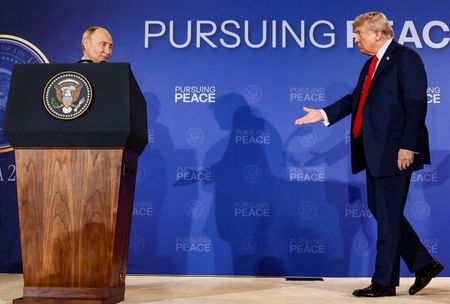
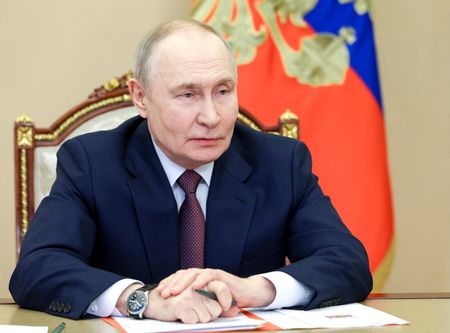
Russian President Vladimir Putin reached out to U.S. President Donald Trump on Sunday with birthday congratulations, praising him as an exceptional leader and expressing optimism about the future of relations between their two countries.
“Dear Mr. President, dear Donald, I wholeheartedly congratulate you, such a bright, remarkable person and politician, on your 80th birthday!” Putin wrote in a message posted to the Kremlin’s official website, which was also cited by Russian news outlets.
The two heads of state spoke over the phone for 55 minutes, according to Kremlin foreign policy aide Yuri Ushakov, who described Putin’s congratulations during the call as delivered in an “informal” way.
In his written message, Putin said he “valued the mutual understanding between us, which allows us to discuss … even the most complex issues on the bilateral and international agenda openly and frankly.”
Putin went on to express confidence in what the two leaders could accomplish together, writing: “I am certain that together we could truly give Russian-American relations a new quality, and also do much to ensure security and stability on the world stage.”
The last time the two presidents met face-to-face was in Alaska in August 2025, as part of efforts to work toward a resolution to the ongoing conflict between Russia and Ukraine.
WESTPORT, Ireland — Canadian Prime Minister Mark Carney is warning that the United States’ decision to restrict access to Anthropic’s newest artificial intelligence models is a wake-up call about the risks of depending too heavily on a small number of American technology providers.
AI company Anthropic announced Friday that it has taken its two latest AI models — known as Fable 5 and Mythos 5 — offline in response to a directive from the Trump administration barring their use by foreign nationals.
The move represents the most sweeping step the U.S. government has taken to date to limit foreign access to cutting-edge AI technology. Anthropic released Fable broadly this week. That model is a scaled-down version of the more powerful Mythos, which the company had already been restricting due to serious cybersecurity concerns.
“The situation we’re in collectively right now with Mythos and Fable is something that can happen with overreliance on certain models,” Carney said. “Nobody has done anything wrong in the situation. But we will have done something wrong if we just accept this, don’t take the lesson, don’t build out and diversify.”
Carney delivered those remarks while in Ireland ahead of the upcoming G7 summit in Evian-les-Bains, France, where he said artificial intelligence is expected to be a major topic of discussion on Monday night.
Anthropic, headquartered in San Francisco, California, announced the Mythos model on April 7, describing it as so “strikingly capable” that the company has limited access to select customers only. The company cited the model’s ability to outperform human cybersecurity experts at identifying and exploiting computer vulnerabilities.
“You’ll hear me say this over and over again. It is never a good idea to have one option,” Carney said.
Carney also revealed he spent 45 minutes discussing artificial intelligence with French President Emmanuel Macron on Friday evening. He cautioned that there “will not be a mission accomplished banner” coming out of the summit, given the complexity of the issues involved.
The Canadian prime minister drew a direct connection between the U.S. AI restrictions and Canada’s ongoing effort to broaden its trade relationships. More than 70% of Canada’s exports currently go to the United States, and Carney has set a goal to double Canada’s non-U.S. exports over the next decade. He noted that Trump’s trade war has already been dampening investment.
Carney does not have a one-on-one meeting scheduled with Trump at the G7, even as the free trade agreement between the U.S., Canada, and Mexico is up for renewal. He said trade discussions under the USMCA framework will instead take place between Canada’s minister responsible for U.S. trade Dominic LeBlanc, Canada’s chief negotiator Janice Charette, U.S. Trade Ambassador Jamieson Greer, and Treasury Secretary Scott Bessent.
“The right way to do it at this stage, will be between the principal negotiators, which is going to happen in Evian,” he said.
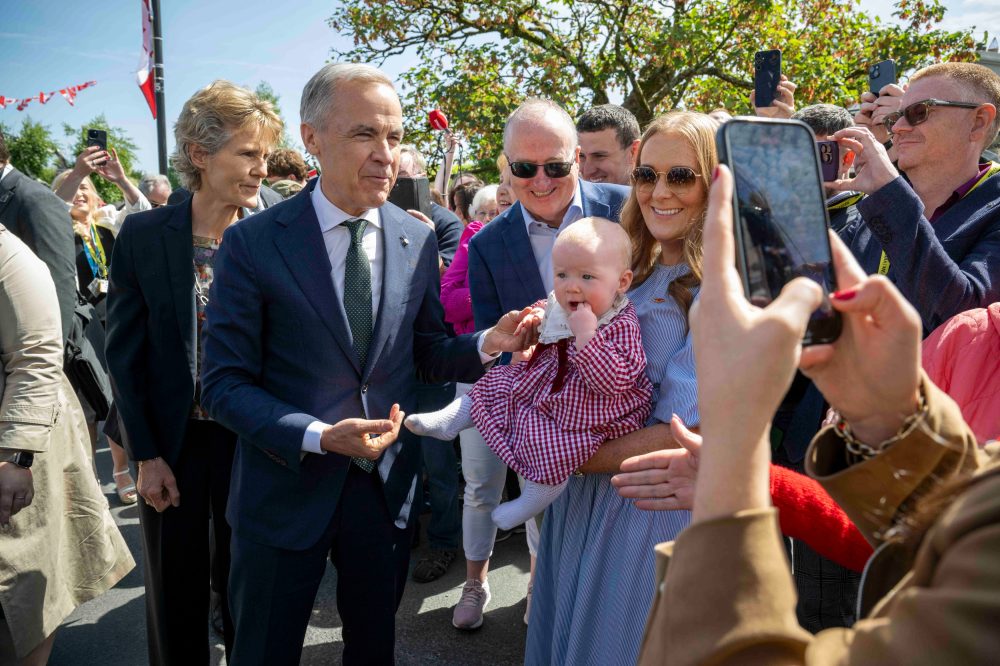
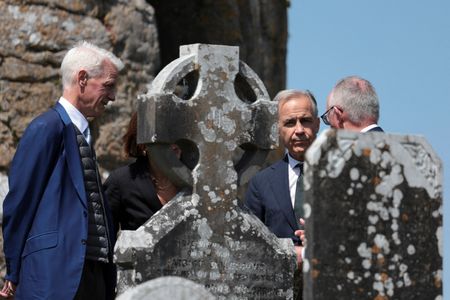
Earlier Sunday, Carney visited the Irish village of Aghagower, where his family has ancestral roots. His grandfather, Robert Carney, and grandmother, Nora Moran, both hailed from the County Mayo town and emigrated to Canada in the 1920s.
Local resident Owen Morgan, who was there with his 17-month-old son Malachy — dressed in a Montreal Canadiens jersey — said the community is proud of the Canadian leader. “People are very impressed,” Morgan said. “He’s very much standing up for Canadians and I think that’s very much admired.”
Armenia’s Central Electoral Commission has officially confirmed that Prime Minister Nikol Pashinyan’s party came out on top in the country’s recent general election — a vote seen as a defining moment for the nation’s future alignment between Russia and the West.
Final results released by the commission for the June 7 election showed Pashinyan’s ruling Civil Contract party capturing 49.7% of the vote, giving it enough support to form a government. The outcome reflects the Pashinyan administration’s push to deepen ties with the European Union and the United States, even as critics argue the country should maintain its longstanding relationship with Russia.
The pro-Russian opposition group Strong Armenia had urged the commission to throw out the results, claiming there were “widespread violations” during the voting process. Supporters of Strong Armenia and other opposition parties gathered outside the commission’s offices while officials worked to finalize the tallies.
The window between the June 8 preliminary results and the final certification gave political parties time to file formal complaints about any perceived problems with the election.
International election monitors from the Organization for Security and Co-operation in Europe (OSCE) said Armenian voters were given a “genuine choice” but noted the election took place amid “highly confrontational…divisive rhetoric” and “uneven campaign opportunities.” Armenian investigators had issued six arrest warrants against Strong Armenia members the day before the election, alleging they had been paying voters for their support.
Samvel Karapetyan, the billionaire leader of Strong Armenia — who built his wealth in Russia — is currently under house arrest. Authorities accuse him of calling for the overthrow of the government, a charge he has denied, calling it politically motivated.
Under Armenian law, the National Assembly must have at least 101 members, each serving five-year terms. Individual parties need at least 4% of the vote to gain entry, while coalitions of three or more parties must reach 8%. Civil Contract’s vote share translates to 64 seats in the assembly. Strong Armenia earned 29 seats, and the Armenia Alliance — led by former President Robert Kocharyan — received 12 seats.
Geopolitical questions dominated the campaign. As he cast his ballot on June 7, Pashinyan declared, “The European Union is our main partner in democratic reform implementation, and we will continue that path.” Armenia formally announced its ambition to join the EU last year.
Most opposition parties, Strong Armenia among them, ran on platforms favoring closer ties with Russia.
Russia, which maintains a military base inside Armenia, has cautioned that the country’s pivot toward the West could bring serious political and economic consequences. President Vladimir Putin has drawn comparisons between Armenia’s trajectory and Ukraine’s, making thinly veiled threats and suggesting Russia’s conflict with Ukraine began with Ukraine’s efforts to align with the EU.
In the weeks leading up to the vote, Moscow rolled out a series of trade restrictions targeting Armenian goods — including flowers, certain cognacs and wines, eggplant, potatoes, dried fruits, and fish. OSCE election monitors described these measures as “direct pressure” on Armenia’s election. Russia maintained the bans were tied to violations of agricultural import regulations.
European Commission President Ursula von der Leyen accused Russia of “weaponizing” economic relations and called the import bans “nothing short of economic coercion.” She announced that the EU would provide 50 million euros — roughly $58 million — in support of Armenia.
The relationship between Moscow and Yerevan deteriorated significantly after Azerbaijan reclaimed control of the Karabakh region, a mountainous area that had been held for decades by ethnic Armenian forces with backing from Armenia, stemming from a prolonged conflict between the two neighboring nations. Armenia blamed Russian peacekeepers stationed in the region for failing to prevent Azerbaijan’s military operation. Moscow, occupied with its war in Ukraine, rejected those accusations.
Pashinyan has taken gradual steps to distance Armenia from Russia, including joining the International Criminal Court in 2023 and suspending Armenia’s participation in the Moscow-led Collective Security Treaty Organization in 2024. Armenia also hosted the European Political Community summit and its first-ever summit with the EU in Yerevan in early May.
In August 2025, U.S. President Donald Trump brought Pashinyan and Azerbaijan’s President Ilham Aliyev together to sign an agreement aimed at ending their decades-long conflict, which included provisions for a new transit corridor connecting Azerbaijan to its exclave of Nakhchivan.
Qatari mediators flew to Tehran on Sunday as part of an urgent diplomatic mission coordinated with the United States, aimed at keeping a proposed peace agreement from collapsing, according to CNN.
The negotiators departed from Doha in an effort to close the remaining gaps between Washington and Tehran after a breakdown in the ceasefire raised fears that talks aimed at ending the conflict and reopening the Strait of Hormuz could fall apart.
A source with knowledge of the talks told CNN that plans for an in-person signing ceremony between both sides were scrapped due to logistical hurdles and concerns that any delays could threaten the already fragile ceasefire. The two sides shifted instead to the idea of an electronic signing process.
Several major issues remain unresolved, including the size of Iran’s uranium enrichment stockpile and Tehran’s reported push to charge ships a fee for passing through the Strait of Hormuz — a proposal the United States has rejected.
The mediation push comes as Iranian officials and media organizations publicly disputed claims that a memorandum of understanding would be signed Sunday.
President Donald Trump posted on Truth Social Saturday that a deal was “scheduled to get signed” the following day. Pakistani Prime Minister Shehbaz Sharif echoed that optimism, writing on X: “We are closer to a peace deal than ever before. With finalisation likely expected in the next 24 hours.”
But a media outlet connected to the Revolutionary Guards flatly rejected that timeline, saying senior Iranian negotiators had made clear the agreement “has not yet been finalized and will certainly not be done on Sunday.”
That same outlet took aim at what it described as President Trump’s “unusual insistence” on a Sunday signing, suggesting the push was tied to the president’s 80th birthday.
President Trump had previously indicated that Vice President JD Vance would attend a signing ceremony in Europe. The president is set to travel to France for the G7 summit.
According to CNN, Qatar’s active role in the mediation reflects the stakes Doha has in reaching an agreement, after Iranian missile strikes hit critical Qatari energy infrastructure during the conflict. The report noted that Qatar has pursued diplomatic channels with Tehran in hopes of preventing further damage to its energy facilities and helping bring the regional blockade to an end.
Colonel Netanel Lasri, known to colleagues as Nati, has died at the age of 40 following a three-year struggle with cancer. At the time of his passing, he was serving as head of the Planning Department within the Israel Defense Forces Ground Forces Command and had previously led the Golan and Hermon Brigade. He is survived by his wife and three children.
Throughout his military career, Lasri was considered one of the most talented and well-respected officers within the IDF’s Armored Corps and combat divisions.
Lasri was born in Lod and participated in the city’s Scouts movement before enlisting in the IDF in 2004, joining the 401st Armored Brigade. Over the course of more than two decades of service, he took part in numerous significant Israeli military operations.
During the Second Lebanon War, he served as a tank crewman. He went on to fill several command roles within the Gaza Division, including serving as a battalion operations officer during Operation Cast Lead and as a deputy company commander during Operation Hot Winter.
While leading an operational company in the 52nd Battalion, Lasri directed forces in halting a complex terrorist attack near the area where the borders of Israel, Egypt, and Gaza converge. That mission earned him a formal commendation from the Gaza Division commander.
His leadership during Operation Pillar of Defense as a company commander was recognized with a certificate of excellence presented by the IDF chief of staff.
Lasri also took part in Operation Protective Edge, this time commanding the Tank Commanders Course training company. He later served as deputy commander of the 52nd Battalion and as an aide to the head of the Operations Directorate.
From 2019 through 2021, he commanded the 9th Battalion, and afterward served as operations officer of the 162nd Division.
In August 2023, Lasri was appointed to lead the Golan and Hermon Brigade, a post he held through April 2024. Despite his ongoing illness, he took on his final assignment in May 2025, heading the Planning Department within the Ground Forces Command.
Over the course of his service, Lasri received the IDF chief of staff’s citation along with several other military honors and commendations.
WASHINGTON — An oil tanker disabled by the U.S. military while attempting to break through America’s blockade of Iran had brushed off nearly 60 verbal warnings and multiple demonstrations of military force before U.S. forces ultimately opened fire, a U.S. official has revealed to The Associated Press.
According to the official, who was not authorized to speak publicly on the sensitive matter and requested anonymity, the ship’s crew also disregarded eight shows of force from military aircraft — including flares and flyovers — along with two final warnings before shots were fired on Wednesday.
Earlier in the week, the U.S. military disclosed that an American aircraft fired what it called “precision munitions” into the engine room of the Palau-flagged vessel M/T Settebello. Indian officials confirmed that three Indian sailors lost their lives in the strike, which took place in the Gulf of Oman.
The U.S. official characterized the vessel as part of a so-called shadow fleet used to illegally move Iranian oil and sidestep international sanctions. The official also noted the ship had been observed attempting to breach the blockade on multiple occasions, and that U.S. forces had communicated with the vessel dozens of times over a two-week period leading up to the day it was disabled.
In an official statement, U.S. Central Command said American forces gave the ship’s crew a 15-minute window to evacuate the engine room before firing the shots that put the vessel out of commission.
“After being in place for more than 60 days, it should be clear by now that U.S. forces will strictly enforce the blockade,” the statement read.
India’s foreign ministry announced that New Delhi had filed a “strong protest” with the United States over the deaths of its citizens.
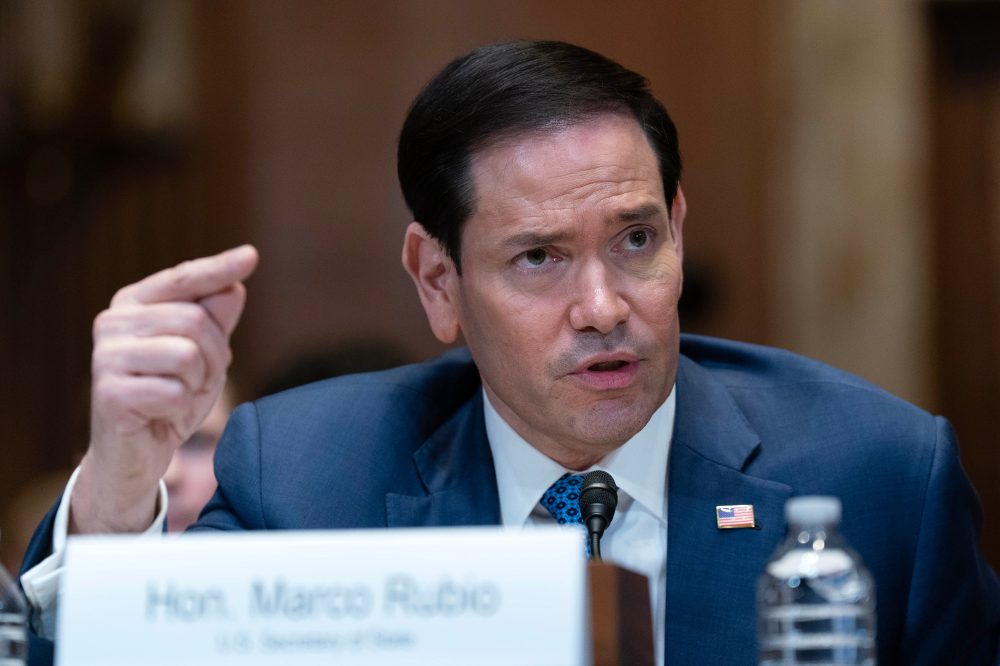
Secretary of State Marco Rubio spoke by phone with his Indian counterpart on Friday, conveying “that all commercial vessels should immediately comply with orders from U.S. forces as they seek to uphold peace and security in the Strait,” according to a summary of the conversation released by the State Department on Saturday.
U.S. President Donald Trump reached out to Russian President Vladimir Putin by phone on Sunday, expressing that bringing the war in Ukraine to a close is critically important and that he stands ready to play a role in making that happen, according to Kremlin adviser Yuri Ushakov, as reported by Russian news agencies.
Ushakov further revealed that during the call, Trump informed Putin that a deal to end the conflict with Iran was close to being finalized. The Russian leader reportedly expressed relief that the fighting would be coming to an end.
In addition to the weighty diplomatic discussions, Ushakov noted that Putin took a moment to wish Trump a happy 80th birthday in what was described as an “informal” manner.
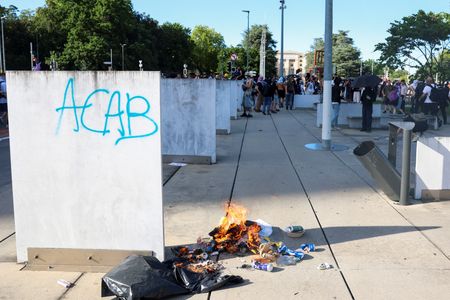
Swiss authorities deployed tear gas Saturday against protesters who descended on United Nations buildings in Geneva, according to a Reuters witness on the scene.
The demonstrators, who were rallying in opposition to a G7 summit being held across the border in France, directed their anger at UN facilities in the Swiss city. Some in the crowd hurled stones at a UN telecommunications building, while others threw flares as police worked to push them away from the site.
Authorities in Yemen are reporting the death of a well-known daredevil adventurer who went by the nickname “The Spider-Man of Yemen,” after he plunged into a volcanic crater while scaling its walls without any safety gear.
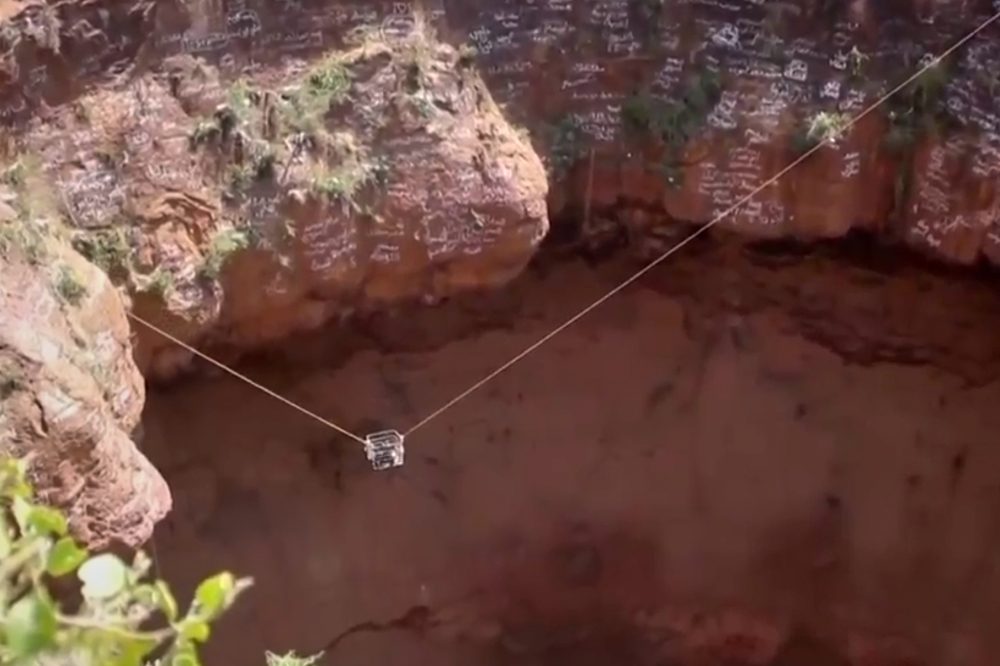
Al-Qaqa Ibn Antar, 30 years old, was attempting to climb the sheer rock faces of the Hardah Dam volcanic crater in Yemen’s southern Dhale province on Friday when he lost his grip and fell 120 meters — roughly 393 feet — into the crater below, according to the Civil Defense Authority. The agency also released a brief video capturing the terrifying moment.
The 10-second clip shows Antar making his way up a rocky cliff face with no protective equipment. Names written in Arabic appear in white lettering on the rock wall he is scaling. The footage then shows him clinging to the cliff with his right hand while his left arm reaches out into the air — before his right-hand grip gives way and he falls.
Search and rescue teams, including divers and water specialists, were deployed to recover Antar’s body. Divers eventually found him at a depth of 30 meters — about 100 feet — beneath the water’s surface. The Civil Defense Authority described the four-hour recovery effort as “complex,” citing the steep, rocky terrain that made reaching the site extremely difficult.
The Hardah Dam — also referred to as the Haradhat Damt — is a distinctive volcanic crater situated near the city of Damt in Yemen’s southern Dahle province. The landmark features sharply rising rock walls surrounding a hot, sulfurous lake at its bottom.
Antar had developed a significant following on social media by posting footage of himself taking on high-risk climbs across some of Yemen’s most challenging terrain. His videos frequently went viral. In one widely-shared clip, he was seen gripping the edge of a rocky cliff with only his bare hands while his legs dangled over a steep drop below — all without any safety equipment.
In the wake of the tragedy, the Civil Defense Authority called on climbers and adventure sports enthusiasts to follow proper safety protocols. The agency issued a formal warning urging people to use “appropriate protective gear to avert similar incidents.”
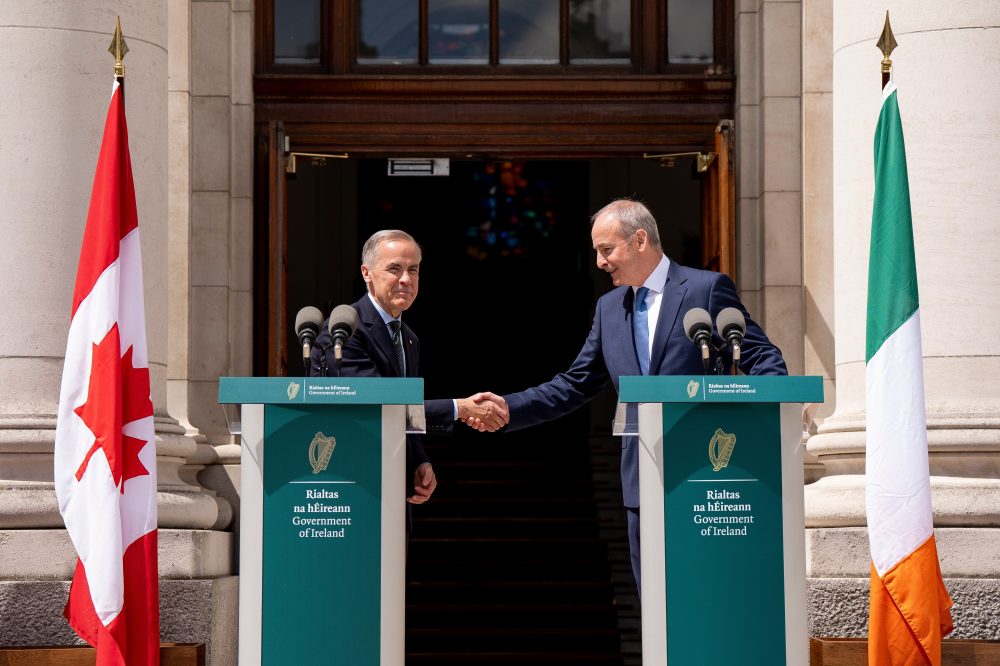
Canadian Prime Minister Mark Carney spent part of his Sunday in Aughagower, a village in western Ireland, where he connected with distant relatives and paid tribute to his family’s roots before heading to the G7 summit in France.
Carney’s grandparents, Robert Carney and Nora Moran, were both born in that village before emigrating to Canada in 1925. The couple married in Vancouver, where Robert took a position with the Canadian Pacific Railway Police and later joined the Royal Canadian Mounted Police. Carney’s father was born in 1933 and eventually became a professor at the University of Alberta.
After attending Sunday Mass at the local Catholic church in Aughagower — the same church his grandparents would have known — Carney also visited the family grave and planted a tree in their honor. Speaking with reporters afterward, he joked about the unexpected size of his extended family: “I have a lot more cousins than I realised.”
The personal visit followed a more formal appearance on Saturday, when Carney addressed students at Trinity College Dublin. There, he called on nations like Canada and Ireland to build a “dense web of connections … ad hoc coalitions” as the global order established after the Cold War continues to unravel.
“Ireland and Canada are navigating a global rupture, not a quiet transition,” he told the students. He added, “I suggest that amidst this change, amidst this disruption, Canada, Ireland, and Europe can be pivotal, powerful, and purposeful, a force for good.”
Irish Prime Minister Micheal Martin, whose country is set to assume the six-month rotating presidency of the Council of the European Union on July 1, echoed the sentiment. He told reporters that his government would work to “put flesh on the bone of an enhanced European Union-Canadian relationship.”
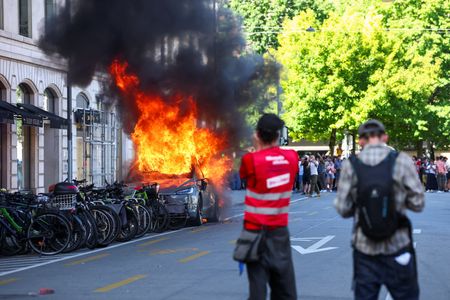
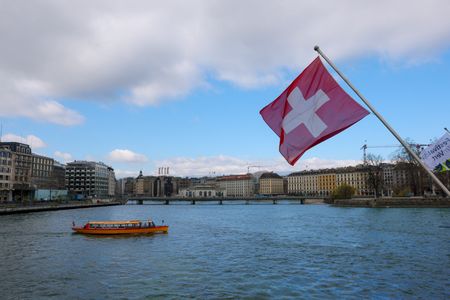
GENEVA — A demonstration in Geneva, Switzerland turned partially violent Sunday when protesters set a Tesla on fire and smashed the windows of a bank, expressing outrage ahead of an upcoming Group of Seven summit scheduled just over the border in France.
Despite those incidents, police described the overall march as largely peaceful. Authorities estimated attendance at up to 7,000 people and said they confiscated a number of knives and pyrotechnic devices from those in the crowd.
Demonstrators said their target was the G7 as a symbol of concentrated wealth and political power. The protest came shortly after Tesla owner Elon Musk, who has served as an advisor to U.S. President Donald Trump, became the world’s first trillionaire — a milestone that many say has intensified public concern over growing inequality.
Protester Pippa Saugy explained her motivation for attending: “To me, it’s a meeting of the rich that shows once again how the rich can become even richer while the poor are left behind.”
The G7 summit is scheduled for June 15 through 17 in Evian-les-Bains, a town situated along the shore of Lake Geneva. It will bring together the leaders of France, Britain, Canada, Germany, Italy, Japan, and the United States, as well as the European Union.
The agenda is expected to be dominated by the ongoing wars in Ukraine and the Middle East. World leaders will also be navigating their relationship with President Trump as he works toward finalizing a framework peace agreement with Iran.
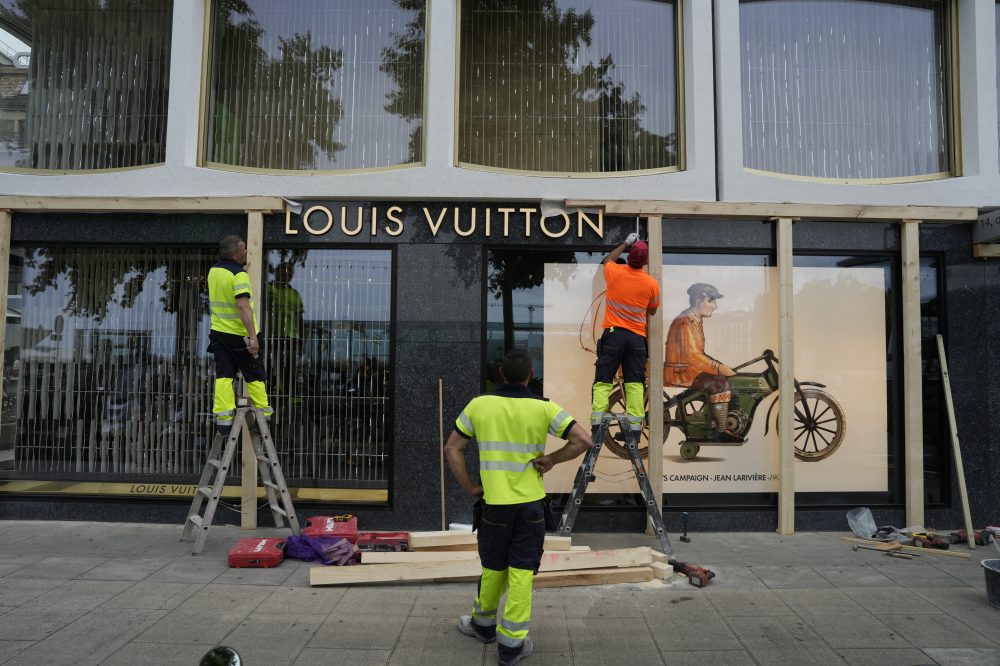
Back in Geneva, storefronts were boarded up and hundreds of riot officers were positioned throughout the city in anticipation of potential unrest. Protests at G7 summits are nothing new — demonstrators have long used these gatherings as a platform to speak out against capitalism, globalization, climate change, and economic inequality.
One demonstrator, Mattia Piccard, expressed frustration at the heavy law enforcement presence on the streets. “This is an attempt to frighten demonstrators, to frighten people and discourage them from coming out to protest,” Piccard said.
Another participant, Clélia Colin, said she was there to draw attention to gender inequality. “The values represented by the G7 are completely misogynistic, and they contribute to inequality because there is absolutely no equality,” Colin said.
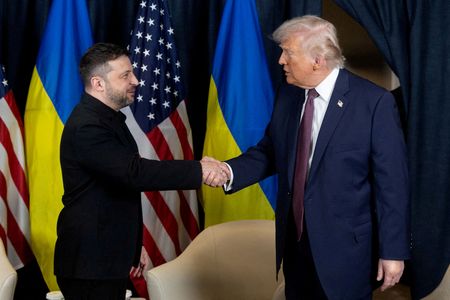
Ukrainian President Volodymyr Zelenskiy got on the phone with U.S. President Donald Trump on Sunday for a conversation that touched on the war in Ukraine, diplomatic efforts, and the ongoing push for peace negotiations, according to a Ukrainian presidential adviser.
The two leaders spoke for roughly 30 to 35 minutes, presidential communications adviser Dmytro Lytvyn confirmed. Along with the serious matters of war and diplomacy, Zelenskiy also extended birthday wishes to Trump, who celebrated his 80th birthday on Sunday.
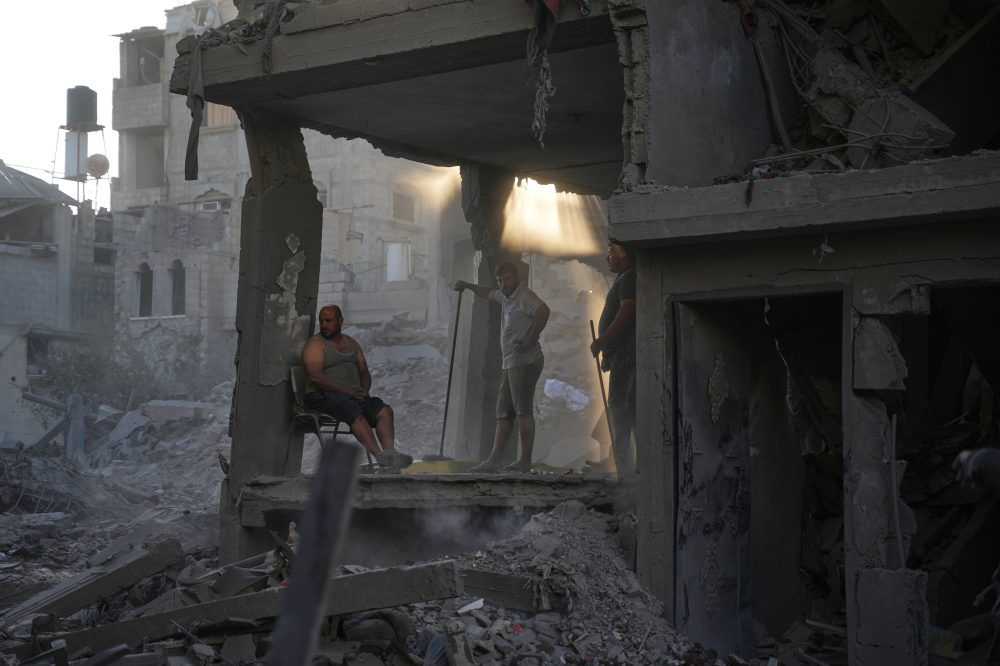
CAIRO — At least six Palestinians were killed Sunday in Israeli airstrikes and gunfire across the Gaza Strip, according to health officials, even as international mediators intensified their push to keep a U.S.-brokered ceasefire alive.
Medical workers reported that an Israeli airstrike claimed the lives of at least four people near Al-Yeman Al-Saeed Hospital in the Jabalia refugee camp, located in the northern part of the enclave. Two additional deaths were recorded in separate shooting incidents — one in Khan Younis in the south and another in Gaza City. The Israeli military offered no immediate response to requests for comment on the incidents.
The bloodshed unfolded as mediators from Egypt, Qatar, and Turkey concluded a week of negotiations with Hamas and other Palestinian factions. Those talks centered on moving forward with the second phase of U.S. President Donald Trump’s Gaza plan, which calls for Hamas to lay down its weapons and for Israel to pull its forces out of the territory.
A truce brokered by Trump in October 2025 has so far failed to put a full stop to Israeli military operations in Gaza or to achieve the disarmament of Hamas fighters. Health officials say Israeli strikes have killed more than 950 people since the truce took effect, while Israel reports that four of its soldiers have been killed by militants during the same period.
Hamas places the blame for the ongoing conflict on what it describes as Israel’s failure to meet obligations agreed upon in October — a deal that paused major combat operations but did not bring Israeli attacks to a complete halt. Israel, for its part, maintains that its strikes are carried out to prevent imminent attacks by Hamas and other militant groups.
On Sunday, Hamas and allied factions announced they had submitted a written response to a 15-point framework put forward by the mediators and Trump’s Board of Peace, though they did not disclose the specifics of their answer. Sources familiar with the negotiations indicated the factions agreed to 14 of the 15 points, with the remaining sticking point being the question of Hamas disarmament. Hamas has said it will only consider full disarmament if a political process toward establishing a Palestinian state is set in motion.
Israel has maintained a firm stance that Hamas must disarm completely, relinquish control of Gaza, and have no part in shaping the territory’s future.
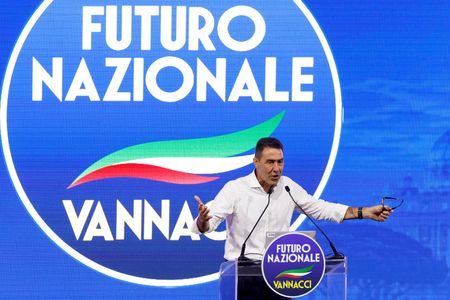
ROME — A retired Italian general formally unveiled his new far-right political party on Sunday, directly challenging Prime Minister Giorgia Meloni’s hold on power as he pushes for a more extreme nationalist agenda ahead of next year’s elections.
General Roberto Vannacci, a 57-year-old former paratrooper, was introduced to the crowd as a modern-day Julius Caesar when he stepped onto the stage at the founding congress of Futuro Nazionale. Supporters greeted him with repeated chants of “Generale, Generale, Generale.”
“We represent the rejects and the dregs, and are proud of it,” Vannacci declared. He left Deputy Prime Minister Matteo Salvini’s League party four months ago and is now positioning himself to the right of Meloni’s conservative coalition.
Futuro Nazionale is already drawing about 5% in polls, putting it in striking distance of the League and potentially threatening Meloni’s chances of returning to power unless she negotiates some kind of electoral deal with Vannacci.
However, any such alliance could backfire for Meloni. Vannacci’s anti-EU, pro-Russia stance and his close connections to far-right European parties — including Germany’s AfD — could drive away moderate voters who currently support her.
Taking the most aggressive anti-immigration position in Italian politics, Vannacci said Sunday that he would reduce the number of foreign nationals living in Italy from roughly 12% of the population down to about 4%.
“We don’t have a programme for immigration, we have a programme for re-migration,” he told the cheering crowd.
The new party’s platform borrows heavily from positions Meloni herself championed while in opposition — before she took the reins of Italy’s massive national debt in 2022 and had to reassure financial markets.
Vannacci said he wants to open a debate on whether Italy should remain part of the euro currency zone. He also called for scrapping the EU’s Green Deal aimed at cutting carbon emissions, and lifting Italy’s existing ban on nuclear energy. The platform additionally includes family-friendly tax incentives, such as reductions for households with children.
Despite Italy having one of the lowest rates of murder and violent crime in the world, Vannacci declared security and defense his top priority, promising a zero-tolerance approach to crime and pledging to expand prison capacity.
While Vannacci has criticized Meloni for walking back on her own campaign promises, he did acknowledge that his own plans are subject to change.
“No plan survives the first shot in battle … it has to be adapted to reality,” he said.
DEIR AL-BALAH, Gaza Strip — The total number of Palestinians killed since the start of the Israel-Hamas war has climbed past 73,000, Gaza’s Health Ministry announced Sunday, even as a fragile ceasefire agreement remains in place but largely deadlocked.
Israel has not halted military strikes within the territory despite the deal that was reached in October, stating that its operations target Hamas fighters and other armed groups that pose a threat, as well as responding to what it describes as ceasefire violations. Five Israeli soldiers have died since the truce went into effect.
The updated death toll was confirmed by two Health Ministry officials: Zaher al-Waheidi, who heads the ministry’s records department, and Hamza Salem from the ministry’s public relations office.
The total death count since the war began now stands at 73,001. On Sunday alone, five deaths were recorded — two in the southern city of Khan Younis, one in central Gaza, and two individuals who succumbed to wounds sustained in earlier incidents.
More than 173,200 people have been injured since the conflict began. The war was triggered by the Hamas-led attack on Israel on October 7, 2023, which killed approximately 1,200 people and resulted in 251 others being taken hostage.
Gaza’s Health Ministry operates under the Hamas-led government but is staffed by medical professionals who maintain detailed casualty records. United Nations agencies and independent experts generally regard the ministry’s data as credible. The ministry does not separate civilian deaths from militant deaths in its figures, though it notes that women and children account for roughly half of all fatalities.
Israel maintains that it works to minimize civilian casualties and attributes civilian deaths to Hamas, arguing that the militant group conducts operations in heavily populated residential areas.
The ceasefire agreement, brokered by the United States and reached in October, brought an end to full-scale military operations and facilitated the release of all remaining hostages held in Gaza.
However, other key components of the deal have stalled. Hamas has refused to disarm, and Israeli forces have moved further into Gaza rather than pulling back. Both parties accuse each other of breaching the agreement while maintaining that it remains technically in force.
Nickolay Mladenov, the top U.S.-appointed diplomat overseeing the ceasefire, has stated that progress on all remaining issues — including reconstruction efforts, the withdrawal of Israeli troops, and the formation of a new Palestinian governing authority — is being blocked by the impasse over Hamas disarmament.
The war has displaced the vast majority of Gaza’s more than 2 million residents, reduced large sections of the territory to rubble, and caused severe shortages of food, medicine, and essential supplies. Nearly all border crossings into Gaza, most of which are under Israeli control, have been closed throughout the conflict.
ROME — In a standing-room-only auditorium near the Vatican, Roberto Vannacci — a former Italian army general whose supporters call him “Il Generale” — rallied followers of his new political movement this weekend, positioning himself as an outsider while simultaneously shaking up Italy’s right wing and mounting a challenge to Premier Giorgia Meloni.
Vannacci’s rapidly growing party, Futuro Nazionale, is introducing fresh uncertainty into the conservative bloc that has been the foundation of Meloni’s government, with tensions mounting as the country looks toward the 2027 general election.
Political observers say the question is no longer whether Vannacci will have an impact on the vote — it’s whether Meloni can contain, absorb, or outmaneuver a rival who is carving out political territory to her right.
The arrival of a competitor on that flank could also test the durability of Meloni’s government and put pressure on the more moderate, pro-European stance she has taken since coming to power.
Vannacci’s ascent is unfolding against a broader backdrop in which far-right and nationalist movements are gaining momentum across Europe, reshaping political landscapes by focusing on divisive issues like immigration and public safety.
“With us, Italy will once again be the home of Italians,” Vannacci declared at his party’s founding assembly in Rome. “Everyone must feel safe in their own home.”
He referred to his core group of lawmakers with pride as the “dirty dozen,” leaning into his image as a political outsider.
Vannacci, 57, first stepped into the public spotlight with a self-published 2023 book titled “Il mondo al contrario” — or “The World Upside Down” — which sparked widespread controversy for its harsh rhetoric targeting LGBTQ+ people, migrants, and minority groups.
He made his formal entry into politics the following year, joining Matteo Salvini’s anti-immigration League party and earning more than 530,000 preference votes in European Parliament elections. He parted ways with the League in February to launch Futuro Nazionale — a split that Salvini labeled a “betrayal.”
Since breaking away, Vannacci has steadily built his base. The party claims it has surpassed 100,000 members and now counts eight deputies in its ranks, including defectors from both the League and the centrist Forza Italia — a sign of growing discontent within Meloni’s coalition.
Vannacci rejects the “far-right” label, preferring to call his movement the “real right.” He has accused Meloni of failing to translate shared political priorities into actual policy and is currently ruling out any alliance with her camp.
His platform takes hard-line stances on security and immigration — including calls for the “remigration” of foreigners he views as not integrated into Italian society — along with opposition to European Union policies such as the Green Deal and criticism of Western sanctions on Russia.
Analysts say Vannacci’s rise signals a deeper political and cultural shift within Italy.
“He is commanding a sort of political raid for hard-right votes within the main parties of the coalition,” said Massimiliano Panarari, a politics professor at the University of Modena and Reggio Emilia. “Meloni’s strategy was to have no one to her right. Now she does.”
Panarari described Vannacci as “an entrepreneur of fear,” arguing that his rhetoric pushes themes Meloni can no longer openly champion in office — such as openly anti-gay and anti-feminist positions.
Lorenzo Pregliasco, a political analyst and polling expert at YouTrend, said the development brings “something new — an opposition from the right to the current government.”
“Now there is a force outside the majority that challenges it on popular issues like migration, security and culture wars,” he said.
That shift carries real electoral weight. Polls place Futuro Nazionale at roughly 4% to nearly 5% — a potentially decisive slice of the vote in a contest where Italy’s main center-right and center-left blocs are closely matched.
“They could be the difference between finishing ahead or behind,” Pregliasco said, calling Vannacci a potential “wild card.”
For Meloni, the challenge is fundamentally strategic. “In terms of political debate, he introduces instability on the right,” Pregliasco said. “She and her allies must decide whether to absorb him into the coalition — but that would create problems.”
Speaking before parliament earlier this week, Meloni accused lawmakers aligned with Vannacci of undermining her government and benefiting the political left. Her Brothers of Italy party and centrist coalition partners have ruled out any electoral agreements with his movement.
For now, Meloni has steered clear of a direct confrontation — a calculated approach that some see as a wager that Vannacci’s momentum will eventually run out of steam.
“The issue is what to do with this loose cannon of Vannacci, which could drag the right back toward the far right,” Panarari said. “I’m not sure it would benefit Meloni to shift further right before general elections. Her approach will likely be marked by ambiguity and ambivalence, as long as possible.”
BRUSSELS — The European Commission announced Sunday that it is examining the real-world impact of a U.S. export control directive targeting artificial intelligence company Anthropic, and said any such measures should not unfairly target allied nations.
Anthropic revealed Friday that it would be forced to “abruptly disable” its most advanced AI models for all users following a U.S. government order requiring the company to cut off access for foreign nationals. The government cited national security as the reason for the directive.
European Commission spokesperson Thomas Regnier addressed the situation in a formal statement, saying, “We are seeing a new generation of highly capable AI models reach the market. These models offer significant benefits, including for cyber-defence, but they also raise serious cybersecurity concerns that need to be addressed.”
Regnier added that “contingency measures taken in this light should not be discriminatory against partners.”
He also used the situation to make a broader point about European independence in the technology sector. “This development is a further illustration of why Europe needs to strengthen its technological sovereignty,” Regnier said. “We are looking closely at the practical consequences of this for European users of these services.”
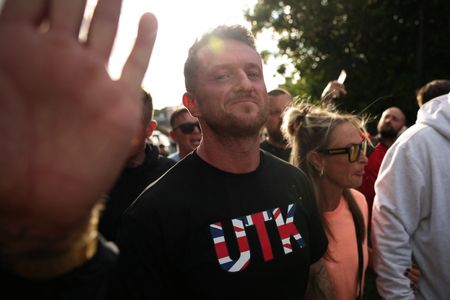
LONDON — British anti-Islam activist Tommy Robinson announced Saturday that he was stopped at Heathrow Airport and had his mobile phone taken by police, following a week in which he flooded social media with commentary about racist and anti-immigrant riots in Northern Ireland.
Robinson, who goes by the name Stephen Yaxley-Lennon in legal settings, posted on X that he was held Saturday evening for approximately three hours under the Counter-Terrorism and Border Security Act.
“My phone has been seized by the police,” he wrote on X. “Please help kick off my legal fund for defence.”
Throughout the previous week, Robinson had repeatedly posted about violence that erupted across Belfast after a video spread widely online showing a man being stabbed in a brutal attack that cost him an eye. A Sudanese man has since been charged with attempted murder. Authorities have stated the attack is not being investigated as an act of terrorism.
In the aftermath of that stabbing, rioters went on to target homes and businesses belonging to ethnic minorities and foreign residents — actions that the British minister responsible for the province described as racist thuggery.
Local elected officials have alleged that far-right figures operating online helped to organize or amplify the violence.
A police spokesperson, without identifying Robinson by name, confirmed that officers had stopped a man in his 40s at Heathrow Airport on Saturday following his arrival back in Britain from Russia, where he had traveled through Turkey.
“The man was interviewed by officers and his communication devices were seized. He was subsequently released,” the spokesperson said.
MOSCOW — A Ukrainian drone strike on a residential apartment building in the Russian city of Oryol left one person dead and nine more injured on Sunday, according to the region’s governor.
Oryol Regional Governor Andrei Klychkov released photographs showing the aftermath of the attack, with multiple floors of the high-rise building displaying blown-out windows and heavy fire damage. The city of Oryol, located south of Moscow, has a population of roughly 300,000 people.
Governor Klychkov stated that emergency services and law enforcement have the situation under control, and that cleanup operations are actively underway.
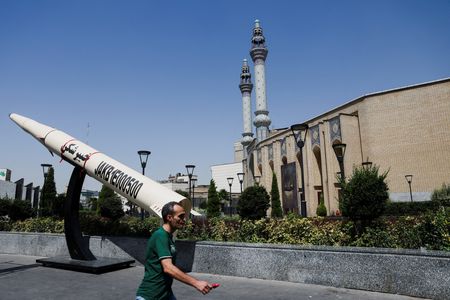
A senior Iranian official has revealed to Reuters the contents of a draft memorandum of understanding between Iran and the United States, touching on everything from nuclear restrictions to trade routes and financial relief measures. If agreed upon, the two countries would then have 60 days to hammer out a final deal.
The official outlined several key areas covered in the draft document:
Strait of Hormuz: Under the proposed terms, Iran would immediately reopen the Strait of Hormuz to all commercial shipping, while the United States would lift its naval blockade on Iranian ports. The blockade would begin to be lifted as soon as the memorandum is signed and would be fully removed within 30 days.
Financial Provisions: The draft calls for the U.S. to hold off on imposing any new sanctions against Iran until a permanent agreement is finalized. Once a final deal is reached, both U.S. and United Nations sanctions on Iran would be lifted on an agreed-upon schedule. The U.S. would also temporarily waive oil sanctions, giving Iran the ability to sell oil and collect revenue during that period. Additionally, Washington would release $25 billion in Iranian assets that have been frozen, through a combination of direct cash payments, cooperation with regional partners, and financial credit arrangements. The U.S. and its regional allies would also develop a reconstruction and development plan for Iran, to be negotiated with Tehran within 60 days.
Nuclear Terms: On the nuclear front, Iran would commit to neither building nor obtaining nuclear weapons. While a final agreement is being worked out, Iran would keep its nuclear program at its current level — meaning no additional uranium enrichment and no expansion of nuclear facilities. The U.S. would agree to permit Iran to dilute its stockpile of highly enriched uranium within its own borders, under the terms of a future comprehensive agreement. The full scope of Iran’s nuclear activities, enrichment operations, and how its enriched uranium stockpile would be handled would all be subject to negotiation within 60 days of the memorandum being signed.
Ukrainian drone attacks claimed one life and ignited a fire at an oil facility inside Russia on Sunday, as Kyiv continues its campaign of strikes targeting military and energy infrastructure deep within Russian territory.
The governor of Russia’s southwestern Oryol region, Andrei Klychkov, announced Sunday that one person was killed and nine others were injured after a Ukrainian drone struck a residential building overnight in the regional capital, which shares the same name as the region — Oryol.
Hundreds of miles away, local officials in Russia’s Yaroslavl region reported that fuel storage facilities burst into flames after being struck by a drone. The Yaroslavl region sits roughly 700 kilometers — about 440 miles — from the Ukrainian border.
Ukrainian President Volodymyr Zelenskyy confirmed his country’s forces were behind the Yaroslavl attack, stating they had “struck an oil facility that was important for the reserve of the aggressor state.”
Ukraine has intensified its targeting of Russian oil and gas infrastructure in recent months, with Kyiv arguing that Russia’s energy sector both finances and directly supports Moscow’s invasion, which has now stretched beyond four years.
In a related development, British Prime Minister Keir Starmer announced Sunday that the United Kingdom is investigating a sanctioned vessel believed to be part of Russia’s so-called “shadow fleet” — a network of ships allegedly used to ship oil in defiance of international sanctions imposed over the war in Ukraine.
British armed forces boarded and seized the ship, identified as the Smyrtos, on Sunday in the English Channel. The country’s Defense Ministry described the operation as “the first U.K.-led operation of its kind.” Russia is thought to be operating hundreds of such vessels to get around the sanctions.
“This operation delivers yet another blow to Russia and reminds those fueling Putin’s war in Ukraine that they cannot hide,” Starmer said.
ISLAMABAD (AP) — A potential agreement to end the war between the United States and Iran moved closer to reality Sunday, as Qatari mediators flew to Tehran to work out the final details of a deal, according to two regional officials who spoke anonymously because they lacked authorization to address the media publicly.
Those officials expressed measured hope that both nations were finally nearing an agreement that could stop a conflict responsible for thousands of deaths and reopen the Strait of Hormuz — a critical waterway whose blockage has sent shockwaves through global markets.
U.S. President Donald Trump and Pakistani Prime Minister Shehbaz Sharif both stated Saturday that a signing was expected to take place Sunday. Iran’s foreign ministry spokesperson Esmail Baghaei indicated it could occur within the next few days. Trump added that the Strait of Hormuz would be reopened immediately once the deal was signed.
The agreement is expected to be completed electronically rather than through a formal in-person ceremony, though the exact timing and process remain uncertain.
The deal does not resolve the most difficult disputes between Washington and Tehran — including Iran’s nuclear program and its frozen financial assets — but it would create a 60-day window for technical discussions on those topics. Pakistani and regional officials, also speaking anonymously, described months of difficult negotiations led by Pakistan, during which both sides came close to walking away on multiple occasions.
Under the terms currently being discussed, the U.S. and Israel appear to have fallen short of their original objectives, which included dismantling Iran’s missile and nuclear capabilities and cutting off its support for proxy forces. It remains unclear whether those issues will be addressed in the final agreement.
Separately, Trump was expected to raise the topic of clearing mines from the Strait of Hormuz at the Group of Seven summit beginning Monday. The waterway plays a vital role in global shipments of oil, natural gas, and products like fertilizer, and its effective closure has caused significant economic disruption worldwide.
The apparent progress toward a deal follows a tense week in which Iran exchanged fire with both the U.S. and Israel, raising fears that a fragile ceasefire — in place since April 7 — could collapse and drag the region back into full-scale conflict.
Iran’s nuclear program has been a long-standing source of tension with the U.S. and Israel, and a broader international concern. Trump posted on social media that once conditions stabilize, the U.S. would move to “downblend and destroy” Iran’s enriched uranium, either in Iran or on U.S. soil.
According to the International Atomic Energy Agency, Iran currently holds 440.9 kilograms — roughly 972 pounds — of uranium enriched to 60% purity, which is just one technical step below the 90% threshold considered weapons-grade. Iran has consistently maintained that its nuclear program is intended for peaceful purposes and has not publicly agreed to surrender its enriched uranium stockpile. That material is believed to be stored beneath three nuclear facilities that were heavily damaged in U.S. airstrikes last year.
Fighting has also continued in Lebanon, where Israel has pushed its military operations deeper into the country than at any point in more than 25 years, clashing with the Iranian-backed militant group Hezbollah despite an existing ceasefire. Iran has sought to have the Lebanon conflict included in any broader deal, and has also pushed for the release of billions of dollars in frozen funds.
The deal as currently structured has drawn strong criticism from Israel’s government, which has largely been left out of negotiations led by Pakistan and other parties. Even some members of Trump’s own Republican Party — facing pressure from an unpopular war heading into midterm elections — have spoken out against the agreement, with some arguing it does not represent an improvement over the 2015 Iran nuclear deal that Trump withdrew from during his first term and continues to call “bad.”
Israel’s military announced Sunday that Hezbollah fired three projectiles aimed at communities in northern Israel, characterizing the incident as a blatant violation of the existing ceasefire.
According to the military, the projectiles came down near the communities of Shomera and Shlomi. Officials noted that these three launches come on top of two additional projectiles that had already crossed into Israeli territory earlier in the weekend.
LONDON — British Prime Minister Keir Starmer announced Sunday that the United Kingdom is investigating a sanctioned oil tanker believed to be part of Russia’s so-called “shadow fleet” — a network of ships allegedly used to move Russian oil in defiance of international sanctions imposed over Moscow’s ongoing war against Ukraine.
British armed forces intercepted and took control of the vessel, identified as the Smyrtos, on Sunday in the English Channel. The country’s Defense Ministry described it as “the first UK-led operation of its kind.”
According to a Defense Ministry statement, the tanker will remain under watch off the southern coast of England while an investigation takes place. The mission was conducted “in close coordination” with French authorities, who have previously stopped several vessels suspected of ties to the shadow fleet.
Russia is believed to be operating a fleet of hundreds of ships to circumvent the international sanctions placed on the country in response to its war against Ukraine.
“This operation delivers yet another blow to Russia and reminds those fueling Putin’s war in Ukraine that they cannot hide,” Starmer said.
British officials added that operations like this one are “directly bearing down on the resources sustaining Russia’s aggression in Ukraine and reducing its capacity to threaten security across Europe and beyond.”
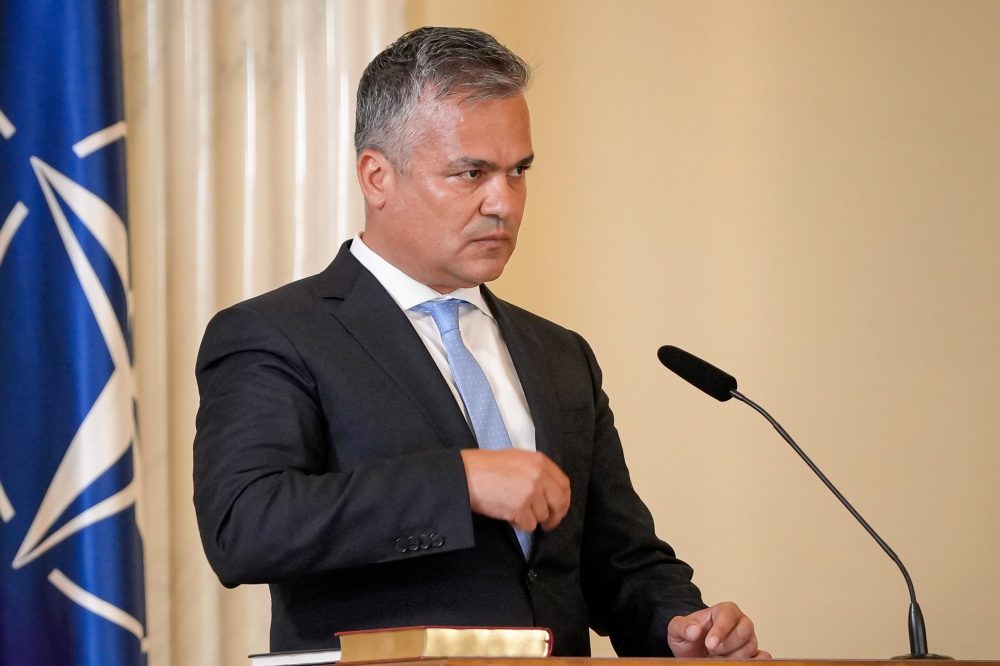
BUCHAREST, Romania — Romania’s president moved Sunday to break a growing political deadlock, naming a former mayor as his new candidate for prime minister after his earlier choice failed to build enough support to move forward.
President Nicusor Dan put forward Adrian Vestea, a 53-year-old career politician from central Brasov County and a longtime member of the National Liberal Party, to attempt to form a new government. Vestea marks Dan’s second prime ministerial pick this month. His previous nominee, Eugen Tomac, was unable to present a cabinet to Parliament within the required 10-day window.
Speaking at the presidential Cotroceni Palace in Bucharest, Dan announced the change directly. “Eugen Tomac withdrew his mandate this morning and … I nominate Adrian Vestea as prime minister,” he said. The nomination still requires approval from lawmakers before it can take effect.
Dan defended his choice by pointing to Vestea’s extensive background in public administration. He noted that Vestea had “gone through all the administrative stages” over the course of his career, having served as mayor of a small town and as county council president of Brasov, where he successfully brought in European funding.
“He was a successful mayor, he was a successful county council president, he was a successful minister,” Dan said. “He is a categorically pro-Western person … a person who has worked for a long time with budgets. So I am convinced that he will successfully fulfill this task.”
Vestea, who held the role of development minister from 2023 to 2024, addressed reporters at the palace and outlined his vision. He said he hopes to lead a “political government that will undertake real reforms and keep Romania on a pro-Western path.”
“We are the sixth largest country in Europe, and we need to put a major emphasis on development,” Vestea added. “Which I will do from day one.”
The back-to-back nominations this month follow a no-confidence vote in May that brought down Prime Minister Ilie Bolojan. With the next general election not set until 2028, the country faces an extended period of political uncertainty.
Romania is currently dealing with one of the highest budget deficits among European Union member nations, along with widespread inflation and a technical recession. When the governing coalition took power in June 2025, reducing the budget deficit was listed as a top priority. Bolojan had been sworn in with the goal of resolving what was described as one of Romania’s most severe political crises since the end of communist rule, but he remained in office for less than a year.
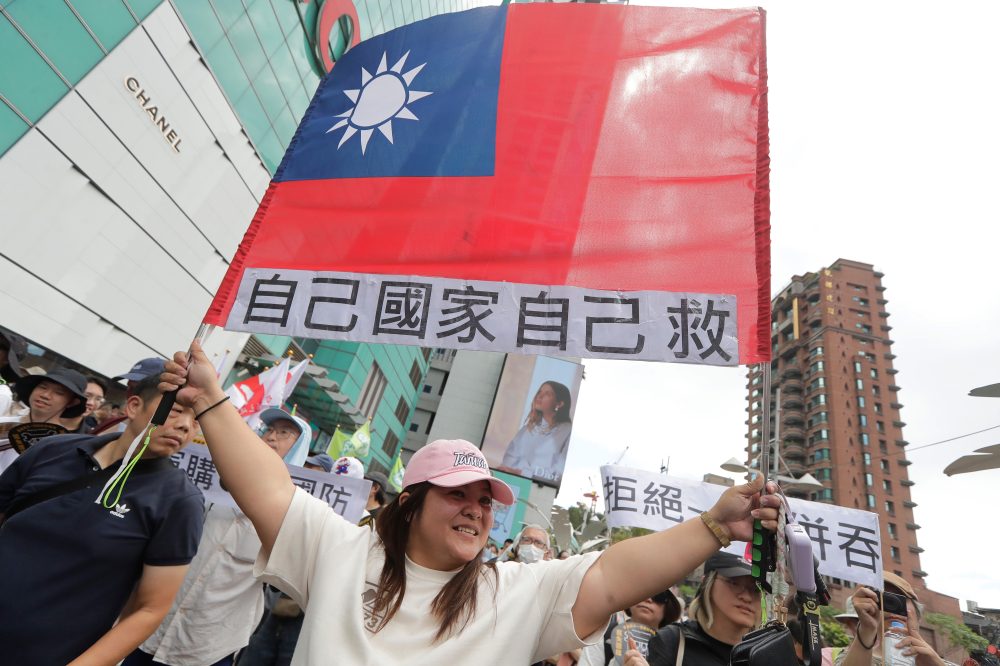
TAIPEI, Taiwan — Taiwan’s top intelligence agency announced Sunday that it is setting up a new online reporting channel designed to allow Chinese nationals to safely submit tips and sensitive information, as tensions between Beijing and the self-governed island continue to run high.
The National Security Bureau of Taiwan said the new webpage will serve as a protected avenue for Chinese citizens to pass along intelligence. Officials noted that a growing number of individuals have recently reached out to Taiwanese agencies expressing a desire to share various kinds of information.
In an official statement, the bureau pointed to conditions inside China as a driving factor. “In recent years, China’s economy has faced mounting difficulties, while political control has remained tight,” the statement read. “Coupled with a growing range of social and livelihood-related problems, these conditions have fueled public discontent.”
Taiwanese officials said the decision was inspired by approaches already in use by intelligence agencies in the United States, the United Kingdom, and Israel.
The move echoes a similar effort by the CIA, which last year released Mandarin-language videos on social media encouraging unhappy Chinese government officials to make contact and share information.
China has also made its own moves on this front, previously launching an online platform aimed at gathering reports of what it calls “Taiwan independence” activities, with the stated goal of holding what it describes as “separatists” accountable.
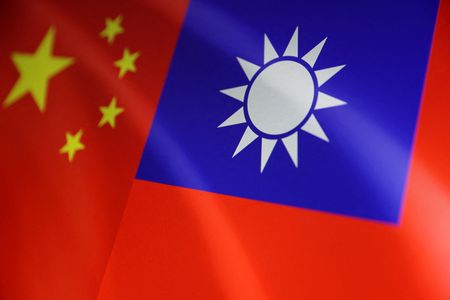
The roots of the conflict stretch back to 1949, when China and Taiwan were divided following a civil war. Beijing has long viewed Taiwan as part of its own territory and has insisted the island must eventually come under its authority — by force if necessary.
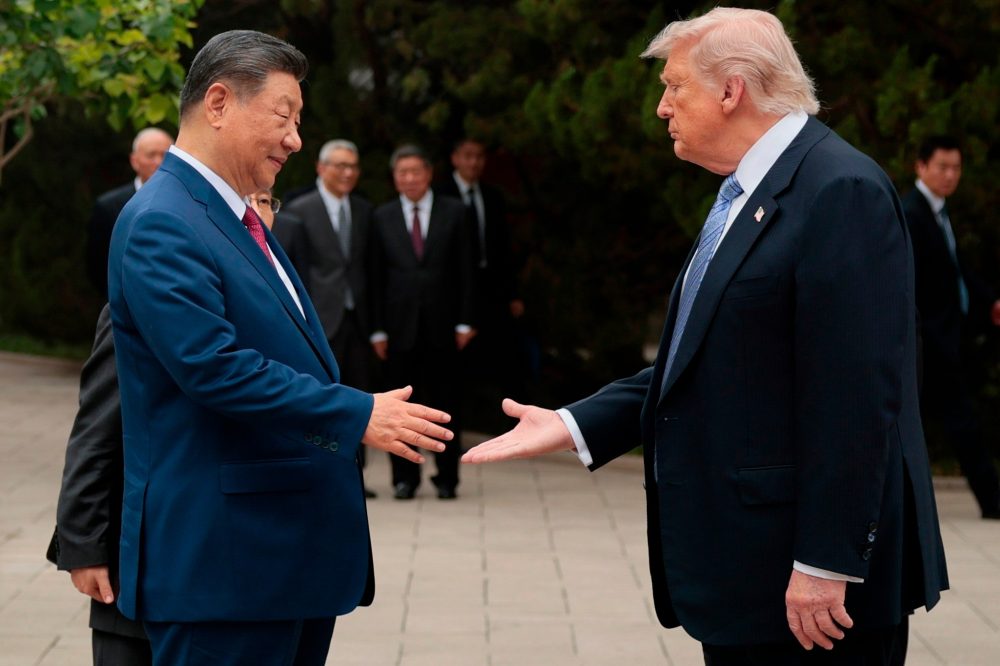
The latest developments come after U.S. President Donald Trump traveled to Beijing in mid-May for a summit with Chinese leader Xi Jinping. During that meeting, Xi warned Trump that the two nations could come into conflict over Taiwan if the matter was not carefully managed.
Military tensions have also been visible in recent days. China has conducted large-scale military drills near Taiwan, while on Wednesday, Taiwan’s armed forces fired rockets toward China from mobile launch vehicles in a show of force intended to demonstrate how the island might defend itself against an attack.
NEW DELHI — An Indian citizen died from medical complications while aboard the tanker MT Celestial, which was docked at Duqm Port in Oman, according to a statement released late Saturday by the Indian embassy in Muscat.
The embassy announced on social media that steps are being taken to return the sailor’s remains to India as quickly as possible. “Necessary arrangements are being made for the early repatriation of the mortal remains to India,” the embassy wrote.
India has a massive maritime workforce, with more than 300,000 seafarers serving on ships around the world, according to government figures. A shipping ministry official noted last week that more than 18,000 of those sailors are currently working in the Middle East.
The incident comes just days after three Indian seafarers lost their lives in a U.S. military strike on a tanker off the coast of Oman — a strike that occurred more than three months into the U.S.-Israeli war on Iran. That event drew sharp criticism from the Indian public and opposition political parties.
Opposition leaders have called on Prime Minister Narendra Modi to bring up the matter directly with U.S. President Donald Trump when the two are expected to meet on the sidelines of the Group of Seven summit later this week.
On Friday, India took the unusual step of filing a second formal protest with the United States over the strike. India’s foreign ministry said it summoned the U.S. chargé d’affaires to express “its deep concern over the use of lethal and deadly force against civilian shipping.”
The sailor who died aboard the MT Celestial has been identified as 35-year-old Nishanth Uirthanathan. He passed away on June 11, and according to the Forward Seamen’s Union of India, his body remained on the vessel for more than two days without proper refrigeration.
The union shared a video on social media that it said was taken aboard the tanker, describing a desperate situation. “Crew is using cold water bottles in a desperate attempt to slow decomposition — a horrifying and health-risking situation,” the union wrote.
WARSAW — Romania’s centrist president, Nicusor Dan, announced Sunday that he is nominating Adrian Vestea, a member of the liberal party, to serve as the country’s next prime minister. The announcement came after independent candidate Eugen Tomac stepped down from consideration earlier that morning.
Vestea, who is 52 years old, currently serves as the county council president of Brasov, a county in central Romania. Tomac had been attempting to form a government made up of technocrats — non-partisan policy experts — but was unable to secure enough backing from Romania’s parliamentary parties.
President Dan addressed the change directly on Sunday, stating, “Eugen Tomac withdrew his mandate this morning and as such I nominate Adrian Vestea as prime minister.” He added, “At the moment it is clear that a political (government) solution is the right one.”
Parties represented in Romania’s parliament had previously argued that a minority political government — one without a guaranteed majority — would be a preferable outcome compared to a technocrat-led administration.
The nomination is part of President Dan’s broader push to bring an end to a political standstill that has slowed government decision-making, put European Union funding at risk, and pushed Romania’s currency, the leu, to record low values. Once nominated, Vestea has a 10-day window to put together a cabinet and secure a parliamentary vote of confidence.
Romania’s next scheduled parliamentary election is not set to take place until 2028. The country has never held an early election, and political analysts suggest the chances of one occurring now are slim, particularly given that far-right opposition parties are currently leading in public opinion polls by a wide margin over pro-European political groups.
Four major banks in Iran had their services disrupted Sunday following a cyberattack, though officials say no customer information was put at risk, according to reports from state media.
Iran’s banking coordination council confirmed the attack hit a shared communications network connecting Bank Melli, Bank Tejarat, Bank Saderat, and the Export Development Bank of Iran. In response, technical teams moved quickly to put protective measures in place, which temporarily affected some banking services.
The council stressed that no customer data had been accessed without authorization and that nothing had been deleted. Officials added that recovery efforts are currently underway to bring services back to normal.
GENEVA — Swiss citizens cast their votes Sunday on a controversial measure that would place a hard ceiling on the country’s population at 10 million people, an effort led by the nation’s dominant right-wing political party.
The Swiss People’s Party, which holds more seats in parliament than any other party, has spent years stoking concerns about immigration — particularly the steady flow of workers arriving from neighboring European Union countries. The party is behind what it calls the “sustainability initiative,” arguing that population growth has put serious strain on Switzerland’s housing, infrastructure, social services, natural resources, and overall quality of life.
But opponents of the measure say it would do more harm than good. They argue that the wave of immigration over the past several decades has been a net positive, supplying skilled workers to key industries including healthcare, finance, pharmaceuticals, and technology. There are also concerns that passing the measure could damage Switzerland’s relationship with the EU, which is the country’s largest trading partner.
Switzerland’s federal government and parliament both stand in opposition to the initiative.
If voters approve the measure, the Swiss government would be required to take steps to keep the population below 10 million by the year 2050. Should the population hit 9.5 million before that deadline, the government would be compelled to tighten rules around asylum seekers, family reunification, and residency permits. It could also be forced to abandon Switzerland’s agreement with the EU allowing people to freely live and work across their shared borders.
A recent survey from polling agency gfs.bern indicated the vote was shaping up to be a tight race.
Switzerland operates under a direct democracy system that allows citizens to weigh in on policy decisions through referendums, which are typically held four times each year. The majority of votes are submitted by mail, with in-person polling closing at noon local time on Sunday.
According to data from the Organization for Economic Cooperation and Development, 32% of Switzerland’s population was foreign-born as of 2024 — a share exceeded only by Luxembourg and Australia among the group’s 38 member nations.
Since Switzerland and the EU opened their borders to one another’s citizens in 2002, Switzerland’s population has climbed 23%, reaching 9.1 million by the close of last year. Over that same stretch, the country’s economic output grew by 24%, according to government figures.
Immigration has been a recurring flashpoint across Europe, where countries face the dual pressures of aging populations and rising anti-foreigner sentiment. In Switzerland’s case, however, most of the foreign-born residents are fellow Europeans — a distinction from other parts of the continent where concerns tend to focus on migrants from developing nations.
Swiss voters have confronted immigration-related questions at the ballot box many times over the past 50 years. Only one such vote has succeeded — a 2014 referendum titled “Against mass immigration” — which squeaked through after campaigners raised alarms about overpopulation and a growing Muslim presence in the country.
Experts in Switzerland note that while many countries place limits on who can immigrate, no nation has ever gone so far as to vote on capping its total population size.
British armed forces stopped a Russian shadow fleet oil tanker from passing through the English Channel on Sunday, June 14, in an operation personally ordered by the country’s prime minister.
The tanker, identified as the SMYRTOS, was boarded by Royal Marine Commandos working alongside specially trained law enforcement officers from the National Crime Agency, according to a statement released by Britain’s Ministry of Defence.
The vessel is being held and monitored off the southern coast of Britain while an investigation moves forward. Officials noted that the enforcement action took place within British territorial waters and was carried out in full compliance with both domestic and international law.
British Prime Minister Keir Starmer confirmed that he gave the order for the interception to take place.
“This successful operation delivers yet another blow to Russia and reminds those fueling Putin’s war in Ukraine that we will not let them hide,” Starmer wrote in a post on X.
GENEVA — Wooden panels now cover the windows and doors of countless shops and businesses in downtown Geneva, as owners brace for large-scale anti-G7 demonstrations planned for Sunday.
Both French and Swiss authorities have put sweeping security measures in place ahead of a G7 summit of leading industrialized nations that kicks off Monday. U.S. President Donald Trump and other world leaders are expected to attend, and officials fear the high-profile gathering could spark violent unrest.
The summit, scheduled for June 15 through 17, is being held in the French town of Evian-les-Bains along the shores of Lake Geneva. Discussions are expected to center on the Middle East, the war in Ukraine, and global economic imbalances. A range of activist groups — including environmentalists, feminists, and opponents of capitalism — have called for a large rally Sunday.
On Saturday, roughly 20 boats sailed across Lake Geneva near Evian, flying anti-G7 and pro-Palestinian banners. According to Swiss media, about 20 protesters were taken into custody Friday evening. Earlier, between 100 and 150 people took part in a protest bicycle ride through Geneva, slowing traffic while chanting anti-G7 and pro-Palestinian slogans, according to public broadcaster RTS.
Much of the anxiety stems from memories of the G8 summit in 2003, when Geneva saw widespread property destruction as protests turned violent. Local resident Robin Hedz described the current scene as a “mess” and said he was puzzled by the “wood-wall everywhere,” though he acknowledged the city’s painful history with summit-related unrest.
The Swiss government announced that approximately 4,000 military personnel will be deployed to assist police throughout the summit. Security operations will include restrictions on airspace and roadways, as well as patrols on Lake Geneva. Of 35 border road crossings, only seven will remain open. The city is also shutting down a major park that activists had intended to use as a gathering spot.
Across the border in France, more than 13,000 police and gendarmerie officers will be on duty in the summit zone. French border control staffing is surging from roughly 60 officers under normal conditions to more than 800. French gendarmes were already visible Saturday, patrolling by motorboat off the Evian coastline, with one officer seen carrying a large drone-interception device.
Protests at high-profile international summits are not unusual, but this time demonstrators say they have a long list of grievances. Activists are voicing frustration over Trump’s positions on tariffs, the war in Iran, and climate change, and some want to draw attention to his past connections to convicted sex offender Jeffrey Epstein.
Francoise Nyffeler, a spokesperson for the NoG7 coalition organizing Sunday’s march, explained the motivation behind the protest. “We are very afraid of the policy and the politics of Mr. Trump and also of the other leaders of the G7, because they are fighting, making war all over the place,” she said.
“The planet is in danger and we are very scared about it and we want to protest and say that the people of the world are against their policies,” Nyffeler added.
MELBOURNE, Australia — A shark attack off a popular Sydney beach has prompted authorities in New South Wales to push for a review of drone flight restrictions, after a woman was left critically injured on Saturday morning.
Emergency crews responded to Coogee Beach in eastern Sydney after reports that a 35-year-old woman had been bitten by a large shark roughly 30 metres — about 100 feet — from the shoreline.
As of Sunday, the woman remained in critical but stable condition at St Vincent’s Hospital, according to a spokesperson who spoke with Reuters. She suffered serious injuries to her lower left leg and both arms.
Coogee Beach and several other beaches in the city’s Randwick Council area were shut down for 24 hours in the wake of the attack. Drones were deployed under emergency provisions to scan the waters for sharks during that time.
New South Wales Agriculture Minister Tara Moriarty addressed the growing concern over shark activity in the region. “It’s been a really tough summer of shark activity and shark attacks in Sydney and it’s something that the NSW government is taking really, really seriously,” she said.
Moriarty added that the government would explore new measures to protect swimmers, including expanded use of drones and other surveillance technology.
While Australian lifesavers routinely use drones to watch for sharks, Coogee Beach has long faced restrictions on commercial drone flights because it falls beneath the flight path of Sydney Kingsford Smith Airport. Following Saturday’s attack, a spokesman for the Civil Aviation Safety Authority released a statement indicating the agency would look into modifying the existing rules.
A paddleboard champion and off-duty lifeguard, 25-year-old Charlie Verco, was credited with rescuing the woman and bringing her safely to shore. Speaking to the Australian Broadcasting Corporation, Verco described the terrifying moment he spotted a three-to-four-metre shark near a group of swimmers.
“I just looked at the beach, tried to signal to the lifeguards, a big code X, to get them to understand how it was going on out there, clear the water if they could, and get the power craft out there,” Verco recalled.
He went on to describe the most harrowing part of the rescue: “She ended up getting taken underwater for a second. I couldn’t see where she was because it was all red. And luckily, she popped up and shark had let her go and I was able to get close enough to bring her into shore.”
Once on the beach, the woman was met by lifeguards, police, and medical personnel before being transported by ambulance to the hospital.
Saturday’s attack is part of a broader pattern of shark incidents across Australia this year. According to the Australian Institute of Health and Welfare, the country’s east and southeast coastline averages around 20 shark attacks annually, with that stretch of shoreline accounting for the majority of such incidents.
TAIPEI — Taiwan’s government took an unusual step Sunday, unveiling a new website designed to give Chinese citizens a secure way to pass along intelligence information — saying a growing number of people inside China are fed up and looking for change.
The two governments have a long history of spying on one another. China considers Taiwan its own territory, despite the island operating as a self-governed democracy. Taiwan has reported a rising number of Chinese espionage cases in recent years.
In explaining the new platform, Taiwan’s National Security Bureau pointed to worsening economic conditions on the mainland and what it described as continued tight political control. “Coupled with a growing range of social and livelihood-related problems, these conditions have fuelled public discontent,” the bureau said in a statement posted in both Chinese and English. “As a result, an increasing number of individuals have approached relevant agencies in Taiwan, wishing to provide various types of information.”
China’s Taiwan Affairs Office had not responded to a request for comment as of the time of this report.
When visitors open the website, they are greeted by a one-minute promotional video that the bureau said was created using artificial intelligence. The video depicts a Chinese civil servant watching as colleagues are investigated and removed from their positions one after another.
“Ah, yet another person has been taken away,” the unnamed civil servant says in the video, speaking in a northern Chinese accent. The dialogue appears with subtitles written in the simplified Chinese characters used in mainland China.
“The old comrades are inexplicably vanishing one by one,” a narrator adds.
The video concludes with the official purchasing a mobile phone and typing on it, accompanied by the words: “Now is the time to change.”
While the website is blocked within China, many Chinese citizens regularly use VPNs — tools that allow access to otherwise restricted sites such as Western social media platforms and search engines.
The bureau called on Chinese nationals both inside the country and living abroad to “actively provide information and make changes with courage.” Officials noted the approach mirrors tactics already used by intelligence agencies in countries including the United States, Britain, and Israel.
The platform is intended to allow Chinese nationals to share intelligence-related information in order to “expand the bureau’s diverse intelligence sources,” according to the bureau’s statement.
China has employed similar strategies in the past. In 2024, Beijing announced an email address where individuals could submit tips about alleged crimes committed by Taiwan “separatists.”
Taiwan’s government continues to reject China’s claims of sovereignty over the island, maintaining that only the Taiwanese people have the right to determine their own future.
Armed kidnappers in Haiti have seized one of the country’s top government and law enforcement figures in Port-au-Prince, in what is being described as the most high-profile abduction the nation has seen in years, according to media reports released Saturday.
James Boyard — who holds the dual roles of cabinet director at the Defense Ministry and inspector general of Haiti’s national police — was taken by force on Thursday from the Bourdon neighborhood of the capital. The Associated Press reported the details, citing a source with knowledge of the situation.
Boyard is considered one of Haiti’s foremost experts on security matters. His kidnapping represents a serious escalation in the targeting of high-ranking officials at a time when gang organizations have been steadily tightening their control over Port-au-Prince.
Abductions in Haiti have been on the rise as criminal networks continue to expand their reach, further eroding the government’s authority and deepening an already severe humanitarian and security crisis gripping the country.
As of Saturday, no official statement has been made by authorities regarding any efforts to secure Boyard’s release.
PARIS (AP) — When major economic powers first convened at a French chateau in 1975 to tackle a struggling global economy, China was never part of the conversation. That gathering — the first of what would become the annual G7 summit — brought together wealthy democratic nations to look out for their shared interests, and China simply didn’t fit the mold.
It wasn’t hard to understand why. The idea of Chinese revolutionary leader Mao Zedong sitting down with U.S. President Gerald Ford and other heads of state would have been absurd at the time.
China was in the middle of internal chaos and was nowhere near the economic powerhouse it has since become. Mao had also backed Ho Chi Minh’s communist forces — the same forces that defeated both France and the United States in Vietnam. That made him a highly unlikely guest at the inaugural Rambouillet summit, which started as a six-nation group before Canada joined the following year to form the G7.
Fast forward to today, and U.S. President Donald Trump is joining fellow G7 leaders in France for a Monday-through-Wednesday gathering — yet China’s continued absence from the club raises new questions, given how deeply Beijing now shapes the global economy.
The bottom line: Does the G7 still make sense without China at the table?
On raw economic terms alone, China has long since earned a spot. Since Mao’s death in 1976, decades of explosive growth have made China’s economy larger than those of Germany, Japan, the United Kingdom, France, Italy, and Canada combined — with only the United States still ahead. Leaving China out, by this measure, is a bit like holding the soccer World Cup without Brazil, a five-time champion.
John Kirton, a G7 specialist at the University of Toronto, put it bluntly: From being “only a tiny, benign, panda bear” in 1975, “China has become a great global dragon.”
“So many understandably ask: Would the G7 and the global community be better off if China became a member of the G7 club? A plausible answer is ‘Yes,’” Kirton added.
Even Trump floated the idea a year ago, saying it “was not a bad idea” when a reporter raised the possibility of expanding the club to include China.
But there’s a longstanding, if unwritten, rule at the heart of the G7: membership is for democracies only.
The founding leaders made that clear in their 1975 Rambouillet declaration: “We are each responsible for the government of an open, democratic society, dedicated to individual liberty and social advancement.”
China fell far short of that standard under Mao, whose rule led to the deaths of tens of millions through famine and revolutionary violence. And under current leader President Xi Jinping, China still doesn’t clear the bar. Multiple global measures — including the annual Freedom in the World study, the World Press Freedom Index, and the Canadian Fraser Institute’s economic freedom rankings — place China well behind G7 nations when it comes to civil liberties.
Still, China’s influence is impossible to ignore. The country announced a record trade surplus of nearly $1.2 trillion in 2025, selling far more to the world than it buys. It holds tight control over vital rare minerals. Its military expansion and technological progress are rattling rivals. And it remains the single largest source of climate-warming pollution on Earth.
All of that makes China the proverbial elephant in the room at this week’s summit in the Alpine spa town of Evian-les-Bains.
French President Emmanuel Macron, serving as this year’s host, has set aside dedicated time for leaders to discuss how to rebalance trade with China, as a flood of Chinese-made cars and other goods threatens to undercut G7 industries.
Relations between Trump and his G7 counterparts have been strained lately — over the conflict with Iran and other points of disagreement — but China may actually be a rare area of common ground. Cédric Dupont, an international politics expert at the Geneva Graduate Institute, noted: “They agree on the same thing, you know: China is a problem.”
China’s government has previously criticized the G7 as an exclusive club that belongs to a Cold War era of ideological division. But in a statement to The Associated Press ahead of the Evian summit, China’s Foreign Ministry softened its tone somewhat, saying “the G7 should serve as a catalyst for solidarity and cooperation rather than an amplifier of division and confrontation.”
Beijing-based analyst Wang Zichen explained that “Beijing is wary of the G7 because it sees the group as structurally aligned with U.S.-led Western power, and increasingly as a venue where China is discussed as a challenge or threat.”
Even so, Chinese leaders pay close attention to what happens at these summits. As Wang put it: “China recognizes that the G7 still represents a very significant concentration of economic, technological, military and financial power.”
Experts warn that actually bringing China into the club could fracture it from within. Beijing’s authoritarian government, its positions on Russia and Iran, and its broader strategic interests clash fundamentally with those of the G7’s democratic members. Having China at the table could also strain long-standing alliances.
Kirton called the prospect a potential “Trojan horse.” With a Chinese leader present, he said, “individual members might be tempted to break G7 ranks to secure special favors from him on the economic, critical minerals, digital technology and other issues they address.”
Chris Alden, an international relations scholar at the London School of Economics and Political Science, agreed, saying that admitting China “would make it very difficult for it to function.”
The G7’s last membership expansion offers a cautionary tale. Russia was welcomed into the group in 1998, but the experiment soured. When Russian President Vladimir Putin seized Crimea from Ukraine in 2014, the other members froze Russia out — a rupture that foreshadowed the full-scale war that has been raging since 2022.
Trump said last year that kicking Russia out “was a very big mistake.” But Kirton argued the episode taught other leaders a hard lesson — that they should “never take a chance on a less than fully democratic power becoming a full member of their fully democratic club again.”
Washington and Tehran are inching toward a framework peace agreement, though exactly when a deal might be formally signed remains an open question — even as fighting continues on multiple fronts.
President Donald Trump took to social media Saturday to announce that a deal with Iran was set to be signed the following day — which also happens to be his 80th birthday. Pakistani Prime Minister Shehbaz Sharif echoed that optimism, saying both sides had agreed on the framework and that Pakistan was preparing for an electronic signing on Sunday, to be followed by technical discussions in the days ahead.
Iran, however, did not confirm that timetable. Iranian Foreign Ministry spokesperson Esmaeil Baghaei, speaking before Trump’s post went up, urged caution about predicting a signing date. State media quoted him as saying, “It will not be tomorrow,” though he added it could happen “in the coming days.”
On the social media platform Truth Social, Trump wrote that once a framework deal is signed, the Strait of Hormuz — a critical passageway for global oil supplies that Iran has blocked — would immediately be “open to all.”
A U.S. official spelled out the terms to reporters: “Iran is going to open up the Strait of Hormuz, that’s a requirement. It could be open with no tolls. As they do that, we will lift our blockade.” The official added, “It’s going to happen in conjunction, and part of the next step, the phase after that, is going to be the demining of the straits,” suggesting nations in the Group of Seven major powers could play a role in that process.
Multiple sources familiar with the draft terms told Reuters the U.S. would begin releasing billions of dollars in frozen Iranian assets and lift sanctions on Iran’s oil exports in exchange for Iran reopening the strait. Baghaei, quoted by Iran’s Fars news agency, confirmed that recovering those frozen assets was a core part of the deal and that Iran would charge fees for use of the strait. He also said foreign military bases in the region would need to be shut down, though no further details were provided.
Iran’s nuclear program — which Trump has cited as a primary justification for the war — would not be addressed in the initial agreement. Instead, a 60-day period of follow-on talks would cover that issue. A U.S. official said the end goal would be the complete dismantling of Iran’s nuclear program, with its stockpile of highly enriched uranium destroyed and removed.
The war between the U.S. and Iran began on February 28, when the U.S. and Israel launched military operations against Tehran. Trump at that time called on the Iranian people to rise up and seize control of state institutions. U.S. strikes have severely weakened Iran’s military-industrial capacity, though analysts note that hardline Revolutionary Guard elements have actually grown more entrenched as a result of the conflict.
Opposition to any deal was visible inside Iran on Saturday. Videos circulating on social media and Iranian news websites showed crowds gathering in public squares and outside the Foreign Ministry in Tehran, directing their anger at Iranian Foreign Minister Abbas Araqchi. Protesters were heard chanting, “Araqchi have some shame, let go of America!” Reuters was unable to immediately confirm the authenticity of those videos.
At pro-government rallies held across Iran on Saturday night, hardliners also made their opposition known. A resident in the northeastern city of Mashhad told Reuters that some in the crowd chanted: “Death to the compromiser” — an apparent dig at Araqchi — followed by “Compromiser, resign, resign.”
Despite the diplomatic activity, military clashes have not stopped. Early Saturday, U.S. forces shot down multiple Iranian one-way attack drones that were headed toward the strait. Israel, which has stated it is not a party to the U.S.-Iran deal, reported striking more than 70 locations in Lebanon over a 24-hour period, targeting Iranian ally Hezbollah. Israeli Prime Minister Benjamin Netanyahu has been at odds with Trump over U.S. pressure on Israel to scale back operations in Lebanon so Washington can finalize a deal with Tehran.
On Friday, Araqchi said that while the agreement’s details could still change, the tentative deal demonstrated that Iran had come out of the conflict in a stronger position. Trump also spoke by phone with British Prime Minister Keir Starmer about efforts to bring the Iran conflict to a close, according to a statement from Downing Street.
Before the war, the Strait of Hormuz served as the route for roughly 20% of the world’s oil shipments.
TOKYO — Japan is preparing to dispatch a delegation to Greenland sometime this summer to assess the potential for rare earth mineral extraction on the Arctic island, according to a report from the Nikkei newswire published Sunday.
The delegation is expected to include officials from Japan’s Ministry of Economy, Trade and Industry, representatives from trading companies, and members of the Japan Organization for Metals and Energy Security. While there, the group plans to meet with local government officials, Nikkei reported.
Greenland, which is an autonomous territory within the Danish kingdom, has attracted significant international attention in recent months. Earlier this year, in January, the White House indicated that U.S. President Donald Trump was exploring ways to acquire the island — a statement that triggered concern among NATO allies across Europe. Those discussions have since shifted onto a diplomatic track.
The island is considered strategically valuable both for its geographic position in the Arctic and for the potentially abundant rare earth reserves believed to lie beneath its surface.
Citizens of Switzerland cast ballots Sunday on a controversial constitutional amendment that would establish a legal ceiling on the nation’s population, in a referendum being compared to Britain’s Brexit decision due to its potential economic and diplomatic ramifications.
The Swiss People’s Party, a right-wing political organization, has championed the constitutional modification that would require the population to stay below 10 million residents by 2050. Government forecasts indicate the country is expected to reach that threshold in the early 2040s, driven by worries over immigration levels, strain on government services, and housing availability.
This novel approach to legally controlling population numbers reflects a broader European trend among conservative political movements seeking stricter immigration policies, fueled by public frustration over living costs, sluggish economic performance, and criminal activity.
“If it goes above 10 million, it will become tight, and immigration should be restricted,” said Helen Gulea, a 58-year-old seamstress and part-time kiosk worker in Zurich, originally from Kenya, who voted by post for the cap.
Vote tallies were anticipated to start arriving around midday local time (1000 GMT).
Approval of this initiative would mean that hitting the 10 million population threshold could force Switzerland to abandon its labor mobility pact with the European Union, which provides a significant portion of workers for the mountainous nation.
With an aging population already surpassing 9 million, polling data indicates public sentiment remains closely divided on the issue.
Recent survey results showed momentum shifting away from the proposal, though an earlier poll had indicated it might succeed.
Patrick Leisibach, a migration expert at think-tank Avenir Suisse, said concern was now widespread that overcrowding was stretching public infrastructure to the limit.
“There’s a traditional anti-immigration vote on the right wing, but these days even many on the left are feeling the pressure,” he said.
Switzerland’s direct democracy framework typically involves citizens voting on national ballot measures four times annually, with passage requiring majority support from both voters and the country’s cantons.
Government officials and parliamentary leaders have encouraged voters to defeat the SVP’s “sustainability initiative,” calling it misguided during a sensitive period for Switzerland’s export-dependent economy.
In the previous year, President Donald Trump imposed Europe’s steepest U.S. tariffs on Swiss products, and the possibility of population restrictions could complicate business planning.
However, SVP lawmaker Thomas Matter argued Swiss gains in prosperity had not kept pace with overall immigration and the country needed to step on the brakes.
Shortly before Trump’s return to office, Switzerland finalized an agreement with Brussels to strengthen economic ties with the EU.
This arrangement, along with other bilateral trade agreements, could face uncertainty if a population cap threatens labor mobility, which serves as a cornerstone of the EU single market.
While Swiss voters have historically rejected measures considered damaging to long-term economic interests, this pattern has become less reliable.
In 2014, voters surprised observers by narrowly approving an SVP-supported initiative to limit EU immigration, though its effects were subsequently weakened during the lawmaking process.
If the current measure passes, certain provisions, including the potential for Switzerland to end labor mobility with the EU, might face separate referendums, according to officials speaking privately.
Some SVP members indicate the proposal aims not to eliminate labor mobility but to sound an alarm.
“I don’t want freedom of movement ended,” said Heinz Taennler, an SVP politician and finance director of the canton of Zug. “Another million people can still immigrate to Switzerland, but the government needs to take action.”
Pakistan and President Donald Trump have both verified that an electronic ceremony to sign a US-Iran agreement will take place on Sunday, though Iranian officials are casting doubt on the proposed schedule while Israeli leaders voice security concerns.
Pakistan’s Ministry of Foreign Affairs announced Saturday evening that Deputy Prime Minister and Foreign Minister Senator Mohammad Ishaq Dar spoke by phone with Saudi Foreign Minister Prince Faisal bin Farhan about the matter.
The ministry’s statement said both officials welcomed the final stages of US-Iran negotiations, with the electronic signing ceremony set for Sunday, and shared hopes that this significant development would help bring lasting peace and stability to the region.
The Saudi Foreign Minister praised Pakistan’s consistent and ongoing efforts supporting mediation and dialogue during the process. The two sides also talked about the upcoming Regional Four (R-4) Foreign Ministers’ meeting planned for Egypt later this month.
Pakistani Prime Minister Shehbaz Sharif previously stated that the United States and Iran are nearer to a peace agreement than they have ever been, with the deal’s completion anticipated within the next 24 hours.
In a Saturday evening post on X, he said Pakistan was getting ready for the electronic signing of the agreement right after its completion, with technical-level discussions to follow next week.
The Prime Minister expressed gratitude to the United States and the Islamic Republic of Iran for their ongoing commitment throughout the negotiations and thanked regional partners for their support.
Shehbaz Sharif said he felt confident that the “historic peace deal” would create a solid foundation for enduring peace.
The Prime Minister included tags for US President Donald Trump, Vice President JD Vance, Secretary of State Marco Rubio, Special Envoy Steve Witkoff, Iranian President Masoud Pezeshkian, and Iranian Foreign Minister Abbas Araghchi in his message.
US President Donald Trump then shared his X post on his Truth Social platform.
President Donald Trump verified that an agreement with Iran is set to be signed on Sunday and stated the Strait of Hormuz would reopen right after.
In a Truth Social message, President Trump wrote: “The Deal is scheduled to get signed tomorrow, and immediately after it is signed, the Hormuz Strait is OPEN TO ALL.”
The president said Iran would not be allowed to acquire a nuclear weapon and claimed the regime is no longer seeking one. He also discussed Iran’s enriched uranium supplies, suggesting they would not be removed right away.
“At the appropriate time, when all is calm, we will go in and get the Nuclear Dust, buried deep under the powerful sunken granite mountains,” President Trump wrote.
CNN reported that Iran had reinforced areas around enriched uranium supplies with explosives to stop the material from being taken.
President Trump added: “We look forward to working with Iran, and the entire Middle East, long into the future. Hopefully, this process will all work out quickly, easily, and smoothly. If it doesn’t, we have the ultimate alternative, hopefully never to be used again!”
The president’s statements differed from comments by Iranian Foreign Ministry spokesman Esmail Baghaei, who indicated that no signing was anticipated Sunday.
“We will have to wait and see about the exact date of the signing of the memorandum of understanding, although it will not be tomorrow,” Baghaei said.
The reported framework includes a suggested 60-day ceasefire on several fronts, including the conflict between Israel and Hezbollah in Lebanon, the reopening of the Strait of Hormuz, the end of the US naval blockade on Iranian ports, talks on sanctions relief and the potential release of frozen Iranian assets depending on Iranian compliance. Additional negotiations would address Iran’s nuclear program and enriched uranium supplies.
Senior Israeli officials quoted by Channel 12 said the agreement seems to accept Tehran’s “main conditions” and could “endanger Israel’s security interests.”
According to the officials, Iran would gain substantial benefits before addressing core concerns. “The Iranians are not agreeing to this for nothing,” one official said.
The officials maintained that Tehran is essentially “paying on credit” and questioned what leverage Washington would keep if Iran fails to fulfill future commitments. They also criticized the reported handling of Iran’s nuclear and missile programs.
“The uranium extraction has become uranium dilution and the missile system is not part of the agreement at all,” the officials said.
They further maintained that the framework does not require Iran to stop support for proxy organizations. “All the goals that Israel set are not immediately dealt with in the agreement,” the officials said, adding, “Not only is Iran not required to stop supporting proxies, it is reconnecting itself with Hezbollah through the agreement.”
Channel 12 reported that President Trump talked about the agreement with Prime Minister Benjamin Netanyahu during a Thursday phone call. According to an American official, President Trump told Netanyahu: “This is the deal. It’s an excellent deal, and it’s to end this war.” The US official added: “Bibi didn’t say much in the call. Evidently, he understood that there’s going to be a deal, and that he can’t stop it.”
On Friday, Sharif said that the final text of a peace agreement between Iran and the United States had been settled during Pakistan’s intensive mediation efforts.
In a statement, he said that a coordinated disinformation campaign was currently happening to undermine the agreement. However, he added that Pakistan was moving forward, completely unaffected by the surrounding noise.
According to the Prime Minister, the final and mutually agreed text of the agreement has been completed, and Pakistan is working in close coordination with both parties to shape the next phases of the process.
According to a separate statement from the Ministry of Foreign Affairs, Dar spoke by telephone with Swiss Foreign Minister Ignazio Cassis on Saturday.
Both leaders welcomed progress toward understanding between the United States and Iran, expressing hope that ongoing diplomatic efforts would help promote peace and stability in the region. They also agreed to keep continued mutual contact.
Switzerland had previously offered to host the signing ceremony of the memorandum of understanding between the United States and Iran.
North Korea declared Sunday that nuclear disarmament has been permanently abandoned, while criticizing recent nuclear deterrence discussions between the United States and South Korea.
“The U.S. and its vassal forces’ meaningless rhetoric against the DPRK and cooperation in posing a nuclear threat to it can never affect the irreversible position of the DPRK as a nuclear weapons state,” a spokesperson for North Korea’s foreign ministry said in a statement carried by state media KCNA, using the country’s official name.
“The ‘denuclearisation’ is an irreversibly finalised matter,” it said.
The declaration follows last week’s discussions between U.S. and South Korean officials in Seoul, where they worked to strengthen nuclear deterrence and preparedness against North Korea’s expanding weapons program through their Nuclear Consultative Group.
Law enforcement officials in southern Mexico have launched an investigation into the deadly shooting of a municipal leader in Oaxaca state, according to the state prosecutor’s office on Saturday. Security forces have begun operations to locate those responsible for the crime.
Jose Angel Bravo Martinez lost his life after being gunned down during an incident in the Mixteca region, according to officials who classified the case as a high-impact crime requiring formal investigation. This marks the second killing of an Oaxaca municipal leader within the past month.
Crime scene investigators and forensic specialists were sent to the location following the shooting to collect evidence and retrieve the victim’s remains, according to a statement from the prosecutor’s office. The agency reported coordination efforts with federal security personnel.
Officials have not yet released additional information regarding potential reasons behind the killing of Bravo, who was affiliated with a coalition of opposition parties, including the PAN (National Action Party).
Attacks on municipal leaders continue to pose significant challenges across regions of Mexico, where criminal organizations frequently exercise control, especially in remote communities. Mario Hernandez Garcia, the mayor of another Oaxaca town, Santiago Amoltepec, was killed last month during an assault that claimed two additional lives.
Data compiled by the non-governmental organization Causa en Comun indicates that no fewer than 60 politicians or lawmakers were killed in deliberate attacks during the previous year.
SOFIA, Bulgaria (AP) — Thousands of advocates for LGBTQ+ rights filled the streets of Romania and Bulgaria’s capital cities Saturday during their yearly Pride celebrations, facing growing pushback from traditional groups in these Orthodox Christian nations.
Demonstrators paraded through Bucharest and Sofia, displaying rainbow banners and sounding horns while demanding equal treatment under the law.
Romania and Bulgaria both became European Union members in 2007. Before joining the bloc, each nation enacted human rights laws to satisfy EU requirements, though public polling frequently shows less acceptance of the LGBTQ+ community compared to other member nations.
According to ILGA-Europe’s 2025 Rainbow Map, which evaluates legal and policy conditions for LGBTQ+ individuals throughout Europe, Romania and Bulgaria placed at the bottom among all 27 EU member states.
“We still have a deeply conservative society, with very strong traditional values,” said Alina Purcaru, a writer who attended the Bucharest march. “We still live in a patriarchy, sometimes explicit … with a lot of prejudice and a lot of fear.”
Neither Romania nor Bulgaria permits same-sex marriage or civil unions, even though the EU forbids discrimination based on sexual orientation.
“That is why we are taking to the streets today … to demand the legalization of civil partnerships,” Vlad Viski, president of the nongovernmental organization MozaiQ, told The Associated Press.
“We are talking about essential rights, such as the right to inheritance, hospital visits, medical decisions, survivor’s pension,” he added.
Simeon Vassilev, one of the organizers of Sofia Pride, told journalists on Saturday that in Bulgaria, “thousands of same-sex couples live together, build homes, raise children, and care for one another … without the right to legal protection or recognition of their relationships.”
According to advocacy organizations, animosity and hateful rhetoric targeting LGBTQ+ communities in these two Eastern European nations have increased in recent years. Counter-demonstrations opposing LGBTQ+ rights occurred in both cities Saturday.
In Sofia, a “March of the Family” gathering — organized by conservative and faith-based organizations since 2021 — promoted “Christian, patriotic and traditional values” during Saturday’s event. The traditional Orthodox Church, representing approximately 80% of Bulgarians, stated its “disagreement with the ideas and messages” and supported the “traditional family.” In Bucharest, a “March for Normality” was conducted by a nationalist organization.
This year’s Pride celebration in Sofia operated under a “Different Together” theme, with organizers seeking to challenge widespread negative messaging about the community.
Furthermore, the “Progressive Bulgaria” party of Prime Minister Rumen Radev, which secured victory in an April general election, expressed backing for the “March of the Family” in Parliament, declaring it “a cornerstone of our national security, identity and future.”
The Bulgarian Helsinki Committee condemned the statement for “placing one type of citizens as more valuable than others.”
ROME (AP) — Competing demonstrations brought tens of thousands of protesters to Rome’s streets Saturday, as opposing sides clashed over immigration policy following a controversial citizen petition that secured enough backing to reach Italy’s Parliament.
The citizen-led effort, called “Remigration and Reconquest,” collected the required 50,000 signatures to force legislative consideration, elevating the previously marginal “remigration” concept into mainstream political discourse. Parliamentary leaders have not yet set a voting schedule.
The initiative, championed by right-wing organizations, demands extensive actions against foreign nationals, including forced deportations, departure incentives, and broader policies that opponents warn could affect lawful residents.
The anti-migration rally drew several thousand participants from across Italy, who sang their national anthem during the event. Multiple times throughout the demonstration, many participants performed fascist salutes while chanting “Duce! Duce!”, referencing Italian dictator Benito Mussolini, who controlled Italy from 1922 to 1943.
A counter-demonstration supporting migration rights brought tens of thousands to Rome’s streets Saturday evening in a separate location. Left-wing organizations and labor unions participated in this march, with some protesters displaying Palestinian flags.
Law enforcement deployed thousands of officers to keep the opposing groups separated. Authorities reported no violent incidents.
The migration discussion presents complex challenges for Premier Giorgia Meloni’s right-wing coalition. The anti-migration League supports advancing the proposal, while Meloni’s Brothers of Italy and centrist partners have shown greater reluctance to embrace initiatives connected to extremist movements, citing legal concerns and potential internal conflicts.
Opposition politicians and legal scholars have condemned the proposal, claiming it would breach constitutional and international anti-discrimination standards by targeting individuals based on ethnic origin, including naturalized citizens and their families.
This debate unfolds as Meloni’s administration simultaneously pursues expanded legal immigration, having endorsed a multi-year strategy to welcome hundreds of thousands of non-EU workers to fill labor gaps in critical economic areas.
The Rome protests occurred one day after new European Union regulations took effect, establishing how the bloc’s 27 nations will handle irregular migration and asylum applications.
The European Migration and Asylum Pact represents the conclusion of extensive negotiations that reformed the previous framework, which was broadly viewed as ineffective and provided far-right movements with a powerful campaign issue.
Gunmen have abducted a high-ranking Haitian security official in what marks the most significant government kidnapping in the Caribbean nation in recent years, according to a source familiar with the situation.
James Boyard, who holds the position of cabinet director within the Defense Ministry and also functions as inspector general for Haiti’s police force, was taken by armed individuals, a person with knowledge of the incident confirmed to The Associated Press on Saturday.
The abduction represents the capture of the most senior government figure in the gang-dominated country in recent memory.
According to local news outlets, the kidnapping occurred Thursday in the Bourdon neighborhood, an area of Port-au-Prince typically viewed as one of the safer districts. Criminal organizations control roughly 70% of the capital through a coalition called Viv Ansanm, which received designation as a foreign terrorist organization by the United States in May of last year.
Boyard, who also holds credentials as a political scientist, has been working on efforts to reconstruct Haiti’s military forces and has participated in evaluating the National Police to implement necessary changes.
Authorities have not identified the kidnappers or confirmed whether ransom demands have been made.
“A person of this rank clearly has a fairly important security detail,” said Diego Da Rin, an analyst with the International Crisis Group.
Da Rin suggested the capture of Boyard likely indicates extensive planning went into the kidnapping and may have required assistance from someone within his security protection team.
According to Da Rin, criminal groups are increasingly conducting abductions in Port-au-Prince areas previously thought secure, with gang members sometimes wearing police clothing and conducting fraudulent traffic stops.
He observed that criminal organizations have been targeting individuals holding dual citizenship and focusing on government officials. This strategy could indicate they are demanding larger ransom payments and potentially attempting to prevent authorities from launching attacks on gang-held territories where victims are detained, Da Rin explained.
Law enforcement has recently conducted operations against Village de Dieu, an area under control of the 5 Segond gang, whose leader Johnson Andre goes by “Izo” and ranks among Haiti’s most influential gang commanders.
Da Rin pointed out that criminal groups have been bringing kidnapping victims to Village de Dieu.
Recent high-profile abductions have included Haitian media personnel and foreign missionaries among their targets. Between December 2025 and February 2026, at least 267 individuals were reported kidnapped, with men comprising the majority of victims, according to United Nations data. The year 2025 saw 1,268 reported kidnappings, representing nearly a 40% decrease from the 2,058 cases documented in the preceding year, the report indicated.
Britain’s Prime Minister Keir Starmer and U.S. President Donald Trump held a telephone conversation Saturday focused on ongoing efforts to resolve the Iran conflict, according to an announcement from Downing Street.
During the call, Starmer expressed appreciation for the advancement achieved to date and emphasized Britain’s readiness to assist in implementing any potential peace deal while collaborating with global partners to guarantee its effectiveness.
Both leaders reached consensus on the importance of restoring navigational freedoms to help reduce worldwide economic consequences.
Thousands of Belfast residents assembled on Saturday to speak out against anti-immigrant violence that swept through parts of Northern Ireland earlier this week following a stabbing incident involving an asylum seeker.
The peaceful counter-demonstration took place after several nights of destructive unrest triggered by the arrest of a 30-year-old Sudanese man facing attempted murder charges in connection with a knife attack that left a victim partially blinded.
Violence escalated when groups wearing masks targeted residences they suspected housed immigrants, setting multiple homes ablaze along with a public bus, while hurling bricks, bottles and explosive devices at law enforcement. The destructive rampage displaced more than 24 residents and wounded a dozen police officers in what authorities described as “thuggery.”
Speaking to the crowd assembled near Belfast City Hall, Elaine Crory stated: “All it takes is for one person who’s not white and local to commit a crime and that fire of racism is rekindled.”
Those participating in the peaceful counter-protest displayed messages reading “The problem is evil & violence not race,” “Your racism is not patriotism” and “Protect people not prejudice.”
A newly married couple, Cara Bell and Matthew Richardson, described it as fortunate timing to exit their wedding ceremony at City Hall and immediately join the peaceful gathering following the disturbing violence they had witnessed days earlier.
“It’s important to note that things like today really show that this is not the general feeling of people in Belfast,” Bell remarked, calling it “a week where you’ve seen the worst of humanity and the best of humanity in Belfast.”
Even with appeals for peace from authorities and the stabbing victim’s relatives, far-right and anti-immigrant activists were accused of inciting demonstrations across multiple locations throughout the United Kingdom during the week.
Violence in Glasgow, Scotland, focused on minority communities and forced mosque attendees into protective lockdown, according to police reports.
Saturday also saw an anti-racism organization mobilize thousands in Glasgow to take back city streets and “stand up to the far right.”
This large group encountered a significantly smaller group of predominantly male counter-protesters who appeared to perform Nazi salutes while shouting anti-Muslim slogans.
The anti-racism demonstrators responded by chanting, “Nazi scum off our streets.”
The White House and French government confirmed Saturday that President Donald Trump and French President Emmanuel Macron will share an evening meal at the historic Palace of Versailles following next week’s G7 summit of major industrialized nations in France.
According to senior administration officials who spoke anonymously under White House guidelines, Trump faces a packed agenda of individual meetings with international leaders alongside the main summit activities in the French lakeside community of Evian-les-Bains. The president is working to advance negotiations on completing an Iran war agreement in the near future.
French officials stated that Macron will welcome Trump for Wednesday evening’s dinner to commemorate the 250th anniversary of American independence at the Palace of Versailles, which they described as “a historic symbol of Franco-American friendship.”
The magnificent palace served as home to French monarchs spanning from Louis XIV through Louis XVI and continues to welcome world leaders and international dignitaries for official functions.
Macron previously welcomed King Charles III and Queen Camilla to the palace in 2021 for its 400th anniversary celebration, hosting them for dinner in the renowned Hall of Mirrors, among the palace’s 2,300 rooms.
The French leader also received Russian President Vladimir Putin at Versailles in 2017 when Macron had just taken office, before their relationship soured due to the Ukraine conflict.
Trump’s schedule includes an initial meeting with Macron following his Monday afternoon arrival in France. The Republican president plans to leave Washington after marking his 80th birthday with a primetime mixed martial arts event on the White House lawn Sunday.
Administration officials revealed Saturday that Trump has scheduled individual discussions with leaders from Qatar, the United Arab Emirates, Egypt and India, nations participating in the summit as Macron’s guests.
The G7 nations — consisting of the United States, Britain, Canada, France, Germany, Italy and Japan — will address topics including economic expansion and development, securing supply chains for essential minerals, unauthorized immigration and artificial intelligence developments.
The conflicts in Ukraine and Iran will feature prominently in discussions. Ukrainian President Volodymyr Zelenskyy will attend the gathering, though officials indicated no formal Trump-Zelenskyy meeting is planned, although an informal encounter remains possible.
JOHANNESBURG (AP) — A deadly shooting in South Africa this week represents the most recent incident in a pattern of violence targeting the nation’s most impoverished communities, which specialists attribute to criminal organizations exploiting law enforcement weaknesses and absence.
Multiple gunmen attacked an informal settlement made up of temporary structures in Johannesburg, resulting in 12 fatalities and a minimum of 15 injuries, officials reported.
No suspects have been taken into custody.
Earlier this year, South Africa’s president authorized military deployment to streets in various crime hotspots to address organized criminal activity — an uncommon decision that critics viewed as acknowledgment that law enforcement in Africa’s most economically advanced nation was failing in those regions.
Additionally, South Africa’s law enforcement agency has faced accusations of corruption and cooperation with criminal organizations. These allegations have led to arrests of over a dozen high-ranking officers and the suspension of top leadership, including the police minister and the national police commissioner.
Recent large-scale shootings — including two incidents in December that claimed over 20 lives — have taken place in economically disadvantaged areas distant from urban centers where criminal organizations exploit circumstances such as inadequate security, insufficient lighting and delayed police response times, specialists indicate.
“Criminal syndicates explicitly capitalize on this to hide weapons, execute hits, and vanish into the shadows,” Jacob Mofokeng, a professor of criminology at the University of South Africa, told The Associated Press.
South Africa experiences extremely elevated rates of violent crime, with current annual data indicating an average exceeding 60 murders daily.
However, the overwhelming majority of homicides happen in impoverished townships or temporary settlements. South Africa maintains a lengthy record of severe inequality that manifests in its criminal activity: wealthy neighborhoods experience significantly lower violent crime statistics.
Unauthorized mining organizations have persistently troubled Johannesburg and surrounding areas, the nation’s largest metropolitan region, which contains some of the world’s most extensive gold deposits.
These organizations are infamous and called zama zamas — a term meaning approximately “hustlers” or “chance-takers” in the Zulu language. They create headquarters in poverty-stricken and inadequately patrolled locations and engage in territorial conflicts with rival groups or employ violence to maintain dominance in those territories.
Mining organizations frequently consist of migrants from adjacent nations who are present in South Africa without legal status, according to officials.
This situation complicates police efforts to locate suspects since they possess “no legal identification, no registered address, and no fingerprints or DNA profile,” said Mofokeng. “They are effectively a ghost.”
South Africa’s government reports losing over $3 billion annually to unauthorized mining. Zama zamas have posed challenges for decades and contributed to South African President Cyril Ramaphosa’s authorization of a year-long military street deployment to combat organized crime in designated areas nationwide.
Community members in the Johannesburg area affected by this week’s mass shooting indicated that unauthorized mining organizations were known to function there. Law enforcement stated the shooting’s motivation remained unknown, but mining organizations were central to the investigation.
South Africa maintains stringent rules governing legal firearm possession, but approximately 2 million to 3 million unauthorized weapons circulate throughout the 62 million-person nation, according to independent research and civil society groups.
Firearms represent by far the most frequent cause of homicides.
Willem Els, an analyst at South Africa’s Institute for Security Studies, said the circulation of unauthorized weapons and police shortcomings created perfect conditions for criminal activity.
“In South Africa, we actually managed to create conditions that are very conducive for violent crime and also for organized crime syndicates to operate with impunity,” he told the AP. “We’ve got a lot of unregistered firearms that are not being controlled by the police.”
Specialists indicate South African police lack adequate resources, but corruption accusations within the force have also severely damaged its reputation.
South Africa has experienced police corruption issues previously. A new accusation last year by a provincial police commander that senior officers and officials were collaborating with organized criminals prompted President Ramaphosa to announce a national investigation into police corruption. This has resulted in numerous arrests of high-ranking police officers.
Private investigator and security specialist Mike Bolhuis said police corruption affects street-level policing in areas impacted by violent crime as residents sometimes hesitate to provide information or assist authorities.
“The public doesn’t trust the police, they don’t trust the authorities, and they don’t trust each other,” Bolhuis said.
DUBLIN (AP) — Speaking in Ireland’s capital on Saturday, Canada’s Prime Minister Mark Carney outlined his vision for middle-power nations to band together rather than vie for American approval, as he continues building stronger ties with European allies before the G7 summit begins.
During his address, Carney highlighted that when combined, Canada and the European Union represent a population more than double that of the United States, featuring an economy of comparable size and collective defense spending that exceeds China’s by twofold.
The Canadian leader emphasized how smaller nations can amplify their influence through partnerships with countries sharing similar values.
“In a world of great power rivalry, middle powers have a choice — to compete for favor or to combine to create a third path with impact,” Carney declared during his speech at Trinity College in Dublin.
These remarks echo statements he delivered at January’s World Economic Forum in Davos, Switzerland, where he proclaimed the end of the global rules-based order and criticized how major powers coerce smaller nations.
His Dublin audience responded with enthusiastic applause, and Trinity’s president praised his earlier Davos remarks.
Before his Dublin speech, Carney held discussions with Ireland’s Taoiseach Micheál Martin on Saturday and met with French President Emmanuel Macron on Friday, building momentum ahead of Monday’s Group of Seven summit in France.
U.S. President Donald Trump plans to depart for the G7 gathering following Sunday’s UFC event at the White House celebrating his 80th birthday.
Carney characterized the Canada-Europe partnership as a “force for good — because we safeguard the values of human rights, dignity, and pluralism that our people hold dear.”
The prime minister noted that the combined EU-Canada relationship represents one of the world’s most significant economic, cultural, technological, financial, and military partnerships.
“The new world order will be built starting with Europe,” Carney stated during his joint press conference with Martin. “Canada is the most European of non-European countries. We are transforming our cooperation with Europe.”
Canada made history in February by becoming the first nation outside Europe to join the SAFE mechanism, the EU’s defense procurement program. During this ninth European visit since taking office 15 months ago, Carney highlighted Canada’s 56 partnerships in critical minerals across more than 10 countries, mostly European.
These statements come despite Carney’s acknowledgment that the U.S. shows little interest in major modifications to the free trade agreement involving Canada and Mexico.
“The U.S. has been clear. They don’t want to go to change the fundamental architecture,” Carney explained.
The U.S.-Mexico-Canada Agreement (USMCA) faces its scheduled July 1 review, representing the current version of the North American trade pact that has connected these three economies since the early 1990s. Trump indicated this week he might not extend the agreement.
However, Carney pointed out that the Trump administration permits approximately 85% of Canadian exports to America to enter tariff-free under USMCA protection.
According to Carney, any fundamental changes to the agreement would require White House consultation with Congress, something the administration wants to avoid.
Following Trump’s repeated assertions this week that America doesn’t require Canadian goods, Carney has established an ambitious target to double Canada’s exports to non-U.S. markets within ten years, citing how Trump’s trade policies are dampening investment confidence.
Armed assailants fatally shot at least 17 farmers and wounded at least 13 others while they were working in agricultural fields in Nigeria’s northwestern region, according to local officials and residents.
The deadly assault took place Friday in Goron Namaye, located in Zamfara state’s Maradun area. While no organization has taken credit for the violence, attacks by criminal gangs have escalated in recent months across the region.
“The farmers were working on their lands when the bandits suddenly attacked and killed 17 of them,” Shehu Musa, a resident of Maradun, told The Associated Press on Saturday, adding that the wounded were being treated at a hospital.
According to Sanusi Dosara, chairman of the Maradun local government, the assault resulted from Zamfara state government’s unwillingness to enter negotiations with the armed groups. In a statement, Dosara urged government forces to eliminate the Bayan-Ruwa enclave in the Maradun forest, where the attackers have established their base.
The violence follows Thursday’s kidnapping of 39 individuals in Magamin Diddi, another Maradun community, where residents had gathered with relatives of a suspected criminal leader to discuss peace negotiations and address ongoing abductions.
The United Nations reports that an insurgency in Nigeria’s northeast, combined with kidnapping for ransom schemes, has resulted in thousands of deaths and displaced millions of people over recent years, despite repeated commitments by President Bola Tinubu to address the security crisis.
LONDON, June 13 – During a Saturday telephone conversation, British Prime Minister Keir Starmer informed NATO Secretary General Mark Rutte that the United Kingdom will release its defense investment strategy before the alliance’s scheduled summit in Ankara, according to a Downing Street spokesperson.
The two leaders discussed the need for alliance members to bolster collective defense capabilities and respond more rapidly to emerging and evolving security challenges during their conversation earlier that day.
“The prime minister updated on plans for the defence investment plan, underlining his commitment to publish it ahead of the NATO summit in Ankara,” the spokesperson said in a statement.
The spokesperson also noted that “The NATO Secretary General welcomed the UK’s increased investment in defence as an important contribution to the alliance and to meeting the threats we face.”
WASHINGTON, June 13 – Senior administration officials announced Saturday that President Trump has scheduled meetings with Middle Eastern leaders and plans to participate in a working session featuring Ukrainian President Volodymyr Zelenskiy at next week’s G7 summit taking place in France.
The officials revealed these diplomatic plans as preparations continue for the international gathering of world leaders.
Former Hungarian Prime Minister Viktor Orban secured another year as head of the Fidesz party during Saturday’s leadership vote, even after his party suffered a significant electoral setback on April 12 when they lost control to the centre-right Tisza party.
The 62-year-old nationalist politician, who became a model for right-wing conservative movements throughout Europe and America through his self-described “illiberal” approach to democracy, faced questions about his political career following the electoral defeat.
For the first time since taking power in 2010, Orban encountered open criticism from former supporters who urged him to step away from political life after Fidesz lost its governing position.
During the party’s congress, 729 out of 737 delegates cast ballots in favor of keeping Orban as their leader, with no other candidates seeking the position, according to state news agency MTI.
“I do not give up, I never, never, never, never, never give up,” Orban declared to congress members during his pre-vote address, while acknowledging his complete accountability for the party’s electoral failure.
The former Prime Minister described Fidesz as having served as a “fantastic governing party” for 16 years, but emphasized the organization must transform itself into an effective opposition force capable of returning to power.
During April’s election, Prime Minister Peter Magyar’s Tisza party secured a two-thirds parliamentary majority, providing sufficient votes to overturn Orban’s previous constitutional modifications.
Public opinion surveys indicate Fidesz has continued losing ground since the election. The Publicus Institute’s May polling showed Tisza enjoying 55% public support, an increase from their 53% election result, while Fidesz dropped to 17% from their previous 39% showing.
Approximately 200 demonstrators destroyed metal barriers and razor wire fencing at a high-end development location along Albania’s Adriatic coastline on Saturday, reflecting mounting opposition to construction projects in ecologically fragile zones.
For several weeks, Albanian citizens have been demonstrating against a proposed upscale resort supported by a firm connected to Jared Kushner, the son-in-law of U.S. President Donald Trump, close to Vlora, an area known for its flamingo population and turtle breeding grounds.
During Saturday’s action, residents of Rrjoll, situated in a region characterized by sandy coastlines and pine woodlands in northwestern Albania, demonstrated against a separate development, claiming construction was occurring on property taken from them.
Demonstrators carried Albanian flags and chanted “Revolution” while dismantling the barriers. Although minor confrontations with law enforcement occurred, officers did not prevent the fence removal.
“The protests will not stop until the residents of the village of Rrjoll are compensated. We are 200 families whose land has been seized,” said Zeke Nikolle Shullani, 56, one of the landowners who have been protesting for several months.
A domestic Albanian firm has been constructing a five-star luxury tourism facility at the location, with the Albanian government granting the project “special status investor” designation.
“What is happening in this country is madness,” said Nikolin Markpalaj, 60, another local landowner. “We asked the investors to come and consult with the people but they refused. They think they can take all this wealth without blood or anything else that might happen here?”
The Zaporizhzhia Nuclear Power Plant in Ukraine has been successfully restored to the electrical grid after maintenance work conducted during a temporary ceasefire arranged by the International Atomic Energy Agency, officials announced Saturday.
The nuclear facility had been operating without external electrical power for almost three full days before technicians were able to complete the necessary repairs under the locally-negotiated pause in hostilities, according to the International Atomic Energy Agency’s statement released on June 13.
KYIV, Ukraine — One person died and three others sustained injuries when Ukrainian drones struck Russia’s southern Krasnodar region on Saturday, according to local authorities, marking another chapter in Ukraine’s ongoing campaign targeting military and energy facilities far inside Russian territory.
The drone wreckage ignited a blaze at a maritime terminal, according to local Gov. Veniamin Kondratyev. While he provided limited specifics, Russian media outlets indicated that a Black Sea export facility handling crude oil, petroleum products and liquefied gas in the village of Volna suffered damage.
Ukraine’s General Staff remained silent about the Krasnodar incident Saturday, though they confirmed their forces had successfully targeted an oil preparation and pumping facility during overnight operations in Russia’s Volgograd region, along with Russian-controlled territories in Ukraine’s Donetsk and Zaporizhzhia regions.
This latest assault follows statements from Ukrainian President Volodymyr Zelenskyy regarding his nation’s forces striking multiple military and energy infrastructure locations deep within Russia, including a defense facility that he claimed manufactured components for Russian drones and missiles.
Speaking Wednesday, he revealed that Ukrainian FP-5 Flamingo long-range missiles had successfully struck the installation in Cheboksary, located in the Chuvashiya region, positioned more than 900 kilometers (560 miles) from active combat zones.
After more than four years since Russia launched its comprehensive invasion of Ukraine, the extensive 1,000-kilometer (620-mile) battle line has remained largely unchanged as drone swarms prevent significant territorial gains. Consequently, both nations have increasingly turned to long-distance strike operations.
Following Ukrainian attacks that ignited an oil facility in St. Petersburg and struck a nearby naval installation last week, Russian President Vladimir Putin pledged to enhance air defense systems, as these incidents overshadowed a prominent economic forum in his home city.
In other developments, Russian strikes wounded nine individuals in Ukraine’s Dnipropetrovsk region, igniting a local marketplace, regional officials reported.
According to regional head Oleksandr Hanzha’s Saturday Telegram post, Russia launched more than 20 attacks using drones and aerial bombs across three districts in the region. He noted that six people required hospitalization, including one man in critical condition.
Iran’s government-controlled media announced Saturday that memorial services for former Supreme Leader Ayatollah Ali Khamenei will take place in July, while diplomatic sources indicate a peace agreement to halt ongoing Middle East hostilities is approaching completion.
According to Iran’s state television network IRIB, the memorial ceremonies and burial rites for Khamenei are scheduled to occur from July 4 through July 9.
Khamenei died during the initial attacks of military action that the United States and Israel began against Iran in late February. His successor is his son Mojtaba, whom observers describe as taking a harder line than his predecessor.
Pakistan’s Prime Minister Shehbaz Sharif announced Saturday that a diplomatic accord to halt the Middle Eastern conflict is nearer to completion than at any previous point and could reach finalization within the next day. Pakistani officials are making preparations for electronic signature of the deal, with technical discussions planned for the following week.
Writing on X, Sharif stated: “We would like to thank United States of America and Islamic Republic of Iran for their ongoing commitment during the negotiations, and we extend our sincere appreciation to our brothers in the region for their support”.
This diplomatic progress follows three days of military exchanges between Iran and both the United States and Israel this week, raising concerns about potential widespread regional conflict.
Iranian Foreign Minister Abbas Araghchi posted Friday on X that a settlement “has never been closer”. U.S. President Donald Trump, who has repeatedly indicated in recent weeks that the nations are approaching an agreement, reshared Araghchi’s message on his platform.
The military campaign initiated by the United States and Israel on February 28 has destabilized the Middle East region and nearly eliminated petroleum and natural gas exports from the Persian Gulf area. A temporary ceasefire has remained in effect since April 7.
Three regional government officials, speaking anonymously due to the delicate nature of ongoing talks, indicated they anticipate a formal signing event for the accord in upcoming days pending approval from officials in Washington and Tehran.
Trump declared Thursday that substantial advancement had occurred in diplomatic discussions, shortly after issuing warnings about intensifying military action and taking control of Iran’s petroleum sector.
Memorial events for Khamenei will commence in Tehran before proceeding to Qom, an important center for senior Shiite religious leaders, and concluding in Mashhad, his place of birth, where burial will occur at the Imam Reza Shrine, regarded as the most sacred site for Shiite believers.
Memorial services for Khamenei’s daughter and son-in-law, who died in the February military strike, are also planned for the same date.
Khamenei significantly transformed the Islamic Republic during his leadership following Ayatollah Ruhollah Khomeini’s death in 1989. Khomeini was the passionate, influential thinker who directed the removal of the shah and established governance by Shiite Muslim religious authorities dedicated to promoting religious devotion.
His tenure exceeded Khomeini’s duration in power. He substantially grew the Shiite religious leadership and developed the paramilitary Revolutionary Guard into the primary organization supporting his authority. The Guard evolved into a military and commercial powerhouse, serving as the nation’s premier force and controller of its missile program, with influence throughout Iran’s economic areas.
Chinese authorities expressed strong disapproval Saturday regarding the Pentagon’s decision to designate several major Chinese corporations as military-linked entities, claiming the action contradicts agreements made during recent high-level diplomatic meetings between the two nations’ leaders.
Earlier this week, the Defense Department included multiple privately-owned Chinese corporations on its military company registry, among them automotive manufacturer BYD and technology corporations Alibaba and Baidu. This designation aims to identify Chinese businesses believed to maintain connections with China’s armed forces, which bars these companies from securing contracts with the U.S. military.
According to a statement released Saturday by a representative from China’s Ministry of Commerce, the inclusion of these companies on the list means “the U.S. side has ignored the consensus reached during the meeting between the heads of state of the two countries in Beijing.”
The ministry representative further stated that America has “disregarded the overall interests of bilateral economic and trade relations, continuously generalized the concept of national security, and abused state power to unjustifiably suppress Chinese enterprises.”
The affected companies BYD, Alibaba and Baidu previously stated there’s no basis to include them in the list.
The Chinese leader Xi Jinping and U.S. President Donald Trump held a highly anticipated meeting in Beijing during mid-May. During their discussions, both leaders committed to strengthening economic cooperation between their nations, with agreements including increased Chinese purchases of American farm goods and Boeing aircraft, plus the establishment of separate trade and investment committees.
Pakistan’s Prime Minister Shehbaz Sharif announced Saturday that America and Iran have reached a framework agreement aimed at resolving the ongoing Middle East crisis that has persisted for months.
According to Sharif, negotiators have completed the final language of the agreement. Pakistan is now making preparations for an electronic signing ceremony anticipated to occur within the coming day, followed by technical discussions scheduled for next week.
Reports from Tel Aviv indicate the United States and Iran may be nearing an agreement to conclude their conflict and restore access to the Strait of Hormuz.
Pakistan’s Prime Minister Shehbaz Sharif announced Friday that both nations have reached consensus on the language of a potential agreement designed to halt their Middle Eastern conflict, with mediators continuing efforts to complete the arrangement.
Past announcements of similar diplomatic breakthroughs have not come to fruition.
This potential diplomatic progress follows a three-day period of military exchanges between Iran, the U.S., and Israel earlier this week, raising concerns about regional escalation. U.S. Central Command reported Friday via social media that it successfully intercepted multiple Iranian attack drones targeting merchant vessels in the Strait of Hormuz.
The conflict, initiated by the U.S. and Israel on February 28, has destabilized the Middle East and essentially halted petroleum and natural gas transport from the Persian Gulf. A temporary ceasefire has remained in effect since April 7.
Key details of the potential agreement:
Iran’s Foreign Minister Abbas Araghchi stated Friday that nuclear program arrangements would be completed within 60 days following the initial agreement’s signing, with possible extensions available.
Tehran’s nuclear capabilities remain a central dispute. American and Israeli officials worry about potential weapons development — a primary justification they provided for military action. Iran maintains its nuclear activities serve civilian purposes.
A senior U.S. administration official, speaking anonymously under White House briefing protocols, confirmed Friday that the proposed agreement would initiate procedures for eliminating or relocating Tehran’s weapons-grade uranium.
The official explained the 60-day post-signing period would address technical aspects of uranium removal. Details remain unclear regarding oversight of the removal process for materials reportedly stored beneath three nuclear facilities damaged in American attacks last year.
The U.S. official confirmed the proposed agreement contains provisions for strait reopening.
Araghchi indicated Iran seeks terms allowing Tehran to collect fees “for services rendered” from vessels using the Strait of Hormuz. Iran implemented a fee structure during the conflict that the U.S. and other countries consider internationally illegal.
Disrupted passage through the Strait of Hormuz, essential for global oil and gas transport, has constrained worldwide energy availability, increased fuel costs, and raised prices for food and essential goods far beyond the immediate region.
Three regional officials, speaking anonymously due to negotiation sensitivity, reported the developing agreement likely includes gradual sanctions relief for Iran and release of frozen Iranian funds.
These sources anticipate a formal signing ceremony within days pending approval from Washington and Tehran officials.
BEIRUT (AP) — Lebanese military forces evacuated their position at a base in a southern village on Saturday as Israeli forces moved into the surrounding region, according to a military official.
The evacuation of the army facility in Kfar Tebnit occurred as Israeli forces issued orders for residents to leave approximately 20 areas, including the southern city of Nabatiyeh and surrounding communities.
Lebanon’s government-operated National News Agency documented air attacks on Saturday targeting various communities near Nabatiyeh, including a strike that resulted in two deaths in Deir al-Zahrani. The agency also reported that Nabatiyeh experienced artillery bombardment on Saturday.
A high-ranking Lebanese military official informed The Associated Press that Lebanese forces relocated from the Kfar Tebnit facility after Israeli troops entered the region. The official, who provided no additional details, requested anonymity according to standard procedures.
Israeli forces appeared to be attempting to seize the tactical Ali Taher hill located at Kfar Tebnit’s perimeter, which provides visibility over extensive areas of Nabatiyeh and several roadways connecting the city to neighboring communities.
Israeli forces maintained control of the Ali Taher hill for 18 years before departing Lebanon in May 2000.
During late May, Israeli troops seized a neighboring tactical mountain crowned by the Crusader-era Beaufort Castle in the most significant penetration into the nation since 2000.
The advance toward Kfar Tebnit’s border occurred one day after Pakistan’s prime minister announced that the United States and Iran have reached consensus on language for an accord designed to halt their Middle Eastern conflict, with negotiators assisting both parties to complete an agreement.
Iranian Foreign Minister Abbas Araghchi informed Iranian government television on Friday that both nations were pursuing the signing of a preliminary accord announcing the conflict’s conclusion “on all fronts, including Lebanon.”
Senior Hezbollah official Hussein Haj Hassan informed Al Jazeera TV that Iranian representatives have notified them that Lebanon would be included in a forthcoming ceasefire agreement between the U.S. and Iran.
Iran serves as Hezbollah’s primary supporter, providing the organization with various weapon types during the past four decades along with billions in funding.
Combat between Israel and Hezbollah has persisted despite a ceasefire implemented on April 17 that received multiple extensions but exists as a ceasefire only in title.
Israel maintains control over substantial portions of southern Lebanon while engaging Hezbollah militants, resulting in civilian deaths and infrastructure destruction. Hezbollah, which is excluded from the ceasefire accord between Israel and Lebanon, has conducted regular rocket and drone strikes.
The current Israel-Hezbollah conflict started on March 2, when Hezbollah launched rockets toward northern Israel two days following the commencement of U.S. and Israeli operations against Iran.
Over 3,700 individuals have died in Lebanon during the recent combat, based on Lebanese Health Ministry data. Additionally, 30 Israeli military personnel and one defense contractor have perished in or around southern Lebanon, while two civilians have been killed in northern Israel, according to Israeli Prime Minister Benjamin Netanyahu’s office.
Hundreds of LGBTQ+ community members and their allies gathered in Nepal’s capital city on Saturday for Pride Month festivities, taking part in a vibrant street demonstration.
The Himalayan nation has witnessed an expanding LGBTQ+ community and has achieved notable progress in advancing rights for sexual minorities over recent years.
Following March elections, the administration led by Prime Minister Balendra Shah established the Ministry of Women, Children, Gender and Sexual Minorities and Social Security, marking the first instance of a government department specifically created to address issues affecting women and sexual minorities.
The country achieved a milestone by becoming among the first Asian nations to permit marriages between same-sex couples. The nation’s 2015 constitution contains explicit language prohibiting discrimination based on sexual orientation.
Following a 2007 judicial ruling that mandated government reforms benefiting LGBTQ+ individuals, citizens who don’t identify as male or female can now select “third gender” as an option on passports and additional official documentation.
Iranian officials have announced the schedule for memorial ceremonies honoring their deceased Supreme Leader Ali Khamenei, according to state media reports released Saturday.
The services will commence in the capital city of Tehran on July 4 and will end with Khamenei’s interment in Mashhad, located in the country’s northeast, on July 9.
Khamenei lost his life during combined Israeli and American military operations against Iran this past February. His passing brought to a close over 30 years of leadership within the Islamic Republic.
Ukrainian forces successfully struck an oil processing and pumping facility located near Kotovo in Russia’s Volgograd region, sparking a fire at the installation, according to Ukraine’s General Staff on Saturday.
The Ukrainian General Staff announced via the Telegram messaging platform that the targeted facility is responsible for oil processing, transportation, and pipeline pumping operations that supply Russian oil refineries and export infrastructure.
Chinese cybersecurity officials announced new measures Saturday designed to strengthen data classification requirements for financial information services, saying the move will enhance security management and provide better industry oversight.
The Cyberspace Administration of China outlined a four-tier system that will categorize data as core, important, sensitive general, or routine general, with classifications determined by how critical the information is, its sensitivity level, and what damage could result if the data were compromised.
Six additional government departments collaborated on the announcement, including the People’s Bank of China.
The nation has been building up its data protection laws in recent years, progressing from broad legislative measures to more targeted regulations for specific industries.
According to the new guidelines, “Financial information services are developing in an orderly manner, and the volume of data is expanding … which urgently requires standardised, classified and graded management.”
The regulations will not cover information related to state secrets or military matters.
MOSCOW – In a Moscow coffee shop known for reliable Wi-Fi, a 41-year-old interior designer named Irina demonstrates the digital gymnastics now required for Russian internet users. She activates a virtual private network to message international friends through WhatsApp, which authorities have blocked domestically.
Minutes later, she disables the VPN to purchase train tickets from the national railway website, which refuses service to users masking their locations. Then she reaches for a separate phone to check client messages on MAX, the government-approved messaging platform.
“Of course this is all a huge pain in the backside, but what else can we do?” Irina said, requesting identification by first name only due to the topic’s sensitivity. “You get used to it and spend your days turning VPNs on and off, toggling between different messengers and switching between different virtual countries or phones to use the apps and websites you need.”
This year’s intensified internet controls represent the most severe digital restrictions under the current administration, affecting everything from banking to transportation and online shopping. The disruptions have frustrated citizens ahead of September parliamentary elections, drawing criticism from opposition groups, business executives, and even typically apolitical social media personalities.
Public approval ratings have declined amid the digital restrictions, combined with inflation, increased taxes, and conflict fatigue. State polling shows support dropping from 75.1% in February to 65.6% in April – the lowest since the Ukraine conflict began in 2022. Current ratings hover near 67%.
Government officials promote domestically-developed alternatives to foreign applications as part of a “digital sovereignty” initiative. However, many users remain skeptical of MAX after warnings from opposition figures and Western technology companies about potential surveillance capabilities, which the app’s owner VK denies.
Keeping the government app isolated on a secondary device provides peace of mind, Irina explained.
Virtual private networks function by routing internet traffic through external servers outside the country. March alone saw 9.2 million downloads of the five leading VPN services from Google Play – fourteen times the previous year’s volume, according to Digital Budget, a Moscow consulting firm tracking online behavior, as reported by newspaper Kommersant.
“We’ve never seen this kind of take-up rate before,” said Sarkis Darbinyan, an internet freedom advocate operating from Lisbon. Moscow has labeled Darbinyan a “foreign agent,” a designation applied to individuals viewed as conducting anti-state activities.
Presidential spokesman Dmitry Peskov has repeatedly justified internet controls as necessary during what officials characterize as an existential confrontation with Western nations over Ukraine. However, the president instructed government agencies in April to adopt a gentler approach, telling legislators it was “counterproductive” to “focus solely on bans and restrictions.”
Government representatives did not respond to inquiries for this report.
Although many authoritarian nations impose strict internet limitations, Russian citizens had grown accustomed to considerable online freedom. While security agencies have historically targeted domestic critics, authorities seldom interfered with foreign app usage or Western media access before the Ukraine war.
Since last year, the FSB security service – the Soviet KGB’s successor – has directed telecommunications companies to disable mobile internet for extended periods across various regions, claiming Ukrainian attack drones utilize these networks for navigation assistance.
Officials have also blocked or slowed connections to an expanding list of applications and websites that state communications regulator Roskomnadzor claims host illegal and extremist material.
WhatsApp and Telegram have accused the government of attempting to compel citizens toward less secure, state-mandated applications.
Disruptions escalated in March with nearly three weeks of outages in Moscow, frustrating senior bureaucrats who depend on internet access and Telegram for coordinating votes for the ruling United Russia party, according to two sources with Kremlin connections and various analysts.
“The issue is not whether the regime will be able to secure the outcome it wants (it will), but whether the electoral process will be a smooth one,” Tatiana Stanovaya, a senior fellow at the Carnegie Russia Eurasia Center, wrote in April.
Even loyal government employees download VPNs and maintain multiple phones to separate government-backed applications like MAX from their personal digital activities, sources informed Reuters.
Some officials also disable microphones and cameras on devices containing MAX installations in case the FSB can access them, one source revealed.
“Even if you’re not up to any mischief, nobody wants the FSB reading your messages,” the source explained.
The president’s special envoy, Kirill Dmitriev, openly demonstrates VPN usage by posting regularly on X, which requires such tools for domestic access.
While VPN use remains legal, Roskomnadzor has blocked access to hundreds of these services, creating an ongoing battle with users who must continuously download new services to reach desired content.
In April, government offices, financial institutions, and major online retailers – following regulator instructions – began blocking access for VPN-enabled users. This coincided with a 10% traffic decrease for Wildberries, the country’s equivalent to Amazon, according to Digital Budget.
“As market participants note, many users do not switch off their VPN to access the site and simply lose interest in making a purchase if they cannot open the product page,” Digital Budget stated in a Telegram post.
The percentage of citizens acknowledging VPN use rose from 23% in 2022 to 36% this year, according to the Levada Center, an independent polling organization on Moscow’s foreign agent list.
Tech-savvy younger adults sometimes purchase VPN subscriptions for their parents or create custom-designed VPNs. However, many citizens prefer applications and websites functioning without such tools.
MAX, launched last year, reported over 85 million daily users as of May, according to its owner.
Reuters TV interviewed half a dozen office workers and pedestrians near Moscow’s Bolshoi Theatre, revealing divided public opinion. Half expressed frustration with the digital environment, while others reported successful adaptation without VPN usage.
“Most Russians simply do not see the need to go to any extra trouble – what is readily available is quite sufficient for them,” Levada director Denis Volkov wrote in April.
When navigation applications failed in Moscow during March, delivery drivers for Flowwow, an online flower and gift marketplace, used vendors’ Wi-Fi connections to download customer directions, said Yuri Semichastnov, the company’s logistics head.
Paper map sales more than doubled in the capital during the shutdown, according to Wildberries data.
As frustration mounted, officials have moderated their messaging recently, assuring the public that mobile internet shutdowns are temporary.
A plan requiring mobile providers to charge customers extra for using more than 15 gigabytes of foreign data monthly was delayed in May, Russian media reported, suggesting the VPN-targeting requirement would likely be implemented after the election.
The president has also requested government agencies and the FSB collaborate to ensure critical services like healthcare platforms and online payment systems remain operational.
Irina, the interior designer, doesn’t anticipate her digital life improving soon.
“In Russia, we have a saying: Nothing is more permanent than the temporary,” she said.
Militants connected to al-Qaeda operating in Mali have dramatically altered their approach in controlled territories, moving away from violent intimidation toward more administrative governance, according to local residents.
In the village of Poutchi, fighters from Jama’at Nusrat al-Islam wal Muslimin (JNIM) now regularly gather community men at a mud-brick mosque to collect taxes on livestock and crops, then distribute food, medicine and animals to those in need.
This represents a stark change from five years ago, when the same militants threatened to kill anyone in Poutchi who challenged their religious interpretation, including the local imam, according to Amadou, a village herder.
“Now, they don’t talk like that,” Amadou explained, noting how the militants now emphasize spreading their religious teachings without using threats or violence. “The dynamic has really changed.”
JNIM pledged loyalty to al-Qaeda upon its formation in 2017 and has spent the past decade using fear and force to establish control across the Sahel region of West Africa, prohibiting music, smoking and wedding celebrations.
Originally limited to remote desert and mountain locations, JNIM has grown stronger since Malian military officers who took power in 2020 expelled approximately 15,000 French and U.N. troops and began relying on Russian mercenaries to combat insurgents.
The group displayed its increased capabilities through bold attacks across Mali in April, striking the airport in the capital Bamako, killing the defense minister and capturing multiple army bases in the north while coordinating with Tuareg-led separatists.
Mali’s government labels both organizations as terrorists responsible for violence and instability throughout the country. Moscow has committed to continuing its fight against insurgents in Mali.
However, the jihadist organization now occupies the center of an expanding network of militants allied with al-Qaeda and Islamic State that spans 3,000 km (1,900 miles) across West Africa. U.N. Secretary-General Antonio Guterres cautioned in November that these groups were connecting and posed an increasing global threat.
Beyond the prominent military victories, a transformation is occurring in regions where JNIM’s control is established, residents reported.
The group’s messaging has become less harsh. Militants are taking on administrative duties, settling long-standing land conflicts between herders and farmers, permitting aid organizations to operate and allowing some government workers to return to JNIM villages for holiday visits with family, according to seven people living under JNIM authority in central Mali who spoke to Reuters.
“The stronger they have become, the less brutal they have to be,” said Corinne Dufka, a Sahel expert who has studied jihadist expansion in Mali for over a decade.
Dufka noted that JNIM was successfully governing in its strongholds, but that residents’ compliance was also a survival tactic.
“There is a combination of coercion, fear and persuasion,” she explained. “For many villagers, including those who have lived, married, and grown up under the group, they have just accepted that this is the new reality.”
Due to concerns about retaliation, the residents spoke to Reuters anonymously or using only first names.
Neither Mali’s government nor the military’s spokesperson provided responses to requests for comment on this story.
The transformation demonstrates the development of the Islamist militant movement in Mali over the past 15 years.
Jihadist organizations initially captured large portions of Mali in 2012 after forming alliances with Tuareg separatists. The combination of local and foreign militants enforced a strict interpretation of Islamic law, conducting public executions, floggings and destroying centuries-old mausoleums in Timbuktu.
JNIM, created from four of those organizations, is increasingly attempting to demonstrate it can peacefully govern seized territories and thereby gain political legitimacy, according to Sahel experts and Tuareg-led separatists working with JNIM.
Bilal Ag Cherif, a veteran of the separatist movement that has maintained an intermittent alliance with the Islamist insurgents and partnered with JNIM in April, said he had observed “positive changes” within the group, including openness to local Islamic interpretations and calls for a more “inclusive” Mali.
“They were open to discussing peace and stability in this region, to discuss important factors for us about their view of the future, to talk with everyone, to have peace,” Cherif, leader of the separatists now called the Azawad Liberation Front (FLA), told Reuters by phone from northern Mali.
He also said the FLA was encouraging JNIM fighters to sever ties with al-Qaeda and concentrate on local issues.
“JNIM is dealing with this point positively, and we consider that very, very important,” he said, adding that it was difficult to envision a solution to the northern Mali conflict without JNIM’s participation.
JNIM has stated its immediate objectives are to force Russian troops out of Mali and to remove the army officers who seized power after coups in 2020 and 2021.
After the April attacks, JNIM modified its messaging, releasing an uncommon French-language statement urging Malians to join them in removing the government and establishing a new Mali based on Islamic law. JNIM increasingly uses videos featuring a Malian fighter speaking Bambara, a language primarily used in southern Mali, far from the jihadi strongholds.
JNIM doesn’t control major cities and does not currently appear focused on capturing the capital, unlike the Islamist rebels once aligned with al-Qaeda who took power in Syria in 2024.
Another video filmed by fighters and shared on social media after the April attacks shows JNIM fighters processing captured Malian troops for release in Tessit. Following previous victories, Islamist militants have executed captured soldiers.
Analysts say JNIM seeks a role in discussions about Mali’s political future – something the military government refuses.
“The government does not intend to engage in dialogue with the lawless armed terrorist groups who bear responsibility for the tragic events that our people have been experiencing for years,” Foreign Minister Abdoulaye Diop said in May, referring to JNIM and FLA.
Russia’s Ministry of Defence did not respond to a request for comment. Reuters was unable to reach JNIM for comment.
The group has been accused of massacres and remains capable of brutal violence.
In January, JNIM fighters killed 12 people in an attack on a fuel convoy – some had their throats cut – and areas that resist face collective punishment. The insurgents attacked two villages in central Mali in May, killing about 50 people.
Nevertheless, the residents living under JNIM rule who spoke to Reuters described a form of governance that is often more predictable, less corrupt and less violent than Mali’s military and allied forces.
“Since JNIM has controlled the area, we are safe. Even though their rule is difficult to respect, we have gotten used to it,” said Aminata, from Birga-Peul village in the Mopti region, which JNIM took over in 2017. “We are not killed.”
“They aren’t violent like the foreigners who were there at the beginning,” she said, referring to jihadists who had come from outside Mali. She said the movement was now much more embedded in the community. “They are tolerant and turn a blind eye to many things, like football and Android phones.”
Where JNIM has not taken control, it sometimes enforces blockades. In the village of Diafarabe, also in the Mopti region, one resident said 13 children and 40 adults, including the elderly, had died from a lack of food and medicine after JNIM imposed a blockade a year ago.
“People can’t even go 500 metres from the village … so there’s no more fish, no more meat, no more firewood,” the person said.
Reuters was unable to independently confirm the figures, nor reach JNIM for comment.
The restrictions on freedoms imposed by Islamist militants in Mali, such as banning wedding celebrations, are at odds with West Africa’s long history of Islam, where Islamic teaching was traditionally blended with local customs.
However, reformist movements have gained influence in recent decades, often by funding health and education in poor communities. Experts say this – coupled with the abuse of civilians by government troops, allied militias and Russian forces – has created opportunities for jihadists to exploit.
Hambarke, 57, who lives in a village in central Mali controlled by JNIM for seven years, recalled how they barred men from shaving and women from engaging in trade.
He said punishments were initially severe, including public whippings, but now the “radical rhetoric” had eased, with sermons focused on calls for unity and social cohesion and JNIM giving warnings before meting out punishments.
Mali’s military has been accused by the U.N. and human rights groups of executing civilians suspected of collaboration with JNIM and other insurgents.
Malian soldiers and their Russian partners have killed three to four times more civilians than jihadists have over the last two years, according to data from Armed Conflict Location & Event Data (ACLED), a conflict monitoring group.
Mali’s government has denied accusations its forces have targeted civilians, saying they had killed terrorists.
Six of the residents who spoke to Reuters reported abuse of civilians by the army or allied militias, with most saying this had driven young men in their villages to join JNIM.
“People have more faith in them, and it’s a good relationship,” said Amadou, the herder in Poutchi.
An 81-year-old Albanian man says he was blocked by barbed wire and security guards from entering what he believes is his own property along the southern Albanian coast last month.
Kostaq Konomi discovered through media coverage that his land had become part of a high-end resort development involving international investors, including Jared Kushner, the son-in-law of former U.S. President Donald Trump.
The scenic property features a hillside covered in blooming gorse that descends to an isolated bay where cattle wade in shallow waters. The state had previously confiscated this land during Albania’s communist era, and Konomi couldn’t stand watching it happen again.
“I was ready to get a rifle and start shooting,” the 81-year-old Konomi shared with Reuters. “I was a small boy when I put my feet in that water. Now I am an old man and they say I cannot.”
Konomi represents one of twelve Zvernec village residents who informed Reuters that their property was improperly sold for development beginning in 2024 by someone else claiming ownership. Multiple villagers presented Reuters with property documents and tax paperwork they believe validate their ownership claims. None received any payment.
Reuters discovered no evidence suggesting Kushner engaged in any misconduct, as he has no direct involvement in the villagers’ ownership dispute. The news organization could not establish which parties hold legitimate ownership of the various land parcels, which remain under legal contestation.
The villagers’ legal assertions add complexity to an already controversial multi-billion-euro development project on an island and pristine mainland area that encompasses protected wetlands where flamingos, seals and sea turtles migrate.
Large-scale demonstrations broke out this week in Albania’s capital city Tirana, with protesters demanding construction be stopped, while the European Union has voiced concerns regarding the project’s environmental impact.
Prime Minister Edi Rama, who promoted the agreement during a Reuters interview this week, maintains that the development follows legal requirements and will safeguard natural habitats.
Kushner failed to respond to comment requests made through his investment company, Affinity Partners.
Sazan Real Estate Development LLC, the firm handling the project development, declined to answer inquiries about the construction plans or the land ownership conflict. A company representative directed Reuters to a Friday statement posted on X by the firm’s chairman, Asher Abehsera.
“Our goal is simple: celebrate Albania’s natural beauty, create jobs, and build something future generations can be proud of,” Abehsera stated.
The representative indicated that Sazan’s partners, including Kushner, were making personal investments rather than investing through Affinity. Reuters could not verify this information independently.
Zvernec sits on a thin peninsula divided from the mainland by a lagoon where flamingos gather during summer months. The ocean-facing side features vacant beaches, olive tree groves and dramatic cliff formations.
This landscape captivated Kushner and his spouse, Ivanka Trump, when they viewed the area from a yacht several years ago.
Rama encountered them during that visit, and Kushner expressed investment interest when they met again at the World Economic Forum in Davos, according to Rama’s account to Reuters.
“You are an American investor, and this country is open to every American investor,” Rama recalled saying to Kushner.
During 2024, Kushner revealed the development plans on social media, sharing an artist’s concept depicting the land transformed with a hotel, residential buildings, swimming pools and yacht docking facilities.
The group of villagers, all in their 70s and 80s, have different intentions. Their attorney, Kostandin Beko, announced they intend to file a court injunction to stop the project.
Their ownership assertions underscore the challenges of investing in Albania, where inadequate documentation, complicated historical background and local corruption make property disputes frequent, according to legal professionals and government officials.
Albania remained under Ottoman control for centuries until 1912, then became isolated from the global community for fifty years following World War Two under a communist regime that collapsed in the early 1990s.
Family properties handed down through generations were seized by the government during communist rule. Following democracy’s return, efforts were made to restore confiscated land, but ownership of plots was frequently contested.
Zvernec’s residents have engaged in ongoing legal proceedings with Artur Shehu, who sold the contested property. Shehu claims his family’s ownership rights extend back to Ottoman Empire times.
Reuters could not contact Shehu or his legal representative, but he stated on an Albanian television program last week that his land ownership claim was “undisputed.”
Shehu, who mentioned living in Miami for 26 years, told the program he sold the disputed property to investors through an unnamed intermediary and was unaware of the buyers’ identities.
Reuters could not verify Shehu’s statements regarding his property rights or the sale details.
The Zvernec residents maintain he lacked authority to sell. A 2013 Albanian court decision determined they owned the land. Shehu filed an appeal, and the case remains pending, according to the residents’ attorney Beko and legal documents he provided to Reuters.
During a Friday phone conversation with Reuters, Rama dismissed these concerns.
“Just because there is a court trial does not automatically mean that the property is frozen,” he explained.
The residents displayed what they described as property deeds from local authorities dated in the 1990s, when land was returned to residents following communism’s end.
The residents and their lawyer stated they were not informed before the land sale and received no compensation.
“We thought Rama would offer us money,” said 84-year-old Thoma Kola.
He and others argued the land should not have been sold while under legal dispute.
Demonstrations began when fencing was installed in May, cordoning off a substantial area surrounding Zvernec and limiting ocean access. Multiple individuals sustained injuries during confrontations with private security personnel, and video of the incident became widely shared.
The fencing has been removed and the bulldozers that carved a new road through the property last month have departed. The timeline for resuming construction remains uncertain.
Stavri Hysa operates a beachside business renting chairs and selling beer and food to visitors in the area. The temporary shoreline closure reminded him of communist times, when authorities would permit access for only a few months annually.
“When I found out that they had blocked access to the sea, I couldn’t sleep for 15 days,” he shared with Reuters while holding back tears. “I do not agree with giving away parts of the beach. This should be public.”
An unmanned aircraft attack by Ukrainian forces resulted in one fatality and ignited a blaze at a maritime terminal in Temryuk, a port city located in Russia’s Krasnodar region, according to governor Veniamin Kondratiev, who made the announcement via the Telegram messaging platform.
The ongoing conflict has seen Ukraine persistently targeting Russia’s energy infrastructure while diplomatic efforts to end the war remain at an impasse.
This marks the second time Temryuk has faced Ukrainian drone attacks, with the previous incident occurring in late May when Kyiv’s security service reported hitting a gas terminal at the same location.
Regional officials also reported another incident on Saturday, where a separate attack ignited a fire in an industrial zone within the Kotovo district of the Volgograd region, according to statements attributed to governor Andrei Bocharov.
Bocharov refrained from providing specifics about the extent of damage or naming which facilities were impacted.
Earlier this month, Reuters documented that the Lukoil-owned Volgograd oil refinery in southern Russia halted its oil processing operations on May 29 after sustaining damage from a Ukrainian drone assault.
MELBOURNE, Australia — A swimmer is fighting for her life after being mauled by a shark at one of Sydney’s most frequented beaches on Saturday morning.
The victim, thought to be in her thirties, sustained severe injuries to her leg and arm during the attack that occurred at 11:15 a.m. near Coogee Beach, authorities reported.
Since mid-May, three individuals engaged in spearfishing have lost their lives to shark attacks along Australia’s coastline, pushing this year’s death toll to four.
Data from the Australian Shark Incident Database, a collaborative effort between the Taronga Conservation Society Australia, Flinders University and the New South Wales state government, shows the country typically experiences two to three deadly shark encounters annually since 2000.
According to police reports, the woman was swimming when the attack occurred on Saturday. Good Samaritans rescued her from the water and began emergency care on shore until medical personnel could respond.
Emergency crews transported the injured swimmer to a nearby rugby field, where a helicopter airlifted her to a medical facility. Authorities continue to list her condition as critical.
Just one week prior, Daniel Turpin, 35, lost his life to a 4.5-meter (15-foot) white shark while spearfishing with relatives near Michaelmas Island, close to the port city of Albany in Western Australia state.
On May 24, spearfishing enthusiast Michael Jensz, 39, died from severe head trauma following an attack at the Great Barrier Reef along Australia’s northeastern waters. Bull sharks had been spotted in the area.
Seven days before that incident, on May 16, Steve Mattabonni, 38, was killed by a four-meter (13-foot) white shark while spearfishing near Perth, Western Australia.
The country’s first shark fatality of the year happened in January, when a 12-year-old boy succumbed to injuries sustained from a bull shark attack in Sydney Harbor.
Australia documented five deadly shark attacks in the previous year. Such incidents have increased over recent decades as population growth coincides with rising participation in water activities like surfing and scuba diving.
Large crowds converged on South Korea’s capital Saturday for competing demonstrations, with an annual LGBTQ pride celebration taking place alongside a conservative Christian counter-protest, according to event organizers and local authorities.
The Seoul Queer Culture Festival has consistently attracted both advocates for LGBTQ rights and strong resistance from conservative religious organizations in South Korea, a nation where marriage between same-sex couples lacks legal recognition and comprehensive anti-discrimination legislation has faced repeated setbacks.
Event coordinators established a performance stage and approximately 70 vendor booths starting at 11 a.m. local time in downtown Seoul, with the main festivities launching later in the day.
The march, serving as the event’s highlight, was set to begin at 4 p.m. and cover approximately 3 kilometers, event planners and police confirmed.
Festival organizers informed police they anticipated 50,000 attendees, according to reports from Yonhap news agency.
A conservative Christian organization staged their opposing demonstration beginning in the early afternoon, positioned roughly 700 meters away from the pride celebration location. This group projected attendance of 30,000 participants and also scheduled a march.
Previous years have seen no violent confrontations between the opposing gatherings.
By 2 p.m., approximately 15,000 people had assembled in the vicinity for both competing events, based on live urban population tracking data from Seoul’s city government.
A confidential internal investigation by Doctors Without Borders has revealed widespread sexual exploitation and abuse by staff members working with refugees along Chad’s border with Sudan, according to documents obtained by The Associated Press.
The humanitarian organization’s investigation, which concluded in July and was first disclosed by the AP on Saturday, documented 59 accusations of misconduct and resulted in the termination of 18 employees who have been banned from future work with the group. The organization reported that some incidents involved minors and staff members exchanging food or employment opportunities for sexual favors with refugees. Some cases suggested organized “sexual trafficking,” according to the findings.
The medical aid group initiated the extensive investigation following AP coverage that exposed allegations from women who claimed staff members sexually exploited them at displacement facilities in Chad, where hundreds of thousands have sought refuge from Sudan’s ongoing civil conflict, now entering its fourth year. The organization acknowledged the AP’s “fundamental role as an external whistleblower” in bringing these issues to light.
The results from Doctors Without Borders — among the largest employers and most significant aid providers in eastern Chad’s refugee settlements — suggest the abuse was more extensive than initially understood.
Humanitarian emergencies have repeatedly been marred by sexual exploitation scandals, despite ongoing efforts by relief organizations to eliminate such misconduct.
During AP’s 2024 investigation in Chad, women reported that individuals supposed to safeguard them — including aid workers and local security personnel — demanded sexual favors in return for money, improved access to services, and employment. This type of sexual exploitation violates Chadian law.
The Doctors Without Borders investigation highlighted that the Chad situation was particularly concerning because the organization had dedicated additional resources specifically to prevent and address abuse. The internal document also indicated the findings likely represent only a fraction of actual incidents, as many women were reluctant to come forward.
When questioned about the internal document, Doctors Without Borders — known by its French initials MSF — described it as “a candid internal analysis” that identified systemic failures.
The 59 misconduct allegations encompassed sexual harassment, exploitation, and abuse and “represent a serious breach of MSF’s values and responsibilities, and we deeply regret the harm caused,” MSF stated in its written reply.
MSF acknowledged that working in environments where people depend on humanitarian aid creates power disparities and abuse risks that require attention. The organization said its investigations aimed to proactively address the misconduct.
The group noted that identifying perpetrators proved impossible in some instances due to the emergency’s magnitude and population displacement.
Following the report’s completion, MSF has enhanced its hiring processes, background verification procedures, and complaint mechanisms, according to its statement to AP.
However, the organization admitted in its response that substantial work remains to achieve permanent reform.
MSF began its investigation in autumn 2024 and uncovered allegations involving exploitation and abuse of Chadian citizens, Sudanese refugees, and MSF personnel and contractors.
The document details investigations into multiple cases where female refugees were sexually exploited in exchange for basic necessities like food, water, and milk. Additional cases involved sex traded for employment opportunities and the prostitution of female refugees, including minors. The report describes an area within a refugee camp where staff members were observed seeking girls, prompting community leaders to establish a curfew to protect young girls from “visiting” MSF personnel.
One documented incident involved seven refugee girls, reportedly employed as day laborers, who were placed in an MSF vehicle under the pretense of going to water distribution and construction locations. Instead, the girls were transported elsewhere and “exposed to” sexual abuse and demands for sex, the investigation found.
The probe also revealed that some female Chadian employees faced job termination threats if they refused sexual advances from supervisors or coworkers.
During focus group sessions with investigators, women explained they frequently remained silent due to concerns about losing access to medical care. Some indicated they were unaware of their right to voice concerns or provide feedback, the report stated.
MSF personnel and community leaders informed investigators they feared reporting abuse due to potential loss of employment or aid. The document noted that six community leaders chose not to report incidents to MSF despite their daughters or sisters being victimized.
The investigation also found that some individuals who did report abuse received no assistance, with multiple alerts going unanswered.
The document criticized certain feedback systems, including complaint boxes, as largely ineffective.
MSF employs thousands of workers across numerous countries in roles spanning medical professionals like doctors, nurses, midwives, and epidemiologists to support staff in human resources, logistics, construction, and sanitation. The report did not identify which positions the accused individuals held. In its correspondence with AP, MSF declined to provide employment details citing privacy and safety considerations.
MSF’s response highlighted implementation of enhanced reporting procedures and integrated prevention and detection measures in current operations — including confidential reporting systems in its response to Congo’s Ebola outbreak.
According to the report, MSF was unaware of most abuse cases before AP’s coverage.
In 2023, the organization conducted extensive training sessions with staff and community leaders focused on prevention. However, these efforts failed to create lasting change and were weakened by high employee turnover, the report stated.
The document indicated that urgent staffing needs and lack of background checks resulted in hiring individuals with histories of misconduct or abuse.
Following the investigation, 18 staff members — including international, local, and contract workers — received or were scheduled to receive “Do Not Hire” classifications. However, the report revealed no system existed to share these flagged names, particularly for local staff, allowing them to potentially secure positions at other MSF locations.
The investigation produced several recommendations: clearly communicating behavioral expectations to staff, implementing “serious reference checks,” and establishing a comprehensive “Do Not Hire” database.
MSF acknowledged in the report having faced similar allegations previously — during the 2021 Ebola outbreak in Congo and reports of extensive exploitation and abuse by aid workers and peacekeepers in multiple West African nations in 2002 — with minimal overall improvement.
“As a reminder, a rather similar diagnosis and recommendations were made in 2021,” the document stated. “Yet this led to no significant change.”
SYDNEY – A 30-year-old swimmer sustained severe injuries during a shark encounter at a Sydney beach Saturday morning, marking another incident in Australia’s recent wave of shark attacks, officials reported.
Authorities responded to Coogee Beach on Sydney’s eastern shore after receiving reports that the woman had been bitten, according to a police statement.
“The woman was pulled from the water by members of the public who commenced first aid,” police said, noting that the victim sustained severe injuries to her arm and leg.
Medical personnel transported her via helicopter to a medical facility, authorities confirmed.
Officials shut down Coogee Beach along with two adjacent beaches Saturday in response to the incident.
Seven days prior, a fatal shark encounter claimed the life of a fisherman off Western Australia’s coastline in another deadly attack.
In the previous month, a 39-year-old fisherman died following an attack near Queensland’s Great Barrier Reef. Ten days before that incident, a 38-year-old person was killed in a fatal mauling near an island close to Perth in Western Australia.
Authorities closed numerous beaches spanning Australia’s eastern coastline, including Sydney locations, this past January following four shark encounters within a 48-hour period. Those attacks occurred after heavy rainfall created cloudy water conditions that draw sharks while limiting their ability to see clearly.
Australia’s eastern and southeastern coastal regions experience the majority of shark encounters, with the nation recording approximately 20 such incidents annually, data from the Australian Institute of Health and Welfare shows.
BEIJING, June 13 (Reuters) – Beijing has voiced strong opposition to Washington’s decision to place multiple major Chinese corporations on the Defense Department’s registry of companies allegedly supporting China’s armed forces, according to Saturday statements from the commerce ministry.
The foreign ministry has similarly raised objections to the Defense Department’s updated registry released Monday, which featured prominent technology corporations including online retail giant Alibaba, search engine company Baidu, and vehicle manufacturers BYD and NIO.
The Pentagon subsequently included two of the globe’s biggest solar panel manufacturers on the registry: Trina Solar and JA Solar Technology.
The registry encompasses numerous leading Chinese technology corporations that are crucial to enhancing Beijing’s defense capabilities and industrial strength, demonstrating Washington’s security worries during heightened strategic rivalry between the nations.
“China is strongly dissatisfied and firmly opposes this,” the commerce ministry stated. “China urges the U.S. to immediately stop its erroneous practices, immediately withdraw relevant measures and return to the correct track of building a constructive strategic and stable China-U.S. relationship.”
Should Chinese companies face unfair treatment, the ministry warned that Beijing will “inevitably retaliate resolutely and forcefully”.
The Pentagon’s revised registry replaces an earlier version from early 2025 and follows by one month the Beijing meeting between Presidents Donald Trump and Xi Jinping, where they preserved a fragile trade-war ceasefire.
The ministry’s statement claimed the Pentagon’s action “ignored the consensus” achieved by the two presidents.
According to U.S. legislation, the Defense Department cannot directly contract with listed companies and faces restrictions on purchasing their goods or services through intermediaries starting in 2027.
The United States and Iran moved closer to ending their military conflict on Friday, with a high-ranking U.S. administration official revealing that both nations have reached consensus on a peace agreement text and Washington anticipates finalizing an initial accord within days.
Iranian Foreign Minister Abbas Araqchi acknowledged that modifications to the agreement remain possible, but emphasized that the preliminary deal demonstrates his nation has gained strength through the confrontation.
“Iran is the winner of the war with the U.S.,” he declared during a state television broadcast.
Following those statements, American military forces intercepted several Iranian one-way attack drones approaching the Strait of Hormuz, according to a source with knowledge of the incident who requested anonymity. The source indicated these drones threatened commercial shipping. U.S. Central Command subsequently verified the military action and confirmed the waterway remains accessible for navigation.
Iranian media outlets reported hearing explosions near the strait at Iran’s Sirik port and Qeshm island, which local residents and officials said came from Iranian forces firing warning shots at vessels trying to pass through the waterway without Revolutionary Guards’ navy authorization.
The draft memorandum of understanding includes provisions for reopening the strait and ending the U.S. naval blockade of Iranian ports, according to sources involved in the negotiations. Discussions regarding Iran’s nuclear program — which U.S. President Donald Trump cited as his primary justification for initiating the conflict — would follow the initial agreement.
The unnamed U.S. official briefed reporters that the deal achieves Trump’s main goals and positions negotiations “in a very, very good place.”
Reports about the proposed terms from Western, Pakistani and Iranian sources suggest conditions that may benefit Iran, prompting criticism from Trump, who called these accounts false.
Despite minor variations in specifics, the proposals generally provide Tehran with much of what it has demanded, while Trump appears to gain little beyond strait reopening, which Iran had closed following U.S. and Israeli strikes in February.
Araqchi stated that Iran would maintain control over strait traffic alongside Oman, noting the waterway previously handled one-fifth of global oil and gas supplies before the conflict began.
“Our sword will always hang over the Strait of Hormuz,” he said.
A Western source indicated the agreement could be finalized as early as Sunday, with U.S. Vice President JD Vance and Iran’s parliament speaker, Mohammad Baqer Qalibaf, potentially signing in Geneva.
The U.S. administration official confirmed Europe has been considered as a signing location but no final decision has been reached.
Araqchi mentioned the deal would be signed remotely before public announcement.
Multiple sources familiar with the draft terms told Reuters the U.S. would begin unfreezing billions in Iranian assets and waiving oil export sanctions in exchange for Iran reopening the strait.
Iran’s nuclear program would be addressed during a 60-day negotiation period. The U.S. official said the final agreement would result in dismantling Iran’s nuclear program, destroying and removing its highly enriched uranium stockpile, and establishing long-term compliance inspections.
However, Araqchi told state television that Iran, which sources say has not agreed to nuclear program dismantling, wants to keep the uranium in diluted form.
“For Tehran, the only preferred solution for its highly enriched uranium stockpile is down-blending the material,” he stated.
The proposals include potential war reparations discussions for Tehran and abandoning longstanding U.S. demands for Iranian missile program restrictions, sources revealed. The U.S. official challenged this characterization.
“None of their money released until they perform. Strait of Hormuz will be open. No Iran funding of terrorist groups,” the official said anonymously. “This is what they have agreed to. This is a performance-based deal.”
Israel has remained outside the negotiations, and Prime Minister Benjamin Netanyahu announced his country would not participate in the agreement.
Netanyahu has disagreed with Trump recently over U.S. requests that Israel limit military operations in Lebanon to facilitate Washington’s deal with Tehran.
Araqchi said the agreement would conclude the Lebanon conflict, suggesting Israeli withdrawal from occupied territories.
Israel’s defense minister rejected withdrawal plans. A senior Israeli official said Israel expects to maintain freedom to respond to threats.
Global stock markets climbed and oil prices dropped on the agreement news. Brent crude prices fell more than 3% to nearly two-month lows.
The conflict has created political challenges for the White House, with increasing fuel costs and declining approval ratings for Trump.
Some Republicans fear the war’s unpopularity could threaten their Congressional control in November’s midterm elections. However, many of Trump’s Republican colleagues may struggle to support an agreement perceived as overly favorable to Iran.
President Donald Trump announced Friday that American military forces conducted an operation that eliminated Hector Rusthenford Guerrero Flores, known by the alias Niño Guerrero, who headed the Venezuelan prison gang Tren de Aragua.
“At my direction, the United States Southern Command delivered a swift and lethal kinetic strike to successfully execute Nino Guerrero the infamous leader of Tren De Aragua, one of the most bloodthirsty Terrorist Organizations on Planet,” Trump wrote in a Friday evening Truth Social post.
“This action was coordinated closely with our friends in Venezuela, with whom we are working very well.”
The president did not provide details about the timing of the military operation.
Venezuela’s information ministry has not yet responded to requests for comment regarding the announcement.
The current administration has previously imposed sanctions on Guerrero and other Tren de Aragua leadership figures for their suspected roles in criminal enterprises including drug trafficking, human smuggling, and financial crimes.
The State Department has classified Tren de Aragua as a foreign terrorist organization.
Trump has previously asserted that Tren de Aragua works in coordination with Venezuelan President Nicolás Maduro’s government for its operations within the United States. The administration has used this purported relationship as justification for sending certain immigrants to a high-security detention facility in El Salvador.
The White House, Pentagon and U.S. Southern Command have not yet provided responses to requests for additional information.
American military forces intercepted and destroyed several Iranian unmanned attack aircraft that were flying toward the Strait of Hormuz on Friday, according to an anonymous source who spoke with Reuters.
The individual, who requested anonymity when discussing the incident, explained that the unmanned aircraft had created a danger for commercial vessels in the area.
This military action occurred on the same day that President Donald Trump issued a stern warning to Iran about targeting ships in the strategic waterway. Trump told Tehran they “better get their act together, and FAST!” regarding any future drone attacks on vessels trying to pass through the Strait.
The incident represents another escalation in military tensions between the two nations, even as both Washington and Tehran have indicated they are making headway in diplomatic discussions aimed at reducing conflicts.
Electoral officials in Peru have begun the extensive process of examining disputed ballots following the completion of initial counting in the nation’s presidential runoff election.
The two candidates remain separated by an extremely narrow gap of approximately 18 million votes cast, making the ballot review process crucial and subject to intense monitoring from both political camps.
The examination is expected to determine Peru’s next leader through a detailed review that could extend for several weeks.
The contested ballots carry significant weight in determining the final outcome. Initial tallying concluded with the candidates divided by slightly more than 1,000 votes, while ballots from over 1,600 polling locations – accounting for roughly 400,000 votes – await examination and have not been included in current totals.
Conservative candidate Keiko Fujimori concluded the preliminary count with 9,036,046 votes, representing 50.004% of the total, while leftist candidate Roberto Sanchez received 9,034,743 votes, or 49.996%.
Many of the questioned ballots originate from Lima, where Fujimori performed well, along with overseas ballots that also supported her candidacy. This distribution has prompted both campaigns to concentrate heavily on the review proceedings.
Ballots enter the review process when polling stations complete result forms containing final vote counts for each candidate. Problems such as mathematical mistakes, unreadable handwriting, or other discrepancies trigger a review flag, sending the ballot to a specialized election panel.
Campaign election monitors may also dispute results at polling locations, contributing to the review process. Both campaigns stationed poll watchers throughout the country and internationally.
A three-person specialized electoral panel examines the tally documentation from disputed polling stations. When issues involve straightforward mathematical or transcription errors, the panel can address them directly, allowing the count to join the official tally.
For more complex cases, the panel may schedule a public hearing to investigate further. These sessions are open to the public, with appeals potentially advancing to the supreme electoral court for final resolution.
The complete review process may require several weeks to finish. Peru’s election officials indicated an official winner should be announced by July 15, though results might become apparent earlier if one candidate establishes a clear lead as reviewed votes join the count.
The contested ballot review differs from nullification requests. Beyond the more than 1,600 polling stations marked for review due to tally sheet problems, Sanchez’s party submitted four separate nullity petitions attempting to void results from approximately 2,400 polling stations.
One submission from Sanchez’s campaign aimed to invalidate results from about 1,750 polling stations primarily in Lima, while three additional filings targeted roughly 650 overseas polling stations, mainly in the United States.
An election panel rejected these requests on Friday due to Sanchez’s party failing to provide all necessary documentation.
The party cannot resubmit these requests or file new ones, as the deadline has expired, according to election authorities.
Russian officials reported Friday that a Ukrainian drone strike claimed one life in the border region of Bryansk, as Moscow’s Defense Ministry announced that air defense systems intercepted 185 Ukrainian drones during a 12-hour span.
The governor of Bryansk, Yegor Kovalchuk, confirmed that one person was killed in a border village, with another person sustaining injuries from the drone attack. Regional military headquarters told Russian media outlets that defense units successfully eliminated 62 drones, though they did not specify when this occurred.
In a Telegram post, Russia’s Defense Ministry stated that 185 drones were shot down during the timeframe of 8 a.m. to 8 p.m. (0500-1700 GMT) across approximately twelve regions, with the majority occurring in central Russia.
Throughout Friday, Moscow Mayor Sergei Sobyanin posted multiple updates on Telegram, detailing how drones targeting the Russian capital were intercepted and noting that experts were analyzing debris found on the ground.
Russian media outlets conducted an unofficial tally showing that 27 drones were eliminated during Friday’s operations.
Ukrainian forces have escalated their drone offensive targeting medium and long-distance objectives within Russian territory, primarily focusing on facilities connected to the petroleum sector.
Acclaimed actress Helen Mirren has been inducted into an exclusive circle of honorees recognized by King Charles III for their exceptional contributions to British society.
The 80-year-old performer received the title of Companion of Honour on Friday, placing her among just 65 individuals worldwide who hold this prestigious designation at any given time.
This distinguished group already includes notable figures such as environmentalist David Attenborough, author Margaret Atwood, and former Prime Minister Gordon Brown. Mirren’s inclusion represents one of the most significant recognitions in Charles’ recent honors announcements.
The royal honors system celebrates individuals who have made meaningful impacts on British culture and society, with ceremonies held twice annually – during New Year’s and in June for the monarch’s birthday celebration.
Close to 1,200 individuals were recognized in the king’s 2026 birthday honors roster.
Mirren brings decades of distinguished work across theater, film, and television to her new role. Her career spans from early performances with the National Youth Theatre and Royal Shakespeare Company in the 1960s to memorable film roles in productions like ‘The Long Good Friday,’ ‘Excalibur,’ and ‘The Madness of King George.’
Television audiences remember her compelling performance as Detective Chief Inspector Jane Tennison throughout seven seasons of ‘Prime Suspect.’
Her portrayal of the monarch in ‘The Queen’ earned her the Academy Award for best actress in 2007, depicting the late Queen Elizabeth II during the period following Princess Diana’s death in 1997.
The Companion of Honour distinction, established in 1917 by King George V, honors those who have demonstrated ‘a major contribution to the arts, science, medicine, or government’ over substantial periods.
Recipients maintain their status for life, with new appointments made only when positions become available. Following the recent passing of artist David Hockney on Thursday, another appointment is expected during the upcoming New Year’s honors.
Author Julia Donaldson also received recognition Friday, earning the title of dame for her literary achievements. The 77-year-old creator of beloved children’s books including ‘The Gruffalo’ and ‘The Highway Rat’ has surpassed Harry Potter author JK Rowling in UK book sales, with over 50 million copies sold globally.
‘Receiving this honor has been a very happy surprise,’ Donaldson commented. ‘It’s really gratifying to have children’s books recognized in this way.’
Athletic achievements were celebrated as well, with Kevin Sinfield receiving knighthood for his rugby league accomplishments and charitable fundraising efforts. The 45-year-old has generated more than 11 million pounds ($15 million) for motor neuron disease research and family support, inspired by teammate Rob Burrow, who succumbed to the condition in 2024.
Golf captain Luke Donald was awarded the Order of the British Empire as he prepares to potentially become the first person to guide a Ryder Cup team to three straight victories against the United States in next year’s Ireland competition.
Soccer player Chloe Kelly, whose penalty kick secured England women’s Euro 2025 championship, became a member of the Most Excellent Order of the British Empire alongside six teammates.
Musical contributions were recognized through honors for Black Sabbath guitarist Tony Iommi, acknowledged for his service to music and charity nearly a year after bandmate Ozzy Osbourne’s death. Former Catatonia vocalist and broadcaster Cerys Matthews also received recognition for her musical contributions.
Selection committees comprised of civil servants evaluate nominations from government sources and public submissions. Award presentations typically occur at Windsor Castle, where Charles primarily resides, conducted by the king or senior royal representatives.
Recognition extends beyond public figures to include community advocates like Debbie Lewis, who established the COVID-19 Families U.K. bereavement support network after losing her father to coronavirus in 2020, just four months following her mother’s death.
Lewis initially reached out through Facebook seeking others experiencing similar losses, connecting with 40 people within a week. Her network has since grown to encompass more than 4,500 individuals over six years.
‘I’m still a little bit in shock,’ the 56-year-old shared regarding her Friday honor. ‘I know it’s a huge achievement and I’m just a little bit overwhelmed at the moment.’
The head of Taiwan’s opposition party wrapped up a Washington visit Friday by defending her approach to China relations, arguing that diplomatic engagement is essential to prevent conflict over the disputed island.
Cheng Li-wun, who leads the Kuomintang Party, told journalists that her organization remains dedicated to protecting the island nation while believing that peace can be achieved by removing permanent independence from consideration.
During her three-day stay in the capital, where she held discussions with U.S. legislators and academic experts, Cheng highlighted alignment with President Donald Trump’s position following his Beijing visit in May, when he stated he wasn’t seeking to have anyone “go independent” or engage in distant warfare.
“I think our basic stances are the same — that is peace and stability in the Taiwan Strait and to avoid any unnecessary war,” Cheng stated.
While confirming meetings with Trump administration officials, Cheng declined to provide additional specifics about those discussions.
Her two-week American tour comes during heightened tensions in U.S.-Taiwan relationships. China’s leader Xi Jinping has issued warnings about potential military confrontation if Washington mishandles Taiwan policy, as Beijing continues threatening to use military force to claim what it considers reunification with the self-governing territory.
Congressional leaders have committed to strengthening Taiwan’s military capabilities, giving initial approval to a $14 billion weapons sale package that awaits Trump administration authorization.
Cheng, who held an April meeting with Xi in Beijing and whose party maintains that both territories belong to one Chinese nation, has been advocating for renewed communication with Beijing as crucial for regional peace, stability and economic growth.
Official dialogue between Beijing and Taiwan’s government has been suspended for ten years due to the ruling party’s rejection of the “One China” principle.
“To initiate the dialogue cross-strait with Xi Jinping doesn’t mean that we will give up the deterrence strength in Taiwan, and, of course, it doesn’t mean that we will compromise or give up our democracy and freedom,” Cheng explained, rejecting claims that she serves Beijing’s interests.
When questioned about her Xi meeting, Cheng characterized the Chinese leader as “very gentle and very nice and very real” and expressed belief that Xi prefers “peaceful means and avoid war” for resolving Taiwan issues.
However, Taiwan’s government has highlighted Beijing’s increasingly aggressive actions in the Taiwan Strait, including routine military exercises near Taiwan over recent years.
Though the United States acknowledges Beijing’s claim that Taiwan belongs to China, it opposes forceful changes to current arrangements. American law also requires providing Taiwan adequate military equipment to prevent invasion. The Trump administration authorized an $11 billion arms package for Taiwan in December.
Trump has suggested he might still communicate with Taiwan President Lai Ching-te despite Chinese public pressure against such contact.
Washington expressed frustration when Taiwan’s opposition-controlled legislature approved only $25 billion of Lai’s original $40 billion special defense spending proposal for major U.S. weapons acquisitions last month.
Cheng explained Friday that her party opposed the initial plan because it wouldn’t approve a “blank check” for an incomplete proposal but supported interim measures prioritizing U.S. weapon purchases.
Sen. Dan Sullivan, R-Alaska, met with Cheng Thursday and posted on social media that Cheng’s party should collaborate with Taiwan’s ruling Democratic Progressive Party to “finish the defense budget and support the Alaska LNG project.”
Rep. Tom Suozzi, D-N.Y., who met her Wednesday, issued a statement expressing concern that the opposition party’s “resistance to a robust defense budget raises concerns for me that the party is drifting closer” to China’s ruling party and “weakening deterrence.”
Rep. John Rose, R-Tenn., who also met Cheng Wednesday, stated his willingness to engage leaders from all parties while affirming his dedication to “supporting Taiwan’s sovereignty and expanding the U.S.-Taiwan relations.”
President Trump has halted planned military operations against Iran while asserting that a peace agreement is within reach. The announcement represents another sudden shift in messaging regarding the ongoing U.S.-Israel conflict with Iran.
The decision to call off the strikes marks yet another abrupt change in direction as the administration continues to issue conflicting statements about the military situation involving the United States and Israel in their operations against Iran.
Four members of Palestine Action received lengthy prison terms Friday after a London court determined their attack on an Israeli defense facility constituted terrorism rather than simple property destruction.
The activists caused damage totaling 1.2 million pounds ($1.6 million) during their assault on the Elbit Systems facility, and their confrontation with security personnel and police resulted in a law enforcement officer suffering a fractured spine.
Justice Jeremy Johnson determined the incident exceeded typical property damage charges because the defendants sought to shut down the defense contractor’s operations or pressure the British government to halt production, creating what he termed a “terrorist connection.”
“Each defendant agreed to take part in high-level actions, and did so with the shared aim of shutting down Elbit and ending what they regarded as British complicity in Israeli war crimes,” Johnson said. “The action was designed to influence the U.K. government and also to intimidate a section of the public, and was for the purpose of advancing an ideological or political cause.”
Samuel Corner, 23, received seven years and eight months behind bars. Charlotte Head and Leona Kamio, both 30, were each sentenced to five years imprisonment, while Fatema Rajwani, 21, got four years and eight months.
The Bristol factory incident in 2024 contributed to the government’s decision to designate Palestine Action as a terrorist organization last year, resulting in more than 1,600 arrests of supporters between July and September, based on Home Office statistics.
London’s High Court declared the group’s terrorist designation illegal, though the prohibition remains active while awaiting an appeals court decision scheduled for Monday.
During Friday’s sentencing at Woolwich Crown Court, authorities arrested over 100 Palestine Action demonstrators gathered outside the southeast London courthouse.
The four defendants received their criminal damage convictions in May.
Head drove a van through the Elbit Systems facility gates on Aug. 6, 2024, after which the four activists, wearing red jumpsuits, used sledgehammers and crowbars to destroy equipment they believed would produce drones for killing people in the Middle East.
During the altercation with security and police, Corner struck police Sgt. Kate Evans twice in the back with a 7-pound (3.2 kilogram) sledgehammer, breaking her spine. He received a conviction for causing serious bodily harm.
Evans informed the court she continues recovering from her injuries and has been subjected to hostile emails claiming she serves “the Zionist occupation of Britain.”
“The emotional impact of this incident has been profound and ongoing,” she said. “I experience disturbed sleep, often waking in a panicked state or after distressing dreams.”
Johnson’s terrorism-related ruling requires each convicted person to complete at least two-thirds of their sentence and obtain Parole Board permission for release.
Amnesty International criticized treating property damage as terrorism, calling it a dangerous precedent.
“Today’s sentencing hearing risks marking a new low in the ongoing crackdown against protest across the U.K.,” Kerry Moscogiuri, Amnesty’s U.K. chief executive said in a statement. “It is completely disproportionate to do so because the offense occurred at a protest.”
These convictions followed an earlier trial where jurors cleared six defendants of aggravated burglary and violent disorder charges but couldn’t reach decisions on property damage accusations. Two other defendants were cleared during the second trial.
BRUSSELS (AP) — Ambassadors from European Union member states gave their approval Friday to begin formal membership discussions with Ukraine starting next week, marking the official start of the process for the conflict-ravaged nation to potentially become part of the globe’s largest trade organization.
During a Brussels gathering, representatives from all 27 EU countries made the decision to formally commence negotiations with both Ukraine and Moldova on Monday in Luxembourg. Russia has similarly attempted to pull Moldova back under its influence.
For Ukraine, joining the EU represents a crucial “security guarantee” for establishing a stable future after its war with Russia concludes.
While NATO membership would provide Ukraine’s strongest protection, the Trump administration maintains this cannot occur. Additional opposition exists to membership while active combat continues. Russia firmly opposes NATO expansion and has pointed to potential NATO membership as justification for its comprehensive invasion launched in 2022, though it has not raised objections to EU membership for Kyiv.
Nations seeking EU membership must successfully negotiate through 35 different policy areas, known as chapters, covering everything from farming to commerce—a lengthy process that typically spans multiple years.
Monday’s intergovernmental conference will formally open essential chapters, organized into “clusters,” focusing on the core values and principles that form the foundation of the union.
“This is a recognition of the determination, courage and hard work shown by both countries in advancing reforms, even in the face of immense challenges,” EU Council President António Costa and Commission President Ursula von der Leyen said in a statement.
The leaders characterized this decision as “a strategic choice” that bolsters “peace, security and prosperity across our continent.” They also called it “a signal that the EU’s offer of peace, stability and opportunity is unmatchable.”
Ukraine submitted its formal EU membership application less than seven days following Russia’s invasion in February 2022. The EU commission has commended the nation for implementing reforms during wartime conditions, though significant worries about corruption and judicial system standards persist.
Last month, German Chancellor Friedrich Merz urged his EU partners to consider offering “associate membership” to Ukraine and breathe new life into talks aimed at ending more than four years of war with Russia.
Other countries – France and the Netherlands among them – have suggested work arounds to bring Ukraine into the fold more quickly but without the rights of full membership.
It all comes as the EU weighs whether to try to launch its own negotiations with Russian President Vladimir Putin, with U.S. mediated talks bogged down while America’s attention focuses on the Iran war.
Under Merz’s proposals, Ukraine would take part in EU meetings, but without voting rights, and would also have non-voting “associate members” of the bloc’s powerful executive branch, the European Commission, and the European Parliament.
All 27 EU members must agree before each policy chapter can be opened, and then again for it to be closed. Hungary, notably, has blocked the opening of negotiations, but the arrival of a new government in Budapest has softened that stance.
Cuba’s President Miguel Díaz-Canel revealed Friday his administration’s plans for economic restructuring designed to draw foreign investment, increase involvement of Cuban expatriates in the nation’s economy, and redistribute certain governmental functions.
While speaking to state media, the president offered no specific details regarding the measures or when they would take effect, but emphasized it is now “time to change” and that the country “simply cannot continue on its current course.”
“Every opportunity in the midst of a crisis must be seized as a moment for takeoff, as a moment for growth,” Díaz-Canel said, according to a statement from the presidency that was republished by state-run media. “We have established a group of priorities to confront this situation,” he added without offering specifics.
The declaration follows ongoing difficulties for Cuban citizens dealing with fuel shortages resulting from the U.S. oil blockade and food scarcity. In January, the United States strengthened restrictions on Cuba’s oil supplies in an effort to pressure the island’s government to change its political and economic model, worsening challenges that have continued for approximately five years.
Díaz-Canel indicated officials are reviewing measures concerning foreign trade, exports, supply chains and logistics. Without providing details, he indicated the government might remove required state intermediaries in import and export activities and provide tariff advantages to those who import raw materials into the country for manufacturing.
Earlier Friday, a vessel transporting almost 100 tons of food and essential supplies reached Cuba from Colombia as part of the humanitarian assistance that multiple countries have delivered to Cuba in recent months as a U.S. energy embargo continues.
The vessel, which left Cartagena in early June, entered the Havana Bay channel early in the morning displaying the Colombian flag and accompanied by a small Cuban auxiliary vessel, The Associated Press confirmed.
The Colombian Presidential Agency for International Cooperation reported that, on orders of President Gustavo Petro, the shipment contained nonperishable food, medicine, hospital supplies, electrical materials, solar panels and other items.
The vessel also transported seven tons of goods gathered by solidarity groups.
Last weekend, another ship transporting 1,700 tons of essential goods from Mexico and Belize reached Havana.
In late January, U.S. President Donald Trump threatened tariffs on any country that sells or provides oil to Cuba. The action has intensified a preexisting crisis caused by U.S. sanctions. Washington is urging the Cuban government to release political prisoners and advance toward political and economic liberalization in exchange for a lifting of sanctions.
Cuba generates only 40% of its oil, leaving the island semiparalyzed and subjected to severe power outages.
WASHINGTON — President Trump announced that the United States is nearing completion of an agreement with Iran to conclude their military conflict, stating that a memorandum of understanding will be finalized within days.
However, several critical goals that Trump established for the military engagement appear to remain only partially completed. While the Trump administration maintains its objectives have been consistent and clear, the list of aims has grown and changed as the president and his team have discussed the conflict since its February 28 beginning. Throughout this period, the military engagement has damaged the worldwide economy, strained international partnerships and created unresolved concerns about the conflict’s planning, rationale and consequences.
According to most assessments, American and Israeli military operations have substantially weakened Iran’s armed forces and eliminated numerous high-ranking officials. However, these battlefield victories don’t automatically mean all of the president’s broader strategic goals have been reached, despite administration claims Friday that they were achieving their stated purposes.
Here’s an examination of the goals Trump has outlined at different times since the conflict started and what is known about their current status:
A primary goal established by the administration was to “destroy their missiles and raze their missile industry to the ground.”
In late March, Trump stated that Iran’s missiles “are mostly decimated” and claimed 90% of their missiles and launchers had been eliminated.
By mid-May, this assessment became more cautious, with the president stating that 82% of Iran’s missile arsenal had been destroyed.
Adm. Brad Cooper, the senior U.S. military leader in the Middle East, informed Congress in mid-May that Iran retains a “very moderate if not small capability to continue strikes” throughout the region.
Iran demonstrated as recently as this week that it continues to possess missile launch capabilities when it struck three Gulf nations allied with the U.S.
During the conflict’s early stages, the president and his team sometimes identified this as an independent goal. At other times, it disappeared from their objectives list.
U.S. Central Command has stated that its strike targets in Iran have encompassed weapons manufacturing and missile and drone production facilities.
Secretary of State Marco Rubio informed Congress in early June that Iran has experienced “massive destruction” of its defense manufacturing infrastructure and “80 to 90% of attrition. It will take years for them to rebuild it.”
Trump told NBC’s “Meet the Press” in an interview broadcast Sunday: “Most of the drone factories have been knocked out, most of the launching pads have been knocked out and most of the missile manufacturing areas have been knocked out. But they still have capacity.”
The U.S. and Israel rapidly gained control of Iranian airspace, where they operated with minimal opposition.
Rubio informed lawmakers that Iran retains drone capabilities but lacks the capacity to deploy drone swarms for attacks, as it did when the war commenced.
He also stated Iran lacks a traditional navy but operates small vessels equipped with machine guns that interfere with shipping and occasionally deploy underwater mines.
Iran has demonstrated continued regional attack capabilities, including a fatal June 3 drone and missile assault on Kuwait that temporarily shut down its primary airport. The U.S. and Bahrain also reported intercepting missiles and drones that Iran launched at the Gulf kingdom.
On Tuesday, Trump held Tehran responsible for bringing down a U.S. Army helicopter near the Strait of Hormuz after it struck an Iranian drone.
Trump significantly changed his position over the past year after announcing in June that the U.S. had “obliterated” Iran’s nuclear program, only for his advisers to subsequently warn that Iran was merely weeks from developing a bomb to justify current military actions.
A critical unresolved issue involves approximately 970 pounds of enriched uranium that Tehran possesses which could potentially be weaponized. This material is reportedly buried beneath three nuclear facilities that the U.S. and Israel bombed last year. Trump stated in a May 29 social media message that it will be recovered by the U.S. “in close coordination and conjunction with the Islamic Republic of Iran, plus the International Atomic Energy Agency, and DESTROYED.”
Iran has not indicated whether it would agree. Without Iranian consent, seizing the material would be extremely dangerous, according to experts, and would require deploying substantial U.S. forces into the country.
Trump informed reporters Thursday that there was a “conceptual” agreement regarding the uranium, but provided no specifics and Iran has not yet confirmed this.
A senior administration official, speaking anonymously to reporters Friday to update negotiations, stated that Iran has agreed the uranium will be destroyed and removed, but implementation details remain unresolved.
Trump added a fifth U.S. objective in a March social media post: “Protecting, at the highest level, our Middle Eastern Allies, including Israel, Saudi Arabia, Qatar, the United Arab Emirates, Bahrain, Kuwait, and others.”
The U.S. maintains thousands of military personnel at regional bases and installations, but Trump has not clarified how extensively he would act to defend Middle East allies from threats.
As Trump announced the U.S. was approaching an Iranian agreement recently, he suggested any deal should somehow require many Gulf allies to join the Abraham Accords, agreements from Trump’s first presidency aimed at normalizing relations with Israel. However, this appears highly unlikely since Israel’s Gaza Strip operations have increased tensions with Gulf Arab nations and the broader Muslim world.
During this week’s exchange of strikes between the U.S. and Iran, Tehran targeted Bahrain, Kuwait and Jordan, prompting American retaliation with additional strikes.
The Trump administration has begun considering whether to allow Gulf allies to use Iran’s frozen financial assets to cover war damages, but officials have not announced whether they will proceed with this approach.
The senior administration official stated Friday that the memorandum of understanding would ensure lasting regional peace, but provided no details about its structure or implementation.
Maintaining commercial shipping through this crucial waterway was not among the original war justifications, but after Iran effectively blocked strait traffic, it has become a major conflict issue.
The Strait of Hormuz serves as a passage for 20% of global oil and natural gas, and its effective closure since the war began has increased worldwide energy costs and other commodity prices. Iran had permitted vessels it considered friendly to transit while imposing substantial fees.
Trump has stated that a proposed Iranian agreement would include reopening the strait and ending the U.S. blockade of Tehran’s ports.
In March, Trump and his administration frequently cited weakening Iran’s proxy terrorist networks as a central operational goal.
Over time, administration officials have provided fewer updates about this objective, which the president described as ensuring “the region’s terrorist proxies can no longer destabilize the region or the world and attack our forces” and “ensuring that the Iranian regime cannot continue to arm, fund, and direct terrorist armies outside of their borders.”
The U.S. initially targeted Iranian-supported militia groups in Iraq. However, the primary concern has become Israel’s expanding Lebanese conflict against Hezbollah, which Iran supports. Iran has demanded that Lebanese fighting must cease as part of any U.S. agreement, but Israeli Prime Minister Benjamin Netanyahu appears determined to pursue his objective of eliminating the militant organization.
Israel announced Thursday that it was not participating in the agreement the U.S. had negotiated with Iran.
The administration official stated Friday that the U.S. was confident that comprehensive regional peace terms in the memorandum of understanding would encompass both Hezbollah and Israel. If Iran fulfills its commitments regarding Hezbollah restraint, Israel would not need to respond, the official explained.
JOHANNESBURG, June 12 – Court documents reveal that South Africa’s President Cyril Ramaphosa submitted emergency legal papers on Friday in an attempt to halt parliamentary impeachment proceedings connected to his “Farmgate” controversy.
The president is asking the high court to first rule on a different legal challenge he filed to overturn an independent panel’s misconduct conclusions regarding the scandal, which involved bundles of cash being taken from a sofa at his farm in 2020.
According to the president’s account, $580,000 in cash was taken, and he claims the money came from buffalo sales. However, the incident has sparked concerns about why the funds were concealed in furniture and whether proper declarations were made. Ramaphosa has maintained his innocence.
Last month, South Africa’s constitutional court reinstated impeachment proceedings against Ramaphosa, ruling that a parliamentary decision in 2022 to halt the process was not valid.
The high court is scheduled to consider his challenge to the misconduct conclusions from September 2 through 4.
The 73-year-old Ramaphosa has served as head of state since 2018, with his second presidential term scheduled to conclude in 2029.
The Farmgate controversy has created significant political difficulties for him, particularly since he assumed office promising to combat corruption and restore the reputation of his African National Congress (ANC) party.
However, political observers anticipate he will weather the storm if the impeachment matter proceeds to a parliamentary vote.
BUDAPEST, June 12 – The Tisza party in Hungary introduced comprehensive legislation Friday aimed at reforming the nation’s public broadcasting system, which opponents both domestically and internationally claim transformed into a propaganda tool during Viktor Orban’s previous administration.
Reforming state media represented a central campaign promise from Prime Minister Peter Magyar’s Tisza party, which defeated Orban decisively in April’s electoral contest. The party’s constitutional majority provides the authority needed to reverse Orban’s changes that opponents argue weakened democratic institutions.
The proposed legislation outlines several major changes:
The primary objective focuses on reestablishing independent, transparent and responsible public broadcasting services.
The proposal would reorganize MTVA, the current holding company managing state media, by dividing it into separate entities for radio and television operations while reestablishing MTI as an independent national news service.
A new Independent Public Media Committee would be created to safeguard media independence, supervise operations and budgets, and participate in selecting leadership positions.
This committee would operate with balanced representation, including equal participation from governing and opposition parties along with independent media industry representatives.
A Public Media Council would oversee adherence to public service standards outlined in a Public Service Charter.
The legislation also targets the Media Council within the National Media and Infocommunications Authority, seeking more balanced composition and transparent decision-making while implementing stronger conflict of interest regulations.
Current public media executives would lose their positions under the reforms, with Culture Minister Zoltan Tarr assuming temporary oversight while new leadership is selected through open applications.
President Donald Trump challenged Iranian media reports about ceasefire conditions on Friday, labeling them as “fake news” and stating the published terms don’t align with the written accord negotiated between the United States and Iran.
Trump’s remarks followed less than a day after he called off scheduled U.S. military operations against Iran and revealed a peace initiative designed to resolve the ongoing tensions.
Using Truth Social, President Trump posted: “The terms that Iran leaked out to the Fake News have NOTHING to do with the terms that were agreed to, in writing. What they said, including their weak and pathetic statement on having a deal, bears no relation to the truth.”
Trump was addressing a 14-point framework that Mehr News agency released on Friday. The reported plan contained elements such as a $300 billion economic recovery and reconstruction package for Iran, complete removal of international military forces from regions near Iran, and lifting of energy-focused sanctions.
After President Trump’s Thursday evening statement, Iranian news outlets indicated “a high probability that the regime will approve that proposal.” However, Iran’s Foreign Ministry claimed the United States had altered certain aspects of the initial agreement.
President Trump also expressed doubt about successfully negotiating with Tehran.
“Very dishonorable people to deal with. With them, there is no such thing as dealing in good faith. AMAZING!”
The president additionally stated: “Also, their totally rebuffed Drone attack last night against Indian Ships leaving the Hormuz Strait is TOTALLY UNACCEPTABLE. They better get their act together, and FAST!”
These statements emerged while military operations persisted despite the ceasefire declaration. Reuters indicated that a U.S. official confirmed American forces stopped two suicide drones aimed at vessels in the Strait of Hormuz during the night. Iranian news sources described explosions close to Sirik, while Fars reported Iranian military actions blocked a tanker from accessing the waterway without proper coordination.
NBC disclosed that U.S. military units were roughly three hours away from executing planned attacks when President Trump declared the suspension on Thursday. The network reported that naval forces had already readied weapons and modified air mission strategies. Kharg Island, which President Trump had earlier mentioned as a possible target, was excluded from the authorized strike plan.
Media organizations with ties to Iran’s diplomatic negotiating team have disclosed specifics of a comprehensive 14-point framework proposal that could shape future discussions between Washington and Tehran regarding sanctions relief, regional security matters, and nuclear concerns.
A significant aspect of this reported framework is that it contains no language regarding Iran’s ballistic missile capabilities. Israeli Prime Minister Benjamin Netanyahu has consistently communicated to the United States that any viable deal must encompass both Iran’s nuclear program and its missile development efforts.
The proposal also includes a request for $300 billion in economic reconstruction and development funding for Iran, even though Washington has consistently rejected providing any form of compensation payments to Tehran.
Additionally, a media source aligned with Hezbollah suggested that language regarding foreign military withdrawal from regions near Iran might be understood to include requirements for Israel to vacate its remaining strategic locations in Lebanon.
According to Mehr, Iranian officials are still examining the proposal and have not granted final authorization. The framework appears to blend immediate trust-building actions with extended negotiations designed to achieve a comprehensive nuclear accord.
The framework’s reported elements include:
1. Ceasefire across regional fronts An immediate and lasting ceasefire would be implemented on various fronts, including Lebanon.
2. US commitment to respect Iranian sovereignty Washington would promise to avoid meddling in Iran’s domestic matters.
3. Removal of naval restrictions Maritime measures targeting Iran would be eliminated within 30 days.
4. Reduction of US military presence near Iran American military personnel would be pulled back or decreased in regions Tehran views as strategically important.
5. Reopening of the Strait of Hormuz The shipping channel would return to standard operations within 30 days through agreements made with Iran.
6. Suspension of energy sanctions Limitations on Iranian oil, petrochemical and associated exports would be eliminated.
7. Economic recovery package The United States and partner nations would supply no less than $300 billion in reconstruction and development aid.
8. Sixty days of nuclear negotiations A two-month discussion period would be created to achieve a final deal on Iran’s nuclear activities and the elimination of sanctions imposed by the United States, the United Nations and the International Atomic Energy Agency.
9. Reaffirmation of non-proliferation commitments Iran would officially reconfirm its commitment to the Nuclear Non-Proliferation Treaty and declare again that it is not pursuing nuclear weapons.
10. No additional pressure during talks The United States would avoid expanding military deployments in the area or adding new sanctions during ongoing discussions.
11. Release of frozen Iranian funds A sum of $24 billion in Iranian resources held abroad would be freed, with half becoming accessible before final discussions commence.
12. Monitoring and verification mechanism A framework would be created to supervise adherence to obligations accepted by both sides.
13. United Nations ratification Any completed agreement would need endorsement through a United Nations Security Council resolution.
14. Conditions and scope of final negotiations Final discussions would not commence until half of Iran’s held funds had been freed, energy sanctions had been suspended and maritime restrictions had been removed. The negotiations would concentrate on nuclear matters, sanctions and economic recovery, while Iran’s ballistic missile activities and backing for regional proxy organizations would stay beyond the negotiation parameters.
Pakistan’s finance minister unveiled the nation’s upcoming budget to parliament on Friday, featuring an 18% boost in military expenditures while reducing allocations for development initiatives and providing limited tax breaks for wage earners.
The budget proposal highlights the challenges facing Prime Minister Shehbaz Sharif’s administration as it grapples with sluggish economic expansion, elevated living expenses, and instability caused by regional conflicts and Middle Eastern warfare.
The country has positioned itself as an important intermediary in facilitating dialogue between Iran and the United States to address the current conflict. While negotiations have reached an impasse, a fragile ceasefire remains active.
Additionally, Pakistan finds itself in a dispute with adjacent Afghanistan, claiming that Kabul is providing refuge to Pakistani insurgents battling the Islamabad government — allegations that Kabul rejects. The renewed violence since February has resulted in hundreds of casualties.
Finance Minister Muhammad Aurangzeb informed Parliament that the proposed budget sets total expenditures at 18.77 trillion rupees ($67.49 billion), representing a modest rise from the previous year.
The fiscal year 2026-27 for Pakistan commences July 1, with parliamentary voting on the proposal scheduled for later this month.
Aurangzeb stated the government targets 4% economic expansion and 8.2% inflation for the upcoming year, although cost pressures continue to burden families already affected by years of increasing expenses.
The budget aligns closely with requirements from Pakistan’s current $7 billion International Monetary Fund agreement, which demands increased revenue collection, expanded taxation, and structural changes to address persistent budget shortfalls.
Civil society organizations from Israel and Palestine gathered in France on Friday to make an urgent plea to world leaders, asking them not to give up on the possibility of a two-state solution as conflict continues to rage in the Middle East.
The Paris gathering brought together diplomatic officials and foreign ministers from numerous nations, working alongside advocacy groups from both sides of the conflict. The conference marked the one-year anniversary of the U.N.-supported New York Declaration, which outlined steps toward establishing Palestinian statehood and led approximately a dozen nations, including France, Britain and Canada, to formally recognize a Palestinian state.
Speaking to 250 civil society representatives from both communities, France’s Foreign Minister Jean-Noel Barrot said, “We could find every reason in the world to give up. But you are here! Your testimonies alone are grounds for hope and action.”
“France refuses to let the side of war prevail over the side of peace,” Barrot added.
Participants concluded the conference by drafting an eight-point “Call for Action” that demands a lasting ceasefire, an end to settlement construction, reconstruction efforts in Gaza, governmental reforms, and increased international support for civil society organizations.
The action plan will be presented to G7 leaders when they convene in the French Alps beginning Monday.
“The region continues to fracture. Gaza is devastated, Israel remains under threat. Settler terrorism, settlement expansion, and de facto annexation and threats to the Palestinian Authority continue to undermine the viability of a future Palestinian state,” the action plan states.
“Israelis and Palestinians alike remain trapped in fear, insecurity, and trauma. We return because, as the G7 convenes in Evian, this conflict risks once again being set aside. The window for a solution remains open; but it is narrowing.”
The conference took place as violence by Israeli settlers in the occupied West Bank has intensified, highlighting growing frustration among Western nations with Israeli Prime Minister Benjamin Netanyahu’s administration, which has continued expanding settlements.
According to diplomatic sources, this expansion strategy is designed to damage the possibility of establishing a Palestinian state.
Of particular concern is Israel’s proposed construction project east of Jerusalem, called the E1 project, which would divide the West Bank and separate it from East Jerusalem, breaking up territory that Palestinians want for their future nation.
European Union foreign policy chief Kaja Kallas stated, “The two-state solution remains the only viable path to bringing lasting peace to the Middle East. The situation in the West Bank is equally alarming. Illegal Israeli settlements continue to expand at an unprecedented pace, and settler violence is increasing without sufficient accountability.”
On Tuesday, Britain, Canada, France and Norway announced coordinated sanctions targeting Israeli networks that finance, enable and execute violence in the Israeli-occupied West Bank.
Both Israel and the United States chose not to participate in the Paris conference.
“The ambassador was invited but will not attend the conference, as it has nothing to do with promoting peace,” the Israeli embassy stated.
“France cannot act as a mediator between Israel and the Palestinians. Regarding the two-state solution, the ambassador recalls that the Palestinians have rejected proposals to establish a Palestinian state on five occasions.”
A U.S. businessman who penned a book documenting his experience during Myanmar’s military takeover has been arrested upon his return to the country Thursday, according to two sources familiar with the situation.
Adam Castillo, who formerly served as head of the American Chamber of Commerce in Myanmar and currently operates a security company in Yangon, was apprehended at an airport after traveling back to the nation, one source revealed.
The U.S. State Department acknowledged being informed of reports regarding an American citizen’s detention in Myanmar but declined further comment, citing privacy considerations.
When contacted by Reuters, a representative for the military-controlled government stated they had not been briefed on the incident and offered no statement.
According to social media activity, Castillo had been traveling internationally to promote his publication, Finding Our Voice, which details his decision to remain in Myanmar after the 2021 military takeover that plunged the nation into chaos.
The armed forces’ seizure of power brought an end to a short-lived period of democratic governance under Nobel Prize winner Aung San Suu Kyi, triggering ongoing civil conflict between military forces and a united front of pro-democracy resistance groups working alongside established ethnic minority organizations.
In early April, former military leader Min Aung Hlaing assumed the presidency following an extensively criticized, military-orchestrated election that barred major opposition factions, including Suu Kyi’s party, and took place amid active warfare.
The former U.S. Marine visited the White House last year, where he proposed to officials that America take on a mediating role to help secure access to rare earth minerals, as previously reported by Reuters.
His publication documents the military’s violent suppression of democracy advocates while also condemning Washington’s approach, including economic sanctions, as unsuccessful and calling for increased business involvement.