
WESTPORT, Ireland — Canadian Prime Minister Mark Carney is warning that the United States’ decision to restrict access to Anthropic’s newest artificial intelligence models is a wake-up call about the risks of depending too heavily on a small number of American technology providers.
AI company Anthropic announced Friday that it has taken its two latest AI models — known as Fable 5 and Mythos 5 — offline in response to a directive from the Trump administration barring their use by foreign nationals.
The move represents the most sweeping step the U.S. government has taken to date to limit foreign access to cutting-edge AI technology. Anthropic released Fable broadly this week. That model is a scaled-down version of the more powerful Mythos, which the company had already been restricting due to serious cybersecurity concerns.
“The situation we’re in collectively right now with Mythos and Fable is something that can happen with overreliance on certain models,” Carney said. “Nobody has done anything wrong in the situation. But we will have done something wrong if we just accept this, don’t take the lesson, don’t build out and diversify.”
Carney delivered those remarks while in Ireland ahead of the upcoming G7 summit in Evian-les-Bains, France, where he said artificial intelligence is expected to be a major topic of discussion on Monday night.
Anthropic, headquartered in San Francisco, California, announced the Mythos model on April 7, describing it as so “strikingly capable” that the company has limited access to select customers only. The company cited the model’s ability to outperform human cybersecurity experts at identifying and exploiting computer vulnerabilities.
“You’ll hear me say this over and over again. It is never a good idea to have one option,” Carney said.
Carney also revealed he spent 45 minutes discussing artificial intelligence with French President Emmanuel Macron on Friday evening. He cautioned that there “will not be a mission accomplished banner” coming out of the summit, given the complexity of the issues involved.
The Canadian prime minister drew a direct connection between the U.S. AI restrictions and Canada’s ongoing effort to broaden its trade relationships. More than 70% of Canada’s exports currently go to the United States, and Carney has set a goal to double Canada’s non-U.S. exports over the next decade. He noted that Trump’s trade war has already been dampening investment.
Carney does not have a one-on-one meeting scheduled with Trump at the G7, even as the free trade agreement between the U.S., Canada, and Mexico is up for renewal. He said trade discussions under the USMCA framework will instead take place between Canada’s minister responsible for U.S. trade Dominic LeBlanc, Canada’s chief negotiator Janice Charette, U.S. Trade Ambassador Jamieson Greer, and Treasury Secretary Scott Bessent.
“The right way to do it at this stage, will be between the principal negotiators, which is going to happen in Evian,” he said.
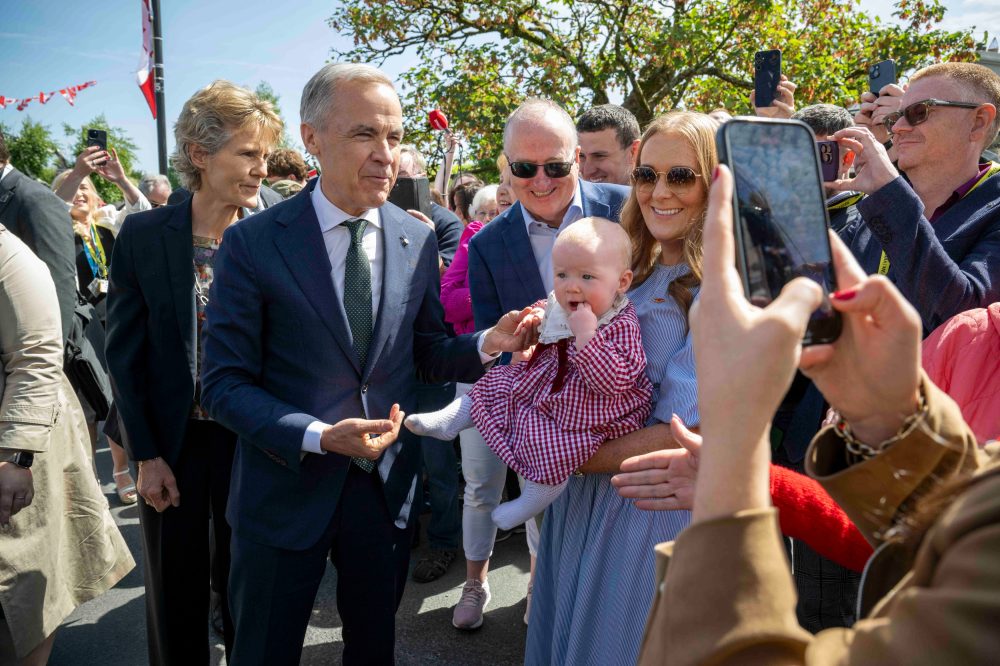
Earlier Sunday, Carney visited the Irish village of Aghagower, where his family has ancestral roots. His grandfather, Robert Carney, and grandmother, Nora Moran, both hailed from the County Mayo town and emigrated to Canada in the 1920s.
Local resident Owen Morgan, who was there with his 17-month-old son Malachy — dressed in a Montreal Canadiens jersey — said the community is proud of the Canadian leader. “People are very impressed,” Morgan said. “He’s very much standing up for Canadians and I think that’s very much admired.”