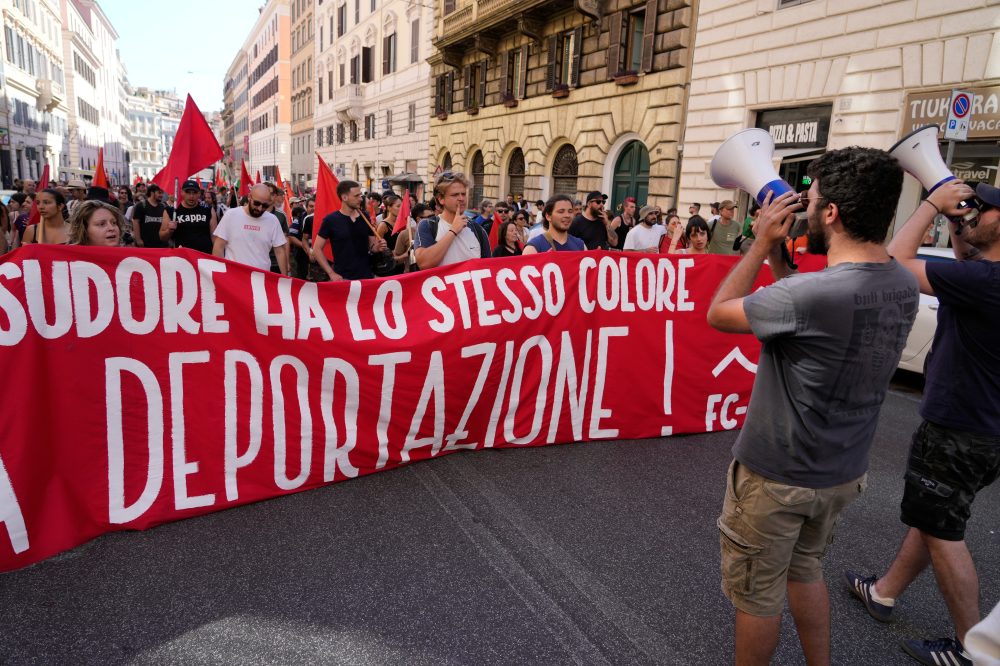

ROME (AP) — Competing demonstrations brought tens of thousands of protesters to Rome’s streets Saturday, as opposing sides clashed over immigration policy following a controversial citizen petition that secured enough backing to reach Italy’s Parliament.
The citizen-led effort, called “Remigration and Reconquest,” collected the required 50,000 signatures to force legislative consideration, elevating the previously marginal “remigration” concept into mainstream political discourse. Parliamentary leaders have not yet set a voting schedule.
The initiative, championed by right-wing organizations, demands extensive actions against foreign nationals, including forced deportations, departure incentives, and broader policies that opponents warn could affect lawful residents.
The anti-migration rally drew several thousand participants from across Italy, who sang their national anthem during the event. Multiple times throughout the demonstration, many participants performed fascist salutes while chanting “Duce! Duce!”, referencing Italian dictator Benito Mussolini, who controlled Italy from 1922 to 1943.
A counter-demonstration supporting migration rights brought tens of thousands to Rome’s streets Saturday evening in a separate location. Left-wing organizations and labor unions participated in this march, with some protesters displaying Palestinian flags.
Law enforcement deployed thousands of officers to keep the opposing groups separated. Authorities reported no violent incidents.
The migration discussion presents complex challenges for Premier Giorgia Meloni’s right-wing coalition. The anti-migration League supports advancing the proposal, while Meloni’s Brothers of Italy and centrist partners have shown greater reluctance to embrace initiatives connected to extremist movements, citing legal concerns and potential internal conflicts.
Opposition politicians and legal scholars have condemned the proposal, claiming it would breach constitutional and international anti-discrimination standards by targeting individuals based on ethnic origin, including naturalized citizens and their families.
This debate unfolds as Meloni’s administration simultaneously pursues expanded legal immigration, having endorsed a multi-year strategy to welcome hundreds of thousands of non-EU workers to fill labor gaps in critical economic areas.
The Rome protests occurred one day after new European Union regulations took effect, establishing how the bloc’s 27 nations will handle irregular migration and asylum applications.
The European Migration and Asylum Pact represents the conclusion of extensive negotiations that reformed the previous framework, which was broadly viewed as ineffective and provided far-right movements with a powerful campaign issue.