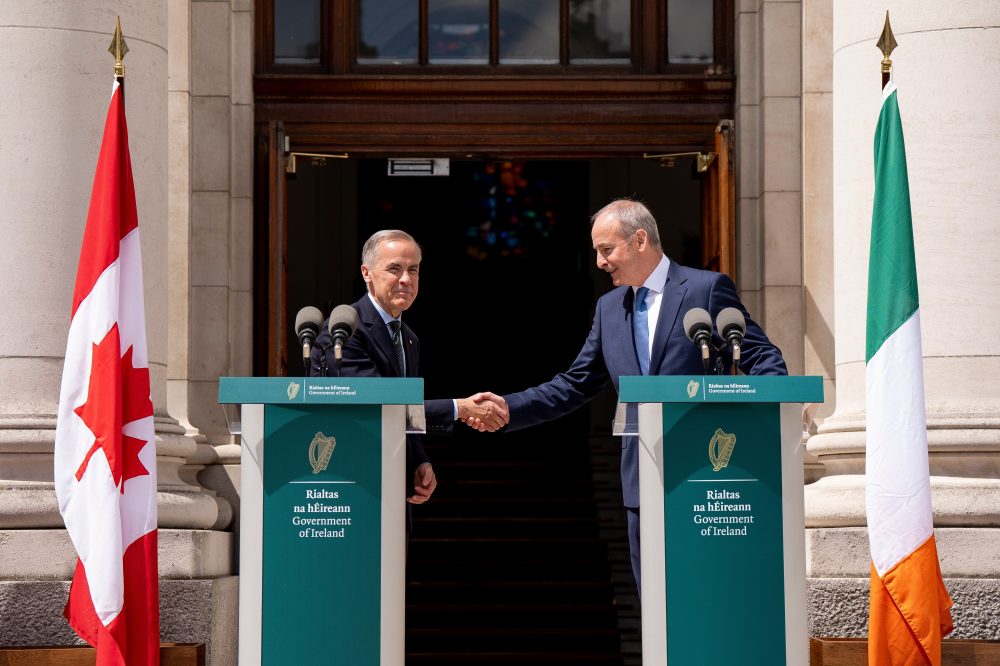

DUBLIN (AP) — Speaking in Ireland’s capital on Saturday, Canada’s Prime Minister Mark Carney outlined his vision for middle-power nations to band together rather than vie for American approval, as he continues building stronger ties with European allies before the G7 summit begins.
During his address, Carney highlighted that when combined, Canada and the European Union represent a population more than double that of the United States, featuring an economy of comparable size and collective defense spending that exceeds China’s by twofold.
The Canadian leader emphasized how smaller nations can amplify their influence through partnerships with countries sharing similar values.
“In a world of great power rivalry, middle powers have a choice — to compete for favor or to combine to create a third path with impact,” Carney declared during his speech at Trinity College in Dublin.
These remarks echo statements he delivered at January’s World Economic Forum in Davos, Switzerland, where he proclaimed the end of the global rules-based order and criticized how major powers coerce smaller nations.
His Dublin audience responded with enthusiastic applause, and Trinity’s president praised his earlier Davos remarks.
Before his Dublin speech, Carney held discussions with Ireland’s Taoiseach Micheál Martin on Saturday and met with French President Emmanuel Macron on Friday, building momentum ahead of Monday’s Group of Seven summit in France.
U.S. President Donald Trump plans to depart for the G7 gathering following Sunday’s UFC event at the White House celebrating his 80th birthday.
Carney characterized the Canada-Europe partnership as a “force for good — because we safeguard the values of human rights, dignity, and pluralism that our people hold dear.”
The prime minister noted that the combined EU-Canada relationship represents one of the world’s most significant economic, cultural, technological, financial, and military partnerships.
“The new world order will be built starting with Europe,” Carney stated during his joint press conference with Martin. “Canada is the most European of non-European countries. We are transforming our cooperation with Europe.”
Canada made history in February by becoming the first nation outside Europe to join the SAFE mechanism, the EU’s defense procurement program. During this ninth European visit since taking office 15 months ago, Carney highlighted Canada’s 56 partnerships in critical minerals across more than 10 countries, mostly European.
These statements come despite Carney’s acknowledgment that the U.S. shows little interest in major modifications to the free trade agreement involving Canada and Mexico.
“The U.S. has been clear. They don’t want to go to change the fundamental architecture,” Carney explained.
The U.S.-Mexico-Canada Agreement (USMCA) faces its scheduled July 1 review, representing the current version of the North American trade pact that has connected these three economies since the early 1990s. Trump indicated this week he might not extend the agreement.
However, Carney pointed out that the Trump administration permits approximately 85% of Canadian exports to America to enter tariff-free under USMCA protection.
According to Carney, any fundamental changes to the agreement would require White House consultation with Congress, something the administration wants to avoid.
Following Trump’s repeated assertions this week that America doesn’t require Canadian goods, Carney has established an ambitious target to double Canada’s exports to non-U.S. markets within ten years, citing how Trump’s trade policies are dampening investment confidence.