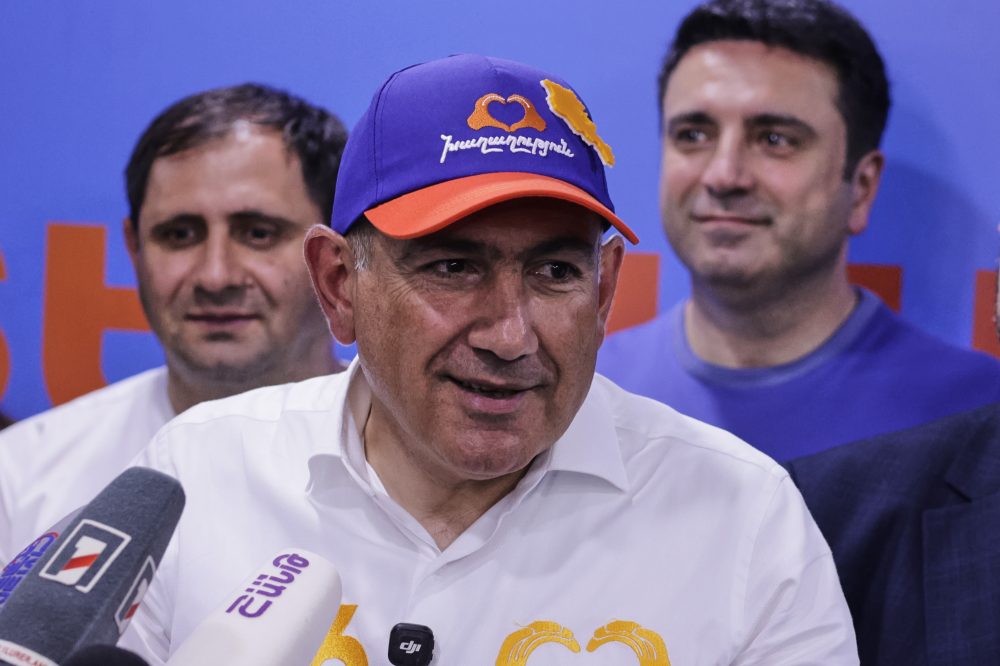

Armenia’s Central Electoral Commission has officially confirmed that Prime Minister Nikol Pashinyan’s party came out on top in the country’s recent general election — a vote seen as a defining moment for the nation’s future alignment between Russia and the West.
Final results released by the commission for the June 7 election showed Pashinyan’s ruling Civil Contract party capturing 49.7% of the vote, giving it enough support to form a government. The outcome reflects the Pashinyan administration’s push to deepen ties with the European Union and the United States, even as critics argue the country should maintain its longstanding relationship with Russia.
The pro-Russian opposition group Strong Armenia had urged the commission to throw out the results, claiming there were “widespread violations” during the voting process. Supporters of Strong Armenia and other opposition parties gathered outside the commission’s offices while officials worked to finalize the tallies.
The window between the June 8 preliminary results and the final certification gave political parties time to file formal complaints about any perceived problems with the election.
International election monitors from the Organization for Security and Co-operation in Europe (OSCE) said Armenian voters were given a “genuine choice” but noted the election took place amid “highly confrontational…divisive rhetoric” and “uneven campaign opportunities.” Armenian investigators had issued six arrest warrants against Strong Armenia members the day before the election, alleging they had been paying voters for their support.
Samvel Karapetyan, the billionaire leader of Strong Armenia — who built his wealth in Russia — is currently under house arrest. Authorities accuse him of calling for the overthrow of the government, a charge he has denied, calling it politically motivated.
Under Armenian law, the National Assembly must have at least 101 members, each serving five-year terms. Individual parties need at least 4% of the vote to gain entry, while coalitions of three or more parties must reach 8%. Civil Contract’s vote share translates to 64 seats in the assembly. Strong Armenia earned 29 seats, and the Armenia Alliance — led by former President Robert Kocharyan — received 12 seats.
Geopolitical questions dominated the campaign. As he cast his ballot on June 7, Pashinyan declared, “The European Union is our main partner in democratic reform implementation, and we will continue that path.” Armenia formally announced its ambition to join the EU last year.
Most opposition parties, Strong Armenia among them, ran on platforms favoring closer ties with Russia.
Russia, which maintains a military base inside Armenia, has cautioned that the country’s pivot toward the West could bring serious political and economic consequences. President Vladimir Putin has drawn comparisons between Armenia’s trajectory and Ukraine’s, making thinly veiled threats and suggesting Russia’s conflict with Ukraine began with Ukraine’s efforts to align with the EU.
In the weeks leading up to the vote, Moscow rolled out a series of trade restrictions targeting Armenian goods — including flowers, certain cognacs and wines, eggplant, potatoes, dried fruits, and fish. OSCE election monitors described these measures as “direct pressure” on Armenia’s election. Russia maintained the bans were tied to violations of agricultural import regulations.
European Commission President Ursula von der Leyen accused Russia of “weaponizing” economic relations and called the import bans “nothing short of economic coercion.” She announced that the EU would provide 50 million euros — roughly $58 million — in support of Armenia.
The relationship between Moscow and Yerevan deteriorated significantly after Azerbaijan reclaimed control of the Karabakh region, a mountainous area that had been held for decades by ethnic Armenian forces with backing from Armenia, stemming from a prolonged conflict between the two neighboring nations. Armenia blamed Russian peacekeepers stationed in the region for failing to prevent Azerbaijan’s military operation. Moscow, occupied with its war in Ukraine, rejected those accusations.
Pashinyan has taken gradual steps to distance Armenia from Russia, including joining the International Criminal Court in 2023 and suspending Armenia’s participation in the Moscow-led Collective Security Treaty Organization in 2024. Armenia also hosted the European Political Community summit and its first-ever summit with the EU in Yerevan in early May.
In August 2025, U.S. President Donald Trump brought Pashinyan and Azerbaijan’s President Ilham Aliyev together to sign an agreement aimed at ending their decades-long conflict, which included provisions for a new transit corridor connecting Azerbaijan to its exclave of Nakhchivan.