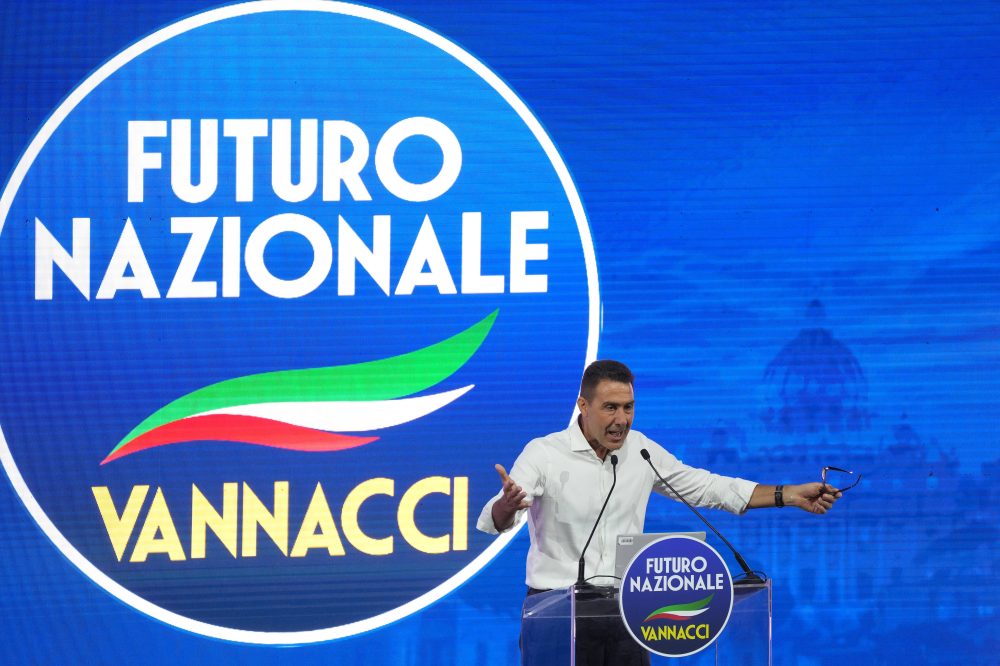

ROME — In a standing-room-only auditorium near the Vatican, Roberto Vannacci — a former Italian army general whose supporters call him “Il Generale” — rallied followers of his new political movement this weekend, positioning himself as an outsider while simultaneously shaking up Italy’s right wing and mounting a challenge to Premier Giorgia Meloni.
Vannacci’s rapidly growing party, Futuro Nazionale, is introducing fresh uncertainty into the conservative bloc that has been the foundation of Meloni’s government, with tensions mounting as the country looks toward the 2027 general election.
Political observers say the question is no longer whether Vannacci will have an impact on the vote — it’s whether Meloni can contain, absorb, or outmaneuver a rival who is carving out political territory to her right.
The arrival of a competitor on that flank could also test the durability of Meloni’s government and put pressure on the more moderate, pro-European stance she has taken since coming to power.
Vannacci’s ascent is unfolding against a broader backdrop in which far-right and nationalist movements are gaining momentum across Europe, reshaping political landscapes by focusing on divisive issues like immigration and public safety.
“With us, Italy will once again be the home of Italians,” Vannacci declared at his party’s founding assembly in Rome. “Everyone must feel safe in their own home.”
He referred to his core group of lawmakers with pride as the “dirty dozen,” leaning into his image as a political outsider.
Vannacci, 57, first stepped into the public spotlight with a self-published 2023 book titled “Il mondo al contrario” — or “The World Upside Down” — which sparked widespread controversy for its harsh rhetoric targeting LGBTQ+ people, migrants, and minority groups.
He made his formal entry into politics the following year, joining Matteo Salvini’s anti-immigration League party and earning more than 530,000 preference votes in European Parliament elections. He parted ways with the League in February to launch Futuro Nazionale — a split that Salvini labeled a “betrayal.”
Since breaking away, Vannacci has steadily built his base. The party claims it has surpassed 100,000 members and now counts eight deputies in its ranks, including defectors from both the League and the centrist Forza Italia — a sign of growing discontent within Meloni’s coalition.
Vannacci rejects the “far-right” label, preferring to call his movement the “real right.” He has accused Meloni of failing to translate shared political priorities into actual policy and is currently ruling out any alliance with her camp.
His platform takes hard-line stances on security and immigration — including calls for the “remigration” of foreigners he views as not integrated into Italian society — along with opposition to European Union policies such as the Green Deal and criticism of Western sanctions on Russia.
Analysts say Vannacci’s rise signals a deeper political and cultural shift within Italy.
“He is commanding a sort of political raid for hard-right votes within the main parties of the coalition,” said Massimiliano Panarari, a politics professor at the University of Modena and Reggio Emilia. “Meloni’s strategy was to have no one to her right. Now she does.”
Panarari described Vannacci as “an entrepreneur of fear,” arguing that his rhetoric pushes themes Meloni can no longer openly champion in office — such as openly anti-gay and anti-feminist positions.
Lorenzo Pregliasco, a political analyst and polling expert at YouTrend, said the development brings “something new — an opposition from the right to the current government.”
“Now there is a force outside the majority that challenges it on popular issues like migration, security and culture wars,” he said.
That shift carries real electoral weight. Polls place Futuro Nazionale at roughly 4% to nearly 5% — a potentially decisive slice of the vote in a contest where Italy’s main center-right and center-left blocs are closely matched.
“They could be the difference between finishing ahead or behind,” Pregliasco said, calling Vannacci a potential “wild card.”
For Meloni, the challenge is fundamentally strategic. “In terms of political debate, he introduces instability on the right,” Pregliasco said. “She and her allies must decide whether to absorb him into the coalition — but that would create problems.”
Speaking before parliament earlier this week, Meloni accused lawmakers aligned with Vannacci of undermining her government and benefiting the political left. Her Brothers of Italy party and centrist coalition partners have ruled out any electoral agreements with his movement.
For now, Meloni has steered clear of a direct confrontation — a calculated approach that some see as a wager that Vannacci’s momentum will eventually run out of steam.
“The issue is what to do with this loose cannon of Vannacci, which could drag the right back toward the far right,” Panarari said. “I’m not sure it would benefit Meloni to shift further right before general elections. Her approach will likely be marked by ambiguity and ambivalence, as long as possible.”