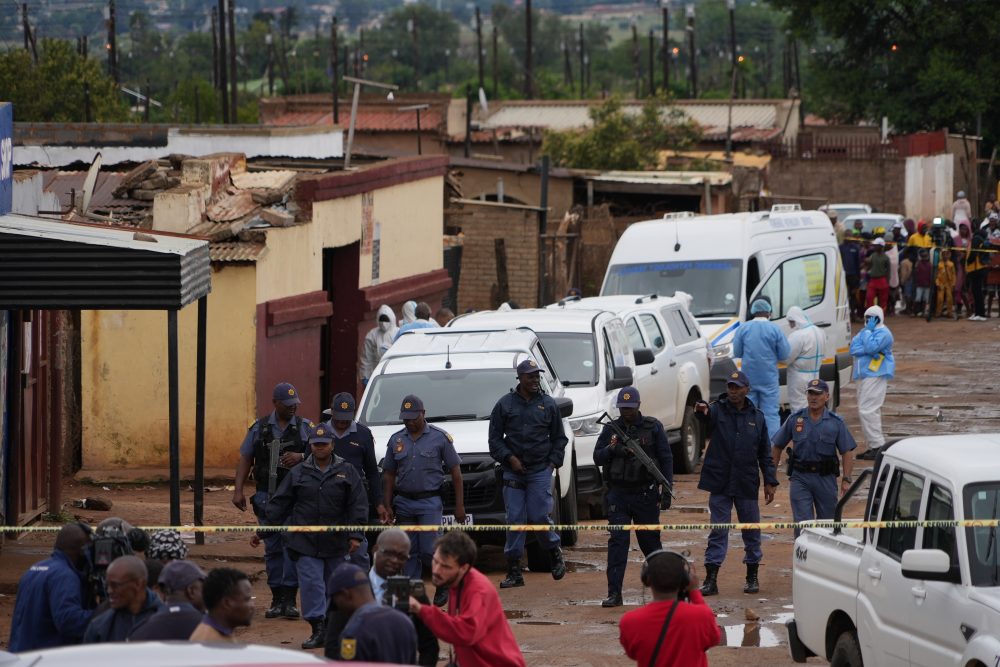

JOHANNESBURG (AP) — A deadly shooting in South Africa this week represents the most recent incident in a pattern of violence targeting the nation’s most impoverished communities, which specialists attribute to criminal organizations exploiting law enforcement weaknesses and absence.
Multiple gunmen attacked an informal settlement made up of temporary structures in Johannesburg, resulting in 12 fatalities and a minimum of 15 injuries, officials reported.
No suspects have been taken into custody.
Earlier this year, South Africa’s president authorized military deployment to streets in various crime hotspots to address organized criminal activity — an uncommon decision that critics viewed as acknowledgment that law enforcement in Africa’s most economically advanced nation was failing in those regions.
Additionally, South Africa’s law enforcement agency has faced accusations of corruption and cooperation with criminal organizations. These allegations have led to arrests of over a dozen high-ranking officers and the suspension of top leadership, including the police minister and the national police commissioner.
Recent large-scale shootings — including two incidents in December that claimed over 20 lives — have taken place in economically disadvantaged areas distant from urban centers where criminal organizations exploit circumstances such as inadequate security, insufficient lighting and delayed police response times, specialists indicate.
“Criminal syndicates explicitly capitalize on this to hide weapons, execute hits, and vanish into the shadows,” Jacob Mofokeng, a professor of criminology at the University of South Africa, told The Associated Press.
South Africa experiences extremely elevated rates of violent crime, with current annual data indicating an average exceeding 60 murders daily.
However, the overwhelming majority of homicides happen in impoverished townships or temporary settlements. South Africa maintains a lengthy record of severe inequality that manifests in its criminal activity: wealthy neighborhoods experience significantly lower violent crime statistics.
Unauthorized mining organizations have persistently troubled Johannesburg and surrounding areas, the nation’s largest metropolitan region, which contains some of the world’s most extensive gold deposits.
These organizations are infamous and called zama zamas — a term meaning approximately “hustlers” or “chance-takers” in the Zulu language. They create headquarters in poverty-stricken and inadequately patrolled locations and engage in territorial conflicts with rival groups or employ violence to maintain dominance in those territories.
Mining organizations frequently consist of migrants from adjacent nations who are present in South Africa without legal status, according to officials.
This situation complicates police efforts to locate suspects since they possess “no legal identification, no registered address, and no fingerprints or DNA profile,” said Mofokeng. “They are effectively a ghost.”
South Africa’s government reports losing over $3 billion annually to unauthorized mining. Zama zamas have posed challenges for decades and contributed to South African President Cyril Ramaphosa’s authorization of a year-long military street deployment to combat organized crime in designated areas nationwide.
Community members in the Johannesburg area affected by this week’s mass shooting indicated that unauthorized mining organizations were known to function there. Law enforcement stated the shooting’s motivation remained unknown, but mining organizations were central to the investigation.
South Africa maintains stringent rules governing legal firearm possession, but approximately 2 million to 3 million unauthorized weapons circulate throughout the 62 million-person nation, according to independent research and civil society groups.
Firearms represent by far the most frequent cause of homicides.
Willem Els, an analyst at South Africa’s Institute for Security Studies, said the circulation of unauthorized weapons and police shortcomings created perfect conditions for criminal activity.
“In South Africa, we actually managed to create conditions that are very conducive for violent crime and also for organized crime syndicates to operate with impunity,” he told the AP. “We’ve got a lot of unregistered firearms that are not being controlled by the police.”
Specialists indicate South African police lack adequate resources, but corruption accusations within the force have also severely damaged its reputation.
South Africa has experienced police corruption issues previously. A new accusation last year by a provincial police commander that senior officers and officials were collaborating with organized criminals prompted President Ramaphosa to announce a national investigation into police corruption. This has resulted in numerous arrests of high-ranking police officers.
Private investigator and security specialist Mike Bolhuis said police corruption affects street-level policing in areas impacted by violent crime as residents sometimes hesitate to provide information or assist authorities.
“The public doesn’t trust the police, they don’t trust the authorities, and they don’t trust each other,” Bolhuis said.