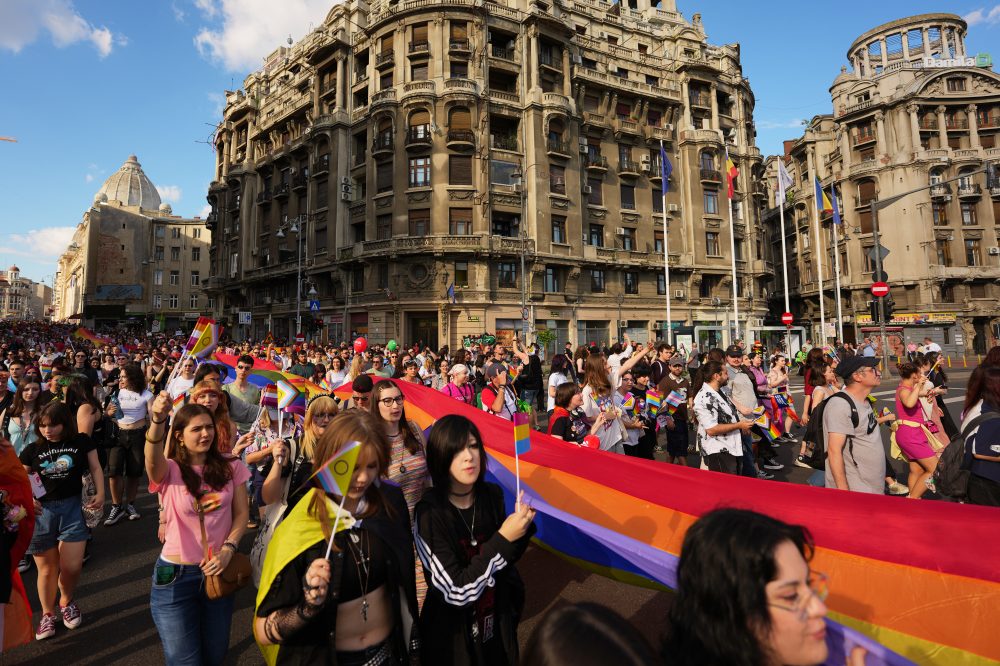

SOFIA, Bulgaria (AP) — Thousands of advocates for LGBTQ+ rights filled the streets of Romania and Bulgaria’s capital cities Saturday during their yearly Pride celebrations, facing growing pushback from traditional groups in these Orthodox Christian nations.
Demonstrators paraded through Bucharest and Sofia, displaying rainbow banners and sounding horns while demanding equal treatment under the law.
Romania and Bulgaria both became European Union members in 2007. Before joining the bloc, each nation enacted human rights laws to satisfy EU requirements, though public polling frequently shows less acceptance of the LGBTQ+ community compared to other member nations.
According to ILGA-Europe’s 2025 Rainbow Map, which evaluates legal and policy conditions for LGBTQ+ individuals throughout Europe, Romania and Bulgaria placed at the bottom among all 27 EU member states.
“We still have a deeply conservative society, with very strong traditional values,” said Alina Purcaru, a writer who attended the Bucharest march. “We still live in a patriarchy, sometimes explicit … with a lot of prejudice and a lot of fear.”
Neither Romania nor Bulgaria permits same-sex marriage or civil unions, even though the EU forbids discrimination based on sexual orientation.
“That is why we are taking to the streets today … to demand the legalization of civil partnerships,” Vlad Viski, president of the nongovernmental organization MozaiQ, told The Associated Press.
“We are talking about essential rights, such as the right to inheritance, hospital visits, medical decisions, survivor’s pension,” he added.
Simeon Vassilev, one of the organizers of Sofia Pride, told journalists on Saturday that in Bulgaria, “thousands of same-sex couples live together, build homes, raise children, and care for one another … without the right to legal protection or recognition of their relationships.”
According to advocacy organizations, animosity and hateful rhetoric targeting LGBTQ+ communities in these two Eastern European nations have increased in recent years. Counter-demonstrations opposing LGBTQ+ rights occurred in both cities Saturday.
In Sofia, a “March of the Family” gathering — organized by conservative and faith-based organizations since 2021 — promoted “Christian, patriotic and traditional values” during Saturday’s event. The traditional Orthodox Church, representing approximately 80% of Bulgarians, stated its “disagreement with the ideas and messages” and supported the “traditional family.” In Bucharest, a “March for Normality” was conducted by a nationalist organization.
This year’s Pride celebration in Sofia operated under a “Different Together” theme, with organizers seeking to challenge widespread negative messaging about the community.
Furthermore, the “Progressive Bulgaria” party of Prime Minister Rumen Radev, which secured victory in an April general election, expressed backing for the “March of the Family” in Parliament, declaring it “a cornerstone of our national security, identity and future.”
The Bulgarian Helsinki Committee condemned the statement for “placing one type of citizens as more valuable than others.”