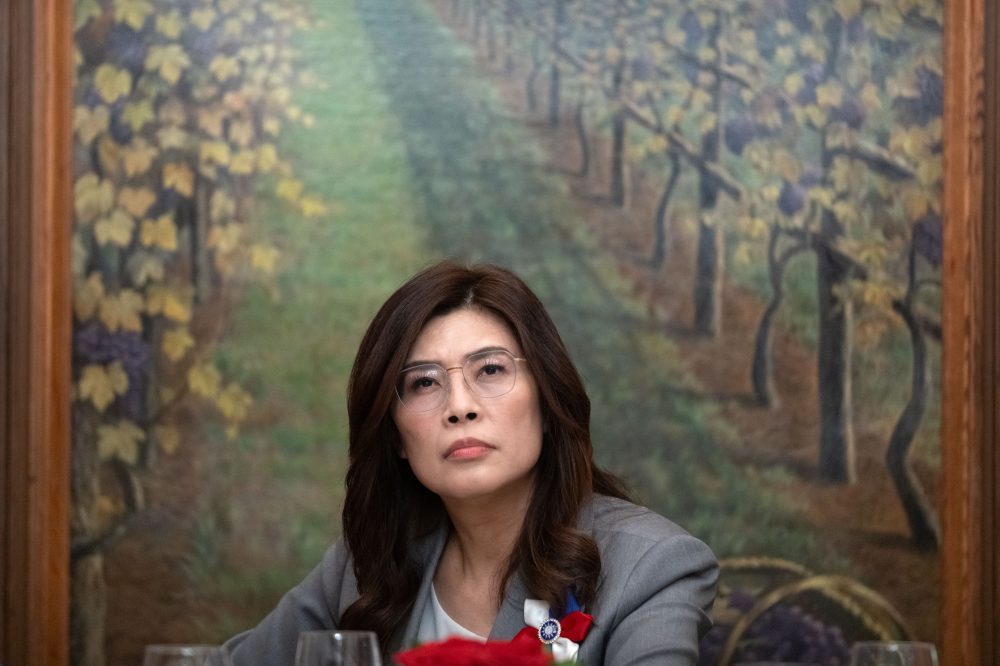

The head of Taiwan’s opposition party wrapped up a Washington visit Friday by defending her approach to China relations, arguing that diplomatic engagement is essential to prevent conflict over the disputed island.
Cheng Li-wun, who leads the Kuomintang Party, told journalists that her organization remains dedicated to protecting the island nation while believing that peace can be achieved by removing permanent independence from consideration.
During her three-day stay in the capital, where she held discussions with U.S. legislators and academic experts, Cheng highlighted alignment with President Donald Trump’s position following his Beijing visit in May, when he stated he wasn’t seeking to have anyone “go independent” or engage in distant warfare.
“I think our basic stances are the same — that is peace and stability in the Taiwan Strait and to avoid any unnecessary war,” Cheng stated.
While confirming meetings with Trump administration officials, Cheng declined to provide additional specifics about those discussions.
Her two-week American tour comes during heightened tensions in U.S.-Taiwan relationships. China’s leader Xi Jinping has issued warnings about potential military confrontation if Washington mishandles Taiwan policy, as Beijing continues threatening to use military force to claim what it considers reunification with the self-governing territory.
Congressional leaders have committed to strengthening Taiwan’s military capabilities, giving initial approval to a $14 billion weapons sale package that awaits Trump administration authorization.
Cheng, who held an April meeting with Xi in Beijing and whose party maintains that both territories belong to one Chinese nation, has been advocating for renewed communication with Beijing as crucial for regional peace, stability and economic growth.
Official dialogue between Beijing and Taiwan’s government has been suspended for ten years due to the ruling party’s rejection of the “One China” principle.
“To initiate the dialogue cross-strait with Xi Jinping doesn’t mean that we will give up the deterrence strength in Taiwan, and, of course, it doesn’t mean that we will compromise or give up our democracy and freedom,” Cheng explained, rejecting claims that she serves Beijing’s interests.
When questioned about her Xi meeting, Cheng characterized the Chinese leader as “very gentle and very nice and very real” and expressed belief that Xi prefers “peaceful means and avoid war” for resolving Taiwan issues.
However, Taiwan’s government has highlighted Beijing’s increasingly aggressive actions in the Taiwan Strait, including routine military exercises near Taiwan over recent years.
Though the United States acknowledges Beijing’s claim that Taiwan belongs to China, it opposes forceful changes to current arrangements. American law also requires providing Taiwan adequate military equipment to prevent invasion. The Trump administration authorized an $11 billion arms package for Taiwan in December.
Trump has suggested he might still communicate with Taiwan President Lai Ching-te despite Chinese public pressure against such contact.
Washington expressed frustration when Taiwan’s opposition-controlled legislature approved only $25 billion of Lai’s original $40 billion special defense spending proposal for major U.S. weapons acquisitions last month.
Cheng explained Friday that her party opposed the initial plan because it wouldn’t approve a “blank check” for an incomplete proposal but supported interim measures prioritizing U.S. weapon purchases.
Sen. Dan Sullivan, R-Alaska, met with Cheng Thursday and posted on social media that Cheng’s party should collaborate with Taiwan’s ruling Democratic Progressive Party to “finish the defense budget and support the Alaska LNG project.”
Rep. Tom Suozzi, D-N.Y., who met her Wednesday, issued a statement expressing concern that the opposition party’s “resistance to a robust defense budget raises concerns for me that the party is drifting closer” to China’s ruling party and “weakening deterrence.”
Rep. John Rose, R-Tenn., who also met Cheng Wednesday, stated his willingness to engage leaders from all parties while affirming his dedication to “supporting Taiwan’s sovereignty and expanding the U.S.-Taiwan relations.”