
Washington and Tehran are inching toward a framework peace agreement, though exactly when a deal might be formally signed remains an open question — even as fighting continues on multiple fronts.
President Donald Trump took to social media Saturday to announce that a deal with Iran was set to be signed the following day — which also happens to be his 80th birthday. Pakistani Prime Minister Shehbaz Sharif echoed that optimism, saying both sides had agreed on the framework and that Pakistan was preparing for an electronic signing on Sunday, to be followed by technical discussions in the days ahead.
Iran, however, did not confirm that timetable. Iranian Foreign Ministry spokesperson Esmaeil Baghaei, speaking before Trump’s post went up, urged caution about predicting a signing date. State media quoted him as saying, “It will not be tomorrow,” though he added it could happen “in the coming days.”
On the social media platform Truth Social, Trump wrote that once a framework deal is signed, the Strait of Hormuz — a critical passageway for global oil supplies that Iran has blocked — would immediately be “open to all.”
A U.S. official spelled out the terms to reporters: “Iran is going to open up the Strait of Hormuz, that’s a requirement. It could be open with no tolls. As they do that, we will lift our blockade.” The official added, “It’s going to happen in conjunction, and part of the next step, the phase after that, is going to be the demining of the straits,” suggesting nations in the Group of Seven major powers could play a role in that process.
Multiple sources familiar with the draft terms told Reuters the U.S. would begin releasing billions of dollars in frozen Iranian assets and lift sanctions on Iran’s oil exports in exchange for Iran reopening the strait. Baghaei, quoted by Iran’s Fars news agency, confirmed that recovering those frozen assets was a core part of the deal and that Iran would charge fees for use of the strait. He also said foreign military bases in the region would need to be shut down, though no further details were provided.
Iran’s nuclear program — which Trump has cited as a primary justification for the war — would not be addressed in the initial agreement. Instead, a 60-day period of follow-on talks would cover that issue. A U.S. official said the end goal would be the complete dismantling of Iran’s nuclear program, with its stockpile of highly enriched uranium destroyed and removed.
The war between the U.S. and Iran began on February 28, when the U.S. and Israel launched military operations against Tehran. Trump at that time called on the Iranian people to rise up and seize control of state institutions. U.S. strikes have severely weakened Iran’s military-industrial capacity, though analysts note that hardline Revolutionary Guard elements have actually grown more entrenched as a result of the conflict.
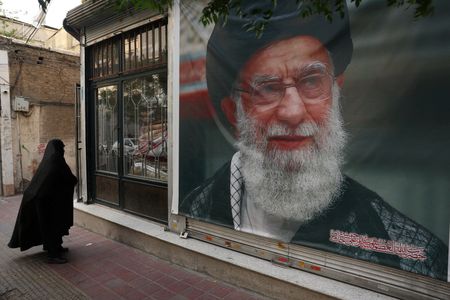
Opposition to any deal was visible inside Iran on Saturday. Videos circulating on social media and Iranian news websites showed crowds gathering in public squares and outside the Foreign Ministry in Tehran, directing their anger at Iranian Foreign Minister Abbas Araqchi. Protesters were heard chanting, “Araqchi have some shame, let go of America!” Reuters was unable to immediately confirm the authenticity of those videos.
At pro-government rallies held across Iran on Saturday night, hardliners also made their opposition known. A resident in the northeastern city of Mashhad told Reuters that some in the crowd chanted: “Death to the compromiser” — an apparent dig at Araqchi — followed by “Compromiser, resign, resign.”
Despite the diplomatic activity, military clashes have not stopped. Early Saturday, U.S. forces shot down multiple Iranian one-way attack drones that were headed toward the strait. Israel, which has stated it is not a party to the U.S.-Iran deal, reported striking more than 70 locations in Lebanon over a 24-hour period, targeting Iranian ally Hezbollah. Israeli Prime Minister Benjamin Netanyahu has been at odds with Trump over U.S. pressure on Israel to scale back operations in Lebanon so Washington can finalize a deal with Tehran.
On Friday, Araqchi said that while the agreement’s details could still change, the tentative deal demonstrated that Iran had come out of the conflict in a stronger position. Trump also spoke by phone with British Prime Minister Keir Starmer about efforts to bring the Iran conflict to a close, according to a statement from Downing Street.
Before the war, the Strait of Hormuz served as the route for roughly 20% of the world’s oil shipments.