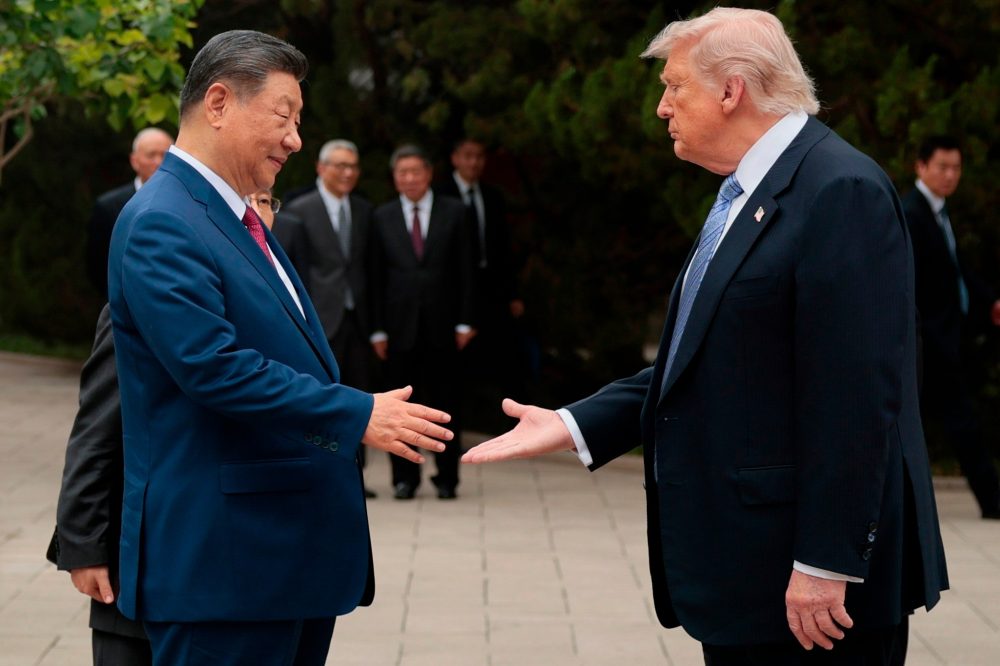

PARIS (AP) — When major economic powers first convened at a French chateau in 1975 to tackle a struggling global economy, China was never part of the conversation. That gathering — the first of what would become the annual G7 summit — brought together wealthy democratic nations to look out for their shared interests, and China simply didn’t fit the mold.
It wasn’t hard to understand why. The idea of Chinese revolutionary leader Mao Zedong sitting down with U.S. President Gerald Ford and other heads of state would have been absurd at the time.
China was in the middle of internal chaos and was nowhere near the economic powerhouse it has since become. Mao had also backed Ho Chi Minh’s communist forces — the same forces that defeated both France and the United States in Vietnam. That made him a highly unlikely guest at the inaugural Rambouillet summit, which started as a six-nation group before Canada joined the following year to form the G7.
Fast forward to today, and U.S. President Donald Trump is joining fellow G7 leaders in France for a Monday-through-Wednesday gathering — yet China’s continued absence from the club raises new questions, given how deeply Beijing now shapes the global economy.
The bottom line: Does the G7 still make sense without China at the table?
On raw economic terms alone, China has long since earned a spot. Since Mao’s death in 1976, decades of explosive growth have made China’s economy larger than those of Germany, Japan, the United Kingdom, France, Italy, and Canada combined — with only the United States still ahead. Leaving China out, by this measure, is a bit like holding the soccer World Cup without Brazil, a five-time champion.
John Kirton, a G7 specialist at the University of Toronto, put it bluntly: From being “only a tiny, benign, panda bear” in 1975, “China has become a great global dragon.”
“So many understandably ask: Would the G7 and the global community be better off if China became a member of the G7 club? A plausible answer is ‘Yes,’” Kirton added.
Even Trump floated the idea a year ago, saying it “was not a bad idea” when a reporter raised the possibility of expanding the club to include China.
But there’s a longstanding, if unwritten, rule at the heart of the G7: membership is for democracies only.
The founding leaders made that clear in their 1975 Rambouillet declaration: “We are each responsible for the government of an open, democratic society, dedicated to individual liberty and social advancement.”
China fell far short of that standard under Mao, whose rule led to the deaths of tens of millions through famine and revolutionary violence. And under current leader President Xi Jinping, China still doesn’t clear the bar. Multiple global measures — including the annual Freedom in the World study, the World Press Freedom Index, and the Canadian Fraser Institute’s economic freedom rankings — place China well behind G7 nations when it comes to civil liberties.
Still, China’s influence is impossible to ignore. The country announced a record trade surplus of nearly $1.2 trillion in 2025, selling far more to the world than it buys. It holds tight control over vital rare minerals. Its military expansion and technological progress are rattling rivals. And it remains the single largest source of climate-warming pollution on Earth.
All of that makes China the proverbial elephant in the room at this week’s summit in the Alpine spa town of Evian-les-Bains.
French President Emmanuel Macron, serving as this year’s host, has set aside dedicated time for leaders to discuss how to rebalance trade with China, as a flood of Chinese-made cars and other goods threatens to undercut G7 industries.
Relations between Trump and his G7 counterparts have been strained lately — over the conflict with Iran and other points of disagreement — but China may actually be a rare area of common ground. Cédric Dupont, an international politics expert at the Geneva Graduate Institute, noted: “They agree on the same thing, you know: China is a problem.”
China’s government has previously criticized the G7 as an exclusive club that belongs to a Cold War era of ideological division. But in a statement to The Associated Press ahead of the Evian summit, China’s Foreign Ministry softened its tone somewhat, saying “the G7 should serve as a catalyst for solidarity and cooperation rather than an amplifier of division and confrontation.”
Beijing-based analyst Wang Zichen explained that “Beijing is wary of the G7 because it sees the group as structurally aligned with U.S.-led Western power, and increasingly as a venue where China is discussed as a challenge or threat.”
Even so, Chinese leaders pay close attention to what happens at these summits. As Wang put it: “China recognizes that the G7 still represents a very significant concentration of economic, technological, military and financial power.”
Experts warn that actually bringing China into the club could fracture it from within. Beijing’s authoritarian government, its positions on Russia and Iran, and its broader strategic interests clash fundamentally with those of the G7’s democratic members. Having China at the table could also strain long-standing alliances.
Kirton called the prospect a potential “Trojan horse.” With a Chinese leader present, he said, “individual members might be tempted to break G7 ranks to secure special favors from him on the economic, critical minerals, digital technology and other issues they address.”
Chris Alden, an international relations scholar at the London School of Economics and Political Science, agreed, saying that admitting China “would make it very difficult for it to function.”
The G7’s last membership expansion offers a cautionary tale. Russia was welcomed into the group in 1998, but the experiment soured. When Russian President Vladimir Putin seized Crimea from Ukraine in 2014, the other members froze Russia out — a rupture that foreshadowed the full-scale war that has been raging since 2022.
Trump said last year that kicking Russia out “was a very big mistake.” But Kirton argued the episode taught other leaders a hard lesson — that they should “never take a chance on a less than fully democratic power becoming a full member of their fully democratic club again.”