A South Korean appeals court has put on hold a government ruling that named Kim Bom, the Korean-American founder of U.S.-listed e-commerce company Coupang, as the group’s controlling entity.
The Seoul High Court approved an injunction requested by both Coupang and Kim on Tuesday, freezing the designation while the broader legal case moves forward, according to court documents.
In its decision, the court stated it acted because of “an urgent need to prevent irreparable harm” to those who filed the request. The court also found no indication that blocking the Fair Trade Commission’s measure would work against the public interest.
The freeze will stay in place until 30 days after the court issues its final ruling in the main lawsuit, at which point judges will determine whether the FTC’s designation was legally valid.
The FTC had made its original designation back in April, identifying Kim as the group’s controlling person under South Korean fair trade law. That change replaced Coupang itself as the group’s “same person” under that legal framework and brought additional disclosure and governance obligations for the company.
Coupang took the matter to court after the FTC’s move, which followed an agency investigation into the role played by Kim’s family members in the company’s operations. The scrutiny came at a time when Coupang was already under heightened regulatory attention following a significant customer data breach.
South Korea’s regulatory actions against Coupang — including a separate record-setting fine handed down by the Personal Information Protection Commission related to the data breach — have created friction between South Korea and the United States over how the company has been treated.
Smartphone shipments in China continued their downward slide in the second quarter of the year, falling 4.3% to 66 million units compared to the same period a year ago, according to research firm IDC. The drop marks the fifth quarter in a row that sales have declined, and shipments for the first half of the year were also down 4.2% year over year.
The culprit behind the slowdown, IDC says, is a surge in the cost of memory chips and other key components, which led most manufacturers to raise prices or eliminate lower-cost models from their lineups. That strategy left many consumers unwilling to spend more on an upgrade.
Two brands stood apart from the rest: Huawei Technologies and Apple. Huawei saw its shipments jump 19.4%, while Apple posted a 24.4% increase — making them the only major vendors to record growth during the quarter.
Arthur Guo, a senior analyst at IDC China, explained why those two companies fared better: “Huawei and Apple held their prices steady while competitors were raising theirs, and that gave hesitant buyers a reason to go ahead and purchase in a quarter when most of the market was giving them a reason to wait.”
Huawei led the market with a 22.6% share, while Apple came in second at 18.1%. Among the brands that struggled, Xiaomi — ranked fifth overall — saw its shipments tumble 21.7%. Oppo and Vivo also posted declines of 9.7% and 11.4%, respectively.
IDC also noted that the gradual disappearance of government subsidy programs, which had helped prop up consumer demand in previous quarters, further contributed to the market’s decline.
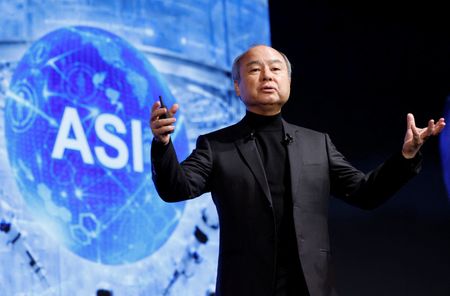
The chief executive of SoftBank Group stood before his company’s annual gathering in Tokyo on Tuesday and delivered a bold forecast: by 2040, the world will need to pour $5 trillion — roughly 800 trillion yen — into artificial intelligence every single year.
Masayoshi Son, who built his reputation and wealth by placing massive bets on game-changing technologies, acknowledged the figure sounds hard to believe. “Every year $5 trillion, or 800 trillion yen, you might think that’s a lie, but I am confident that’s what it will cost,” he told the audience.
Son argued the economics would work out. “The business model will be viable because by 2040, if AI revenue makes up 20% of global GDP, spending 800 trillion yen a year is a rounding error,” he said. He did not, however, explain the methodology behind either the $5 trillion projection or his estimate of AI’s share of global economic output.
The SoftBank chief also pushed back hard against growing skepticism in financial circles about whether the AI sector is overheating. AI companies have seen their valuations skyrocket even as the cost of building the infrastructure to support them has ballooned, raising questions about whether returns will justify the spending. Son was dismissive of those concerns. “Asking if AI is a bubble is absurd. I don’t think people who ask that question know what AI is about,” he said.
SoftBank has been on an aggressive investment push over the past two years, positioning itself as a central player in the AI landscape. The company has directed tens of billions of dollars into OpenAI, the maker of ChatGPT, with its total investment in that firm expected to surpass $60 billion before the end of 2026. It has also funded data center construction and put money into robotics companies.
Son’s track record is a mixed one. He scored enormous gains from an early stake in Chinese e-commerce giant Alibaba and was instrumental in bringing the iPhone to Japan’s mobile market. But he also backed WeWork, the shared-office company that ultimately went bankrupt after failing to live up to its initial promise.
Looking further ahead, Son predicted that powering AI systems will require data centers consuming 3 terawatts of electricity by 2040 — a figure equal to 1.8 times the entire world’s current power usage. He said natural gas would carry the load initially, with nuclear fusion eventually taking over as the dominant energy source. “Will we use solar power in space as Elon Musk says? Maybe we will use both, but if you ask me fusion on earth will be the cheaper, cleaner energy source,” he said.
Son closed with a philosophical vision of the world 15 years from now, describing a future in which 100 trillion AI agents make independent decisions, take action, and interact with one another. “We will go from a human-centric world to an agent-centric world. The age when humans are the highest life form on earth will end. For better or for worse, it will happen and it can’t be stopped,” he said.
American consumers may get a small break from inflation in June, but economists say it is far from cause for celebration — and the pain at the pump is already returning.
The Labor Department’s Bureau of Labor Statistics is expected to release its Consumer Price Index report on Tuesday, with a Reuters survey of economists predicting the CPI rose 3.8% over the 12 months ending in June. That would be a step down from May’s 4.2% surge — the largest year-on-year increase since April 2023 — which many economists believed represented the peak.
Estimates for the June figure ranged from 3.6% to 4.0%. On a monthly basis, consumer prices are expected to have actually fallen 0.1% in June, which would mark the first monthly decline since May 2020, after climbing 0.5% in May.
The main driver behind the anticipated slowdown is a retreat in gasoline prices. The national average dropped to $4.18 per gallon in June from $4.61 in May — the highest level since July 2022 — according to data from the U.S. Energy Information Administration. A fragile ceasefire between the U.S. and Iran helped bring prices down temporarily, but that truce collapsed last week after commercial tankers were fired upon in the Strait of Hormuz, prompting military strikes between the two countries.
Gas prices have since reversed course. The national average climbed to $3.87 per gallon on Monday, up from $3.80 the previous week, according to motorist advocacy group AAA. President Donald Trump announced Monday that the United States would reinstate its blockade on Iranian shipping through the Strait of Hormuz, a critical corridor for global oil supplies and one of the central flashpoints of the ongoing conflict.
“The pain level just went down from 10 to nine, consumers are still in a lot of pain,” said Brian Bethune, an economics professor at Boston College. “We’re not out of the woods yet.”
Any relief at the gas pump in June was likely offset by rising food prices, which economists expect to have picked up after only a marginal increase in May. The U.S.-Israel war with Iran has pushed fertilizer prices higher and increased distribution costs. Combined with dry conditions in parts of the country, economists warn food prices could climb further later this year and into 2027.
Diane Swonk, chief economist at KPMG, cautioned that even efforts by some grocery stores to lure customers back with price cuts won’t make a significant dent. “The level of prices is still compounding, and even with some grocery stores talking about trying to get people back in with some price cuts, it won’t probably lower their overall bill much because there will be other factors,” she said. “People are still struggling to catch up.”
Stripping out the more volatile food and energy categories, so-called core inflation was projected to rise 2.8% year-over-year in June, slightly below May’s 2.9% reading. On a monthly basis, core prices were expected to increase 0.2%, matching May’s gain.
In June specifically, core inflation is expected to have been pushed higher by increased prices for services, hotel and motel rooms tied to the FIFA World Cup, and a rebound in motor vehicle insurance costs after a sharp drop in May. Moderate increases were also expected in airfares and rents, while core goods prices were likely flat for the month.
Andrew Hollenhorst, chief U.S. economist at Citigroup, noted that core inflation — which is not directly influenced by oil prices — remains the key measure for Federal Reserve officials. “One concern was that higher energy costs would ‘pass-through’ to core inflation, but aside from somewhat stronger airfares, which should now reverse, higher oil prices did not significantly boost core,” he said.
Other economists were less optimistic, arguing that persistent underlying inflation keeps the possibility of a rate hike on the table. The Fed left its benchmark interest rate unchanged in the 3.50%-3.75% range at its June 16-17 meeting, though updated projections pointed to a growing expectation of a rate increase in 2026. Minutes from that meeting, published last week, showed policymakers’ concerns about inflation intensified last month.
Financial markets were pricing in roughly a 50.8% probability that the Fed will raise borrowing costs at its September 15-16 policy meeting, according to CME’s FedWatch tool. The Fed uses the Personal Consumption Expenditures Price Index — not the CPI — as its primary inflation benchmark, targeting 2%. Inflation has not been below that level since early 2021.
Samuel Tombs, chief U.S. economist at Pantheon Macroeconomics, summed up the uncertain outlook: “June’s CPI report is unlikely to decisively lean toward or rule out the Fed tightening policy this year.”
SEOUL — South Korea’s ruling party is working to make it easier for chipmaker SK Hynix to partner with outside investors when building new manufacturing facilities, as part of a broader national push to become a dominant force in artificial intelligence.
Lawmakers from President Lee Jae Myung’s Democratic Party of Korea have put forward a proposal to amend existing legislation covering “strategic industries with cutting-edge technologies.” Under current law, a subsidiary of a subsidiary is prohibited from forming such investment partnerships.
SK Hynix is a unit of SK Square, which itself is a unit of SK Inc. If the amendment passes, SK Hynix would be allowed to bring in outside capital for new chip factories, provided it holds at least a 50% stake in any joint venture it creates.
The proposed change is particularly significant for SK Hynix because of how the company is structured. Other large South Korean business groups maintain control over their key subsidiaries through complex networks of cross-shareholdings rather than direct ownership chains. SK Hynix is the top producer of high-bandwidth memory chips used in Nvidia’s artificial intelligence processors.
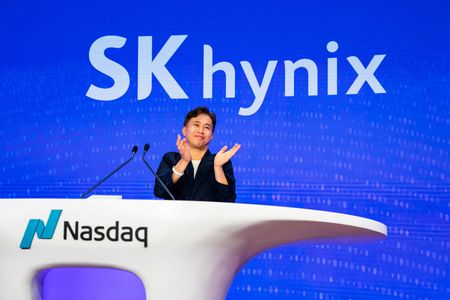
Last week, SK Hynix completed a high-profile share sale on a U.S. stock exchange, raising $26.5 billion. However, analysts expect the company will need considerably more funding to carry out its ambitious plans to expand chip production.
The South Korean government has laid out plans to develop new semiconductor manufacturing sites in the southwestern part of the country. Both SK Hynix and Samsung Electronics have each committed to investing 400 trillion won — roughly $268 billion — toward those efforts.
In the draft bill, lawmakers argued that South Korea needs “fast construction of fabs to win against other major countries and companies,” and noted that companies can no longer rely solely on traditional methods of raising capital to cover such enormous costs.
The proposed law would also require any newly formed venture to be headquartered or have its main office located outside the greater Seoul metropolitan area, consistent with government efforts to boost economic activity in other regions of the country.
SK Hynix shares listed in Seoul fell 8.6% on Tuesday, extending steep losses from the previous session as early excitement over the company’s debut on the Nasdaq stock exchange began to fade.
Oil prices surged early Tuesday as conflict in the Middle East intensified, while Asian stock markets fell amid a broader selloff in artificial intelligence-related stocks.
Brent crude, the international oil benchmark, climbed to just above $84 per barrel on Tuesday, following a dramatic near-10% spike on Monday. U.S. benchmark crude also rose, gaining 1.4% to reach $79.20 per barrel.
While oil prices remain below the wartime high of nearly $120 a barrel, growing uncertainty about the future of energy supplies has rattled markets. Both the United States and Iran have claimed control of the Strait of Hormuz, a critical waterway for global oil shipments. The U.S. launched additional strikes on Iran after President Donald Trump announced that Washington was “reinstating” a blockade on Iran in the strait.
The ongoing fighting has prevented oil tankers from passing through the waterway to deliver crude from the Persian Gulf to customers around the world, pushing fuel prices higher globally. U.S. stock futures were down 0.3% in early trading.
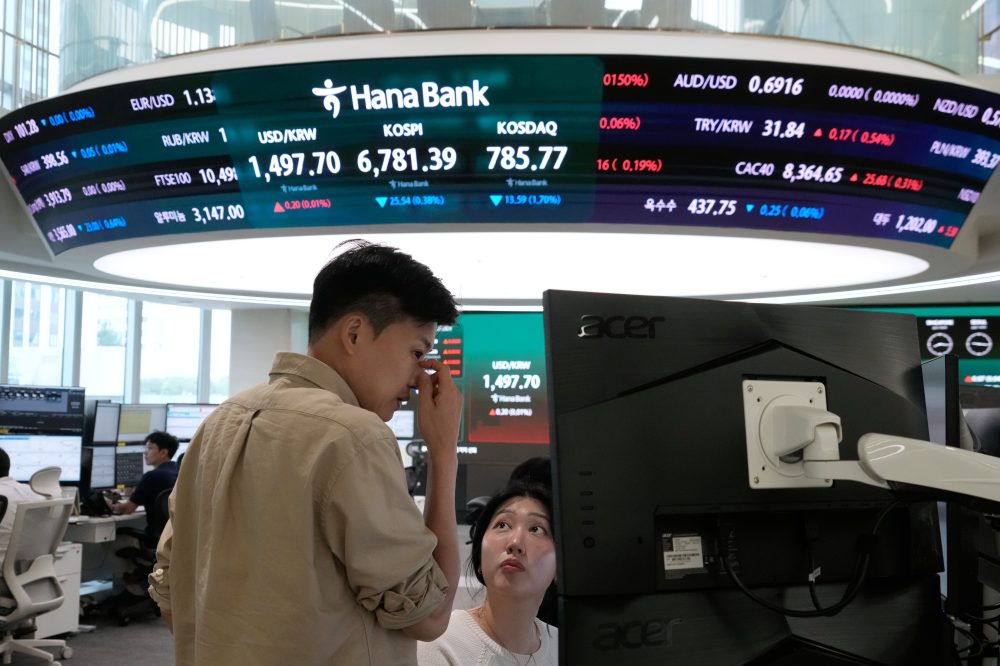
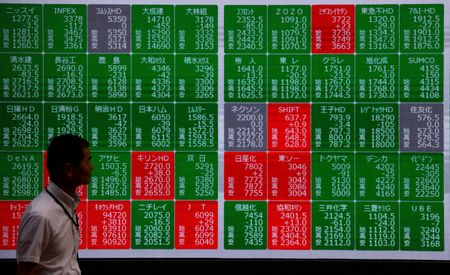
Across Asia, markets broadly declined. Tokyo’s Nikkei 225 dropped 1% to close at 66,574.96, while South Korea’s Kospi fell sharply by 3.2% to 6,589.37. China’s Shanghai Composite index slipped 0.8% to 3,884.32, even as the Chinese government reported that the country’s exports surged 27% in June compared to a year ago, fueled in part by strong demand for computer chips and other technology driven by AI adoption. Hong Kong’s Hang Seng edged slightly higher by 0.1% to 24,230.46, and Australia’s S&P/ASX 200 declined 0.5% to 8,767.00.
On Wall Street Monday, the S&P 500 fell 0.8%, snapping what had been four winning weeks out of the previous five. The Dow Jones Industrial Average dropped 0.3%, and the Nasdaq composite sank 1.6%.
Chip manufacturers led the decline. Micron Technology dropped 4.4%, cutting into what had been an impressive 243.1% gain for the stock so far this year. Nvidia slid 3.5%, and because it holds the title of Wall Street’s most valuable company — largely due to excitement surrounding AI — it was the single biggest drag on the S&P 500.
Investor anxiety is growing that stock prices have climbed too far, too fast, and that demand for AI-related products may not hold up if the technology fails to generate the profits and productivity gains many are expecting.
Much of Wall Street’s focus this week will shift to corporate earnings reports. On Tuesday alone, Bank of America, Citigroup, JPMorgan Chase, Goldman Sachs, and Wells Fargo are all scheduled to release their latest quarterly results. Analysts tracked by FactSet are projecting overall earnings growth of 23.6% for S&P 500 companies compared to a year ago — which, if accurate, would mark the second consecutive quarter of growth exceeding 20%.
Rising oil prices could also complicate the inflation picture. More expensive fuel tends to push consumer prices higher, which could pressure the Federal Reserve and other central banks to raise interest rates. Higher borrowing costs can help cool inflation but also slow economic growth and weigh on investment values across the board.
In currency markets early Tuesday, the U.S. dollar dipped slightly to 162.34 Japanese yen from 162.35 yen, while the euro climbed to $1.1391 from $1.1381.
Chipmaking giant Nvidia has cut its list of approved Asian buyers of artificial intelligence chips by more than half, the Financial Times reported Monday. The company established a new “white list” of businesses that have cleared more rigorous compliance screening designed to keep its products out of China’s hands.
According to the report, which cited three people with knowledge of the situation, Nvidia has stepped up its vetting process over recent months in Singapore, Malaysia, and Japan.
Reuters, which first reported on the Financial Times story, said it was unable to immediately confirm the details. Nvidia had not responded to a request for comment as of the time of the report.
The tightened review resulted in more than half of Nvidia’s former customers being removed from the approved list — particularly smaller cloud computing providers known as neo-cloud companies. The report noted that businesses that did not pass the initial screening can make adjustments and submit a new application.
The development follows guidance issued in May by the U.S. Commerce Department aimed at stopping advanced AI chips from being obtained by overseas branches of Chinese firms. Authorities had raised alarms that Nvidia’s high-powered Blackwell processors may have been shipped to entities with Chinese ties operating in countries like Malaysia, despite existing U.S. export restrictions.
TAIPEI — The world’s largest producer of advanced artificial intelligence chips is poised to hit another financial milestone, with analysts widely expecting Taiwan Semiconductor Manufacturing Co. — better known as TSMC — to post record profits for the fifth quarter in a row.
The surge is being fueled by explosive growth in AI infrastructure spending, which has kept demand for TSMC’s most advanced chip manufacturing processes at an all-time high. The company’s 3-nanometre and 2-nanometre chip technologies, along with its advanced chip packaging method known as CoWoS, continue to see strong orders from major clients.
TSMC serves as a critical supplier to companies including Nvidia and Apple, and has grown into Asia’s most valuable company. Its market capitalization now stands at roughly $1.97 trillion — nearly double that of South Korean competitor Samsung Electronics.
For the second quarter, analysts project TSMC will report a 59% jump in net profit, reaching approximately T$632.6 billion — equivalent to about $19.65 billion — based on an LSEG SmartEstimate drawn from 18 analysts. SmartEstimates give more weight to forecasts from analysts with a stronger track record of accuracy.
Any quarterly net income figure topping T$572.5 billion would represent the company’s highest-ever single-quarter result and would extend its streak of consecutive quarters with profit growth to ten.
Earlier this week, TSMC reported a 36% year-over-year increase in second-quarter revenue, surpassing market expectations and setting a new all-time record.
Dan Nystedt, a research analyst at TriOrient, an Asia-based private investment firm, noted the strength of the results. “TSMC’s strong second-quarter revenue shows AI demand remains healthy, driving demand for its advanced chip production and CoWoS packaging,” he said.
Most analysts expect TSMC to raise its full-year revenue growth forecast. Haas Liu, Bank of America’s Asia semiconductor analyst, wrote in a research note that supply chain checks point to a continued strong AI demand pipeline, and suggested TSMC could lift its full-year outlook beyond its current guidance of “above 30%” year-over-year growth.
Investors are also closely watching whether TSMC will increase its capital spending projections, which many view as a signal of how confident company leadership is in the long-term strength of AI demand.
During its most recent earnings call in April, TSMC indicated that its 2026 capital expenditures would land at the high end of a previously stated range of $52 billion to $56 billion. While Nystedt expects that guidance to hold, Liu believes TSMC could push capital spending to around $58 billion, citing tight equipment availability and aggressive capacity expansion by memory chip makers including Samsung Electronics, Micron Technology, and SK Hynix.
Separately, TSMC has committed $165 billion to construct chip manufacturing facilities in the U.S. state of Arizona.
Shares of TSMC listed on the Taipei stock exchange have climbed 56% so far this year, edging slightly ahead of the broader market’s 54% gain.
China’s customs agency announced Tuesday that the country’s exports jumped 27% in June compared to the same month a year ago, a figure that far outpaced what economic analysts had anticipated.
The previous month had already shown strong performance, with exports climbing 19.4% year-over-year in May — but June’s numbers blew past those results by a wide margin.
Import activity also picked up considerably, rising 36% in June. That figure topped May’s already-strong year-over-year import growth of 27.4%.
Much of the export surge is being credited to the rapid expansion of artificial intelligence technology, which is creating strong global demand for semiconductors and other electronic components. Chinese shipments of vehicles — particularly electric vehicles — along with a range of tech-related goods have seen significant growth as a result.
Analysts note that the robust performance in export manufacturing has helped make up for softer consumer spending within China itself, where domestic demand has remained relatively weak.
SEOUL — When South Korean President Lee Jae Myung set a 5,000-point target for the country’s KOSPI stock index last year, many observers considered it a stretch — the market would have needed to nearly double from where it was sitting at the time.
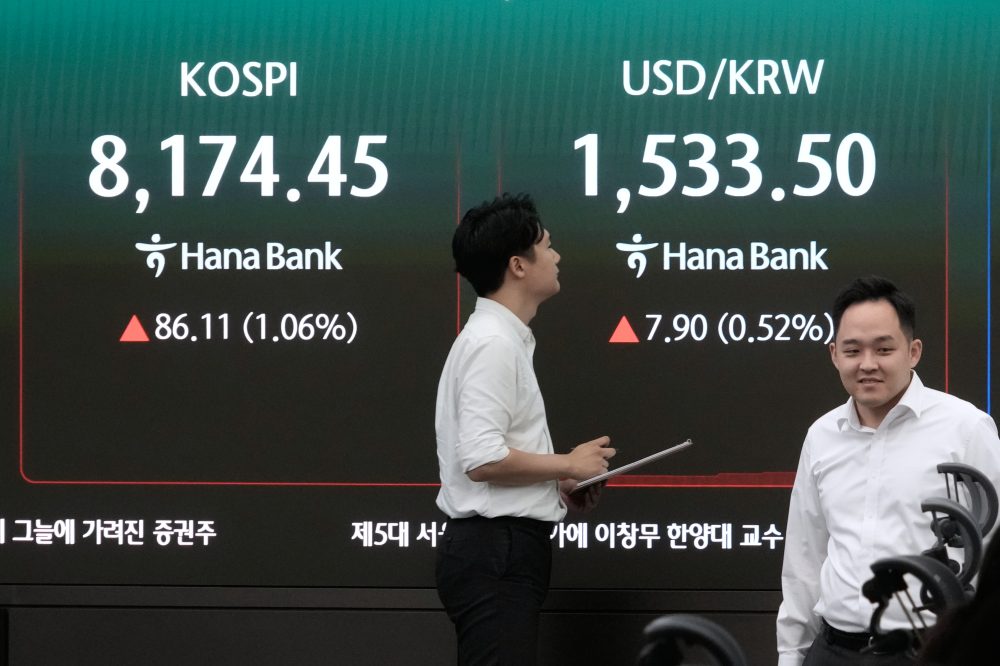
Less than a year later, the index had rocketed past 8,000 points in a record-breaking surge powered by artificial intelligence excitement. Even then, President Lee maintained that South Korean stocks were undervalued.
That breathtaking climb has since turned into one of the most confusing reversals in recent market history. The KOSPI has fallen into bear market territory, losing roughly a quarter of its value since late June — and yet it still stands as the world’s top-performing major stock market for the year by a wide margin.
The dramatic back-and-forth underscores both the opportunity and the danger embedded in South Korea’s AI-driven stock surge.
Strong earnings growth at semiconductor heavyweights Samsung Electronics and SK Hynix continues to support the bullish case for investing. But a rally that was supercharged by borrowed money, heavily concentrated in just two companies, and increasingly out of step with the broader economy, has put regulators on edge and left investors vulnerable to sharp, sudden swings.
“It’s a wake-up call,” said Francis Tan, chief strategist for Asia at Indosuez Wealth Management in Singapore. “Both for those who are greedy and those who are fearful. For those who were fearful … it’s a great time to buy in, but if you are already overweight this gives you a reminder that exposure (to chips) can be a volatile game.”
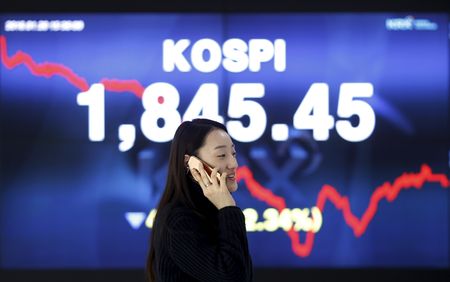
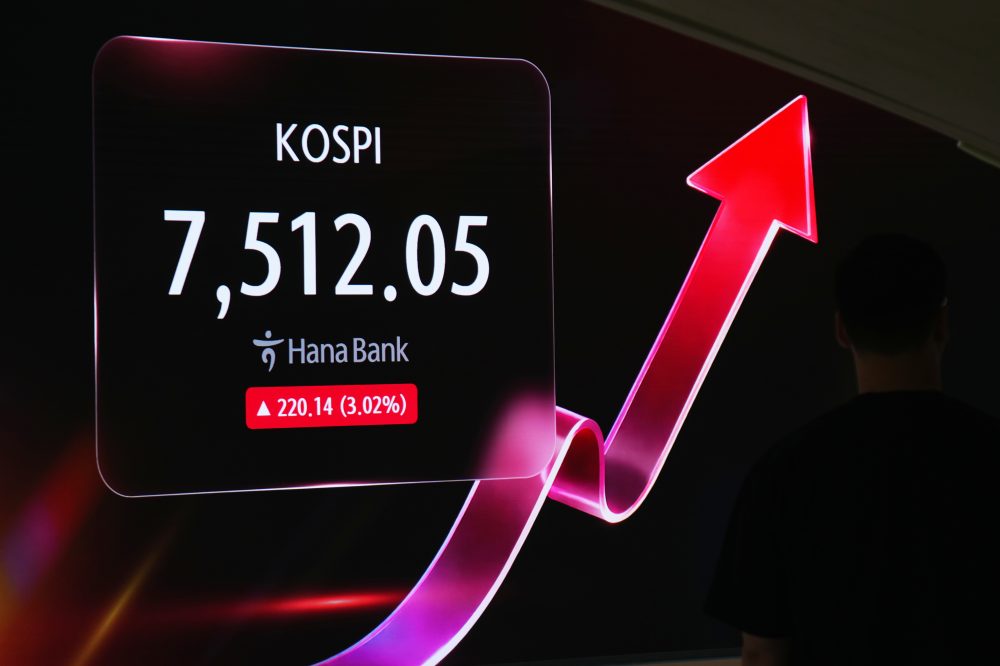
As of Tuesday, the KOSPI was trading below 7,000 points, having dropped about 25% from its record closing high of 9,114.55 points — officially placing it in bear market territory since late June. Despite that, the index is still up approximately 60% for the year, far outpacing the roughly 10% gain seen in MSCI’s broadest global equities benchmark.
“Just as it went up explosively, it went down explosively,” said Lee Seung-ho, a 24-year-old college student who took out margin loans to transform between 10 and 20 million won (roughly $7,000 to $13,000) into 300 million won during the bull run — only to watch those gains disappear.
“I think people like my mom and grandma, while saying Samsung is South Korea’s No.1 company, do not fully understand the risks of leveraged investments (and) think about them rising twice as fast, without thinking of falling twice as fast,” he added.
Few stocks capture the market frenzy quite like SK Hynix, which rode a wave of borrowed money to triple its share price and complete a record-setting $26.5 billion U.S. listing by a foreign company — debuting 14% above its offer price.
That same stock is now at the center of some of the most severe volatility in its history. On Monday, SK Hynix shares fell 14% in Seoul, while a twice-leveraged ETF tied to the stock plunged more than 30% in Hong Kong. The selling compounded itself, deepening losses and pulling the broader KOSPI down 8%.
Samsung Electronics and SK Hynix together make up just over half of the entire KOSPI index, meaning big moves in either company can dominate the direction of the whole market.
“The impact of single-stock leveraged products on the index is higher than in other countries due to the high share of Samsung and SK Hynix in the KOSPI,” said Park Woo-yeol, an analyst at Shinhan Securities. For comparison, a major U.S. stock like Nvidia accounts for only about 7% of the S&P 500.
The KOSPI’s volatility index stood at 82.07 on Tuesday, after reaching an all-time high of 97.99 on June 29 — compared with just 28.85 at the end of 2025.
South Korea’s Financial Supervisory Service announced it would keep an eye on leveraged products and look into aggressive marketing practices if warranted. The Bank of Korea also told a lawmaker it was monitoring whether single-stock ETFs could distort market behavior and amplify volatility.
Foreign investors have pulled a record of nearly $110 billion out of South Korean equities this year, largely to keep their portfolios from becoming too heavily weighted toward the country’s soaring market. That has shifted much of the buying pressure onto everyday domestic retail investors.
Retail investors purchased 13.2 trillion won in KOSPI shares this month, following 42.4 trillion won in purchases during June. Their total borrowed investment in KOSPI shares stood at 28 trillion won as of July 14, just below the record high of 29.8 trillion won reached on June 24.
“Korea is still the biggest portfolio overweight, but I started to reduce,” said Alexander Redman, chief equity strategist at CLSA. “What worries me is that retailers are in the driving seat, because they use a lot of margin.”
It’s worth noting that projected profits at Samsung and SK Hynix have climbed so steeply that forward price-to-earnings ratios have actually declined this year, even as share prices more than doubled.
Still, some experienced investors are keeping their distance.
“I don’t like to buy markets that have been going straight up, so I’m not doing anything,” said Jim Rogers, co-founder with George Soros of the Quantum Fund. “I like things to be depressed and to have lots of unhappiness and gloom around. That’s not the case in South Korea yet.”
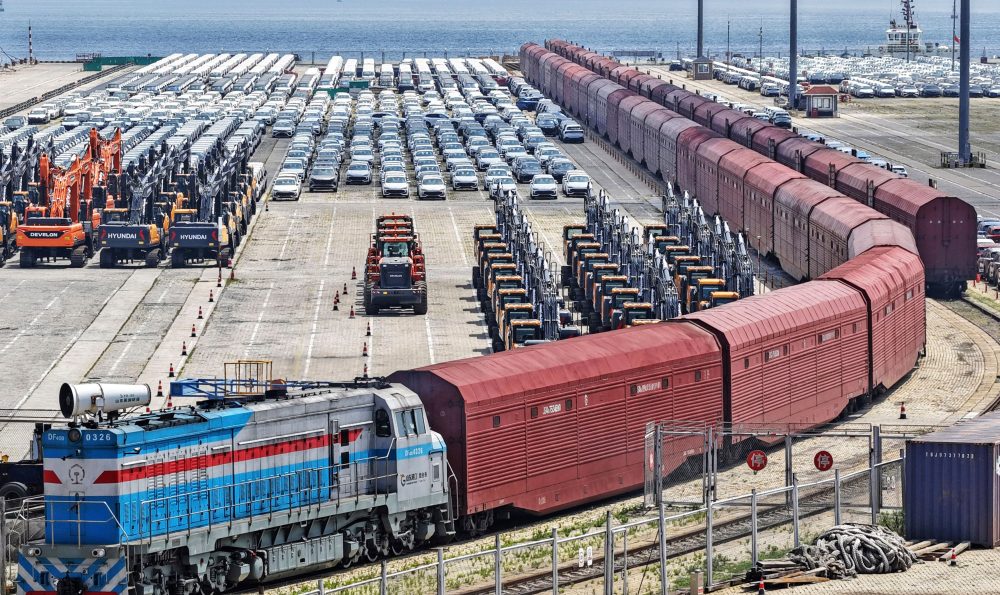
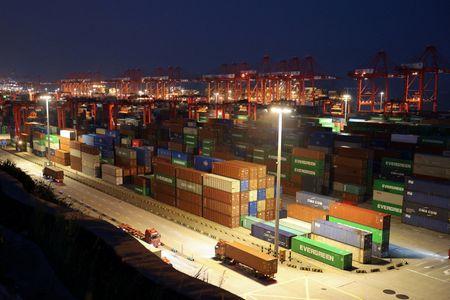
BEIJING — China posted stronger-than-expected trade numbers for June, with export growth hitting its highest level in four months as demand for semiconductors surged and U.S. retailers rushed to place orders before potential new tariffs take effect.
Exports rose 27% compared to the same month a year ago, measured in U.S. dollar terms, according to customs data released Tuesday. That figure easily outpaced the 19.4% gain recorded in April and exceeded the 18.2% growth that economists had predicted.
Imports also came in well above forecasts, jumping 36% — a five-year high — compared to a 27.4% increase the month before. Analysts had anticipated import growth of around 24% for June.
The robust trade performance indicates Chinese manufacturers have managed to keep overseas sales strong despite slowing economic growth in major economies and ongoing uncertainty surrounding trade relations with Washington. Analysts credit surging global investment in artificial intelligence technology, early ordering by U.S. buyers, and aggressive pricing strategies by Chinese exporters for the better-than-expected results.
Global AI investment is acting as a significant buffer for manufacturers operating within China’s $20 trillion economy, even as the ongoing conflict in the Middle East and a prolonged slump in the country’s property sector continue to drag on broader economic growth.
Separate data on manufacturing activity for June, published late last month, showed that overseas demand was beginning to pick up. However, factory-gate prices kept falling as companies slashed prices to attract customers facing higher energy costs tied to the Iran conflict.
American retailers contributed to the export boost by moving their orders forward by four to six weeks, building up inventory for Black Friday and Christmas sales ahead of expected tariff increases later this year. Uncertainty remains elevated, however, following U.S. President Donald Trump’s May visit to Beijing, which fell short of the major breakthroughs many observers had anticipated.
Strong export performance helped China’s economy exceed growth expectations in the first quarter, but that momentum has since faded. Economists warn that weak consumer spending at home leaves China vulnerable if global conditions deteriorate, increasing the likelihood of additional government stimulus measures.
China is scheduled to release its second-quarter GDP figure on Wednesday.
China’s trade surplus for June reached $125.6 billion, up from $105.4 billion in May.
Asian financial markets opened on shaky ground Tuesday, with stocks seesawing between gains and losses and oil prices climbing to their highest point in a month, following President Donald Trump’s announcement that the U.S. would reimpose a blockade on Iranian shipping in the Gulf and charge a 20% levy on all cargo moving through the Strait of Hormuz.
The MSCI index tracking Asia-Pacific shares outside Japan edged up 0.4%, with South Korean stocks leading the way with a 2.2% jump. Japan’s Nikkei 225 gained 0.2%, while S&P 500 e-mini futures slipped 0.1%.
Brent crude futures jumped 2.6% to $85.50 per barrel as Asian trading got underway — the highest price since mid-June.
Chris Weston, head of research at Pepperstone Group Ltd in Melbourne, noted that while tension had been building over the past week, markets reacted sharply to the latest developments in the Iran conflict. “While the risk had been building in the system over the past week, markets reacted aggressively,” he said. He added that “the prospect of tighter monetary policy into a potential energy shock is rarely supportive for risk assets.”
Markets were already on edge following remarks Monday from Federal Reserve Governor Christopher Waller, who suggested the central bank might need to raise interest rates “in the near term” if upcoming economic data show inflation remaining well above the Fed’s 2% target.
On Wall Street the night before, stocks sold off and oil futures surged more than 9% as the U.S.-Iran standoff flared up again, restricting the flow of goods through the Strait of Hormuz. The S&P 500 closed down 0.8% and the Nasdaq Composite dropped 1.6%.
Later Tuesday, U.S. consumer price index data is set to be released, followed by remarks from Fed Chair Warsh, who will present the central bank’s semi-annual monetary policy report to Congress.
Markets are now pricing in a 43.3% chance of a 25-basis-point interest rate increase at the Federal Reserve’s next two-day policy meeting on July 28-29 — up from a 34.2% probability as of Friday, according to the CME Group’s FedWatch tool.
The yield on the 10-year U.S. Treasury bond rose 2.2 basis points to 4.6297%. The U.S. dollar index held steady at 101.29, near its highest levels of the month, while gold slipped 0.1% to $3,997.27.
In Seoul, shares in memory chipmaker SK Hynix were particularly volatile, dropping as much as 4.7% in the opening minutes before swinging to gains of up to 4.6%. The wild swings follow a steep drop the previous day, coming on the heels of the company’s Nasdaq debut last week.
In the cryptocurrency market, bitcoin edged up 0.3% to $62,318.43, while ether rose 0.7% to $1,777.63.
The U.S. dollar held its ground Tuesday as financial markets prepared for a closely watched round of American inflation reports, while escalating tensions between the United States and Iran sent oil prices surging and kept the Japanese yen under pressure.
The dollar index, which tracks the greenback against a group of major currencies including the yen and the euro, was unchanged at 101.27.
All eyes are on inflation this week, with the release of U.S. June Consumer Price Index data on Tuesday, followed by June Producer Price Index figures the next day, and Federal Reserve Chair Kevin Warsh’s first semiannual testimony before Congress also on the schedule.
Worries about a deepening confrontation between the U.S. and Iran resurfaced after President Donald Trump announced Monday that Washington was reimposing a naval blockade on Tehran and would keep the Strait of Hormuz open for a fee, following a fresh round of missile and drone exchanges.
Over the weekend, U.S. and Iranian forces traded heavy missile and drone strikes. Iran struck U.S. facilities in states across the Gulf on Sunday and declared it had once again shut down the strategically critical Strait of Hormuz shipping lane.
Oil prices surged more than 9% to a one-month high on Monday. Both U.S. West Texas Intermediate and Brent crude futures climbed more than 2% to their highest levels since mid-June during early Tuesday trading.
The euro held steady against the dollar at $1.1383, while the British pound traded at $1.3347.
Federal Reserve Governor Christopher Waller stated that interest rates may need to go higher “in the near term” if incoming data shows inflation staying well above the Fed’s 2% goal.
Ray Attrill, head of FX strategy at National Australia Bank, noted in a podcast that a core CPI reading of 0.3% or more would likely suggest — depending on the PPI figures due later in the week — that the Fed’s preferred core PCE deflator is also running at 0.3% or above.
“That may well be a trigger for a Fed rate hike as early as the July meeting,” Attrill said.
Economists’ median forecast for June core CPI was 0.2% growth on a month-over-month basis. Fed funds futures are currently pricing in roughly 30 basis points of rate increases by the U.S. central bank this year, according to LSEG data.
The Japanese yen was nearly flat against the dollar at 162.40, a level that has traders watching closely for possible intervention by Japanese authorities as the currency lingers near 40-year lows.
“Japanese authorities appear to have softened their tolerance a touch, though they remain vigilant and have indicated that further forceful intervention is on the cards should we see another dramatic move from here,” said Matthew Ryan, head of market strategy at Ebury, a British payment firm.
The yen slipped Monday after Reuters reported that Tokyo had no immediate plans to adjust the asset allocations of its state pension funds, cooling expectations for near-term support for domestic assets.
The yen and Japanese bonds had rallied Friday after Finance Minister Satsuki Katayama said the government would look for ways to encourage pension funds — including the Government Pension Investment Fund — to increase their investments in Japanese financial assets.
The Australian dollar last traded at $0.6915 against the greenback. New Zealand’s kiwi rose 0.24% against the dollar to $0.5762.
In cryptocurrency markets, bitcoin edged up 0.23% to $62,293.66, while ether gained 0.56% to reach $1,775.54.
California announced Monday that it has retained the law firm Milbank to assist in its legal effort to block the merger of Paramount and Warner Bros., bringing in seasoned antitrust attorneys to match what the state expects will be a formidable legal team from Paramount’s side.
California Attorney General Rob Bonta explained the decision by saying the state hired Milbank, a prominent corporate law firm, because “we need the firepower.” He added that California anticipated going up against “an army of high-powered private attorneys” representing Paramount.
The attorneys joining California’s effort from Milbank include Richard Parker and James Weingarten. Weingarten is a former U.S. government antitrust lawyer who previously worked on the team that attempted — unsuccessfully — to block Microsoft’s $69 billion acquisition of Activision Blizzard.
On Paramount’s side, Jeffrey Kessler of the law firm Winston Taylor is set to serve as lead trial counsel defending the merger. Paramount has also brought on former U.S. Solicitor General Paul Clement.
The lawsuit, filed Monday, involves California and 11 other states. They contend the deal would give the merged company increased leverage to drive up prices across film and television markets, with the burden ultimately landing on consumers and workers.
The case pits California, New York, and other states led by Democratic officials against major media corporations whose merger received approval in June from the Trump administration.
The Justice Department cleared the transaction following an eight-month review, concluding it was likely to benefit competition rather than harm it.
The hiring of Milbank adds an interesting dimension to the legal battle. The firm is among several that reached agreements with President Donald Trump last year to avoid executive orders his administration had issued targeting prominent law firms over issues including their past clients, hiring decisions, and ties to individuals Trump viewed as adversaries. As part of its agreement, Milbank committed to providing $100 million in free legal services for mutually agreed-upon causes.
California and other states had criticized those settlements at the time, arguing the firms were caving to political pressure.
Despite its agreement with the Trump administration, Milbank has continued to oppose the administration in court on other matters. The firm represented small businesses that challenged Trump’s use of emergency powers to impose broad tariffs, ultimately securing a Supreme Court ruling in February that struck down those measures. In June, Milbank and other attorneys also won a ruling defeating the administration’s lawsuit targeting immigration policies in New Jersey cities.
Milbank, the White House, and the Justice Department did not respond to requests for comment.
Argentine power company YPF Electric Energy has filed paperwork for a U.S. initial public offering, revealing a 45.8% increase in quarterly revenue as part of the process. The filing, submitted Monday, comes as a growing number of energy companies look to secure listings on New York markets amid a more favorable investment climate.
Investor confidence in Argentina has been on the rise following President Javier Milei’s market-focused economic reforms and renewed interest in the country’s energy sector. Another Argentine power firm, Genneia, also submitted its own U.S. IPO filing earlier this month.
YPF Electric Energy focuses exclusively on power generation and runs 17 thermal and renewable power plants across Argentina, with a combined installed capacity of 3,764 megawatts.
IPOX CEO Josef Schuster weighed in on the filing, saying, “Given its significant size and role amongst leading utilities in Argentina, I believe there will be significant interest for the IPO in principle.”
Schuster also pointed to recent market activity as a signal for the timing of the move. “The strong debut of Korea’s SK Hynix last week underlines that the IPO window for large foreign companies to list in the U.S. is wide open. This is the motivation for YPF Electric Energy to go public and trade in the U.S. at this time,” he said.
The company’s renewable energy portfolio — which includes both wind and solar facilities — accounted for 19% of the electricity it delivered in the year ending March 31. The remaining power came from thermal generation. YPF Electric Energy noted that renewable output is expected to grow as recently completed facilities begin ramping up.
For the three-month period ending March 31, the Buenos Aires-based company posted revenue of $217.2 million, up from $149 million during the same period the prior year. Net profit climbed to $66.5 million, compared to $43.4 million a year earlier.
Shares being offered in the IPO are coming from stakeholder BNR Power Investments, which is jointly owned by GE Vernova and China’s Silk Road Fund. YPF Electric Energy itself will not receive any of the money raised through the offering.
Goldman Sachs, BofA Securities, and Citigroup are serving as global coordinators for the IPO. The company plans to list American Depositary Shares on the NYSE under the ticker symbol “YLUZ,” with each depositary share representing 10 Class B common shares.
Thomson Reuters announced Monday that it is cutting what it describes as “a small number of roles” in its engineering division, as the Canadian content and technology company ramps up its use of artificial intelligence across its operations.
The job cuts affect employees worldwide and were disclosed during an internal technology staff meeting held earlier in the day, according to an employee who was present at the gathering. That employee asked not to be identified, since the meeting was not open to the public.
According to that employee, Thomson Reuters is looking to eliminate as many as 500 positions. Based on calculations using the company’s 2025 annual report, that figure represents roughly 1.8% of the company’s total global workforce of approximately 27,100 people.
The cuts represent about 5.2% of the 9,400 workers employed within the company’s operations and technology division.
These reductions are part of a broader trend sweeping the technology industry, where the rise of artificial intelligence tools has made writing software code faster and more efficient — leaving software engineers among the first to feel the financial consequences of the technology’s rapid adoption.
In total, approximately 120,000 technology workers have been laid off across 228 companies — including major players like Meta and Amazon — in 2026, according to the job-tracking website layoffs.fyi.
A Thomson Reuters spokesperson explained the company’s reasoning: “As customer expectations across legal, tax, and regulatory workflows evolve, we are focusing our capacity where it matters most to customers.”
The spokesperson went on to say, “We are supporting affected colleagues through the transition. At the same time, we expect to hire more than 250 net-new engineering roles globally over the next two years, the large majority senior and AI-native.”
Thomson Reuters is the parent company of Reuters News.
Canada’s top banking regulator sent a warning to the country’s largest financial institutions about the cybersecurity dangers posed by Anthropic’s Claude Mythos and other cutting-edge artificial intelligence models, according to an email obtained through an access-to-information request.
The Office of the Superintendent of Financial Institutions — known as OSFI — distributed the message in April to chief technology officers, chief information security officers, and chief risk officers across the financial sector, including major banks and insurance companies.
Cybersecurity specialists describe Mythos as an AI model with an exceptional ability to identify and exploit security weaknesses, posing serious challenges to the banking industry and its older technology infrastructure. Regulators around the world are working to understand the risks that such frontier AI models present.
“Advanced artificial intelligence models, such as Anthropic Claude Mythos, significantly compress the timeframe for effective risk mitigation,” OSFI stated in the email.
“Accordingly, this bulletin is grounded in our existing guidance and outlines sound practices that institutions can adopt to enhance the speed and effectiveness of risk identification, mitigation and response,” the regulator added.
Portions of the email were withheld under certain provisions of the Access to Information Act. OSFI’s recognition of the risks tied to Mythos could push Canadian banks, insurers, and other regulated entities to invest more in technology that shields customers from cyber threats.
After Reuters submitted questions to OSFI last week, the regulator published a public bulletin on generative and agentic artificial intelligence on Monday.
“OSFI takes a technology-neutral, risk-focused approach to emerging technologies, including advanced artificial intelligence models such as Mythos. Our focus is not the technology itself, but how federally regulated financial institutions govern and manage the risks associated with its use,” OSFI said in its written response.
In early April, Canadian bank executives sat down with regulators to talk through the dangers of Mythos — a meeting that followed a similar urgent gathering in the United States, where Treasury Secretary Scott Bessent and then-Federal Reserve Chair Jerome Powell brought together bank CEOs to address cyber risks linked to Anthropic’s latest AI model. OSFI formally sent its email to company executives on April 29.
OSFI oversees the stability of Canada’s financial sector, covering everything from banks to pension funds, and monitors threats stemming from foreign interference, geopolitical tensions, and new technologies.
The cyber capabilities of certain frontier AI systems are viewed as so formidable that access has been restricted in some regions — euro zone banks are currently barred from using Mythos.
Anthropic has also navigated a complicated relationship with the U.S. government. A federal judge blocked an initial Pentagon blacklisting of the company in March, and tensions have since eased following the private release of Mythos.
Three of Canada’s six largest banks — Royal Bank of Canada, TD Bank, and BMO — have laid out plans to generate revenue from their AI investments, having moved beyond experimental projects into practical applications such as customer chatbots, internal tools, and reduced dependence on outside vendors. Bank of Nova Scotia, CIBC, and National Bank have also announced various AI initiatives.
The Canadian government has said it has access to Anthropic’s Project Glasswing, a program that allows companies to use Mythos, though it remains unclear which Canadian banks, if any, are currently using it. Some banks directed questions to the Canadian Bankers Association, which said financial institutions have made significant investments to protect the financial system and are meeting OSFI’s requirements for cyber risk management and incident reporting.
In a June interview, RBC’s chief technology officer Bruce Ross said Mythos highlighted a fundamental shift in how cyberattacks unfold, making it critical for organizations to respond quickly since new attack methods can surface the moment vulnerabilities are discovered.
“The way we’re (the industry) dealing with it is, building our own AI defenses… we’ll continue to do that,” Ross said.
The federal government posted a $120 billion budget deficit in June, a stark reversal from the $27 billion surplus recorded in June of last year, the U.S. Treasury Department announced Monday. Officials pointed to growing refunds stemming from President Donald Trump’s tariffs as a major factor behind the shift.
According to the Treasury, the government collected $23.6 billion in gross customs duties during the month, but paid out $49.2 billion in refunds — resulting in a net outflow of $25.6 billion. Total receipts for June fell by $31 billion, or 6%, compared to the same month a year ago, coming in at $496 billion.
Total government spending for June reached $616 billion — an increase of $117 billion, or 23%, over the reported June 2025 figure. However, the Treasury noted that last year’s June outlay total was reduced by $97 billion due to timing shifts in benefit payments. When adjusted for that calendar difference, the June deficit was $53 billion higher than the prior year’s adjusted deficit of $67 billion, representing a 79% increase.
Interest payments on the national debt were also a significant factor. The Treasury’s gross interest outlays on public debt climbed $41 billion, or 28%, to $185 billion for the month. That figure was partially offset by a $10 billion increase — about 17% — in interest received by federal trust funds, which totaled $70 billion.
Looking at the broader fiscal picture, the cumulative deficit for the fiscal year to date rose $29 billion, or 2%, reaching $1.367 trillion. Revenues for that period were up $143 billion, or 4%, totaling $4.151 trillion, while spending increased $172 billion, or 3%, to $5.518 trillion.
PARIS — Saudi airline startup Riyadh Air is weighing the purchase of an additional 25 to 30 Boeing 787 Dreamliner aircraft by converting the majority of its existing contractual options with the American aircraft manufacturer into firm orders, according to industry sources.
The carrier, which completed its first commercial revenue flight just last month, originally placed an order for as many as 72 Boeing Dreamliners back in 2023. That agreement included 39 confirmed purchases along with options for 33 additional planes.
Industry sources say a formal announcement converting most of those options into definitive purchases could come as soon as next week at the Farnborough Airshow. However, the sources noted that the finer details of the deal are still being worked out.
Neither Riyadh Air nor Boeing offered any comment when contacted about the potential order.
California is leading a coalition of 12 states in a legal effort to stop Paramount from completing its $110 billion purchase of Warner Bros. Discovery, with the states warning the deal would hand a single media company an outsized grip on the film and television industries.
The merger is central to Paramount CEO David Ellison’s vision of turning his company into a powerhouse competitor to streaming giants like Netflix and Disney. However, the states contend the deal would damage movie theaters, pay TV providers, and ultimately hurt everyday consumers and workers.
In the lawsuit, the states wrote that after the merger, the combined company would collect more than 25 cents of every dollar generated by wide-release theatrical films and basic cable channels across the United States. “This merger, in short, would create a media behemoth,” the states declared in the filing.
Paramount fired back, saying the lawsuit twists established antitrust law and misrepresents how competition actually works in the entertainment business.
The deal had already received a green light from federal antitrust regulators last month, a clearance that some critics have questioned given Paramount CEO David Ellison’s family ties to Republican President Donald Trump. Ellison’s father, billionaire Oracle co-founder Larry Ellison, has cultivated a relationship with the president. Notably, all of the state attorneys general who joined Monday’s lawsuit are Democrats.
According to the states, if the merger goes through, the new company would control 27% of the market for films distributed to theaters nationwide, 30% of the blockbuster film distribution market, and 27% of the basic cable channel market.
Hollywood workers have spoken out against the deal, fearing widespread job losses, while theater owners worry it would mean fewer films being made. The U.S. Department of Justice, which cleared the deal last month, took the opposite view, saying it would be good for consumers and workers.
Paramount shares climbed 2.9% after the lawsuit was filed, while Warner Bros. shares rose 2.6%.
A court ruling on the states’ challenge is not expected for several months, a delay that could cost Paramount hundreds of millions of dollars. The states have asked the company to hold off on closing the deal until the courts resolve the matter — and warned they will seek a court order to block the closing if Paramount refuses.
The states argued that Paramount and Warner Bros. currently compete fiercely for prime release dates and screen time at thousands of movie theaters. Without that rivalry, both theaters and moviegoers could end up paying more, the states said.
Pay TV providers and their customers would also feel the impact, the states argued, since the two companies together would control major networks including CNN, MTV, HGTV, Cartoon Network, and Nickelodeon.
Joining California in the suit are Arizona, Colorado, Connecticut, Massachusetts, Minnesota, Nevada, New Jersey, New Mexico, New York, Oregon, and Washington.
Oregon Attorney General Dan Rayfield commented on the decision to act despite federal approval, saying, “Despite the federal regulators rubber-stamping this bad deal, we’re stepping up to protect families, small businesses, and Oregon’s film industry.”
Paramount has argued the merger will actually increase output, not reduce it, after the company trims $6 billion in overlapping infrastructure, marketing, and corporate positions. CEO Ellison has pledged that the merged film studios would put out 30 movies per year.
The states dismissed that commitment as unenforceable, adding that even if Paramount kept its word on film output, the company would still have the market power to raise prices and reduce quality. They also warned the merger would ripple through state economies, putting tens of thousands of writers, actors, crew members, and other entertainment workers at risk.
Paramount has agreed to pay roughly $650 million per quarter to Warner Bros. Discovery shareholders if the deal fails to close before October. The company has cautioned that delays could force a renegotiation of the deal’s financing, create instability for its stock price, or even cause the transaction to fall apart entirely.
NEW YORK — A group of 12 states went to court Monday to try to block what would be one of the biggest deals in entertainment history — Paramount’s proposed takeover of Warner Bros. Discovery, a transaction valued at $81 billion that critics say would wipe out competition in Hollywood and put thousands of industry jobs at risk.
California’s attorney general is spearheading the legal effort, with the states calling on both companies to hold off on finalizing the merger until the courts have had a chance to weigh in. If the companies refuse to wait voluntarily, the coalition says it will seek a temporary restraining order to force a pause.
“The unlawful merger of these two entertainment behemoths would lead to higher prices, lower quality, and less content for film and television, harming movie theaters, basic cable distributors, and ultimately, audiences on every sofa and movie theater seat in the U.S.,” said California Attorney General Rob Bonta in a written statement.
Joining California in the lawsuit are Arizona, Colorado, Connecticut, Massachusetts, Minnesota, Nevada, New Jersey, New Mexico, New York, Oregon, and Washington. Skydance-owned Paramount did not respond to a request for comment by Monday, and Warner Bros. directed all questions back to Paramount.
Paramount, which was acquired by Skydance just last year, is looking to absorb all of Warner Bros. Discovery. If completed, the deal would bring together properties like HBO Max, the “Harry Potter” franchise, and CNN under the same corporate umbrella as CBS, “Top Gun,” and the Paramount+ streaming platform.
The lawsuit lands at a critical moment. After a very public bidding competition with Netflix that played out over months, the deal received shareholder approval in April and then got the green light from the Trump administration just last month. Still, the states’ legal challenge could delay or derail those plans.
The U.S. Justice Department has chosen not to oppose the merger — and went further by releasing an unusually detailed statement of support, arguing the combined company would “increase competition across the media and entertainment ecosystem, with benefits for American consumers and workers.”
Paramount has also pointed to regulatory approvals it says it has secured in several other countries, including China, Canada, and Australia. However, reviews are still underway in the European Union and the United Kingdom, with the U.K. hinting it may step in to examine the deal separately.
Both companies had previously indicated they hoped to wrap up the transaction sometime during the third quarter of this year and have recently signaled a push to finish the process within the coming weeks. There is financial pressure to move quickly — Paramount has promised shareholders a 25-cent per share “ticking fee” for every quarter the deal remains unclosed past September 30. The company has also agreed to a $7 billion regulatory termination fee. When debt is factored in, the full value of the acquisition reaches nearly $111 billion, or about $31 per share.
Supporters of the merger argue that combining the two companies — particularly the HBO Max and Paramount+ content libraries — would give consumers access to more programming and help both businesses grow. Opponents, however, warn that further consolidation in an industry already dominated by a small number of major players could do more harm than good.
Thousands of actors, writers, directors, and other entertainment professionals have gone on record with what they call “unequivocal opposition” to the deal, saying it would shrink job opportunities and limit choices for both filmmakers and audiences. A number of lawmakers have raised similar concerns.
Democrats have questioned whether regulators operating under President Donald Trump would give the deal the scrutiny it deserves, with worries about political influence hanging over the process. The Justice Department has insisted politics played no role in its decision — but Trump himself has at times publicly commented on Warner’s future, even after walking back earlier suggestions about his personal involvement in the outcome.
Trump also has a well-documented relationship with the Ellison family, including Oracle founder Larry Ellison, who is contributing billions of dollars to back the bid being pursued by his son’s company. Much of the attention has focused on CNN, a network that has long been a target of criticism from Trump and his allies. Paramount’s CBS has already undergone significant changes in editorial leadership since Skydance took over — and a completed Warner merger could extend that influence further. Several Trump administration officials have been open about their hopes for CNN’s direction under new ownership. Defense Secretary Pete Hegseth told reporters in March that “the sooner David Ellison takes over that network, the better.”
Shein Executive Chairman Donald Tang is preparing to exit his leadership role as the global fast-fashion company edges closer to completing its initial public offering, three sources with direct knowledge of the situation told Reuters on Monday.
Tang has spent the past three years serving as the public-facing representative of Shein, a role in which he engaged with politicians and regulators across the globe on behalf of the company’s secretive founder, Sky Xu. Tang, a Chinese-American billionaire who built his early career in banking, also represented Shein at conferences and various public events.
With Tang’s departure on the horizon, observers are now wondering whether Xu will take a more visible role himself, hand responsibilities to one of his co-founders, or recruit a new outside executive to fill the gap.
According to one source familiar with the company’s internal thinking, Tang, 63, will transition into a senior adviser position and continue working alongside the management team for the time being. That source noted there is no set timeline for when the change will officially take place.
Shein did not offer any comment and left unanswered questions about who would take over Tang’s responsibilities. One source indicated that Xu — not Tang — is expected to lead the investor roadshow ahead of the company’s stock listing.
Tang, who is based in Los Angeles, was reportedly introduced to Xu by Neil Shen, the founding and managing partner of HSG, formerly known as Sequoia Capital China. He was selected for the executive chairman role due to his background managing business interests between China and the United States, as well as his extensive network of contacts in both finance and political circles, according to one of the sources. Shen did not respond to a request for comment.
Tang’s original goal was to guide Shein through a listing on the New York Stock Exchange, and he relocated to Washington, D.C. to lobby lawmakers there. As scrutiny grew over Shein’s use of the “de minimis” customs duty exemption — which allows low-value goods to enter the U.S. without tariffs — Tang moved proactively in July 2023 to publicly support eliminating that waiver. He also worked to counter allegations from U.S. lawmakers that Shein’s Chinese supply chain had ties to forced labor, a charge Beijing strongly denies.
When the New York listing effort fell through and Shein turned its attention to London, Tang became a regular presence at the five-star Peninsula hotel near Hyde Park, frequently accompanied by his dog, a teacup Australian Shepherd named Satchi. However, the London bid also collapsed after China’s securities regulator withheld its approval, even though British financial regulators had already given the IPO the green light. The company then shifted its sights to a Hong Kong listing.
Tang had hoped to leave behind a legacy of stronger internal oversight — including better systems for removing sellers of illegal products from Shein’s marketplace — and improved relationships with regulators worldwide, one source said. Last year, he led an internal effort to strengthen regulatory compliance after Shein faced significant fines from regulators in France and Italy.
However, in November, French authorities discovered child-like sex dolls being sold through Shein’s online marketplace, setting off a national scandal and prompting a government crackdown. The controversy erupted just as Shein was opening its first permanent retail location inside the BHV department store in Paris. A large promotional poster featuring Tang and his dog Satchi had been displayed on the BHV building ahead of the launch, but it was removed shortly afterward. Shein has since abandoned its French retail store venture.
Bank of America announced Monday that it has added nine senior-level investment bankers to its roster across the United States, a strategic move aimed at meeting rising demand from middle-market businesses.
The newly hired professionals are located in Austin, Boston, Charlotte, Chicago, Detroit, Minneapolis, New York, San Francisco, and West Palm Beach. They join an already established team of more than 200 bankers working across 26 cities who are focused specifically on serving middle-market clients.
Mike Joo, co-head of BofA’s Global Investment Banking, spoke to the importance of this segment of the economy. “Middle market companies play a vital role in driving business and economic growth across the U.S., and we continue to see significant opportunity to help these businesses grow, invest and achieve their objectives,” he said.
Bank of America also noted that it has held the top investment banking ranking among global commercial banking clients for three straight years, while also growing its market share year after year.
Here is a breakdown of the nine bankers joining the team:
Bob Berry will come aboard as a managing director in Boston in late July, arriving from Rothschild. Matt Dalton will join as a managing director in Minneapolis in early August to cover the Midwest region, coming from Lazard.
Rick Florjancic will step in as a managing director in Chicago in mid-September, where he will lead that office and help broaden senior leadership coverage across the wider Midwest. He is coming from BMO Capital Markets.
Ian Mackay will join as a managing director in Charlotte in mid-August, where he will strengthen the middle-market financial sponsors practice across the Southeast and nationally. He previously worked at BlackArch Partners.
Joe Park has already joined as a managing director in Detroit, where his focus will be expanding client coverage across the Midwest. He previously held the roles of president and chief financial officer at Princeton NuEnergy and served in executive positions within SK Group.
Mitch Theiss has rejoined the bank as a vice chair in West Palm Beach, where he will help grow coverage of Florida-based middle-market clients and family businesses while providing senior-level support on key relationships. He most recently was a partner at Seabrook Partners.
Daniel Webb has also rejoined, this time as a managing director in Austin, to expand coverage across Texas and the broader Southwest. He brings more than 15 years of investment banking experience along with deep expertise in the technology sector.
Joe Winters will come on board as a managing director in San Francisco in early August, joining from JPMorgan. And Bo Brown has recently joined as a managing director in New York, where he will strengthen advisory work across financial sponsors, industrial, and middle-market clients. He came from BMO Capital Markets.
California and 11 other states have gone to court to stop Paramount from completing its $110 billion purchase of Warner Bros. Discovery, claiming the merger would weaken competition in both film distribution and cable television — ultimately hurting movie theaters and pay TV providers.
The legal challenge poses a significant obstacle to Paramount CEO David Ellison’s ambition to reshape his company into a major rival against streaming giants like Netflix and Disney.
“With this lawsuit, California and our sister states are fighting for free and fair markets, not rigged markets. America has no kings in government or our economy,” Bonta said in a statement.
According to the states filing the suit, if the deal goes through, Paramount would control 27% of the market for distributing films shown in theaters across the country, 30% of the blockbuster film distribution market, and 27% of the market for basic cable channels.
A court ruling on the states’ challenge is not expected for several months, and the delay could cost Paramount hundreds of millions of dollars in the meantime.
The proposed merger has already sparked backlash from actors, writers, and others in the entertainment industry who fear it will result in job losses. Theater owners have also pushed back, worried that combining the Warner Bros. movie studio with Paramount Pictures would lead to fewer films being made.
Paramount, for its part, has argued the deal will actually increase production rather than reduce it, even as it plans to cut $6 billion by eliminating overlapping infrastructure, marketing operations, and corporate positions. Ellison has pledged that the merged studios would put out 30 films per year.
Despite the state-level opposition, the U.S. Department of Justice has already signed off on the deal, concluding it does not create any competition problems.
Paramount CEO David Ellison’s father, billionaire Oracle co-founder Larry Ellison, has developed connections with President Donald Trump, and the company has brought on former Trump administration officials.
Paramount has agreed to pay Warner Bros. Discovery shareholders roughly $650 million per quarter in fees if the deal fails to close before October. The company has warned that prolonged delays could force it to revisit the deal’s financing terms, create instability for its stock price, or potentially derail the transaction entirely.
Intel has kicked off a massive €5 billion — roughly $5.7 billion — capital investment at its manufacturing campus in Leixlip, just outside Dublin, Ireland. The U.S. chipmaker announced Monday that the funding is designed to expand European production and keep pace with surging worldwide demand for artificial intelligence and high-performance computing technology.
According to Intel, the investment will push its European manufacturing base to maximum capacity by growing current production levels, advancing research and development efforts, and making better use of existing cleanroom space at the Leixlip facility.
Intel is a major player in Ireland’s economy, which has long relied on attracting foreign investment. The company has poured €30 billion into the country since first setting up operations there in 1989. More than half of that total — invested between 2019 and 2023 — went toward doubling the plant’s capacity so it could produce the company’s most cutting-edge chip technologies.
The chipmaker, which has approximately 4,900 employees in Ireland, said the latest round of spending at Leixlip got underway earlier this year. The funds will be used to upgrade existing fabrication facilities and bring in state-of-the-art manufacturing equipment capable of producing Intel Xeon 6 processors, as well as a next-generation Intel Xeon chip built on the company’s Intel 3 manufacturing process.
Naga Chandrasekaran, executive vice president of Intel Foundry, emphasized the broader significance of the investment. “We are not just increasing output of critical products, we are ensuring Ireland remains at the forefront of the world’s most advanced manufacturing ecosystems, while strengthening the region’s role in the global technology landscape,” he said in a prepared statement.
Fintech company Payoneer Global, which trades on the Nasdaq, is set to hire approximately 300 engineers by the close of 2026 as part of its launch of a new global capability centre in India. The move puts Payoneer alongside a growing number of international firms turning to the world’s most populous country to meet their workforce demands.
Major financial technology players such as Mastercard, PayPal, and Revolut have already established India-based centers to drive product development, handle payment processing, and expand their artificial intelligence capabilities. According to industry consultant ANSR, revenue generated by global capability centres in India is projected to grow 12% to $84 billion by 2026.
Payoneer, which operates as a cross-border platform for sending and receiving payments, intends to recruit AI and platform engineers for its new facility in Gurugram, located near Delhi. The site is expected to become the company’s second-largest technology and research and development center in the world, according to Gaurav Gupta, the company’s India site leader, who spoke publicly on Friday.
Gupta explained the reasoning behind the company’s decision to set up operations in India: “India has an amazing talent pool for people who have experience in building financial technologies at a very large-scale (with) deep-tech expertise. So our key reason to come to India is to tap into the talent density.”
Payoneer already maintains an office in Bengaluru focused on sales operations for the local Indian market, employing around 400 people.
Last month, Canadian fintech company Nuvei announced it intends to purchase Payoneer in a deal valued at roughly $2.75 billion, pending regulatory approval. Gupta indicated that the proposed buyout would have no effect on the India global capability centre or its day-to-day business activities in the region.
Maxivision Super Specialty Eye Hospitals, an Indian eye-care chain supported by healthcare-focused investment firm Quadria Capital, has brought on ICICI Securities and IIFL Capital to help prepare for a planned initial public offering in 2027, according to two people with knowledge of the situation.
The company, which was founded in 1996 and is headquartered in Hyderabad, currently operates more than 90 eye-care facilities spread across six Indian states. It operates in a competitive space alongside other eye-care chains such as Dr. Agarwal’s Health Care, Centre for Sight, and ASG Eye Hospitals.
Demand for eye care in India is being fueled by an aging population, increasing rates of diabetes, and expanding health insurance access. According to data from Grand View Research, the Indian eye-care market is expected to climb from $12.8 billion in 2025 to $31.2 billion by 2033.
Sources say Maxivision is still in the early phases of its IPO preparations. The offering is expected to include a combination of newly issued shares and existing shares being sold by current investors. The final size of the offering has not been set, the sources noted, speaking on condition of anonymity given the private nature of the discussions.
Maxivision did not offer a comment on the matter, and ICICI Securities, IIFL Capital, and Quadria Capital had not responded to requests for comment at the time of publication.
The move comes as India’s healthcare sector sees a surge in investment and capital markets activity. Reuters previously reported that KKR is in advanced discussions to purchase a controlling stake in the Indian operations of Sweden-based Medicover for at least $1 billion. Additionally, Manipal Health Enterprises earlier this year submitted paperwork for an IPO that could bring in as much as $1.17 billion.
American households and the Federal Reserve are facing a fresh inflation challenge — this time driven by the explosive growth of artificial intelligence.
Investment in data centers built to power AI is expected to surpass $700 billion this year alone. That surge in spending has driven up the cost of memory chips, computer processors, and other hardware, while also pushing electricity prices higher. Economists say the pressure on prices is expected to continue at least through the end of 2025.
While the impact isn’t expected to rival the inflation surge of 2021 through 2023 — when prices peaked at 9.1% — the AI-driven spending wave could keep inflation running hotter than the Federal Reserve would prefer. That could prompt the central bank to raise its key interest rate later this year, a move that typically leads to higher costs for car loans, home mortgages, and business borrowing.
Fed officials are expected to closely examine June’s inflation report, set for release Tuesday, for early signs of AI’s effect on prices. Inflation last month likely eased somewhat, in part because gasoline prices dropped after a ceasefire was reached between the U.S. and Iran — though that situation has since changed as fighting has resumed.
Just four major technology companies — Google’s parent Alphabet, Amazon, Meta Platforms, and Microsoft — are projected to spend a combined $720 billion this year, with the bulk of that going toward data center construction.
Those facilities require enormous quantities of semiconductors, and chip supplies have been stretched thin. Economists at JPMorgan Chase estimate that the price of certain computer memory chips could climb as much as 400% between 2024 and the close of this year.
Consumers are already feeling the pinch at the checkout counter. Prices have risen on a wide array of electronics, including laptops, smartphones, video game consoles, and desktop computers. Utility bills are also climbing as data centers consume an ever-larger share of newly generated electricity.
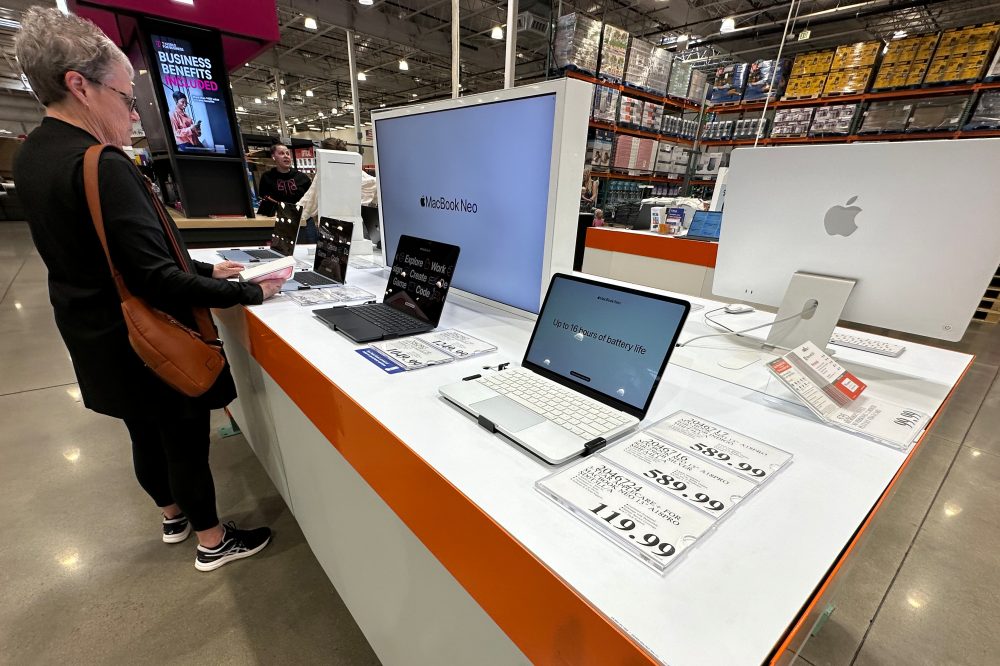
Last month, Apple announced it was raising prices on its laptops and iPads by roughly 15% to 25%. Its top-of-the-line MacBook now carries a price tag of $1,999, up from $1,699. Analysts widely expect iPhone prices to follow suit.
In a statement, Apple explained the increases this way: “The rapid expansion of AI data centers has created an extraordinary surge in demand for memory and storage. We have never seen a component price increase this much, this quickly.”
On the same day Apple made its announcement, Microsoft said the price of its Xbox video game console would increase by $100 by August 1st, pointing to higher memory chip costs as the reason. Sony has similarly raised prices on the PlayStation, and both Dell Computer and HP have increased prices on their laptop lines.
Analysts at investment bank Evercore ISI recently noted that a “wave of AI-related cost pressures spilling over into consumer prices is still in the early stages of building.”
The overall effect on broad inflation measures may be relatively contained. Many economists project that AI investment will add roughly half a percentage point to core consumer prices — which strip out food and energy costs — by year’s end.
Even so, that increase could cancel out price relief coming from other directions, such as the fading impact of President Donald Trump’s tariffs and cooling rental costs. Core inflation, based on the Fed’s preferred measure, stood at 3.4% in May. Some economists now believe it may only dip slightly by December, staying well above the Fed’s 2% goal.
The AI-driven price pressure may prove to be temporary, but it follows earlier rounds of inflation tied to tariffs and a spike in gasoline prices stemming from the conflict with Iran. The Fed generally overlooks short-lived price increases rather than raising rates to combat them — but a long string of temporary shocks could fuel more lasting inflation, which has already been above the Fed’s target for more than five years.
“In isolation one or two such shocks is perhaps transitory, something they’re willing to live with,” said Abiel Reinhart, an economist at J.P. Morgan. “A sustained series of shocks, or a wider range of shocks, becomes more concerning to them.”
Fed policymakers are increasingly focused on AI’s potential to stoke inflation. Kevin Warsh, who took over as chair on May 22nd, has expressed the view that AI will ultimately make the U.S. economy more efficient, which should reduce inflation over time even as growth picks up. However, in remarks delivered July 1st, he acknowledged that AI investment is currently boosting demand, though he stopped short of predicting how inflationary the effect would be.
Despite that cautious optimism, many Fed officials are worried that demand for AI-related equipment will keep outpacing supply — a dynamic that tends to sustain higher prices.
“If this creates a sustained impulse to demand relative to supply in inflation, I do think that’s the kind of situation where you don’t look through this,” said John Williams, president of the Federal Reserve Bank of New York and vice chair of the Fed’s rate-setting committee, speaking Thursday. Williams has previously favored holding rates steady, but his comment signals he could back a rate hike under certain conditions.
Minutes from the Fed’s June 16th and 17th policy meeting, released Wednesday, indicate that many other officials share Williams’ concerns.
AI’s massive appetite for electricity is another route through which the technology could drive up prices. Power companies across the country are adding new capacity to meet demand — a costly process that can push utility bills higher for everyone.
According to government data, electricity prices rose 5.9% in May compared to the same month a year ago, outpacing overall inflation, which came in at 4.2%. After a spike during the pandemic, electricity price growth had settled back to around 2% annually in early 2025 before the AI-driven demand surge took hold.
While chip prices could peak and begin to fall later this year, experts believe AI’s electricity demands will keep utility costs elevated through 2028 or longer. Economists at Goldman Sachs projected in February that electricity prices will climb 6% both this year and next, followed by an above-average increase of 3% in 2028.
“We do know what effect AI is having on inflation now, and it is inflationary, not deflationary,” wrote Dario Perkins, an economist at TSLombard, in a note published this week.
A decision by Michael Saylor’s bitcoin-accumulating company Strategy to approve more bitcoin sales has put renewed scrutiny on a group of publicly traded crypto stockpiling firms that are feeling the pressure of declining cryptocurrency values.
Strategy’s stock got a brief bump on Friday after analysts gave their approval to a plan unveiled late last month. That plan includes a stock buyback program and authorization to sell up to $1.25 billion worth of bitcoin.
The company’s shares had surged in late 2024 and through much of last year, but dropped to two-year lows last month. Strategy has already offloaded roughly $218 million in bitcoin so far this year, using the proceeds to cover dividends and rebuild its cash reserves.
Those sales have reignited debate about the long-term viability of the many copycat companies known as “digital asset treasury” firms, or DATs. These companies exploded in popularity last year, riding a wave of investor enthusiasm tied to U.S. President Trump’s pro-crypto stance.
DATs give investors a way to gain exposure to cryptocurrency through regulated public companies, while also offering the potential for amplified returns. However, the model is extremely vulnerable to falling crypto prices, which can shrink the value of their holdings, make fundraising more difficult, and undermine the leveraged returns that draw investors in.
Bitcoin, the most widely held cryptocurrency, has plunged as much as 33% this year as markets have grappled with geopolitical tensions, rising oil prices, and a reshaping of the Federal Reserve under new chair Kevin Warsh. The fortunes of DAT companies have fallen right along with it.
The combined market value of DAT companies hit its peak last July, when the broader crypto market reached $4 trillion in total value. That was followed by a sharp decline in November after global trade fears triggered a record $19 billion liquidation of crypto positions. These companies have not been able to fully recover in 2026 as the crypto market has remained sluggish.
Many DATs traded at a premium to their actual crypto holdings last year, because investors expected them to use access to equity and debt markets to keep buying more tokens. But starting late last year, the companies’ combined market value relative to the net asset value of their crypto holdings — a measure called mNAV — dropped below 1. That means the companies were trading at a discount to what they actually hold.
This is a significant problem, since most DATs need their shares to trade above their net asset value to attract new capital. Strategy’s own mNAV dipped below 1 for the first time late last month.
Despite the challenges, executives at DAT companies have said their long-term success will depend on making smart investment choices, and they are exploring new ways to increase value for shareholders, according to previous reporting.
Weekly trading volume in DAT shares peaked last August, according to data from blockchain data provider Artemis Terminal, but has been volatile since. Volume hit a low point in February, following a selloff in bitcoin and other cryptocurrencies triggered by news that Warsh would be nominated to lead the Federal Reserve. Analysts expect Warsh to push for reducing the Fed’s balance sheet — a move that would drain liquidity from the financial system and act as a drag on risk assets like cryptocurrencies.
Strategy remains by far the largest holder of crypto among these companies, even after this year’s bitcoin sales. BitMine Immersion Technologies, which holds ether — the second-largest cryptocurrency behind bitcoin — has the next biggest stockpile.
Several other crypto treasury companies have also sold portions of their holdings this year. Nakamoto Inc., which describes itself as a bitcoin operating company, sold roughly 5% of its bitcoin in March and another approximately 600 bitcoin in June.
All companies mentioned in this report either declined to comment or did not respond to requests for comment.
American chip stocks have stumbled out of the gate in July, and market watchers say more turbulence could be on the way as investors grapple with lofty valuations and growing uncertainty about how long the artificial intelligence spending boom will last.
The Philadelphia Semiconductor index has dropped more than 11% since reaching a record peak in June. Despite that slide, the index remains up 83% for the year — a figure that hangs over every conversation about the sector’s future. These companies have benefited enormously from rising prices and supply-demand imbalances, but financial markets are always looking ahead.
Steve Sosnick, chief market analyst at Interactive Brokers, put it plainly: “We’ve never seen this kind of extreme earnings growth. But the question then becomes, how long can we expect this to continue.”
Money Flowing Out
Funds that track U.S. semiconductor stocks saw outflows of roughly $11 billion during the week ending June 24 — the largest weekly exodus of money from the sector this century, according to LSEG Lipper data. That followed two weeks in which those same funds had pulled in about $12 billion in fresh investment, underscoring just how volatile sentiment has become.
Analysts broadly expect that major technology companies will keep spending heavily on cloud and AI infrastructure. A note from BofA Securities this week projected that global cloud and AI infrastructure capital expenditure could approach $1.5 trillion by 2027, representing a 40% to 50% jump year over year. Much of the current anxiety, analysts say, is driven by hypothetical scenarios — what happens if stock prices fall or companies start cutting their capital spending plans.
Wall Street Still Bullish
Despite the recent dip, U.S. brokerages have been raising their price targets for chip stocks, fueled by expectations that demand for AI technology will keep supporting earnings growth.
Among S&P 500 chipmakers, Micron has the highest projected upside relative to its current price — more than 60% — based on the consensus analyst target, according to LSEG data. Memory chipmaker Sandisk’s shares are seen rising more than 30%. Nvidia’s stock is expected to climb over 40%.
SK Hynix, another memory chip company, jumped more than 10% in its U.S. trading debut on Friday after a $26.5 billion share sale, buoyed by soaring memory prices driven by tight supplies.
However, several other large semiconductor firms are already trading near their median 12-month price targets, suggesting that much of the expected gain may already be reflected in current prices.
Alexander Lis, chief investment officer at SD Ventures, offered a note of caution: “I consider elevated price targets to be rather a consequence of the incredible momentum in semis rather than a reliable indicator of future performance.”
Short Sellers Returning
Data analytics firm ORTEX reports that bets against major semiconductor companies have been building over the past year, with short interest now sitting at a three-year high.
Peter Hillerberg, co-founder at ORTEX, described the trend this way: “This is caution and hedging creeping back into the sector after a huge run, not the kind of crowded, high-conviction shorting that leads to squeezes.”
Hillerberg added that short interest in these stocks has nearly doubled on average over the past three years, with the biggest increases seen in Marvell, Qualcomm, and Micron.
Earnings Under the Microscope
Earnings for companies on the S&P 1500 Semiconductors & Equipment Industry index are expected to more than double this year, driven largely by Micron and Nvidia, according to data compiled by LSEG. But that growth is projected to slow in 2027, with profits expected to rise 46.1%.
Adding to the uncertainty, the unclear path for U.S. interest rates and ongoing conflict in the Middle East could weigh on future earnings estimates.
The Valuation Question
Nvidia, which has been central to the AI-driven market rally, is currently trading at a forward price-to-earnings ratio of about 19 — its lowest level in more than a decade. Micron’s forward P/E touched a nine-year low of 5.4 back in May.
Chris Maxey, chief market strategist at Wealthspire Advisors, explained: “The valuations have gotten cheaper over the last two years, and that’s primarily a function of earnings growing faster than the price.”
Still, forward P/E ratios for Intel, Advanced Micro Devices, and Marvell Technology remain well above their long-term averages, suggesting that earnings expectations haven’t caught up quickly enough — and potentially turning investor attention back toward the cyclical, commodity-like nature of the chip business, especially in memory chips.
Marija Veitmane, head of equity research at State Street Global Markets, summed up the long-term outlook: “It’s impossible to argue that the cyclicality of the sector will go away. I think the cycle will just get a lot longer.”
Meta announced Monday that its data center located in Richland Parish, Louisiana will grow to a compute capacity of 5 gigawatts, a massive scale-up designed to power the social media giant’s push into artificial intelligence.
Since construction began in December 2024, Louisiana-based businesses have already been awarded more than $1.6 billion in contracts tied to the project, according to the company.
Here is a closer look at the key details of the expansion:
The data center growth represents an investment of more than $50 billion in the Richland Parish area — a figure that U.S. President Donald Trump had referenced last year when discussing the project’s expected cost.
As part of the expansion, Meta says it intends to put over $1 billion toward upgrading local infrastructure, including improvements to roads, water systems, and wastewater facilities in the surrounding region.
Meta joins other major technology companies in aggressively funneling billions of dollars into AI-focused data centers and computing infrastructure, as the demand for that capacity continues to grow faster than the industry can keep up.
Looking further ahead, the company has committed to investing $600 billion in U.S. infrastructure and job creation over the next three years, as CEO Mark Zuckerberg pushes forward with ambitious plans centered on AI agent technologies.
Stock index futures pointed to a lower opening on Wall Street Monday after the United States and Iran traded attacks in the Gulf, with Tehran claiming it had sealed off the Strait of Hormuz — a crucial artery for the world’s oil supply.
The renewed hostilities shook investor confidence and sent crude futures climbing more than 2%, while technology stocks bore the brunt of the selling pressure in premarket trading.
The latest flare-up cast serious doubt on an interim agreement the two countries had reached last month, which was intended to reopen the strait and wind down hostilities following 60 days of negotiations.
Semiconductor companies were among the hardest hit. Micron Technology dropped 5.2% before the opening bell, while Western Digital fell 6%, Seagate slid 4.8%, and Sandisk lost 6.6%. U.S.-listed shares of SK Hynix tumbled 9.3%, just days after the company made a high-profile debut on the Nasdaq last Friday. The iShares semiconductor ETF declined 2.7%.
Kathleen Brooks, research director at XTB, explained the market dynamic: “U.S. futures are pointing to a lower open later today. This suggests that the rise in geopolitical tensions and the spike in the oil price are disrupting the momentum trade once again, which will hit the tech trade and the chip stock rally.”
As of 5:14 a.m. ET, Dow E-minis were up a modest 28 points, or 0.05%, while S&P 500 E-minis were off 23.5 points, or 0.31%. Nasdaq 100 E-minis were down 303.75 points, representing a decline of 1.01%.
For context, the Dow Jones Industrial Average closed up 0.29% at 52,637.01 on Friday, and the futures contract remained 0.56% above that closing level.
Despite Monday’s jitters, the S&P 500 has gained more than 10% so far this year and sits less than 1% beneath its record closing high set in early June. The index logged back-to-back weekly gains last week, weathering turbulence in chip stocks and earlier U.S.-Iran tensions.
The week ahead is packed with potential market-moving events. Several of the country’s largest financial institutions — including JPMorgan Chase, Goldman Sachs, and Morgan Stanley — are set to report second-quarter results. Netflix, General Electric, and UnitedHealth are also scheduled to release earnings. According to LSEG IBES, S&P 500 profits are forecast to rise 23.7% compared to the same period a year ago.
Investors will also be watching a series of key economic reports. Tuesday brings the U.S. consumer price index, an inflation gauge that could reshape expectations around interest rate policy. Producer price data is due Wednesday, followed by monthly retail sales figures on Thursday.
Also on Tuesday, Fed Chair Kevin Warsh is expected to deliver his first monetary policy testimony before Congress. Fed Governor Christopher Waller is scheduled to speak Monday on the economic outlook.
According to LSEG data, markets are currently pricing in at least one 25-basis-point interest rate increase before the end of the year.
Fast-fashion giant Shein is set to face a critical hearing with the Hong Kong stock exchange on Thursday as part of its initial public offering process, according to two sources familiar with the situation who spoke on condition of anonymity due to the sensitive nature of the information.
The hearing represents a major milestone for the rapidly growing retail company, which has been working toward a public market debut for some time. Earlier on Friday, Shein cleared one of the biggest hurdles in that process when China’s securities regulator gave the green light for the company to pursue its Hong Kong IPO.
The sources who provided this information were not identified publicly because the details remain confidential. Shein had not responded to a request for comment at the time of reporting.
The nation’s largest banks are moving quickly to weave AI-powered digital assistants into their everyday operations, working to figure out how these automated tools fit alongside human workers and clients as competition in the sector heats up.
Financial institutions are locked in a race to adopt what’s known as agentic AI — artificial intelligence capable of completing tasks with little to no human direction — across departments ranging from wealth management to trading, client screening, and treasury functions. The goal is a significant boost in productivity by letting these digital agents act independently on behalf of users while working side by side with human employees.
“We are working with banks in particular on agents and human employees … to help the banks look at all the roles end to end, and then determine which ones are hybrid roles, which ones are agentic employees, which ones are only human employees,” said Peter Torrente, U.S. sector leader for banking at KPMG. A survey conducted by KPMG in June found that 51% of banks were already running pilot programs for AI agents.
Across the industry, major financial players are either already using or actively planning to use agentic AI in a wide range of daily functions.
Koren Maranca, who leads Artificial Intelligence for Wealth Management at Morgan Stanley, said the bank plans to begin testing digital assistants later this summer that will be available to interact with clients around the clock. Morgan Stanley already relies on AI agents to support financial advisors with a variety of tasks. “We are now preparing these agents to start pushing reminders or recommendations to the financial advisors regarding their clients,” Maranca said. These assistants are designed to evaluate investments, propose strategies, and help build client portfolios.
At BNY, digital workers are treated much like human teammates — assigned specific duties, able to communicate with one another, and even given login credentials and nicknames. BNY’s CEO Robin Vince described the setup on a Wall Street Journal podcast earlier this year. “The digital employee has a login, it can actually operate in the systems, and it actually has a … human manager that’s responsible for training it, making sure that it actually is doing all the right things, like a performance review, if you will, quality control, and it has tasks every day,” Vince explained, using the bank’s AI assistant known as Payment Pete as an example. BNY did not respond when contacted for comment.
UBS financial advisors receive thousands of automated alerts each day through their AI agents, flagging situations that require attention — such as a client whose annuity is about to mature and needs to be reinvested. “They gather all internal information from meetings, accounts and e-mail communications,” said Richard James, head of AI product at UBS. Once an advisor decides on a course of action with a client, AI agents can carry out trades and process money transfers, James added. UBS says the technology has enabled advisors to spend 70% of their time in direct conversations with clients rather than on routine administrative work.
Goldman Sachs joined forces with Anthropic earlier this year to build agents capable of handling trading, transaction accounting, client screening, and onboarding. JPMorgan has identified corporate treasury as an area with strong potential for AI transformation, while Citi is preparing to introduce an AI-powered virtual wealth management team member.
“Banks are increasingly using agentic AI and figuring out more ways to use it because it has a lot of potential,” said Bhavi Mehta, global lead for advanced analytics in financial services at Bain & Company.
Bank investors have been pressing for clarity on what kind of return they’re getting on technology spending as AI investments continue to grow. “Investors are asking, where should we be looking for ROI on these tech spends and that’s why banks are likely to focus on certain areas of AI spends where the returns are much more evident and can be scaled up,” said Torrente.
The expanding role of AI agents is also drawing attention to questions of accountability and oversight. When banks deploy these tools, they grant them access to internal systems — but with built-in limits and safeguards. Morgan Stanley’s Maranca emphasized that human oversight will remain a constant, and that agents will not be given the authority to independently make portfolio decisions.
“They are still primarily using it for internal purposes and are being extremely cautious when it touches the customer and are making sure that there is a human involved for any critical functions,” said Mehta.
Volkswagen CEO Oliver Blume has put employees on notice that the company could be looking at cutting approximately 50,000 additional positions, according to an internal memo obtained by Reuters on Monday.
Blume indicated the potential job reductions stem from calculations aimed at bringing Volkswagen’s costs in line with what competitors spend to operate, making the automaker more financially competitive within the industry.
A meaningful rally in the U.S. dollar in 2026, fueled by a more aggressive Federal Reserve stance, is gaining additional momentum as major global pension funds unwind the currency protection strategies they put in place after last year’s “Liberation Day” market turmoil.
Climbing inflation figures and the arrival of Kevin Warsh as the new Fed chair have pushed U.S. real interest rates — that is, rates adjusted for inflation — higher in recent months, reshaping the calculus for international investors.
A Wells Fargo review of foreign exchange hedge ratios found that pension funds in Canada, the Netherlands, and Denmark have been pulling back from the dollar-hedging strategies they adopted last year. The pullback is relieving some of the downward pressure on the greenback and chipping away at the short-lived narrative that global investors were abandoning U.S. assets in a so-called “sell America” trade.
Karl Schamotta, chief market strategist at payments company Corpay in Toronto, said a similar trend appears to be unfolding among other large institutional investors, even though detailed hedging data are hard to come by. “Because long-duration hedging can be expensive and cut into returns, some of that increase is now being unwound — mostly passively, as firms let hedges roll off without replacement,” Schamotta said.
The numbers tell the story: hedge ratios — which measure how much of a fund’s dollar exposure is shielded from currency fluctuations — have dropped by 5 percentage points over the past year at some Danish funds and by about a percentage point at certain Canadian funds.
Erik Nelson, global head of FX strategy at Wells Fargo, acknowledged that the “sell America” movement had real substance behind it. “Sell America wasn’t all hype … there were some genuine flows behind it,” he said, pointing to the hedging activity among global pension funds. “But the hedging impulse has faded … those trends have since gone into reverse.”
A More Expensive Hedge
With the dollar hovering near a one-year high, expectations for a hawkish Fed are making hedging a harder sell. Foreign investors typically hedge currency risk by selling dollars forward, but that strategy becomes pricier when U.S. interest rates are elevated relative to those in other countries — because the cost of the hedge is tied directly to that rate gap.
Currently, U.S. short-term interest rates sit roughly 140 basis points above those in the euro zone, making dollar hedging a costly proposition for many overseas investors.
Garth Appelt, head of FX and emerging markets derivatives at Mizuho Americas, explained the dynamic: “Higher U.S. real interest rates make dollar investments more attractive, but also make currency hedging more expensive, so big investors have chosen to leave more of their U.S. stock holdings unhedged.”
Another factor reducing the urgency to hedge is a shift in how the dollar behaves relative to U.S. stocks. When President Donald Trump announced sweeping “Liberation Day” global tariffs in early 2025, the dollar broke from its usual pattern of strengthening during market stress — instead falling alongside U.S. equities. That left foreign investors with heavy U.S. exposure taking a hit on two fronts simultaneously.
Alex Moloney, head of macro discretionary currency solutions at Insight Investment, described the shock: “People were losing double the amount on a position that had previously worked for the prior decade as a perfect hedge.”
This year, however, the dollar has reasserted itself as a safe-haven currency, particularly during the risk-off period that followed the U.S.-Iran conflict.
Concerns about the Fed’s independence had also weighed on the dollar last year, as President Trump repeatedly criticized then-Chair Jerome Powell. Those worries have largely dissipated since Warsh stepped in to lead the central bank.
What It Means Going Forward
The retreat from hedging, even if modest, removes one obstacle to a stronger dollar. Just as those hedging flows had acted as a drag on the currency, their absence is likely to serve as “a marginal dollar support going forward,” Moloney said.
Analysts note that much of the dollar’s future path will hinge on whether the U.S. artificial intelligence investment story continues to attract international capital. If expectations around AI growth prove overly optimistic and the broader U.S. economy slows, funds may revisit their hedging strategies.
For now, though, the dollar remains in a position of strength. “You’re still in a situation where the dollar rates, dollar carry, and dollar equity returns are high,” Wells Fargo’s Nelson said. “So until that changes, we’re still in a generally strong dollar world.”
China’s innovative pharmaceutical sector has hit an all-time high in deal-making, with the value of out-licensing agreements totaling roughly $110 billion from January through June of this year, according to state broadcaster CCTV. The network cited data from the National Medical Products Administration in its Monday report.
By the end of June, Chinese drugmakers had entered into 81 separate licensing agreements with foreign companies — a pace that has already surpassed 80% of the entire previous year’s total deal value.
An out-licensing agreement allows one company to grant another the rights to develop, manufacture, or bring to market a pharmaceutical product or technology. In return, the licensing company typically receives an upfront payment or future payments tied to specific development milestones, which helps spread the financial risk of drug development.
The medications covered under these deals span several major medical fields, including cancer treatment, metabolic conditions, immunology, and neurological disorders. Companies based in the United States, the United Kingdom, France, and Italy were among the primary recipients of these licensing rights.
Industry analysts note that major global pharmaceutical companies are increasingly turning to Chinese-developed experimental drugs as they race to fill their product pipelines ahead of upcoming patent expirations on existing medications.
MEXICO CITY — A well-known Mexican pharmacy chain and a fast-growing financial technology company have teamed up to roll out a new co-branded credit card, with the goal of reaching the large portion of Mexico’s population that currently has no access to traditional banking or credit services.
Farmacias Similares and fintech firm Stori officially unveiled the card on Monday. Rather than a plain design, the card features the pharmacy’s famous mascot — Dr. Simi, a mustachioed figure dressed in a white lab coat who has become a widely recognized cultural symbol throughout Mexico.
The new card comes with several perks for shoppers. Cardholders will receive a 25% discount on their very first purchase, along with the opportunity to earn up to a 10% monthly discount on purchases made at the pharmacy’s physical locations and online store, provided the card was used somewhere else during the previous month.
Stori co-founder and chief governance officer Marlene Garayzar explained the motivation behind the launch: “We want to tear down the barriers that separate Mexicans from credit and demonstrate that money can also be on the side of the most important thing we have, which is health.”
Farmacias Similares has built its reputation around affordable generic medications and the Dr. Simi brand, growing into one of Mexico’s most recognizable retail names with more than 11,000 store locations across the country.
Stori, which was founded in 2018, has expanded rapidly by offering credit to consumers who have little or no formal credit history. The company currently serves 5 million customers. In 2024, Stori also partnered with Chinese fast-fashion retailer Shein to launch what was Shein’s first co-branded credit card anywhere in the world, a move designed to help both companies grow their presence in the Mexican market.
TAIPEI — The world’s largest contract semiconductor manufacturer announced Monday that its revenue for the second quarter reached 1.27 trillion Taiwan dollars, equivalent to approximately $39.63 billion, outpacing analyst forecasts and climbing 36% compared to the same period last year.
The surge was driven largely by rapidly growing demand for artificial intelligence applications, which has pushed chipmakers into the spotlight as tech companies race to build out AI capabilities.
A consensus estimate compiled by LSEG SmartEstimate, based on projections from 20 analysts, had forecast quarterly revenue of 1.264 trillion Taiwan dollars for the April-through-June period — a figure that Taiwan Semiconductor Manufacturing Co., known as TSMC, comfortably exceeded.
The company serves as a critical manufacturing partner for some of the biggest names in the technology industry, including Nvidia and Apple.
Global financial markets are feeling the pressure this Monday as tensions between Iran and the United States escalate in the Gulf region, with Tehran claiming to have shut down the Strait of Hormuz — one of the world’s most important waterways for oil shipments.
President Donald Trump pushed back on that claim, stating the strait remains open to commercial vessels. U.S. officials added that 20 ships had been escorted through the waterway during the previous 24-hour period. However, the United Kingdom Maritime Trade Operations reported that transits had already slowed to just 10 by Friday, and ship tracking data showed no vessels appearing in the narrowest section of the strait on Monday — or at least none broadcasting their location signals.
Even the possibility of disrupted shipping was enough to move markets significantly. Both Brent crude and U.S. crude oil prices climbed nearly 4%, 10-year bond yields edged up by 2 basis points, and the dollar gained ground broadly. Japan’s Nikkei index led Asian markets downward, and European share futures fell roughly 0.6%.
Nasdaq futures also dropped 0.6% as investors grow more focused on the approaching earnings season and whether the enormous expectations surrounding artificial intelligence companies and chipmakers can actually be delivered upon. Major banks are set to begin reporting results starting Tuesday, with Netflix and General Electric also scheduled to release their numbers.
Analysts at BofA cautioned that the massive wave of AI spending is cutting into cash generation, noting that large technology companies have already spent $234 billion this year on capital expenditures. Forward free cash flow is expected to turn negative for the first time since at least 2007.
Meanwhile, investors slightly increased their expectations for an interest rate increase from the Federal Reserve, just one day before Chair Kevin Warsh is scheduled to appear before Congress for the first time since taking the role.
Inflation data for June, due out Tuesday, may show some easing in the headline rate of 4.2%, partly due to falling gasoline prices — though that relief could be short-lived now that oil prices are climbing again.
On the currency front, the dollar strengthened to 162.05 yen, recovering some of the ground it lost Friday after Japanese Finance Minister Satsuki Katayama floated a proposal to encourage the $1.8 trillion Government Pension Investment Fund and similar retirement funds to repatriate some of their overseas holdings.
The British pound slipped to $1.3381 ahead of a significant week in UK politics, with Andy Burnham expected to be formally named Labour leader on Friday and appointed prime minister on July 20.
Key figures scheduled to speak Monday and potentially influence markets include Fed Board Governor Christopher Waller, Fed Vice Chair for Supervision Michelle Bowman, European Central Bank member Isabel Schnabel, and Bank of England Executive Director Ruth Smith.
BEIJING — China’s export sector is expected to have posted another solid month of growth in June, though at a slightly slower pace than May, as companies raced to get goods to the United States before potential new tariffs kicked in, capitalized on surging global demand for artificial intelligence technology, and slashed prices to attract budget-conscious buyers around the world.
A Reuters survey of 20 economists projects that Chinese exports rose 18.2% compared to the same month last year when measured in U.S. dollars — a step down from the 19.4% growth recorded in May, but still a strong figure by most standards.
The worldwide boom in AI investment has become a crucial support for China’s $20 trillion economy, giving manufacturers a cushion against growing headwinds including disruptions tied to conflict in the Middle East and an ongoing slump in the country’s property market.
On the import side, economists expect a 24% year-on-year increase, slowing from the 27.4% pace seen the month before. Export data from South Korea — often used as an indicator of Chinese import activity — suggests that most of that demand came from purchases of semiconductors and other components used in tech products, rather than a broader rebound in consumer spending inside China.
Manufacturing data released at the end of last month showed overseas demand beginning to pick up, but factory prices kept falling as Chinese companies continued cutting costs to win contracts from international customers already feeling the pinch from higher energy prices connected to the Iran conflict.
Chinese exporters also received a lift from U.S. retailers, who moved their orders up by four to six weeks to build up inventory for Black Friday and Christmas shopping seasons before anticipated tariff increases later this year. Still, uncertainty lingers following U.S. President Donald Trump’s May trip to Beijing, which did not produce the major agreements many observers had anticipated.
Economists were divided in their predictions for June. BNP Paribas and Mizuho Securities each projected a 20% jump in exports, in line with the robust growth seen throughout the first half of the year. On the more cautious end, China Industrial Securities and Shanghai Securities both projected growth of just 12%.
While exports helped China beat expectations during the first quarter, the economy has lost momentum since then. That slowdown has deepened worries that weak domestic spending leaves China’s growth heavily dependent on foreign markets — and has strengthened calls for additional government policy support.
China is set to release its second-quarter GDP figure on Wednesday. The government has established a growth target in the range of 4.5% to 5%.
Trade figures from last month underscored a notable imbalance: demand for semiconductors stayed robust, while most other categories of Chinese exports saw minimal growth. Furniture exports, for instance, increased just 1.9% in value terms year-on-year through May, while shipments of automated data processing equipment surged 60% over the same period.
China’s trade surplus for June is forecast to reach $120.60 billion, up from $105.43 billion in May.
Samsung Electronics is working to open its new chip manufacturing facility in Yongin, a city located south of Seoul, South Korea, a full one to two years ahead of schedule, according to a source who spoke with Reuters on Monday.
The chipmaker originally planned to begin operations at the Yongin site between 2030 and 2031, but is now targeting 2029 as the new launch date. The accelerated timeline reflects the company’s effort to meet rapidly growing demand for memory chips that power artificial intelligence infrastructure.
Samsung did not respond to a request for comment from Reuters. South Korean outlet Yonhap News Agency was the first to report on the change in plans, publishing the story on Sunday.
Shares of SK Hynix tumbled as much as 4.4% during early Monday trading in Seoul, pulling back after the world’s top AI memory chipmaker enjoyed a remarkable first appearance on the Nasdaq exchange last Friday.
The South Korean memory chip company brought in more than $26 billion through the sale of American Depositary Receipts, which were initially priced at $149 apiece. When trading began, the stock opened at $170 — roughly 14% above the offer price — and ultimately closed its debut session with a gain of 12.8%.
South Korea’s benchmark KOSPI index was also in negative territory, down 0.4% as of 0021 GMT on Monday.
The U.S. dollar gained ground against most major world currencies Monday as renewed conflict in the Middle East raised fresh concerns about inflation and pushed traders to anticipate additional interest rate hikes from central banks.
Against the Japanese yen, the dollar edged up 0.1% to 161.92 yen. The euro dipped 0.1% to $1.1403, while the British pound fell 0.1% to $1.3383. The Australian dollar slipped 0.1% to $0.6942, and the New Zealand dollar dropped 0.1% to $0.5757.
The latest market turbulence followed a weekend of heavy military exchanges between U.S. and Iranian forces. Tehran struck U.S. facilities in Gulf states on Sunday and announced it had once again shut down the strategically critical Strait of Hormuz.
When Asian markets opened for the week, oil prices surged — Brent crude futures climbed 3.3% to $78.49 per barrel.
Tony Sycamore, a market analyst at IG in Sydney, explained the connection between the conflict and currency markets. “After the flare-up into the end of last week which continued over the weekend, the dollar has responded, and the crude oil price has been the driver,” he said. “This reinflames concerns that if the energy prices rise from here, we could start to see rate hikes pulled forward.”
Markets are now leaning toward the possibility of two rate increases from the Federal Reserve before the end of the year. According to the CME Group’s FedWatch tool, Fed funds futures are now pricing in a 52.1% chance of two or more rate hikes by the Fed’s December meeting — up from a 47.6% probability as of Friday.
The U.S. dollar index, which tracks the greenback’s performance against a basket of six major currencies, held at 101.07 after climbing as much as 0.2% from Friday’s closing level — reaching its strongest point since July 8.
Analysts at Westpac noted that inflation risks are expected to remain a central focus in the days ahead, with U.S. consumer price index data due Tuesday, producer price figures the following day, and Fed Chair Kevin Warsh scheduled to testify before both chambers of Congress.
Meanwhile, three sources familiar with the Bank of Japan’s internal thinking told Reuters that the central bank may raise its economic growth forecast for fiscal 2026, keeping its attention on the risk that inflation could overshoot expectations. Rising costs tied to a weak yen and strong demand for artificial intelligence are helping to offset some of the decline in oil prices.
In the cryptocurrency markets, bitcoin fell 0.6% to $63,770.42, while ether dropped 1.1% to $1,801.28.
Stock markets across Asia retreated Monday as conflict escalated in the Gulf region and Iran announced it had shut down the critical Strait of Hormuz, causing oil prices to spike and raising fresh concerns about inflation around the world.
The U.S. dollar strengthened alongside bond yields as investors increased the likelihood of the Federal Reserve raising interest rates — just one day before Chair Kevin Warsh is scheduled to appear before Congress for the first time since taking the role.
An inflation report for June, due out Tuesday, may show some easing in the headline rate of 4.2%, partly due to lower gasoline prices — though that relief could be short-lived now that oil is climbing again.
Brent crude surged 3.3% in early trading, reaching $78.50 per barrel and climbing well above its recent low of $70.14. U.S. crude rose 3.4% to $73.83 per barrel.
American officials reported that roughly 20 ships had been guided through the strait over the previous 24 hours, although vessel tracking services showed minimal movement in the waterway.
Stock investors are hopeful that the upcoming earnings season will live up to optimistic projections, with major banks set to begin reporting results on Tuesday. Netflix and General Electric are also expected to release their figures soon.
Analysts at Citi wrote in a research note that “tech continues to screen highly in our models, supported by stand out earnings growth/momentum and attractive valuations.”
The same analysts added, “While AI volatility may remain elevated over the coming quarter, we maintain our Overweight stance on global IT and the U.S. We pair these growth exposures with over weights in cyclical regions/sectors, including Japan, financials and materials.”
Early market moves showed S&P 500 futures slipping 0.3% and Nasdaq futures dropping 0.5%. Japan’s Nikkei index fell 1.0%, following a 1.7% decline last week. The MSCI index tracking Asia-Pacific shares outside Japan dipped 0.2%.
South Korea’s market, which had been on a hot streak, pulled back 0.4% and remained under scrutiny after losing nearly 8% last week as heavily leveraged bets on semiconductor stocks came under strain. The South Korean market has become a closely watched indicator for the global chip industry, meaning further declines there could have wider ripple effects.
South Korean chipmaker SK Hynix saw its U.S.-listed shares jump nearly 14% during their Nasdaq debut on Friday. Separately, news broke after markets closed that Apple had filed a lawsuit against OpenAI and two former employees, alleging theft of trade secrets.
The oil-driven jump pushed 10-year U.S. Treasury yields up 2 basis points to 4.59%. Fed fund futures slipped slightly, pointing to about 34 basis points of policy tightening expected before year’s end.
The dollar index held firm at 101.12. The euro slipped slightly to $1.1403, reflecting Europe’s heavier dependence on imported oil compared to the United States.
Against the Japanese yen, the dollar edged up 0.1% to 161.96, recovering some of the ground it lost Friday after Japanese Finance Minister Satsuki Katayama floated the idea of encouraging the $1.8 trillion Government Pension Investment Fund and other retirement funds to repatriate some of their overseas holdings.
Taylor Nugent, a senior economist at NAB, noted that “the GPIF currently allocates 50/50 between domestic and offshore and a move back even to the pre-pandemic norm closer to 60/40 would come with a large JPY buying flow.”
He cautioned, however, that “while allocations can theoretically be reviewed any time, they tend to be slow moving, and the FY26 investment plan is already in place.”
In commodity markets, the rise in yields weighed on gold, which does not pay interest, sending it down 1.1% to $4,076 per ounce.
U.S. stock markets are heading into a jam-packed week that could test their recent strength, with major corporate earnings, a closely watched inflation report, and fresh developments surrounding Iran all set to demand investors’ attention.
The S&P 500 wrapped up its second consecutive week of gains, pushing the benchmark index up more than 10% for the year and within striking distance — less than 1% away — of its record closing high from early June. That weekly performance came despite sharp swings in semiconductor stocks and a renewed flare-up in U.S.-Iran tensions that brought concerns about the ongoing Middle East conflict and potential energy price spikes back into focus.
The week ahead brings the launch of second-quarter earnings season, led by several of the country’s biggest banks. A string of important economic reports is also on the calendar, with the U.S. consumer price index — a key measure of inflation — taking center stage.
“You’ve got a number of crosscurrents from geopolitical headlines, the start of earnings season, some CPI data on the horizon and some skepticism around the AI trade,” said Michael Reynolds, vice president of investment strategy at Glenmede. “It just seems like a lot of factors coming to a head all at once.”
OIL PRICES AND IRAN BACK IN FOCUS
In recent months, investors had largely assumed the Middle East conflict would remain contained, and a blowout first-quarter earnings season helped push stocks higher. But oil prices climbed this week as concerns mounted over renewed attacks on shipping and their effect on global supplies.
Brent crude was last trading near $76 a barrel — well below the $100 level hit earlier this year that analysts consider more alarming for financial markets. Even so, investors said they are keeping a close eye on any developments tied to Iran, including the effect on shipping lanes and any potential widening of the regional conflict.
“It’s a very difficult environment to make strategic investment calls when the situation … in Iran is so fluid,” said King Lip, chief strategist at BakerAvenue Wealth Management in San Francisco.
The recent easing of oil prices could reduce pressure on global central banks to raise interest rates further to fight inflation. For the U.S. Federal Reserve, strategists at Macquarie wrote in a Thursday note that “what happens to the price of oil may determine the level of the urgency of the next rate hike — i.e., whether it comes in September or October.”
INFLATION DATA COULD SHIFT RATE EXPECTATIONS
The June consumer price index report, due out Tuesday, could add more pressure on the Fed. Investors will be paying particular attention to the core CPI figure, which excludes energy prices, to see whether rising oil costs this year have been filtering into broader inflation.
“If we get hotter inflation or we see signs that inflation will remain elevated for the next few months, it could push odds of a rate increase higher by year end,” said Anthony Saglimbene, chief market strategist at Ameriprise.
The producer price index — another inflation measure — follows a day later. Monthly retail sales figures on Thursday will offer a window into how much consumers are still spending.
Higher interest rates can weigh on stocks by making borrowing more expensive for both businesses and individuals. Investors’ expectations for near-term rate hikes increased after a surprisingly hawkish Federal Reserve meeting last month — the first under new Chair Kevin Warsh. Minutes from that meeting, released this week, revealed growing concern among policymakers about inflation. Warsh is expected to deliver his first congressional testimony on monetary policy next week.
MAJOR BANKS KICK OFF EARNINGS SEASON
JPMorgan Chase and Goldman Sachs are among the big-name banks set to report results on Tuesday, which will help set the tone for what analysts expect to be a strong overall earnings season.
Their reports may also shed light on how consumers are holding up financially, particularly through credit card data, and offer a broader look at credit conditions across the economy.
“If you’re seeing healthy earnings and outlooks coming from the big banks next week, it’s a sign that the overall economy, the overall environment for businesses and consumers held up relatively well in the second quarter,” Saglimbene said.
Netflix, BlackRock, and Johnson & Johnson are also among the high-profile companies scheduled to report next week. According to data from LSEG IBES, S&P 500 earnings are projected to surge 23.7% compared to the same period a year ago.
“We’re in store for a really strong quarter,” said Glenmede’s Reynolds. “A lot of these companies are going to have to put up some good numbers to really justify those expectations.”
When it comes to flying in the United States, the choices passengers have may be fewer than they realize. The four largest American airlines now hold a combined 75% share of the domestic air travel market — a level of industry concentration that is historically unprecedented.
Consumer advocates and industry critics argue that this kind of consolidation is harmful to passengers, pointing to concerns about pricing, service quality, and reduced options on many routes. When fewer companies control the majority of flights, the argument goes, travelers have less bargaining power and fewer alternatives.
The airlines, however, push back on that characterization. Carriers maintain that meaningful competition still exists within the industry and that passengers continue to benefit from a functioning marketplace.
The debate over airline consolidation has gained renewed attention as travelers increasingly question whether the shrinking number of major players in the skies is working in their favor — or against them.
India’s largest software services company, Tata Consultancy Services, is assembling a specialized team of up to 8,900 engineers focused on artificial intelligence deployment — and it’s also on the hunt for AI-related acquisitions, according to two senior TCS executives who spoke with Reuters.
The move comes as investors grow increasingly worried that AI could shake up India’s $315 billion information technology services sector by shrinking demand for large engineering teams, cutting project timelines, and pushing down prices as clients look to capture productivity gains for themselves.
CEO K Krithivasan explained the company’s staffing target in an interview, saying, “We would be … ensuring that we have as many as 1% to 1.5% of our associates who could be what you would call FDEs.” Based on TCS’s headcount at the end of June, that percentage works out to somewhere between 5,900 and 8,900 employees. Krithivasan did not specify whether those positions would be filled through new hires or by retraining current staff.
These so-called forward-deployed engineers work directly alongside clients to speed up AI adoption and customize tools for specific business needs. The role has become one of the few bright spots for hiring in a tech sector otherwise feeling pressure from AI-driven efficiency improvements.
By building out this workforce, TCS is putting itself in competition with companies like OpenAI, Anthropic, and Microsoft, all of which have been expanding their own forward-deployed engineering teams to help clients put AI tools into practice.
The Mumbai-headquartered firm is also weighing potential acquisitions in AI, data security, and cybersecurity — a shift from its long-standing preference for organic growth that largely held until late 2025.
CFO Samir Seksaria described the acquisition strategy this way: “We are looking at where we can find things which will help us enable or enhance our strategic positioning.”
Krithivasan pushed back on the idea that AI poses a threat to the outsourcing model, arguing that businesses still need experienced partners like TCS to integrate and roll out AI systems effectively.
“What you need is a deep knowledge of the customer environment to make it work. That is where we differentiate ourselves. This has nothing to do with cost arbitrage. It’s essentially because of the talent pool that we have built,” he said.
He added that companies are increasingly running multiple AI models at once and need partners to connect those systems with existing infrastructure and manage data flows.
Despite the optimistic outlook, TCS’s annualized AI revenue growth slowed to 13% in the most recent quarter, down from 28% the quarter before. Krithivasan said he hopes to see roughly 25% quarter-over-quarter growth over the long run, though he acknowledged the path won’t be a straight line.
TCS invests approximately $1 billion per year on talent development and making AI tools accessible across the organization, with an emphasis on training programs, targeted hiring, and recruiting specialists in AI-native technologies, according to Seksaria.
BERLIN (AP) — Volkswagen’s chief executive signaled over the weekend that shutting down manufacturing facilities is not his preferred path forward as the automaker works to improve its financial performance.
The company, headquartered in Wolfsburg, Germany, is grappling with the need to reduce spending domestically while also facing growing competition in the highly profitable Chinese market.
Last week, Volkswagen announced that its ongoing “fundamental realignment” — now in its fourth year — had entered a new stage. As part of that effort, the automaker revealed plans to cut its vehicle model offerings by as much as half, though no specific details were provided. Questions continue to swirl about additional cost-reduction measures, including the fate of several German production facilities.
“There are more intelligent solutions than closing plants,” CEO Oliver Blume told the German newspaper Bild am Sonntag.
Blume noted that cost-cutting measures already in place in Germany are delivering results. “We were able to improve our factory costs in Germany by an average 20% last year alone,” he said, calling it “strong progress.”
The CEO acknowledged that while Volkswagen’s vehicles enjoy strong consumer demand, the company’s bottom line remains a challenge. “We just earn too little money with them. So we must continue to reduce our costs. In all kinds of costs,” Blume said.
Ford Motor Company announced Saturday that it has reached a tentative three-year national labor agreement with Canadian auto union Unifor.
The proposed contract would cover more than 5,000 unionized Ford employees across Canada, according to the company.
Neither Ford nor Unifor responded to requests for comment on the specifics of the agreement outside of normal business hours.
Unifor launched negotiations with Ford last month as part of broader contract talks with Detroit’s Big Three automakers — Ford, General Motors, and Stellantis. The union, which represents nearly 19,000 workers at those three companies, entered talks seeking improvements in pay, job security, and benefits.
The union chose to begin negotiations with Ford first, saying last month that the automaker has shown the strongest commitment to keeping its operations running in Canada.
Before the deal can take effect, it must be ratified by Unifor members who work at Ford. The existing labor agreements between Unifor and the automakers are scheduled to expire on September 20.
Unifor kicked off bargaining earlier than it typically would, pointing to deteriorating economic conditions as the reason for the accelerated timeline.
Across the three automakers, approximately 6,000 workers have faced layoffs as the companies have shifted or suspended production at a number of facilities.
The economy and inflation dominated headlines over the past week, with rising costs at the grocery store and gas pump continuing to squeeze American households and businesses alike.
The International Monetary Fund lowered its outlook for the global economy in 2026, pointing to the energy shock triggered by the Iran war as a primary driver. That blow is being partially cushioned by surging investment in artificial intelligence and other emerging technologies.
The IMF now projects world economic growth of just 3% in 2026, a step down from 3.5% last year and below the 3.1% it had predicted back in April. The fund does anticipate a recovery to 3.4% growth the following year.
For the United States — the world’s biggest economy — the IMF expects growth of 2.3% this year, a slight improvement over 2.1% in 2025 and consistent with its April projection. The 21 European nations sharing the euro are expected to grow a modest 0.9% this year, down from 1.4% in 2025, as higher energy prices take a heavy toll on that region.
Sales of previously owned homes slipped in June, but prices continued to climb. Existing home sales dropped 2.4% from May, landing at a seasonally adjusted annual rate of 4.09 million units, the National Association of Realtors reported. That figure came in below the 4.21 million pace that economists had anticipated, according to FactSet. Year-over-year, sales were up 2.8% compared to June 2024.
Even with the slower sales pace, the national median home price rose 1.8% in June compared to a year ago, reaching $440,600 — an all-time high in data stretching back to 1999. Home prices have now increased on an annual basis for 36 straight months, the NAR noted.
Inside the Federal Reserve, there is a clear disagreement about what comes next for inflation. Meeting minutes released this week — the first under new Chair Kevin Warsh — showed that Fed officials are split on whether inflation will stay elevated or cool off once the Iran conflict subsides.
Many of the Fed’s 19 officials indicated they believe the central bank’s key interest rate will end the year at or slightly below its current level of 3.6%. However, others expect it to be higher by year’s end. Forecasts from after the June 17 meeting showed exactly half of the 18 policymakers who submitted projections favored raising rates before the year is out, while the other half preferred holding steady or cutting. Warsh chose not to submit a forecast, citing his belief that doing so can unnecessarily tie policymakers to a fixed path when economic conditions may change.
Global oil demand is on track to fall this year for the first time since 2020, when the COVID-19 pandemic kept billions of people at home, according to the International Energy Agency. The agency projects demand will drop by 1 million barrels per day in 2026, driven by elevated prices and disruptions to oil supplies that have rippled across the world.
Much of that decline has been concentrated in Asia, which relies heavily on oil transported through the Strait of Hormuz — a route that has been largely closed to tanker traffic since the war began. Asian countries have responded by adjusting work schedules and implementing other energy-saving measures.
One notable exception to the global pullback in oil use was the United States, where gasoline consumption actually increased in the second quarter of 2026, even as pump prices sat nearly 50% above their pre-war levels as of May.
On the jobs front, the number of Americans filing for unemployment benefits edged down slightly last week, a sign that layoffs remain historically low. For the week ending July 4, new jobless claims fell by 2,000 to 215,000, the Labor Department reported Thursday — better than the 220,000 analysts surveyed by FactSet had expected.
Weekly unemployment filings are closely watched as a near real-time gauge of the job market’s health. However, last week’s broader June jobs report showed that employers pulled back significantly on hiring, adding just 57,000 jobs — less than half the total from the prior month and an indication that many companies are proceeding cautiously.
U.S. stock markets drifted to a quiet close Friday after a volatile stretch driven by concerns over how the Iran war could disrupt global oil supplies. The S&P 500 rose, putting it on pace for a fourth winning week out of the last five. The Dow Jones Industrial Average posted a slight gain, while the Nasdaq composite finished nearly flat. Oil prices held relatively steady despite a fresh round of unclaimed airstrikes on Iran following the conclusion of U.S. military operations.
Germany’s top automakers are feeling the pain in China, where sales have fallen sharply as consumer confidence drops and homegrown competitors gain ground in the world’s largest car market.
Volkswagen, Mercedes-Benz, BMW, and Porsche all reported sales declines of between 30% and 41% in China during the April-through-June quarter, based on figures each company released over the past week. For the entire first half of this year, all four brands saw year-over-year sales fall by more than 20% in China — losses that have weighed heavily on their overall profits and, in some cases, wiped out gains made in other parts of the world.
Independent auto analyst Lei Xing described the latest quarterly figures as among the steepest declines these German brands have experienced in China.
Volkswagen Group, for instance, delivered 424,300 vehicles in China during the quarter — a drop of 36.6% — which pulled its global sales down 8.6%, even as its numbers improved in Europe and the Americas. The automaker, headquartered in Wolfsburg, Germany, has long counted heavily on the Chinese market and announced it will now cut its vehicle model lineup by as much as half in response to the sales slump.
A prolonged downturn in China’s real estate sector, combined with a broader economic slowdown, has dampened consumer spending and made buyers more cautious about major purchases like vehicles. On top of that, an intense and ongoing price war among domestic Chinese automakers has made affordable local brands far more attractive to Chinese drivers.
Porsche, which is part of the Volkswagen Group, described China’s current market conditions as “challenging,” while Mercedes-Benz pointed to “a significantly weaker overall market and macroeconomic environment” in China.
According to the China Association of Automobile Manufacturers, passenger car sales within China fell 24% in the first half of this year, totaling nearly 8.3 million vehicles. The consulting firm AlixPartners projects that overall light vehicle sales in China — a category that includes passenger cars — will likely slide about 10% for the full year.
Stephen Dyer, who leads the automotive practice for Asia-Pacific at AlixPartners, said at a news briefing last month that as Chinese brands become increasingly popular with local buyers, “foreign automakers are going to have to fight for every share of (the) market.”
Chris Liu, an analyst with the research and advisory group Omdia, noted that German automakers remain far more competitive in traditional gasoline-powered vehicles than in electric vehicles — a significant disadvantage at a time when EV sales in China are outpacing conventional fuel-powered cars.
“The German automakers are bearing most of the brunt,” said Xing, the independent analyst.
Dyer also pointed out that Chinese automakers have a built-in advantage because they refresh their vehicle lineups far more frequently than their foreign competitors, keeping buyers engaged with newer options.
The troubles in China don’t stop at its borders. These same German brands now face growing competition from Chinese automakers in Europe and other international markets, as leading Chinese brands like BYD expand their global reach.
Oregon’s attorney general office announced Friday that it has withdrawn its legal motion seeking to put the brakes on Paramount’s proposed $110 billion purchase of Warner Bros.
The Oregon Department of Justice released a statement to Reuters explaining the decision: “Paramount made it clear that they weren’t going to comply with the investigative demand, and that they think they’re above the law. We’re not going to let them waste Oregonians’ resources on these games.”
The department added, “We’ve withdrawn the motion to consider our next steps.”
Earlier this week, Oregon Attorney General Dan Rayfield’s office had gone to a court in Multnomah County seeking to compel the company to turn over documents and halt the deal for 60 days while the state conducted its review. Paramount had agreed not to finalize the transaction before July 22 while the review was ongoing.
At the heart of Oregon’s inquiry are documents related to what Paramount internally called “Project Warrior” — the company’s effort to secure regulatory approval for the deal. The state also wants records tied to Paramount’s lobbying of the Trump administration in support of the merger.
A Paramount spokesperson responded positively to the withdrawal, telling Reuters the company was pleased with the development and defending the merger as both “lawful” and “pro-competitive.”
The proposed deal would bring together two of Hollywood’s four major studios and has sparked concern among actors, writers, and other industry workers who worry about potential job cuts. The merger is also facing pressure from additional U.S. states, which Reuters reports could file lawsuits to block the acquisition as early as next week, citing competition concerns.
New York City officials announced Friday that the city will become the first municipality in the United States to ban businesses from locking consumers into subscription traps, introducing what they are calling a groundbreaking consumer protection policy.
The announcement came jointly from the offices of New York City Mayor Zohran Mamdani and Department of Consumer and Worker Protection Commissioner Samuel Levine, who described the new rules as unlike anything previously enacted at the local government level in the country.
At the heart of the policy is a so-called “Click to Cancel” rule, which takes effect on October 1. The rule covers automatic renewal and continuous service subscriptions, requiring companies to clearly spell out subscription terms upfront and provide a simple, transparent way for customers to cancel — no hoops, no runarounds.
The policy also targets “junk” fees, requiring businesses to advertise the true, all-in price of goods and services from the start, including any mandatory charges or add-on fees that might otherwise be buried in the fine print.
City officials pointed to consumer reports estimating that hidden fees cost the average family of four roughly $3,200 every year — a figure they cited as a driving reason behind the new rules.
Companies found to be in violation of the policy will face consequences including repayment to affected consumers and civil penalties starting at $525 per violation.
The move follows a failed attempt at the federal level. Former President Joe Biden’s administration had pursued a similar national “Click to Cancel” rule, but a federal appeals court struck it down last year before it could take effect.
Mayor Mamdani, a democratic socialist who campaigned on a platform of making New York City more affordable for residents, took office in January.
American stock markets edged upward Friday, fueled by continued investor appetite for companies benefiting from the artificial intelligence boom. The S&P 500 gained 0.4%, wrapping up its fourth winning week out of the last five. The Dow Jones Industrial Average climbed 0.3%, and the Nasdaq composite also added 0.3%. Shares of South Korean technology company SK Hynix surged on their first day of trading in the United States. Oil prices slipped, while Treasury yields moved slightly higher. Stock markets outside the U.S. showed mixed results.
Apple Sues OpenAI Over Alleged Trade Secret Theft
Apple filed a lawsuit Friday accusing ChatGPT creator OpenAI of stealing its trade secrets as the AI company works to develop its own hardware. The legal action marks a significant breakdown in the relationship between the iPhone manufacturer and the artificial intelligence firm. Filed in a California federal court, Apple’s lawsuit claims the theft was part of what it described as a “coordinated pattern of misconduct at an institutional level” by OpenAI. Two former Apple employees who now work at OpenAI are also listed as defendants in the case. OpenAI had not responded to requests for comment as of Friday.
Global Oil Demand Falling, But American Drivers Still Filling Up
Global demand for oil is on track to fall this year for the first time since 2020, according to the International Energy Agency, which projects a decline of roughly 1 million barrels per day by 2026. The drop is being driven by elevated oil prices and supply disruptions linked to the U.S.-Iran conflict. In May, worldwide demand slipped to 97.9 million barrels per day, with Asia experiencing the sharpest decline. China cut its oil consumption by nearly 6 million barrels per day. Despite high prices, American gasoline use actually increased during this period. A fragile ceasefire allowed some oil to flow through the Strait of Hormuz, helping to stabilize prices.
Volkswagen Reports Steep Sales Drop, Plans to Trim Brand Lineup
German automaker Volkswagen announced Friday that its sales fell sharply, with particularly severe declines in China, and revealed plans to cut its vehicle model lineup by nearly half. Group-wide sales dropped 8.6% in the second quarter, falling to just under 2.1 million vehicles. Sales in China alone collapsed by more than one-third. CEO Oliver Blume said the goal is to make the company faster and more competitive by reducing complexity and excess production capacity. The automaker pointed to geopolitical tensions and rising costs as key challenges. On Thursday, workers demonstrated outside the Zwickau manufacturing plant, calling for job protections as the facility transitions to electric vehicle production.
EU Orders Meta to Remove Addictive Features from Facebook and Instagram
The European Union accused Meta on Friday of violating social media regulations by engineering Facebook and Instagram to be addictive. The EU’s executive body called on Meta to turn off features such as infinite scrolling and autoplay by default. The charges stem from an investigation under the Digital Services Act, which requires technology platforms to safeguard users or risk substantial financial penalties. Regulators say Meta failed to properly evaluate the health risks these design features pose to users, including minors. While Meta does offer tools to help users manage their time on the platforms, those tools are described as easy to dismiss. Meta will have an opportunity to respond before any final decision is made, which could result in significant fines.
Trump Lets Housing Bill Become Law Without His Signature
President Donald Trump announced Friday that he will not sign a broad housing affordability bill, citing his frustration that Congress failed to pass a strict voter ID measure that lacks sufficient support to advance. Despite refusing to sign the legislation, the housing bill is expected to become law on its own, as Trump had a 10-day window to issue a veto and chose not to do so. Trump’s public statement simply indicated he would not be putting his signature on the measure.
SK Hynix Soars Nearly 13% in Record-Breaking US Market Debut
Shares of South Korean memory chipmaker SK Hynix jumped nearly 13% on their first day of trading in the United States, riding a wave of surging demand for chips tied to the artificial intelligence boom. The company priced its American depositary receipts at $149 each, and they closed Friday at $168.01 on the Nasdaq. The offering of 177.9 million ADRs raised $26.5 billion, making it the largest initial share sale on a U.S. exchange ever by a foreign company. SK Hynix holds a leading global position in high bandwidth memory, a component considered essential to the advancement of AI technology.
China Halts Helium Exports Amid Iran War Supply Crunch
China announced Friday that it is temporarily suspending exports of helium, a critical material used in semiconductor manufacturing, as the ongoing Iran war continues to disrupt global supply chains. The ban was announced by China’s commerce ministry and customs agency, citing the country’s Foreign Trade Law. Helium plays a vital role not only in chipmaking but also in medical applications such as cooling MRI machines. Supply disruptions and rising prices have been ongoing since the Iran war began in late February. China produces about 15% of its own helium and imports much of the rest from Qatar. The move is intended to protect domestic industries as China works to strengthen its self-sufficiency in chipmaking and artificial intelligence.
New York Times Files Countersuit Alleging Political Retaliation
The New York Times fired back Friday with a countersuit against a federal civil rights agency, accusing it of political retaliation and violations of free speech. The move came in response to a discrimination lawsuit the news organization is facing on behalf of a white male employee who was passed over for a position given to a multiracial woman. In its court filing, the Times argued that the Equal Employment Opportunity Commission brought the original lawsuit in retaliation for the newspaper’s critical reporting on President Donald Trump’s administration — specifically a story revealing that EEOC staff are under pressure to pursue cases aligned with the administration’s priorities, including discrimination claims filed by white men.
Federal Reserve Forms Task Forces With High-Profile Leaders
The Federal Reserve released a list of names Thursday of prominent figures who will help develop recommended changes to the central bank’s operations. Among those named are venture capitalist Marc Andreessen, economist Raj Chetty, and former Bank of England governor Mervyn King. The effort is being led by someone who previously called for “regime change” at the Fed while being considered to replace former chair Jerome Powell. That individual has expressed a desire to communicate less about the Fed’s interest rate thinking and has indicated he wants to reduce the central bank’s approximately $6.7 trillion in government bond holdings. How far-reaching the task forces’ recommendations will ultimately be remains to be seen.
The U.S. Securities and Exchange Commission is requiring activist investors to publicly identify their clients in regulatory filings — a surprise move that could significantly disrupt the hedge fund industry, which has long fought to keep such information private.
The updated guidance, covering 13D filings and proxy statements, was issued by the nation’s top securities regulator on Thursday. Legal advisers who work in investor activism said the changes were unexpected and had not been widely anticipated. Those attorneys spoke anonymously in order to discuss the matter candidly.
The new guidance falls under the SEC’s Corporate Finance Interpretations and clarifies how the agency applies its rules to key filings. The update comes after a particularly active six-month stretch of activist investor campaigns. The regulator did not respond to requests for comment and has not explained what prompted the timing of the new interpretation.
Attorneys who advise on these matters say the changes reflect a growing interest in making investor activity more transparent — especially regarding what investors pushing for corporate changes must reveal about who is backing them. The guidance arrives as so-called “sidecar” special purpose vehicles have become an increasingly popular tool for financing activist campaigns.
In addressing Question 110.09, the SEC states: “The identities of the investors in an entity formed for the purpose of acquiring securities of a specific issuer and engaging in an activism campaign at that issuer must be disclosed.”
The agency also addressed Question 155.02, which asks whether clients count as “participants” in a limited partnership seeking to solicit votes for changes to a company’s board of directors. The SEC’s answer is yes — if those clients invested more than $500.
The first half of 2026 saw a surge in activist investing, with firms including Elliott Investment Management, Ancora Alternatives, and TOMS Capital Investment Management pressuring companies such as media giant Warner Bros Discovery and Devon Energy to improve their performance.
Hedge funds have traditionally guarded the identities of their investors closely, arguing that revealing such information could invite copycat strategies and hurt their ability to generate returns. As these funds compete to attract more capital, many have turned to special purpose vehicles that allow individual clients to invest in specific companies rather than participate in a broader fund pool.
Companies on the receiving end of activist campaigns, however, have argued that knowing who is behind those efforts is essential information for mounting a defense.
The SEC’s new stance is likely to bring back memories of a 2022 episode involving medical device company Masimo Corp. Facing a campaign by Politan Capital, Masimo updated its bylaws to require any activist seeking to nominate directors to disclose the identities of the fund’s limited partners and reveal any future plans to nominate candidates at other companies.
That move drew sharp backlash from experienced activist investors. While few other companies followed Masimo’s example, hundreds of corporations reached out to their attorneys to explore whether similar bylaw changes made sense for them, according to legal advisers. By early 2023, Masimo reversed course and dropped the disclosure requirement. The company was later acquired by Danaher in 2026.
Activist investment firm Elliott Investment Management has quietly accumulated a large ownership stake in CCC Intelligent Solutions, according to a Bloomberg News report published Friday, as the software company weighs a potential sale.
CCC, which is headquartered in Chicago, has brought in Morgan Stanley to guide the sale process, Reuters reported exclusively on Thursday.
The precise size of Elliott’s position remains unclear, but Bloomberg reported — citing individuals with knowledge of the situation — that the firm built its stake before CCC began formally considering a sale. The effort is being spearheaded by Elliott’s private equity division.
Neither Elliott nor CCC responded to requests for comment.
CCC develops cloud-based software tools used by auto insurance companies, collision repair facilities, vehicle manufacturers, and parts suppliers to handle accident claims and coordinate repair operations.
The company’s market value has taken a significant hit over the past year, sliding from approximately $6.4 billion to around $3.3 billion. Investors have grown uneasy over slowing growth, reduced claims activity across the industry, and a slower-than-anticipated rollout of some of the company’s newer software offerings.
Data from Barclays shows that activist investors ramped up pressure on companies globally during the second quarter, pushing at a faster overall pace through the first half of 2026. Their most common demand: that companies sell themselves, amid a recovering deal-making environment.
A pharmaceutical company working to bring a pill-based treatment for sleep apnea to market has taken a major step toward going public. Apnimed submitted paperwork Friday for an initial public offering in the United States.
The move comes as the biotech industry experiences a significant turnaround, with new investment flowing back into the sector and improving confidence among investors following a lengthy period of decline. IPO activity in the biotech space had fallen to its lowest point in over a decade heading into 2025.
Apnimed was established in 2017 and focuses on creating oral medications to address obstructive sleep apnea, commonly known as OSA, along with related conditions. Unlike current treatments that often rely on devices worn during sleep, the company is pursuing a pill-based approach.
The company’s primary drug in development, called AD109, is an experimental pill taken once each night at bedtime. In May, it successfully met the main goal of a late-stage clinical trial, marking a significant milestone. Apnimed has already submitted a marketing application and is anticipating a potential decision from the FDA sometime in the first quarter of 2027.
BofA Securities, Evercore ISI, Cantor, and LifeSci Capital are serving as the underwriters for the public offering. Apnimed plans to list its shares on the Nasdaq stock exchange under the ticker symbol “APMD.”
A federal bankruptcy judge ruled Friday that California is barred from seeking financial damages from the successor company to 23andMe in connection with a 2023 data breach that exposed the genetic and personal information of an estimated 6.9 million customers.
U.S. Bankruptcy Judge Brian Walsh, presiding in St. Louis, determined that 23andMe’s Chapter 11 reorganization plan prevents California from pursuing monetary relief against Chrome Holding Co and an affiliated company. However, the state may still seek non-monetary remedies.
Judge Walsh gave California 14 days to either dismiss its May 28 lawsuit filed in San Francisco Superior Court, or revise the complaint to remove any requests for financial damages.
The ruling represents a significant setback for California Attorney General Rob Bonta, who had accused 23andMe of disregarding warnings that its systems had been compromised and minimizing the seriousness of the breach. Bonta had been pursuing what could have amounted to millions of dollars in civil penalties. His office did not respond to requests for comment.
In arguing against the ruling, the attorney general’s office contended that Congress never granted bankruptcy judges the authority to block state-level enforcement actions in state courts, warning that allowing such power could turn bankruptcy courts into what he called “a haven for wrongdoers.”
Judge Walsh pushed back on that characterization, writing that he “disagreed” that 23andMe’s reorganization plan created any such haven — and adding that even if it had, California would not be in a position to challenge it at this stage.
“Because the state was a party to the Chapter 11 case and was given a fair chance to challenge this court’s subject-matter jurisdiction, the state cannot challenge it now” by proceeding with its lawsuit, Walsh wrote in his decision.
California filed its lawsuit four months after Walsh had already approved the creation of a fund to settle most customer claims stemming from the data breach. On Tuesday, Walsh authorized an additional $32.46 million payment on top of $14.29 million that had already been distributed, bringing the total payout to $46.75 million.
23andMe, which was headquartered in Palo Alto, California, sought bankruptcy protection from creditors in March 2025. TTAM Research Institute, a nonprofit controlled by 23andMe co-founder Anne Wojcicki, purchased the company’s assets for $305 million last July.
Energy company Holtec Nuclear Corporation took a major step toward going public on Friday, submitting its initial public offering filing with U.S. regulators.
The move comes as the American IPO market has made a strong comeback following several years of sluggish activity. Bigger deals and listings tied to artificial intelligence have pushed the total dollar value of offerings toward record-breaking territory, even though the overall number of new public companies remains well below the highs seen during previous boom periods.
Holtec’s core business centers on developing small modular reactors, known as SMRs. These compact nuclear units are promoted as being more affordable and faster to construct compared to traditional full-scale nuclear plants, which can take many decades to complete.
The company sees its SMR technology as a potential replacement for coal-burning power plants and as a way to meet more localized energy demands.
Several major financial institutions are serving as underwriters for the offering, including J.P. Morgan, Guggenheim Securities, Goldman Sachs, and Citigroup.
Holtec plans to list its shares on both Nasdaq and Nasdaq Texas, trading under the ticker symbol “HNUC.”
NEW YORK — For the first time since the COVID-19 pandemic hit in 2020, global oil demand is expected to fall this year, according to a new report from the International Energy Agency.
The agency projects that worldwide oil consumption will drop by roughly 1 million barrels per day in 2026. The decline has been driven by elevated oil prices and major disruptions to the physical supply of crude — though the impact has not been felt equally around the world.
Those supply disruptions stem from the ongoing war between the U.S. and Iran, which left oil tankers stranded in the Persian Gulf for more than three months. The ships were unable to safely pass through the Strait of Hormuz — a critical shipping corridor for global oil and gas — during that time.
Jim Burkhard, vice president and head of crude oil research at S&P Global Energy, warned that the situation at that key waterway remains unstable. “The future of Hormuz is probably more uncertain today than it was at the beginning of the war,” he said.
Burkhard noted that Iran continues to assert control over the strait, while the U.S. has yet to fully restore normal shipping operations, making a return to pre-war conditions unlikely in the near term.
In May, global oil demand averaged just 97.9 million barrels per day — a drop of 5.3 million barrels per day compared to the same time last year. Asia, which is heavily dependent on Middle Eastern oil, accounted for a large share of that decline.
China saw the steepest drop of any country, cutting its oil consumption by 1.5 million barrels per day — a 9% reduction — according to the report.
Burkhard said China made a deliberate decision to slash its purchases from the global market as prices climbed during the spring, reducing consumption by nearly 6 million barrels per day overall. “What China said is, ‘You know what, prices are high, there’s a crisis. We have this huge inventory stock, we can sustain demand. We’re just going to cut by 50% the amount of crude oil we buy,’” he said.
Daniel Sternoff, a senior fellow at the Center on Global Energy Policy at Columbia University, explained that one way China trimmed its consumption was by pausing the filling of its strategic petroleum reserve — a process that had previously been adding close to 1 million barrels per day. The crisis also pushed China further toward electric vehicles, which reduced its need for gasoline and diesel on the roads.
“What we’re tracking so far, at least since the crisis began, is China is probably on track to see somewhere between 500,000 and 600,000 barrels per day worth of demand losses for gasoline and diesel. So that’s pretty significant,” Sternoff said.
A fragile ceasefire allowed some vessels to pass through the Strait of Hormuz in June, easing supply constraints and pushing oil prices lower. But even as tensions between the U.S. and Iran flared again earlier this month, prices did not surge dramatically.
“This gray zone conflict that the U.S. and Iran are in, it’s not really a shock to the oil market,” Burkhard said. “It can push prices up and down a few dollars like it did the other day, but it’s not the same shock that it was in early March when Iran did what many thought was unthinkable.”
Experts also pointed out that there were simply fewer buyers in the market to absorb newly available supply. Beyond China’s reduced demand, several Russian oil refineries were knocked out of service by Ukrainian drone strikes, and refineries across the Middle East remained damaged from the war. As a result, prices for gasoline, diesel, and other refined fuels have remained elevated even as crude oil prices softened.
“There’s this gush of supply of crude oil being made available to the market, and there’s simply less demand for that crude oil,” Burkhard said.
The notable exception to the global trend has been the United States. Despite average gasoline prices surpassing $4.50 per gallon for regular unleaded in May — more than 50% higher than before the war began, according to AAA data — American drivers actually used more gasoline during the second quarter of 2026.
Sternoff offered a couple of explanations. He noted that the share of household income Americans spend on gas has been declining over time, and that many workers have been transitioning back from remote work to in-office jobs, putting more people on the road.
“Even though it’s a really political price that people pay a lot of attention to, if you are in the higher quintiles of income in the U.S., you might grumble about it, but you’re not really driving less just because of that increase in prices,” Sternoff said.
Apple took legal action against OpenAI on Friday, accusing the maker of ChatGPT of stealing confidential trade secrets as the AI company works to develop its own hardware — a significant breakdown in what had been a working partnership between the two tech giants.
The lawsuit, filed in a California federal court, alleges that the theft was part of what Apple described as a “coordinated pattern of misconduct at an institutional level” by OpenAI.
“This case is about Apple’s former employees stealing Apple’s trade secrets for the benefit of OpenAI,” the court filing states. “Apple brings this suit to put a stop to it.”
Two former Apple employees who are now on OpenAI’s payroll are listed as defendants in the case. The first is Tang Tan, who played a role in designing the iPhone, Apple Watch, and iPod and now serves as OpenAI’s chief hardware officer. The second is Chang Liu, a former electrical engineer whom Apple says was trusted with some of its most sensitive product development work before he left to join OpenAI earlier this year.
OpenAI had not responded to requests for comment as of the time of this report.
While OpenAI has not publicly disclosed the exact nature of the device it is developing, the company has described the project as an effort to create a new way for people to interact with artificial intelligence — one that moves beyond what it calls “traditional products and interfaces.” The initiative is part of a broader industry push to give AI a physical presence, coming roughly a decade after Amazon and Google brought voice-activated speakers into households across the country.
Apple’s lawsuit contends that this hardware effort was built, at least in part, on information taken illegally from Apple.
“OpenAI’s nascent hardware business now rests on the shakiest of foundations, rotten to its core by its illegal reliance on misappropriated trade secrets,” the lawsuit reads.
According to Apple, an internal investigation revealed a pattern of theft involving former employees who went on to work at OpenAI. The company alleges that both Liu and Tan accessed private Apple files and information while already employed by OpenAI. Specifically, Apple claims Liu downloaded several confidential hardware-related documents onto an Apple-issued device he kept after leaving the company. Apple also alleges that Tan instructed job candidates — who were still Apple employees at the time — to bring “actual parts” from Apple to their OpenAI interviews.
Apple says it first contacted OpenAI in February to flag its concerns, but the company never received a reply.
In a statement released Friday, an Apple spokesperson said the company will “always defend our teams’ hard work and innovations, and we are taking all appropriate steps to do so.”
American drivers who had enjoyed weeks of falling gas prices are now facing a reversal at the pump, as fresh military clashes between the United States and Iran sent crude oil prices sharply higher.
According to AAA data, the national average price for a gallon of gasoline climbed 6 cents this week to $3.88 on Friday — the steepest single-week increase since mid-May. The jump came as global oil benchmark Brent crude posted a weekly gain of roughly 5.5%, its strongest weekly performance in eight weeks.
The trigger was renewed fighting centered on the Strait of Hormuz, a critical waterway that carried about 20% of the world’s daily oil and gas supplies before the conflict began on February 28. Attacks on several tankers passing through the strait were followed by retaliatory strikes between Washington and Tehran, and the U.S. subsequently revoked a general license that had allowed the sale of Iranian oil.
“Gasoline prices have rallied alongside the massive move higher in crude oil after several tankers in the Strait of Hormuz were attacked,” said Alex Hodes, director of energy market strategy at brokerage StoneX.
Oil flows through the Strait of Hormuz remain well below pre-conflict levels, raising concerns that even small disruptions could send shockwaves through global fuel markets.
The situation has become a political pressure point for President Donald Trump, whose Republican Party is working to maintain slim congressional majorities heading into November midterm elections. Trump has accused oil companies of price gouging and has pushed gasoline retailers to lower prices more aggressively. The administration has also urged the Justice Department to investigate potential gouging and recently launched a price-cutting program offering discounted fuel at certain locations in Pennsylvania and New Jersey.
Beyond the conflict in the Middle East, supply problems elsewhere are adding to the crunch. Hodes noted that unplanned refinery shutdowns in both Russia and the United States have further squeezed available fuel.
Russia’s refining industry has been battered by repeated attacks, sharply cutting fuel production. Moscow has responded by limiting diesel exports and increasing gasoline imports, which has tightened global supplies and pushed prices higher. Tom Kloza, chief energy adviser at Gulf Oil, described Russian output of gasoline, diesel, jet fuel, and fuel oil as having been “decimated,” with many months of recovery time still ahead.
Domestically, refinery disruptions have compounded the problem. Outages have been reported at Marathon Petroleum’s 146,000-barrel-per-day facility in Detroit, Michigan, and Delta’s 190,000-barrel-per-day refinery in Trainer, Pennsylvania.
The Energy Information Administration reported Wednesday that U.S. gasoline inventories dropped by 1.9 million barrels last week to 212.1 million barrels — nearly 10 million barrels below the five-year seasonal average.
Denton Cinquegrana, chief oil analyst at Dow Jones Energy, noted that gasoline stocks are running below normal levels across every region of the country, with the Gulf Coast showing the most severe shortfall. Inventories there fell to 76.4 million barrels, compared to a five-year average of 82.3 million barrels. The Gulf Coast is the source of the vast majority of the nation’s refined fuel products.
With Middle Eastern and Russian barrels largely off the global market, U.S. refiners have stepped in as key suppliers, boosting exports. U.S. petroleum product exports hit a weekly record of 8.7 million barrels per day in the week ending July 3, according to EIA data.
“The U.S. Gulf of Mexico may see consistent gasoline exports of 1-million b/d and there are bets among Houston traders as to whether 2-million b/d will be achieved for distillate departures,” Kloza wrote to clients on Thursday.
The summer driving season, which runs from June through early September, typically increases gasoline demand. The switch to more expensive summer-blend fuel also raises refining costs, putting additional upward pressure on pump prices.
“It seems prices will mostly drift up and down here in the short-term,” Cinquegrana said.
Apple has taken legal action against artificial intelligence company OpenAI and two of its former employees, accusing them of stealing confidential company information to give OpenAI an advantage as it moves into the consumer hardware market. The lawsuit was filed Friday in the U.S. District Court for the Northern District of California.
The complaint names Chang Liu, who previously served as a senior system electrical engineer at Apple, and Tang Yew Tan, a former Vice President of Product Design for iPhone and Apple Watch. OpenAI Foundation, OpenAI Group PBC, and io Products are also listed as defendants. None of the parties responded immediately to requests for comment.
According to Apple’s filing, Liu failed to return a company-issued laptop after leaving the company and later exploited an authentication vulnerability to gain access to Apple’s internal network, where he allegedly downloaded “dozens of Apple’s confidential hardware-related files.”
Apple further claims that Tan, who now serves as OpenAI’s hardware chief, was “methodically using Apple’s confidential information to benefit OpenAI” — including emailing himself details about Apple suppliers and internal industry summaries before his departure from the company.
The lawsuit also alleges that Tan encouraged Apple workers to bring company parts to job interviews at OpenAI for what were described as “show and tell” sessions. Apple’s filing references one incident in which a job candidate at OpenAI reportedly said he “didn’t even know we could take those from the office.”
Apple noted in the filing that more than 400 of its former employees now work at OpenAI, adding that “it is not surprising” that some of them possess knowledge of its confidential information. However, the company was direct in its position: “That OpenAI now employs people who were once entrusted with Apple’s trade secrets does not entitle OpenAI to use that information to jumpstart its hardware efforts.”
The suit also alleges that OpenAI employees reached out to Apple suppliers seeking confidential information, with one supplier allegedly being asked to perform what Apple described as a secret metal finishing technique — under the mistaken belief that OpenAI had Apple’s authorization to use it.
OpenAI’s interest in consumer hardware grew significantly after it acquired the startup io Products — founded by former Apple designer Jony Ive — in a $6.5 billion deal last year. Ive is not named in the lawsuit.
The legal battle has been building for some time. Apple stated in its complaint that it reached out to OpenAI back in February, expressing concern that its confidential information was ending up in OpenAI’s hands and requesting a conversation about the issue. Apple says it received no response. A source familiar with the situation told Reuters in May that OpenAI had been weighing its own legal options against Apple, though it was considering stopping short of a full lawsuit.
Despite the conflict, the two companies have maintained a business partnership. In 2024, Apple announced that its “Apple Intelligence” platform would be integrated across its apps, including Siri, and that ChatGPT would be made available on Apple devices. The arrangement lets users pull up ChatGPT results through Siri, and iPhone users can sign up for ChatGPT memberships directly through their iOS settings.
Apple also recently rolled out a long-awaited redesign of Siri — an update that came two years after the company first promised significant improvements that were repeatedly pushed back.
Fashion retailer Tailored Brands took a major step toward going public on Friday, releasing its initial public offering documents for the U.S. market.
The move comes at a favorable time for companies looking to list on U.S. exchanges, as stronger stock markets, better valuations, and growing demand for artificial intelligence investment have helped boost the IPO landscape.
The company, headquartered in Houston, Texas, had quietly submitted its IPO paperwork back in April before making the filing available to the public on Friday.
Goldman Sachs, Morgan Stanley, and Jefferies are among the financial institutions handling the underwriting for the offering.
Tailored Brands plans to list its shares on the Nasdaq stock exchange under the ticker symbol “MENW.”
Altera, a maker of programmable chips that was separated from Intel, is now growing at approximately 20% annually and more than doubling its operating income as it works toward an eventual stock market debut, the company’s chief executive said in a recent interview.
The company achieved full independence last September after Intel agreed to sell a 51% ownership stake to Silver Lake for $4.46 billion, a deal that placed Altera’s total value at $8.75 billion. Intel continues to hold the remaining 49% stake.
Chief Executive Raghib Hussain, who previously worked at Marvell Technology before taking the helm when Intel spun off Altera, said the company grew more than 20% last year and anticipates mid-20% growth again in the current year. Because Altera remains privately held, it does not release specific financial figures.
Hussain described his approach to business as centered on direct technical collaboration. “I believe in an engineer-to-engineer type of a discussion,” he said. “We have brought engineering very close to the customers, so that actually already is showing up in our customer engagement.”
The turnaround follows a rough period for Altera. Intel had reported the company brought in $1.5 billion in revenue during 2024, a steep drop from $2.9 billion in 2023. That decline was driven in part by customers shifting their spending toward GPU chips for artificial intelligence applications, and partly by Altera losing ground to its biggest rival, AMD-owned Xilinx.
Hussain is now steering the company toward opportunities in AI and robotics, positioning Altera’s “field programmable gate array” chips — known in the industry as FPGAs — to handle connectivity, data pre-processing, and sensor fusion alongside GPU processors.
“If GPU is the brain, the FPGAs are the nervous system,” Hussain said. He projected that FPGA content valued between $100 and several hundred dollars per robot could generate a market worth “100 billion to several hundred billion dollars” over the next decade.
On the operational side, Hussain noted that Altera produced working prototypes of six new chips last year and has significantly reduced its reliance on transition service agreements inherited from Intel, cutting them from 125 down to just 15.
He also said Altera is currently the only programmable chip supplier in full production using a newer type of memory called DDR5, designed for mid- to high-end programmable chips. The company has also built up a memory stockpile that is helping shield it from current supply shortages.
Altera produces its chips through both Intel Foundry and Taiwan Semiconductor Manufacturing Co., and is developing future products using TSMC’s 2-nanometer and 3-nanometer manufacturing technologies, Hussain said.
The chief executive of South Korean memory chipmaker SK Hynix is sounding the alarm about an unprecedented shortage of memory chips on the horizon, predicting that 2027 will be the most severe supply crunch the industry has ever seen.
Kwak Noh-jung made the remarks during an interview with Reuters on Friday — the same day his company began trading on the Nasdaq stock exchange.
“We forecast that next year will be the worst year in the industry’s history from the supply perspective,” Kwak said. “Our customer demand continues to go up, while our capacity has limitations. We still forecast that customer demand will remain higher than our supply capacity even beyond 2030. But we are doing our best to solve the problem.”
SK Hynix has become a key player in the artificial intelligence supply chain, largely because of its early investment in high-bandwidth memory, known as HBM, which is used in Nvidia chipsets. Shares of the company jumped 14.8% to $170.94 on the Nasdaq during Friday afternoon trading.
POSSIBLE U.S. MANUFACTURING FACILITY
Kwak also addressed the possibility of building a wafer fabrication plant in the United States, saying the country is among several locations being evaluated — though no final decision has been reached.
He outlined the key factors the company would weigh, including available land, electricity, water supply, a skilled workforce, and competitive production costs.
“If those conditions are met, the U.S., Japan and Southeast Asia are all under consideration,” Kwak said. “Nothing has been decided yet. We are evaluating which location can provide the greatest business advantage.”
The company’s primary manufacturing facilities are located in Icheon, where it is headquartered, and Cheongju. It is also constructing a large new facility in the city of Yongin.
SK Hynix and Samsung Electronics are both participating in a South Korean government initiative aimed at doubling the nation’s memory chip production capacity within five years. The plan involves 400 trillion won — roughly $266 billion — in investment for chip production facilities in the country’s southwest. Some investors have expressed concern that the scale of the plan could leave the companies more vulnerable if the market were to turn downward.
In the United States, SK Hynix is already investing approximately $4 billion to construct an advanced chip packaging facility in Indiana. The company is also committing $10 billion toward building an AI solutions company in the U.S. as it looks for new growth opportunities in the artificial intelligence sector.
QUESTIONS ABOUT AI DEMAND
Some market observers have raised questions about whether the current wave of AI investment is nearing a peak, a concern that has weighed on chip-related stocks recently.
Reports that Apple is exploring ways to bring Chinese suppliers into its semiconductor supply chain — and that Meta is looking to monetize surplus AI computing capacity — have added to those concerns.
Still, many industry analysts maintain that memory supply continues to fall short of demand. Nvidia’s chief executive said last month that shortages of AI memory are expected to persist for several more years due to strong demand, and noted that SK Hynix would remain Nvidia’s largest memory supplier.
Financial firm UBS has similarly projected that the global DRAM market will remain undersupplied through at least the second quarter of 2028.
RECORD PROFITS AND SOARING STOCK
SK Hynix has emerged as one of the biggest winners of the AI technology boom, driven by its early commitment to high-bandwidth memory — a bet that was once dismissed but is now widely regarded as a shrewd move. The company posted a record operating profit of 47 trillion won, equivalent to about $31 billion, in 2025. That figure was double its earnings from the prior year and a dramatic turnaround from an operating loss in 2023.
The current quarter is expected to be even stronger, with one financial estimate placing operating income at 65.5 trillion won.
While worries about the durability of the AI-driven stock rally have pushed SK Hynix shares down roughly 18% over the past two weeks, the stock has still climbed more than sevenfold over the past 12 months.
SK Hynix got off to a powerful start on Wall Street, with its U.S.-listed shares climbing 14% above the offering price when they began trading on the Nasdaq for the first time.
The strong opening day performance points to robust investor confidence in companies that stand to gain from the ongoing surge in artificial intelligence technology and development.
WASHINGTON — The Federal Reserve issued a stark warning Friday, telling Congress that U.S. inflation “stepped up further this spring” as a combination of tariff impacts, rising energy costs tied to conflict in the Middle East, and the rapid expansion of artificial intelligence technology pushed prices higher — adding to pressures that were already building late last year.
The report stated that “inflation has risen this year and remains elevated relative to the Federal Open Market Committee’s longer-run objective of 2%.” The Fed’s preferred inflation measure, the Personal Consumption Expenditures Price Index, was running at roughly double that 2% target as of May, according to the document.
On the jobs front, the picture was more encouraging. The Fed noted that “the labor market has stabilized, with demand and supply roughly in balance,” and described the June unemployment rate of 4.2% as still “low.” However, the report pointed to shifting trends affecting the workforce, noting that “a marked slowdown in immigration and ongoing declines in labor force participation due to the aging of the population led to a slowdown in labor supply growth.”
This report is the first monetary policy update to Congress submitted under new Fed Chairman Kevin Warsh, who took over in late May after former Fed Chair Jerome Powell’s term concluded. Warsh is scheduled to appear before both House and Senate committees next Tuesday and Wednesday for what are intended to be semi-annual congressional reviews of monetary policy. Those hearings were delayed earlier due to a dispute between Powell and President Donald Trump.
The Fed has kept interest rates unchanged since December. Concerns about continued inflation have led investors to expect the possibility of rate increases later this year.
The inclusion of artificial intelligence as a factor driving near-term inflation is significant. While Warsh has expressed optimism that AI could eventually help bring inflation down by boosting productivity, he has more recently acknowledged that the timing of those gains remains uncertain — even as demand for electricity, computer chips, and other materials needed to build out AI infrastructure continues to grow.
Shopify has issued a directive to merchants using its web-hosting platform, telling them to pull all vape products from their online stores — a move the Ottawa-based company confirmed on Friday following a Reuters report.
The e-commerce infrastructure provider, which supports millions of online businesses worldwide, had been signaling this shift since June after facing pressure from a coalition of U.S. state and city law enforcement authorities. The coalition had raised concerns about widespread sales of illegal vape products through websites operating on Shopify’s platform.
The company’s updated policy goes further than initially anticipated, covering all vape-related products rather than just those deemed illegal.
A notice dated June 24 stated: “Due to changes in legal restrictions on the sale of Electronic Nicotine Delivery Systems (ENDS), Shopify no longer supports the sale of these products.” Merchants were instructed to remove all e-cigarette products by July 8 or face product suspension or complete store termination.
While Shopify verified the notice was genuine, the company declined to elaborate further. Earlier in June, Shopify had told Reuters that it does not permit illegal activity and that its enforcement decisions are guided by its review of legal requirements across different jurisdictions.
The policy change comes in response to pressure from attorneys general in California, Illinois, and Arizona, along with authorities in the City of New York, the District of Columbia, and Puerto Rico. That same coalition has also pushed for similar policy changes at other companies, including Mastercard.
California Attorney General Rob Bonta, who co-led the coalition alongside the City of New York, praised the decision. “This change will help significantly reduce the sale of illegal nicotine products. We will continue to hold companies accountable and protect public health,” Bonta said.
A spokesperson for Bonta confirmed to Reuters that Shopify’s ban is being applied on a global scale.
Germany’s top automakers are facing a deepening crisis in China, where sales fell sharply during the April through June period as the world’s largest car market continues a prolonged downturn that is squeezing established brands competing against homegrown rivals.
Volkswagen, Mercedes-Benz, and BMW each posted sales declines of at least 30% in China during the second quarter, based on figures released by the companies. Volkswagen suffered the worst drop of the three, with a year-over-year decline of 36.6%.
Volkswagen sales executive Marco Schubert acknowledged the difficult environment, saying, “The situation remains challenging in China, where we were unable to escape the overall market decline of around 20%, despite initial positive momentum from our newly launched, locally developed electric vehicles there.”
Volkswagen had previously been knocked from its position as the top-selling automaker in China by Chinese electric vehicle giant BYD in 2024. The German brand briefly reclaimed that top spot earlier this year after launching a push toward electric vehicles in the country, a rebound that was partly tied to expiring subsidies for greener cars in China.
Analysts and industry observers note that German automakers built their reputation in China on gasoline-powered vehicles, a legacy that no longer appeals to younger, tech-focused Chinese consumers.
BMW has also been feeling the strain. Last month, the company cut its 2026 financial outlook — its third China-related profit warning in fewer than three years. BMW also pointed to the ongoing conflict in the Middle East as a factor driving up fuel costs and dampening Chinese consumer interest in the combustion-engine vehicles the company still heavily depends on in that market.
All three German automakers are working to introduce new electric vehicle models designed specifically for Chinese tastes and preferences. However, industry experts say the effort may not be moving fast enough.
“They’re trying to play catch-up at a very rapid pace, whilst their competition is running at twice the speed,” said Paul Bennett, managing partner at advisory firm Madox Square.
Car sales across China declined for a ninth straight month in June, pushing automakers to look increasingly toward export markets, including Europe, to make up the difference.
Despite those efforts, Volkswagen, Mercedes-Benz, and BMW were unable to recover their China losses through sales in other regions. For the second quarter, the three companies posted global sales declines of 8.6%, 8%, and 4.9%, respectively.
Foreign investors fled technology-heavy stock markets in South Korea and Taiwan at a historic pace last month, driving net emerging market equity outflows to $46.1 billion in June, according to new data from a banking industry trade group. The losses contributed to a second consecutive month of overall portfolio declines for developing economies worldwide.
A monthly report released Friday by the Institute of International Finance revealed that foreign investors withdrew $30.5 billion from South Korean stocks alone — the steepest outflows recorded in more than 25 years. Taiwan’s equity markets shed an additional $18.3 billion over the same period.
Despite the dramatic stock sell-off, the picture for bonds told a very different story. Emerging market debt attracted $28.3 billion in fresh investment during June, though overall portfolio flows still ended the month with a net loss of $17.8 billion.
IIF chief economist Jonathan Fortun addressed the divide in the report, writing: “Investors are still willing to lend to EM. They are less willing to add broad equity risk.”
The report also flagged potential headwinds ahead, warning that a more hawkish U.S. Federal Reserve under new chairman Kevin Warsh, combined with renewed swings in oil prices, could tighten the availability of dollars and raise the bar for emerging market investment.
Fortun pointed to several factors behind the equity pullback, including higher global discount rates, uncertainty surrounding China, weakening confidence in corporate earnings, and investor sensitivity to positions in technology and energy sectors.
The data revealed stark differences across regions. Emerging Asia as a whole recorded $27 billion in total portfolio outflows during June, while flows into Latin America, emerging Europe, and the Middle East and North Africa all remained positive.
China was a notable drag within the figures, with equity outflows reaching $14 billion — a sharp reversal from May, when the country saw $8.1 billion flow in. Foreign investors also pulled $3.7 billion out of Chinese debt instruments.
Fortun summarized the first half of the year bluntly: “The first half message is clear. EM has still attracted capital in aggregate, but only because debt inflows have more than offset persistent equity liquidation.”
Sovereign bond issuance for the first half of the year reached approximately $170 billion, the strongest opening half in recent memory, with net issuance topping $100 billion for the year. June saw international bond deals from Mexico, China, Latvia, and Bahrain, which the report said confirmed that access to global capital markets remained open across different regions.
PRAGUE — Skoda Auto, the Czech-based arm of Volkswagen, announced Friday that it does not anticipate any direct consequences from its parent company’s sweeping restructuring initiative.
On Thursday, Volkswagen — Europe’s largest automaker — revealed plans to dramatically reduce the number of vehicle models it produces and scale back manufacturing capacity. Sources indicate the overhaul could result in the elimination of approximately 100,000 jobs. However, sources also say labor unions have taken steps to oppose the plan.
In a written statement, Skoda said: “This development has no immediate impact on our operations.”
The company added: “Business continues as usual. Skoda is currently the second best-selling automotive brand in Europe, and Skoda Auto production plants are operating at full capacity.”
The stakes for the Czech Republic are significant. Skoda is one of the country’s largest employers, with a workforce exceeding 34,000 people. The company also sits at the center of the Czech Republic’s sprawling auto parts sector, which depends heavily on exports to Western European carmakers. Any major shifts in that industry would send ripple effects throughout the broader Czech economy.
Wall Street was pointing toward a mixed start Friday morning, with investors keeping a close eye on the highly anticipated U.S. stock market debut of South Korean memory chip company SK Hynix, even as renewed tensions in the Middle East stirred fresh concerns about inflation.
Major U.S. indexes had closed higher the day before, driven largely by gains among chipmakers. Heading into Friday, both the S&P 500 and the Nasdaq were on pace to finish the week in positive territory, with artificial intelligence stocks back in the spotlight ahead of SK Hynix’s high-profile listing.
The offering is expected to rank as the largest share sale in the world since SpaceX’s record-breaking IPO last month. SK Hynix raised approximately $26.5 billion on Thursday by selling American Depositary Receipts at $149 each.
Kathleen Brooks, research director at XTB, offered an optimistic take on the listing. “We’ve heard that it’s oversubscribed and people want to own the stock. So I don’t think it’s going to be a disaster or cause any negative volatility. And in fact, if anything, once it starts trading, it could lift the entire chip sector as we move into the weekend,” she said.
Chipmakers have been among the top performers this year, riding a wave of enthusiasm around artificial intelligence and expectations of heavy investment in data centers and AI infrastructure. However, worries about high valuations and profit-taking have introduced some turbulence into the sector recently.
Semiconductor stocks faced selling pressure in premarket trading. Intel fell roughly 2.6%, while memory chip maker Micron Technology slipped 1.3% after surging 4.5% the previous session.
As of 8:28 a.m. Eastern Time, Dow E-minis were up 104 points, or 0.2%. S&P 500 E-minis dipped slightly, down just 1 point, or 0.01%, and Nasdaq 100 E-minis fell 84.25 points, or 0.28%.
Geopolitical tensions also weighed on markets after Iranian armed forces launched attacks on U.S. military infrastructure in Gulf states on Thursday, following U.S. strikes on Iran’s southern coastal and eastern provinces. The escalation renewed fears about the potential inflationary impact of the ongoing conflict.
New York Federal Reserve President John Williams said Thursday that he does not anticipate Middle East hostilities will cause a lasting increase in energy prices through the remainder of the year.
Investors are also looking ahead to June inflation figures due next week, which could provide clues about the Federal Reserve’s next policy moves. Fed Chair Kevin Warsh is also scheduled to testify before the House Committee on Financial Services.
Markets are currently pricing in at least one 25-basis-point interest rate increase before the end of 2026, according to LSEG data.
Delta Air Lines edged down 0.5% in volatile trading, despite issuing a third-quarter profit forecast that exceeded analyst expectations.
Cryptocurrency-linked stocks moved higher alongside gains in bitcoin. Strategy climbed 5.4%, while Coinbase and Riot Platforms rose 4.9% and 2.2%, respectively.
Earnings season is set to ramp up next week. Analysts tracking LSEG data expect S&P 500 earnings to climb 24% compared to the same period a year ago, with technology companies expected to lead much of that growth.
Federal Reserve Chairman Kevin Warsh announced Thursday the individuals he has chosen to lead a wide-ranging review of how the nation’s central bank carries out its policy operations.
Below is a closer look at each of the 13 men and two women who will guide the five taskforces Warsh has established.
COMMUNICATIONS
Peter Fisher, a professor of practice at the Foster School of Business at the University of Washington, previously served as under secretary of the U.S. Treasury for domestic finance during the first two years of former President George W. Bush’s administration. Before that, he managed the System Open Market Account at the New York Fed.
Arminio Fraga is the founder and chairman of Gávea Investimentos and a former president of the Central Bank of Brazil. During the 1990s, Fraga worked at the New York investment firm of global financier George Soros. He led Brazil’s central bank from March 1999 through December 2002, a period that immediately followed the Latin American nation’s era of extreme inflation. He has since operated his own investment firm, Gavea Investments, and sits on the advisory council of the Bretton Woods Committee, which supports international economic cooperation and the work of the International Monetary Fund and World Bank Group.
Mervyn King served as governor of the Bank of England for ten years, from 2003 to 2013, a span that included the global financial crisis. He is recognized among the generation of central bankers who championed inflation targeting and greater transparency in communications.
BALANCE SHEET POLICY
Karen Dynan is a professor of economics at Harvard University. She served as chief economist at the U.S. Treasury Department from 2014 to 2017 during former President Barack Obama’s second term. Earlier in her career, she spent 17 years as a staff economist at the Fed, where she led its household and real estate finance section from 2000 to 2007.
Raghuram Rajan is a professor of finance at the University of Chicago Booth School of Business and a former governor of the Reserve Bank of India. He led the RBI from 2013 to 2016 and, a decade before that, served as chief economist at the IMF. In 2022, he co-authored a paper for the Kansas City Fed’s annual Jackson Hole symposium examining the difficulties of reducing the Fed’s large balance sheet, titled “Liquidity Dependence: Why Shrinking Central Bank Balance Sheets is an Uphill Task.”
Jeremy Stein is a professor of economics at Harvard University and a former governor of the Federal Reserve Board. He served as a Fed governor for two years, from May 2012 to May 2014. Last year, he and two other academics co-authored a Brookings Institution paper titled “Treasury Market Dysfunction and the Role of the Central Bank,” which examined shifts in the U.S. Treasury securities market following the Fed’s large-scale bond purchases during the COVID-19 pandemic.
DATA
Raj Chetty is a professor of economics at Harvard University and leads the Opportunity Insights team there, which is widely known for influential research on the declining ability of lower-income Americans to move into the middle class. Harvard describes him as one of the youngest tenured professors in the university’s history, and his team uses large-scale data analysis to explore ways to improve outcomes for disadvantaged children.
Doug McMillon is the former president and CEO of Walmart, where he wrapped up a twelve-year tenure in January. He is credited with transforming the retail giant from a traditional big-box store into a technology-focused company capable of competing in the e-commerce space against rivals such as Amazon.
Kevin Murphy is a professor of economics at the University of Chicago. His research has centered largely on inequality, unemployment, and wage differences, as well as addiction and the economic value of advances in health and longevity, according to his university profile.
PRODUCTIVITY AND JOBS
Marc Andreessen is the cofounder and general partner of Andreessen Horowitz. He was an early pioneer of the Internet and is one of Silicon Valley’s most prominent venture capitalists. He is a well-known supporter and major financial donor to President Donald Trump and provided guidance to the administration’s cost-cutting Department of Government Efficiency, known as DOGE.
Charles “Chad” Jones is a professor of economics at Stanford University, currently on leave at the Anthropic Institute. He earned a doctorate in economics from MIT in 1993 and has spent his career studying the factors that drive economic growth. In a recent paper, he outlined a scenario in which artificial intelligence could fundamentally reshape the economy by dramatically boosting productivity over several decades, while also cautioning that it would be “prudent to spend the intervening time making preparations for the potentially large consequences for labor markets, inequality, and catastrophic risk.”
Asha Sharma serves as executive vice president and Xbox CEO at Microsoft. She first joined the company after graduating from the University of Minnesota in 2011, later worked at other technology firms including Facebook and Instacart — where she was chief operating officer during its 2023 IPO — before returning to Microsoft in 2024 to oversee internal AI development. Since February of this year, she has led the company’s gaming division, which this week announced it was eliminating 3,200 jobs as part of a restructuring. Microsoft stated the positions are not being replaced by artificial intelligence, though analysts have drawn a link between the cost-cutting and the heavy investment Big Tech has made in AI.
INFLATION FRAMEWORKS
Greg Mankiw is a professor of economics at Harvard University and a former chairman of former President George W. Bush’s Council of Economic Advisers. In 2024, he outlined views on inflation that align with those of Warsh, including skepticism about placing too much emphasis on the unemployment rate as a gauge of inflation pressure, and the notion that a central bank targeting 2% inflation should be willing to declare success when inflation rounds to that figure rather than hitting it precisely. In 2002, he co-authored a paper for the European Central Bank suggesting that an inflation-targeting central bank should use a price index that accounts for nominal wage levels; the ECB did not adopt that approach.
Thomas Sargent is a professor of economics at New York University and a 2011 Nobel laureate in economics. His published research spans a wide range of topics related to the causes of inflation. He has argued that when governments are running budget deficits, raising interest rates to combat inflation today could paradoxically lead to higher inflation down the road. In a recent paper, he attributed the Fed’s slow response to rising inflation in 2022 not only to the belief that it would be temporary, but also to uncertainty about how tight labor markets truly were and concerns that hiking rates would cause excessive economic harm.
William White is a senior fellow at the C.D. Howe Institute and a former economic adviser at the Bank for International Settlements. He earned his doctorate in economics from the University of Manchester in the United Kingdom in 1969 and held positions at both the Bank of England and the Bank of Canada before joining the BIS in 1996. There, he oversaw research and data operations and helped coordinate meetings of central bankers from around the world. During his time at the BIS, he published a critique of inflation targeting as a policy framework.
Global equity funds recorded their strongest weekly inflow in three weeks during the period ending July 8, as growing excitement over AI-driven technology products and fading fears of Federal Reserve rate hikes pushed investors toward riskier assets.
According to LSEG Lipper data, equity funds worldwide attracted a net $49.23 billion during the week — their biggest single-week haul since June 17.
Positive manufacturing reports for June pointed to robust demand for AI-related products such as chips and computers, helping fuel investor confidence heading into the week.
Expectations for strong earnings in the AI space also lifted market sentiment. Analysts’ estimates tracked by LSEG project the technology sector will report a 54.2% year-over-year increase in second-quarter net income.
Breaking down the numbers by region, U.S. equity funds took in $24.97 billion — also their strongest showing in three weeks. European funds attracted $13.67 billion, while Asian funds pulled in $6.95 billion.
Technology sector funds were a standout, drawing $11.49 billion in inflows — more than a quarter higher than the $8.88 billion recorded the prior week. Financial sector funds and industrial funds also saw meaningful inflows of $1.52 billion and $789 million, respectively.
Global bond funds posted their largest weekly inflow since at least 2019, bringing in $31.34 billion. Short-term bond funds led with $7.19 billion in net purchases, followed by euro-denominated bond funds at $3.87 billion, corporate bond funds at $2.92 billion, and government bond funds at $2.73 billion.
Money market funds also saw strong demand, with investors directing $83.76 billion into those accounts — the largest weekly net purchase since June 3.
Not all asset classes fared well. Gold and other precious metals commodity funds posted an eighth straight week of outflows, shedding $372 million.
In emerging markets, data covering 28,884 funds showed equity funds lost roughly $500 million, extending their losing streak to 11 consecutive weeks of outflows. Emerging-market bond funds, however, continued to attract interest, recording $1.66 billion in net inflows.
A Taiwanese company that tests computer chips and supplies Nvidia is planning a major financial commitment to the United States, announcing Friday it intends to invest as much as $1.4 billion to build a new American facility.
King Yuan Electronics, known as KYEC, said the planned investment is designed to support the company’s growth and reinforce its role in the worldwide supply chain for semiconductors.
The announcement comes as Taiwanese semiconductor and electronics manufacturers have increasingly been setting up operations in the United States, a trend that accelerated following TSMC’s multibillion-dollar expansion into Arizona. Foxconn and Wistron are among the Taiwanese companies currently building artificial intelligence server manufacturing capacity in Texas for Nvidia.
King Yuan Electronics did not reveal which clients the new American facility would serve, nor did the company disclose where the plant would be located or when construction might begin.
SK Hynix, one of the biggest memory chip manufacturers on the planet, has officially entered the U.S. stock market at a moment when the explosive growth of artificial intelligence is driving demand for its products far beyond what the company can currently produce.
The South Korean tech giant is already a major player on the Seoul stock exchange, trading alongside Samsung Electronics on the Kospi index. Despite a recent dip, the Kospi has climbed 77% this year, and SK Hynix shares have more than tripled in value.
The company set the price of its American depositary receipts, known as ADRs, at $149 apiece on Thursday. With 177.9 million ADRs offered at that price, the total proceeds came to $26.5 billion — making it the single largest U.S. debut ever by a foreign company. The shares were set to begin trading on the Nasdaq on Friday.
SK Hynix holds a commanding global share of the high bandwidth memory market, a type of chip that is essential to developing cutting-edge AI systems. The company recently formed a partnership with Nvidia, Wall Street’s most valuable company, to supply advanced memory chips as AI infrastructure continues to expand around the world.
The AI boom has been a major profit driver for chipmakers across the industry. As demand for memory chips outstrips supply, prices have risen sharply. Technology giant Apple recently announced it would raise prices on Macs and iPads, citing the increased cost of memory chips.
The United States is SK Hynix’s single largest market, generating 68.8% of the company’s revenue last year. The company is also planning to build its first U.S. manufacturing facility in Indiana. In 2025, SK Hynix posted revenue of just under $65 billion, with profits nearly doubling to around $28 billion.
The company recently joined Samsung and the South Korean government in announcing a combined investment of 800 trillion won — roughly $518 billion — to build a new semiconductor manufacturing hub in the southwestern part of South Korea. The initiative is part of a broader national effort to spread economic development beyond the greater Seoul area, which currently serves as the country’s financial and semiconductor hub.
The promise of continued profit growth has sent tech stock prices soaring, especially among chipmakers. Micron Technology’s stock more than tripled in 2025 and is on pace to do so again in 2026. Nvidia saw similar gains in earlier years and posted more modest growth in 2025.
Major chipmakers have grown into some of the most powerful and valuable companies on Wall Street, and their elevated stock prices have had an outsized effect on major market indexes, which have been hitting record highs largely on the strength of the tech sector.
SK Hynix shares trading in Seoul edged down 0.3% on Friday.
MILAN — The company behind one of the world’s most recognizable cocktail ingredients is fighting to keep copycats at bay as the booming spritz market draws in a growing wave of competitors.
Campari, which owns the Aperol brand, is intensifying efforts to protect its flagship product as imitation orange aperitifs and alternative spritz-style drinks compete for customers in bars, restaurants, and grocery stores across Europe and beyond.
The global spritz market has expanded dramatically, with consumption climbing to nearly 4 billion servings in 2024 — up from fewer than 2.5 billion in 2019, according to data firm IWSR. Aperol sits at the center of that growth, representing roughly 26% of Campari’s total revenue.
The competition is sharpest in Italy, where Campari has responded with a new promotional campaign and a loyalty program for bars and restaurants that can verify they serve the genuine product. That program now covers 2,000 venues across the country.
A key part of the company’s strategy involves rolling out pre-prepared Aperol Spritz in keg form — a move designed to compete with ready-made mixes that have made it easier for establishments to substitute other products.
Andrea Neri, managing director of House of Aperitivi at Campari, explained that a newer trend has emerged since 2023. “The new development is that, since 2023, some bars and restaurants have begun serving orange-coloured drinks, often from tap, that are not necessarily made with Aperol,” he said, adding that many customers believe they are getting the real thing.
Italy is Campari’s second-largest individual market, trailing only the United States. The country is also where the Aperol Spritz was born and where consumers have long favored light, bittersweet cocktails — making it a particularly competitive battleground.
On supermarket shelves, the situation is similarly challenging. Orange-colored aperitif bottles that closely resemble Aperol have become increasingly common, often priced 30 to 40 percent below Aperol, which sells in Italy for around €10 a bottle.
Campari has pursued trademark protections on the brand’s distinctive orange color and has taken legal action against certain smaller competitors as part of a broader effort to defend its intellectual property.
Neri acknowledged the supermarket lookalike issue is not new. “The presence of similar products in supermarkets is not a new phenomenon and can be observed across Europe,” he said, while downplaying its effect on Aperol’s overall sales.
A marketing expert offered a different perspective. “The fact that there are lookalike products is a sign that Aperol is a very strong brand,” said Sandro Castaldo, a marketing professor at Bocconi University, noting that color is typically the first feature imitators try to replicate.
Beyond direct knockoffs, other spritz-style drinks are also gaining ground. Hugo Spritz — a lighter-colored drink made with elderflower syrup or liqueur and Prosecco — has been appearing more frequently on U.S. summer menus and in British pubs. Bacardi, which owns the French elderflower liqueur St-Germain — a popular Hugo Spritz ingredient — told Reuters the product has seen double-digit year-over-year sales growth driven by Hugo Spritz’s rising popularity.
Campari has not stood still in the face of these alternatives. In Europe, the company launched Sarti Rosa, a fruit-based aperitif marketed with a viral campaign targeting female consumers around the hot pink drink.
Neri noted a broader shift in consumer habits. “As the category leader, we have worked to expand our spritz portfolio across multiple brands,” he said, pointing to growing interest in lower-alcohol aperitif options and rising daytime drinking occasions.
Campari’s aperitif lineup extends beyond Aperol to include the Campari brand itself, Sarti, Cynar, non-alcoholic option Crodino, and an elderflower aperitif called Mondoro.
Despite the competitive pressure, Aperol’s global sales grew 1.4% last year to €785 million (approximately $897 million). Campari invested around €547 million in advertising and promotions in 2024, equal to 17.9% of net sales.
Industry analysts remain largely confident in Aperol’s staying power. “I don’t see lookalike products representing a threat for now,” said Theodore Duval-Segard, an analyst at AlphaValue. “Campari has literally reinvented the spritz. At this point, Aperol and spritz are almost inseparable.”
Neri acknowledged there could be some cost to the competition. “We could probably have grown even faster,” he said of the Italian market, while noting the company lacks precise figures to quantify the impact of lookalike products.
Fast-fashion powerhouse Shein has finally received Beijing’s blessing to move forward with a stock market listing in Hong Kong, according to a notice posted Friday on the website of China’s top securities regulator, the China Securities Regulatory Commission (CSRC). The approval clears the path for a public offering that previously fell through in both the United States and the United Kingdom.
A spokesperson for Shein declined to comment on the regulatory green light.
The online clothing retailer spent roughly a year waiting for Beijing’s approval — a process that required sign-off from the highest levels of China’s ruling Communist Party, according to a source with direct knowledge of the situation.
That source indicated Beijing has treated Shein as politically sensitive, citing concerns that the company could cause further embarrassment for China following a scandal in France involving a sex doll and widespread reports of poor working conditions at its supplier factories in China.
VALUATION NOW EXPECTED BETWEEN $40 BILLION AND $50 BILLION
At its peak in 2022, Shein carried a valuation of up to $100 billion. That figure was later scaled back as the pandemic-era surge in online shopping cooled and opposition from politicians, retailers, and regulators grew stronger. The company’s most recent private fundraising round, completed in May 2023, placed its value at $66 billion.
The source said Shein is now likely aiming for a valuation of $40 billion to $50 billion through its Hong Kong IPO. While that would be significantly smaller than its chief rival — Temu’s parent company PDD Holdings, which carries a market capitalization of $117 billion — it would still be roughly double the size of Swedish fast-fashion chain H&M, which is valued at around $24 billion and has lost ground to Shein in recent years.
FAILED ATTEMPTS IN NEW YORK AND LONDON
Shein was founded in 2012 by Chinese-born entrepreneur Sky Xu and originally based in Nanjing, China. The company, which now operates out of Singapore after relocating its headquarters there in 2022, sells items like $5 dresses and $10 jeans in roughly 150 countries worldwide.
Shein first attempted a U.S. stock market listing in November 2023, but that effort stalled in the face of mounting resistance from American lawmakers and regulators. The company then pivoted to London, where British financial regulators approved a draft prospectus — but the CSRC withheld its approval, blocking that path as well.
Shein’s lengthy struggle to go public reflects how geopolitical tensions have complicated the road for Chinese companies seeking international investment. It also illustrates how Beijing has tightened its oversight of major entrepreneurs since it abruptly halted the IPO of Jack Ma’s Ant Group at the last moment in 2020.
Rules adopted by the CSRC in 2023 gave the agency authority to review and block overseas stock listings that it determines could threaten China’s national interests. Even though Shein moved its headquarters to Singapore, it remained subject to those rules because the vast majority of its products are manufactured through a network of third-party suppliers based in China.
CONTROVERSIES OVER LABOR AND TRADE PRACTICES
Shein has faced criticism on multiple fronts. Competitors, regulators, and advocacy groups have raised concerns about its highly addictive app, labor conditions in its supply chain factories, and the environmental impact of shipping low-cost garments around the world by air.
Its business model — sourcing clothing in China and delivering it by air directly to customers’ doors — has also come under pressure as both the U.S. and European governments have moved to close customs loopholes and impose duties on inexpensive imported packages.
A successful Hong Kong listing would be a significant boost for the city, which has emerged as one of the world’s leading IPO destinations this year. Over the past 12 months, the CSRC has approved more than 180 other public offerings, according to public disclosures, helping fuel a surge in Hong Kong’s equity markets.
BERLIN (AP) — Volkswagen released disappointing sales figures on Friday, one day after the major German automaker unveiled a sweeping restructuring plan that includes cutting its vehicle model lineup by nearly half amid a sharp decline in sales, especially in China.
The company, headquartered in Wolfsburg, Germany, reported that group-wide sales dropped 8.6% during the second quarter to just under 2.1 million vehicles. Sales in China alone collapsed by more than one-third during that period.
Following a board meeting on Thursday, Volkswagen announced that its ongoing “fundamental realignment” — now in its third year — had entered a new phase. The automaker said it intends to simplify its model offerings by up to 50%, though no specific details were provided.
CEO Oliver Blume outlined a strategy aimed at making the company faster and more competitive. His plan focuses on reducing complexity, honing in on key technologies, better coordinating across regional markets, and cutting excess production capacity. Blume pointed to an “increasingly demanding environment” as the driving force behind the changes.
Looking at individual brands, the core Volkswagen nameplate delivered just over 1 million vehicles in the second quarter — a 14% decline compared to the same period last year. Audi deliveries fell 8%, while Porsche saw an even steeper drop of 18%.
Not all brands struggled, however. Lamborghini, Skoda, and the company’s trucks division all reported sales increases. Sales also grew in both the Americas and Europe.
Volkswagen pointed to a turbulent year marked by geopolitical tensions, higher costs driven largely by tariffs, tighter regulatory requirements, and intensifying competition as factors weighing on its performance.
As recently as December, the automaker had been making major bets on the Chinese market, where electric vehicles have been rapidly gaining ground and competition has grown fierce.
Research firm BernsteinSG responded to Thursday’s announcement with skepticism. “VW stated that it is extending its technology leadership, a claim that will likely raise eyebrows given the pace of innovation among its Chinese competitors,” the firm wrote in a note.
Also on Thursday, hundreds of workers staged a protest outside Volkswagen’s plant in Zwickau, demanding job protections and pushing back against plans to shut down the facility. The factory had already fully transitioned to producing electric vehicles.
LONDON — The United Kingdom has formally identified Microsoft, Google, Amazon, and Oracle as critical third-party suppliers to its financial sector, placing all four tech giants under direct regulatory supervision for the first time.
The British government announced the designations on Friday, saying the step is intended to strengthen the financial industry’s ability to withstand major technology disruptions, including cyberattacks and service outages.
“As banks, insurers and financial market infrastructures become increasingly reliant on cloud services, disruption at a major supplier could affect multiple firms at the same time, potentially impacting services customers depend on,” the government said in a statement.
The specific entities designated are Microsoft Ireland Operations Ltd, Google Cloud EMEA Ltd, Amazon Web Services EMEA SARL, and Oracle Corporation UK Ltd. The designations officially take effect on July 13.
Going forward, the four companies will fall under the joint supervision of the Bank of England, the Prudential Regulation Authority, and the Financial Conduct Authority. Under the new framework, the firms will be required to conduct resilience testing, perform regular self-assessments, and report any significant incidents to regulators.
The UK’s approach differs from that of the European Union, which designated 19 technology and services companies under a comparable regulatory framework back in November.
A spokesperson for Google Cloud offered a positive response to the announcement, stating: “With effective implementation and meaningful industry engagement, this new Critical Third Party framework can enhance the long-term resilience of the UK’s financial ecosystem and increase understanding, transparency, and trust between all parties.”
SEOUL — When South Korean billionaire Chey Tae-won steps up to ring the bell at SK Hynix’s $26.5 billion Nasdaq listing ceremony on Friday, it will represent the ultimate vindication of a business decision that many once dismissed as foolhardy: purchasing a money-losing chipmaker that has since grown into a dominant force in the artificial intelligence industry.
SK Group’s purchase of Hynix back in 2012 was met with skepticism — even from within the conglomerate itself. Memory chips are known for their boom-and-bust cycles and require enormous capital investment. At the time, the company was bleeding money and lagging behind Samsung Electronics in both market share and technology.
But Chey had a vision. Determined to find an edge over Samsung, he steered SK Hynix toward high-bandwidth memory (HBM) chips — a niche technology at the time — and committed to that direction for more than a decade. That long-term bet proved to be a stroke of genius when HBM emerged as an essential ingredient in Nvidia’s AI accelerator chips, propelling SK Hynix to become the world’s top producer of the technology.
Nvidia CEO Jensen Huang made clear just how important that partnership has been. Speaking to reporters in Seoul in June, with the 65-year-old Chey standing at his side, Huang said: “SK is our largest memory partner. Without SK’s partnership, today’s AI industry would not have developed as wonderfully as it has.”
Kim Dae-il, a former SK Hynix board member and economics professor at Seoul National University, noted that Chey chose to elevate executives from within Hynix rather than importing managers from elsewhere in the SK Group. He pointed to Park Sung-wook, a veteran chip engineer appointed as CEO in 2013, as a key figure who refused to abandon HBM even when board members expressed doubt.
“There was enormous investment behind SK Hynix’s rise to that position. Ultimately, Chairman Chey’s achievement was making the right bets and putting the right people in place,” Kim said.
SK Hynix and SK Group did not respond to requests for comment.
Even as SK Hynix surfs the AI wave, Chey — who studied physics at Korea University and later pursued postgraduate work in economics at the University of Chicago — is grappling with concerns that demand may not keep up with the rapid rise in memory prices.
“We are facing a shortage of memory supply, which in some ways is a welcome problem for me,” Chey acknowledged in a speech delivered in April. “People may say, ‘Isn’t it good because you’re making a lot of money?’ But this situation cannot last forever,” he added.
Earlier this month, both SK Hynix and Samsung announced plans to invest hundreds of billions of dollars in new chip manufacturing facilities in South Korea, responding to surging demand after President Lee Jae Myung called for steps to reduce regional economic inequality. However, those expansion plans have sparked fresh worries about the possibility of oversupply in the notoriously volatile memory chip sector.
Chey serves as chairman of SK Group, a massive conglomerate with business interests spanning telecommunications, refining, and construction. He is not a direct shareholder of SK Hynix, but holds the largest stake in SK Inc., which in turn owns a 32% share in SK Square — SK Hynix’s top shareholder. Forbes estimates his personal wealth at $5.4 billion.
Chey stands out among South Korean business titans, most of whom tend to stay out of the public eye. His career has been marked by both controversy and personal hardship. In 2015, he published a letter in a local newspaper openly admitting he had grown apart from his then-wife and had fathered a child with another woman who had provided him emotional support. The unusually candid confession from a Korean business leader sparked divided reactions in a society where extramarital relationships carry deep social stigma.
Chey is currently embroiled in a bitter divorce lawsuit involving hundreds of millions of dollars — a case with potential implications for the ownership structure of South Korea’s second-largest conglomerate after Samsung Group.
His past also includes a prison sentence of more than two years for embezzling corporate funds. He received a presidential pardon in 2015, with the government at the time stating that freeing Chey and other business figures was intended to allow them to contribute to the country’s economic development.
Yet as SK Hynix takes center stage in the global AI revolution, the story of the businessman once ridiculed for buying a failing chipmaker is increasingly being rewritten as one of the boldest and most successful corporate wagers in South Korean history.
Circle, the company behind one of the world’s largest stablecoins, announced Friday that it has received final approval from the U.S. Office of the Comptroller of the Currency to open a national trust bank — a move that sent its stock price jumping 10% before markets officially opened.
The newly granted charter gives Circle the authority to serve as custodian for its own financial reserves and to hold cryptocurrency assets on behalf of large institutional clients.
Circle’s CEO Jeremy Allaire called the development a landmark moment. “OCC approval to establish Circle National Trust marks a defining step in bringing blockchain technology and digital assets into the core of the U.S. financial system,” he said in an official statement.
With the approval in place, Circle’s trust bank will now operate under direct federal supervision by the OCC, which serves as the main regulatory authority over national lenders and trust banks.
The milestone reflects a broader trend in the digital asset industry. As regulatory barriers have loosened over the past year, crypto companies have been pushing deeper into traditional financial services — seeking banking licenses, custody operations, and payment platforms.
Circle is the issuer of USDC, a stablecoin pegged to the value of the U.S. dollar. Stablecoins are a type of cryptocurrency engineered to hold a consistent value — typically by maintaining a one-to-one ratio with the dollar — and are commonly used to move money between different crypto tokens. According to data from CoinGecko, USDC currently carries a market value of roughly $73.2 billion.
Despite Friday’s surge, Circle shares have had a rough year overall, declining 20.5% since January through their most recent closing price. That performance gives the company a market capitalization of approximately $15.7 billion, based on figures from LSEG.
The Strait of Hormuz had slipped out of the headlines in recent weeks, overshadowed by turbulence in chip stocks, World Cup excitement, and sweltering heat waves across the globe. But a fresh series of back-and-forth military strikes between the United States and Iran this week thrust the narrow but critical waterway back into the center of global attention.
Despite the severity of the escalation, financial markets have responded with relative calm. That measured reaction suggests many investors have watched this kind of standoff play out before and believe it will ultimately lead back to the negotiating table rather than a full-blown war.
The United States launched its first wave of strikes against Iranian targets on Tuesday, simultaneously revoking sanctions waivers on Iranian oil exports. The move came after repeated Iranian attacks on shipping vessels in the strait. Iran fired back with strikes on U.S. bases in the region, and both sides continued trading blows on Wednesday and Thursday. At the NATO summit held in Ankara, Turkey on Wednesday, President Donald Trump initially declared that the memorandum of understanding aimed at ending the conflict was “over,” though he later said he did not anticipate a return to full-scale fighting.
This latest flare-up signals how emboldened Iran has grown during the 60-day negotiating window that began with last month’s interim ceasefire agreement — and how fiercely Tehran wants to maintain influence over the strait. For investors, the key question is not just how this particular confrontation gets resolved, but whether periodic outbursts of violence in the Gulf region might become the new normal. If so, that could spell serious trouble for energy producers throughout the region.
Oil prices climbed to a multi-week high on Wednesday before retreating the following day. Brent crude is still trading well below $80 a barrel, a threshold it last crossed on June 19.
Traders are now wrestling with a tangled web of geopolitical and logistical variables as they try to forecast how oil supply and demand will balance out in the months ahead.
On one side of the equation, tanker traffic through the Strait of Hormuz came to a near standstill again on Thursday. That is yet another setback for OPEC+, which recently announced plans to raise its production quotas by 188,000 barrels per day. Two major questions now loom: how much of that oil can actually leave the Gulf, and who will purchase it?
On the other hand, if shipping through Hormuz resumes, the market could actually face an oversupply problem as Gulf producers compete aggressively for market share. Global demand does not appear as strong as many had anticipated, at least in the near term. That has already pushed producers, including Saudi Arabia, to offer steep price discounts. In the end, OPEC+ itself could emerge as the biggest loser in this scramble.
The NATO summit in Ankara also produced significant developments beyond the Iran situation. While Trump’s sharp rhetoric about Iran and his threat to cut off trade with Spain initially dominated the gathering, his Wednesday meeting with Ukrainian President Volodymyr Zelenskiy yielded a major announcement: a commitment to grant Ukraine a license to manufacture Patriot missile interceptors. This represents a significant victory for Kyiv, which has long pushed for permission to produce these defensive weapons domestically.
Ukraine’s ongoing drone campaign targeting Russia’s energy infrastructure — widely seen as Moscow’s most vulnerable pressure point — appears to be taking a toll. Russia announced Wednesday that it was suspending diesel exports in order to shore up its domestic supply. That move could deal a serious blow to the global diesel market, which has little cushion left following the ongoing conflict in the Middle East.
The recent swings in crude oil prices are adding another layer of complexity for central banks and economic policymakers around the world trying to get a handle on inflation.
Minutes from the Federal Reserve’s June meeting, released Wednesday, revealed that a “few participants” saw a possible case for raising interest rates immediately, while several others noted that price pressures were becoming “more broad-based” — suggesting that energy costs are just one of several inflation concerns on policymakers’ radar.
Worries about rising prices are clearly widespread. That sentiment was reflected in a global spike in government bond yields this week, with Japan’s benchmark 10-year bond yield reaching its highest point in 30 years on Thursday.
However, Japanese government bond yields pulled back and the yen strengthened on Friday after the country’s finance minister announced that the government intends to steer its massive state pension funds toward “substantially” increasing investments in domestic assets.
In equity markets, semiconductor stocks continued to be a major story this week, swinging sharply after a massive run-up during the first half of the year. Shares of Samsung Electronics fell even after the company reported a 19-fold increase in second-quarter operating profit on Tuesday. South Korea’s chip-heavy KOSPI index briefly entered bear market territory on Wednesday before recovering on Friday as chip stocks bounced back. The index still sits more than 70% higher on the year.
Whether the market is genuinely reconsidering the artificial intelligence investment narrative, simply rotating out of recent winners, or some blend of both remains an open question.
One signal that enthusiasm for AI remains strong: Samsung rival SK Hynix saw its $26.5 billion U.S. share offering heavily oversubscribed. The South Korean chipmaker is set to make its Nasdaq debut today.
The economic calendar was relatively quiet this week, but that changes next week when U.S. consumer price inflation data for June arrives on Tuesday. Earnings season will also get underway in full force, with major financial institutions including JPMorgan, Bank of America, Goldman Sachs, Wells Fargo, and Citigroup all scheduled to report results.
Whether geopolitical developments will once again overshadow the economic data remains to be seen.
President Donald Trump kicked off this week with a historic first — ringing the stock market’s opening bell from the Oval Office.
That moment reflects a central theme of his second term. Trump has increasingly held up Wall Street’s performance as a measuring stick for his administration, treating record-high stock prices as evidence that his economic agenda is delivering results — even as millions of Americans struggle with elevated living costs and have no money invested in the markets at all.
Some economists say this approach risks confusing the performance of financial markets with the day-to-day financial reality of American households. According to Gallup polling, roughly four out of every 10 Americans have no stock market investments whatsoever.
Trump has pointed to climbing stock values to justify a wide range of policies — from military action against Iran to sweeping global tariffs and major domestic legislation. At the same time, his administration has pushed to expand stock ownership among everyday Americans and has taken an active role in the finances of some of the nation’s largest corporations.
White House officials describe Trump’s emphasis on markets as part of a larger effort to bring more American households into the world of investing — an approach that has drawn praise from investors who say the administration is in tune with the economy.
Trump regularly brings up stock market performance in a variety of settings — during meetings with foreign leaders, at campaign-style rallies, and even at military events. In June, before presenting three service members with the Medal of Honor — the nation’s highest military award — Trump told the audience, “The stock market just hit a new all-time high, the 401(k)s are at a new all-time high, and oil is dropping like a rock.”
The Republicans’ $4.1 trillion “One Big Beautiful Bill” created government-funded investment accounts for newborns, dubbed “Trump accounts.” In February, Trump also announced plans to match up to $1,000 in 401(k) contributions for workers who sign up for so-called “Trump IRA” accounts.
His economic vision has focused heavily on business growth as a stand-in for household financial well-being. The administration has also brokered deals with major corporations — including taking an equity stake in Intel, a “golden share” in U.S. Steel, and revenue-sharing agreements with Nvidia and AMD. Trump points to those companies’ success as signs of a growing economy, rather than the result of significant federal involvement in private markets.
A ‘K-Shaped’ Economy
But some economists say that focus leaves a large portion of Americans behind. About 40% of the country holds no stock, per Gallup data, while the wealthiest 1% control more than half of all U.S. capital market investments.
This divide is what economists call a “K-shaped” economy — one where spending by affluent households keeps markets afloat while middle- and lower-income Americans are pulling back.
The U.S. stock market has added $15 trillion in value since Trump returned to the White House — roughly a 25% increase — and stocks make up about a third of overall household wealth. But those gains are concentrated at the top. For the bottom half of American households, wealth is more likely tied up in real estate and physical goods, meaning stock market rallies do little to improve their immediate financial situation.
The broader U.S. economy is largely stable, with solid growth and low unemployment. However, recent inflation — driven in part by the conflict with Iran — has left some consumers feeling pessimistic about their financial outlook.
White House spokesman Kush Desai said in a statement that Trump was “simultaneously focused on ensuring every American has a stake in the successes of America’s next golden age with their own piece of the pie.”
An Imperfect Yardstick
Trump himself has significant personal exposure to the stock market. In the first three months of 2026, his investment accounts executed 3,600 stock trades valued at between $212 million and $695 million, according to his financial disclosures.
“You know why I’m profiting? Because the stock market’s going up, everybody’s profiting,” he said last week.
Even some of Trump’s strongest supporters admit the metric he leans on isn’t always a reliable gauge of the overall economy. “It’s not a perfect correlation. There are other measures of how businesses are doing,” said Stephen Moore, a conservative economist who periodically advises Trump and White House officials. “But a valuation of their stock is an important indication.”
Critics argue that Trump has reversed major policy decisions in response to market downturns — including walking back portions of his trade war after stocks fell sharply following its announcement.
He has also factored market performance into his thinking on the Iran conflict, mindful of comparisons to President Herbert Hoover, who was in office during the 1929 stock market crash. At the Group of Seven summit in June, Trump noted that “every time we talked about the possibility of peace, the stock market shot up like a rocket ship.”
“This is the way that people can get his attention or society can get his attention,” said Alex Jacquez, chief of policy and advocacy at the liberal think tank Groundwork Collaborative. “Where it’s dangerous is that it only seems to assert itself when corporate or financial interests are at stake.”
Jacquez also noted that using the stock market as an economic barometer leaves out young people with little equity exposure, as well as women and minority groups who are underrepresented in capital markets.
The metric also fails to capture the health of small businesses — which form the backbone of the U.S. labor market — or privately held companies. Many economists prefer to track annual gross domestic product and wage growth as more reliable indicators of economic health. U.S. GDP grew by 2.1% in 2025, and average hourly wages rose 3.5% — a meaningful raise for workers, but not quite enough to keep pace with recent inflation.
Investors who are pleased with the president’s attention to markets say it could help prevent major financial shocks from catching Wall Street off guard. Some Trump administration officials have echoed that view, though certain voices on Wall Street remain skeptical that any president can permanently insulate markets from downturns.
“Having President Trump always focused on the market helps investors sleep well at night,” said Dan Ives, global head of tech research at Wedbush Securities. “It almost creates some natural guardrails.”
Federal Reserve officials are keeping a close eye on inflation and have made clear they are prepared to push interest rates higher if prices don’t come down soon enough, according to the minutes from the central bank’s most recent policy meeting.
The record of the June 16-17 Federal Open Market Committee meeting, released Wednesday, revealed a nearly even division among policymakers — one group largely comfortable leaving rates where they are, and another believing higher borrowing costs are the right move. All of this is playing out against a backdrop of renewed conflict in the Middle East, which is adding pressure to energy and commodity prices.
The core takeaway from the minutes centered on how officials would respond to different economic conditions. If inflation proves stubborn and continues to spread across more sectors of the economy, most Fed officials said they would be ready to act by raising rates. On the other hand, if inflation begins to cool, most said they would be content to hold rates steady or eventually lower them.
New York Fed President John Williams addressed the minutes during a conference at his regional bank on Thursday. “I do think (the minutes) showed that richness of these scenarios,” he said. “There are certain parts of the inflation outlook that are probably maybe a little bit more benign, say on the tariffs, maybe on the energy prices, depending how that plays out. But there are other scenarios where inflation is more persistent and stays higher, which would … call for tighter monetary policy. I think that’s the right way to think about it.”
Williams added: “I think that the minutes actually captured a collective reaction function in a way, even though it’s not designed to do that.”
Economists took note of how brief and sparse the latest minutes were compared to previous releases. Some debated whether that reflected the influence of new Fed Chairman Kevin Warsh, who has been leading a review of how the central bank communicates with the public. Notably absent was a section on risk management that had been a regular feature under former Fed Chair Jerome Powell.
Gregory Daco, chief economist at EY-Parthenon, said the document still sent clear signals. “The minutes provide the clearest articulation yet of the Fed’s reaction function under Chair Warsh, marking a shift from broad risk-management language toward explicit scenario-based policymaking,” he wrote. “Our interpretation is that the Committee wants markets to recognize that additional tightening remains a live possibility if inflation proves more persistent.”
In a follow-up comment to Reuters on Thursday, Daco elaborated: “What struck me was that this scenario discussion was not framed as a risk-management strategy. Rather, it aimed to show consensus amongst policymakers as to their reaction function across different scenarios, even if there is an even split between the two views.”
One economist went so far as to call the June minutes “milquetoast,” saying they offered very little clarity on where interest rates are headed. Michael Feroli, chief U.S. economist at J.P. Morgan, summed up the situation bluntly in an email he titled “Milquetoast minutes reflect divided dots”: “The short version is: if inflation comes down, rates could come down, but if inflation doesn’t come down, rates could go up!”
By contrast, the minutes from the April 28-29 meeting had used stronger language. Those notes said “several” participants believed a rate cut would likely be appropriate once there were clear signs that inflation was heading back toward the Fed’s 2% target or if the job market showed significant weakness. Meanwhile, “a majority” of participants in April felt that “some policy firming would likely become appropriate” if inflation stayed too high. The shift in tone between April and June was notable.
The June minutes described two overlapping groups: “most” policymakers who saw scenarios where inflation could ease soon — in which case “almost all” would support holding rates steady or cutting them — and “most” who saw scenarios where inflation stays elevated, in which case “almost all” would back raising rates.
On a more encouraging note, the June minutes indicated that officials broadly expect inflation to remain elevated in the short term before eventually declining as the effects of tariffs, energy price increases, and supply disruptions tied to the closure of the Strait of Hormuz begin to fade. The April minutes had contained no such overarching expectation for inflation to fall.
Omair Sharif, founder and president of the forecasting firm Inflation Insights, noted that “this suggests somewhat greater confidence that temporary disruptions would fade” and that inflation would be lower down the road. He also pointed out that the June minutes dropped a phrase from April saying a “vast majority” of participants felt inflation would take longer than expected to return to 2%. “This clearly seems more dovish,” Sharif wrote.
Looking ahead, the Fed’s next big test will come from consumer and producer inflation reports for June, due out next week. Oil prices have pulled back to near pre-conflict levels amid ceasefire negotiations, which could mean some relief in those numbers. However, with the Consumer Price Index having risen 4.2% for the year through May and officials expressing concern about inflation spreading in the services sector, the central bank may not be ready to lower its guard anytime soon.
“I’ve spent much of my career as a policymaker talking about being data-dependent,” Williams said Thursday. “I have not changed. I still think we need to be data-dependent.”
Next week will also mark Chairman Warsh’s first appearance before Congress since formally taking over the Fed’s top job in late May. He is expected to face pointed questions — particularly from Democrats — about what the central bank plans to do to bring inflation under control.
Engineer Beth Flippo made a major life change in 2021, moving her family from New Jersey to rural Ohio to lead a grocery drone delivery pilot program for Kroger. The experiment didn’t last long — just eight months before both sides agreed to pull the plug.
“We couldn’t make any money,” said Flippo, who now heads drone company Dexa. The program required workers stationed throughout the community to keep the drones in their line of sight at all times, as federal regulations demanded. “It just couldn’t scale,” she said.
Those obstacles may soon be history. Following an executive order issued by President Donald Trump’s administration in June 2025, the Federal Aviation Administration has put forward new regulations aimed at fast-tracking drone deployment across the country.
U.S. officials have framed the push as part of a broader competition with China. “America – not China – will lead the way in this exciting new technology,” U.S. Transportation Secretary Sean Duffy said in a statement in August.
Flippo says Dexa is now in active discussions with Kroger about reviving the shelved program. A Kroger spokeswoman declined to confirm those talks. Dexa did eventually obtain an FAA waiver allowing it to fly drones beyond visual range — but the approval process dragged on for four years.
If the newly proposed FAA rules are finalized, that kind of lengthy wait could become a thing of the past, potentially opening the door to rapid industry expansion that’s already building steam.
Researchers at PwC estimated in 2024 that the U.S. drone market will grow at 65% per year through 2034. Globally, drone deliveries are projected to surge from roughly 13 million this year to more than 800 million by 2034, according to PwC’s forecasts.
The market is still relatively modest for now — worth a few billion dollars worldwide by most estimates. But retail giants Walmart and Amazon, which launched their drone programs in 2021 and 2022 respectively, are actively building out their networks. Food industry players including Papa John’s, Wonder, and DoorDash are developing earlier-stage programs, partnering with drone operators who have secured regulatory waivers.
“We’re at a commercial inflection point,” said Heather Rivera, chief business officer at Wing, the drone division of Alphabet, which counts Walmart as its largest client. Rivera was brought on board less than a year ago to strengthen commercial ties with retailers and restaurants — the first role of its kind at the 12-year-old company.
At Walmart, which also works with drone provider Zipline, the technology is primarily used for “last-minute, urgent, convenience-driven items,” according to Mike Walden, the retailer’s senior vice president of fulfillment innovation. That includes things like allergy medications, cat food, and condiments a backyard cookout host suddenly realizes are missing.
The Walmart app lets shoppers know upfront whether their purchase qualifies for drone delivery. If they choose that option, the app monitors the cart to ensure the order stays within weight limits. Payload capacity currently ranges from about 3 to 8 pounds depending on the drone, Walden said.
Walmart is “inching toward 2 million” drone deliveries, Walden said, with the bulk of those coming this year as the program accelerates. The company currently has drones operating out of 70 stores — a small slice of its roughly 4,600 U.S. locations — but plans to expand to more than 270 stores by the end of next year.
Amazon, which this week launched its 10th U.S. drone delivery network in Baton Rouge, Louisiana, says its drones can complete deliveries in under 30 minutes.
Challenges persist — some communities have raised concerns about noise and privacy — but the potential cost savings are hard to ignore. PwC researchers estimated that the cost per drone delivery could drop to as little as $2 by 2034, well below traditional delivery costs.
Neither Walmart nor Amazon would discuss their current per-delivery costs. “But if it wasn’t competitive, we wouldn’t be continuing to invest in the technology,” said Amazon’s global head of drone expansion, Matt McCardle.
Most U.S. drone operators and retailers are focusing on suburban areas, where large yards, heavy road traffic, and population density make aerial delivery an attractive option. Speed is a major selling point — Walmart claims to have completed a drone delivery in under five minutes and says drones are generally faster than ground-based delivery. Rivera noted she recently received ice cream via drone and it arrived still cold.
“Everyone is trying to scale as fast as they can,” said Amit Regev of Tel Aviv-based Flytrex, which announced a partnership with Little Caesars in April to deliver pizzas by drone.
The FAA’s proposed rule change, which has not yet been finalized, would allow certified drone operators to fly beyond the visual line of sight without going through a lengthy and sometimes expensive waiver process.
That could trigger “massive, exponential growth of the space over the next few years,” said Andreas Raptopoulous, CEO of California-based drone maker Matternet.
The push comes as China’s so-called “low altitude economy” — defined as aerial commerce below 3,000 meters — is projected to grow to more than 2 trillion yuan, or about $280 billion, by 2030, up from 1.5 trillion yuan in 2025, according to estimates from the Chinese Academy of Sciences, Peking University, and China’s Civil Aviation Administration. Drone deliveries there are concentrated in cities like Shenzhen and Guangzhou.
E-commerce company JD Logistics, which has tested drone delivery networks in Jiangsu, Shaanxi, and Sichuan, has stated publicly that its drones can cut shipping times for rural customers by as much as 70%.
Without the line-of-sight restriction, drone delivery becomes a low-labor operation, Flippo explained. A single controller earning around $25 an hour can monitor 40 drones at once on a screen — handling roughly 160 deliveries per hour — at a fraction of the cost of deploying a fleet of drivers.
Dexa has built smaller partnerships with food delivery services like Wonder, though Flippo acknowledges that going up against industry heavyweights like Alphabet “feels like fighting Goliath.”
Testing by Walmart and its competitors is also pushing the technology forward. “With each cycle, the hardware, battery, range and reliability all improve,” said Marios Savvides, a professor at Carnegie Mellon University’s College of Engineering. Technology matures “in the field — not in the lab,” he added.
Audi, the premium vehicle brand owned by German automaker Volkswagen, announced Friday that its worldwide deliveries dropped 7% during the first six months of this year compared to the same stretch in 2024.
The brand pointed to two major factors behind the decline: fierce market competition in China and the burden of U.S. tariffs, both of which weighed heavily on consumer demand.
In China, deliveries tumbled by nearly one-fifth during the January through June period. North American deliveries also suffered a significant blow, falling roughly 17% over the same timeframe.
The automaker addressed the situation in a formal statement, saying, “The market environment in China remains challenging and highly competitive.” The company cited pricing pressure, climbing fuel costs, and shifts in government subsidy policies as contributing factors to the difficult conditions.
Investors chasing the latest market trends are getting a reminder that a popular investment isn’t always a winning one.
The Roundhill Meme Stock ETF has climbed roughly 35% so far in 2026, including a 3.5% jump on Thursday alone. That rise has been fueled in part by gains from companies such as AST Spacemobile, Terawulf, and Lumentum Holdings.
Much of the excitement can be traced to the ongoing artificial intelligence boom, which has sent shares of profitable chip companies soaring while also reigniting a wave of speculative trading. That speculative energy has brought back leveraged ETFs, wild price swings in smaller companies, and a general sense that meme stock mania has returned.
But despite this year’s strong run, the fund — which holds about $20 million in assets — is still trading below the price it launched at in October 2025. That means investors who got in from the very beginning are still in the red, even after the 2026 rebound.
The situation illustrates a point that often gets lost during market booms: short-term investment gains can be driven by hype and popularity, but over time, factors like a company’s profitability, competitive standing, and the price originally paid tend to matter far more.
Olga Bitel, chief investment strategist at William Blair Investment Management, offered this perspective: “If you are looking to invest for the long term, however you define that long term, then you need to really understand the fundamentals of the business and what that business could potentially be worth.”
She added: “Just because retail investors participate en masse in these exciting companies and IPOs, doesn’t mean you shouldn’t do the work and figure out what this thing actually does, where it fits into the ecosystem and whether it can deliver on the promises.”
Those same concerns could apply to some of the most talked-about names in the market right now, including SpaceX and potential future public offerings from AI companies OpenAI and Anthropic. Both have attracted enormous investor interest thanks to rapid growth and their leading roles in emerging technology — but whether their financial results will live up to sky-high expectations remains an open question.
History offers a cautionary tale. During the dot-com boom in 2000, Cisco Systems became the most valuable company in the world as investors bet heavily on its role in the internet’s expansion. Cisco did go on to dominate the networking equipment market, but those who bought near the peak had to wait 25 years before the stock returned to its dot-com high.
Anthropic and OpenAI could face a similar test. Both carry massive private-market valuations despite not yet turning a consistent profit. In May, Anthropic raised money at a valuation of $965 billion — ahead of OpenAI, which was last valued at $852 billion back in March. Anthropic is just now approaching its first quarterly operating profit, while continuing to spend heavily on developing and deploying its AI systems. OpenAI also spent more than it earned in the first quarter of 2026.
As for the meme stocks themselves, the ETF closed Thursday at $8.41 — leaving those who bought at launch down about 15%. Meanwhile, the S&P 500 and the Nasdaq have each gained around 12% over that same period.
The fund’s construction reflects its high-risk nature. Its portfolio turns over nearly five times per year, one of the fastest rates on Wall Street, and nearly 60% of its assets are concentrated in its 10 largest holdings. Those include fuel cell energy developer Bloom Energy, fiber-optic manufacturer Applied Optoelectronics, and Australia-based data center company IREN Limited. Holdings are chosen largely based on implied volatility and retail trading activity, essentially making the fund a wager on investor sentiment.
Dave Mazza, CEO of Roundhill Investments, addressed the fund’s performance in a statement: “The MEME ETF is designed to provide investors exposure to stocks with the potential for meme-like behavior, and that comes with volatility in both directions. The fund’s inception coincided with the peak of the last retail cycle, which speaks to timing rather than to whether these stocks can deliver strong moves on the upside, as we have seen this year.”
Will McGough, chief investment officer at Prime Capital Financial, summed it up this way: “The retail army of traders certainly helps trends happen, but there’s obviously no free lunch in investing.”
A flood of fund managers are racing to get exchange-traded funds tied to SK Hynix into the market just as the South Korean chipmaker prepares to make its U.S. trading debut, according to regulatory filings.
At least 10 fund managers — including major issuers Direxion and ProShares — have submitted registration filings to list single-stock ETFs that would track SK Hynix once the company begins trading in the United States. Nearly all of the filings involve leveraged or inverse strategies tied to the chipmaker’s American Depositary Receipts, which are set to list on the Nasdaq.
SK Hynix is scheduled to begin trading on the Nasdaq on Friday, following a massive capital raise of $26.5 billion earlier this week.
Among those moving quickly is ThemesETFs, which plans to launch a 2x leveraged ETF and a 1x short ETF on the Cboe exchange on July 13 under its Leverage Shares brand, the company announced in a press release.
CorgiFunds has also filed to list a 2x leveraged SK Hynix ETF on the Cboe BZX Exchange, with trading expected to begin on the same date, according to the fintech firm.
Direxion is likewise pursuing a 2x leveraged SK Hynix ETF. The company said in a press release that it will “begin trading shortly after SK Hynix’s ADR lists on Nasdaq.”
The rush comes with some caution in the background. Leveraged ETFs tracking SK Hynix’s shares on the South Korean market have already drawn scrutiny, with the head of that country’s market regulator publicly stating regret over having approved them, citing concerns about their distorting effect on the Seoul market.
South Korean chipmaker SK Hynix made its long-awaited entrance into U.S. markets on Friday, with its American trading debut serving as a major indicator of how confident investors remain in the ongoing artificial intelligence spending wave — even as chip stocks have recently lost some steam.
The $26.5 billion share offering ranks as the second-largest stock sale in U.S. history, trailing only SpaceX’s record-breaking IPO last month. The proceeds will allow SK Hynix to construct new manufacturing facilities while giving the company direct access to the world’s largest pool of investors.
Semiconductor stocks have pulled back somewhat in recent weeks after a remarkable stretch of gains, driven in part by investor concerns that AI spending could slow down. SK Hynix’s own shares have fallen about 25% from the record high they reached just two weeks ago — yet the stock still sits roughly 650% above where it was a year ago.
Thomas Hayes, chairman at Great Hill Capital in New York, described the current climate bluntly: “Global semiconductors is the most crowded trade in the world right now. The bankers and the issuer, in this case SK Hynix, are meeting demand where it is. They’re seeing excessive valuations, and they want to take advantage of it.”
SK Hynix shares climbed 2.2% to 2.233 million won — equivalent to about $1,479.98 — on the Seoul exchange Friday, following the company’s sale of American Depositary Receipts at $149 each. That price represented a 2.7% premium over the stock’s average closing price during the three most recent trading sessions. Every ten ADRs correspond to a single common share.
Based in Icheon, South Korea, SK Hynix holds the top position globally in producing high-bandwidth memory chips, known as HBM chips. These components are critical for the enormous data-processing demands of AI-focused graphics processing units made by companies such as Nvidia and AMD.
As major technology companies pour money into advanced AI processors, HBM chips have become increasingly scarce, pushing prices higher and making their manufacturers some of the most sought-after investments on Wall Street. Investors have come to view these chip suppliers as the essential infrastructure providers — the “picks and shovels” — of the AI revolution.
Giuseppe Sette, co-founder of the investment analysis platform Reflexivity, explained the appeal of the listing: “This is the purest large-cap way for U.S. investors to own the AI-memory theme, and Hynix deliberately picked Nasdaq to tap that demand and the higher valuations U.S. chip names command versus Seoul.” He added a note of caution: “SK Hynix gets its deal done on the strength of the story, but companies coming after it may face a tougher, more selective market.”
SK Hynix’s U.S.-based rival Micron has also surged dramatically, rising 711% over the past year. Analysts believe SK Hynix’s Nasdaq listing could help narrow the valuation gap between the two companies. Despite leading the world in HBM chip production, SK Hynix trades at roughly 6.8 times projected earnings, compared to Micron’s valuation of about 13 times forward earnings, according to data from LSEG.
Technology giants racing to build faster and more capable AI systems are funneling hundreds of billions of dollars into the underlying infrastructure, raising money through both stock offerings and debt markets. Analysts anticipate that spending will keep growing in the near term. A note from BofA Securities this week projected that global cloud and AI infrastructure capital expenditures could near $1.5 trillion by 2027 — a jump of 40% to 50% compared to current annual levels.
Still, questions are mounting about whether those massive investments will ultimately pay off, raising the possibility that major cloud providers could eventually be forced to pull back on spending.
Matt Kennedy, senior strategist at Renaissance Capital — a firm specializing in IPO research and related investment funds — summed up the uncertainty: “Investors will weigh the strength of the past year’s rally against this latest volatility… Oversupply fears are inherent to the industry.”
HONG KONG — Asian stock markets posted gains Friday, with technology-related shares leading the way higher, even as oil prices edged down and investors kept a close watch on the ongoing Iran war.
U.S. futures were pointing slightly lower heading into the trading day.
Tensions between Iran and the United States intensified this week after President Donald Trump declared that the Iran war ceasefire agreement was “over,” following a series of exchanges of attacks between the two countries.
South Korea’s Kospi index climbed 2.5% to 7,475.94, clawing back some of the ground it lost earlier in the week. Shares of memory chipmaker SK Hynix, which is scheduled to make its Nasdaq debut in New York on Friday, rose 2.2% in Seoul trading.
Japan’s Nikkei 225 advanced 1.9%, finishing at 69,030.35. SoftBank Group, a major investor in OpenAI, surged 10.5%, while chip equipment manufacturer Tokyo Electron added 4%.
Hong Kong’s Hang Seng index was up 1.8% at 24,455.01, while China’s Shanghai Composite reversed early gains to close down 0.5% at 4,017.50.
Australia’s S&P/ASX 200 gained 0.5%, settling at 8,806.00, and India’s Sensex added 0.9%.
Oil prices swung back and forth again on Friday, as global supplies remained constrained by the limited number of ships capable of navigating the Strait of Hormuz, a critical waterway for global energy shipments.
Brent crude, the international benchmark, fell 0.3% to $76.07 per barrel — compared to roughly $72 a barrel before the war broke out in late February. U.S. benchmark crude also dropped 0.3%, to $71.89 a barrel.
On Thursday, U.S. stocks closed higher. The S&P 500 rose 0.8% to 7,543.64, the Dow Jones Industrial Average added 0.3% to reach 52,487.41, and the Nasdaq composite gained 1.3% to close at 26,206.89, with technology stocks driving much of the momentum.
Semiconductor companies were standout performers. Micron Technology jumped 4.5% after announcing plans to expand its U.S. investments, pointing to what it called “surging demand for memory in the AI era.” Shares of Advanced Micro Devices, known as AMD, surged 5.7%. Marvell Technology rose 5%, and ON Semiconductor gained 4.4%.
In currency markets early Friday, the U.S. dollar fell to 161.56 Japanese yen from 162.37 yen the day before. The euro was trading at $1.1444, up slightly from $1.1430.
The yen strengthened against the dollar after Finance Minister Satsuki Katayama told a parliamentary committee that the government intends to push large pension funds to put more money into domestic, yen-denominated investments.
Bayer announced Friday that it has reached a deal with Apollo-managed funds worth €3 billion — approximately $3.4 billion — in equity financing connected to its long-acting reversible contraceptives, known as LARC, division.
Under the terms of the agreement, Apollo funds and their affiliates will receive a minority, non-controlling stake in a newly created entity that will house the LARC business. Bayer will hold a majority stake and retain what the company described as “complete operational control” over the division.
Despite the new structure, Bayer confirmed the contraceptives business will continue to function as part of its pharmaceuticals division’s core operations and will remain fully consolidated within the company’s overall financial accounts.
Bayer’s Chief Financial Officer Judith Hartmann described the arrangement as a “strategic financing solution” designed to strengthen the company’s balance sheet and improve financial flexibility. She noted the company is managing “increased liquidity requirements this year related to bond maturities and litigation procedures.”
Bayer said the transaction is anticipated to close during the third quarter of 2026, pending antitrust regulatory approval and other standard conditions.
UAE telecommunications company E& announced Friday it has agreed to offload its entire ownership stake in British mobile giant Vodafone to the family investment group of French billionaire Xavier Niel in a deal worth $5.95 billion.
Under the terms of the agreement, Vodafone shares are valued at 112.5 pence each — representing a 15% premium above the stock’s most recent closing price of 97.76 pence. E& said the transaction is expected to generate a net cash return of roughly $1.3 billion for the company.
The Abu Dhabi-headquartered firm said its choice to exit the Vodafone investment reflected what it described as the “natural evolution” of its business strategy, aimed at sharpening its focus on core operations while freeing up capital from the sale.
Niel is the founder and owner of French telecommunications company Iliad. Iliad Group had not responded to a request for comment at the time of reporting.
According to E&, the shares will be transferred through off-market block trades to three financial institutions simultaneously. Those institutions will hold the shares until the Niel family group’s acquisition vehicle has satisfied all required regulatory approvals.
E& also confirmed it would no longer seek to play any role in shaping Vodafone’s board decisions or management direction. The company’s representative on Vodafone’s board has already stepped down from the non-executive director position.
Vodafone had not issued any public statement regarding the stake sale at the time of this report.
European financial regulators are running into a wall when it comes to getting data from U.S. officials about the private credit market — and the friction is exposing a growing divide between the two sides of the Atlantic on financial oversight, according to officials familiar with the situation.
European authorities have grown increasingly worried about the global private credit industry, which is estimated at approximately $2 trillion and largely concentrated in the United States. Their concerns center on limited transparency, unclear asset valuations, and complicated funding arrangements within the sector.
Those concerns have been amplified by recent stress in the markets, including restrictions placed on withdrawals at certain funds and a string of notable corporate defaults — all of which have raised alarms about unseen risks quietly spreading through the broader financial system.
European supervisors have been pushing for detailed information on the assets that the financial institutions they regulate are exposed to, including specifics on borrowers, how investments are valued, and what guarantees back those investments.
However, U.S. Treasury officials have resisted sharing that data more broadly. Multiple sources say Treasury officials have argued the information is confidential and that requiring additional disclosures would place unnecessary burdens on companies.
Bundesbank board member Michael Theurer described the pushback in an interview, saying: “We feel some resistance from some supervisors around the world. There are arguments that they are not allowed to share — they have legal restrictions. And then there is the general criticism that these are new reporting requirements, a new bureaucratic burden.”
The conversations between U.S. and European supervisors have been taking place within international bodies, including the Financial Stability Board, according to other officials who asked not to be identified because FSB discussions are kept confidential.
A spokesperson for the FSB noted that inconsistent data and varying definitions make it difficult to compare private credit risks from one country to another, pointing to the need for better disclosure and shared reporting standards.
Some European officials have cautioned that if more information is not made available, regulators may have no choice but to impose tougher capital requirements on the banks they supervise in order to account for potential losses.
Spokespeople for both the Federal Reserve and the U.S. Treasury Department declined to comment. A spokesperson for the U.S. Securities and Exchange Commission — which represents the United States at the FSB alongside the Fed and Treasury — said the agency participates in those forums but takes seriously the confidentiality and legal limits around sharing certain information.
The data dispute is part of a broader transatlantic rift that extends across issues including international security, climate change, trade, market regulation, and technology.
At the heart of European regulators’ concerns is what they describe as an inability to truly see through private credit investment structures to understand where risks ultimately end up.
Recent analysis from the European Central Bank suggests that direct exposure among euro zone banks is relatively contained — estimated at around €62.5 billion, or approximately $71.46 billion, which equals just 0.2% of total assets. Insurers hold roughly €211 billion in exposure, while pension funds hold around €52 billion. Those exposures are concentrated among a small number of large institutions, particularly in Germany, France, and the Netherlands.
Still, officials say that looking at the big picture is no longer sufficient. They are especially worried about the risk of contagion spreading from the United States and want granular information on the underlying assets, borrowers, valuations, and guarantees tied to private credit investments.
Regulators say it is becoming harder to track financial risk as private credit assets get repackaged and moved through multiple layers of the financial system, creating complex links between banks, insurance companies, and pension funds.
Theurer of the Bundesbank put it plainly: “There are cascades of different investment layers — collateralised loan obligations, leveraged lending, asset-intensive reinsurances — and it is possible to combine all of them. That makes the underlying risks opaque.”
The ECB recently ran a simulation of a severe shock to global private credit markets and concluded that direct losses would be manageable for banks and investors. However, the exercise also revealed that the most significant damage would likely come not from the private credit loans themselves, but from broader market selloffs and valuation losses rippling through the financial system — a finding that has deepened supervisors’ concerns that aggregate exposure figures may be understating the true level of risk.
One European policymaker summed up the frustration this way: “Where is the money? Where is the risk? What kind of assets are underneath and how are they valued?”
In the United States, Fed Vice Chair for Supervision Michelle Bowman said in May that default and loss rates among non-bank lenders would need to be “abnormally high” before banks would be put at serious risk, adding that bank loans to private credit firms appeared to be well secured. She also noted that the Fed is working to make its reporting requirements more detailed when it comes to bank lending to non-banks, in order to better gauge concentration risks.
MILAN — When you think of cutting-edge artificial intelligence infrastructure, the local post office probably isn’t the first thing that comes to mind. But Italy is doing just that, tapping its national postal service to lead the country’s push into the digital age.
Poste Italiane — the postal organization behind Italy’s 12,600 post offices, which are fixtures in remote communities much like the local church — has placed a €13.5 billion (roughly $15.4 billion) bid to acquire Telecom Italia, known as TIM. The goal is to fast-track its expansion into digital, telecommunications, and cloud services.
The Italian government owns two-thirds of Poste, which began its digital transformation in the early 2000s by moving into electronic payments. Over the last decade, it has enrolled 30 million users — about 70% of the eligible population — into Italy’s digital ID system used to access government services online.
With 46 million customers across banking, insurance, telecommunications, and energy, Poste also uses its branch network — the largest retail network in Italy — to help less tech-savvy citizens with services like passport applications.
The proposed TIM acquisition fits into a wider European trend of building sovereign cloud infrastructure. Countries like Germany and France are developing domestic cloud and AI systems to serve sensitive sectors including defense, healthcare, and public administration.
A person familiar with the plans said Poste believes the combined company could build a distributed computing network across Italy. Even without the massive financial resources of U.S. tech giants like Amazon, Google, or Microsoft, the new entity could position itself as a supplier to those very companies, the source added.
Large technology firms routinely purchase infrastructure services — including fiber networks, data center capacity, and local network access points — from telecom operators.
TIM currently ranks among Italy’s top three data center operators, with 125 megawatts of installed capacity. However, Italy’s overall installed capacity is only about 15% of Germany’s.
According to the person briefed on the plans, a combined Poste-TIM could expand computing power at distributed telecom hubs and repurpose old postal sorting facilities as local edge-computing centers, bringing processing power physically closer to end users. TIM’s mobile network sites could eventually factor into that strategy as well.
Both Poste and TIM declined to offer comment on the plans.
Antonio Capone, dean of the School of Industrial and Information Engineering at Milan’s Politecnico University, said the broader industry is already moving in this direction. “As demand for data centres grows, the industry is increasingly looking at networks of smaller facilities located closer to users rather than just large, centralised sites,” he said.
Capone noted that telecom operators, with assets spread throughout the country, are well-suited to develop such facilities. “This is an emerging trend in the industry, and Poste is right to focus on it. Managing a distributed network is operationally more complex — think of maintenance, cooling or power management — but it is a challenge that makes strategic sense to embrace,” he added.
Europe already trails the United States significantly in AI investment and infrastructure, and Italy faces the additional burden of energy costs that are considerably higher than those in France or Spain.
TIM itself has had a difficult few decades. A troubled privatization roughly 30 years ago left the company weighed down by debt, and it has since faced fierce price competition that squeezed profits and limited its ability to invest in upgrades. While TIM cut its debt-to-profit ratio in half and nearly doubled revenue per employee following the 2024 sale of its fixed-line network to U.S. investment fund KKR, the company would still find it difficult to fund the large-scale 5G and cloud investments needed going forward.
Italy has made some headway on basic 5G, but AI-powered services demand more advanced 5G networks. In the United States, advanced 5G accounts for about one-fifth of all mobile connections. In Europe, only Spain has surpassed the 5% mark.
“Building a 5G network is extremely capital intensive and you need scale to make it viable: you cannot sustain four mobile network operators in a market like Italy,” said a leading TIM investor, who requested anonymity. The investor said the investment case depends heavily on anticipated industry consolidation.
TIM currently competes against Vodafone-Fastweb, WindTre, and Iliad. WindTre, which is owned by Hong Kong conglomerate CK Hutchison, and France’s Iliad began exploring a potential merger — a development Reuters reported last year — though no agreement has been reached.
Poste already holds a 20% stake in TIM. A full takeover would allow Italy to benefit from higher profits at the former phone monopoly if the number of competing operators were to shrink to three through long-discussed consolidation.
The anonymous investor noted that a rise in Poste’s share price following the announcement suggests the market believes the deal’s benefits could surpass the targeted €700 million. The investor also pointed to the potential for a state-backed entity to manage sensitive communications, including in the defense sector, and highlighted Poste’s “low-leverage business with strong cash generation from payments, insurance and financial services.”
Poste has stated that the deal would help TIM grow beyond its traditional consumer telecom business — which has been contracting for over a decade — and move into higher-margin services for corporate clients, including cloud computing and cybersecurity.
Claudio Baretti, a partner at consultancy AlixPartners, said the business logic is compelling. “From a commercial standpoint the combination has a strong rationale: an even wider bundle of services could be offered to an even larger client base. That increases switching costs and helps customer retention,” he said.
Wall Street’s biggest financial institutions have collected a substantial payday following their work on SK Hynix’s enormous share offering, pulling in close to $260 million in fees — a welcome windfall after earning a relatively slim cut from SpaceX’s historic stock market debut just weeks earlier.
According to filings from SK Hynix, the fees represented roughly 0.97% of the total amount raised in the deal. That percentage was actually higher than what bankers received for their work on SpaceX’s initial public offering, where advisors took home $500 million — or about 0.67% — of the $75 billion raised. SpaceX’s IPO broke the previous record set by Saudi Aramco back in 2019, and also surpassed SK Hynix’s own U.S. listing this week in total size.
Citigroup came out on top among the banks advising on the SK Hynix deal, earning more than $70 million — a figure that exceeded what other banks on the transaction received by about 20%, according to a source with direct knowledge of the matter. That source asked not to be identified because the information is confidential. Citigroup served as both a joint global coordinator and the depository bank for the offering. The bank declined to offer any comment on its fee earnings.
Bank of America, Goldman Sachs, and JPMorgan also served as global coordinators on the deal. JPMorgan declined to comment, while Bank of America and Goldman Sachs did not respond to requests for a statement.
South Korean chipmaker SK Hynix raised approximately $26.5 billion through the offering after setting its U.S. stock price at $149 per depository receipt. That price represented a 2.7% premium above the company’s average share price on the Seoul exchange over the prior three trading days.
Chinese gaming and internet giant Tencent is reportedly in discussions to take the top ownership stake in artificial intelligence startup Manus, according to two sources familiar with the situation who spoke on Friday.
The negotiations come after Chinese authorities ordered Meta to reverse its $2 billion purchase of the AI startup, prompting investors to search for other options.
The Financial Times was first to report on the Tencent discussions earlier that day.
According to one of the sources and a third individual who was briefed on the situation, Tencent — along with Manus’ original backers, including ZhenFund and HSG — are working on a plan to repurchase the company from Meta for a price of no less than $2 billion.
Tencent, Manus, Meta, and the two investment firms had not responded to requests for comment at the time of reporting.
Asian stock markets surged Friday morning, driven by gains in semiconductor and artificial intelligence companies, even as tit-for-tat military strikes between the United States and Iran continued to threaten oil flows through the vital Strait of Hormuz.
The ongoing back-and-forth attacks have further weakened a fragile ceasefire that was only about three weeks old, once again putting oil prices, inflation concerns, and the global interest rate outlook under the microscope.
Brent crude futures were on pace for a roughly 5% gain for the week — their strongest weekly performance since early May. However, at $76.03 per barrel, Brent has surrendered most of the price increases it accumulated since the conflict broke out at the end of February.
Nick Twidale, chief market strategist at ATFX Global in Sydney, acknowledged the troubling geopolitical picture but noted that investors appear unfazed. “I’m looking at updates from the Middle East and things don’t look good, but investors seem incredibly resilient to those risks at the moment, with tech again driving markets higher,” he said.
Japan’s Nikkei index climbed 1.8%, while South Korea’s KOSPI — considered the heart of the global AI stock rally — jumped 2.4% in early trading. Chip industry heavyweights SK Hynix and Samsung each gained about 3%. Markets in Taiwan were closed for the session.
The MSCI’s broadest measure of Asia-Pacific shares outside Japan rose 0.76%.
Twidale added a note of caution despite the upbeat start: “We will start on the front foot again in Asia, but I’m still very cautious that we are not pricing in enough event risk that the Strait of Hormuz may be closed again in the coming days.”
Throughout the week, investors have largely set aside concerns about the military escalation, choosing instead to focus on the AI investment theme that has pushed global stock markets to record levels — even as questions grow about whether the scorching rally can be sustained.
Overnight in the United States, the tech-dominated Nasdaq closed sharply higher after Micron Technology announced plans to invest more than $250 billion domestically through 2035, giving chip stocks a major boost. The Philadelphia SE Semiconductor index rose 3%.
Much of Friday’s attention will be focused on SK Hynix’s debut on U.S. markets. The South Korean chip maker priced its American Depositary Receipts at $149 on Thursday, raising approximately $26.5 billion — a sign of robust investor demand for exposure to the AI supply chain.
The massive offering, intended to fund new manufacturing facilities and equipment to keep up with soaring AI chip demand, is expected to rank as the world’s second-largest share sale ever, trailing only SpaceX’s record-breaking IPO last month.
Sam Konrad, investment manager for Asia Equity Income at Jupiter Asset Management, said the U.S. listing could result in the ADR trading at a premium over SK Hynix’s locally listed shares, but could also help boost the valuation of the Korean-listed stock. “If SK Hynix re-rates that should help support a re-rating in Samsung Electronics too, especially when they release details of their shareholder return plans,” said Konrad, who holds positions in both South Korean companies.
SK Hynix’s Korean shares have skyrocketed 238% so far this year, pushing the broader KOSPI benchmark to record highs and making it the world’s best-performing major stock market since the beginning of 2025.
Still, the AI frenzy has also produced sharp market swings in recent weeks as investors grow nervous about lofty valuations and question whether the companies can maintain their extraordinary profit growth.
In currency markets, the Japanese yen remained a focal point, hovering near its lowest point in 40 years as traders watched for potential intervention from Japanese authorities. The yen last traded at 162.18 per U.S. dollar, close to the 1986 low of 162.84 it reached last week.
The U.S. dollar was largely flat as investors waited for new signals on the direction of American interest rates. Traders are currently pricing in 34 basis points of rate hikes for the year, though that calculation could shift depending on how much inflationary pressure the ongoing conflict generates.
In commodities, gold was heading for a roughly 1% weekly loss and was last trading at $4,113 per ounce in early Friday trading.