
SEOUL — When South Korean President Lee Jae Myung set a 5,000-point target for the country’s KOSPI stock index last year, many observers considered it a stretch — the market would have needed to nearly double from where it was sitting at the time.
Less than a year later, the index had rocketed past 8,000 points in a record-breaking surge powered by artificial intelligence excitement. Even then, President Lee maintained that South Korean stocks were undervalued.
That breathtaking climb has since turned into one of the most confusing reversals in recent market history. The KOSPI has fallen into bear market territory, losing roughly a quarter of its value since late June — and yet it still stands as the world’s top-performing major stock market for the year by a wide margin.
The dramatic back-and-forth underscores both the opportunity and the danger embedded in South Korea’s AI-driven stock surge.
Strong earnings growth at semiconductor heavyweights Samsung Electronics and SK Hynix continues to support the bullish case for investing. But a rally that was supercharged by borrowed money, heavily concentrated in just two companies, and increasingly out of step with the broader economy, has put regulators on edge and left investors vulnerable to sharp, sudden swings.
“It’s a wake-up call,” said Francis Tan, chief strategist for Asia at Indosuez Wealth Management in Singapore. “Both for those who are greedy and those who are fearful. For those who were fearful … it’s a great time to buy in, but if you are already overweight this gives you a reminder that exposure (to chips) can be a volatile game.”
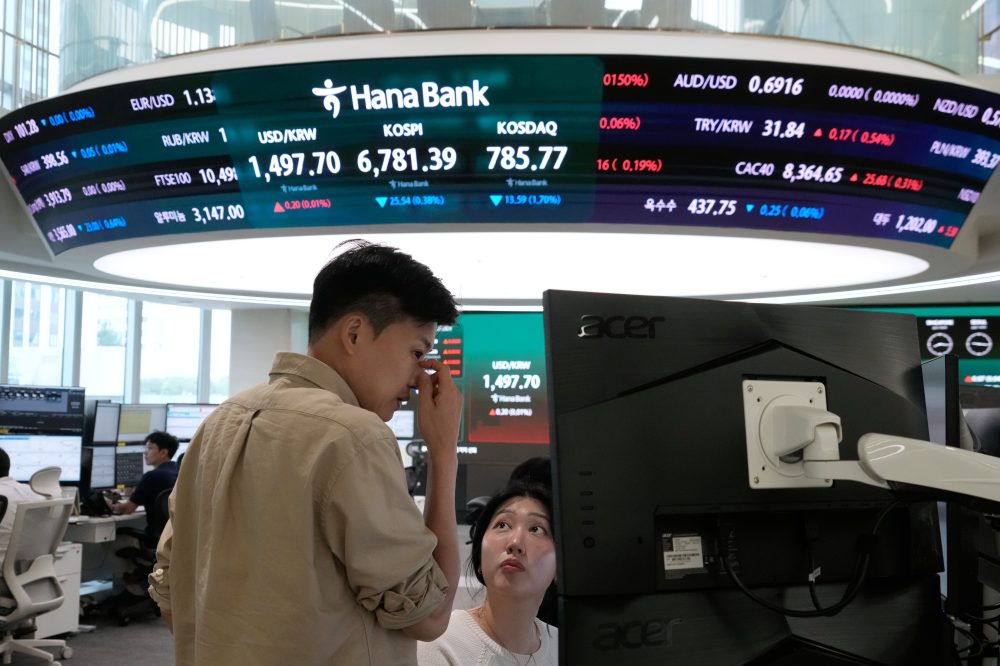
As of Tuesday, the KOSPI was trading below 7,000 points, having dropped about 25% from its record closing high of 9,114.55 points — officially placing it in bear market territory since late June. Despite that, the index is still up approximately 60% for the year, far outpacing the roughly 10% gain seen in MSCI’s broadest global equities benchmark.
“Just as it went up explosively, it went down explosively,” said Lee Seung-ho, a 24-year-old college student who took out margin loans to transform between 10 and 20 million won (roughly $7,000 to $13,000) into 300 million won during the bull run — only to watch those gains disappear.
“I think people like my mom and grandma, while saying Samsung is South Korea’s No.1 company, do not fully understand the risks of leveraged investments (and) think about them rising twice as fast, without thinking of falling twice as fast,” he added.
Few stocks capture the market frenzy quite like SK Hynix, which rode a wave of borrowed money to triple its share price and complete a record-setting $26.5 billion U.S. listing by a foreign company — debuting 14% above its offer price.
That same stock is now at the center of some of the most severe volatility in its history. On Monday, SK Hynix shares fell 14% in Seoul, while a twice-leveraged ETF tied to the stock plunged more than 30% in Hong Kong. The selling compounded itself, deepening losses and pulling the broader KOSPI down 8%.
Samsung Electronics and SK Hynix together make up just over half of the entire KOSPI index, meaning big moves in either company can dominate the direction of the whole market.
“The impact of single-stock leveraged products on the index is higher than in other countries due to the high share of Samsung and SK Hynix in the KOSPI,” said Park Woo-yeol, an analyst at Shinhan Securities. For comparison, a major U.S. stock like Nvidia accounts for only about 7% of the S&P 500.
The KOSPI’s volatility index stood at 82.07 on Tuesday, after reaching an all-time high of 97.99 on June 29 — compared with just 28.85 at the end of 2025.
South Korea’s Financial Supervisory Service announced it would keep an eye on leveraged products and look into aggressive marketing practices if warranted. The Bank of Korea also told a lawmaker it was monitoring whether single-stock ETFs could distort market behavior and amplify volatility.
Foreign investors have pulled a record of nearly $110 billion out of South Korean equities this year, largely to keep their portfolios from becoming too heavily weighted toward the country’s soaring market. That has shifted much of the buying pressure onto everyday domestic retail investors.
Retail investors purchased 13.2 trillion won in KOSPI shares this month, following 42.4 trillion won in purchases during June. Their total borrowed investment in KOSPI shares stood at 28 trillion won as of July 14, just below the record high of 29.8 trillion won reached on June 24.
“Korea is still the biggest portfolio overweight, but I started to reduce,” said Alexander Redman, chief equity strategist at CLSA. “What worries me is that retailers are in the driving seat, because they use a lot of margin.”
It’s worth noting that projected profits at Samsung and SK Hynix have climbed so steeply that forward price-to-earnings ratios have actually declined this year, even as share prices more than doubled.
Still, some experienced investors are keeping their distance.
“I don’t like to buy markets that have been going straight up, so I’m not doing anything,” said Jim Rogers, co-founder with George Soros of the Quantum Fund. “I like things to be depressed and to have lots of unhappiness and gloom around. That’s not the case in South Korea yet.”
(Exchange rate reference: $1 = 1,505.9000 won)