
American consumers may get a small break from inflation in June, but economists say it is far from cause for celebration — and the pain at the pump is already returning.
The Labor Department’s Bureau of Labor Statistics is expected to release its Consumer Price Index report on Tuesday, with a Reuters survey of economists predicting the CPI rose 3.8% over the 12 months ending in June. That would be a step down from May’s 4.2% surge — the largest year-on-year increase since April 2023 — which many economists believed represented the peak.
Estimates for the June figure ranged from 3.6% to 4.0%. On a monthly basis, consumer prices are expected to have actually fallen 0.1% in June, which would mark the first monthly decline since May 2020, after climbing 0.5% in May.
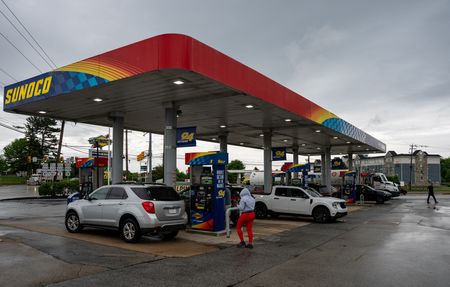
The main driver behind the anticipated slowdown is a retreat in gasoline prices. The national average dropped to $4.18 per gallon in June from $4.61 in May — the highest level since July 2022 — according to data from the U.S. Energy Information Administration. A fragile ceasefire between the U.S. and Iran helped bring prices down temporarily, but that truce collapsed last week after commercial tankers were fired upon in the Strait of Hormuz, prompting military strikes between the two countries.
Gas prices have since reversed course. The national average climbed to $3.87 per gallon on Monday, up from $3.80 the previous week, according to motorist advocacy group AAA. President Donald Trump announced Monday that the United States would reinstate its blockade on Iranian shipping through the Strait of Hormuz, a critical corridor for global oil supplies and one of the central flashpoints of the ongoing conflict.
“The pain level just went down from 10 to nine, consumers are still in a lot of pain,” said Brian Bethune, an economics professor at Boston College. “We’re not out of the woods yet.”
Any relief at the gas pump in June was likely offset by rising food prices, which economists expect to have picked up after only a marginal increase in May. The U.S.-Israel war with Iran has pushed fertilizer prices higher and increased distribution costs. Combined with dry conditions in parts of the country, economists warn food prices could climb further later this year and into 2027.
Diane Swonk, chief economist at KPMG, cautioned that even efforts by some grocery stores to lure customers back with price cuts won’t make a significant dent. “The level of prices is still compounding, and even with some grocery stores talking about trying to get people back in with some price cuts, it won’t probably lower their overall bill much because there will be other factors,” she said. “People are still struggling to catch up.”
Stripping out the more volatile food and energy categories, so-called core inflation was projected to rise 2.8% year-over-year in June, slightly below May’s 2.9% reading. On a monthly basis, core prices were expected to increase 0.2%, matching May’s gain.
In June specifically, core inflation is expected to have been pushed higher by increased prices for services, hotel and motel rooms tied to the FIFA World Cup, and a rebound in motor vehicle insurance costs after a sharp drop in May. Moderate increases were also expected in airfares and rents, while core goods prices were likely flat for the month.
Andrew Hollenhorst, chief U.S. economist at Citigroup, noted that core inflation — which is not directly influenced by oil prices — remains the key measure for Federal Reserve officials. “One concern was that higher energy costs would ‘pass-through’ to core inflation, but aside from somewhat stronger airfares, which should now reverse, higher oil prices did not significantly boost core,” he said.
Other economists were less optimistic, arguing that persistent underlying inflation keeps the possibility of a rate hike on the table. The Fed left its benchmark interest rate unchanged in the 3.50%-3.75% range at its June 16-17 meeting, though updated projections pointed to a growing expectation of a rate increase in 2026. Minutes from that meeting, published last week, showed policymakers’ concerns about inflation intensified last month.
Financial markets were pricing in roughly a 50.8% probability that the Fed will raise borrowing costs at its September 15-16 policy meeting, according to CME’s FedWatch tool. The Fed uses the Personal Consumption Expenditures Price Index — not the CPI — as its primary inflation benchmark, targeting 2%. Inflation has not been below that level since early 2021.
Samuel Tombs, chief U.S. economist at Pantheon Macroeconomics, summed up the uncertain outlook: “June’s CPI report is unlikely to decisively lean toward or rule out the Fed tightening policy this year.”