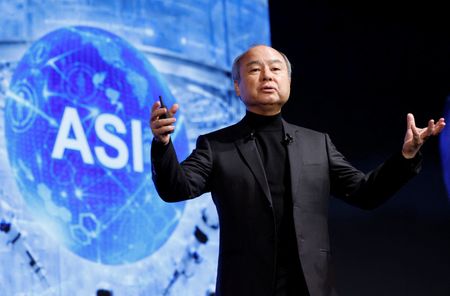

The chief executive of SoftBank Group stood before his company’s annual gathering in Tokyo on Tuesday and delivered a bold forecast: by 2040, the world will need to pour $5 trillion — roughly 800 trillion yen — into artificial intelligence every single year.
Masayoshi Son, who built his reputation and wealth by placing massive bets on game-changing technologies, acknowledged the figure sounds hard to believe. “Every year $5 trillion, or 800 trillion yen, you might think that’s a lie, but I am confident that’s what it will cost,” he told the audience.
Son argued the economics would work out. “The business model will be viable because by 2040, if AI revenue makes up 20% of global GDP, spending 800 trillion yen a year is a rounding error,” he said. He did not, however, explain the methodology behind either the $5 trillion projection or his estimate of AI’s share of global economic output.
The SoftBank chief also pushed back hard against growing skepticism in financial circles about whether the AI sector is overheating. AI companies have seen their valuations skyrocket even as the cost of building the infrastructure to support them has ballooned, raising questions about whether returns will justify the spending. Son was dismissive of those concerns. “Asking if AI is a bubble is absurd. I don’t think people who ask that question know what AI is about,” he said.
SoftBank has been on an aggressive investment push over the past two years, positioning itself as a central player in the AI landscape. The company has directed tens of billions of dollars into OpenAI, the maker of ChatGPT, with its total investment in that firm expected to surpass $60 billion before the end of 2026. It has also funded data center construction and put money into robotics companies.
Son’s track record is a mixed one. He scored enormous gains from an early stake in Chinese e-commerce giant Alibaba and was instrumental in bringing the iPhone to Japan’s mobile market. But he also backed WeWork, the shared-office company that ultimately went bankrupt after failing to live up to its initial promise.
Looking further ahead, Son predicted that powering AI systems will require data centers consuming 3 terawatts of electricity by 2040 — a figure equal to 1.8 times the entire world’s current power usage. He said natural gas would carry the load initially, with nuclear fusion eventually taking over as the dominant energy source. “Will we use solar power in space as Elon Musk says? Maybe we will use both, but if you ask me fusion on earth will be the cheaper, cleaner energy source,” he said.
Son closed with a philosophical vision of the world 15 years from now, describing a future in which 100 trillion AI agents make independent decisions, take action, and interact with one another. “We will go from a human-centric world to an agent-centric world. The age when humans are the highest life form on earth will end. For better or for worse, it will happen and it can’t be stopped,” he said.