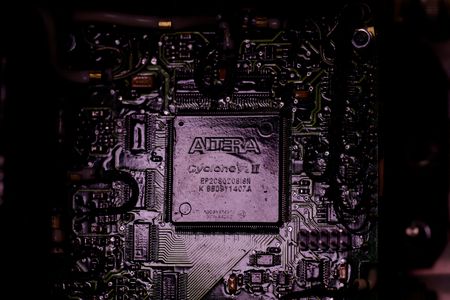

Altera, a maker of programmable chips that was separated from Intel, is now growing at approximately 20% annually and more than doubling its operating income as it works toward an eventual stock market debut, the company’s chief executive said in a recent interview.
The company achieved full independence last September after Intel agreed to sell a 51% ownership stake to Silver Lake for $4.46 billion, a deal that placed Altera’s total value at $8.75 billion. Intel continues to hold the remaining 49% stake.
Chief Executive Raghib Hussain, who previously worked at Marvell Technology before taking the helm when Intel spun off Altera, said the company grew more than 20% last year and anticipates mid-20% growth again in the current year. Because Altera remains privately held, it does not release specific financial figures.
Hussain described his approach to business as centered on direct technical collaboration. “I believe in an engineer-to-engineer type of a discussion,” he said. “We have brought engineering very close to the customers, so that actually already is showing up in our customer engagement.”
The turnaround follows a rough period for Altera. Intel had reported the company brought in $1.5 billion in revenue during 2024, a steep drop from $2.9 billion in 2023. That decline was driven in part by customers shifting their spending toward GPU chips for artificial intelligence applications, and partly by Altera losing ground to its biggest rival, AMD-owned Xilinx.
Hussain is now steering the company toward opportunities in AI and robotics, positioning Altera’s “field programmable gate array” chips — known in the industry as FPGAs — to handle connectivity, data pre-processing, and sensor fusion alongside GPU processors.
“If GPU is the brain, the FPGAs are the nervous system,” Hussain said. He projected that FPGA content valued between $100 and several hundred dollars per robot could generate a market worth “100 billion to several hundred billion dollars” over the next decade.
On the operational side, Hussain noted that Altera produced working prototypes of six new chips last year and has significantly reduced its reliance on transition service agreements inherited from Intel, cutting them from 125 down to just 15.
He also said Altera is currently the only programmable chip supplier in full production using a newer type of memory called DDR5, designed for mid- to high-end programmable chips. The company has also built up a memory stockpile that is helping shield it from current supply shortages.
Altera produces its chips through both Intel Foundry and Taiwan Semiconductor Manufacturing Co., and is developing future products using TSMC’s 2-nanometer and 3-nanometer manufacturing technologies, Hussain said.