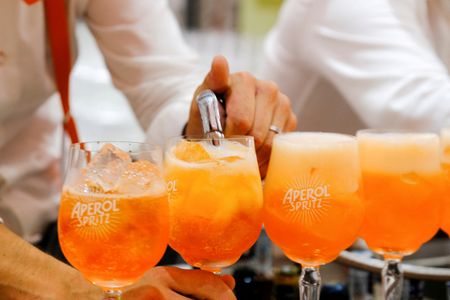

MILAN — The company behind one of the world’s most recognizable cocktail ingredients is fighting to keep copycats at bay as the booming spritz market draws in a growing wave of competitors.
Campari, which owns the Aperol brand, is intensifying efforts to protect its flagship product as imitation orange aperitifs and alternative spritz-style drinks compete for customers in bars, restaurants, and grocery stores across Europe and beyond.
The global spritz market has expanded dramatically, with consumption climbing to nearly 4 billion servings in 2024 — up from fewer than 2.5 billion in 2019, according to data firm IWSR. Aperol sits at the center of that growth, representing roughly 26% of Campari’s total revenue.
The competition is sharpest in Italy, where Campari has responded with a new promotional campaign and a loyalty program for bars and restaurants that can verify they serve the genuine product. That program now covers 2,000 venues across the country.
A key part of the company’s strategy involves rolling out pre-prepared Aperol Spritz in keg form — a move designed to compete with ready-made mixes that have made it easier for establishments to substitute other products.
Andrea Neri, managing director of House of Aperitivi at Campari, explained that a newer trend has emerged since 2023. “The new development is that, since 2023, some bars and restaurants have begun serving orange-coloured drinks, often from tap, that are not necessarily made with Aperol,” he said, adding that many customers believe they are getting the real thing.
Italy is Campari’s second-largest individual market, trailing only the United States. The country is also where the Aperol Spritz was born and where consumers have long favored light, bittersweet cocktails — making it a particularly competitive battleground.
On supermarket shelves, the situation is similarly challenging. Orange-colored aperitif bottles that closely resemble Aperol have become increasingly common, often priced 30 to 40 percent below Aperol, which sells in Italy for around €10 a bottle.
Campari has pursued trademark protections on the brand’s distinctive orange color and has taken legal action against certain smaller competitors as part of a broader effort to defend its intellectual property.
Neri acknowledged the supermarket lookalike issue is not new. “The presence of similar products in supermarkets is not a new phenomenon and can be observed across Europe,” he said, while downplaying its effect on Aperol’s overall sales.
A marketing expert offered a different perspective. “The fact that there are lookalike products is a sign that Aperol is a very strong brand,” said Sandro Castaldo, a marketing professor at Bocconi University, noting that color is typically the first feature imitators try to replicate.
Beyond direct knockoffs, other spritz-style drinks are also gaining ground. Hugo Spritz — a lighter-colored drink made with elderflower syrup or liqueur and Prosecco — has been appearing more frequently on U.S. summer menus and in British pubs. Bacardi, which owns the French elderflower liqueur St-Germain — a popular Hugo Spritz ingredient — told Reuters the product has seen double-digit year-over-year sales growth driven by Hugo Spritz’s rising popularity.
Campari has not stood still in the face of these alternatives. In Europe, the company launched Sarti Rosa, a fruit-based aperitif marketed with a viral campaign targeting female consumers around the hot pink drink.
Neri noted a broader shift in consumer habits. “As the category leader, we have worked to expand our spritz portfolio across multiple brands,” he said, pointing to growing interest in lower-alcohol aperitif options and rising daytime drinking occasions.
Campari’s aperitif lineup extends beyond Aperol to include the Campari brand itself, Sarti, Cynar, non-alcoholic option Crodino, and an elderflower aperitif called Mondoro.
Despite the competitive pressure, Aperol’s global sales grew 1.4% last year to €785 million (approximately $897 million). Campari invested around €547 million in advertising and promotions in 2024, equal to 17.9% of net sales.
Industry analysts remain largely confident in Aperol’s staying power. “I don’t see lookalike products representing a threat for now,” said Theodore Duval-Segard, an analyst at AlphaValue. “Campari has literally reinvented the spritz. At this point, Aperol and spritz are almost inseparable.”
Neri acknowledged there could be some cost to the competition. “We could probably have grown even faster,” he said of the Italian market, while noting the company lacks precise figures to quantify the impact of lookalike products.