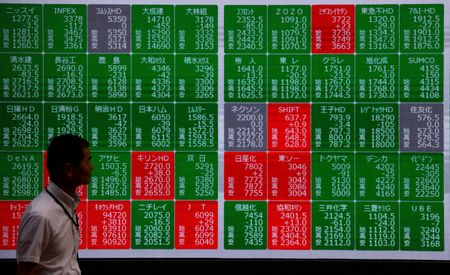

Asian stock markets surged Friday morning, driven by gains in semiconductor and artificial intelligence companies, even as tit-for-tat military strikes between the United States and Iran continued to threaten oil flows through the vital Strait of Hormuz.
The ongoing back-and-forth attacks have further weakened a fragile ceasefire that was only about three weeks old, once again putting oil prices, inflation concerns, and the global interest rate outlook under the microscope.
Brent crude futures were on pace for a roughly 5% gain for the week — their strongest weekly performance since early May. However, at $76.03 per barrel, Brent has surrendered most of the price increases it accumulated since the conflict broke out at the end of February.
Nick Twidale, chief market strategist at ATFX Global in Sydney, acknowledged the troubling geopolitical picture but noted that investors appear unfazed. “I’m looking at updates from the Middle East and things don’t look good, but investors seem incredibly resilient to those risks at the moment, with tech again driving markets higher,” he said.
Japan’s Nikkei index climbed 1.8%, while South Korea’s KOSPI — considered the heart of the global AI stock rally — jumped 2.4% in early trading. Chip industry heavyweights SK Hynix and Samsung each gained about 3%. Markets in Taiwan were closed for the session.
The MSCI’s broadest measure of Asia-Pacific shares outside Japan rose 0.76%.
Twidale added a note of caution despite the upbeat start: “We will start on the front foot again in Asia, but I’m still very cautious that we are not pricing in enough event risk that the Strait of Hormuz may be closed again in the coming days.”
Throughout the week, investors have largely set aside concerns about the military escalation, choosing instead to focus on the AI investment theme that has pushed global stock markets to record levels — even as questions grow about whether the scorching rally can be sustained.
Overnight in the United States, the tech-dominated Nasdaq closed sharply higher after Micron Technology announced plans to invest more than $250 billion domestically through 2035, giving chip stocks a major boost. The Philadelphia SE Semiconductor index rose 3%.
Much of Friday’s attention will be focused on SK Hynix’s debut on U.S. markets. The South Korean chip maker priced its American Depositary Receipts at $149 on Thursday, raising approximately $26.5 billion — a sign of robust investor demand for exposure to the AI supply chain.
The massive offering, intended to fund new manufacturing facilities and equipment to keep up with soaring AI chip demand, is expected to rank as the world’s second-largest share sale ever, trailing only SpaceX’s record-breaking IPO last month.
Sam Konrad, investment manager for Asia Equity Income at Jupiter Asset Management, said the U.S. listing could result in the ADR trading at a premium over SK Hynix’s locally listed shares, but could also help boost the valuation of the Korean-listed stock. “If SK Hynix re-rates that should help support a re-rating in Samsung Electronics too, especially when they release details of their shareholder return plans,” said Konrad, who holds positions in both South Korean companies.
SK Hynix’s Korean shares have skyrocketed 238% so far this year, pushing the broader KOSPI benchmark to record highs and making it the world’s best-performing major stock market since the beginning of 2025.
Still, the AI frenzy has also produced sharp market swings in recent weeks as investors grow nervous about lofty valuations and question whether the companies can maintain their extraordinary profit growth.
In currency markets, the Japanese yen remained a focal point, hovering near its lowest point in 40 years as traders watched for potential intervention from Japanese authorities. The yen last traded at 162.18 per U.S. dollar, close to the 1986 low of 162.84 it reached last week.
The U.S. dollar was largely flat as investors waited for new signals on the direction of American interest rates. Traders are currently pricing in 34 basis points of rate hikes for the year, though that calculation could shift depending on how much inflationary pressure the ongoing conflict generates.
In commodities, gold was heading for a roughly 1% weekly loss and was last trading at $4,113 per ounce in early Friday trading.