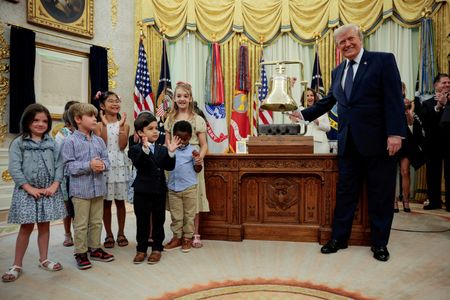

President Donald Trump kicked off this week with a historic first — ringing the stock market’s opening bell from the Oval Office.
That moment reflects a central theme of his second term. Trump has increasingly held up Wall Street’s performance as a measuring stick for his administration, treating record-high stock prices as evidence that his economic agenda is delivering results — even as millions of Americans struggle with elevated living costs and have no money invested in the markets at all.
Some economists say this approach risks confusing the performance of financial markets with the day-to-day financial reality of American households. According to Gallup polling, roughly four out of every 10 Americans have no stock market investments whatsoever.
Trump has pointed to climbing stock values to justify a wide range of policies — from military action against Iran to sweeping global tariffs and major domestic legislation. At the same time, his administration has pushed to expand stock ownership among everyday Americans and has taken an active role in the finances of some of the nation’s largest corporations.
White House officials describe Trump’s emphasis on markets as part of a larger effort to bring more American households into the world of investing — an approach that has drawn praise from investors who say the administration is in tune with the economy.
Trump regularly brings up stock market performance in a variety of settings — during meetings with foreign leaders, at campaign-style rallies, and even at military events. In June, before presenting three service members with the Medal of Honor — the nation’s highest military award — Trump told the audience, “The stock market just hit a new all-time high, the 401(k)s are at a new all-time high, and oil is dropping like a rock.”
The Republicans’ $4.1 trillion “One Big Beautiful Bill” created government-funded investment accounts for newborns, dubbed “Trump accounts.” In February, Trump also announced plans to match up to $1,000 in 401(k) contributions for workers who sign up for so-called “Trump IRA” accounts.
His economic vision has focused heavily on business growth as a stand-in for household financial well-being. The administration has also brokered deals with major corporations — including taking an equity stake in Intel, a “golden share” in U.S. Steel, and revenue-sharing agreements with Nvidia and AMD. Trump points to those companies’ success as signs of a growing economy, rather than the result of significant federal involvement in private markets.
A ‘K-Shaped’ Economy
But some economists say that focus leaves a large portion of Americans behind. About 40% of the country holds no stock, per Gallup data, while the wealthiest 1% control more than half of all U.S. capital market investments.
This divide is what economists call a “K-shaped” economy — one where spending by affluent households keeps markets afloat while middle- and lower-income Americans are pulling back.
The U.S. stock market has added $15 trillion in value since Trump returned to the White House — roughly a 25% increase — and stocks make up about a third of overall household wealth. But those gains are concentrated at the top. For the bottom half of American households, wealth is more likely tied up in real estate and physical goods, meaning stock market rallies do little to improve their immediate financial situation.
The broader U.S. economy is largely stable, with solid growth and low unemployment. However, recent inflation — driven in part by the conflict with Iran — has left some consumers feeling pessimistic about their financial outlook.
White House spokesman Kush Desai said in a statement that Trump was “simultaneously focused on ensuring every American has a stake in the successes of America’s next golden age with their own piece of the pie.”
An Imperfect Yardstick
Trump himself has significant personal exposure to the stock market. In the first three months of 2026, his investment accounts executed 3,600 stock trades valued at between $212 million and $695 million, according to his financial disclosures.
“You know why I’m profiting? Because the stock market’s going up, everybody’s profiting,” he said last week.
Even some of Trump’s strongest supporters admit the metric he leans on isn’t always a reliable gauge of the overall economy. “It’s not a perfect correlation. There are other measures of how businesses are doing,” said Stephen Moore, a conservative economist who periodically advises Trump and White House officials. “But a valuation of their stock is an important indication.”
Critics argue that Trump has reversed major policy decisions in response to market downturns — including walking back portions of his trade war after stocks fell sharply following its announcement.
He has also factored market performance into his thinking on the Iran conflict, mindful of comparisons to President Herbert Hoover, who was in office during the 1929 stock market crash. At the Group of Seven summit in June, Trump noted that “every time we talked about the possibility of peace, the stock market shot up like a rocket ship.”
“This is the way that people can get his attention or society can get his attention,” said Alex Jacquez, chief of policy and advocacy at the liberal think tank Groundwork Collaborative. “Where it’s dangerous is that it only seems to assert itself when corporate or financial interests are at stake.”
Jacquez also noted that using the stock market as an economic barometer leaves out young people with little equity exposure, as well as women and minority groups who are underrepresented in capital markets.
The metric also fails to capture the health of small businesses — which form the backbone of the U.S. labor market — or privately held companies. Many economists prefer to track annual gross domestic product and wage growth as more reliable indicators of economic health. U.S. GDP grew by 2.1% in 2025, and average hourly wages rose 3.5% — a meaningful raise for workers, but not quite enough to keep pace with recent inflation.
Investors who are pleased with the president’s attention to markets say it could help prevent major financial shocks from catching Wall Street off guard. Some Trump administration officials have echoed that view, though certain voices on Wall Street remain skeptical that any president can permanently insulate markets from downturns.
“Having President Trump always focused on the market helps investors sleep well at night,” said Dan Ives, global head of tech research at Wedbush Securities. “It almost creates some natural guardrails.”