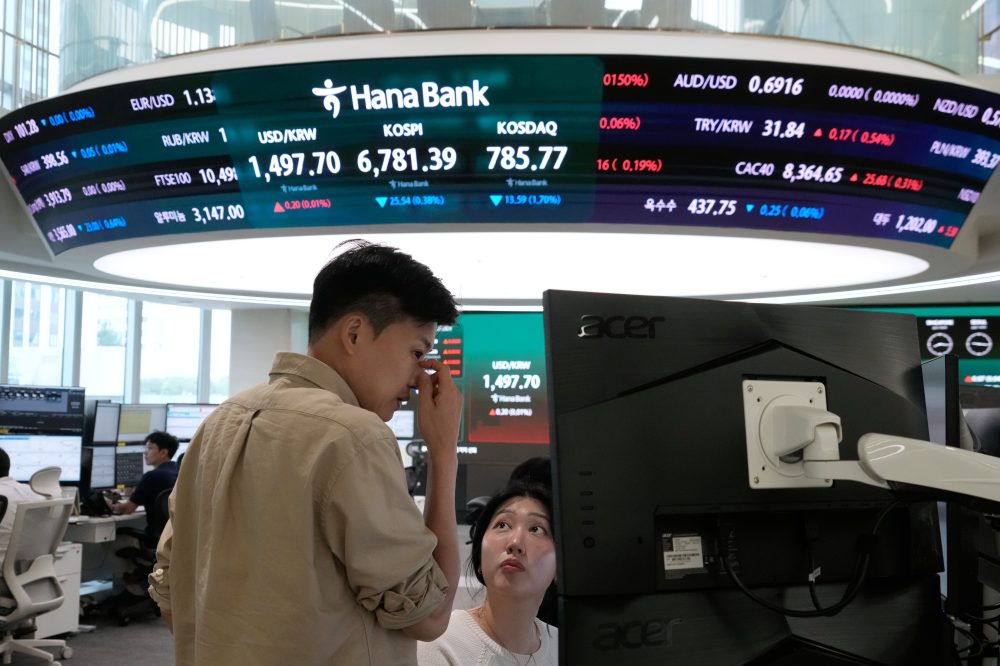

Oil prices surged early Tuesday as conflict in the Middle East intensified, while Asian stock markets fell amid a broader selloff in artificial intelligence-related stocks.
Brent crude, the international oil benchmark, climbed to just above $84 per barrel on Tuesday, following a dramatic near-10% spike on Monday. U.S. benchmark crude also rose, gaining 1.4% to reach $79.20 per barrel.
While oil prices remain below the wartime high of nearly $120 a barrel, growing uncertainty about the future of energy supplies has rattled markets. Both the United States and Iran have claimed control of the Strait of Hormuz, a critical waterway for global oil shipments. The U.S. launched additional strikes on Iran after President Donald Trump announced that Washington was “reinstating” a blockade on Iran in the strait.
The ongoing fighting has prevented oil tankers from passing through the waterway to deliver crude from the Persian Gulf to customers around the world, pushing fuel prices higher globally. U.S. stock futures were down 0.3% in early trading.
Across Asia, markets broadly declined. Tokyo’s Nikkei 225 dropped 1% to close at 66,574.96, while South Korea’s Kospi fell sharply by 3.2% to 6,589.37. China’s Shanghai Composite index slipped 0.8% to 3,884.32, even as the Chinese government reported that the country’s exports surged 27% in June compared to a year ago, fueled in part by strong demand for computer chips and other technology driven by AI adoption. Hong Kong’s Hang Seng edged slightly higher by 0.1% to 24,230.46, and Australia’s S&P/ASX 200 declined 0.5% to 8,767.00.
On Wall Street Monday, the S&P 500 fell 0.8%, snapping what had been four winning weeks out of the previous five. The Dow Jones Industrial Average dropped 0.3%, and the Nasdaq composite sank 1.6%.
Chip manufacturers led the decline. Micron Technology dropped 4.4%, cutting into what had been an impressive 243.1% gain for the stock so far this year. Nvidia slid 3.5%, and because it holds the title of Wall Street’s most valuable company — largely due to excitement surrounding AI — it was the single biggest drag on the S&P 500.
Investor anxiety is growing that stock prices have climbed too far, too fast, and that demand for AI-related products may not hold up if the technology fails to generate the profits and productivity gains many are expecting.
Much of Wall Street’s focus this week will shift to corporate earnings reports. On Tuesday alone, Bank of America, Citigroup, JPMorgan Chase, Goldman Sachs, and Wells Fargo are all scheduled to release their latest quarterly results. Analysts tracked by FactSet are projecting overall earnings growth of 23.6% for S&P 500 companies compared to a year ago — which, if accurate, would mark the second consecutive quarter of growth exceeding 20%.
Rising oil prices could also complicate the inflation picture. More expensive fuel tends to push consumer prices higher, which could pressure the Federal Reserve and other central banks to raise interest rates. Higher borrowing costs can help cool inflation but also slow economic growth and weigh on investment values across the board.
In currency markets early Tuesday, the U.S. dollar dipped slightly to 162.34 Japanese yen from 162.35 yen, while the euro climbed to $1.1391 from $1.1381.