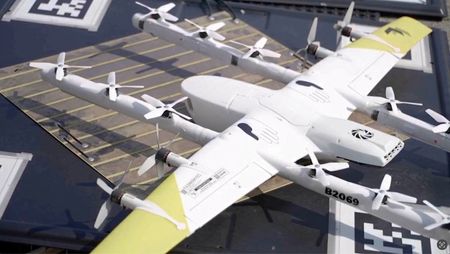

Engineer Beth Flippo made a major life change in 2021, moving her family from New Jersey to rural Ohio to lead a grocery drone delivery pilot program for Kroger. The experiment didn’t last long — just eight months before both sides agreed to pull the plug.
“We couldn’t make any money,” said Flippo, who now heads drone company Dexa. The program required workers stationed throughout the community to keep the drones in their line of sight at all times, as federal regulations demanded. “It just couldn’t scale,” she said.
Those obstacles may soon be history. Following an executive order issued by President Donald Trump’s administration in June 2025, the Federal Aviation Administration has put forward new regulations aimed at fast-tracking drone deployment across the country.
U.S. officials have framed the push as part of a broader competition with China. “America – not China – will lead the way in this exciting new technology,” U.S. Transportation Secretary Sean Duffy said in a statement in August.
Flippo says Dexa is now in active discussions with Kroger about reviving the shelved program. A Kroger spokeswoman declined to confirm those talks. Dexa did eventually obtain an FAA waiver allowing it to fly drones beyond visual range — but the approval process dragged on for four years.
If the newly proposed FAA rules are finalized, that kind of lengthy wait could become a thing of the past, potentially opening the door to rapid industry expansion that’s already building steam.
Researchers at PwC estimated in 2024 that the U.S. drone market will grow at 65% per year through 2034. Globally, drone deliveries are projected to surge from roughly 13 million this year to more than 800 million by 2034, according to PwC’s forecasts.
The market is still relatively modest for now — worth a few billion dollars worldwide by most estimates. But retail giants Walmart and Amazon, which launched their drone programs in 2021 and 2022 respectively, are actively building out their networks. Food industry players including Papa John’s, Wonder, and DoorDash are developing earlier-stage programs, partnering with drone operators who have secured regulatory waivers.
“We’re at a commercial inflection point,” said Heather Rivera, chief business officer at Wing, the drone division of Alphabet, which counts Walmart as its largest client. Rivera was brought on board less than a year ago to strengthen commercial ties with retailers and restaurants — the first role of its kind at the 12-year-old company.
At Walmart, which also works with drone provider Zipline, the technology is primarily used for “last-minute, urgent, convenience-driven items,” according to Mike Walden, the retailer’s senior vice president of fulfillment innovation. That includes things like allergy medications, cat food, and condiments a backyard cookout host suddenly realizes are missing.
The Walmart app lets shoppers know upfront whether their purchase qualifies for drone delivery. If they choose that option, the app monitors the cart to ensure the order stays within weight limits. Payload capacity currently ranges from about 3 to 8 pounds depending on the drone, Walden said.
Walmart is “inching toward 2 million” drone deliveries, Walden said, with the bulk of those coming this year as the program accelerates. The company currently has drones operating out of 70 stores — a small slice of its roughly 4,600 U.S. locations — but plans to expand to more than 270 stores by the end of next year.
Amazon, which this week launched its 10th U.S. drone delivery network in Baton Rouge, Louisiana, says its drones can complete deliveries in under 30 minutes.
Challenges persist — some communities have raised concerns about noise and privacy — but the potential cost savings are hard to ignore. PwC researchers estimated that the cost per drone delivery could drop to as little as $2 by 2034, well below traditional delivery costs.
Neither Walmart nor Amazon would discuss their current per-delivery costs. “But if it wasn’t competitive, we wouldn’t be continuing to invest in the technology,” said Amazon’s global head of drone expansion, Matt McCardle.
Most U.S. drone operators and retailers are focusing on suburban areas, where large yards, heavy road traffic, and population density make aerial delivery an attractive option. Speed is a major selling point — Walmart claims to have completed a drone delivery in under five minutes and says drones are generally faster than ground-based delivery. Rivera noted she recently received ice cream via drone and it arrived still cold.
“Everyone is trying to scale as fast as they can,” said Amit Regev of Tel Aviv-based Flytrex, which announced a partnership with Little Caesars in April to deliver pizzas by drone.
The FAA’s proposed rule change, which has not yet been finalized, would allow certified drone operators to fly beyond the visual line of sight without going through a lengthy and sometimes expensive waiver process.
That could trigger “massive, exponential growth of the space over the next few years,” said Andreas Raptopoulous, CEO of California-based drone maker Matternet.
The push comes as China’s so-called “low altitude economy” — defined as aerial commerce below 3,000 meters — is projected to grow to more than 2 trillion yuan, or about $280 billion, by 2030, up from 1.5 trillion yuan in 2025, according to estimates from the Chinese Academy of Sciences, Peking University, and China’s Civil Aviation Administration. Drone deliveries there are concentrated in cities like Shenzhen and Guangzhou.
E-commerce company JD Logistics, which has tested drone delivery networks in Jiangsu, Shaanxi, and Sichuan, has stated publicly that its drones can cut shipping times for rural customers by as much as 70%.
Without the line-of-sight restriction, drone delivery becomes a low-labor operation, Flippo explained. A single controller earning around $25 an hour can monitor 40 drones at once on a screen — handling roughly 160 deliveries per hour — at a fraction of the cost of deploying a fleet of drivers.
Dexa has built smaller partnerships with food delivery services like Wonder, though Flippo acknowledges that going up against industry heavyweights like Alphabet “feels like fighting Goliath.”
Testing by Walmart and its competitors is also pushing the technology forward. “With each cycle, the hardware, battery, range and reliability all improve,” said Marios Savvides, a professor at Carnegie Mellon University’s College of Engineering. Technology matures “in the field — not in the lab,” he added.