
The chief executive of South Korean memory chipmaker SK Hynix is sounding the alarm about an unprecedented shortage of memory chips on the horizon, predicting that 2027 will be the most severe supply crunch the industry has ever seen.
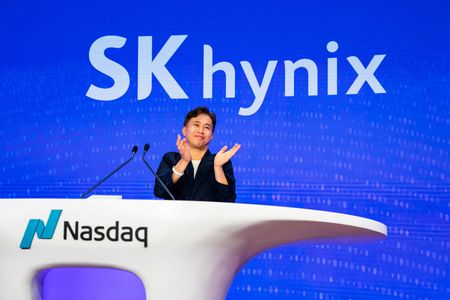
Kwak Noh-jung made the remarks during an interview with Reuters on Friday — the same day his company began trading on the Nasdaq stock exchange.
“We forecast that next year will be the worst year in the industry’s history from the supply perspective,” Kwak said. “Our customer demand continues to go up, while our capacity has limitations. We still forecast that customer demand will remain higher than our supply capacity even beyond 2030. But we are doing our best to solve the problem.”
SK Hynix has become a key player in the artificial intelligence supply chain, largely because of its early investment in high-bandwidth memory, known as HBM, which is used in Nvidia chipsets. Shares of the company jumped 14.8% to $170.94 on the Nasdaq during Friday afternoon trading.
POSSIBLE U.S. MANUFACTURING FACILITY
Kwak also addressed the possibility of building a wafer fabrication plant in the United States, saying the country is among several locations being evaluated — though no final decision has been reached.
He outlined the key factors the company would weigh, including available land, electricity, water supply, a skilled workforce, and competitive production costs.
“If those conditions are met, the U.S., Japan and Southeast Asia are all under consideration,” Kwak said. “Nothing has been decided yet. We are evaluating which location can provide the greatest business advantage.”
The company’s primary manufacturing facilities are located in Icheon, where it is headquartered, and Cheongju. It is also constructing a large new facility in the city of Yongin.
SK Hynix and Samsung Electronics are both participating in a South Korean government initiative aimed at doubling the nation’s memory chip production capacity within five years. The plan involves 400 trillion won — roughly $266 billion — in investment for chip production facilities in the country’s southwest. Some investors have expressed concern that the scale of the plan could leave the companies more vulnerable if the market were to turn downward.
In the United States, SK Hynix is already investing approximately $4 billion to construct an advanced chip packaging facility in Indiana. The company is also committing $10 billion toward building an AI solutions company in the U.S. as it looks for new growth opportunities in the artificial intelligence sector.
QUESTIONS ABOUT AI DEMAND
Some market observers have raised questions about whether the current wave of AI investment is nearing a peak, a concern that has weighed on chip-related stocks recently.
Reports that Apple is exploring ways to bring Chinese suppliers into its semiconductor supply chain — and that Meta is looking to monetize surplus AI computing capacity — have added to those concerns.
Still, many industry analysts maintain that memory supply continues to fall short of demand. Nvidia’s chief executive said last month that shortages of AI memory are expected to persist for several more years due to strong demand, and noted that SK Hynix would remain Nvidia’s largest memory supplier.
Financial firm UBS has similarly projected that the global DRAM market will remain undersupplied through at least the second quarter of 2028.
RECORD PROFITS AND SOARING STOCK
SK Hynix has emerged as one of the biggest winners of the AI technology boom, driven by its early commitment to high-bandwidth memory — a bet that was once dismissed but is now widely regarded as a shrewd move. The company posted a record operating profit of 47 trillion won, equivalent to about $31 billion, in 2025. That figure was double its earnings from the prior year and a dramatic turnaround from an operating loss in 2023.
The current quarter is expected to be even stronger, with one financial estimate placing operating income at 65.5 trillion won.
While worries about the durability of the AI-driven stock rally have pushed SK Hynix shares down roughly 18% over the past two weeks, the stock has still climbed more than sevenfold over the past 12 months.