Intel has kicked off a massive €5 billion — roughly $5.7 billion — capital investment at its manufacturing campus in Leixlip, just outside Dublin, Ireland. The U.S. chipmaker announced Monday that the funding is designed to expand European production and keep pace with surging worldwide demand for artificial intelligence and high-performance computing technology.
According to Intel, the investment will push its European manufacturing base to maximum capacity by growing current production levels, advancing research and development efforts, and making better use of existing cleanroom space at the Leixlip facility.
Intel is a major player in Ireland’s economy, which has long relied on attracting foreign investment. The company has poured €30 billion into the country since first setting up operations there in 1989. More than half of that total — invested between 2019 and 2023 — went toward doubling the plant’s capacity so it could produce the company’s most cutting-edge chip technologies.
The chipmaker, which has approximately 4,900 employees in Ireland, said the latest round of spending at Leixlip got underway earlier this year. The funds will be used to upgrade existing fabrication facilities and bring in state-of-the-art manufacturing equipment capable of producing Intel Xeon 6 processors, as well as a next-generation Intel Xeon chip built on the company’s Intel 3 manufacturing process.
Naga Chandrasekaran, executive vice president of Intel Foundry, emphasized the broader significance of the investment. “We are not just increasing output of critical products, we are ensuring Ireland remains at the forefront of the world’s most advanced manufacturing ecosystems, while strengthening the region’s role in the global technology landscape,” he said in a prepared statement.
Fintech company Payoneer Global, which trades on the Nasdaq, is set to hire approximately 300 engineers by the close of 2026 as part of its launch of a new global capability centre in India. The move puts Payoneer alongside a growing number of international firms turning to the world’s most populous country to meet their workforce demands.
Major financial technology players such as Mastercard, PayPal, and Revolut have already established India-based centers to drive product development, handle payment processing, and expand their artificial intelligence capabilities. According to industry consultant ANSR, revenue generated by global capability centres in India is projected to grow 12% to $84 billion by 2026.
Payoneer, which operates as a cross-border platform for sending and receiving payments, intends to recruit AI and platform engineers for its new facility in Gurugram, located near Delhi. The site is expected to become the company’s second-largest technology and research and development center in the world, according to Gaurav Gupta, the company’s India site leader, who spoke publicly on Friday.
Gupta explained the reasoning behind the company’s decision to set up operations in India: “India has an amazing talent pool for people who have experience in building financial technologies at a very large-scale (with) deep-tech expertise. So our key reason to come to India is to tap into the talent density.”
Payoneer already maintains an office in Bengaluru focused on sales operations for the local Indian market, employing around 400 people.
Last month, Canadian fintech company Nuvei announced it intends to purchase Payoneer in a deal valued at roughly $2.75 billion, pending regulatory approval. Gupta indicated that the proposed buyout would have no effect on the India global capability centre or its day-to-day business activities in the region.
President Donald Trump’s latest financial disclosures reveal a striking contrast: while he and his two eldest sons were publicly urging investors to put their money into cryptocurrency projects, his own financial managers were quietly shifting a large portion of those earnings into more conservative investments.
According to filings submitted to the U.S. Office of Government Ethics, Trump took in more than $1.4 billion last year from his family’s crypto ventures, including World Liberty Financial and the Trump meme coin.
A Reuters review of his financial holdings over the past two years found that his stock and bond portfolios grew at least fourfold during the same period that crypto revenues were pouring in. By the end of 2025, Trump held between $703 million and $2.6 billion in traditional financial assets — a dramatic jump from the $225 million to $608 million he reported at the close of 2024. The filings use value ranges rather than exact numbers, so a precise breakdown of how the crypto earnings were redistributed could not be determined.
Nine digital asset experts who reviewed the Reuters analysis concluded that Trump’s personal financial behavior suggests he does not view cryptocurrency as a reliable long-term place to store his wealth. Notably, he did not report purchasing shares in two publicly traded crypto companies backed by his sons Eric Trump and Donald Trump Jr.
Timothy Massad, director of the Digital Assets Policy Project at the John F. Kennedy School of Government at Harvard University — and a former chairman of the Commodity Futures Trading Commission under President Barack Obama — offered a pointed assessment. “Although the President talks about digital assets as the frontier of finance and making the United States the crypto capital of the world, the disclosure form suggests his personal strategy is to make a quick buck from crypto — through the sale of his meme coin and World Liberty tokens — but then invest his profits in traditional assets like stocks and bonds,” Massad said.
A Reuters report published last month found that retail investors who put money into the four main Trump-endorsed crypto projects had collectively lost $2.3 billion as of April.
Trump’s filings do show he still holds a substantial amount of digital tokens. As of the end of last year, he held 15.75 billion World Liberty crypto governance tokens valued at more than $50 million — tokens he received in exchange for his role in the company. As a co-founder, he faces a longer waiting period before he can sell those holdings compared to the general public.
The companies managing Trump’s stakes in World Liberty Financial and the Trump meme coin project held at least $160 million in bitcoin and ether — the two most widely used cryptocurrencies — along with up to $6 million in other tokens at the end of 2025. That represents a significant increase from the $1 million to $5 million in ether he reported holding at the end of 2024.
A spokesperson for the family business said in a statement that the president’s financial disclosure “demonstrates that The Trump Organization continues to maintain a strong financial position, supported by world class, valuable assets, substantial liquidity and a conservative balance sheet.” The spokesperson did not address why crypto proceeds were being moved into traditional financial instruments.
The White House told Reuters that the president’s assets are held in “fully discretionary accounts managed by independent third-party financial institutions.”
A World Liberty spokesman, David Wachsman, stated: “World Liberty has been built for the long-term and we strongly believe the future of financial services will be architected with digital asset technology.”
Trump’s children oversee the trust that holds the president’s assets and have been among the loudest champions of his crypto projects. Since November 2024, Eric Trump — who heads the Trump Organization — has repeatedly told media outlets and conference audiences that bitcoin is “the greatest asset” of the modern era and predicted it would eventually reach $1 million in value, compared to roughly $64,000 at current prices. Eric Trump also said last year that his father “believed in digital assets in a big way.”
Neither Eric Trump nor Donald Trump Jr. responded to requests for comment regarding the president’s investment decisions.
LONDON — The United Kingdom’s government announced Monday it is using new state-threat powers to crack down on Iran’s Islamic Revolutionary Guard Corps and a second Iran-linked organization, following a wave of antisemitic incidents carried out on British streets.
The newly applied powers would essentially make it illegal to support either group while also expanding the authority of police and intelligence services to address any threats connected to them.
Prime Minister Keir Starmer addressed the move directly, stating: “These new powers will make it easier to prosecute and lock up anyone carrying out their dirty work here in Britain.”
The IRGC has long operated as an elite military branch loyal to Iran’s Supreme Leader, having been founded in the aftermath of the 1979 Islamic Revolution. The organization is already subject to British sanctions.
The second group named, the Islamic Movement of Companions of the Right, has claimed responsibility for seven separate attacks targeting Jewish and Israeli communities as well as Persian-language media outlets. Among those incidents was an antisemitic arson attack on March 23 that destroyed four Hatzola ambulances in the Golders Green area.
In addition to the two Iranian-linked organizations, Britain also applied the new powers to Russia’s GRU military intelligence agency.
All of the designations are subject to parliamentary approval before they can officially go into force.
A lane shift is currently in effect for southbound Route 896 drivers approaching the ramp from Interstate 95 northbound to Ramp D.
The temporary traffic configuration is the result of construction work in the area and is expected to remain in place until 5:00 p.m.
Drivers traveling through the area are encouraged to slow down, stay alert for changed traffic patterns, and plan for possible delays during the construction period.
Motorists traveling through Wilmington should plan for delays on Baynard Boulevard, where construction crews have prompted intermittent lane closures between North Broom Street and Concord Avenue (Route 202).
The lane restrictions are expected to remain in effect until 5:00 PM. Drivers are encouraged to allow extra travel time or consider alternate routes to avoid potential slowdowns in the area.
Westbound travelers on Harrington Highway, also known as Route 14, in Milford are encountering a lane shift between Canterbury Road and Church Hill Road due to active construction work in the area.
The lane shift is expected to remain in place until 5 PM. Drivers are encouraged to slow down, stay alert, and follow all posted traffic control signs as they move through the construction zone.
No additional details about the nature of the construction project were provided. Motorists looking for alternate routes may want to plan ahead to avoid potential delays.
Emotions ran high this past weekend in Houston, where community members came together to remember Lorenzo Salgado Araujo, a man who was fatally shot by agents from Immigration and Customs Enforcement.
The gathering drew a crowd that displayed a powerful mix of grief and anger as attendees paid their respects to Salgado Araujo and called attention to the circumstances surrounding his death.
Road crews are on the scene along Swinnen Drive today, carrying out curb cleaning operations that are scheduled to continue until 5:30 p.m.
Motorists traveling through the area are advised to use caution and allow extra time, as the work may affect normal traffic flow until crews have finished for the day.
Northbound travelers on Edgemoor Road are facing a lane restriction this afternoon as construction crews work in the area.
The right lane on Edgemoor Road northbound is closed between Philly Pike and Governor Printz Boulevard. The closure is expected to remain in effect until 5 PM.
Drivers in the area should allow extra travel time or consider using an alternate route to avoid delays.
Motorists traveling southbound on Interstate 95 are facing a right shoulder closure between Exit 1A and the toll plaza, according to traffic officials.
The lane restriction is the result of ongoing construction activity in the area. Drivers are advised to use caution and be prepared for possible slowdowns as they approach the affected stretch of roadway.
The closure is scheduled to remain in place until 5:00 PM. No further details about the nature of the construction work were provided.
The pesticide industry has been on a winning streak, securing a string of legal and regulatory victories that have drawn sharp criticism from environmental and public health organizations.
The biggest win came on June 25, when the U.S. Supreme Court ruled 7-2 in favor of German agrichemical and pharmaceutical company Bayer. The justices determined that plaintiffs cannot sue the company under state law for failing to include a cancer warning on the label of its Roundup weedkiller, whose active ingredient is glyphosate.
Following the ruling, Bayer’s stock surged to its largest single-day gain in 23 years. The company had been facing tens of thousands of lawsuits from Roundup users who claimed the product caused their cancer.
On Thursday, Bayer moved to persuade a federal judge to dissolve a consolidated federal lawsuit that combines nearly 4,000 additional cancer-related claims. The company has previously warned that the financial weight of that litigation could force it to stop making the weedkiller altogether.
Bayer, which purchased U.S.-based Roundup manufacturer Monsanto in 2018, has since reorganized its Roundup operations into a separate business unit and filed for duties on glyphosate imported from China.
The Trump administration backed Bayer’s position in the Supreme Court case — a stance that put it at odds with pesticide opponents aligned with the “Make America Healthy Again” movement led by U.S. Health and Human Services Secretary Robert F. Kennedy Jr., who had supported Trump in the 2024 presidential race.
Ken Cook, CEO of the Environmental Working Group, a non-profit that pushes for tighter pesticide regulations, said the administration appears to have concluded that “our constituency is these big farmers and pesticide companies.”
Cook said his organization and others fighting for pesticide limits have long been frustrated with the EPA’s pesticide oversight program. He noted that under former President Joe Biden, “it was at least more cautious,” adding, “There’s a big shift.”
The EPA, however, defended its decisions, saying they often include new application restrictions and that “the impact for farmers and the environment is straightforward. Growers get modern, more precise chemistries that do more with less.”
Bayer called the Supreme Court ruling “good for science, farmers, and industries that depend on regulatory clarity for innovation.”
Dicamba Gets Two-Season Green Light
Another herbicide at the center of controversy, dicamba — made by both Bayer and Syngenta — has also seen a favorable regulatory outcome. The chemical is applied to cotton and soybean crops that have been genetically modified to withstand it.
Critics have long argued that dicamba can drift away from where it is applied, damaging nearby plants and crops. In 2024, a U.S. District Court found that the EPA had previously failed to follow proper public input procedures when approving three dicamba products, and it threw out those approvals. That left farmers unable to use dicamba on their crops in 2025.
Then, in February 2026, the EPA announced it was re-approving dicamba products for the next two growing seasons under stricter rules, including a lower maximum application rate and limits on use during hot weather.
The non-profit Center for Biological Diversity, which opposes dicamba use, responded that those new measures would be ineffective and hard to enforce.
The EPA said in an email that the approval was “deliberately temporary” and featured “the strictest guardrails EPA has ever placed on this herbicide.”
Federal Agency Says Atrazine Not an Extinction Threat
The herbicide atrazine, widely produced by Syngenta and commonly used on crops such as corn and sugarcane, has also received a more favorable regulatory assessment.
In May, as part of an ongoing EPA registration review, the U.S. Fish and Wildlife Service issued a biological opinion concluding that atrazine does not pose an extinction risk to the threatened or endangered species it examined. “We anticipate that the registration of atrazine is not likely to jeopardize the continued existence of these species,” the agency wrote.
That finding marks a significant departure from a 2021 EPA biological evaluation, which determined that atrazine was likely to negatively affect more than 1,000 protected species.
The Centers for Disease Control and Prevention has noted that some scientific studies have suggested a possible connection between atrazine exposure and elevated rates of certain cancers, as well as premature births.
In 2025, the World Health Organization’s International Agency for Research on Cancer classified atrazine as “probably carcinogenic to humans.”
Nathan Donley, environmental health science director for the Center for Biological Diversity, was sharply critical of the outcome. “Instead of taking the environmental and health risks of atrazine seriously, the Trump administration has once again done the pesticide industry’s bidding, allowing this extraordinarily dangerous pesticide to continue poisoning our land and water for decades to come,” he said in a statement.
The EPA noted that the biological opinion was issued by a separate agency, and said it would factor in any new scientific findings as its own review of atrazine continues.
Syngenta, on a company website dedicated to atrazine, maintains that when the chemical is used as directed, it does not cause harmful effects to human health or the environment.
Northbound travelers on Whiteleysburg Road (Road 59) are facing a temporary right lane shift between Vernon Road and Sugar Stick Road due to ongoing construction activity.
The lane shift closure is expected to remain in effect until 5 PM. Drivers in the area are encouraged to plan accordingly and use caution when passing through the construction zone.
JOHANNESBURG — A 45-year-old British citizen suspected of murdering his wife and two daughters at their home in England has been arrested in Johannesburg after purchasing an illegal firearm, South African police revealed.
Ndodana Mkhanyisi Tshuma, a British national of Zimbabwean heritage, appeared before a Johannesburg magistrate’s court on Monday. He was remanded in custody until July 22 so that authorities can determine whether he is in South Africa lawfully.
South African authorities have charged him with illegal possession of a firearm — an offense that can carry up to 15 years in prison for first-time offenders. The court will also weigh whether Tshuma should be extradited to Britain to face murder charges there.
British prosecutors have given police the go-ahead to charge Tshuma with three counts of murder after the bodies of his wife, 42, and his two daughters, aged 15 and 5, were discovered at the family’s residence in Bedfordshire earlier this month.
Tshuma had departed Britain through Heathrow Airport before the victims were found, according to South African police.
South African police spokesperson Athlenda Mathe told reporters that investigators believe Tshuma purchased the weapon shortly after arriving in the country. “According to our investigation, after landing in South Africa on July 5, he then went to one of the townships and he bought this particular unlicensed firearm,” Mathe said. “It is our suspicion that this … firearm was going to be used to end his life.”
Mathe confirmed that South Africa had received a provisional extradition request from Britain, though officials are still awaiting the full formal documentation.
She also noted that Tshuma’s own family members in South Africa assisted police in tracking him down. “His family did not harbour him. … They played a very pivotal role,” Mathe said.
Maxivision Super Specialty Eye Hospitals, an Indian eye-care chain supported by healthcare-focused investment firm Quadria Capital, has brought on ICICI Securities and IIFL Capital to help prepare for a planned initial public offering in 2027, according to two people with knowledge of the situation.
The company, which was founded in 1996 and is headquartered in Hyderabad, currently operates more than 90 eye-care facilities spread across six Indian states. It operates in a competitive space alongside other eye-care chains such as Dr. Agarwal’s Health Care, Centre for Sight, and ASG Eye Hospitals.
Demand for eye care in India is being fueled by an aging population, increasing rates of diabetes, and expanding health insurance access. According to data from Grand View Research, the Indian eye-care market is expected to climb from $12.8 billion in 2025 to $31.2 billion by 2033.
Sources say Maxivision is still in the early phases of its IPO preparations. The offering is expected to include a combination of newly issued shares and existing shares being sold by current investors. The final size of the offering has not been set, the sources noted, speaking on condition of anonymity given the private nature of the discussions.
Maxivision did not offer a comment on the matter, and ICICI Securities, IIFL Capital, and Quadria Capital had not responded to requests for comment at the time of publication.
The move comes as India’s healthcare sector sees a surge in investment and capital markets activity. Reuters previously reported that KKR is in advanced discussions to purchase a controlling stake in the Indian operations of Sweden-based Medicover for at least $1 billion. Additionally, Manipal Health Enterprises earlier this year submitted paperwork for an IPO that could bring in as much as $1.17 billion.
Southeast Asia’s regional alliance, ASEAN, is drawing scrutiny from analysts who warn that renewed engagement with Myanmar’s military-backed government could grant it political legitimacy while producing little to no real progress toward peace.
Foreign ministers from the Association of Southeast Asian Nations gathered in Bangkok on Sunday for an informal meeting with Myanmar’s top diplomat — the first face-to-face encounter of its kind since the military staged a coup in February 2021 and was subsequently banned from the bloc’s high-level summits.
While officials characterized the Bangkok gathering as a chance for Myanmar to update its neighbors on conditions within the country, Richard Horsey, senior Asia adviser at Crisis Group, raised a pointed concern: the meeting could be normalizing political ties before any real progress has been made.
“It would be a mistake for ASEAN to accept Myanmar back into the fold without getting anything meaningful in return,” Horsey said.
The meeting is being seen as a critical test of whether ASEAN will stand behind its own peace blueprint or allow Myanmar’s military-aligned leadership to reclaim regional standing without taking genuine steps to end the conflict — such as freeing political prisoners including Nobel laureate Aung San Suu Kyi or restoring full democratic governance.
Myanmar has been engulfed in turmoil since Aung San Suu Kyi’s democratically elected government was removed from power in the February 2021 coup. The junta’s violent crackdown on nationwide protests ignited an armed resistance movement that has since grown into a full-scale civil war.
In April 2021, ASEAN agreed to a “Five-Point Consensus” calling for a halt to violence, dialogue between all parties, humanitarian aid, and the appointment of a special envoy. However, the military government refused to implement the plan, leading ASEAN to exclude it from top-tier meetings and limit Myanmar’s participation to non-political representatives.
Last week, Myanmar’s military-dominated parliament approved a motion urging the country’s new government to push back against the Five-Point Consensus, labeling it interference in internal affairs, according to the state-run Global New Light of Myanmar newspaper.
Opposition groups — including the exile-based National Unity Government and ethnic armed organizations such as the Karen National Union — issued a joint statement Saturday expressing alarm over the foreign ministers’ informal meeting. They called on ASEAN to broaden its engagement to include all major democratic political stakeholders inside the country.
The human toll of the conflict has been devastating. An estimated 100,000 people have lost their lives, more than 3.6 million have been forced from their homes, and the country’s economy has been severely damaged. Aung San Suu Kyi remains under house arrest with her location undisclosed, while numerous senior members of her party and other opponents of the junta have been imprisoned or barred from political life.
Analysts cautioned that ASEAN may be giving away too much leverage by engaging with Myanmar’s leadership in Naypyitaw before meaningful conditions are met.
“The central question is whether the organization will uphold its own agreed framework or permit re-engagement with the military regime without requiring meaningful implementation of the Five-Point Consensus,” said Ye Myo Hein, a senior fellow at the Southeast Asia Peace Institute.
Thailand’s Foreign Minister Sihasak Phuangketkeow pushed back on suggestions that Sunday’s discussions represented a shift in ASEAN’s stance. “This process of engagement does not mean any change in our basic position as reflected in the Five-Point Consensus, but it does mean achieving towards engagement, listening, and being realistic about what can be achieved,” he said.
The BBC Burmese service reported that Sihasak was planning to hold separate informal meetings with some ethnic armed organizations and the National Unity Government, though no official confirmation of those talks has been provided by officials or the opposition groups themselves.
The signs of warming relations come roughly six months after a phased election organized by the junta — an election that critics and Western governments dismissed as a staged process meant to preserve military control behind a civilian facade. That process concluded in April when a pro-military parliament chose former junta chief Min Aung Hlaing as president, formalizing the grip on power he had held since the coup.
Analysts warned that moving too quickly toward re-engagement would erode ASEAN’s ability to push its peace agenda and hold influence over Myanmar’s government. “Once the regime secures the regional legitimacy it seeks without meeting any meaningful conditions, ASEAN will have far fewer tools to encourage compliance with the Five-Point Consensus or promote a genuine political dialogue,” Ye Myo Hein said.
Southbound travelers on Atlanta Road (Road 30) are facing a lane shift between Tull Drive and Oak Street due to ongoing construction work.
The lane shift closure is expected to remain in place until 3:30 PM. Drivers in the area should slow down and be prepared for changed traffic patterns as crews work in the zone.
Motorists are encouraged to allow extra travel time or consider alternate routes if possible until the closure is lifted.
HAVANA — Most evenings, 39-year-old Frank Alfonso climbs to the rooftop of his apartment building to escape the stifling heat that comes with Havana’s ever-more-frequent power outages. But when the rain swept in last Friday afternoon at the same moment Cuba’s entire national electrical grid went down, even that small escape was taken from him.
Alfonso lives in one of thousands of aging tenement buildings across Havana called “solares” — structures that have been carved up over the decades into tiny living spaces. Now six months into a U.S.-imposed oil blockade, residents of these buildings are enduring extended stretches without power as Cuba’s worn-out infrastructure struggles to keep the lights on with dwindling fuel supplies.
“We didn’t even realize this time that the whole grid had collapsed, because we were already in a blackout,” Alfonso said.
Over the course of more than 24 hours this past weekend, as the system failure stretched across much of the island, Reuters followed Alfonso and his neighbors through what has become an ordinary part of their lives: existing without electricity.
NO POWER MEANS NO WATER
Just next door to Alfonso’s unit, 51-year-old Yunaisi Durruti sat in an armchair late Friday night, the glowing tip of her cigarette the only source of light in the room. Her biggest worry wasn’t the heat or the darkness — it was water.
Her faucet had been dry for a full week. The pump that moves water from the ground-floor cistern up to her second-floor apartment’s tank runs on electricity, and during the brief windows each day when power does come on, the cistern is typically already empty due to routine water shutoffs.
Durruti originally came to Havana as a young woman to study culinary arts, and later spent ten years working in the kitchen of a beachside resort operated by the Spanish hotel company Melia. That chapter of her life is behind her now. She works as a security guard, and after each shift she travels to her parents’ home in a part of the city that sees fewer blackouts — just to shower, prepare food, and wash her clothes. Her own refrigerator sits empty, since there’s no point keeping food that will only spoil.
Melia has since announced it is pulling out of Cuba following tightened U.S. sanctions imposed this spring.
Durruti noted that Cuba’s deep-rooted tradition of neighbors looking out for one another has helped soften the blow of the shortages — but only to a point.
“Everyone can share a small bucket of water,” she said. “But in this crisis, more than that is impossible.”
A PROPHECY FULFILLED
Cuba’s electrical grid and broader infrastructure have been declining for years, but residents of the tenement building said the power cuts that used to be occasional have become relentless in recent months since the oil blockade took hold.
On Saturday afternoon, 28-year-old Thalía Castillo sat nursing her three-month-old son, Thayler, while a small rechargeable fan worked to keep the heat and mosquitoes away from the infant in their ground-floor apartment.
Castillo and her husband, Lazaro Herrera, had been among the lucky ones — for a while. A power station sent by Castillo’s grandmother living in the United States had kept their apartment running for several hours after the grid went down. But the charge eventually ran out. A frozen package of meat — another item made possible by their U.S.-based family — was slowly thawing in the freezer, and every few hours Castillo wiped away the pooling blood seeping into the refrigerator.
Small figurines representing Yoruba deities lined their kitchen. Herrera serves as a priest — called a babalawo — in the Afro-Cuban faith tradition, which is widely observed across the island. Each new year brings a set of prophecies delivered by community elders. This past January, the forecast spoke of upheaval and conflict.
“Everything has come true, so far,” Herrera said.
A BRIEF MOMENT OF LIGHT
Just before 9 p.m. Saturday, Alfonso hurried back to the building. The power was still out — but Argentina’s World Cup quarterfinal match against Switzerland was about to kick off, and he wasn’t about to miss it.
Since the tournament began, Alfonso and Herrera had worked out a solution for the repeated blackouts: they mounted Herrera’s television on a rack outside and ran it off a generator from across the street.
By the time the match started, several dozen residents from the building and the surrounding neighborhood had gathered in the street around the screen. An older woman from the second floor perched on the front steps, scolding younger viewers who wandered into her line of sight. When Argentina scored its opening goal, the crowd erupted in cheers.
The rest of the street — stretching all the way to Havana’s waterfront boulevard — remained completely dark.
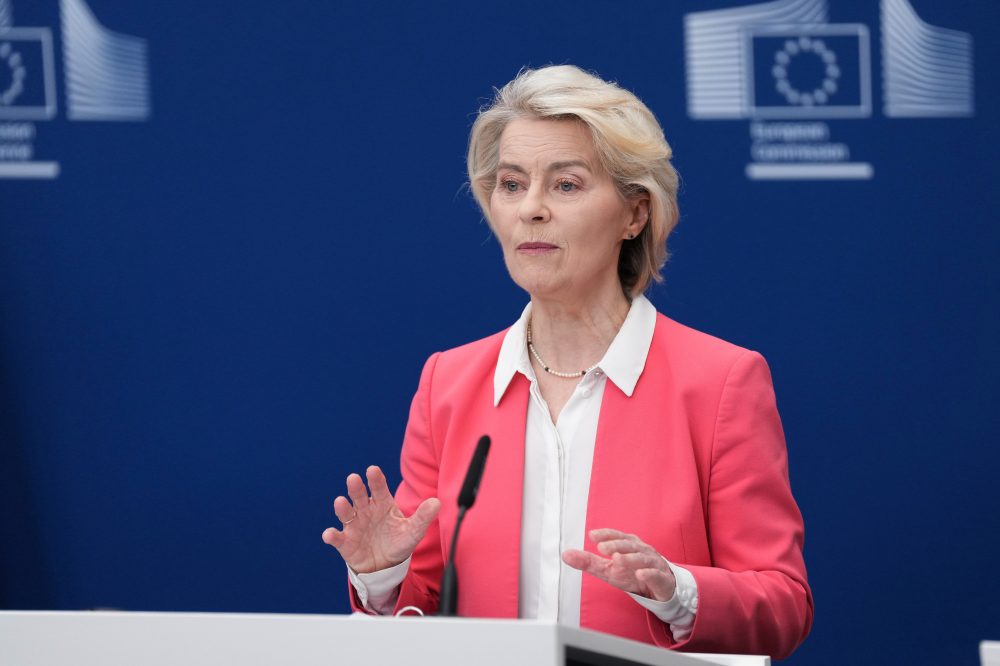
BRUSSELS (AP) — The president of the European Commission spoke out Monday in favor of placing limits on how children can access social media, as a special EU advisory panel released a report recommending that platforms be off-limits to children under 13 until technology companies can demonstrate their services are safe.
Concerns about the impact of social media on young, still-developing minds have been fueling a wave of new laws around the world. Countries including Australia, the United Kingdom, Turkey, and Indonesia have enacted bans preventing children under 15 or 16 from using platforms such as TikTok, YouTube, and Instagram.
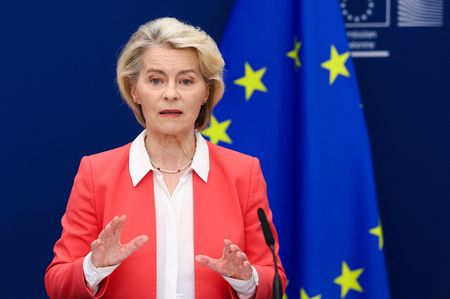
European Commission President Ursula von der Leyen, who holds a medical degree, laid out her concerns about children’s exposure to social media and stated that children under the age of 3 should have no screen time whatsoever.
“I believe we need to consider phased and gradual access for different age ranges because childhood won’t wait and once it’s gone, we can never give it back,” von der Leyen told reporters.
She drew comparisons to other age-gated activities: “Just as we don’t give our children keys to the car before they have their license, or we do not let them buy alcohol until they are legally allowed. We need to set the age at which they can, the children can, legally access social media,” she said.
Von der Leyen also singled out infinite scrolling as one of the “addictive” features that technology companies need to address.
While she stopped short of naming specific age thresholds beyond the restriction for toddlers, the European Commission — the EU’s executive body — is expected to put forward a formal proposal for the bloc’s 27 member nations to consider in the coming months. Von der Leyen’s policy positions carry significant weight among EU member countries.
The special panel, which was created to examine child safety in the digital space, delivered its findings to the EU chief on Monday. The report concluded that when it comes to online safety, “the burden of proof needs to be on providers, not regulators, parents and children.”
“Until they demonstrate that their services are safe by design, social media and other digital services providers should have restricted access to children under the age of 13 in the EU,” the report stated. Its findings are expected to play a significant role in shaping von der Leyen’s next steps.
The panel also recommended that EU member countries consider “further precautionary age restrictions” for children who are older than 13.
Ukrainian President Volodymyr Zelenskyy arrived in Paris on Monday to sit down with approximately two dozen European leaders committed to supporting Kyiv as the conflict with Russia stretches into its fifth year.
At the same time, European foreign ministers gathered separately in Brussels, where discussions were expected to focus on Ukraine’s ongoing needs and the broader threat Russia poses to the continent.
Both Ukraine and its European allies are eager to build on recent Ukrainian battlefield gains and push Russian President Vladimir Putin toward peace talks. However, Moscow has shown no sign of willingness to compromise, despite a year of diplomatic efforts by the Trump administration.
Analysts and Western officials say Ukraine’s growing drone capabilities have given it a significant advantage in recent months. Strikes on Russian supply lines behind the front have slowed the Russian military’s progress and made advances increasingly costly for Moscow.
Ukrainian forces have focused heavily on cutting off supplies to Crimea, sparking what observers describe as the worst fuel shortage on the Black Sea peninsula since Russia’s illegal annexation of the territory in 2014. These strikes have also undermined the Kremlin’s claims that Russia is winning the war.
Zelenskyy has been pushing to fast-track a joint European effort to develop anti-ballistic air defense systems capable of intercepting Russia’s attacks on Ukraine’s power infrastructure.
Following the latest wave of overnight Russian attacks across Ukraine, Zelenskyy posted on social media Monday: “Everyone in the world sees that Ukraine needs more air defense, more protection of life.”
U.S. President Donald Trump announced last week that he would grant Ukraine a license to manufacture Patriot air-defense systems — a move that could represent a significant turning point for Kyiv. Still, experts and Ukrainian officials caution that converting that commitment into actual weapons systems would likely require years of work.
The Paris gathering, organized under the so-called Coalition of the Willing — a group of more than 30 nations backing Ukraine — was expected to draw around 25 heads of state and government. The unusually high number of attending leaders was seen as a strong signal of long-term support for Ukraine and a warning to Moscow as Russia continues to test European resolve.
French Foreign Minister Jean-Noël Barrot announced Monday that France would summon the Russian ambassador and impose sanctions on Russian hackers. He told BFMTV-RMC that the actions stem from “a vast cyber campaign aimed at sabotage and espionage, carried out by Russia in about 10 European countries.”
The war’s reach has also extended beyond Ukraine’s borders. Moldova’s Ministry of Foreign Affairs reported Monday that a drone launched during Russian overnight strikes on Ukraine’s Odesa region crashed and detonated on Moldovan soil, calling the incident “serious and unacceptable.”
Zelenskyy made the trip to Paris following the death of U.S. Sen. Lindsey Graham, one of Ukraine’s most vocal supporters in Washington. He also departed amid a significant and still-unfinished reshuffling of his government, which included Prime Minister Yulia Svyrydenko stepping down on Sunday.
Ukraine has continued striking deep inside Russian territory using domestically developed long-range drones and missiles, at times matching or surpassing the volume of aerial attacks launched by Russia.
Moscow Mayor Sergei Sobyanin reported that Russian air defenses shot down 350 Ukrainian drones heading toward Moscow since late Sunday, including 50 near the capital itself. Andrei Vorobyov, who leads the region surrounding Moscow, said 81 Ukrainian drones were intercepted overnight.
Vorobyov also reported that three people were killed and three others injured by a Ukrainian strike on the Pionersky settlement near Istra in the western Moscow region, with five private homes catching fire.
Ukraine’s air force, meanwhile, reported that Russia launched 134 long-range strike drones and three guided missiles at Ukrainian territory. Air defenses successfully intercepted or jammed all three missiles and 123 of the drones, though six drones caused damage at five separate locations.
In the southern Ukrainian city of Zaporizhzhia, more than 70 people were hospitalized following a series of recent Russian strikes that damaged 11 apartment buildings, according to military administration head Ivan Fedorov.
Russia’s Federal Security Service claimed it foiled a Ukrainian plot to strike the Ukrainka air base in the far eastern Amur region and the Shagol air base in the Chelyabinsk region in the southern Urals. The agency said small drones were smuggled into Russia’s western Bryansk region via air balloons and larger transport drones, then transported by car to locations near the targeted bases by Ukrainian operatives. Authorities said they arrested Ukrainian agents and associates and seized 24 drones, describing the alleged scheme as part of a series of planned strikes “unprecedented in its scale and the level of threat.”
Just over a year ago, a Ukrainian covert mission known as Operation Spiderweb reportedly destroyed or damaged nearly one-third of Moscow’s strategic bomber fleet by smuggling drones into Russian territory, according to Ukrainian officials.
BRUSSELS — The European Union announced sanctions Monday against Russian military intelligence officers, hackers, and private companies, condemning what it described as a years-long campaign of cyber espionage aimed at weakening the bloc.
The sanctions target nine individuals and four organizations accused of ties to an online spying network that the EU says has been attacking governments and conducting sabotage operations against critical infrastructure — including heating and power plants — since 2010.
The European Council released a statement saying those hit by the sanctions “contribute to Russia’s efforts to destabilize the EU, its member states and international partners.” The espionage and sabotage activities have been traced to at least nine countries.
The names of the specific individuals and organizations were not included in the official statement.
According to the European Council, the countries targeted include France, Germany, Poland, Cyprus, the Netherlands, Austria, Slovakia, Romania, and Finland, “among others.”
French Foreign Minister Jean-Noël Barrot announced that France plans to call in the Russian ambassador within the coming days. Speaking to French BFM television, he explained that the cyber operations are designed “either to capture information, or sabotage the operation, for example, of railway infrastructures as it was the case in Poland.”
The EU’s actions focused specifically on the 16th Centre of Russia’s Federal Security Service, known as the FSB. The bloc stated the FSB has been “controlling a variety of cyber threat groups” and has “conducted a wide range of malicious cyber activities with growing severity.”
Several nations have previously accused Russia of using cyberattacks and disinformation campaigns to interfere in elections.
In April, Sweden announced that a pro-Russian group with connections to Russia’s security and intelligence services was responsible for a cyberattack on a heating plant the previous year. That announcement came on the heels of warnings from officials in Poland, Norway, Denmark, and Latvia that Russia has been systematically targeting critical infrastructure throughout Europe.
AVON, France — A wildfire burning through the famous Fontainebleau forest south of Paris forced residents out of their homes and brought train and highway travel to a halt on Monday, adding to a growing list of wildfires scorching western Europe during a relentless summer heat wave.
The Fontainebleau forest is a historically significant and heavily visited destination located roughly 70 kilometers — about 42 miles — from the French capital. The surrounding region is home to the Fontainebleau Chateau, a palace once favored by Napoleon, and draws large numbers of tourists and day-trippers from Paris and elsewhere.
Hundreds of firefighters were sent to battle the blaze, and two water-dropping aircraft were brought in to help from the air. Regional fire service spokesperson Paul Laurain shared updates with public broadcaster France-Info as crews worked to bring the fire under control.
Train service to and from Paris’s busy Gare de Lyon station had been thrown into chaos late Sunday but was gradually recovering by Monday morning. A stretch of the heavily traveled A6 highway heading southeast out of Paris was also closed due to fire danger.
The Fontainebleau fire is just one piece of a larger crisis unfolding across France. Wildfires in the southern part of the country have already burned thousands of hectares since last week, putting a strain on firefighting resources and even forcing changes to the route of the Tour de France cycling race.
France is currently in the grip of its third heat wave of the summer. Temperatures have climbed past 40 degrees Celsius — 104 degrees Fahrenheit — across western and central parts of the country, with Paris seeing temperatures around 37 C, or roughly 98 F.
Across the border in Spain, the situation remains grim following a deadly wildfire that tore through a remote expat community in the country’s south last week. A 93-year-old British national died Sunday in a hospital from injuries suffered in the Los Gallardos fire, bringing the total death toll to 13. Ten people were still unaccounted for as of Monday.
Spanish Prime Minister Pedro Sánchez was expected to travel to the fire zone Monday. Regional officials said the blaze had been contained by Sunday after burning through approximately 70 square kilometers — about 27 square miles — of forest and farmland, an area larger than the island of Manhattan.
Extreme heat, strong winds, and a prolonged lack of rainfall have combined to create dangerous fire conditions across Spain, allowing small blazes to explode in size before they can be stopped.
The fires are unfolding against a backdrop of long-term climate change. According to the European Union’s Copernicus Climate Change Service, Europe is the fastest-warming continent on Earth, with temperatures rising at twice the global average rate since the 1980s.
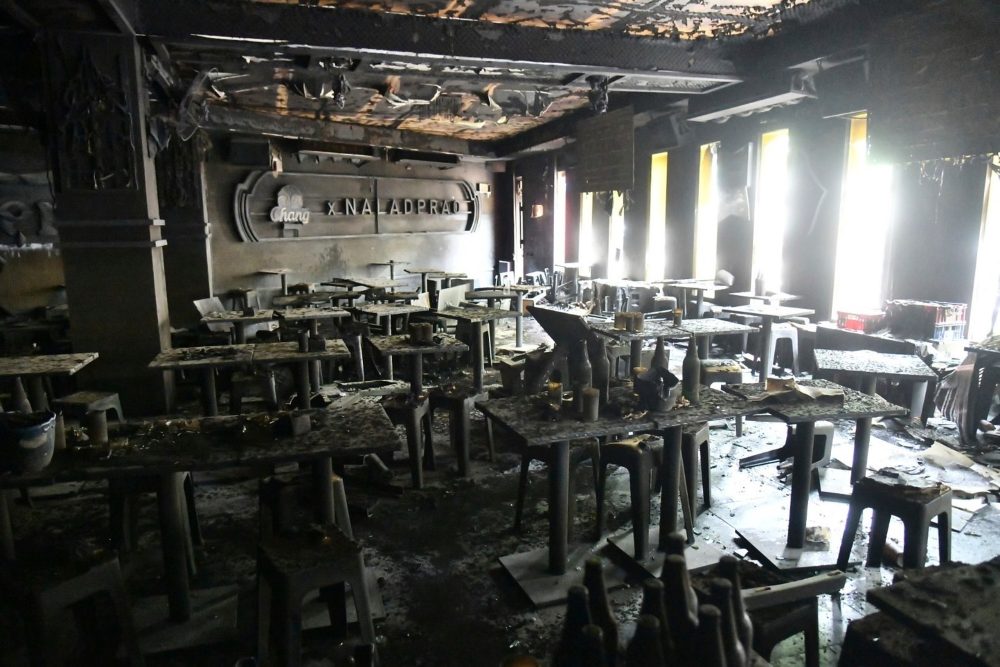
Thai authorities are working to determine the cause of a deadly fire at a Bangkok music bar that left at least 27 people dead and dozens more injured — the latest in a long history of catastrophic blazes at nightlife venues across the globe.
Fire safety experts say the high number of casualties may reflect problems commonly seen in past entertainment venue disasters, including inadequate safety measures. The fire broke out at the Na Ladprao music bar shortly before midnight Sunday and appeared to race quickly across a ceiling covered with flammable decorative materials before cutting off the main entrance. Local media reports indicate that packed conditions inside the bar, blocked escape routes, and widespread panic made it harder for people to get out.
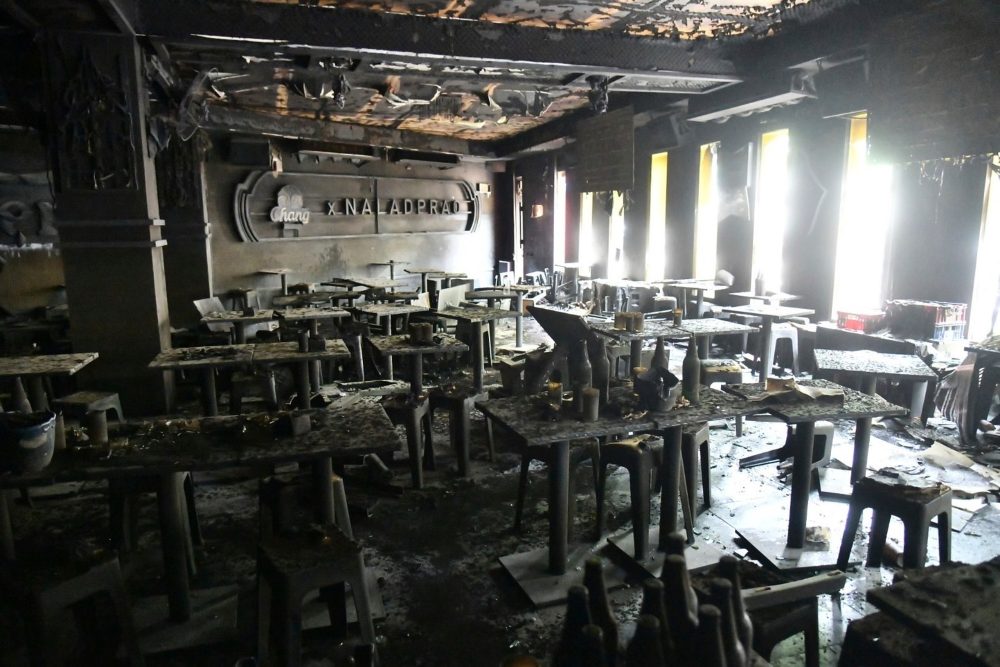
Witness videos posted online captured the bar engulfed in flames while thick black smoke poured from the front entrance and people rushed to escape. Images and footage recorded at the scene Monday showed Thai investigators picking through the burned-out structure, with the worst destruction visible overhead. Large portions of the ceiling had been reduced to charred ruins, while the floor below — tables still holding beer bottles — was buried under ash and debris.
Thailand Prime Minister Anutin Charnvirakul said a musician who had been performing at the bar told him he noticed smoke rising from a circuit breaker near the stage just before the power cut out. An explosion followed, and the bar quickly filled with dense smoke.
Thai officials said investigators would look into what materials were used in the ceiling and whether any emergency exits were blocked at the time of the fire. A Google image from February appeared to show plastic plants decorating the ceiling above the stage.
Lee Young Ju, a fire safety professor at South Korea’s Kyungil University, said the fire may have been triggered by an electrical fault — possibly tied to audio or lighting equipment or faulty wiring — that then spread rapidly along the ceiling.
Royal Thai Police chief Kittharath Punpetch said investigators are also looking beyond the ceiling materials and overhead wiring. Police are examining whether gas canisters stored in the kitchen may have played a role in fueling the blaze.
Huang Xinyan, a professor at Hong Kong’s Polytechnic University, said video from the fire site suggests the bar contained combustible foam materials, had no sprinkler system, and featured small exits that may have slowed evacuation. He noted that plastic ceiling decorations may have been combined with foam soundproofing materials, potentially accelerating how fast the fire grew.
Professor Lee cautioned, however, that even if sprinklers had been present, it’s uncertain they would have slowed a fire burning along the ceiling, since sprinkler systems are not built to fight fires spreading overhead.
The Bangkok disaster is the most recent in a troubling pattern of deadly fires at entertainment venues around the world. On New Year’s Day, a fire tore through a bar in the Swiss ski resort town of Crans-Montana, killing around 40 people and injuring more than 100. A 2013 nightclub fire in Santa Maria, in southern Brazil, claimed more than 200 lives.
Huang said the Bangkok fire may share similarities with the Switzerland blaze, pointing out that such venues tend to be packed with flammable soundproofing materials and overcrowded with patrons, both of which can drive up the death toll.
Professor Lee said high casualty numbers in entertainment venue fires often come down to large crowds crammed into relatively small spaces, making rapid evacuation nearly impossible. He noted that these venues frequently don’t have enough exits, and most people inside only know the main entrance they used to get in. Loud music and alcohol can also leave patrons less alert and slower to react when danger strikes.
Jiang Liming, another professor at Hong Kong’s Polytechnic University, pointed out that bars typically have few large windows and exits can quickly become overwhelmed by panicked crowds trying to escape all at once.
“Once there was a rapidly growing fire, large (numbers) of casualties might occur due to high density of people and fast accumulation of smoke,” Jiang said.
Kong Ha-song, a disaster prevention professor at South Korea’s Woosuk University, said death tolls in bar and nightclub fires are frequently made worse because these spaces can resemble a “maze,” with beer crates, tables, and other items blocking hallways and exit paths. He also noted that emergency exits are sometimes kept locked to prevent theft or unauthorized entry.
Thai police chief Kittharath said the single-story bar had four exits in total, but investigators were looking into whether the two rear exits were blocked or otherwise unusable at the time of the fire. One exit near the restrooms — where most of the victims were discovered — had a table pushed in front of it, while another exit near the kitchen had a damaged sign and a sliding door with its handle missing.
American households and the Federal Reserve are facing a fresh inflation challenge — this time driven by the explosive growth of artificial intelligence.
Investment in data centers built to power AI is expected to surpass $700 billion this year alone. That surge in spending has driven up the cost of memory chips, computer processors, and other hardware, while also pushing electricity prices higher. Economists say the pressure on prices is expected to continue at least through the end of 2025.
While the impact isn’t expected to rival the inflation surge of 2021 through 2023 — when prices peaked at 9.1% — the AI-driven spending wave could keep inflation running hotter than the Federal Reserve would prefer. That could prompt the central bank to raise its key interest rate later this year, a move that typically leads to higher costs for car loans, home mortgages, and business borrowing.
Fed officials are expected to closely examine June’s inflation report, set for release Tuesday, for early signs of AI’s effect on prices. Inflation last month likely eased somewhat, in part because gasoline prices dropped after a ceasefire was reached between the U.S. and Iran — though that situation has since changed as fighting has resumed.
Just four major technology companies — Google’s parent Alphabet, Amazon, Meta Platforms, and Microsoft — are projected to spend a combined $720 billion this year, with the bulk of that going toward data center construction.
Those facilities require enormous quantities of semiconductors, and chip supplies have been stretched thin. Economists at JPMorgan Chase estimate that the price of certain computer memory chips could climb as much as 400% between 2024 and the close of this year.
Consumers are already feeling the pinch at the checkout counter. Prices have risen on a wide array of electronics, including laptops, smartphones, video game consoles, and desktop computers. Utility bills are also climbing as data centers consume an ever-larger share of newly generated electricity.
Last month, Apple announced it was raising prices on its laptops and iPads by roughly 15% to 25%. Its top-of-the-line MacBook now carries a price tag of $1,999, up from $1,699. Analysts widely expect iPhone prices to follow suit.
In a statement, Apple explained the increases this way: “The rapid expansion of AI data centers has created an extraordinary surge in demand for memory and storage. We have never seen a component price increase this much, this quickly.”
On the same day Apple made its announcement, Microsoft said the price of its Xbox video game console would increase by $100 by August 1st, pointing to higher memory chip costs as the reason. Sony has similarly raised prices on the PlayStation, and both Dell Computer and HP have increased prices on their laptop lines.
Analysts at investment bank Evercore ISI recently noted that a “wave of AI-related cost pressures spilling over into consumer prices is still in the early stages of building.”
The overall effect on broad inflation measures may be relatively contained. Many economists project that AI investment will add roughly half a percentage point to core consumer prices — which strip out food and energy costs — by year’s end.
Even so, that increase could cancel out price relief coming from other directions, such as the fading impact of President Donald Trump’s tariffs and cooling rental costs. Core inflation, based on the Fed’s preferred measure, stood at 3.4% in May. Some economists now believe it may only dip slightly by December, staying well above the Fed’s 2% goal.
The AI-driven price pressure may prove to be temporary, but it follows earlier rounds of inflation tied to tariffs and a spike in gasoline prices stemming from the conflict with Iran. The Fed generally overlooks short-lived price increases rather than raising rates to combat them — but a long string of temporary shocks could fuel more lasting inflation, which has already been above the Fed’s target for more than five years.
“In isolation one or two such shocks is perhaps transitory, something they’re willing to live with,” said Abiel Reinhart, an economist at J.P. Morgan. “A sustained series of shocks, or a wider range of shocks, becomes more concerning to them.”
Fed policymakers are increasingly focused on AI’s potential to stoke inflation. Kevin Warsh, who took over as chair on May 22nd, has expressed the view that AI will ultimately make the U.S. economy more efficient, which should reduce inflation over time even as growth picks up. However, in remarks delivered July 1st, he acknowledged that AI investment is currently boosting demand, though he stopped short of predicting how inflationary the effect would be.
Despite that cautious optimism, many Fed officials are worried that demand for AI-related equipment will keep outpacing supply — a dynamic that tends to sustain higher prices.
“If this creates a sustained impulse to demand relative to supply in inflation, I do think that’s the kind of situation where you don’t look through this,” said John Williams, president of the Federal Reserve Bank of New York and vice chair of the Fed’s rate-setting committee, speaking Thursday. Williams has previously favored holding rates steady, but his comment signals he could back a rate hike under certain conditions.
Minutes from the Fed’s June 16th and 17th policy meeting, released Wednesday, indicate that many other officials share Williams’ concerns.
AI’s massive appetite for electricity is another route through which the technology could drive up prices. Power companies across the country are adding new capacity to meet demand — a costly process that can push utility bills higher for everyone.
According to government data, electricity prices rose 5.9% in May compared to the same month a year ago, outpacing overall inflation, which came in at 4.2%. After a spike during the pandemic, electricity price growth had settled back to around 2% annually in early 2025 before the AI-driven demand surge took hold.
While chip prices could peak and begin to fall later this year, experts believe AI’s electricity demands will keep utility costs elevated through 2028 or longer. Economists at Goldman Sachs projected in February that electricity prices will climb 6% both this year and next, followed by an above-average increase of 3% in 2028.
“We do know what effect AI is having on inflation now, and it is inflationary, not deflationary,” wrote Dario Perkins, an economist at TSLombard, in a note published this week.
The White House is preparing to gather electric utility companies and data center developers for a voluntary commitment aimed at preventing the rapid rise in electricity demand from artificial intelligence from driving up power bills for everyday consumers and businesses, according to three people with knowledge of the plans.
An announcement event is expected within the next few weeks, with multiple companies set to participate and pledge that existing ratepayers will not be left footing the bill for AI-driven infrastructure expansion. The list of attendees is still being put together, sources said.
The White House did not respond when asked for comment.
Data centers require enormous amounts of electricity, and their surging power needs have led regulators, consumer advocates, and state lawmakers across the country to raise alarms that ordinary households could end up covering the cost of grid upgrades that primarily benefit some of the world’s biggest technology companies. That backdrop has fueled skepticism about whether any voluntary pledge will result in meaningful action or amount to little more than a public relations gesture.
President Donald Trump’s administration has been pushing hard to speed up the buildout of AI infrastructure and is eager to sidestep any political fallout that could come from higher electricity bills hitting American families.
Earlier this year, Amazon, Google, Meta, Microsoft, OpenAI, Oracle, and xAI signed a voluntary “Ratepayer Protection Pledge” at a White House ceremony. Through that agreement, the companies committed to paying for the electricity infrastructure their AI operations require rather than shifting those expenses onto existing utility customers. That included contributions toward new power generation, grid upgrades, and costs related to reserved but unused capacity.
The upcoming event is expected to expand on those earlier commitments by pulling in electric utilities, companies that construct and run data centers on behalf of major tech firms, and governors from states that are at the forefront of building out the power infrastructure needed to handle the anticipated surge in electricity demand.
Administration officials have maintained that the United States can only win the global competition in artificial intelligence by rapidly growing its electricity generation and transmission capacity — but that consumers should not be made to pay for that growth. The White House has framed the initiative as a way to reassure the public that expanding AI investment does not have to mean higher energy costs.
A decision by Michael Saylor’s bitcoin-accumulating company Strategy to approve more bitcoin sales has put renewed scrutiny on a group of publicly traded crypto stockpiling firms that are feeling the pressure of declining cryptocurrency values.
Strategy’s stock got a brief bump on Friday after analysts gave their approval to a plan unveiled late last month. That plan includes a stock buyback program and authorization to sell up to $1.25 billion worth of bitcoin.
The company’s shares had surged in late 2024 and through much of last year, but dropped to two-year lows last month. Strategy has already offloaded roughly $218 million in bitcoin so far this year, using the proceeds to cover dividends and rebuild its cash reserves.
Those sales have reignited debate about the long-term viability of the many copycat companies known as “digital asset treasury” firms, or DATs. These companies exploded in popularity last year, riding a wave of investor enthusiasm tied to U.S. President Trump’s pro-crypto stance.
DATs give investors a way to gain exposure to cryptocurrency through regulated public companies, while also offering the potential for amplified returns. However, the model is extremely vulnerable to falling crypto prices, which can shrink the value of their holdings, make fundraising more difficult, and undermine the leveraged returns that draw investors in.
Bitcoin, the most widely held cryptocurrency, has plunged as much as 33% this year as markets have grappled with geopolitical tensions, rising oil prices, and a reshaping of the Federal Reserve under new chair Kevin Warsh. The fortunes of DAT companies have fallen right along with it.
The combined market value of DAT companies hit its peak last July, when the broader crypto market reached $4 trillion in total value. That was followed by a sharp decline in November after global trade fears triggered a record $19 billion liquidation of crypto positions. These companies have not been able to fully recover in 2026 as the crypto market has remained sluggish.
Many DATs traded at a premium to their actual crypto holdings last year, because investors expected them to use access to equity and debt markets to keep buying more tokens. But starting late last year, the companies’ combined market value relative to the net asset value of their crypto holdings — a measure called mNAV — dropped below 1. That means the companies were trading at a discount to what they actually hold.
This is a significant problem, since most DATs need their shares to trade above their net asset value to attract new capital. Strategy’s own mNAV dipped below 1 for the first time late last month.
Despite the challenges, executives at DAT companies have said their long-term success will depend on making smart investment choices, and they are exploring new ways to increase value for shareholders, according to previous reporting.
Weekly trading volume in DAT shares peaked last August, according to data from blockchain data provider Artemis Terminal, but has been volatile since. Volume hit a low point in February, following a selloff in bitcoin and other cryptocurrencies triggered by news that Warsh would be nominated to lead the Federal Reserve. Analysts expect Warsh to push for reducing the Fed’s balance sheet — a move that would drain liquidity from the financial system and act as a drag on risk assets like cryptocurrencies.
Strategy remains by far the largest holder of crypto among these companies, even after this year’s bitcoin sales. BitMine Immersion Technologies, which holds ether — the second-largest cryptocurrency behind bitcoin — has the next biggest stockpile.
Several other crypto treasury companies have also sold portions of their holdings this year. Nakamoto Inc., which describes itself as a bitcoin operating company, sold roughly 5% of its bitcoin in March and another approximately 600 bitcoin in June.
All companies mentioned in this report either declined to comment or did not respond to requests for comment.
American chip stocks have stumbled out of the gate in July, and market watchers say more turbulence could be on the way as investors grapple with lofty valuations and growing uncertainty about how long the artificial intelligence spending boom will last.
The Philadelphia Semiconductor index has dropped more than 11% since reaching a record peak in June. Despite that slide, the index remains up 83% for the year — a figure that hangs over every conversation about the sector’s future. These companies have benefited enormously from rising prices and supply-demand imbalances, but financial markets are always looking ahead.
Steve Sosnick, chief market analyst at Interactive Brokers, put it plainly: “We’ve never seen this kind of extreme earnings growth. But the question then becomes, how long can we expect this to continue.”
Money Flowing Out
Funds that track U.S. semiconductor stocks saw outflows of roughly $11 billion during the week ending June 24 — the largest weekly exodus of money from the sector this century, according to LSEG Lipper data. That followed two weeks in which those same funds had pulled in about $12 billion in fresh investment, underscoring just how volatile sentiment has become.
Analysts broadly expect that major technology companies will keep spending heavily on cloud and AI infrastructure. A note from BofA Securities this week projected that global cloud and AI infrastructure capital expenditure could approach $1.5 trillion by 2027, representing a 40% to 50% jump year over year. Much of the current anxiety, analysts say, is driven by hypothetical scenarios — what happens if stock prices fall or companies start cutting their capital spending plans.
Wall Street Still Bullish
Despite the recent dip, U.S. brokerages have been raising their price targets for chip stocks, fueled by expectations that demand for AI technology will keep supporting earnings growth.
Among S&P 500 chipmakers, Micron has the highest projected upside relative to its current price — more than 60% — based on the consensus analyst target, according to LSEG data. Memory chipmaker Sandisk’s shares are seen rising more than 30%. Nvidia’s stock is expected to climb over 40%.
SK Hynix, another memory chip company, jumped more than 10% in its U.S. trading debut on Friday after a $26.5 billion share sale, buoyed by soaring memory prices driven by tight supplies.
However, several other large semiconductor firms are already trading near their median 12-month price targets, suggesting that much of the expected gain may already be reflected in current prices.
Alexander Lis, chief investment officer at SD Ventures, offered a note of caution: “I consider elevated price targets to be rather a consequence of the incredible momentum in semis rather than a reliable indicator of future performance.”
Short Sellers Returning
Data analytics firm ORTEX reports that bets against major semiconductor companies have been building over the past year, with short interest now sitting at a three-year high.
Peter Hillerberg, co-founder at ORTEX, described the trend this way: “This is caution and hedging creeping back into the sector after a huge run, not the kind of crowded, high-conviction shorting that leads to squeezes.”
Hillerberg added that short interest in these stocks has nearly doubled on average over the past three years, with the biggest increases seen in Marvell, Qualcomm, and Micron.
Earnings Under the Microscope
Earnings for companies on the S&P 1500 Semiconductors & Equipment Industry index are expected to more than double this year, driven largely by Micron and Nvidia, according to data compiled by LSEG. But that growth is projected to slow in 2027, with profits expected to rise 46.1%.
Adding to the uncertainty, the unclear path for U.S. interest rates and ongoing conflict in the Middle East could weigh on future earnings estimates.
The Valuation Question
Nvidia, which has been central to the AI-driven market rally, is currently trading at a forward price-to-earnings ratio of about 19 — its lowest level in more than a decade. Micron’s forward P/E touched a nine-year low of 5.4 back in May.
Chris Maxey, chief market strategist at Wealthspire Advisors, explained: “The valuations have gotten cheaper over the last two years, and that’s primarily a function of earnings growing faster than the price.”
Still, forward P/E ratios for Intel, Advanced Micro Devices, and Marvell Technology remain well above their long-term averages, suggesting that earnings expectations haven’t caught up quickly enough — and potentially turning investor attention back toward the cyclical, commodity-like nature of the chip business, especially in memory chips.
Marija Veitmane, head of equity research at State Street Global Markets, summed up the long-term outlook: “It’s impossible to argue that the cyclicality of the sector will go away. I think the cycle will just get a lot longer.”
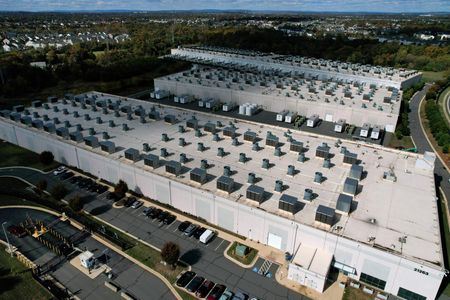
Meta announced Monday that its data center located in Richland Parish, Louisiana will grow to a compute capacity of 5 gigawatts, a massive scale-up designed to power the social media giant’s push into artificial intelligence.
Since construction began in December 2024, Louisiana-based businesses have already been awarded more than $1.6 billion in contracts tied to the project, according to the company.
Here is a closer look at the key details of the expansion:
The data center growth represents an investment of more than $50 billion in the Richland Parish area — a figure that U.S. President Donald Trump had referenced last year when discussing the project’s expected cost.
As part of the expansion, Meta says it intends to put over $1 billion toward upgrading local infrastructure, including improvements to roads, water systems, and wastewater facilities in the surrounding region.
Meta joins other major technology companies in aggressively funneling billions of dollars into AI-focused data centers and computing infrastructure, as the demand for that capacity continues to grow faster than the industry can keep up.
Looking further ahead, the company has committed to investing $600 billion in U.S. infrastructure and job creation over the next three years, as CEO Mark Zuckerberg pushes forward with ambitious plans centered on AI agent technologies.
Stock index futures pointed to a lower opening on Wall Street Monday after the United States and Iran traded attacks in the Gulf, with Tehran claiming it had sealed off the Strait of Hormuz — a crucial artery for the world’s oil supply.
The renewed hostilities shook investor confidence and sent crude futures climbing more than 2%, while technology stocks bore the brunt of the selling pressure in premarket trading.
The latest flare-up cast serious doubt on an interim agreement the two countries had reached last month, which was intended to reopen the strait and wind down hostilities following 60 days of negotiations.
Semiconductor companies were among the hardest hit. Micron Technology dropped 5.2% before the opening bell, while Western Digital fell 6%, Seagate slid 4.8%, and Sandisk lost 6.6%. U.S.-listed shares of SK Hynix tumbled 9.3%, just days after the company made a high-profile debut on the Nasdaq last Friday. The iShares semiconductor ETF declined 2.7%.
Kathleen Brooks, research director at XTB, explained the market dynamic: “U.S. futures are pointing to a lower open later today. This suggests that the rise in geopolitical tensions and the spike in the oil price are disrupting the momentum trade once again, which will hit the tech trade and the chip stock rally.”
As of 5:14 a.m. ET, Dow E-minis were up a modest 28 points, or 0.05%, while S&P 500 E-minis were off 23.5 points, or 0.31%. Nasdaq 100 E-minis were down 303.75 points, representing a decline of 1.01%.
For context, the Dow Jones Industrial Average closed up 0.29% at 52,637.01 on Friday, and the futures contract remained 0.56% above that closing level.
Despite Monday’s jitters, the S&P 500 has gained more than 10% so far this year and sits less than 1% beneath its record closing high set in early June. The index logged back-to-back weekly gains last week, weathering turbulence in chip stocks and earlier U.S.-Iran tensions.
The week ahead is packed with potential market-moving events. Several of the country’s largest financial institutions — including JPMorgan Chase, Goldman Sachs, and Morgan Stanley — are set to report second-quarter results. Netflix, General Electric, and UnitedHealth are also scheduled to release earnings. According to LSEG IBES, S&P 500 profits are forecast to rise 23.7% compared to the same period a year ago.
Investors will also be watching a series of key economic reports. Tuesday brings the U.S. consumer price index, an inflation gauge that could reshape expectations around interest rate policy. Producer price data is due Wednesday, followed by monthly retail sales figures on Thursday.
Also on Tuesday, Fed Chair Kevin Warsh is expected to deliver his first monetary policy testimony before Congress. Fed Governor Christopher Waller is scheduled to speak Monday on the economic outlook.
According to LSEG data, markets are currently pricing in at least one 25-basis-point interest rate increase before the end of the year.
Good morning, Delmarva! We’re kicking off the week with a gorgeous summer day in store. Expect plenty of sunshine and a comfortable high near 83°F this afternoon, with light easterly winds keeping things feeling pleasant along the Shore. It’s a great day to get outside and enjoy some time on the water or in the yard!
Tonight looks equally pleasant, with mostly clear skies and temperatures dropping down to around 64°F — perfect sleeping weather with the windows open.
Looking ahead to Tuesday, we’re turning up the heat a notch. Sunny skies continue, but that afternoon high climbs to near 89°F, so make sure you’re staying hydrated and wearing sunscreen if you’re spending time outdoors. Tuesday night stays clear and warm, with lows settling around 71°F.
No storms or rain in sight for the next couple of days — just classic Delmarva summer sunshine. Enjoy it! I’ll have a full extended outlook on TV Delmarva tonight at 6. Stay cool out there, folks!
Minos Conaway Road is currently closed at its intersection with Route 1 due to active construction in the area.
According to traffic officials, the closure is expected to remain in place until September 14, 2026 at 8 p.m. Drivers who normally travel through that intersection will need to find an alternate route until the construction work is completed.
No additional details were provided regarding the nature of the construction project. Motorists are encouraged to allow extra travel time and watch for signage directing them around the affected area.
When prisoners try to formally report mistreatment behind bars, they are often met with retaliation — and that’s making it harder for inmates to hold federal prison staff accountable, according to a new investigation.
NPR and The Marshall Project jointly conducted the investigation, which found that federal prison guards are using various tactics to discourage or prevent inmates from filing complaints in the first place.
Prisoners have the legal right to submit grievances about how they are treated while incarcerated. However, the investigation suggests that exercising that right can come at a cost for many inmates.
Retaliation against prisoners who speak up is a key concern highlighted in the report. When guards or staff respond to complaints with punishment or intimidation, it can effectively shut down the grievance process before any formal legal action is ever taken.
The findings point to a broader problem within the federal prison system, where the mechanisms meant to protect inmates from abuse may themselves be undermined by those in positions of authority.
Fast-fashion giant Shein is set to face a critical hearing with the Hong Kong stock exchange on Thursday as part of its initial public offering process, according to two sources familiar with the situation who spoke on condition of anonymity due to the sensitive nature of the information.
The hearing represents a major milestone for the rapidly growing retail company, which has been working toward a public market debut for some time. Earlier on Friday, Shein cleared one of the biggest hurdles in that process when China’s securities regulator gave the green light for the company to pursue its Hong Kong IPO.
The sources who provided this information were not identified publicly because the details remain confidential. Shein had not responded to a request for comment at the time of reporting.
A 25-year-old man was shot and killed by a federal agent with the Memphis Safe Task Force while he was experiencing a mental health crisis, according to reports.
Jonah Neal was struck by a Homeland Security Investigations agent in May in Memphis, Tennessee. His death is one of at least four fatal shootings connected to the task force.
Neal’s grandmother, Cindy Leachman Aldridge, has been left holding onto memories of her grandson following the deadly encounter. She was photographed at her home in Owensboro, Kentucky, holding a picture of Jonah.
The Memphis Safe Task Force has come under scrutiny following the string of deadly shootings involving its agents. The incident involving Neal raises broader questions about how law enforcement responds to individuals in mental health distress.
The nation’s largest banks are moving quickly to weave AI-powered digital assistants into their everyday operations, working to figure out how these automated tools fit alongside human workers and clients as competition in the sector heats up.
Financial institutions are locked in a race to adopt what’s known as agentic AI — artificial intelligence capable of completing tasks with little to no human direction — across departments ranging from wealth management to trading, client screening, and treasury functions. The goal is a significant boost in productivity by letting these digital agents act independently on behalf of users while working side by side with human employees.
“We are working with banks in particular on agents and human employees … to help the banks look at all the roles end to end, and then determine which ones are hybrid roles, which ones are agentic employees, which ones are only human employees,” said Peter Torrente, U.S. sector leader for banking at KPMG. A survey conducted by KPMG in June found that 51% of banks were already running pilot programs for AI agents.
Across the industry, major financial players are either already using or actively planning to use agentic AI in a wide range of daily functions.
Koren Maranca, who leads Artificial Intelligence for Wealth Management at Morgan Stanley, said the bank plans to begin testing digital assistants later this summer that will be available to interact with clients around the clock. Morgan Stanley already relies on AI agents to support financial advisors with a variety of tasks. “We are now preparing these agents to start pushing reminders or recommendations to the financial advisors regarding their clients,” Maranca said. These assistants are designed to evaluate investments, propose strategies, and help build client portfolios.
At BNY, digital workers are treated much like human teammates — assigned specific duties, able to communicate with one another, and even given login credentials and nicknames. BNY’s CEO Robin Vince described the setup on a Wall Street Journal podcast earlier this year. “The digital employee has a login, it can actually operate in the systems, and it actually has a … human manager that’s responsible for training it, making sure that it actually is doing all the right things, like a performance review, if you will, quality control, and it has tasks every day,” Vince explained, using the bank’s AI assistant known as Payment Pete as an example. BNY did not respond when contacted for comment.
UBS financial advisors receive thousands of automated alerts each day through their AI agents, flagging situations that require attention — such as a client whose annuity is about to mature and needs to be reinvested. “They gather all internal information from meetings, accounts and e-mail communications,” said Richard James, head of AI product at UBS. Once an advisor decides on a course of action with a client, AI agents can carry out trades and process money transfers, James added. UBS says the technology has enabled advisors to spend 70% of their time in direct conversations with clients rather than on routine administrative work.
Goldman Sachs joined forces with Anthropic earlier this year to build agents capable of handling trading, transaction accounting, client screening, and onboarding. JPMorgan has identified corporate treasury as an area with strong potential for AI transformation, while Citi is preparing to introduce an AI-powered virtual wealth management team member.
“Banks are increasingly using agentic AI and figuring out more ways to use it because it has a lot of potential,” said Bhavi Mehta, global lead for advanced analytics in financial services at Bain & Company.
Bank investors have been pressing for clarity on what kind of return they’re getting on technology spending as AI investments continue to grow. “Investors are asking, where should we be looking for ROI on these tech spends and that’s why banks are likely to focus on certain areas of AI spends where the returns are much more evident and can be scaled up,” said Torrente.
The expanding role of AI agents is also drawing attention to questions of accountability and oversight. When banks deploy these tools, they grant them access to internal systems — but with built-in limits and safeguards. Morgan Stanley’s Maranca emphasized that human oversight will remain a constant, and that agents will not be given the authority to independently make portfolio decisions.
“They are still primarily using it for internal purposes and are being extremely cautious when it touches the customer and are making sure that there is a human involved for any critical functions,” said Mehta.
Volkswagen CEO Oliver Blume has put employees on notice that the company could be looking at cutting approximately 50,000 additional positions, according to an internal memo obtained by Reuters on Monday.
Blume indicated the potential job reductions stem from calculations aimed at bringing Volkswagen’s costs in line with what competitors spend to operate, making the automaker more financially competitive within the industry.
A meaningful rally in the U.S. dollar in 2026, fueled by a more aggressive Federal Reserve stance, is gaining additional momentum as major global pension funds unwind the currency protection strategies they put in place after last year’s “Liberation Day” market turmoil.
Climbing inflation figures and the arrival of Kevin Warsh as the new Fed chair have pushed U.S. real interest rates — that is, rates adjusted for inflation — higher in recent months, reshaping the calculus for international investors.
A Wells Fargo review of foreign exchange hedge ratios found that pension funds in Canada, the Netherlands, and Denmark have been pulling back from the dollar-hedging strategies they adopted last year. The pullback is relieving some of the downward pressure on the greenback and chipping away at the short-lived narrative that global investors were abandoning U.S. assets in a so-called “sell America” trade.
Karl Schamotta, chief market strategist at payments company Corpay in Toronto, said a similar trend appears to be unfolding among other large institutional investors, even though detailed hedging data are hard to come by. “Because long-duration hedging can be expensive and cut into returns, some of that increase is now being unwound — mostly passively, as firms let hedges roll off without replacement,” Schamotta said.
The numbers tell the story: hedge ratios — which measure how much of a fund’s dollar exposure is shielded from currency fluctuations — have dropped by 5 percentage points over the past year at some Danish funds and by about a percentage point at certain Canadian funds.
Erik Nelson, global head of FX strategy at Wells Fargo, acknowledged that the “sell America” movement had real substance behind it. “Sell America wasn’t all hype … there were some genuine flows behind it,” he said, pointing to the hedging activity among global pension funds. “But the hedging impulse has faded … those trends have since gone into reverse.”
A More Expensive Hedge
With the dollar hovering near a one-year high, expectations for a hawkish Fed are making hedging a harder sell. Foreign investors typically hedge currency risk by selling dollars forward, but that strategy becomes pricier when U.S. interest rates are elevated relative to those in other countries — because the cost of the hedge is tied directly to that rate gap.
Currently, U.S. short-term interest rates sit roughly 140 basis points above those in the euro zone, making dollar hedging a costly proposition for many overseas investors.
Garth Appelt, head of FX and emerging markets derivatives at Mizuho Americas, explained the dynamic: “Higher U.S. real interest rates make dollar investments more attractive, but also make currency hedging more expensive, so big investors have chosen to leave more of their U.S. stock holdings unhedged.”
Another factor reducing the urgency to hedge is a shift in how the dollar behaves relative to U.S. stocks. When President Donald Trump announced sweeping “Liberation Day” global tariffs in early 2025, the dollar broke from its usual pattern of strengthening during market stress — instead falling alongside U.S. equities. That left foreign investors with heavy U.S. exposure taking a hit on two fronts simultaneously.
Alex Moloney, head of macro discretionary currency solutions at Insight Investment, described the shock: “People were losing double the amount on a position that had previously worked for the prior decade as a perfect hedge.”
This year, however, the dollar has reasserted itself as a safe-haven currency, particularly during the risk-off period that followed the U.S.-Iran conflict.
Concerns about the Fed’s independence had also weighed on the dollar last year, as President Trump repeatedly criticized then-Chair Jerome Powell. Those worries have largely dissipated since Warsh stepped in to lead the central bank.
What It Means Going Forward
The retreat from hedging, even if modest, removes one obstacle to a stronger dollar. Just as those hedging flows had acted as a drag on the currency, their absence is likely to serve as “a marginal dollar support going forward,” Moloney said.
Analysts note that much of the dollar’s future path will hinge on whether the U.S. artificial intelligence investment story continues to attract international capital. If expectations around AI growth prove overly optimistic and the broader U.S. economy slows, funds may revisit their hedging strategies.
For now, though, the dollar remains in a position of strength. “You’re still in a situation where the dollar rates, dollar carry, and dollar equity returns are high,” Wells Fargo’s Nelson said. “So until that changes, we’re still in a generally strong dollar world.”
A new national poll shows that while supporting Israel is a cornerstone of Jewish identity for many older American Jews, younger Jewish adults are more inclined to express their faith through other means — like observing Jewish holidays — pointing to a generational divide that goes beyond politics and into questions of religious identity.
The AP-NORC Center for Public Affairs Research surveyed 1,022 Jewish adults and found that the gap over Israel’s actions since the Hamas-led attack on October 7, 2023 — which sparked the ongoing war in Gaza — reflects deeper differences in how generations define what it means to be Jewish.
Cameron Bernstein, a 27-year-old medical student in New Orleans, grew up with deep ties to Israel, even celebrating her bat mitzvah there. But her feelings have shifted. “I pray for people in the land of Israel. I don’t need to pray for the state,” she said, noting that today Israel “doesn’t play a role in my life, more than another country with people I love.”
The survey found that religiously affiliated Jewish adults make up about 68% of all Jewish adults. Among that group, roughly 6 in 10 say being Jewish is “extremely” or “very” important in their lives, regardless of age.
However, the similarities largely end there when it comes to Israel. About half of older religious Jewish adults — those 45 and up — say that supporting Israel is “extremely” or “very” important to their Jewish identity, roughly the same share who say that about celebrating Jewish holidays. Among younger religious Jewish adults, only about 4 in 10 place that same level of importance on supporting Israel, while about 7 in 10 say celebrating Jewish holidays is highly significant to them.
Susan Boyer, a 72-year-old retiree from Southern California, sees backing Israel as inseparable from supporting the Jewish people’s right to a homeland. With antisemitism on the rise, she views Israel as a vital safeguard against history repeating itself.
“I’ve been defending myself as a Jew since I was a child … getting mugged by girls in my classes for being a Jew,” Boyer said. “It’s invasive into your daily living that you have to constantly, constantly be defending yourself as a Jew, constantly making sure that nobody is redefining you or nobody is like insulting your land.”
Ari Pollack, a 30-year-old arts fundraiser in Wisconsin, sees things very differently. He argues that Israel’s military operations have actually fueled antisemitism and made the world less safe for Jewish people.
“I’m personally pretty opposed to basically everything Israel’s doing these days,” said Pollack, who attended religious school growing up. “A source of a lot of frustration that I have for the Jewish establishment is that sort of dogmatic teaching of pro-Israel ideas that I’ve had to unlearn as an adult. And it’s part of what’s kept me away from, you know, attending regular synagogue services.”
Like roughly 3 in 10 religious Jewish adults under 45, Pollack believes Israel has committed genocide during the Gaza war — an accusation Israel has strongly denied. That compares to about 2 in 10 Jewish adults aged 45 and older who hold that view.
The poll also found that younger religiously Jewish Americans are more likely than their older counterparts to say that observing Shabbat or following dietary restrictions — such as avoiding pork or shellfish — are highly important parts of their Jewish identity.
Phoebe Wapnitsky, a 32-year-old in Connecticut, strongly opposes Israel’s military actions, which she sees as inconsistent with Jewish values. “Standing against oppression, promoting social justice — those are the roles that Judaism plays in my life,” she said, adding that she felt disconnected from Israel even before the October 7 attack.
Brian Ebarb, a 47-year-old attorney in Louisiana, also defines his Jewish identity around “action and community” — but for him, that includes standing with Israel. “When the government makes mistakes, it should be criticized,” he said, while cautioning that criticism of Israel can slide into something more dangerous. “The existence of the state of Israel is so precarious that we have to be careful and not allow criticism of Israel to become criticism of Jews worldwide.”
The AP-NORC poll of 3,040 adults was conducted June 11–17 using a sample from NORC’s probability-based AmeriSpeak Panel, designed to represent the U.S. population. The 1,022 Jewish adults surveyed carry a margin of sampling error of plus or minus 5 percentage points.
A massive fire ripped through a music bar in Bangkok late Sunday night, killing at least 27 people and leaving 25 others in critical condition — making it the deadliest fire the Thai capital has seen in 17 years.
The blaze broke out at the Rong Beer Na Ladprao bar, located in a northern section of the city, just before midnight. Photographs from the scene showed panicked patrons running from the single-story building as flames burst through it and thick black smoke rose into the night sky. Scattered shoes left behind by people desperate to escape were visible in images taken after the fire was extinguished.
Bangkok city officials reported that firefighters managed to get the blaze under control within roughly 30 minutes. By Monday morning, forensic teams had cordoned off the area and were carefully searching through the charred wreckage to determine what started the fire.
The destruction was evident from the street — windows had been blown out, and the sidewalk was covered in debris including burned television sets, speakers, and a scorched electric guitar. Through the shattered windows, gutted tables could be seen inside, some still holding empty beer bottles.
Thai national police chief Kittharath Punpetch, who visited the site Monday morning, said the majority of the victims were discovered in windowless bathrooms near a rear exit. He believes people may have retreated there to escape the flames in the main hall. He noted that the exit had not been used, possibly because a table set up in the hallway to sell candy blocked the path, or because the darkness made it impossible to find.
Kittharath also said that access to another exit near the kitchen may have been narrowed by shelving units and lockers. He added there were indications that at least some exit doors may have been locked.
Investigators are zeroing in on the ceiling above the performance stage, where materials believed to have been used as decorations were discovered. Police plan to look into whether flammable materials were used in the building’s interior and how electrical wiring was run across the ceiling.
Prime Minister Anutin Charnvirakul told reporters that a musician who had been performing at the bar described seeing smoke coming from a circuit breaker near the stage just before the power went out. The performer said an explosion followed, and thick smoke rapidly filled the venue.
Bangkok’s Erawan emergency services center confirmed 73 people were injured in total, with 25 in critical condition. Bangkok Gov. Chadchart Sittipunt said the majority of deaths resulted from smoke inhalation, and that authorities are working to identify victims, many of whom were not carrying identification.
Buddhist monks came to the site Monday morning to pray for those who lost their lives, while nurses distributed face masks to nearby residents to shield them from lingering smoke and fumes. A registration station was also established to collect information from family members arriving at the scene in search of loved ones.
Singer Sukanya Wongwongwai said she had been performing at a nearby venue when she heard about the fire and rushed over, as several of her bandmates had been playing at the bar that night. She said one of them died, three were taken to the hospital, and one remains unaccounted for.
“From what I heard from people who were inside, when the fire started everything went dark. The power was out and there was smoke everywhere, so they couldn’t locate other people,” she said.
The tragedy follows a 2022 fire at a music bar in eastern Thailand that killed 14 people. More than a decade earlier, 66 people died and over 200 were injured when fire broke out during a New Year’s Eve celebration at the Santika nightclub in Bangkok on January 1, 2009 — a blaze believed to have been ignited by an indoor fireworks display.
A Singapore court has delayed the case of a 19-year-old French student who faces criminal charges after posting a video of himself licking a straw from a juice vending machine and returning it to the dispenser.
Didier Gaspard Owen Maximilien had been widely anticipated to enter a guilty plea Monday on charges of mischief and public nuisance. However, the proceedings came to a halt when prosecutors requested additional time to determine whether a conviction would result in the revocation of his student pass, which would impact his ability to continue his education in Singapore. The judge adjourned the matter to July 30.
According to authorities, Maximilien carried out the act at a shopping mall on March 12. After the video spread rapidly across social media, he was formally charged on April 24. He has remained enrolled at a Singapore business school while released on bail.
If convicted of mischief, he could face up to two years in prison, a fine, or both. The public nuisance charge carries a lighter penalty — up to three months behind bars, a fine, or both.
IJooz, the company that operates the juice vending machine involved in the incident, filed a police report following the stunt. The company responded by sanitizing the machine and replacing all 500 straws inside it. IJooz has also announced plans to upgrade its machines with safety improvements, including individually wrapped straws and compartments that only open once a purchase is completed.
Singapore is a small and densely populated city-state known for its strict rules around public conduct and cleanliness. The country enforces regulations such as limits on chewing gum and stiff penalties for littering and vandalism.
Outgoing Michigan Sen. Gary Peters announced Monday that he is endorsing U.S. Rep. Haley Stevens in the Democratic primary race to fill his Senate seat, joining a broader push by party leaders to boost her chances against progressive challenger Abdul El-Sayed ahead of next month’s vote.
Peters, who is stepping down after serving 12 years in the Senate, said Stevens “will be ready on day one to fight for Michigan.” The announcement marks a notable shift from his position in late May, when he told The Associated Press he planned to remain neutral in the contest.
Since then, Democratic leadership has increasingly lined up behind Stevens as the August 4th primary draws closer, with growing concern among party insiders that El-Sayed’s more progressive positions could hurt the party’s chances in the November general election. Winning the Michigan Senate seat is seen as essential to Democrats’ efforts to regain control of the Senate.
Stevens, a four-term congresswoman, has positioned herself as a moderate Democrat with a focus on manufacturing issues in the key swing state. El-Sayed, who has never previously held elected office, is running on a more left-leaning platform that includes Medicare for All and campaign finance reform. He has also been a vocal critic of the war in Gaza, an issue that has created divisions within the party.
Democratic anxieties about Michigan have deepened following turmoil in Maine, where the party’s Senate nominee Graham Platner withdrew from the race last week after a sexual assault allegation. Democrats in Maine now face the task of selecting a new candidate to run against Republican Sen. Susan Collins.
Peters’ endorsement also follows the earlier exit of state Sen. Mallory McMorrow from the Michigan Democratic primary this month, which turned the contest into a direct matchup between Stevens and El-Sayed.
Stevens welcomed the endorsement, saying in a statement: “Senator Peters knows what it takes to win in Michigan, and he knows what Michigan needs from our next U.S. Senator: grit, effectiveness, hard work, and Michigan common sense. I am honored to have his support.”
Peters previously won two Senate campaigns in Michigan and led the Senate Democrats’ campaign organization during both the 2022 and 2024 election cycles.
The backing from Peters adds to an already substantial list of establishment Democratic supporters for Stevens. Senate Democratic leader Chuck Schumer of New York, Sen. Ruben Gallego of Arizona, and Sen. Catherine Cortez Masto of Nevada have all endorsed her. El-Sayed, meanwhile, has earned the support of Sen. Bernie Sanders of Vermont and, more recently, Sen. Chris Van Hollen of Maryland.
The race has become increasingly heated in recent weeks. El-Sayed has taken aim at tens of millions of dollars in outside spending flowing into Stevens’ campaign, including money from the American Israel Public Affairs Committee. Stevens, in turn, has criticized El-Sayed for failing to release his personal financial records.
At a July 7th debate, both candidates accused each other of running a negative campaign. “Abdul has spent this entire campaign attacking me,” Stevens said.
The Democratic nominee will likely face Republican Mike Rogers, a former U.S. House member who is running unopposed in his party’s primary, in what is expected to be one of the most expensive and closely followed Senate races in the country this election cycle.
LONDON — The British government on Monday unveiled a new wave of sanctions directed at Russian cyber networks, holding them responsible for efforts to destabilize nations across Europe.
In an official statement, the government declared: “Today’s action targets 24 individuals and entities behind the destructive cyber and hybrid operations including cybercriminals involved in proxy networks linked to the Russian Intelligence Services.”
The statement went on to say: “This includes sanctioning GRU senior leadership figures Vyacheslav Stafeyev, Ivan Senin and Ivan Kasyanenko for their role in directing GRU cyber and hybrid threat operations.”
More than 400 firefighters battled through the night to contain a wildfire raging in the historic Fontainebleau forest, located south of Paris, as French authorities dispatched two water-bombing aircraft Monday to help bring the blaze under control.
The fire ignited near a highway close to Fontainebleau, a site famous for one of France’s most celebrated royal palaces — a former hunting lodge and seasonal home for past French monarchs. By midnight, hot winds had driven the flames across more than 800 hectares, the equivalent of roughly 1,980 acres.
Situated just 70 kilometres — about 43.5 miles — from Paris, the fire forced authorities to shut down the A6 highway, a major route connecting Paris to Lyon and southern France. Separate smaller fires in the region also disrupted high-speed rail service.
“The fight continues today,” the French fire service announced on social media platform X. Residents in the area were also put on notice that the Canadair water-scooping aircraft would need to draw water directly from the River Seine, which runs through the heart of Paris.
The wildfire is one of many scorching parts of Europe as the continent endures its third extended stretch of dangerously high temperatures this summer. Scientists widely attribute the growing frequency and intensity of such fires to climate change, which has left large portions of continental Europe severely dry.
Wildfires have already burned through areas of France, Spain, Portugal, and Greece, destroying thousands of hectares of land. In Spain’s southeastern Almeria province, the death toll from a separate fire climbed to 13 over the weekend following the death of a 93-year-old British woman from burn injuries.
A heatwave in late June is believed to have killed thousands across Europe, with countries recording more than 10,000 excess deaths. The extreme temperatures also knocked out power, forced school closures, and shattered temperature records in France, Spain, and Britain.
Lasse Vestergaard, chief physician at Denmark’s Statens Serum Institut — the organization that hosts EuroMOMO, a Europe-wide system for tracking mortality — described the numbers as alarming. “To have this kind of excess at this time of year is unusual. It’s really high,” he said. “It is difficult to explain this high excess mortality by anything but the extreme heat,” Vestergaard told Reuters.
A United States citizen who became infected with the Ebola virus while in the Democratic Republic of Congo has been admitted to Frankfurt University Hospital in Germany, according to officials.
The patient was brought into the hospital’s specialized isolation unit at approximately 3 a.m. local time Monday morning. The individual contracted the Bundibugyo strain of the Ebola virus while in Congo.
Earlier, on Friday, the U.S. Centers for Disease Control and Prevention announced that an American working for a humanitarian organization in Congo had tested positive for the Bundibugyo Ebola virus.
Timo Wolf, who leads the hospital’s special isolation unit, provided an update on the patient’s status. “The patient’s condition is currently stable,” Wolf said.
Hospital officials emphasized that neither the general public nor other patients face any danger, explaining that the infected individual is being kept in complete isolation within a unit that is both physically and operationally separate from the rest of the hospital.
The news comes as Congo’s Ebola situation continues to worsen. The country’s public health institute reported Monday that confirmed cases have climbed to 1,926, with 702 deaths recorded. The outbreak has also expanded into two previously unaffected provinces — Haut-Uele and Tshopo.
This is not the first time a U.S. citizen has been transported to Europe for Ebola treatment. In June, another American who contracted Ebola in Congo was released from Charité hospital in Berlin after receiving care there.
BRUSSELS — The European Commission is preparing to roll out a proposal that would place limits on children’s access to social media, according to an announcement made Monday by Commission President Ursula von der Leyen.
Speaking to reporters in Brussels, von der Leyen emphasized the importance of allowing children to experience life outside of digital platforms before technology begins to define them.
“Our children need time in the real world. Time to play, time to build friendships, time to make mistakes. Time to shape their own identity, their own personality, before an algorithm shapes them instead,” she said.
Von der Leyen also framed the issue in a way that shifts the focus from children’s behavior to the platforms themselves, stating: “This is not about whether children can access social media. It is about whether and when social media can access our children.”
The Commission is expected to formally present the proposal after the summer period.
Farmers in Italy’s Emilia-Romagna region once only cracked open their barn windows on summer nights to give their cattle a bit of relief from the heat. Now, with temperatures climbing to record-breaking levels, those windows never close — day or night — as producers fight to protect their cows and safeguard the region’s prized Parmigiano Reggiano cheese industry.
“Extreme heat impacts milk’s quality and quantity,” said Nicola Bertinelli, president of the Parmigiano Reggiano Consortium. Bertinelli also oversees the dairy farm his family established in 1895 near Parma.
When temperatures climb past 40 degrees Celsius — about 104 degrees Fahrenheit — cows rest more, eat less, and can produce as much as 10% less milk. Milk is one of only three ingredients in authentic Parmigiano Reggiano, alongside salt and rennet.
The cheese can only legally be produced in five specific provinces, most of which fall within the Emilia-Romagna region. Additionally, the cows must be fed exclusively on grass and hay grown within that same area.
“If it doesn’t rain, grass doesn’t grow, hay cannot be produced and it’s impossible to obtain the milk needed to make the cheese,” said Bertinelli, 54.
To combat the heat, farmers like Bertinelli have added fans and water-misting systems to their barns — but those solutions have come at a steep price, sending energy bills sharply higher.
Those rising costs are also being felt in the climate-controlled warehouses where Parmigiano Reggiano wheels are stored during the aging process, which lasts a minimum of 12 months and can stretch to three years or beyond.
Two warehouses operated by Magazzini Generali delle Tagliate — known as MGT, a unit of Credito Emiliano — hold more than 500,000 cheese wheels across the provinces of Reggio Emilia and Modena. Together, those wheels are valued at over €300 million.
“During this year’s peak heatwaves, our daily energy consumption rose by about 30%,” said MGT director Giancarlo Ravanetti. He noted that the company has worked to offset those costs by improving cooling systems, upgrading insulation, and expanding renewable energy production.
These warehouses have become iconic in the region, collectively referred to as the Bank of Parmigiano. Inside, tradition and modern technology work side by side. Each cheese wheel goes through rigorous quality checks — including X-ray scans — and is inspected weekly by specialists who tap the wheels with small hammers, listening for any signs of defects that may have developed during aging.
“The human factor remains key and is the real strength of the entire process,” Ravanetti said.
Paolo Ganzerli, international sales director at food group GranTerre — which reported consolidated revenue of €1.87 billion in 2025 — shared similar concerns about the financial pressures ahead.
“If extreme events become longer-lasting and more intense, they will certainly have an impact on both the quantity and quality of milk, but above all they will lead to higher costs,” he said.
The stakes are enormous. The Parmigiano Reggiano industry brings in an estimated €4.5 billion — roughly $5.15 billion — in revenue each year, supporting thousands of jobs and anchoring the regional economy.
In 2025, exports made up more than half of the cheese’s total global sales, with the United States standing as its largest international market.
Ganzerli noted that Parmigiano Reggiano “has existed for more than 800 years.”
“We don’t want to be the last generation to eat it,” he added.
The American Red Cross has officially declared a national blood emergency, citing a dramatic drop in blood supplies alongside a sharp rise in demand.
According to the Red Cross, blood supply levels fell by 25% during the month of June, while at the same time, the need for blood from hospitals and patients increased significantly.
The combination of dwindling supply and growing demand prompted the organization to issue the emergency declaration, signaling an urgent need for blood donations nationwide.
LONDON (AP) — Over the course of the two-week Wimbledon tennis championships in London, Associated Press photographers captured thousands of images from one of the sport’s most celebrated events.
Each photographer covering the tournament was invited to choose a handful of their personal favorites, resulting in a curated collection of standout moments from the competition.
The photo gallery was assembled by AP photographers Brian Inganga, Kin Cheung, Kirsty Wigglesworth, and Maja Smiejkowska, with contributions from photo editor Eloy Martin.
China’s economy likely lost momentum in the second quarter of this year, as soft domestic demand undercut the gains made by strong export performance during a period of global oil market turbulence — and that slowdown is now driving expectations that Beijing will roll out new economic support measures.
The world’s second-largest economy is wrestling with a growing gap between supply and demand. Robust industrial production, fueled in part by exports tied to the artificial intelligence sector, stands in sharp contrast to declining consumer spending and private investment, compounded by a long-running slump in the property market and unpredictable global oil prices.
A Reuters survey of 54 economists projects China’s gross domestic product grew 4.5% compared to the same period last year during the April-to-June stretch — a notable step down from the 5.0% growth recorded in the first quarter. That figure also falls below the 4.7% that economists had anticipated in an earlier Reuters poll conducted in April, and sits at the bottom edge of Beijing’s official full-year growth target of 4.5% to 5%.
Analysts at Goldman Sachs described the situation in a written note: “Growth has become more uneven: exports continue to support headline activity, but domestic demand has softened notably.” They added, “Moreover, the boost from exports has not translated into a stronger labour market or meaningful profit improvement, limiting the pass-through from external demand to domestic growth.”
China’s export figures, scheduled for release on Tuesday, are expected to show continued solid growth in June, though at a slightly reduced pace. Companies have been rushing shipments to the United States ahead of potential new tariffs, capitalizing on the AI-driven demand surge and cutting prices aggressively to attract budget-conscious buyers around the world.
Financial markets are keeping a close eye on a Politburo meeting anticipated for late July, which could offer signals about upcoming policy moves for the remainder of the year. However, analysts do not expect Beijing to take dramatic action unless growth deteriorates more significantly, given that exports remain resilient and Chinese officials are focused on reining in excess factory output to combat deflation.
Looking ahead, the Reuters poll projects GDP growth will tick up slightly to 4.6% in the third quarter before easing back to 4.5% in the fourth. On a quarter-over-quarter basis, the economy is expected to have expanded just 0.9% in the second quarter, compared to 1.3% in the first three months of the year.
For all of 2026, China’s GDP growth is forecast to cool to 4.6%, down from 5.0% last year, with a further dip to 4.4% projected for 2027. The Chinese government is scheduled to release its official second-quarter GDP figures alongside June data on retail sales, industrial output, and investment on July 15 at 0200 GMT.
Economists widely expect China to lean on government spending to cushion any further economic deceleration. The country’s central bank has limited flexibility to make major interest rate moves, even after the recent easing in oil prices. Beijing has set a budget deficit target of roughly 4% of GDP for 2026 and plans significant bond issuance to support growth.
The government is also expected to ramp up fiscal spending after a slowdown in the second quarter that followed a front-loaded burst of support earlier in the year.
Capital Economics wrote in a note that “China’s growth should pick up over the second half of this year as fiscal support ramps up,” but cautioned that “domestic overcapacity will remain entrenched, leaving China’s economy reliant on exports for growth.”
According to the Reuters poll, analysts expect China’s central bank to hold its key policy rate — the seven-day reverse repo rate — steady for the rest of 2026. The weighted average reserve requirement ratio is also expected to remain unchanged in the third quarter, with a possible 20-basis-point reduction in the fourth quarter. The central bank has kept both policy rates and reserve requirements on hold since May 2025, relying instead on short-term liquidity measures to maintain supportive funding conditions while it overhauls its broader monetary policy approach.
On inflation, polled analysts estimate Chinese consumer prices will rise about 1.2% this year — below the government’s approximately 2% target — with that pace holding steady into 2027.
Russia’s Defense Ministry announced Monday that its forces had carried out an attack on the port of Chornomorsk in Ukraine, located near the city of Odesa, resulting in significant damage to the facility.
According to the ministry’s statement, the strikes targeted port infrastructure being used to offload military supplies, as well as fuel storage tanks and a warehouse storing ammunition.
Russian forces also reportedly struck two ferries and a container ship during the operation.
Ukrainian agricultural company Kernel Holding announced Monday that it had halted all operations at Chornomorsk after its facilities there suffered extensive damage during Russian missile and drone attacks that took place over the nights of July 10 through July 12.
As of Monday, Ukrainian authorities had not issued any public response to Russia’s claims.
The strikes come amid growing tensions in the more than four-year conflict between Russia and Ukraine. Moscow has signaled it may further escalate the war after Ukraine targeted Russian oil refineries and tankers in recent weeks, a campaign that has triggered severe fuel shortages within Russia.
China’s innovative pharmaceutical sector has hit an all-time high in deal-making, with the value of out-licensing agreements totaling roughly $110 billion from January through June of this year, according to state broadcaster CCTV. The network cited data from the National Medical Products Administration in its Monday report.
By the end of June, Chinese drugmakers had entered into 81 separate licensing agreements with foreign companies — a pace that has already surpassed 80% of the entire previous year’s total deal value.
An out-licensing agreement allows one company to grant another the rights to develop, manufacture, or bring to market a pharmaceutical product or technology. In return, the licensing company typically receives an upfront payment or future payments tied to specific development milestones, which helps spread the financial risk of drug development.
The medications covered under these deals span several major medical fields, including cancer treatment, metabolic conditions, immunology, and neurological disorders. Companies based in the United States, the United Kingdom, France, and Italy were among the primary recipients of these licensing rights.
Industry analysts note that major global pharmaceutical companies are increasingly turning to Chinese-developed experimental drugs as they race to fill their product pipelines ahead of upcoming patent expirations on existing medications.
India has turned down a quick trade agreement with the United States and is digging in for a better deal, according to officials and analysts familiar with the situation. Prime Minister Narendra Modi’s government is drawing confidence from new trading partnerships, improved economic conditions, and recent political victories at home.
Months of negotiations between the two countries failed to produce even a limited interim agreement during U.S. Trade Representative Jamieson Greer’s visit to New Delhi last month — despite expectations from both sides that a narrow deal was close.
The talks broke down because Washington did not offer guarantees on India’s core demands: a tariff edge over rivals like China and a promise of no additional U.S. levies once a deal is struck, according to an Indian government official familiar with the negotiations.
“Our position is clear — we don’t intend to rush into a deal that is not on favourable terms or compromise on red lines like ceding ground on agriculture,” the official said.
The U.S. had been hoping for swift trade concessions from the strategic partner as President Donald Trump prepares to roll out new tariffs expected to take effect later this month. India’s refusal to budge risks higher duties on its exports and extended uncertainty for businesses in both countries.
The day after the Greer talks concluded, Indian Trade Minister Piyush Goyal publicly stated that any U.S. deal would not move forward unless India is guaranteed an advantage — a clear signal that New Delhi is not feeling pressure to act quickly, even with higher tariffs looming.
Currently, most Indian goods entering the U.S. face a 10% tariff, in line with most other countries. But the Trump administration is expected to announce steeper tariffs later this month through trade investigations into what it calls excess industrial capacity — a charge India has denied.
Washington has also already proposed tariffs of up to 12.5% on dozens of countries, including India, over claims those nations failed to stop trade in goods produced using forced labor.
A U.S. source familiar with the negotiations said Washington’s view is that India must make its own concessions to earn the preferential trade treatment it has been seeking.
Both the Indian official and the U.S. source spoke on condition of anonymity because the negotiations are confidential. Neither the Indian trade ministry nor the Office of the U.S. Trade Representative responded to requests for comment.
A U.S. official, also speaking anonymously, said Washington is still engaged with India and expects an agreement to be reached eventually, though no timeline was given. The official also noted that India has at times been slow, bureaucratic, and difficult during negotiations — suggesting a quick resolution is unlikely.
When asked about the impasse, White House spokesman Kush Desai said: “The Trump administration continues to productively engage with Indian officials to finalise a historic trade deal that puts Americans and America First.”
India’s position at the negotiating table has been strengthened by several economic developments. Between April and June, India’s total goods exports climbed roughly 15% compared to the same period a year ago, helped by higher petroleum prices, despite disruptions from the war on Iran.
Exports to Gulf countries have bounced back to pre-war levels, jumping to $5.3 billion in May from $2.62 billion in March, as traders found alternative shipping routes. Exports to the United States also edged higher, reaching $17.29 billion during April and May combined.
India is also expanding its reach in other major markets. A free trade agreement with the United Kingdom is set to take effect this month, and a deal with the European Union is anticipated by early next year.
“Indian negotiators have gained some leverage in the talks, given its strong economy, diversification initiatives with other partners, and its strategic standing in the world,” said Wendy Cutler, senior vice president at the Washington-based Asia Society Policy Institute and a former U.S. trade official.
An interim peace deal between the U.S. and Iran has also eased oil prices, improving India’s economic outlook, according to Goldman Sachs economist Santanu Sengupta. The bank raised its 2026 growth forecast for India to 6.8% and lowered its inflation and current-account deficit projections — giving New Delhi more economic breathing room to hold out for better terms. A weaker rupee has additionally boosted the competitiveness of Indian exporters.
India is also keeping a close eye on potential legal and political challenges to U.S. trade actions. A coalition of 22 Democratic state attorneys general has already filed objections to the Trump administration’s proposed tariffs stemming from the forced labor investigations.
Trade analysts say the legal uncertainty surrounding U.S. tariffs, combined with Modi’s recent state election victories, have given India more reason to resist a rushed agreement.
Senior figures within Modi’s Bharatiya Janata Party have publicly argued that any trade deal must protect Indian farmers and small businesses — two politically powerful groups that New Delhi has historically shielded in trade negotiations.
“India realises that delaying — or even abandoning — a rushed deal may be more prudent than locking into obligations whose costs could far exceed any temporary tariff relief,” said Ajay Srivastava, founder of the Global Trade Research Initiative and a former trade negotiator.
Pharmaceutical company GSK announced Monday that its cancer-fighting drug Jemperli has successfully achieved the main objective of a mid-stage clinical trial, demonstrating a clinically meaningful rate of patients showing no detectable traces of cancer for at least one year following treatment for a particular form of locally advanced rectal cancer.
The drug, known scientifically as dostarlimab, is being evaluated against rectal cancer tumors that have a specific genetic flaw — they are unable to properly repair DNA damage. According to GSK, this tumor subtype accounts for roughly 5% to 10% of the approximately 730,000 rectal cancer cases diagnosed globally each year.
The current standard treatment for this type of cancer typically involves a combination of chemotherapy, radiation therapy, and surgery. These treatments can result in serious long-term consequences for patients, including permanent colostomy bag use and infertility.
Because these tumors accumulate mutations due to their inability to fix DNA damage, they tend to respond strongly to immunotherapy treatments like Jemperli. The interim results from the Phase II AZUR-1 trial also indicated that the drug’s safety and tolerability were consistent with what had been observed in earlier studies involving solid tumors.
Jemperli is already approved for use in the United States and United Kingdom for certain subtypes of endometrial cancer. The drug brought in $1.1 billion in sales in 2025, and GSK considers it a key component of its long-term goal of surpassing £40 billion (approximately $53.52 billion) in annual sales by 2031.
The U.S. Food and Drug Administration has granted Jemperli both Breakthrough Therapy and Fast Track designations. GSK said it intends to present the new trial data to regulatory agencies around the world for their review.
A South Korean court handed down a two-year prison sentence Monday to former President Yoon Suk Yeol, finding him guilty of illegally accepting opinion polling services valued at 270 million won — roughly $179,800 — from a political broker without paying for them, according to local media reports.
The Seoul Central District Court determined that Yoon broke political funding laws when he received 14 separate rounds of polling at no cost. The court also found that he later used his political influence to secure a nomination for a former lawmaker as a way of repaying the broker.
Yoon had pushed back against the accusations, maintaining that he never asked for the polls and made no promises in exchange for them.
The ruling stood in contrast to earlier court decisions involving former first lady Kim Keon Hee, which had concluded there was no evidence of a quid pro quo arrangement tied to the same polling services.
Yoon’s legal team has the option to appeal Monday’s decision.
The 65-year-old former president is currently entangled in eight separate legal cases. Among the most serious, he is appealing a life sentence handed down in February after a court convicted him of leading an insurrection connected to his brief declaration of martial law in 2024.
Adding to his legal woes, the South Korean Supreme Court last week issued a final ruling upholding a seven-year prison sentence against him for interfering with authorities who attempted to arrest him.
BUDAPEST — Hungary’s parliament is expected to pass a constitutional amendment on Monday that would remove President Tamas Sulyok from office, as new Prime Minister Peter Magyar continues his push to dismantle the political infrastructure left behind by former leader Viktor Orban.
Magyar, whose party Tisza swept to power in a landslide election this past April, ending Orban’s 16-year grip on the country, described Sulyok in a Saturday Facebook post as a “puppet” of the former premier. Magyar announced that parliament would vote on the constitutional change Monday, and warned that if Sulyok fails to sign the legislation within five days, impeachment proceedings would be initiated.
While Hungary’s president holds limited authority — primarily the ability to veto or request reviews of legislation — the office carries significant symbolic weight.
Tisza holds a supermajority in parliament, giving it the power to amend the constitution and reverse changes made under Orban’s government that Magyar says undermined democratic institutions. The party has already moved quickly on several fronts, including suspending news broadcasts on state-run television and radio last week as part of a broader effort to make public media more independent.
Sulyok served a decade as a Constitutional Court judge before parliament appointed him to the presidency in 2024. He has maintained that he has no political agenda and has pushed back against the amendment, requesting a review from the Venice Commission — an advisory body under the Council of Europe that evaluates whether constitutional changes meet democratic standards. The Venice Commission has declined to comment on the matter.
Orban’s Fidesz party staged a protest in support of Sulyok last Thursday, though Orban himself did not attend.
Before the vote, Magyar is expected to address parliament at 1:00 p.m. local time. The legislation being considered would also cap lawmakers’ terms at 12 years and states that its purpose is to ensure “the preconditions for the restoration of constitutional democracy.”
The amendment would bring Sulyok’s term to an immediate end, citing the public’s “serious loss of confidence” in him. Parliament would then elect a replacement president to serve either until a new constitution takes effect or for a maximum of five years, whichever comes first. Magyar’s government has indicated it plans to pursue broader constitutional reform this autumn.
A fire at a beer hall in Bangkok, Thailand’s capital, has left at least 27 people dead and dozens more injured, sparking an investigation into what caused the blaze and why the death toll was so high — including whether emergency exits may have been blocked.
The fire at Na Ladprao bar in northern Bangkok ranks among the deadliest club fires in Thailand since New Year’s Day 2009, when 67 people lost their lives in a nightclub blaze.
The tragedy is a grim reminder of a long history of deadly fires at bars, nightclubs, and music venues across the globe. Here is a look at some of the worst:
January 2026: On New Year’s Day, a fire tore through a bar at the Swiss ski resort of Crans-Montana in the early morning hours, killing 41 people and injuring more than 100.
December 2025: A fire swept through a popular nightclub in Arpora village in India’s Goa state, claiming the lives of 25 people, including kitchen workers and tourists.
March 2025: A fire and subsequent stampede at the packed Pulse club in Kocani, North Macedonia, killed 63 people — most of them young partygoers — and left more than 200 injured. The fire was triggered by a pyrotechnic flame that spread across the club’s roof.
April 2024: A fire at the Masquerade nightclub in Istanbul, Turkey, trapped workers inside while the venue was shut down for renovations. Twenty-nine people died. The club was located on the ground and basement floors of a 16-story residential building.
October 2023: A fire that began at a nightclub in the southeastern Spanish city of Murcia spread to two neighboring clubs, resulting in 13 deaths.
January 2022: A nightclub in Sorong, in Indonesia’s West Papua province, caught fire after two groups clashed inside the building, killing 19 people.
January 2022: A fire at Liv’s Nightclub Yaouba in Yaounde, the capital of Cameroon, triggered a series of explosions that killed 17 people. Government officials attributed the fire to fireworks.
December 2016: Thirty-six people died when fire broke out at a converted warehouse in Oakland, California, known as the “Ghost Ship,” which served as both a residence and an event space for artists. The blaze erupted during an electronic music and dance party and spread so rapidly that people were trapped on an illegally built second floor.
October 2015: A pyrotechnics display by a rock band at the Colectiv nightclub in Bucharest, Romania’s capital, sparked a fire that killed 64 people and injured roughly 190 others.
January 2013: More than 200 people were killed in a fire at the Kiss nightclub in Santa Maria, a city in southern Brazil. Investigators determined that soundproofing foam on the ceiling ignited and released toxic gases that rapidly killed those attending a university party.
December 2009: An indoor fireworks display set off a blaze at the Lame Horse nightclub in Perm, Russia, when the sparks ignited a plastic ceiling adorned with branches. About 152 people died.
January 2009: An indoor fireworks show following a New Year’s countdown ignited a fire at the Santika club in Bangkok, Thailand, killing 67 people and injuring many more. Victims perished from burns, smoke inhalation, and being crushed in the chaos.
September 2008: A fireworks display at the overcrowded King of Dancers nightclub in Shenzhen, China, ignited the ceiling and triggered a deadly stampede. Forty-four people were killed.
December 2004: In Buenos Aires, Argentina, a flare set fire to ceiling foam at the packed Cromagnon Republic club, killing 194 people. Club owner Omar Chaban was later sentenced to 20 years in prison for causing the fatal fire and for bribery, while others involved received lesser sentences.
February 2003: One hundred people died and more than 200 were hurt when fireworks used by a performing band ignited flammable foam inside the Station nightclub in West Warwick, Rhode Island.
January 2001: Fourteen people were killed and more than 200 injured in a fire at a cafe in the Dutch town of Volendam, where patrons were ringing in the New Year.
December 2000: A fire blamed on a welding accident killed 309 people at a disco in the central Chinese city of Luoyang.
Sam Neill, the New Zealand actor who became a household name playing paleontologist Dr. Alan Grant in the dinosaur blockbuster “Jurassic Park,” has passed away at the age of 78.
His family shared the news on social media, saying Neill’s death occurred in Sydney and was “sudden and unexpected but blessed by the fact that Sam remained cancer free.” Just this past April, Neill had publicly announced he had beaten blood cancer.
Throughout his career, critics praised Neill as “versatile” and “reliably excellent.” He took on leading roles across a wide spectrum of genres — from a submarine officer in the 1990 action-thriller “The Hunt for Red October” to portraying the anti-Christ in 1981’s “Omen III.”
He also appeared alongside Holly Hunter in the Oscar-winning “The Piano” (1993) and opposite Meryl Streep in 1988’s “Evil Angels,” which was also released under the title “A Cry in the Dark.”
Neill was born in Omagh, a town in Northern Ireland, under the name Nigel John Dermot Neill. He relocated to New Zealand at age seven when his father, a New Zealander, left the army and chose to return to his homeland.
At 11 years old, he adopted the name Sam. In his 2023 memoir “Did I ever tell you this?,” he explained the reasoning: “to land in a primary school with a plum in the voice and Nigel for a name was asking for trouble.” He wrote that Sam was “easy to say, sounds friendly, sounds a bit blokey and has a touch of Labrador about it.”
By his own description, he was a “wonky, nerdy, unsporty, stuttering boy,” but school theater gave him his first taste of performing. He landed small parts in school productions, including playing a bridesmaid in “The Pirates of Penzance.” As he recalled in his memoir, “I liked getting a laugh.”
His career got its start with the low-budget New Zealand film “Sleeping Dogs” in 1977, which drew enough attention to open doors for higher-profile roles in Australia. Even as his international profile grew, Neill regularly returned to New Zealand to work. Among his most cherished roles at home was the grumpy Hector in the 2016 film “Hunt for the Wilderpeople,” directed by Taika Waititi.
He came close to a very different kind of fame in the mid-1980s when he screen-tested for the role of James Bond. However, he admitted his heart wasn’t in it and that he felt uncomfortable throughout the daylong audition. “You never want to be the Bond that no one likes — that’s a fate worse than death,” he once said on an Australian breakfast television program.
Over the course of his career, Neill received three Golden Globe nominations and two Primetime Emmy nominations. He took home three Australian television awards, including one in 2025 for “The Twelve.”
In 2022, after declining the honor for years, Neill accepted a knighthood recognizing his outstanding contribution to film. He said he agreed to accept it because he believed it was important for all the arts to receive recognition. “Acting might look easy, but it’s actually very hard. In fact, if it looks like it’s easy, it means that the actor is doing something very hard, very well,” he said.
Neill was married and divorced twice. In his later years, he divided his time between Australia and his vineyard in New Zealand’s Central Otago region. He launched his wine label “Two Paddocks” in 1997, producing Pinot Noir from land he owned there — a pursuit he called both thrilling and demanding.
He delighted fans on social media by regularly sharing photos of animals on his farm, many of which he named after celebrity friends, including a hen named Laura Dern and a bull named Graham Norton. He had also recently spoken out publicly against a proposed new mine in the area.
MOSCOW — Russia’s Federal Security Service, known as the FSB, announced Monday that it had stopped a large-scale Ukrainian plot to strike two military air bases located far inside Russian territory, according to state news agency TASS.
TASS reported the FSB’s statement indicating that Ukrainian intelligence operatives had been planning attacks on the Shagol air base, situated in Russia’s Ural mountains region, and the Ukrainka air base, located in Russia’s far east. Officials stated that those involved in carrying out the attacks have since been detained.
According to the FSB, Ukraine’s plan involved using balloons and unmanned drones to transport containers packed with smaller drones into Russia’s Bryansk region. From there, the drones were intended to be moved overland to the two targeted military installations.
The disrupted plot bears a striking resemblance to an earlier 2025 attack that successfully struck Russian military air bases — including the Ukrainka facility — which the United States said resulted in the destruction of roughly 10 Russian aircraft.
New Zealand actor Sam Neill died unexpectedly on Monday at the age of 78, not long after recovering from cancer, according to a statement released by his family.
Tributes began pouring in from around the world following the announcement of his passing.
Australian Prime Minister Anthony Albanese took to social media to honor the actor, writing: “Wry and dry, thoughtful and laconic, Sam fought illness with the same dignity, humour and conviction that gave strength to his every performance. He will be much mourned and long remembered. May he rest in peace.”
New Zealand Prime Minister Christopher Luxon also paid his respects online, saying: “Sir Sam Neill was one of the greats. He started out when there was barely a film industry in this country to speak of. For more than fifty years he took New Zealand stories to the world and his talents helped make our film industry into what it is today – one of our greatest cultural exports.”
U.S. and Iranian forces have traded heavy missile and drone strikes, with Iran targeting American military facilities across multiple Gulf nations and again declaring the critical Strait of Hormuz closed — a move that sent global oil prices climbing.
Iran’s Revolutionary Guards announced Monday that they had struck U.S. military installations in Bahrain and Kuwait, taken out radar systems in Oman, and hit fuel storage and ammunition depots at Prince Hassan Air Base in Jordan. The attacks were described as a response to the latest wave of American strikes.
The exchange represents the most recent chapter in an ongoing cycle of attacks and counter-strikes, as Iran attempts to assert authority over shipping through the Strait of Hormuz. Military analysts noted that this latest barrage was more intense and far-reaching than previous rounds.
The U.S. military reported that its forces struck Iranian air-defense systems, coastal radar installations, missile and drone capabilities, and small watercraft during Sunday operations, deploying aircraft, naval ships, and drones.
The renewed fighting has cast serious doubt on the future of an interim agreement between the two countries, signed just last month, which was designed to reopen the strait and bring an end to the conflict following an additional 60 days of diplomatic negotiations.
In a brief phone call with Reuters on Sunday afternoon, President Donald Trump commented on the weekend’s military activity against Iran. “We’re beating them up,” he said.
Over the past week, Trump has indicated he views the ceasefire as effectively finished, though he has left open the possibility of further talks.
Iran’s lead negotiator, Mohammad Baqer Qalibaf, took to X on Sunday with a pointed message: “The era of one-sided deals is OVER. We told you: keep your word or pay the price. Reality is knocking.”
The conflict, which began when the U.S. and Israel launched military action against Iran on February 28, has created widespread instability throughout the Gulf region. Iran has struck American bases in multiple countries, and its effective blockade of the strait has driven energy costs higher and contributed to global inflation.
In a Monday statement, Iran’s Revolutionary Guards declared that the only path to restoring normal shipping through the strait was for the U.S. to halt its military operations in the waterway. They warned that “continued interference could lead to greater incidents in the global oil and gas sector.”
Brent crude oil prices jumped 4.3% on Monday, reaching $79.31 per barrel, though that figure remains well below the highs seen earlier in the conflict.
Rising fuel costs, particularly at the gas pump, carry significant political weight for Trump as November’s congressional elections approach.
U.S. officials reported that roughly 20 ships had been escorted through the strait in the prior 24-hour period, though vessel tracking services showed minimal maritime traffic actually moving through the waterway.
Iran has been working to establish a permanent toll system for ships passing through the strait, which before the war carried one-fifth of the world’s oil and liquefied natural gas shipments. Iran has warned ships not to sail through without its approval.
Late Saturday, Iran announced it had closed the waterway after firing a warning shot that struck a vessel traveling on what it called an unauthorized route. On Sunday, it reported disabling a second ship.
Iran’s newly established Persian Gulf Strait Authority said Sunday that passage through the strait was not currently possible, citing what it called “recent illegal movements of the United States military forces in the region.” The authority said permits would be granted “as soon as stability and calm are restored.”
The U.S. — which earlier in the week revoked a license that had exempted Iranian crude oil sales from sanctions — maintained that its forces were in position to protect freedom of navigation despite what it characterized as “aggression, harassment, threats, and arbitrary declarations” from Iran. “Iran does not control the strait. Traffic is flowing,” U.S. officials stated.
The U.S. Navy-led Joint Maritime Information Center repeated its guidance that, despite serious security risks, an “expanded” southern route near Oman remained open for two-way ship traffic.
On Saturday, U.S. Central Command reported that American forces had struck 140 Iranian military targets, with more than 300 total targets hit over three nights that week, aimed at degrading Iran’s ability to threaten civilian mariners and commercial vessels in the strait.
Iran’s Revolutionary Guards said over the weekend that they had destroyed a command-and-control center and drone storage facilities in Jordan, hit a U.S. radar site and rocket launcher systems in Kuwait, attacked U.S. aircraft carrier support and refueling platforms in Oman, and destroyed a jet maintenance center and command facility in Qatar.
South Korea’s government announced Monday that it intends to put together a record-setting budget of more than 800 trillion won — equivalent to approximately $530.97 billion — for the 2027 fiscal year, with the windfall from a thriving AI chip sector helping to make it possible.
Budget Minister Park Hong-keun made the announcement during a national fiscal strategy meeting, explaining that the spending plan would be funded through a combination of increased tax collections and cuts to existing expenditures. The proposed figure represents a significant jump from the current year’s spending plan of 727.9 trillion won, not counting any supplementary budgets.
The government identified three so-called “mega-projects” as top fiscal priorities: investments in semiconductor chips, AI data centers, and physical AI technology. Officials said funding for these initiatives would come largely from a sweeping overhaul of current spending programs rather than depending entirely on new tax revenue.
President Lee Jae Myung pledged that the government would use every tool at its disposal to keep corporate investment plans on track.
“Additional tax revenue coming at this time is a precious resource to be used at a golden time when global AI dominance will be determined,” Lee said.
Budget Minister Park added that the government plans to restructure roughly 50 trillion won in spending — double what was done the previous year — by reviewing both discretionary and mandatory expenditures and eliminating programs that have underperformed.
South Korea also announced the creation of a Future Response Fund, a strategic investment vehicle designed to channel tax revenues that exceed long-term projections into four key areas: opportunities for youth, economic growth engines, regional development, and talent cultivation.
The National Weather Service office in Mount Holly, New Jersey has issued an Extreme Heat Watch beginning early Sunday morning, July 13, and lasting through Tuesday evening, July 15 at 8:00 PM Eastern Time.
A Heat Watch means that conditions are favorable for an extreme heat event to develop in the area. Residents are encouraged to stay cool, stay hydrated, and check on vulnerable neighbors, the elderly, and young children during this period.
Officials urge people to limit time outdoors during the hottest parts of the day, never leave children or pets in parked vehicles, and seek air-conditioned spaces if possible. Local cooling centers may be available for those without access to air conditioning.
Stay with TV Delmarva for the latest updates on this developing weather situation as the National Weather Service continues to monitor conditions through the week.
MEXICO CITY — A well-known Mexican pharmacy chain and a fast-growing financial technology company have teamed up to roll out a new co-branded credit card, with the goal of reaching the large portion of Mexico’s population that currently has no access to traditional banking or credit services.
Farmacias Similares and fintech firm Stori officially unveiled the card on Monday. Rather than a plain design, the card features the pharmacy’s famous mascot — Dr. Simi, a mustachioed figure dressed in a white lab coat who has become a widely recognized cultural symbol throughout Mexico.
The new card comes with several perks for shoppers. Cardholders will receive a 25% discount on their very first purchase, along with the opportunity to earn up to a 10% monthly discount on purchases made at the pharmacy’s physical locations and online store, provided the card was used somewhere else during the previous month.
Stori co-founder and chief governance officer Marlene Garayzar explained the motivation behind the launch: “We want to tear down the barriers that separate Mexicans from credit and demonstrate that money can also be on the side of the most important thing we have, which is health.”
Farmacias Similares has built its reputation around affordable generic medications and the Dr. Simi brand, growing into one of Mexico’s most recognizable retail names with more than 11,000 store locations across the country.
Stori, which was founded in 2018, has expanded rapidly by offering credit to consumers who have little or no formal credit history. The company currently serves 5 million customers. In 2024, Stori also partnered with Chinese fast-fashion retailer Shein to launch what was Shein’s first co-branded credit card anywhere in the world, a move designed to help both companies grow their presence in the Mexican market.
Peyvand Naimi has been sitting in an Iranian prison for more than six months, accused of killing government security agents during nationwide protests. His family says no formal charges have been filed and no evidence has been presented against him. According to the family, when they pressed for his release, a prosecutor bluntly told them it would never happen — referring to Naimi only by his religion. “The Baha’is will not be released,” the family says it was told.
The Baha’i faith traces its roots to 19th-century Persia — the land that is now Iran — and its followers there have faced persecution throughout history, with the crackdowns typically growing harsher during times of national crisis.
This year has proven to be no exception. With massive anti-government protests sweeping the country and war with the United States and Israel underway, the Islamic Republic has launched one of its most aggressive campaigns yet against Iran’s largest non-Muslim religious minority, according to human rights organizations.
Since January, dozens of Baha’is have been locked up solely because of their faith, rights groups say. During raids on Baha’i family homes, authorities have desecrated holy books and religious symbols — actions that rights organizations say reveal the sectarian nature of the crackdown. Those taken into custody have reportedly endured abuse ranging from electric shocks to mock hangings, and some have been forced to confess to crimes that carry the death penalty.
The intensified targeting of Baha’is is part of a broader wave of repression across Iran. Nationwide protests that erupted in late December triggered the deadliest response by Iranian security forces since the Islamic Republic came to power in 1979, with thousands killed and tens of thousands reportedly arrested.
Iran’s Foreign Ministry and its United Nations spokesperson did not reply to multiple requests for comment on the treatment of Baha’is.
The government’s targeting of Baha’is — who account for less than 1% of Iran’s population — is carried out openly. State television and government-linked social media accounts routinely accuse Baha’is of being foreign spies and blame them for Iran’s economic problems.
“Every time there is a crisis — social, economic, or political — shift the blame to the Baha’is,” said Simin Fahandej, who represents the international Baha’i community at the United Nations. “And this (year’s) protest and the war have also been no different.”
Although many Baha’is practice their faith in secret, the Iranian government actively encourages citizens to report neighbors who are known or suspected to follow the religion, which Iran’s ruling clerics consider immoral.
“Much of this portrayal stems from theological hostility,” said Omid Ghaemmaghami, an associate professor of Middle East Studies at the State University of New York at Binghamton. He and other experts noted that using Baha’is as scapegoats also serves a broader purpose — instilling fear and compliance among the wider Iranian population.
Naimi was taken into custody at his workplace on the afternoon of January 8 by agents from Iran’s intelligence ministry, his family says. The family insists he had no involvement in the anti-government protests. Amnesty International says the killings of three Basij agents — the crimes Naimi is accused of — occurred during January 8 protests in Kerman after he had already been arrested. The government has not released any details about the alleged killings.
On February 1, Iranian state television aired a clip of Naimi appearing to admit involvement in the protests. His family says the confession was obtained under duress.
Authorities also accused Naimi of “celebrating” from his prison cell the killing of Supreme Leader Ayatollah Ali Khamenei during the early stages of the Iran war, according to the Baha’i International Community. The organization said Naimi had no access to any communications at that time and “no knowledge” of Khamenei’s death.
Naimi told his family by phone that he was held in solitary confinement at Kerman Central Prison for more than two months, according to Fahandej.
His cousin, Emilia Nazari, said a judge ordered Naimi’s release on March 7, but he was never let go. In the days that followed, family members went to the prosecutor’s office every day for over a week demanding his freedom. That is when the prosecutor reportedly told them it would never happen — and identified Naimi only by his religion.
When his parents visited him in late March, he told them he had been subjected to ten days of harsh treatment, including being denied food, Nazari said. In mid-May, the family learned he had been moved out of solitary confinement and into the general prison population at Kerman, Nazari added.
The Baha’i faith was established in the 1860s by a Persian nobleman known as Baha’u’llah, whom followers regard as a prophet. His teachings held that all world religions represent successive stages in the unfolding of God’s will, ultimately pointing toward the unity of all people and faiths.
There are more than 5 million Baha’is around the world, according to Harvard University’s The Pluralism Project. The majority live in Asia, with the largest single community located in India.
Baha’is also face persecution in Egypt, Qatar, and Yemen, but the worst treatment occurs in Iran, where Shiite Muslim clerics have viewed the faith as heretical since its earliest days.
Following the 1979 Islamic Revolution, large numbers of Baha’is fled Iran amid arrests, executions, property confiscations, and bans on education and employment. Some remained, and others returned in the decades that followed. An estimated 300,000 Baha’is currently live in Iran, a country with a population exceeding 90 million.
Many Baha’is feel a sense of calling to remain in Iran, said Sheyda Kamran, a professor at the Baha’i Institute for Higher Education. Even while living in fear, her students often ask how they can support fellow Iranians who are grieving losses from the protests and war. “They have a goal,” she said. “That is the only way they can survive.”
The crackdown on Baha’is — and on Iranians broadly — grew even more severe after the United States and Israel launched the war in late February.
As of June 11, the Baha’i International Community says at least 63 Baha’is were being held in Iranian prisons, though the organization acknowledges the number is likely an undercount, as some families are afraid to speak out.
Most of those detained are being held without any known charges, while others face accusations of spreading “propaganda against the regime” or engaging in acts deemed “contrary to Islamic law,” according to the Human Rights Activists News Agency.
Iranian television outlets and social media accounts have amplified anti-Baha’i messaging in recent months, accusing followers of working with Israel to destabilize the Islamic Republic.
In May, a public exhibition in the northern Mazandaran province depicted Baha’is as enemies of the state, according to IRNA, Iran’s state-run news agency. A representative of Iran’s supreme leader who attended the exhibition, Mohammad Baqer Mohammadi Laini, called Baha’is “spies” and said they should be prohibited from owning property, according to the semiofficial news agency Tasnim.
The very public nature of the harassment suggests the real goal is to spread fear throughout Iranian society, said Mahmood Amiry-Moghaddam, founder of Iran Human Rights, an Oslo-based organization. “I think it’s part of the general intensification of the repression in Iran,” he said.
In April, Behzad Basiri was arrested by Revolutionary Guard agents at his home in Shiraz with no charges given, according to his family, which said Baha’i holy books were torn apart during the raid. His wife, Mandana Sotoudeh, was arrested the same day at her parents’ home, and her sister, Mahsa Sotoudeh, had been detained three days earlier.
Basiri was released on bail on May 6. His wife and sister-in-law were released on bail on July 1, the family said.
Basiri’s sister, Roya, who lives in Canada, said some family members chose to remain in Iran out of love for their country and hope for a better future. “They’re paying the heavy price for that choice,” she said.
New Zealand actor Sam Neill, widely recognized for his iconic performances in “Jurassic Park” and “The Piano,” passed away Monday at the age of 78, according to a statement from his family.
Neill died in Sydney, and his family described the death as “sudden and unexpected” in a message shared on the actor’s social media accounts. No specific cause of death was given.
Back in 2023, Neill had publicly revealed a diagnosis of angioimmunoblastic T-cell lymphoma, a rare form of non-Hodgkin lymphoma. Despite that battle, his family noted he “remained cancer free” at the time of his death.
Throughout his career, Neill was celebrated as a polished and adaptable performer, equally at home in art-house cinema and major Hollywood productions. He famously evaded velociraptors in the blockbuster “Jurassic Park” and portrayed Holly Hunter’s husband in the critically acclaimed drama “The Piano.” Neill was among a generation of actors and directors — including Paul Hogan, Mel Gibson, Geoffrey Rush, Russell Crowe, Jane Campion, Peter Weir, and Gillian Armstrong — who rose to international prominence during a creative surge in Australian filmmaking that began in the late 1970s.
HANOI, Vietnam — The remains of 15 Indian tourists who lost their lives in a deadly speedboat accident off the coast of southern Vietnam last week were transported back to India on Monday.
The vessel, which was carrying 32 Indian tourists along with four Vietnamese crew members, capsized near the shore on Saturday afternoon shortly after departing from Hon May Rut Ngoai island, located near Phu Quoc — Vietnam’s largest island — according to authorities.
The boat’s captain, Nguyen Hong Hai, 57, is now under investigation on suspicion of violating waterway transportation safety regulations, according to state media reports.
A flight carrying the victims’ remains departed from Ho Chi Minh City and was expected to arrive in Mumbai late Monday, the Indian Embassy in Hanoi announced via social media. The embassy indicated that home state authorities were asked to help coordinate further transportation for the families. Among those killed, ten were from Tamil Nadu state, three were from Andhra Pradesh, and two were from Kerala.
The tourists were part of a company-sponsored trip organized by Lava International, a manufacturer of smartphones and consumer electronics, for its employees, distributors, and retail partners, according to a statement from the company.
The Indian Embassy had previously reported that 16 survivors were discharged from the hospital and had begun making their way back to India, while one person remained hospitalized in critical condition in Vietnam.
Hon May Rut island sits roughly 10 kilometers, or about 6 miles, south of Phu Quoc, a well-known beach destination that draws millions of visitors from both within Vietnam and abroad each year. Both locations are celebrated for their white sand beaches and crystal-clear waters.
India has become one of the fastest-growing sources of tourism for Vietnam in recent years.
Powerful flooding has overwhelmed communities in northern China, with roads completely submerged and vehicles swept away by raging floodwaters in Hebei and Liaoning provinces, according to videos circulating on social media.
In Kuancheng, a county in Hebei province home to roughly 240,000 residents, water rose to heights exceeding two meters on local roads, according to an account from a local resident that was broadcast by official local media. The county sits along the banks of the Luan River.
Social media footage captured multiple cars colliding with one another as they were tossed around on a flooded street in Kuancheng before being carried off entirely by the powerful current.
The disaster followed in the wake of Typhoon Bavi, described as the strongest storm to hit mainland China so far this year. The typhoon brought intense rainfall to the eastern coastline and fierce winds to densely packed urban areas, pushing the country’s emergency response systems to their limits.
Officials issued warnings that the storm would unleash torrential downpours across the provinces of Jilin, Liaoning, Hebei, Shandong, Jiangsu, and Anhui — compounding flood dangers in regions already saturated from earlier storms.
State broadcaster CCTV reported that approximately 1,800 villagers in Kuancheng found themselves stranded, with authorities declaring that moving and sheltering affected residents was the highest priority. In Liaoning, officials elevated the flood alert to red — the most severe level — citing extremely high risks of flash flooding.
Hebei authorities posted a warning on WeChat stating: “During a red alert for heavy rain, all work stoppages, business closures, and gatherings must be fully implemented.”
Remarkable footage shared on RedNote, a Chinese social media platform also known as Xiaohongshu, showed a person swimming backstroke down a street in Shenyang, Liaoning, where rows of parked cars were nearly fully submerged with only their rooftops visible. Another video from the same platform showed someone navigating the flooded streets while standing on a paddleboard.
China Railway announced Monday that train service in Shenyang has been largely suspended, with more than 30 railway segments impacted by the flooding.
Schools have shut down across multiple regions, including the northeastern province of Jilin.
CCTV, citing the country’s Central Meteorological Observatory, reported that parts of northeastern China could see thunderstorms or hailstorms reaching Force 8 or stronger.
“In some areas of central and northern Jiangsu, thunderstorm winds of level 10 or above will occur, with maximum winds reaching force 11 or above, and tornadoes may occur locally,” the observatory warned. Force 11 winds can reach speeds as high as 117 kilometers per hour, or about 73 miles per hour.
China’s Ministry of Water Resources reported that 46 rivers across the country are currently experiencing water levels above official flood warning thresholds, according to CCTV.
Congo’s AFC/M23 rebel group has used a small Ebola outbreak within its territory as an opportunity to demonstrate its capacity to govern, building a response operation that runs almost entirely independent of the national government in Kinshasa — and drawing significant support from neighboring Rwanda in the process.
That’s the picture emerging from response teams on the ground and official documents reviewed by Reuters, which spoke with eight sources involved in the Ebola effort in rebel-held areas. Those sources included one AFC/M23 official, two members of the technical coordination committee, and five aid workers. Most requested anonymity, citing fears of appearing to legitimize the rebel group or losing access to the region.
The AFC/M23 controls vast stretches of North and South Kivu provinces following a rapid military advance in early 2025 that included the capture of Goma and Bukavu, the two largest cities in eastern Congo. The United Nations and Western governments have stated the group receives backing from Rwanda, an allegation Kigali denies.
Four Ebola cases were confirmed in rebel-held territory after the outbreak was officially declared on May 15 — one in Goma and three near Bukavu — according to data from Congo’s Health Ministry and the World Health Organization. Late last month, AFC/M23 announced the outbreak had ended in its territory following a 21-day period with no new infections.
Freddy Kaniki, the rebel group’s deputy coordinator for the Ebola response, said 400 contacts had been tracked, with 98% receiving daily check-ins. Documents reviewed by Reuters show 207 samples were tested in rebel-controlled areas of North Kivu as of June 18.
The situation in the rest of Congo tells a very different story. Transmission has continued across government-held areas, with the outbreak infecting 1,873 people and killing 672, according to government figures released Saturday. Congo’s Health Ministry and a government spokesperson did not respond to requests for comment.
The rebels have actively promoted their response through videos circulated on social media, showing Kaniki and other officials touring laboratories, reviewing operations, and meeting with health workers — all aimed at presenting AFC/M23 as a functioning governing authority.
Kaniki acknowledged that government-held areas faced a far greater challenge, noting dozens of infections were already circulating when the outbreak was declared. He credited his group’s success to greater “discipline” and “anticipation,” particularly when it came to isolating cases and tracing contacts.
Strict containment steps were also enforced, including the suspension of bus routes connecting rebel-held areas to government territory. A journalist who traveled to Ituri told Reuters that he and his colleagues were placed in mandatory 15-day isolation in a town on the Ugandan border after returning to AFC/M23-controlled land.
Outside analysts are more measured in their assessment. “AFC/M23 is keen to demonstrate its capacity to function as a state and manage a public health crisis better than the Congolese government,” said Reagan Miviri of the Kinshasa-based Ebuteli research institute. “But with only four cases recorded, it has been a limited test so far,” he added.
The rebel response has been organized through health administrations that operate parallel to — and separately from — the central government’s health structures. Coordination with Kinshasa has been largely limited to sharing data and laboratory testing results.
Damien Mama, the U.N.’s interim humanitarian coordinator in Congo, said aid organizations have worked to bridge the gap between the two sides, using established disease surveillance systems to help ensure the accuracy of reported figures.
Lacking support from Kinshasa, AFC/M23 turned to Rwanda to fill the void. Kigali sent six specialists to Goma, including experts in surveillance, laboratory work, logistics, and safe burials, according to a response committee member and an aid worker.
As of June 18, the Rwanda Biomedical Center had provided $6,891 worth of medicines and materials, while Gisenyi Hospital — located just across the border — had supplied an additional $85,467 in goods, primarily protective equipment, according to response documents.
Rwanda government spokesperson Yolande Makolo said Kigali’s involvement centered on supporting regional surveillance and preparedness, noting that infectious diseases “do not respect borders.”
Despite that assistance, resources have remained stretched thin. Documents highlight shortages of protective gear, infection-control kits, vehicles, and fuel. The laboratory in Goma had only two extraction kits as of mid-June, significantly limiting its ability to process tests. Goma’s airport has been closed since the rebels took the city, and the banking system in rebel-held areas has also shut down, making it harder to move people, supplies, and money.
“If the outbreak spread into frontline areas and case numbers were to rise significantly, the response could become much more complicated,” Miviri warned.
New Zealand actor Sam Neill has passed away suddenly at the age of 78, his family confirmed in a statement released Monday.
The family shared the news through Neill’s Instagram account, writing: “The loss was sudden and unexpected but blessed by the fact that Sam remained cancer free.”
Neill, widely recognized for his starring role in Jurassic Park, had publicly announced just this past April that he had successfully beaten stage-three blood cancer following medical treatment.
TAIPEI — The world’s largest contract semiconductor manufacturer announced Monday that its revenue for the second quarter reached 1.27 trillion Taiwan dollars, equivalent to approximately $39.63 billion, outpacing analyst forecasts and climbing 36% compared to the same period last year.
The surge was driven largely by rapidly growing demand for artificial intelligence applications, which has pushed chipmakers into the spotlight as tech companies race to build out AI capabilities.
A consensus estimate compiled by LSEG SmartEstimate, based on projections from 20 analysts, had forecast quarterly revenue of 1.264 trillion Taiwan dollars for the April-through-June period — a figure that Taiwan Semiconductor Manufacturing Co., known as TSMC, comfortably exceeded.
The company serves as a critical manufacturing partner for some of the biggest names in the technology industry, including Nvidia and Apple.
The Cincinnati Reds have landed starting pitcher Nick Lodolo back on the injured list, this time for 15 days, after a blister on his left index finger forced him out of Saturday’s game against the visiting Chicago Cubs.
To fill his roster spot, the team called up 23-year-old rookie right-hander Chase Petty from Triple-A Louisville.
Blisters on that same finger have been a persistent problem for Lodolo. He was already on the injured list to start this season after a blister developed on March 22, and Saturday marked just his 12th start since returning. He was pulled from that outing after giving up a leadoff home run to Carson Kelly in the sixth inning.
Before exiting, the 28-year-old southpaw had allowed two runs on five hits, walked three, and struck out four batters over five-plus innings. Lodolo said he noticed something was off while warming up before the sixth inning, though he didn’t spot the blister on his finger until after Kelly’s home run cleared the fences.
On the season, Lodolo carries a 3-2 record with a 4.60 ERA, 27 walks, and 50 strikeouts across 62 2/3 innings in those 12 outings.
Looking at his career numbers, Lodolo is 27-24 with one save and a 4.13 ERA, totaling 144 walks and 506 strikeouts over 472 1/3 innings in 88 regular-season appearances — 87 of them starts — since breaking into the majors in 2022. Blister-related injured list stints have also occurred in 2024 and 2025, and he missed time as a minor leaguer in 2021. The Reds originally selected him in the first round, seventh overall, in the 2019 MLB Draft out of TCU.
Lodolo is actively looking for ways to prevent the blisters from recurring, including possibly adjusting the grip on his breaking ball. Reds manager Terry Francona said the organization is working through options alongside him, but cautioned against rushing into any changes.
“Nick even mentioned it last night talking to him. Saying that, you really got to think it through,” Francona said. “Because for me to sit here in my chair and say, ‘Well, just move your finger over to the side.’”
“The kid’s been pitching like this his whole life. I agree the blister is not good. If you hurt your shoulder (changing grips), there’s got to be some pulling back on the reins a little bit and not jumping in until you know something can really help,” Francona added.
As for Petty, the young right-hander has appeared in 11 games for Cincinnati this season — including two starts — posting a 1-2 record with one save, a 4.38 ERA, seven walks, and 11 strikeouts over 24 2/3 innings. Minnesota originally drafted him in the first round, 26th overall, in 2021 before trading him to Cincinnati in March 2022 in exchange for right-hander Sonny Gray and minor league pitcher Francis Peguero. Since making his major league debut in 2025, Petty holds a career mark of 1-5 with one save and a 7.34 ERA across 30 2/3 innings in 14 games.
ATHENS, Greece — When Christopher Nolan’s big-screen take on “The Odyssey” hits theaters Friday, it arrives with enormous worldwide buzz — and a fair share of debate over who was chosen to play its iconic roles. But in Greece, where Homer’s ancient epic is a cornerstone of education, the reaction is far more measured.
Discussions about adaptations of classic works often center on how faithfully they stick to the original. Yet in a nation where Homer’s tale is part of every school curriculum, many Greeks point out that the story has survived for close to 3,000 years not in spite of being reinterpreted, but because of it.
“What we want children to understand is that every new creation is exactly that — a new creation,” said Filippos Mantzaris, a teacher who instructs seventh graders on “The Odyssey.”
The film features Matt Damon in the role of King Odysseus alongside a roster of well-known Hollywood performers. It follows Homer’s framework: a king’s long journey home from war, navigating gods and monsters, only to discover his palace has been taken over by rivals vying for his throne.
In Greece, “The Odyssey” is part of the standard seventh-grade curriculum in every classroom across the country.
In Mantzaris’ class, students enthusiastically discuss Odysseus’ clashes with mythical creatures and the various trials he faces. The lessons push students to weigh the hero’s cleverness against his physical might, wrestle with whether revenge can be morally justified, question whether a war-weary king is truly someone to admire, and debate whether his slaughter of his wife’s suitors was right. Through role-playing activities, children are asked to put themselves in Odysseus’ shoes.
“It’s an amazing literary text, with which children can identify, perhaps see Odysseus in themselves, but also see their own homeland,” Mantzaris said.
Twelve-year-old Kyriakos Agapiou, a student in Mantzaris’ class, said the poem taught him “that everything is possible and we should never give up.”
Farm scientist Nikos Varelas took his 4-year-old son to see a stage version of the story after the two had already read youth editions of both “The Iliad” and “The Odyssey” together at home.
“It is our duty as parents, as Greeks,” Varelas said.
Actor Manos Pintzis, who played Odysseus in that local theatrical production, said bringing the story to life on stage helps young audiences connect with mythology in ways that reading alone cannot achieve.
“You don’t tell a child, ‘Just read the story because you have to,’ because the child will resist when something is forced on them,” Pintzis said. “When the child sees all of this unfolding before their eyes — that becomes a valuable step toward learning, to willingly learn what they’re expected to study.”
Back in the United States, particularly in conservative circles, much of the pre-release discussion has focused less on Nolan’s storytelling and more on his casting decisions. Elon Musk declared that Nolan had desecrated “The Odyssey” after Black actress Lupita Nyong’o was announced as Helen of Troy — even though Musk had not yet seen the film. Conservative commentators, including Matt Walsh, argued the movie placed identity politics above artistic merit, drawing comparisons to past backlash over the casting of Black and Latino actors in beloved roles.
In an interview with The Telegraph, Nolan responded that criticism “comes with the territory,” and added that “these conversations that happen before people see the film — they’re always irrelevant, because no one having them knows what the film actually is yet.”
Nolan also told the AP that his goal was to make the film accessible and relatable, and “not look back to sort of past Hollywood versions of how to take on the ancient world.”
“You want to question people’s assumptions about how things should be portrayed in movies and what those are based on,” he said. “There’s a challenge to that and a risk to that. But my hope is that by creating a cohesive world, people understand the world as they watch the movie and they feel they understand it.”
In Greece, however, that controversy has gained little traction. Greeks are well accustomed to seeing non-Greek actors portray figures from their ancient history. Scotsman Gerard Butler famously shouted “This is Sparta!” as King Leonidas in “300.” Oklahoma native Brad Pitt took on the role of Achilles in “Troy.” Ireland’s Colin Farrell played Alexander the Great, with Angelina Jolie cast as his mother. And Anthony Quinn’s portrayal of a Greek character in the 1964 film “Zorba the Greek” remains one of the most cherished screen performances in the country’s memory.
Nolan’s cast continues that tradition, featuring Nyong’o, Damon, Tom Holland, Anne Hathaway, Robert Pattinson, Zendaya, and Charlize Theron, with narration provided by rapper Travis Scott.
One exception to Greece’s general indifference is the small nationalist party Niki, which has spoken out against both the casting and a Greek government decision to provide approximately 6 million euros — roughly $6.9 million — in subsidies to support filming in Greece. The party accused Greek taxpayers of being made to fund what it called the imposition of “woke-type ideology” on Greek history and cultural identity, citing Musk’s comments in support of its position.
Greece’s Culture Minister Lina Mendoni pushed back sharply on that criticism.
“It is not the state’s role to dictate to a creator how they should artistically interpret a work or a myth,” she told the Greek popular culture magazine Lifo. “Can we seriously be having a conversation about whether the state should censor Christopher Nolan?”
Christos Tsagalis, a professor of ancient Greek literature at the Aristotle University of Thessaloniki, said that in the end, audiences will decide whether Nolan’s interpretation succeeds. What truly counts, he said, is whether the film captures something essential about one of the greatest stories ever told.
Homer’s works have lasted through the ages by transcending their origins and becoming part of a shared human experience, Tsagalis said.
“I think it’s wonderful that something that is created at a specific point in time by a given people is shared by so many people across the globe… It’s shared culture,” he said.
“It’s a fascinating story,” he added. “It is like a movie.”
A Vermont man who was just 17 years old when he helped kill two married Dartmouth College professors a quarter century ago is now asking a court to shorten his life prison sentence.
Robert Tulloch, currently 43 years old, received an automatic life sentence without the possibility of parole after pleading guilty to first-degree murder in the 2001 stabbing deaths of Half and Susanne Zantop. However, a 2012 U.S. Supreme Court decision declared that mandatory life-without-parole sentences for juvenile offenders are unconstitutional — a ruling that was later extended to apply retroactively to existing cases.
Those decisions opened the door for hundreds of people who had been sentenced to life in prison as teenagers to seek new sentences, including five men in New Hampshire who committed murders while minors. Tulloch’s resentencing hearing, the final one among those five cases, got underway Monday at Grafton County Superior Court.
Prosecutors have not yet disclosed what sentence they plan to request. However, in a filing submitted to the court last week, Tulloch’s attorneys — Richard Guerriero and Oliver Bloom — argued that a minimum sentence of 30 to 40 years is appropriate. They based their argument on comparisons with other juvenile murder cases in New Hampshire and similar cases across the country affected by the Supreme Court rulings.
The defense attorneys also pointed to Tulloch’s prison record, saying it shows significant personal growth over the years. After some early disciplinary issues, he has had no major infractions since 2012 and no minor ones since 2017. As his lawyers noted, “The vast majority of his write-ups are for possessing too many books.”
Drawing from his therapy records, the attorneys said Tulloch has shown “significant remorse” for what he himself describes as a terrible and unforgivable act. The records also reflect his acknowledgment of his “warped youthful thinking” and his “good capacity for empathy.”
According to Tulloch’s accomplice, James Parker, the two teenagers were deeply dissatisfied with their lives in Chelsea, Vermont, and hatched a scheme to kill strangers, steal their money, and relocate to Australia. For several months leading up to the murders, the pair went door-to-door in New Hampshire and Vermont posing as environmental survey takers. That ruse eventually got them inside the home of the Zantops. Susanne Zantop, 55, led Dartmouth’s German studies department, while her husband, Half Zantop, 62, was a professor of Earth sciences.
Parker, who was 16 at the time, told prosecutors that Tulloch stabbed Half Zantop and then instructed Parker to attack Susanne Zantop, whom Tulloch also stabbed. Physical evidence — including fingerprints found on a knife sheath and a bloody boot print — connected the two teens to the killings. After being interviewed by police, they fled Vermont and hitchhiked westward before being taken into custody at a truck stop in Indiana several weeks later.
Parker cooperated with investigators and pleaded guilty to being an accomplice to second-degree murder. He was released on parole in 2024 at age 40, having served close to the minimum term of his 25-years-to-life sentence. During his parole hearing, Parker was asked by a board member what he thought about what he had done. “I think it’s unimaginably horrible,” he replied. “I know there’s not an amount of time or things that I can do to change it, or alleviate any pain that I’ve caused.”
The Supreme Court rulings addressed only mandatory life-without-parole sentences for juvenile offenders, yet the United States remains the only nation in the world that still allows judges to impose discretionary life sentences on minors. According to the Campaign for the Fair Sentencing of Youth, 28 states and the District of Columbia have outlawed the practice entirely, while five additional states permit it but currently have no one serving such a sentence.
New Hampshire legislators have repeatedly turned down efforts to eliminate life sentences for juvenile offenders, though Tulloch’s case could strengthen future reform efforts. After Tulloch argued in 2018 that sentencing minors to life without parole violated the state constitution, the presiding judge asked the state Supreme Court to weigh in — but that court declined. Then, last July, Superior Court Judge Lawrence MacLeod sided with Tulloch, ruling that the state constitution categorically forbids such sentences as “cruel or unusual” punishment.
Nationwide, among juvenile lifers who have been resentenced following the U.S. Supreme Court decisions, more than 75% received sentences of less than 40 years, according to a study published in 2024 in the Journal of Criminal Justice. In New Hampshire specifically, one man was resentenced to life without parole after refusing to attend his own hearing or allow his attorneys to argue for a lesser sentence. Others in the state received new minimum sentences of 25, 40, and 45 years to life.
MIAMI — Florida recently executed its oldest death row inmate in modern history, and the next two prisoners scheduled to die are even older, shining a spotlight on the nation’s rapidly aging death row population.
On June 25, Dusty Ray Spencer, 74, was put to death after being convicted of fatally stabbing his wife in 1992. The U.S. Supreme Court had turned down his appeal, which argued that his liver disease would make lethal injection especially painful. Spencer became the oldest person Florida has executed in the modern era.
Now, two more elderly inmates are scheduled to die before the end of July. Dennis Sochor, convicted of murdering 18-year-old Patricia Gifford on New Year’s Day in 1982 — just hours after meeting her at a party — is set to be executed Tuesday. He would be just one week older than Spencer was at the time of his execution.
Marilyn Gifford, the victim’s sister, said her family plans to witness the execution. “I’m just happy it’s ever happening in our lifetime,” she said. “I wish my mother was alive to see it.”
A childhood family friend of the Giffords, Frank Frandel, who grew up in Portland, Michigan, recalled Sochor as a bully. “I could believe he could be violent like that,” Frandel said. He dismissed any sympathy for Sochor’s age, noting that Sochor’s father is turning 99 this year. “He could live another 20 years. So no, I don’t feel sorry for him being at that age,” Frandel said.
At the time Patricia Gifford disappeared, Sochor had been free on probation stemming from a 1980 rape conviction.
The second upcoming execution involves Dominick Anthony Occhicone, 80, who has been on death row for nearly 40 years after being convicted in the murders of his ex-girlfriend’s parents in 1986. He is scheduled to die on July 28. If carried out, Occhicone would become the second oldest prisoner known to be executed in the United States. The oldest was Walter Moody Jr., who was 83 when Alabama put him to death in 2018 for killing a federal judge and a Black civil rights attorney. There are currently three inmates on Florida’s death row who are even older than Occhicone.
Occhicone’s attorneys say he suffers from multiple age-related health problems, including kidney and prostate issues, and that he requires assistance getting in and out of the shower.
The back-to-back scheduling of these executions has raised questions, though the reasons behind it remain unclear. Maria DeLiberato, legal director of Floridians for Alternatives to the Death Penalty, pointed out that in Florida, the governor has nearly exclusive authority over when executions are scheduled — a power that differs from many other death penalty states, where the courts make that determination.
Gov. Ron DeSantis has overseen a record 19 executions in 2025, more than any other Florida governor in a single year since the state reinstated the death penalty in 1976. Nine inmates have been executed in Florida so far this year. DeSantis’ office did not respond to a request for comment on the upcoming executions.
Last year, DeSantis explained his approach, saying: “Some of these crimes were committed in the ’80s. Justice delayed is justice denied.”
The effort to schedule executions hasn’t always been swift. The family of one victim spent a full year writing and calling DeSantis’ office requesting that a death warrant be signed before the killer was finally executed earlier this year.
Nationally, the average age of executed inmates has climbed from the 30s to the 50s over the past 50 years, according to the Death Penalty Information Center. Lengthy appeals processes and mandatory reviews — designed to protect constitutional rights and prevent wrongful executions — have contributed to inmates spending decades behind bars, sometimes developing serious medical conditions in the process.
Under current Supreme Court precedent, individuals who were under 18 at the time of their crime cannot be executed. But age alone does not provide a legal basis for avoiding execution, according to Gerod Hooper, an attorney with Florida’s Capital Collateral Regional Counsel, a state agency that handles post-conviction legal representation.
“You’d have to say it’s unconstitutional to execute this 80-year-old because he’s mentally deficient, he doesn’t have capacity to be executed,” Hooper said. “Or because of some underlying medical condition, the drug cocktail they inject would cause undue pain and suffering.”
In other states, some death row inmates with dementia in Utah and Alabama have avoided execution and later died of natural causes. An inmate in Idaho has received at least one stay of execution due to cancer and other health issues, though state officials continue to pursue his execution.
The Rev. Dustin Feddon, a Catholic priest who has ministered to Florida death row inmates since 2013, questioned the ethics of executing the elderly. Reflecting his church’s opposition to capital punishment, he asked: “Is this intentional, as though to say, we’re not going to let a natural death help you escape executions?” He added: “To execute those that are the most frail and elderly is even more cruel and unusual.”
About half of Florida’s 242 death row inmates have exhausted their appeals and could have a death warrant issued against them at any time.
Global financial markets are feeling the pressure this Monday as tensions between Iran and the United States escalate in the Gulf region, with Tehran claiming to have shut down the Strait of Hormuz — one of the world’s most important waterways for oil shipments.
President Donald Trump pushed back on that claim, stating the strait remains open to commercial vessels. U.S. officials added that 20 ships had been escorted through the waterway during the previous 24-hour period. However, the United Kingdom Maritime Trade Operations reported that transits had already slowed to just 10 by Friday, and ship tracking data showed no vessels appearing in the narrowest section of the strait on Monday — or at least none broadcasting their location signals.
Even the possibility of disrupted shipping was enough to move markets significantly. Both Brent crude and U.S. crude oil prices climbed nearly 4%, 10-year bond yields edged up by 2 basis points, and the dollar gained ground broadly. Japan’s Nikkei index led Asian markets downward, and European share futures fell roughly 0.6%.
Nasdaq futures also dropped 0.6% as investors grow more focused on the approaching earnings season and whether the enormous expectations surrounding artificial intelligence companies and chipmakers can actually be delivered upon. Major banks are set to begin reporting results starting Tuesday, with Netflix and General Electric also scheduled to release their numbers.
Analysts at BofA cautioned that the massive wave of AI spending is cutting into cash generation, noting that large technology companies have already spent $234 billion this year on capital expenditures. Forward free cash flow is expected to turn negative for the first time since at least 2007.
Meanwhile, investors slightly increased their expectations for an interest rate increase from the Federal Reserve, just one day before Chair Kevin Warsh is scheduled to appear before Congress for the first time since taking the role.
Inflation data for June, due out Tuesday, may show some easing in the headline rate of 4.2%, partly due to falling gasoline prices — though that relief could be short-lived now that oil prices are climbing again.
On the currency front, the dollar strengthened to 162.05 yen, recovering some of the ground it lost Friday after Japanese Finance Minister Satsuki Katayama floated a proposal to encourage the $1.8 trillion Government Pension Investment Fund and similar retirement funds to repatriate some of their overseas holdings.
The British pound slipped to $1.3381 ahead of a significant week in UK politics, with Andy Burnham expected to be formally named Labour leader on Friday and appointed prime minister on July 20.
Key figures scheduled to speak Monday and potentially influence markets include Fed Board Governor Christopher Waller, Fed Vice Chair for Supervision Michelle Bowman, European Central Bank member Isabel Schnabel, and Bank of England Executive Director Ruth Smith.
The Edmonton Oilers made their move on Sunday, signing restricted free agent forward Colton Dach to a two-year contract worth $2.4 million.
Before joining Edmonton, the 23-year-old spent the majority of last season with the Chicago Blackhawks, putting up nine points — three goals and six assists — along with a minus-15 rating, 47 penalty minutes, 27 blocked shots, and 189 hits across 53 games. His time in Chicago came to an end on March 4, when he and forward Jason Dickinson were dealt to the Oilers in exchange for forward Andrew Mangiapane and a conditional first-round draft pick in 2027.
Once in Edmonton, Dach appeared in eight regular-season games and contributed four points — two goals and two assists — with a zero rating, five penalty minutes, two blocked shots, and 30 hits.
When the playoffs arrived, the 6-foot-4, 218-pound forward added one assist, four penalty minutes, one blocked shot, and 23 hits over five postseason games with the Oilers.
Combining his totals from both teams, Dach’s 219 hits on the season placed him 14th in the entire league — a notable achievement considering he played just 61 games, the fewest among any player ranked in the top 17 on that list.
Chicago originally selected Dach in the second round of the 2021 NHL Draft. Over his career, spanning time with the Blackhawks from 2024 to 2026 and the Oilers in 2026, he has accumulated 20 points — seven goals and 13 assists — along with a minus-18 rating, 69 penalty minutes, 41 blocked shots, and 305 hits in 86 regular-season games.
The federal watchdog agency overseeing the U.S. health department announced Monday that it generated $5.56 billion in expected recoveries and projected savings during a six-month stretch, while also removing 1,212 individuals and organizations from federal health programs. Despite those figures, total enforcement activity dropped to its lowest level in at least two years.
The Department of Health and Human Services Office of Inspector General released a semiannual report to Congress covering October through March, stating that for every dollar it spent, it returned $12.70.
Several high-profile cases drove the headline dollar figure, including a 15-year prison sentence handed down to a telemedicine software executive tied to a $1 billion fraud scheme, along with $674 million in settlements involving Kaiser Permanente affiliates and CVS Health’s Aetna related to inflated Medicare Advantage billing.
Despite the large dollar amounts, the number of actual cases declined significantly. Combined criminal and civil actions totaled 604 — down from 833 in the previous reporting period and the lowest figure recorded in at least two years. Criminal referrals also dropped, falling from 1,451 to 1,168. The number of individuals and entities barred from Medicare continued a two-year downward trend, slipping from a high of 1,795 to the current 1,212.
Compared to the same time frame under the prior administration, casework was essentially unchanged before declining. No data in the report indicated a surge in enforcement activity.
The way the office calculates its headline figure also changed. A new measurement called “total monetary impact” — which combines projected savings with money actually ordered to be repaid — was introduced in early 2025. That figure has fluctuated widely, ranging from $16.61 billion to $2.43 billion before landing at the current $5.56 billion. The report itself notes in its glossary that these figures represent amounts ordered or agreed to be repaid, not money that has actually been collected.
The report comes as Vice President JD Vance, HHS Secretary Robert F. Kennedy Jr., and Medicare chief Mehmet Oz have publicly promoted what the White House has described as an “unrelenting” effort to combat fraud. The OIG noted it now works alongside a new White House fraud task force led by Vance.
Oz has previously stated that the government identified roughly $2 billion in improper spending linked to people in the country illegally — a figure that does not appear anywhere in the report.
The report’s geographic findings crossed political boundaries, with improper payments made on behalf of deceased enrollees found across 35 states, Puerto Rico, and Washington, D.C.
Autism-related services also drew scrutiny in the report. Vance and Oz have pointed to autism-linked Medicaid spending as a sign of widespread fraud, but the OIG’s audits tell a more limited story. In four states — Indiana, Wisconsin, Maine, and Colorado — the office found hundreds of millions of dollars in improper or potentially improper payments connected to applied behavior analysis therapy.
In each instance, the problems identified were administrative in nature: missing paperwork, unsigned evaluations, copied session notes, staff without proper credentials, and insufficient state-level oversight. None of the audits accused anyone of criminal wrongdoing, though they did not rule out the possibility that other agencies could pursue criminal charges.
This report marks the first full accounting signed by Inspector General T. March Bell, a longtime Republican attorney who was confirmed by the Senate in December. Bell previously led a House investigation of Planned Parenthood and served as chief of staff in the HHS Office for Civil Rights during the first Trump administration.
Whether you’re settling in for a movie night or looking for something new to listen to, this week has no shortage of fresh content hitting your screens and speakers. Here’s a look at what’s worth your time, as highlighted by Associated Press entertainment journalists.
Television & Film
Netflix’s fan-favorite series “Heartstopper” wraps up its story with a feature-length finale titled “Heartstopper Forever,” arriving on the platform July 17. Written by series creator and graphic novelist Alice Oseman, the film picks up after the Season 3 ending, in which Nick Nelson (played by Kit Connor) and Charlie Spring (played by Joe Locke) deepen their relationship. The story moves forward with new hurdles, including Nick weighing his university options.
Filmmaker Sofia Coppola — known for “Lost in Translation” and “The Bling Ring” — steps into documentary territory for the first time with “Marc by Sofia,” a profile of fashion designer Marc Jacobs. Much of the film was captured as Jacobs prepares to debut a ready-to-wear collection. It lands on HBO Max on July 16.
Christian Petzold’s film “Miroirs No. 3” arrives on Mubi on July 17. Described by AP Film Writer Jake Coyle as “beguiling and restorative,” the film follows a piano student (Paula Beer) who recovers from a car accident at the rural home of an older woman (Barbara Auer) who lives near the crash site. It was considered one of the standout films of the first half of 2026.
Anya Taylor-Joy stars as Lucky, a con artist sitting on a winning lottery ticket she can’t legally cash, in a new Apple TV+ series simply called “Lucky.” While the jackpot could be her ticket to a fresh start, both law enforcement and her crime boss are closing in. Reese Witherspoon, who selected the source novel for her book club back in 2021, serves as an executive producer. The first two episodes drop Wednesday.
Will Ferrell takes on the role of Lonnie Hawkins in “The Hawk” — a golfer who was ranked No. 1 in the world back in 2004. Now, years of wear on the course are catching up with him, and both his ex-wife and his son — golf’s newest rising star — are pushing him toward retirement. Lonnie isn’t ready to walk away, though. He’s determined to win one more major and complete a career Grand Slam. The supporting cast includes Molly Shannon, Jimmy Tatro, Fortune Feimster, Luke Wilson, and Chris Parnell. “The Hawk” premieres July 16 on Netflix.
Robert Irwin, winner of Season 34 of “Dancing with the Stars,” now steps into the host’s role for “The Next Pro,” a new Hulu series in which 12 dancers compete for a spot as a professional on the show’s next season. Judging the competition is Mark Ballas — a three-time Mirrorball champion — alongside his mother Shirley Ballas, a celebrated Latin dance competitor, instructor, and British television personality. Rotating guest judges will include Derek Hough, Witney Carson, and Jenna Johnson. The show debuts on Hulu Tuesday.
“Marc by Sofia” also arrives July 16, while Sofia Coppola marks her first foray into documentary filmmaking with an intimate look at designer Marc Jacobs preparing to launch a new collection.
Music
Steve Lacy, the alt-R&B artist formerly of the group the Internet, is releasing a new album this Friday called “Oh yeah?” Lacy broke through in a big way in 2022 with the hit “Bad Habit” and its memorable, self-deprecating hook: “I wish I knew you wanted me.” The new project marks a pop-leaning evolution, featuring a dreamy collaboration with SZA titled “Is It Cool?” and the ambitious track “The Feeling.”
Also dropping Friday is “Caribenya” from Colombian Canadian artist Lido Pimienta. The album’s title blends the words “Caribe” and the name of elusive Irish singer Enya — a fitting framework for an album that sits at the crossroads of cumbia, DIY roots, and Pimienta’s ongoing anti-colonial sonic experimentation. She is frequently compared to both Björk and Natalia Lafourcade.
Gaming
“Culdcept Begins” brings back a cult-classic game that has been missing from consoles for years. It combines elements of a board game — think rolling dice and claiming property like in Monopoly — with a collectible card game mechanic similar to Magic: The Gathering, where players summon creatures, cast spells, and deploy weapons. Landing on a space already claimed by an opponent triggers a battle. With more than 400 cards and boards that change with every session, the game offers both a solo campaign and online multiplayer. It launches Thursday, July 16, on Switch.
“D-topia” presents a world where artificial intelligence curates daily life to maximize human happiness — but not everything runs smoothly. Players take on the role of a facilitator tasked with repairing the cracks in the system, encountering residents who aren’t quite as content as they’re supposed to be. Dig deeper and you’ll uncover the hidden “Block Side” — and the unsettling secrets it holds. Publisher Annapurna Interactive calls it “a calm, yet thought-provoking journey” where player choices can lead to very different outcomes. “D-topia” is available starting July 14 on PlayStation 5, Xbox X/S, Switch, and PC.
CHARLESTON, S.C. — The passing of Sen. Lindsey Graham over the weekend has thrown South Carolina politics into uncharted territory, coming in a year that has already seen significant political turbulence. Graham had been seeking a fifth Senate term at the time of his death.
As one of the state’s most senior and influential conservative voices and a close ally of President Donald Trump, Graham had been widely expected to cruise to another victory in November.
Now, Gov. Henry McMaster faces the task of naming a temporary replacement to fill the seat through January, while the state simultaneously gears up for a special primary election to let voters choose a new Republican nominee for the general election.
The sudden availability of the Senate seat has sparked intense interest among South Carolina’s ambitious conservatives, many of whom have been looking for an opportunity to advance their political careers.
The state’s Republicans had just wrapped up a hard-fought primary battle to determine who would succeed McMaster, who is finishing his second term as governor. State Attorney General Alan Wilson emerged victorious, defeating a field that included Lt. Gov. Pamela Evette, Rep. Nancy Mace, and Ralph Norman — all of whom are now reportedly considering a run for Graham’s seat.
Under South Carolina law, a one-week filing window for the special primary opens on the second Tuesday following a candidate’s death — in this case, July 21. The special primary itself would then be held on the second Tuesday after that filing period ends, landing on Aug. 11. If a runoff is needed, it would take place two weeks later on Aug. 25.
That would leave the eventual Republican nominee just over two months to campaign before the general election on Nov. 3.
The compressed timeline raises concerns under federal law, which mandates that military and overseas ballots be sent out at least 45 days before any federal election. For the general election primary, that deadline would have fallen on June 27. Officials at the Federal Election Commission had not responded to requests for clarification about how the process would proceed.
Graham died Saturday night. A preliminary report from the medical examiner indicated he suffered an aortic dissection — a tear in the body’s main artery.
Within hours of the announcement of his death, speculation was already swirling within South Carolina Republican circles about who might step into the role. Given how close the November election is, political observers believe McMaster’s appointee could have a significant advantage in the special primary, though it’s also possible the governor may opt to name someone who serves only as a short-term placeholder.
Evette, who spent nearly eight years serving alongside McMaster and had his backing in the governor’s race before losing the June 23 runoff to Wilson, is considered a leading candidate for the appointment. A source familiar with her thinking, who was not authorized to speak publicly, said she has been receiving encouragement from across the state and believes she would be competitive in the special primary.
It is considered unlikely that McMaster would appoint a sitting House member to complete Graham’s current term, given how narrow the Republican majority in the chamber currently is.
U.S. Rep. Joe Wilson, who had been mentioned as a potential replacement, said he told Trump on Sunday that “my goal is to remain in the House to keep his two-vote majority for the American people!!!”
That said, House members may still enter the race for the next full Senate term. A source familiar with Rep. Nancy Mace’s thinking, speaking anonymously, said she is weighing a run. Mace is not seeking reelection to her current House seat.
Another House Republican, Rep. Russell Fry, is also seen as a potential contender. The two-term congressman represents the fast-growing area around Myrtle Beach and has been a strong supporter of Trump.
A spokesman for businessman Mark Lynch, who was defeated by Graham in the primary, did not respond to a message left Sunday.
Treasury Secretary Scott Bessent, who previously lived in South Carolina before joining the Trump administration, has received calls about potentially taking Graham’s seat. However, a source who requested anonymity to discuss private conversations said Bessent has no interest in the position and is content in his current role serving the president.
No Democrat has captured a Senate seat in South Carolina in several decades, and Republican candidates have typically won statewide races by wide margins. When Graham last ran in 2020, he defeated Democratic challenger Jaime Harrison by 10 percentage points.
Despite that history, Republican leaders are keeping a close eye on the political landscape. Charleston pediatrician Annie Andrews, who secured the Democratic nomination last month, has raised more than $8 million in the race and had just under $3 million in cash on hand as of the end of May, according to federal filings. Graham had raised $6 million, with just over $4 million available.
In a statement Sunday, Andrews called on South Carolinians to join her “in setting partisanship aside and offering gratitude” to Graham for his years of service.
Harrison, Graham’s 2020 opponent, reflected on their relationship in a social media post, writing that even though he and Graham “had our share of political disagreements,” he “always appreciated that even in our fiercest political battles, we could still share a conversation, a laugh, and a mutual respect for South Carolina and the institutions we were both privileged to serve.”
Graham’s death leaves a significant gap in the Senate, where seniority carries real weight in terms of influence and committee leadership. He spent more than two decades in the chamber, building up enough standing to chair committees and help shape the legislative agenda.
South Carolina’s junior senator, Sen. Tim Scott, has served since 2012 — a relatively short tenure by the state’s historical standards. Former Sen. Fritz Hollings served 38 years, and Sen. Strom Thurmond held his seat for 47.
Scott, who had co-chaired Graham’s reelection campaign, said his former colleague was “irreplaceable.”
“America lost a statesman, but I lost a friend,” Scott said in an appearance on ABC’s “This Week.”
Oil prices surged and stock markets across Asia fell broadly Monday following a series of military exchanges between the United States and Iran that have reignited concerns about global energy supplies.
Brent crude, the international benchmark for oil pricing, climbed 3.9% to $78.96 per barrel. U.S. benchmark crude rose 4% to reach $74.26 per barrel.
Both oil benchmarks had recently returned to pre-war levels after the two nations reached a temporary agreement to pause hostilities and oil tankers resumed passage through the Strait of Hormuz. That progress was reversed over the weekend when Iran attacked a container ship in the strait, setting it on fire and leaving one crew member unaccounted for. In response, the U.S. launched multiple waves of airstrikes on Iran that continued into Monday morning. Iran then struck back by targeting multiple countries throughout the Middle East.
U.S. stock futures retreated in response to the escalation. The contract tied to the S&P 500 dropped 0.4%, the Dow futures fell 0.3%, and the Nasdaq composite futures slid 1%.
Across Asia, Tokyo’s Nikkei 225 dropped 1.1% to 67,786.86. South Korea’s Kospi fell sharply, declining 5.6% to 7,060.69. South Korean memory chipmaker SK Hynix, which had surged 13% in its Wall Street debut on Friday, tumbled 10.6% in Seoul trading. Its larger competitor Samsung Electronics also fell, dropping 6.7%.
Hong Kong’s Hang Seng bucked the regional trend, edging up 0.1% to 24,202.41. China’s Shanghai Composite index fell 1.2% to 3,947.34, and Australia’s S&P/ASX 200 dipped 0.3% to 8,777.00.
On Friday, U.S. stocks had finished higher, driven by continued investor enthusiasm for companies benefiting from the artificial intelligence boom. The S&P 500 gained 0.4%, the Dow Jones Industrial Average rose 0.3%, and the Nasdaq composite added 0.3%. Nvidia was the biggest single contributor to Friday’s S&P 500 gains, rising 4%.
SK Hynix made its Wall Street debut Friday afternoon after raising approximately $26.5 billion by selling American depositary shares at $149 each. The company’s stock in Seoul had already surged more than 600% over the past year, fueled by surging demand for computer memory tied to the AI boom. However, concerns have grown that AI-related stock valuations may have risen too far and that massive global spending on chips and data centers may not generate enough productivity and profit growth to justify the investment.
Those concerns have caused significant volatility among AI-related stocks, which have become some of Wall Street’s most influential due to their enormous market sizes.
Investors are also turning their attention to the upcoming corporate earnings season, when companies will report their spring profits. Firms across multiple sectors will need to show strong profit growth to support their current stock prices, which remain near record highs. Next Tuesday alone, major banks including Bank of America, Citigroup, JPMorgan Chase, Goldman Sachs, and Wells Fargo are all scheduled to release earnings.
The ongoing conflict with Iran is adding uncertainty to the economic outlook by threatening to push energy prices higher, which could fuel broader inflation. Elevated bond yields have already been pressuring financial markets globally, as rising oil costs and persistent inflation could prompt the Federal Reserve and other central banks to raise interest rates. While higher rates can help bring inflation under control, they also slow economic growth and weigh on investment values across the board.
WASHINGTON — Senate Republicans are heading back to the nation’s capital this Monday facing a deeply uncertain road ahead, following the unexpected death of South Carolina Republican Sen. Lindsey Graham — a committee chairman and one of President Donald Trump’s closest allies in the chamber.
Graham, 71, passed away Saturday evening after suffering a tear in his aorta, his office confirmed in a statement released Sunday. The news sent shockwaves through Washington, coming at a time when another high-profile Republican senator, former Republican leader Mitch McConnell, has been hospitalized for nearly a month. McConnell broke his extended public silence on Sunday evening, revealing that he had been recovering from pneumonia and a fall at his home.
The combination of McConnell’s ongoing absence and Graham’s sudden passing has rattled Republican ranks at an already turbulent moment. Senators are returning from a two-week recess already divided internally and behind on several key priorities. With Republicans holding a 53-47 majority, the loss of even one or two members adds significant complications to what was already expected to be a chaotic stretch leading into the November midterm elections.
Even with control of the Senate, House, and White House, Republicans have struggled to advance their agenda. Disagreements between the chambers and the administration have caused repeated stalls, and Trump has publicly criticized Senate Republicans — particularly for their failure to pass legislation requiring proof of citizenship for voters. Graham had frequently served as a go-between, helping smooth tensions between Trump and his Senate colleagues.
Trump spoke about Graham on NBC’s “Meet the Press” Sunday morning, saying he had spoken with him just the day before. “He was a great — like a gauge, a temperature gauge of the Senate,” Trump said. “He could go in and get something approved. He would just get people on his side.”
The Senate had already departed Washington after a difficult stretch. Trump blocked confirmation of one of his own nominees, pushed senators to fund portions of a White House ballroom renovation despite opposition, and put them in the uncomfortable position of defending military action against Iran while many privately questioned the strategy.
Trump also declined to sign a bipartisan housing bill that had strong support in both chambers, insisting Congress should instead pass his voter citizenship bill — known as the SAVE America Act. That bill became law at midnight Friday after Trump neither signed nor vetoed it.
Tensions between Trump and Senate Republicans have also been strained after the president endorsed primary challengers against two sitting Republican senators who had been reliable supporters — Texas Sen. John Cornyn and Louisiana Sen. Bill Cassidy. Cassidy had directly confronted Trump over the Iran conflict during a Capitol meeting shortly before the recess, which sources described as going poorly.
Senators are returning to a packed agenda, including the confirmation of Trump’s attorney general pick, Todd Blanche, and the nomination of Jay Clayton to serve as director of national intelligence — a pick Trump had temporarily blocked himself. They must also navigate Democratic opposition and Trump’s frustration to avoid yet another government shutdown. Graham held a senior seat on the Senate Appropriations Committee, as does McConnell, making both absences particularly significant for spending negotiations.
Graham also served on the Judiciary Committee, which will take up Blanche’s nomination, and chaired the Senate Budget Committee, which has been under pressure to advance a defense spending package tied to the Iran situation.
Additionally, a bipartisan Russia sanctions bill that Graham and Democratic Sen. Richard Blumenthal of Connecticut had unveiled on Friday now faces an uncertain future. The two senators had announced the package after months of negotiations with the Trump administration.
Blumenthal told The Associated Press on Sunday that Graham had been “absolutely focused on this moment” when they made the announcement. He expressed hope that Graham’s legacy would push the Senate to move the legislation forward.
“We’ve really reached this moment where all of the stars are aligned and we will be lacking Lindsey’s spectacular advocacy,” Blumenthal said.
Senate leadership has not yet announced plans to formally honor Graham, who died from what his office described as an aortic dissection — a tear in the inner wall of the aorta — connected to hardening of his arteries. A final cause of death will be released pending toxicological and microscopic testing, according to his office.
Graham had served in Congress for more than three decades and was a former Air Force lawyer. He had just returned from a trip to Ukraine before his death.
Several Republican names have already surfaced as potential replacements to serve out the remainder of Graham’s term, including Rep. Nancy Mace, Rep. Ralph Norman, and Lt. Gov. Pamela Evette — all of whom fell short in this year’s gubernatorial primary. Rep. Russell Fry, elected to the House in 2022, has also been mentioned as a possible contender.
As for McConnell, his Sunday statement was the first public acknowledgment of the circumstances surrounding his hospitalization. The Kentucky Republican, who is set to retire in January, said he was “briefly unconscious” around the time he was first admitted to the hospital in June. He has since undergone numerous tests to determine the cause of his fall and has been treated for mild pneumonia before being moved to a rehabilitation facility.
“My doctors have confirmed that I didn’t break any bones or suffer a concussion. I didn’t have a heart attack or a stroke. I don’t have any tumors or hemorrhages,” McConnell said, adding that he is now “regaining my strength.”
He acknowledged he cannot return to the Senate “quite yet” and explained his four weeks of silence by noting that “folks of my generation often hesitate to share the vulnerability that comes with growing older.” “Even in the public eye, I feel that same instinct — I can’t help it,” he said.
Western allies are convening in Paris on Monday with the goal of securing additional air defense pledges for Ukraine, as ammunition shortages have left the country increasingly exposed to Russian ballistic missile attacks — even as momentum on the ground has shown some signs of shifting.
Ukrainian President Volodymyr Zelenskiy is attending the Coalition of the Willing meeting alongside at least 25 other world leaders. The gathering is part of a broader effort that includes developing a unified position that could be presented to Russia, as well as working out security guarantees to support any future peace agreement.
The Paris summit follows closely on the heels of a NATO meeting that sought to demonstrate transatlantic unity and lasting support for Ukraine.
Over the weekend, Russia carried out missile and drone strikes on Ukraine, killing eight people and wounding dozens more, according to officials. Zelenskiy responded by urging allies to speed up weapons deliveries to Kyiv.
French Foreign Minister Jean-Noel Barrot addressed the urgency of the situation in an interview with Ouest-France newspaper on Sunday. “The ballistic missiles launched by Vladimir Putin are deliberately targeting civilian zones and June was one of the most murderous months since the start of the war,” he said.
Russia maintains that it only strikes targets with military significance and denies deliberately attacking civilians.
A French presidency official, speaking to reporters, said the summit’s primary focus would be anti-ballistic missile cooperation. That includes efforts to obtain more U.S. Patriot interceptors, advance the deployment of the Franco-Italian SAMP-T air defense system, and explore how European and Ukrainian defense industries might develop alternative solutions.
One possibility being considered involves multiple European countries working together on a system that would work alongside SAMP-T and/or Patriot, with Ukraine playing a meaningful role in its production.
Ukraine’s stockpiles of munitions for its air defense systems are critically low, and the country has been largely unable to intercept ballistic missiles — which travel at several times the speed of sound — over the past month. Ukraine has been pressing allies for more supplies and has also urged Europe to collaborate with it on developing its own anti-ballistic missile defense system.
As Russian strikes have intensified, Ukraine has also stepped up drone attacks deep inside Russian territory, focusing on oil infrastructure and weapons manufacturing in an effort to weaken Moscow’s economic capacity to sustain the war.
Leaders at the summit will also discuss ways to cut into Russia’s revenue streams, particularly targeting the so-called “shadow fleet” — tankers with murky ownership structures used to ship Russian oil while evading international oversight.
The European Union is also expected to adopt a 21st package of sanctions against Russia in the coming week.
French President Emmanuel Macron has indicated there will be announcements on Monday, some of them bilateral, potentially involving joint arms production agreements.
Macron also said the coalition could announce joint military exercises as part of broader efforts to make the concept of a future multinational force in Ukraine a practical reality rather than just an idea.
“What must be remembered is that the MNFU consists of land, air, sea and training. All of these pillars are intended to be tested continuously, to varying degrees, with all participants in order to guarantee their credibility,” the French presidency official said, adding: “It’s not a question of conducting exercises in Ukraine.”
Baltimore Orioles utility player Blaze Alexander is dealing with a fractured left hand after being struck by a pitch during Sunday’s game against the Kansas City Royals, according to Orioles manager Craig Albernaz.
The incident took place in the seventh inning when Alexander was hit by a 95-mph fastball thrown by Royals right-hander Lucas Erceg. The pitch — the seventh of the at-bat — prompted both teams’ benches to clear. Erceg said after the game that hitting Alexander was not intentional.
Medical imaging confirmed a non-displaced fracture in Alexander’s hand. The 27-year-old is scheduled to meet with a doctor during the All-Star break this week, Albernaz said.
“You know it hurts, but he has a good attitude about it,” Albernaz said. “Blaze will be around and see where he’s at rehab-wise and go from there.”
No timeline has been established for Alexander’s return. Albernaz described the loss of the player as “definitely a gut punch.” Alexander was not available to speak with reporters following the game.
Before the injury, Alexander had a strong afternoon at the plate, going 2-for-2 with two runs scored and a walk while playing third base. The performance pushed his batting average to a team-best .312, with a .368 on-base percentage and a .439 slugging percentage. He has tallied four home runs and 29 RBIs across 82 games this season.
Originally drafted by the Arizona Diamondbacks in the 11th round of the 2018 MLB Draft, Alexander was acquired by Baltimore in February in exchange for rookie right-hander Kade Strowd and two minor league players.
Alexander has proven to be one of the team’s most versatile players this season, starting at third base 34 times, second base 11 times, shortstop seven times, center field six times, left field four times, and right field twice.
Taiwan Semiconductor Manufacturing Co, known as TSMC, is set to build two more advanced chip packaging facilities at the Chiayi Science Park in southern Taiwan, according to the island’s science and technology minister.
The Chiayi Science Park is already being developed as a major hub for TSMC’s advanced chip packaging operations. The company’s first packaging plant at the site has already reached full-scale production, and a second facility is expected to follow suit in the near future.
National Science and Technology Council Minister Wu Cheng-wen made the announcement Sunday during a groundbreaking ceremony for the next phase of development. “Today’s groundbreaking marks the start of the second phase, which will include a third and fourth plant,” Wu said.
The minister added that once all four plants are fully operational, the park is projected to produce more than 300 billion Taiwan dollars — roughly $9.35 billion — in annual output and support more than 9,000 jobs.
TSMC has been aggressively scaling up its advanced chip packaging capacity, including its chip-on-wafer-on-substrate technology. The push is being driven by surging demand from artificial intelligence chip designers such as Nvidia, where current supply has struggled to keep pace with what customers need.
When France and Spain square off Tuesday for a spot in the World Cup final, one notable chapter will come to a close — the life of the Dallas Stadium pitch.
The playing surface, which took five years of research to develop and perfect, will be torn apart once the match concludes and one of the two teams heads to New York to prepare for the championship game.
“What we’re doing here is hosting the biggest football tournament in the world, these are the best players in the world so we want to provide the best surfaces for them,” said Ian Craig, FIFA’s pitch manager for Dallas Stadium.
Creating a consistent playing experience across all 16 World Cup venues — plus training sites for the first-ever 48-team tournament — required turf scientists and groundskeepers to collaborate with the University of Tennessee, Michigan State University, and FIFA’s pitch management team. Their goal was to standardize how the ball rolls and bounces on every surface.
“It’s not just about having green grass. We have to make sure that these pitches play the way that these elite-level players are used to, which is obviously where years of research and hard work have gone into,” Craig explained.
Dallas presented a particularly tough challenge as one of three indoor venues in the tournament. The lack of natural sunlight and the constant use of air conditioning meant that grass native to Texas simply wouldn’t survive. Instead, a variety capable of tolerating cooler temperatures was brought in from Colorado.
To keep the grass alive on non-match days, grow lamps have been hung from the stadium’s roof and repositioned as needed. The entire pitch sits four-and-a-half feet above the artificial turf the Dallas Cowboys normally play on.
“We’re standing four-and-a-half feet above where the NFL field is, just in order to fit this within the stadium, but we have a full soil profile in there,” Craig said. “This is a full football pitch. This isn’t just a temporary installation. This is typical of what would be underneath a standard playing surface. We also have the hybrid elements, so it’s typical of what you would see at the elite level in Europe.”
After hosting nine matches over the course of more than four weeks, the pitch has served its purpose. Craig and his crew will begin tearing it down as soon as the semifinal wraps up.
“This is a very, very busy stadium,” Craig noted. “It has a lot of events, so this pitch has done what it was here to do, and it’s then on to concerts and the NFL again.”
BEIJING — China’s export sector is expected to have posted another solid month of growth in June, though at a slightly slower pace than May, as companies raced to get goods to the United States before potential new tariffs kicked in, capitalized on surging global demand for artificial intelligence technology, and slashed prices to attract budget-conscious buyers around the world.
A Reuters survey of 20 economists projects that Chinese exports rose 18.2% compared to the same month last year when measured in U.S. dollars — a step down from the 19.4% growth recorded in May, but still a strong figure by most standards.
The worldwide boom in AI investment has become a crucial support for China’s $20 trillion economy, giving manufacturers a cushion against growing headwinds including disruptions tied to conflict in the Middle East and an ongoing slump in the country’s property market.
On the import side, economists expect a 24% year-on-year increase, slowing from the 27.4% pace seen the month before. Export data from South Korea — often used as an indicator of Chinese import activity — suggests that most of that demand came from purchases of semiconductors and other components used in tech products, rather than a broader rebound in consumer spending inside China.
Manufacturing data released at the end of last month showed overseas demand beginning to pick up, but factory prices kept falling as Chinese companies continued cutting costs to win contracts from international customers already feeling the pinch from higher energy prices connected to the Iran conflict.
Chinese exporters also received a lift from U.S. retailers, who moved their orders up by four to six weeks to build up inventory for Black Friday and Christmas shopping seasons before anticipated tariff increases later this year. Still, uncertainty lingers following U.S. President Donald Trump’s May trip to Beijing, which did not produce the major agreements many observers had anticipated.
Economists were divided in their predictions for June. BNP Paribas and Mizuho Securities each projected a 20% jump in exports, in line with the robust growth seen throughout the first half of the year. On the more cautious end, China Industrial Securities and Shanghai Securities both projected growth of just 12%.
While exports helped China beat expectations during the first quarter, the economy has lost momentum since then. That slowdown has deepened worries that weak domestic spending leaves China’s growth heavily dependent on foreign markets — and has strengthened calls for additional government policy support.
China is set to release its second-quarter GDP figure on Wednesday. The government has established a growth target in the range of 4.5% to 5%.
Trade figures from last month underscored a notable imbalance: demand for semiconductors stayed robust, while most other categories of Chinese exports saw minimal growth. Furniture exports, for instance, increased just 1.9% in value terms year-on-year through May, while shipments of automated data processing equipment surged 60% over the same period.
China’s trade surplus for June is forecast to reach $120.60 billion, up from $105.43 billion in May.
DUBAI, United Arab Emirates — Missile alert sirens blared across Bahrain for the second time Monday as Iran struck back against the United States following a new wave of American airstrikes targeting Iranian territory.
Residents of the island nation, which serves as home base for the U.S. Navy’s 5th Fleet, were warned to seek shelter immediately. No immediate reports of casualties or damage were available following Monday morning’s attacks.
The U.S. military announced it had concluded its most recent round of strikes against Iran after hitting dozens of targets. Iran’s paramilitary Revolutionary Guard confirmed it had begun launching retaliatory strikes in response.
The conflict escalated after the United States launched multiple waves of strikes on Iran stretching into Monday morning. The military action followed an Iranian attack on a container ship in the Strait of Hormuz over the weekend, which set the vessel on fire and left one crew member missing.
Iran’s state media confirmed the latest strikes on Iranian soil early Monday, reporting explosions at several locations and acknowledging at least one death.
The U.S. military’s Central Command said its forces struck dozens of sites, including air defense systems, radar installations, missile and drone equipment, and small boats. The command also addressed the central issue now threatening to reignite the broader conflict — control of the Strait of Hormuz, through which a fifth of the world’s traded oil and natural gas once flowed.
The Golden State Warriors are bolstering their coaching staff by bringing in Frank Vogel as associate head coach alongside head coach Steve Kerr, ESPN reported Sunday.
Vogel steps into the role previously held by Terry Stotts, who departed Golden State’s staff along with Jerry Stackhouse following the 2025-26 season.
The 53-year-old Vogel is best known for guiding the Los Angeles Lakers to the NBA championship in 2020. Most recently, he served as an assistant coach with the Dallas Mavericks last season — his first time on the bench in a non-head coaching capacity after a lengthy run leading teams at the top level.
His head coaching career included stops with the Indiana Pacers from 2011 to 2016, the Orlando Magic from 2016 to 2018, the Lakers from 2019 to 2022, and the Phoenix Suns from 2023 to 2024. He compiled an overall head coaching record of 480 wins and 422 losses, guiding his teams to the playoffs eight times. Among his highlights were back-to-back Eastern Conference Finals appearances with Indiana in 2013 and 2014, before his Lakers squad captured the title during the NBA’s COVID bubble season.
That Lakers championship was the only title the franchise won during LeBron James’ tenure there. James is currently reported to be weighing the Warriors as one of several potential destinations for his next team.
Golden State is coming off one of its most difficult seasons in recent memory, finishing 37-45 — their worst record since 2019-20. The Warriors did earn a spot in the Western Conference play-in tournament, where they defeated the Clippers in their first game before falling to the Suns and being eliminated.
The Boston Red Sox are heading into the All-Star break on a roll, winning their ninth consecutive game Sunday by edging the New York Mets 3-2 in extra innings to close out a three-game interleague series in New York.
Anthony Siegler delivered the go-ahead sacrifice fly in the 10th inning to seal the victory for Boston. The Red Sox had rallied in the ninth, with Andrew Monasterio drawing a bases-loaded walk and Jarren Duran adding an RBI single to force extra innings. Aroldis Chapman earned the win after getting through a ninth-inning threat, and Garrett Whitlock recorded his second save by retiring all three batters he faced in the 10th. Boston’s current streak is its longest since the club won 10 straight last July.
Francisco Lindor was responsible for all of New York’s offense, hitting a run-scoring double in the first inning and a solo home run in the sixth. However, a one-out error by Lindor in the ninth kept Boston’s comeback alive. Rookie Zach Thornton put together a solid outing for the Mets, surrendering just two hits and two walks while striking out five across seven innings in his first appearance since June 26. Brooks Raley took the loss after giving up Siegler’s decisive fly ball.
Pirates 14, Brewers 5
Pittsburgh put up 10 runs in the fourth inning alone to blow past Milwaukee and complete a three-game sweep at home. The Pirates sent 14 batters to the plate in that massive inning, chasing two Brewers pitchers in the process. Starter Paul Skenes allowed two runs on three hits with seven strikeouts over 5 1/3 innings to improve to 8-8. Jared Triolo collected three of Pittsburgh’s 15 hits on the day. Milwaukee starter Robert Gasser fell to 2-4 after giving up seven runs on eight hits in just over three innings. He was filling in for Jacob Misiorowski, who was sidelined with arm fatigue. Jackson Chourio led the Brewers with two hits, including a double.
Orioles 8, Royals 2
Baltimore swept visiting Kansas City in three games, heading into the break riding a season-best four-game winning streak. Leody Taveras homered and later drove in the tiebreaking run, finishing with three RBIs on the day. Samuel Basallo also went deep, Gunnar Henderson had three hits, and Blaze Alexander scored twice. Grant Wolfram picked up the win to move to 2-2. The Royals, now on a five-game skid, collected nine hits from players like Lane Thomas and Bobby Witt Jr. but stranded nine runners on base.
Yankees 5, Nationals 3
New York completed a three-game sweep in Washington, using yet another late-inning rally — this time an eighth-inning comeback — to close out the first half. Ben Rice’s two-run triple in the eighth was the key blow. Ryan Yarbrough improved to 2-0 with the victory, and Paul Blackburn pitched two innings for his first career save. Cody Bellinger had two hits for New York, which has won four straight and enters the break second in the American League East and leading the AL wild-card standings. James Wood homered for the second consecutive day and Curtis Mead also went deep for Washington, which sits fourth in the National League East and remains in wild-card contention.
Phillies 5, Tigers 0
Zach Wheeler was dominant for Philadelphia, striking out 10 over six innings as the Phillies blanked Detroit to head into the break with two straight wins. Wheeler improved to 10-1 on the season. Jose Alvarado, Orion Kerkering, and Jonathan Bowlan each threw a perfect inning of relief to complete the two-hit shutout. J.T. Realmuto paced the offense with two hits, two runs, and three RBIs, while Bryson Stott and Kyle Schwarber each added two hits and an RBI. Detroit starter Tarik Skubal dropped to 5-5 after allowing two runs and four hits over five-plus innings. Riley Greene and Zack McKinstry each had a single for the Tigers’ only hits.
Cubs 8, Reds 4
Alex Bregman went 3-for-4 with a three-run homer in the seventh inning to power Chicago past Cincinnati in the deciding game of their three-game series. Michael Busch added two hits and an RBI, and Kevin Alcantara drove in two for the Cubs, who have won five of their last seven entering the break. Left-hander Matthew Boyd won his third straight start to improve to 5-1, though he allowed four hits and six runs in 6 1/3 innings. Eugenio Suarez homered for Cincinnati, which has dropped three of four. Chase Petty took the loss for the Reds after two-plus innings of work.
Guardians 5, Marlins 2
Cleveland swept Miami at home, with Brayan Rocchio and Chase DeLauter each hitting home runs and Joey Cantillo striking out nine batters over five innings. Rocchio went 2-for-5 with two RBIs and two runs scored, while right fielder Kahlil Watson contributed two hits, an RBI, a stolen base, and an outfield assist. Cantillo improved to 8-4 as the Guardians extended their winning streak to four games entering the break. Miami had entered the series on a six-game winning streak but was swept, scoring just five total runs in three games. Griffin Conine homered and Xavier Edwards had an RBI single for the Marlins. Opener Tyler Phillips dropped to 2-4 after giving up two runs in one inning.
Mariners 8, Rays 2
Seattle salvaged one win from its six-game Florida road trip by beating Tampa Bay in St. Petersburg. Weston Wilson and Randy Arozarena both homered during a four-run fourth inning. J.P. Crawford went 3-for-4 with two doubles, three RBIs, a run, and a walk, while Josh Naylor reached base three times. Starter Emerson Hancock exited in the second inning after fielding a comebacker barehanded, and Jose A. Ferrer stepped in to escape the jam with a key strikeout. Ferrer improved to 2-1 with the win. Jonathan Aranda homered to reach 64 RBIs for Tampa Bay, and Yandy Diaz went 2-for-4. Starter Ian Seymour fell to 6-2 after surrendering six runs — five earned — on six hits in 3 1/3 innings.
White Sox 9, Athletics 1
Rookie Braden Montgomery delivered a career-high four RBIs, including a three-run homer in a six-run first inning, as host Chicago routed Oakland. Sam Antonacci also went deep for the White Sox. Rookie left-hander Noah Schultz picked up his first win since May 1, improving to 3-6 by allowing just one run and four hits over five innings. The Chicago bullpen — Jordan Hicks, Seranthony Dominguez, and Tyler Schweitzer — combined for four hitless innings without issuing a single walk. Shea Langeliers hit a solo shot early to give Oakland a brief lead — the first time the club had led since July 1. Starter J.T. Ginn dropped to 7-6 after allowing eight runs in 4 1/3 innings. The Athletics have now dropped nine straight and 13 of their last 14 games.
Twins 4, Angels 2
Taj Bradley threw seven strong innings and Ryan Jeffers hit a go-ahead two-run double in the third inning as Minnesota beat Los Angeles at home. Bradley improved to 9-3, allowing two runs on six hits with six strikeouts — going 4-0 over his last five starts. Trevor Larnach added an RBI single and a solo homer for the Twins, who have now won five straight series. Josh Lowe and rookie Denzer Guzman each hit solo homers for the Angels, but Los Angeles couldn’t generate more. Starter Jose Soriano fell to 8-6, dropping to 0-2 over his last five outings. The Angels have lost 10 of their last 12 to fall to a season-worst 21 games below .500 at 38-59.
Braves 4, Cardinals 3
A ninth-inning throwing error by St. Louis shortstop Masyn Winn — a Gold Glove winner — allowed the go-ahead run to score, lifting visiting Atlanta to a series-salvaging win after dropping the first two games. JoJo Romero pitched the ninth for the Cardinals, allowing Ozzie Albies’ one-out double. Matt Olson’s groundout moved Albies to third. Romero then hit Michael Harris II with a pitch, a call that prompted St. Louis manager Oliver Marmol to argue and get ejected. Mauricio Dubon followed with a grounder, and Albies scored when Winn’s throw went astray. Raisel Iglesias closed it out with a perfect ninth for his 19th save in 20 attempts. Tyler Kinley earned the win at 5-3 by striking out Winn in the eighth.
Diamondbacks 5, Dodgers 3
Arizona completed a three-game sweep of Los Angeles on the road, with Ildemaro Vargas delivering a go-ahead single in the sixth inning and Tim Tawa adding a home run. Nolan Arenado and Ryan Waldschmidt also drove in runs for the Diamondbacks, who enter the break on a four-game winning streak — their best run since a five-game stretch in May. Mitch Bratt filled in for injured Zac Gallen and allowed three runs in three innings before the bullpen shut down the Dodgers with six hitless frames. Ryan Thompson earned the win at 4-2, and Paul Sewald notched his 22nd save. Shohei Ohtani homered and Tommy Edman had a two-run single for Los Angeles. The Dodgers head into the break at a major-league-best 61-34 despite losing three straight for the first time since a four-game skid in early May.
Rangers 6, Astros 5
Brandon Nimmo capped a 3-for-5 performance with a walk-off single in the bottom of the ninth to give Texas a victory over Houston in the rubber match of their in-state series in Arlington. Nimmo also had an RBI triple earlier in the game. Kyle Higashioka homered for the Rangers, who blew a 4-1 lead but still won. Starter MacKenzie Gore was effective on short rest, allowing just one run over four innings. Jacob Latz improved to 2-1 by escaping a ninth-inning jam with a double play. Cam Smith hit his 12th homer and Jose Altuve blasted his 11th for Houston. Josh Hader dropped to 3-1 after allowing hits to all three batters he faced in the ninth, capped by Nimmo’s walk-off.
Giants 3, Rockies 1
Willy Adames had three hits, including an RBI single in a two-run eighth inning, as San Francisco edged visiting Colorado. Trevor McDonald allowed three hits and one run over seven innings, combining with two relievers on a four-hit complete effort. The Giants scored the decisive runs off Colorado reliever Antonio Senzatela, who fell to 9-2. Erik Miller improved to 1-1 by striking out Mickey Moniak to escape an eighth-inning jam before finishing with a scoreless ninth. Colorado’s Jake McCarthy hit an inside-the-park home run on just the second pitch of the game for the Rockies’ only run. Michael Lorenzen lasted five innings for Colorado, giving up one run and five hits.
Padres 5, Blue Jays 4
Ty France’s sacrifice fly in the bottom of the eighth inning broke a tie and lifted San Diego past visiting Toronto. Manny Machado had three hits on the day, including an RBI single earlier in the eighth that knotted the score. Starter German Marquez went four innings before Adrian Morejon picked up the win at 7-2, and Mason Miller earned his 25th save in as many chances. Toronto’s four runs all came via home runs — solo shots from Nathan Lukes, Ernie Clement, and Jonatan Clase. Clase’s blast in the eighth gave the Blue Jays a 4-3 lead before San Diego responded. Kevin Gausman worked six innings for Toronto, allowing four hits and three runs. Jeff Hoffman dropped to 5-6 with the loss.
A Boston-based drug discovery firm has announced a major new financial agreement with a Chinese pharmaceutical company aimed at tackling diseases of the central nervous system.
Insilico Medicine said that China Medical System will provide up to roughly 1.2 billion yuan — equivalent to approximately $177 million — in milestone payments as part of a joint research and development program in the central nervous system disease field.
According to a statement from Insilico, the collaboration is focused on a “mass-market indication in central nervous system” conditions. The company added that both parties will “jointly advance the co-development of the R&D programme.”
This is not the first time the two companies have worked together. Insilico has previously announced partnerships with China Medical System covering disease areas that include both central nervous system and autoimmune conditions.
When asked about the specific disease targeted by this latest collaboration, China Medical System did not immediately provide a response.
Motorists in the area should be aware that Glenda Road is closed at its intersection with Case Ridge Road due to a tree that has fallen across the roadway.
The closure is expected to remain in place until July 13, 2026, while crews work to address the situation.
Drivers are advised to seek alternate routes and allow extra travel time until the road is reopened.
A devastating fire tore through a popular pub in Bangkok, Thailand’s capital city, killing 27 people and leaving 22 others in critical condition, according to officials speaking on Monday.
The tragedy is far from an isolated incident. Thailand has experienced numerous deadly fires over the years, with some of the most notable incidents listed below:
December 29, 2024: A hotel fire near Bangkok’s well-known backpacker district claimed the lives of three foreign nationals — one each from the United States, Brazil, and Ukraine.
October 1, 2024: A school bus transporting more than 40 students and teachers on a field trip burst into flames on the outskirts of Bangkok, killing at least 23 people.
July 30, 2023: An explosion involving firecrackers inside a warehouse in the southern province of Narathiwat, which shares a border with Malaysia, left 12 people dead and more than 100 injured.
August 5, 2022: Fire engulfed the Mountain B night club in the Sattahip district of Chonburi, located roughly 180 kilometers (about 110 miles) southeast of Bangkok. At least 13 people were killed and 35 others were hurt.
July 5, 2021: An explosion at a factory in Samut Prakan province resulted in the death of one firefighter, injuries to 29 people, and the evacuation of thousands of nearby residents.
January 1, 2009: A fire broke out at a Bangkok nightclub packed with New Year’s revelers, killing at least 65 people and injuring more than 200 others.
July 11, 1997: At least 90 lives were lost when fire ripped through a 16-story beachfront hotel in Pattaya, approximately 200 kilometers (about 125 miles) southeast of Bangkok. Authorities determined that a cooking gas explosion in the hotel’s ground-floor cafeteria ignited the blaze, which spread with alarming speed.
May 10, 1993: One of Thailand’s deadliest industrial disasters unfolded at toy manufacturer Kader Industrial in Nakhon Pathom, where a fire killed 188 workers and injured nearly 500 more.
Motorists traveling eastbound on US-40 at Porter Road are facing a temporary lane restriction due to ongoing construction work.
The right turning lane at that intersection is currently shut down, and drivers should plan accordingly when passing through the area.
The closure is scheduled to remain in effect until 6 a.m., at which point the lane is expected to reopen. Drivers are encouraged to allow extra travel time or seek alternate routes until construction activity wraps up.
Retired tennis star Mardy Fish may have found his second calling on the golf course.
The 44-year-old Fish captured his third American Century Championship title on Sunday, pulling away from the field with a final score of 72 points at Edgewood Tahoe Golf Course in Stateline, Nevada.
Fish, who reached a career-high ranking of No. 7 in the world during a 15-year tennis career that included six singles titles and eight doubles championships, now has three celebrity golf victories to his name. He finished six points ahead of runner-up Joe Pavelski in the tournament’s modified Stableford scoring format.
Speaking with NBC after the win, Fish reflected on his love for the game. “I think I played the right sport, but I am obsessed with this game,” he said. “I do love playing. This is the best week of the year. It’s the best email of the year when you get the invite.”
Pavelski, a retired hockey player who was attempting to defend his title from the previous year, saw his chances slip away on Hole 17 with a bogey. Needing an eagle on the final hole to catch Fish, Pavelski instead sent his shot into the water, ending his bid for back-to-back titles.
Golden State Warriors star Steph Curry finished third with 59 points. LPGA legend Annika Sorenstam came in fourth with 58 points, and former MLB pitcher John Smoltz rounded out the top five with 55 points.
Here is the full American Century Championship Top 10:
1. Mardy Fish – 72 2. Joe Pavelski – 66 3. Steph Curry – 59 4. Annika Sorenstam – 58 5. John Smoltz – 55 6. Tony Romo – 52 7. Derek Lowe – 50 8. Taylor Twellman – 47 9. Matt Boldy – 43 10. Dwight Freeney – 42
Zack Wheeler isn’t interested in a consolation prize.
The ace pitcher for the Philadelphia Phillies announced he has turned down a late invitation to the MLB All-Star Game, saying the selection committee “disrespected” him through a series of oversights.
Wheeler was left off the All-Star roster when it was officially announced last weekend. To make matters worse, he wasn’t included when replacement players were added on Tuesday either. It wasn’t until Friday that he finally received an invite — as an injury replacement — but by then, the damage was done.
“They disrespected me, so I’m just not going to participate in that thing,” Wheeler told NBC Sports Philadelphia on Saturday.
The veteran pitcher said he didn’t want to be treated as a last resort. “Maybe I didn’t earn it from the get-go, but maybe just second choice,” he said. “Once I feel like they kind of messed that up, I’m out.”
Wheeler, 36, has put together an impressive season despite missing the first month of the year while recovering from thoracic outlet surgery. He has logged 93 innings across 15 starts and has been pitching at an elite level.
His last two outings made a strong case that MLB made a serious error. He matched a career best with 14 strikeouts against the Cincinnati Reds on Tuesday, then followed that up Sunday with six scoreless innings and 10 strikeouts against the Detroit Tigers, outdueling that team’s ace Tarik Skubal.
Sunday’s victory pushed Wheeler’s record to 10-1, and his 2.13 ERA ranks second in the National League, trailing only Jacob Misiorowski.
The three-time All-Star called the midsummer classic a “privilege” and said this particular year would have carried extra meaning given his comeback from surgery.
“It’s personal to me, and I really tried hard to get back to where I was,” Wheeler said. “This is hard work, appreciation of everybody who kind of helped me get back to where I am now.”
Adding another layer to the story, this year’s All-Star Game is scheduled for Tuesday at Citizens Bank Park in Philadelphia — Wheeler’s home ballpark. Despite his absence, six of his Phillies teammates will be on hand to represent the club: Kyle Schwarber, Bryce Harper, Cristopher Sanchez, Jhoan Duran, Brandon Marsh, and late addition Jesus Luzardo.
Minnesota Governor Tim Walz activated state National Guard troops this past Sunday to help fight a series of wildfires burning along the northern edge of the state near the Canadian border.
According to the Minnesota state website, the fires have burned through more than 800 acres over the course of five days and have not yet been brought under control. These blazes are part of a broader wave of wildfires spreading across the United States, fueled by hot and dry weather conditions tied to an El Niño weather pattern affecting the entire continent.
Governor Walz, a Democrat, announced the emergency measure in a statement: “I’ve declared a peacetime emergency and mobilized the National Guard to assist with wildfire response in northern Minnesota. Minnesotans extend our deepest gratitude to all of the first responders working around the clock to keep their neighbors safe.”
Sixteen individual fires are currently burning within the Superior National Forest in northern Minnesota — a popular destination that typically sees around 150,000 visitors during the summer months. The Minnesota Natural Resources Department reported that park rangers spent the weekend escorting visitors safely out of the area.
The National Weather Service noted that elevated temperatures over the weekend added to the already dangerous fire conditions.
Samsung Electronics is working to open its new chip manufacturing facility in Yongin, a city located south of Seoul, South Korea, a full one to two years ahead of schedule, according to a source who spoke with Reuters on Monday.
The chipmaker originally planned to begin operations at the Yongin site between 2030 and 2031, but is now targeting 2029 as the new launch date. The accelerated timeline reflects the company’s effort to meet rapidly growing demand for memory chips that power artificial intelligence infrastructure.
Samsung did not respond to a request for comment from Reuters. South Korean outlet Yonhap News Agency was the first to report on the change in plans, publishing the story on Sunday.
KUBUQI DESERT, China — For the past 50 years, millions of laborers across northern China have performed the same painstaking task: pushing forearm-length sticks into shifting sands, first in one direction, then crossing them to form a grid pattern. Once the grid is in place, young trees are planted at the center of each small square.
This method, called “straw checkerboards,” is a straightforward but highly effective approach to anchoring sand dunes against wind erosion. Combined with irrigation systems that deliver water to the plants, the technique has become central to China’s massive anti-desertification campaign known as the Three-North Protective Forest Program — or more popularly, the Green Great Wall.
Generations of effort have produced real, measurable results, though scientists are quick to point out that protecting those gains will require many more decades of sustained work.
Over a long period, drought, overgrazing, and farming stripped the land of vegetation, damaged the soil, and left vast areas exposed to fierce winds and sandstorms — a process known as desertification. That spread of desert conditions in northern China reached its worst point in 2000, but since then, the amount of desertified land has been reduced by more than 1,000 square kilometers, or about 400 square miles, every year, according to figures released by Chinese state media.
The Chinese government says the program, which got its start in 1978, has been central to transforming enormous stretches of land covering nearly half the country — shifting from a reality of “desertification advancing and people retreating” to one of “greenery advancing and the desertification retreating.” Forests planted under the program now span a total of 500,000 square kilometers, or roughly 200,000 square miles.
“The broad significance of the Three-North Program is not only the scale of restoration, but the long-term political commitment behind it,” said Barron Joseph Orr, chief scientist for the U.N. Convention to Combat Desertification. In written comments to The Associated Press, he noted that turning back desertification is achievable when it becomes embedded in long-term development strategies.
Similar efforts are underway elsewhere in the world. A project launched in Africa in 2007 aims to plant trees across multiple countries to help hold back the expanding Sahara Desert.
According to Zhu Jiaojun, a scientist at the Institute of Applied Ecology within the Chinese Academy of Sciences who has spent years working on the program, the results stem from the dedication of frontline workers combined with strong national planning and significant government funding. He also noted that some regions have seen increased rainfall in recent years, which has made it easier to restore plant life.
“The achievement of desertification combat is due to people’s hard work and a bit of luck with climate,” Zhu said.
Long-term monitoring data collected by Zhu’s research team shows that China’s total desertified land area has shrunk by roughly 10% since 2000, while land classified as severely or extremely desertified has fallen by more than 40%. Forest coverage within the program’s zone has climbed from approximately 5% in 1978 to 14% as of 2022.
During a recent media tour organized by the government to the Kubuqi Desert — located about 800 kilometers, or 500 miles, west of Beijing — a 60-year-old sand-control worker named Yin Yuzhen described her early years on the job as “very lonely.” Working with her husband near her hometown in the adjacent Mu Us desert, she said even the smallest signs of life were a source of joy.
“Even the passing of a bird across the sky made me happy,” she recalled.
She described conditions four decades ago when blowing sand was so dense it was difficult to see even a short distance ahead.
“But now we can see the sun. We can see the green in the distance. We can see the road,” Yin said.
Today, she and her husband work each morning from sunrise until noon, tending to trees and repairing or replacing checkerboard grids. Their children pitch in as well, along with local volunteers from time to time.
Zhu estimated that more than 300 million rural workers have taken part in the program over the years, most of them on a paid, part-time basis.
Orr noted that ecosystems restored in dry regions can gradually become more self-sufficient over time, but they still need careful management and ongoing monitoring. He said success hinges on factors like water availability and soil health.
The environmental group Green Camel Bell, based in Gansu province, works with farmers and herders to raise awareness about desertification and its dangers, plants trees alongside community members in dry areas, and helps sustain vegetation over the long term.
“Efforts to combat desertification and restore forests should be linked to local livelihoods, so communities do not see economic development and ecological protection as an either-or choice,” said the group’s founder, Zhao Zhong.
Orr echoed that view, saying restoration projects are far more likely to succeed when local communities can also benefit economically from the work.
Zhu identified a central question facing the program going forward: how can conservation be maintained if the level of human effort and government investment eventually decreases?
“This is what we are very concerned with and this is also the biggest challenge,” he said.
For Yin, her greatest hope is that younger people will carry on the mission she has devoted her life to.
“We need to teach young people to love this Earth. If we love it with all our hearts, nature will love us in return,” she said.
Shares of SK Hynix tumbled as much as 4.4% during early Monday trading in Seoul, pulling back after the world’s top AI memory chipmaker enjoyed a remarkable first appearance on the Nasdaq exchange last Friday.
The South Korean memory chip company brought in more than $26 billion through the sale of American Depositary Receipts, which were initially priced at $149 apiece. When trading began, the stock opened at $170 — roughly 14% above the offer price — and ultimately closed its debut session with a gain of 12.8%.
South Korea’s benchmark KOSPI index was also in negative territory, down 0.4% as of 0021 GMT on Monday.
The U.S. dollar gained ground against most major world currencies Monday as renewed conflict in the Middle East raised fresh concerns about inflation and pushed traders to anticipate additional interest rate hikes from central banks.
Against the Japanese yen, the dollar edged up 0.1% to 161.92 yen. The euro dipped 0.1% to $1.1403, while the British pound fell 0.1% to $1.3383. The Australian dollar slipped 0.1% to $0.6942, and the New Zealand dollar dropped 0.1% to $0.5757.
The latest market turbulence followed a weekend of heavy military exchanges between U.S. and Iranian forces. Tehran struck U.S. facilities in Gulf states on Sunday and announced it had once again shut down the strategically critical Strait of Hormuz.
When Asian markets opened for the week, oil prices surged — Brent crude futures climbed 3.3% to $78.49 per barrel.
Tony Sycamore, a market analyst at IG in Sydney, explained the connection between the conflict and currency markets. “After the flare-up into the end of last week which continued over the weekend, the dollar has responded, and the crude oil price has been the driver,” he said. “This reinflames concerns that if the energy prices rise from here, we could start to see rate hikes pulled forward.”
Markets are now leaning toward the possibility of two rate increases from the Federal Reserve before the end of the year. According to the CME Group’s FedWatch tool, Fed funds futures are now pricing in a 52.1% chance of two or more rate hikes by the Fed’s December meeting — up from a 47.6% probability as of Friday.
The U.S. dollar index, which tracks the greenback’s performance against a basket of six major currencies, held at 101.07 after climbing as much as 0.2% from Friday’s closing level — reaching its strongest point since July 8.
Analysts at Westpac noted that inflation risks are expected to remain a central focus in the days ahead, with U.S. consumer price index data due Tuesday, producer price figures the following day, and Fed Chair Kevin Warsh scheduled to testify before both chambers of Congress.
Meanwhile, three sources familiar with the Bank of Japan’s internal thinking told Reuters that the central bank may raise its economic growth forecast for fiscal 2026, keeping its attention on the risk that inflation could overshoot expectations. Rising costs tied to a weak yen and strong demand for artificial intelligence are helping to offset some of the decline in oil prices.
In the cryptocurrency markets, bitcoin fell 0.6% to $63,770.42, while ether dropped 1.1% to $1,801.28.