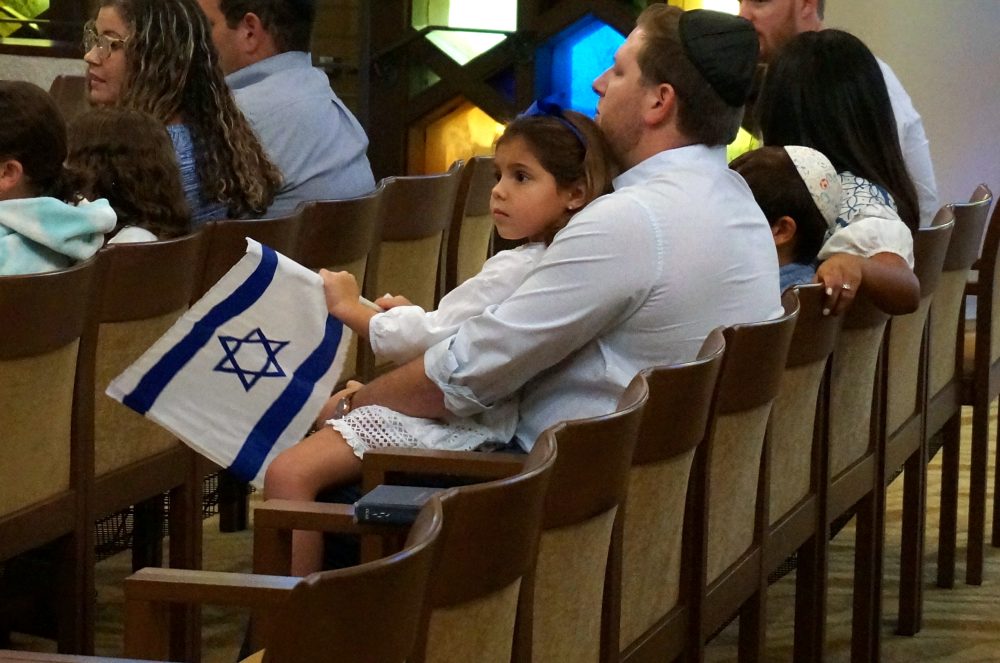

A new national poll shows that while supporting Israel is a cornerstone of Jewish identity for many older American Jews, younger Jewish adults are more inclined to express their faith through other means — like observing Jewish holidays — pointing to a generational divide that goes beyond politics and into questions of religious identity.
The AP-NORC Center for Public Affairs Research surveyed 1,022 Jewish adults and found that the gap over Israel’s actions since the Hamas-led attack on October 7, 2023 — which sparked the ongoing war in Gaza — reflects deeper differences in how generations define what it means to be Jewish.
Cameron Bernstein, a 27-year-old medical student in New Orleans, grew up with deep ties to Israel, even celebrating her bat mitzvah there. But her feelings have shifted. “I pray for people in the land of Israel. I don’t need to pray for the state,” she said, noting that today Israel “doesn’t play a role in my life, more than another country with people I love.”
The survey found that religiously affiliated Jewish adults make up about 68% of all Jewish adults. Among that group, roughly 6 in 10 say being Jewish is “extremely” or “very” important in their lives, regardless of age.
However, the similarities largely end there when it comes to Israel. About half of older religious Jewish adults — those 45 and up — say that supporting Israel is “extremely” or “very” important to their Jewish identity, roughly the same share who say that about celebrating Jewish holidays. Among younger religious Jewish adults, only about 4 in 10 place that same level of importance on supporting Israel, while about 7 in 10 say celebrating Jewish holidays is highly significant to them.
Susan Boyer, a 72-year-old retiree from Southern California, sees backing Israel as inseparable from supporting the Jewish people’s right to a homeland. With antisemitism on the rise, she views Israel as a vital safeguard against history repeating itself.
“I’ve been defending myself as a Jew since I was a child … getting mugged by girls in my classes for being a Jew,” Boyer said. “It’s invasive into your daily living that you have to constantly, constantly be defending yourself as a Jew, constantly making sure that nobody is redefining you or nobody is like insulting your land.”
Ari Pollack, a 30-year-old arts fundraiser in Wisconsin, sees things very differently. He argues that Israel’s military operations have actually fueled antisemitism and made the world less safe for Jewish people.
“I’m personally pretty opposed to basically everything Israel’s doing these days,” said Pollack, who attended religious school growing up. “A source of a lot of frustration that I have for the Jewish establishment is that sort of dogmatic teaching of pro-Israel ideas that I’ve had to unlearn as an adult. And it’s part of what’s kept me away from, you know, attending regular synagogue services.”
Like roughly 3 in 10 religious Jewish adults under 45, Pollack believes Israel has committed genocide during the Gaza war — an accusation Israel has strongly denied. That compares to about 2 in 10 Jewish adults aged 45 and older who hold that view.
The poll also found that younger religiously Jewish Americans are more likely than their older counterparts to say that observing Shabbat or following dietary restrictions — such as avoiding pork or shellfish — are highly important parts of their Jewish identity.
Phoebe Wapnitsky, a 32-year-old in Connecticut, strongly opposes Israel’s military actions, which she sees as inconsistent with Jewish values. “Standing against oppression, promoting social justice — those are the roles that Judaism plays in my life,” she said, adding that she felt disconnected from Israel even before the October 7 attack.
Brian Ebarb, a 47-year-old attorney in Louisiana, also defines his Jewish identity around “action and community” — but for him, that includes standing with Israel. “When the government makes mistakes, it should be criticized,” he said, while cautioning that criticism of Israel can slide into something more dangerous. “The existence of the state of Israel is so precarious that we have to be careful and not allow criticism of Israel to become criticism of Jews worldwide.”
The AP-NORC poll of 3,040 adults was conducted June 11–17 using a sample from NORC’s probability-based AmeriSpeak Panel, designed to represent the U.S. population. The 1,022 Jewish adults surveyed carry a margin of sampling error of plus or minus 5 percentage points.