
Thai authorities are working to determine the cause of a deadly fire at a Bangkok music bar that left at least 27 people dead and dozens more injured — the latest in a long history of catastrophic blazes at nightlife venues across the globe.
Fire safety experts say the high number of casualties may reflect problems commonly seen in past entertainment venue disasters, including inadequate safety measures. The fire broke out at the Na Ladprao music bar shortly before midnight Sunday and appeared to race quickly across a ceiling covered with flammable decorative materials before cutting off the main entrance. Local media reports indicate that packed conditions inside the bar, blocked escape routes, and widespread panic made it harder for people to get out.
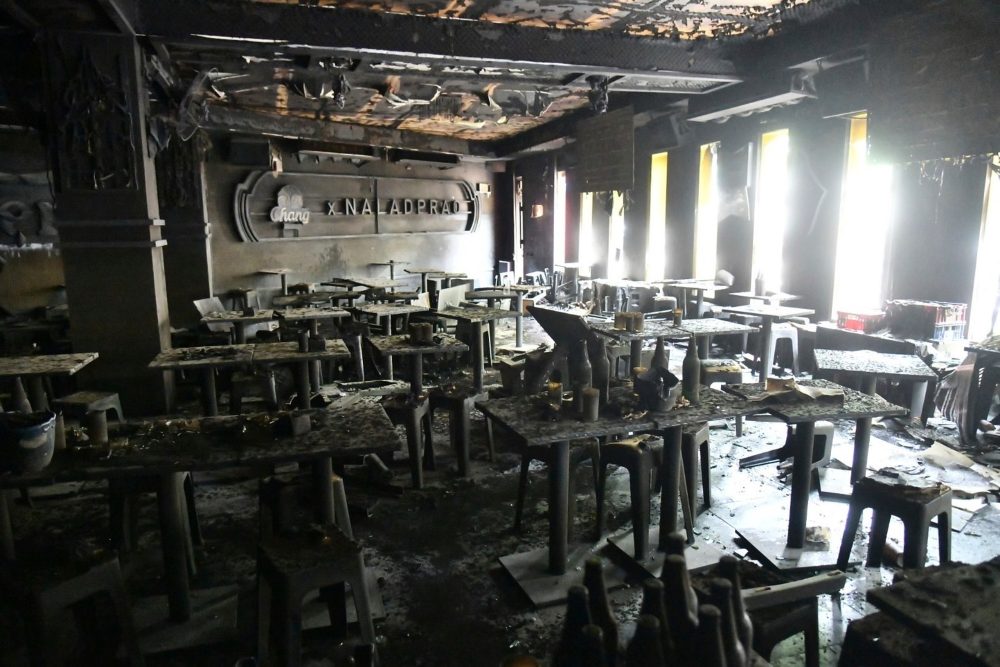
Witness videos posted online captured the bar engulfed in flames while thick black smoke poured from the front entrance and people rushed to escape. Images and footage recorded at the scene Monday showed Thai investigators picking through the burned-out structure, with the worst destruction visible overhead. Large portions of the ceiling had been reduced to charred ruins, while the floor below — tables still holding beer bottles — was buried under ash and debris.
Thailand Prime Minister Anutin Charnvirakul said a musician who had been performing at the bar told him he noticed smoke rising from a circuit breaker near the stage just before the power cut out. An explosion followed, and the bar quickly filled with dense smoke.
Thai officials said investigators would look into what materials were used in the ceiling and whether any emergency exits were blocked at the time of the fire. A Google image from February appeared to show plastic plants decorating the ceiling above the stage.
Lee Young Ju, a fire safety professor at South Korea’s Kyungil University, said the fire may have been triggered by an electrical fault — possibly tied to audio or lighting equipment or faulty wiring — that then spread rapidly along the ceiling.
Royal Thai Police chief Kittharath Punpetch said investigators are also looking beyond the ceiling materials and overhead wiring. Police are examining whether gas canisters stored in the kitchen may have played a role in fueling the blaze.
Huang Xinyan, a professor at Hong Kong’s Polytechnic University, said video from the fire site suggests the bar contained combustible foam materials, had no sprinkler system, and featured small exits that may have slowed evacuation. He noted that plastic ceiling decorations may have been combined with foam soundproofing materials, potentially accelerating how fast the fire grew.
Professor Lee cautioned, however, that even if sprinklers had been present, it’s uncertain they would have slowed a fire burning along the ceiling, since sprinkler systems are not built to fight fires spreading overhead.
The Bangkok disaster is the most recent in a troubling pattern of deadly fires at entertainment venues around the world. On New Year’s Day, a fire tore through a bar in the Swiss ski resort town of Crans-Montana, killing around 40 people and injuring more than 100. A 2013 nightclub fire in Santa Maria, in southern Brazil, claimed more than 200 lives.
Huang said the Bangkok fire may share similarities with the Switzerland blaze, pointing out that such venues tend to be packed with flammable soundproofing materials and overcrowded with patrons, both of which can drive up the death toll.
Professor Lee said high casualty numbers in entertainment venue fires often come down to large crowds crammed into relatively small spaces, making rapid evacuation nearly impossible. He noted that these venues frequently don’t have enough exits, and most people inside only know the main entrance they used to get in. Loud music and alcohol can also leave patrons less alert and slower to react when danger strikes.
Jiang Liming, another professor at Hong Kong’s Polytechnic University, pointed out that bars typically have few large windows and exits can quickly become overwhelmed by panicked crowds trying to escape all at once.
“Once there was a rapidly growing fire, large (numbers) of casualties might occur due to high density of people and fast accumulation of smoke,” Jiang said.
Kong Ha-song, a disaster prevention professor at South Korea’s Woosuk University, said death tolls in bar and nightclub fires are frequently made worse because these spaces can resemble a “maze,” with beer crates, tables, and other items blocking hallways and exit paths. He also noted that emergency exits are sometimes kept locked to prevent theft or unauthorized entry.
Thai police chief Kittharath said the single-story bar had four exits in total, but investigators were looking into whether the two rear exits were blocked or otherwise unusable at the time of the fire. One exit near the restrooms — where most of the victims were discovered — had a table pushed in front of it, while another exit near the kitchen had a damaged sign and a sliding door with its handle missing.