South Korea announced Tuesday that it is moving quickly to accelerate artificial intelligence investments as part of a broader push to strengthen its economy, raising its 2026 growth outlook to a five-year high of 3.0% on the strength of a worldwide semiconductor surge.
The country’s finance ministry, in semi-annual economic policy plans, projected next year’s growth at 3.0% — the best performance since 2021 and a significant jump from the previous forecast of 2.0%, as well as last year’s modest 1.1% growth rate.
The ministry outlined three key goals for its economic policies, including pushing the economy’s potential growth rate up to 3% from its current estimated level of below 2%.
To help reach that target, the government plans to accelerate three “mega projects” announced last month, focusing on semiconductor development, AI data centers, and physical AI investments.
Earlier this week, officials revealed plans to boost 2027 budget spending by at least 10%, bringing total spending to more than 800 trillion won — roughly $532.73 billion — with priority given to those mega projects. The increased spending would be supported by stronger tax revenues flowing in from the semiconductor industry.
“While robust economic indicators, such as exports, driven by a semiconductor boom are clearly opportunity factors, there remain tasks that our economy needs to overcome at the same time,” said Vice Finance Minister Lee Hyoung-il.
The nation, which ranks as Asia’s fourth-largest economy, recorded its strongest quarterly growth in nearly six years last quarter, fueled by surging chip exports as global demand for AI technology continues to climb.
The ministry also set long-term targets, including positioning South Korea among the world’s four largest exporters and raising gross national income per capita to $50,000, up from an expected $40,000 this year. The country currently sits among the top five exporters globally.
Officials also pledged steps to address ongoing challenges, including stubborn inflation, a weakened currency, and elevated bond yields tied to the Middle East conflict. Planned measures include fuel price caps, extended foreign-exchange regulatory relief, and low-cost policy loans in the second half of the year.
Inflation is now forecast at 2.6% for 2026, higher than the earlier projection of 2.1% set in January, largely due to elevated oil prices. That would outpace the 2.1% inflation rate seen in 2025 and mark the fastest pace since 2023.
Looking further ahead, the ministry projected 2027 economic growth at 2.2%, with inflation also expected to come in at 2.2% that year.
BEIJING — China posted stronger-than-expected trade numbers for June, with export growth hitting its highest level in four months as demand for semiconductors surged and U.S. retailers rushed to place orders before potential new tariffs take effect.
Exports rose 27% compared to the same month a year ago, measured in U.S. dollar terms, according to customs data released Tuesday. That figure easily outpaced the 19.4% gain recorded in April and exceeded the 18.2% growth that economists had predicted.
Imports also came in well above forecasts, jumping 36% — a five-year high — compared to a 27.4% increase the month before. Analysts had anticipated import growth of around 24% for June.
The robust trade performance indicates Chinese manufacturers have managed to keep overseas sales strong despite slowing economic growth in major economies and ongoing uncertainty surrounding trade relations with Washington. Analysts credit surging global investment in artificial intelligence technology, early ordering by U.S. buyers, and aggressive pricing strategies by Chinese exporters for the better-than-expected results.
Global AI investment is acting as a significant buffer for manufacturers operating within China’s $20 trillion economy, even as the ongoing conflict in the Middle East and a prolonged slump in the country’s property sector continue to drag on broader economic growth.
Separate data on manufacturing activity for June, published late last month, showed that overseas demand was beginning to pick up. However, factory-gate prices kept falling as companies slashed prices to attract customers facing higher energy costs tied to the Iran conflict.
American retailers contributed to the export boost by moving their orders forward by four to six weeks, building up inventory for Black Friday and Christmas sales ahead of expected tariff increases later this year. Uncertainty remains elevated, however, following U.S. President Donald Trump’s May visit to Beijing, which fell short of the major breakthroughs many observers had anticipated.
Strong export performance helped China’s economy exceed growth expectations in the first quarter, but that momentum has since faded. Economists warn that weak consumer spending at home leaves China vulnerable if global conditions deteriorate, increasing the likelihood of additional government stimulus measures.
China is scheduled to release its second-quarter GDP figure on Wednesday.
China’s trade surplus for June reached $125.6 billion, up from $105.4 billion in May.
The Trump administration announced Monday that American citizens in the Democratic Republic of Congo will not be permitted to board commercial flights headed to the United States, according to a White House official.
The restriction is being implemented under a transportation law known as Title 49 and places affected U.S. citizens — including those who have recently departed Congo — on a “do-not-board” list. Before they can return home, those individuals must first spend a minimum of 21 days in a third country.
The move follows a growing Ebola crisis within Congo, where the outbreak has expanded across multiple provinces. As of late Sunday, official figures showed 1,926 confirmed cases of the disease and 702 deaths.
Ebola is a serious and often deadly viral illness that spreads through direct contact with bodily fluids from infected people or animals. Symptoms can include high fever, vomiting, and both internal and external bleeding.
A U.S. official said approximately two dozen Americans had been scheduled to fly back to the United States on Tuesday following travel to Congo. The State Department is expected to provide support to those individuals and others impacted while they wait out the required period in a third country.
Earlier Monday, U.S. Secretary of Health and Human Services Robert F. Kennedy Jr. signed a separate order citing elevated Ebola risks, pointing in part to the virus spreading to areas just hours away from Congo’s capital city of Kinshasa.
The U.S. Centers for Disease Control and Prevention reported Friday that a U.S. citizen working for a humanitarian organization in Congo had tested positive for the Bundibugyo strain of the Ebola virus. One American infected in Congo was admitted to Frankfurt University Hospital in Germany early Monday, officials confirmed. A second American — identified by the Serge Christian mission organization as Dr. Peter Stafford — had also contracted Ebola and was transported to Germany for treatment, according to information the CDC released in May.
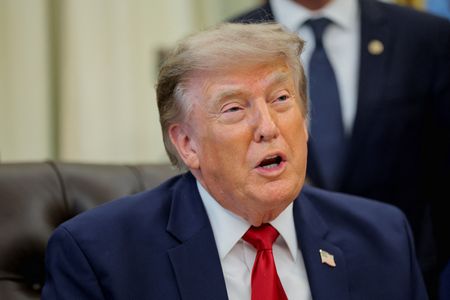
President Donald Trump said Monday that Gulf nations should pay the United States back for the military protection it provides over the Strait of Hormuz, one of the world’s most critical waterways for oil shipments.
Trump made the comments while speaking with reporters at the White House, in the Oval Office, indicating he believes countries in the region should share the financial burden of keeping the strait secure.
A proposed merger between professional tennis’s two major tours — the men’s Association of Tennis Professionals (ATP) and the Women’s Tennis Association (WTA) — has been shelved with no clear timeline for revival, according to a report published Monday by The Guardian.
The two organizations had been working toward combining their commercial and media rights into a single deal. Talks had advanced to near-agreement in 2025 under the WTA’s former chair, Steve Simon. However, when his replacement, Valerie Camillo, took over, she determined that the revenue-sharing arrangement on the table was not acceptable, causing the WTA to walk away from negotiations.
As recently as January, ATP chief executive Eno Polo had spoken optimistically about the discussions, telling reporters the two sides were “quite close” to finalizing an agreement.
A significant financial gap between the two tours lies at the heart of the dispute. The WTA reported revenues of $142 million in 2024, which is less than half of the ATP’s reported $294 million for the same period. While joining forces on rights deals would have boosted the WTA’s total income, it would have also locked the women’s tour into a smaller share of the combined revenue — a setback for women’s sports organizations that have been pushing for greater financial parity.
Both tours are currently dealing with budget pressures. The ATP recently announced cuts to its doubles programming as a cost-saving measure. The WTA has so far avoided a similar step, but reports indicate the organization has begun trimming expenses in other ways, including sending fewer staff members to major tournaments like Wimbledon.
PHILADELPHIA — Kyle Schwarber kept his Home Run Derby dreams alive on his home turf Monday night, blasting nine home runs in the second round to defeat Boston’s Willson Contreras and punch his ticket to the finals at Citizens Bank Park.
The Phillies’ slugger and major league home run leader will now square off against St. Louis Cardinals outfielder Jordan Walker in the championship round.
The atmosphere inside Citizens Bank Park was electric, with Philadelphia fans providing a raucous backdrop for every swing — particularly during the matchup between Schwarber and Contreras, who were teammates on the 2016 World Series champion Chicago Cubs. Contreras was met with loud boos that only grew with each home run he hit, and the crowd erupted when his final swing resulted in nothing more than a flyball that landed on the All-Star logo painted in short-center field.
Schwarber struggled out of the gate, failing to clear the fence on his first three swings of the second round. He then rattled off four consecutive home runs — most of them pulled by the left-handed hitter into the right-field seats in the first or second decks — sending the crowd into a frenzy.
“This place is electric,” Schwarber said. “Follow the energy. Follow the energy they bring.”
On the other side of the bracket, Walker made quick work of Tampa Bay’s Junior Caminero, hitting his sixth homer of the second round with seven swings still remaining. Caminero — last year’s runner-up to Seattle’s Cal Raleigh — managed just five home runs on 15 swings after totaling 12 in the first round.
Walker, a 24-year-old who was selected in the first round of the 2020 draft, is enjoying a breakout season with 22 home runs for the Cardinals. He took the plate wearing a backward cap, reminiscent of Hall of Famer Ken Griffey Jr.
Phillies star Bryce Harper, who said earlier Monday that this would be his final Home Run Derby appearance, managed only eight home runs in the first round and was the last hitter of the round with a chance to advance. The crowd went wild trying to will him into the next round, but it wasn’t enough. Harper previously won the Derby in 2018 in Washington while playing for the Nationals.
Schwarber, who made the finals in 2018 at Nationals Park before losing to Harper, had hoped both he and his teammate would move on this time around.
“Bittersweet,” Schwarber said after the first round. “I wanted both of us to move on.”
Kansas City’s Jac Caglianone and New York Yankees slugger Ben Rice also failed to advance from the first round. In the second round, Contreras and Walker each hit 13 home runs, while Caminero finished with 12.
Schwarber didn’t connect on one of his trademark long balls until his sixth swing of the first round, then followed up with home runs on his seventh, eighth, and ninth attempts — a stretch reminiscent of his four-homer game last season against Atlanta.
MLB changed its format this season, abandoning the timed clock and returning to a swing-based system. Each hitter received 20 swings in the first round, with the top four advancing. In the second round, hitters took 15 swings, and any batter who homered on their final swing kept going until they failed to go deep.
The new format gave hitters a bit more time between swings to watch their blasts — and gave the Philadelphia crowd a few extra seconds to unleash their boos at Contreras.
Schwarber and Harper — the first pair of teammates to participate in the Derby since 2018 — received thunderous ovations when ring announcer Michael Buffer introduced them before the competition. The other six participants, all wearing home jerseys with red, white, and blue uniform numbers, were loudly booed, with Rice drawing the biggest jeers. He laughed it off as he walked out from his Liberty Bell entrance.
Harper played to the crowd, waving his arms and shaking the ropes at the home plate platform like a professional wrestler as the fans went wild for the star known as The Showman.
Even the ball-shagging kids in the outfield weren’t spared from the boos.
Some highlights from the first round included Caglianone launching a ball deep into the third deck in right field, and Contreras sending several shots into the upper deck in left field, including one that bounced off the concourse in front of a bar after clearing the last row of seats. His longest blast measured 490 feet, making it the longest of the first round.
The longest Home Run Derby shot since Statcast began tracking in 2016 remains a 520-foot blast by Juan Soto in the thin air of Denver’s Coors Field during the 2021 event.
This was Citizens Bank Park’s first Home Run Derby and All-Star Game since the ballpark opened in 2004, and the first Derby held in Philadelphia since Barry Bonds defeated Mark McGwire in an afternoon event at Veterans Stadium in 1996 — in front of thousands of empty seats.
This year’s Derby was a sellout and aired on Netflix for the first time as part of a three-event package the streaming service secured this season. Netflix previously aired the opening night game, and the third event is the Field of Dreams game between the Minnesota Twins and Philadelphia Phillies scheduled for August 13.
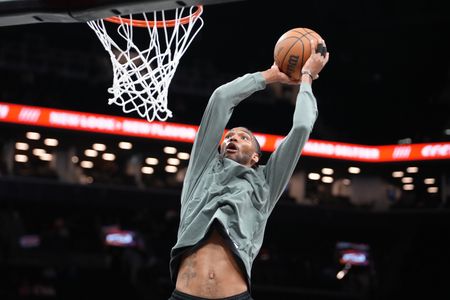
The Los Angeles Lakers rounded out their roster on Monday by inking small forward Ziaire Williams to a one-year deal worth $3 million, according to reports from multiple news outlets.
The signing carries a personal connection — Williams and Bronny James were teammates at Sierra Canyon, a California high school, and will now share a locker room once again at the professional level.
Williams was selected 10th overall in the 2021 NBA Draft by the Memphis Grizzlies. Over his career, he has averaged 8.7 points per game. Most recently, he posted a career-best 10.2 points per game during his second season with the Brooklyn Nets, having previously spent three seasons in Memphis.
With Williams now on the books, the Lakers have reached the league maximum of 15 players on their roster. However, ESPN notes that Los Angeles is still in pursuit of Jonathan Kuminga, potentially through a sign-and-trade arrangement with the Atlanta Hawks.
Williams joins a group of other newly signed Lakers players, including Quentin Grimes, Walker Kessler, Kevon Looney, Sandro Mamukelashvili, and Collin Sexton.
Asian financial markets opened on shaky ground Tuesday, with stocks seesawing between gains and losses and oil prices climbing to their highest point in a month, following President Donald Trump’s announcement that the U.S. would reimpose a blockade on Iranian shipping in the Gulf and charge a 20% levy on all cargo moving through the Strait of Hormuz.
The MSCI index tracking Asia-Pacific shares outside Japan edged up 0.4%, with South Korean stocks leading the way with a 2.2% jump. Japan’s Nikkei 225 gained 0.2%, while S&P 500 e-mini futures slipped 0.1%.
Brent crude futures jumped 2.6% to $85.50 per barrel as Asian trading got underway — the highest price since mid-June.
Chris Weston, head of research at Pepperstone Group Ltd in Melbourne, noted that while tension had been building over the past week, markets reacted sharply to the latest developments in the Iran conflict. “While the risk had been building in the system over the past week, markets reacted aggressively,” he said. He added that “the prospect of tighter monetary policy into a potential energy shock is rarely supportive for risk assets.”
Markets were already on edge following remarks Monday from Federal Reserve Governor Christopher Waller, who suggested the central bank might need to raise interest rates “in the near term” if upcoming economic data show inflation remaining well above the Fed’s 2% target.
On Wall Street the night before, stocks sold off and oil futures surged more than 9% as the U.S.-Iran standoff flared up again, restricting the flow of goods through the Strait of Hormuz. The S&P 500 closed down 0.8% and the Nasdaq Composite dropped 1.6%.
Later Tuesday, U.S. consumer price index data is set to be released, followed by remarks from Fed Chair Warsh, who will present the central bank’s semi-annual monetary policy report to Congress.
Markets are now pricing in a 43.3% chance of a 25-basis-point interest rate increase at the Federal Reserve’s next two-day policy meeting on July 28-29 — up from a 34.2% probability as of Friday, according to the CME Group’s FedWatch tool.
The yield on the 10-year U.S. Treasury bond rose 2.2 basis points to 4.6297%. The U.S. dollar index held steady at 101.29, near its highest levels of the month, while gold slipped 0.1% to $3,997.27.
In Seoul, shares in memory chipmaker SK Hynix were particularly volatile, dropping as much as 4.7% in the opening minutes before swinging to gains of up to 4.6%. The wild swings follow a steep drop the previous day, coming on the heels of the company’s Nasdaq debut last week.
In the cryptocurrency market, bitcoin edged up 0.3% to $62,318.43, while ether rose 0.7% to $1,777.63.
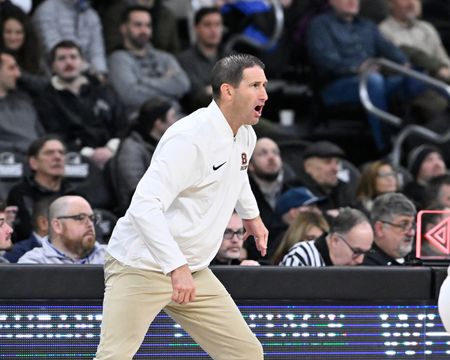
Brown University basketball head coach Mike Martin announced his resignation on Monday, leaving his post to take on an assistant coaching role at the University of Michigan.
Brown acknowledged the move on social media, honoring Martin for what it called “a distinguished 14-year coaching career.” Michigan separately confirmed the transition through an official news release.
A spot opened up on the Wolverines’ coaching staff after Mike Boynton Jr. was elevated to head coach, a change that followed the Dallas Mavericks’ decision to bring Dusty May on board as their head coach.
Martin expressed enthusiasm about his new role, stating: “I’m incredibly grateful to Coach Boynton for the opportunity to join the Michigan basketball family. Michigan has established itself as one of the premier programs in college basketball, and it’s easy to see why. The championship culture, the people and the commitment to excellence all make this a special place. I’m excited to get to work with our student-athletes and help build on everything this program has accomplished.”
Boynton spoke highly of his new hire, saying: “Mike is someone I’ve admired for a long time. He’s an outstanding coach, an exceptional teacher and one of the best recruiters in the game, but more than anything, he’s a great person who truly invests in his players. At Brown, he’s built consistently competitive teams through player development and a winning culture, and those values align perfectly with what we’re building here in Ann Arbor. We’re excited to welcome Mike, Kristin and their daughters to the Michigan family.”
Martin, 44, took over as head coach at his alma mater in 2012, having previously played for the Bears from 2000 to 2004. Over his 14 seasons leading the program, he compiled a 171-202 record, with his strongest campaign coming during the 2018-19 season when Brown finished 20-12.
According to ESPN, Brown plans to conduct a full coaching search outside the university to fill the vacancy left by Martin’s departure.
Eleven college athletes representing multiple sports and universities nationwide have joined forces in a class action lawsuit targeting the NCAA over its newly revised eligibility rules.
The federal lawsuit was filed Friday in U.S. District Court in Colorado. Among the named plaintiffs are Minnesota basketball player Cade Tyson and Northern Colorado basketball player Brock Wisne. The group alleges that the NCAA’s updated rules unlawfully cut off thousands of student-athletes from additional eligibility — and, by extension, from Name, Image and Likeness (NIL) earning opportunities.
Earlier this summer, the NCAA overhauled its eligibility framework by establishing a universal five-year window for all athletes. However, the organization chose not to apply that rule retroactively to athletes who had already used up their eligibility heading into the 2025-26 season — the very group that stood to benefit most from the change.
The lawsuit contends that thousands of athletes have been wrongfully denied a fifth year of competition as a result.
Rob Shelquist, a partner at Cuneo Gilbert Flannery & LaDuca, LLP, spoke on behalf of the plaintiffs. “These athletes aren’t asking for special treatment,” he said. “They’re asking to not be singled out and excluded from the NCAA’s eligibility framework. The NCAA updated the rules but refused to apply them only to the very group that was most immediately affected.”
Shelquist continued: “If the NCAA has determined that five years of eligibility is the fair rule for college athletes, then athletes who would still be eligible but for completing four years of eligibility should not be deprived of the same educational, athletic, and NIL opportunities.”
Beyond Tyson and Wisne, the lawsuit names nine additional plaintiffs competing in men’s and women’s basketball, baseball, and track and field: Anthony Johnson of Arizona State, Louie Jordan of Radford, Jefferson De La Cruz Monegro of California State, Isaiah Jones of South Florida, Aidan Shaw of Boston College, Dimond Loosli of Penn State, Jake Morell of Seattle, Aislin Malcolm of Robert Morris, and Abigail Jefferies of Long Island.
The outcome of the case could have significant consequences. A ruling in the athletes’ favor could strike down the NCAA’s new rule entirely, while a ruling for the NCAA could actually reinforce its position. The decision could also influence a number of similar lawsuits currently making their way through state courts.
Just last week, an Ohio judge ruled in favor of 24 athletes in one such state-level case. Despite that outcome, an NCAA cabinet publicly responded that “we do not intend to change course.”
Shortstop Roch Cholowsky, the first overall selection in last weekend’s MLB Draft, is set to receive a historic $10.35 million signing bonus from the Chicago White Sox, according to a Monday report from MLB.com.
Although the figure falls short of the $11.35 million slot value assigned to the top pick, it still stands as the largest signing bonus ever handed out in Major League Baseball history. The previous record was shared by Chase Burns and Charlie Condon, who each signed for $9.25 million as the No. 2 and No. 3 picks in the 2024 MLB Draft.
Cholowsky, 21, had long been discussed as a future top draft prospect throughout his college career at UCLA. Over three seasons and 178 games with the Bruins, he posted a .329 batting average and a .448 on-base percentage, while clubbing 52 home runs and driving in 167 runs. He also showed exceptional plate discipline, drawing more walks — 105 — than he had strikeouts, which totaled 100.
The young shortstop is considered a likely fast-mover through Chicago’s farm system and could find himself in the big leagues as early as next season. He joins a White Sox organization that has turned things around dramatically, sitting at 50-45 heading into the All-Star break after suffering 100-plus loss seasons in each of the past three years.
Global oil prices surged 2% on Tuesday, hitting a four-week peak as tensions between the United States and Iran intensified in the Strait of Hormuz, raising fresh concerns about the stability of energy supplies worldwide.
Brent crude futures gained $1.68, or 2%, reaching $84.98 per barrel by 0051 GMT. U.S. West Texas Intermediate crude also climbed $1.65, or 2.1%, to $79.79 per barrel. The gains follow an extraordinary 9.6% single-day spike in Brent crude during the previous session — the largest daily increase since May 2020.
Prices are now at their highest point since the two nations signed a memorandum of understanding on June 17 to bring their conflict to an end.
The latest flashpoint came Monday when two tankers belonging to the United Arab Emirates were struck by Iranian cruise missiles in the southern lane of the Strait of Hormuz, within Omani territorial waters. The UAE Ministry of Defence confirmed the attack, which killed one Indian crew member and left eight others injured.
U.S. President Donald Trump told reporters that the United States had brought back its blockade of Iranian shipping. He also stated that he expected other nations benefiting from U.S. protection in the strait to help cover the cost of those efforts.
Tim Waterer, chief market analyst at KCM Trade, described the situation as a significant new risk for energy markets. “The latest escalation, including the U.S. reinstatement of the blockade and Iranian responses, has clearly injected fresh risk into the market,” he said. “While a full closure hasn’t occurred, the competing objectives of both sides have made the supply picture highly uncertain,” Waterer added.
U.S. Central Command reported that it launched a third straight night of strikes against Iran. Meanwhile, Iran’s semi-official YJC news agency reported early Tuesday that seven explosions were heard in the port city of Bandar Abbas, with two additional blasts reported on Kish Island.
Adding to regional instability, Yemen’s Houthi movement launched missiles toward Saudi Arabia after accusing the kingdom of striking an airport under Houthi control on Monday.
Simon Wong, a portfolio manager at Gabelli Funds, warned in a note that “if the Houthis extend their attacks to Saudi’s crude products in the Red Sea, it could put (further) uncertainties on crude flows from the region.”
On the domestic supply front, a preliminary Reuters poll conducted Monday suggested that U.S. crude oil stockpiles likely declined last week, while gasoline and distillate inventories were expected to have increased.
The U.S. dollar held its ground Tuesday as financial markets prepared for a closely watched round of American inflation reports, while escalating tensions between the United States and Iran sent oil prices surging and kept the Japanese yen under pressure.
The dollar index, which tracks the greenback against a group of major currencies including the yen and the euro, was unchanged at 101.27.
All eyes are on inflation this week, with the release of U.S. June Consumer Price Index data on Tuesday, followed by June Producer Price Index figures the next day, and Federal Reserve Chair Kevin Warsh’s first semiannual testimony before Congress also on the schedule.
Worries about a deepening confrontation between the U.S. and Iran resurfaced after President Donald Trump announced Monday that Washington was reimposing a naval blockade on Tehran and would keep the Strait of Hormuz open for a fee, following a fresh round of missile and drone exchanges.
Over the weekend, U.S. and Iranian forces traded heavy missile and drone strikes. Iran struck U.S. facilities in states across the Gulf on Sunday and declared it had once again shut down the strategically critical Strait of Hormuz shipping lane.
Oil prices surged more than 9% to a one-month high on Monday. Both U.S. West Texas Intermediate and Brent crude futures climbed more than 2% to their highest levels since mid-June during early Tuesday trading.
The euro held steady against the dollar at $1.1383, while the British pound traded at $1.3347.
Federal Reserve Governor Christopher Waller stated that interest rates may need to go higher “in the near term” if incoming data shows inflation staying well above the Fed’s 2% goal.
Ray Attrill, head of FX strategy at National Australia Bank, noted in a podcast that a core CPI reading of 0.3% or more would likely suggest — depending on the PPI figures due later in the week — that the Fed’s preferred core PCE deflator is also running at 0.3% or above.
“That may well be a trigger for a Fed rate hike as early as the July meeting,” Attrill said.
Economists’ median forecast for June core CPI was 0.2% growth on a month-over-month basis. Fed funds futures are currently pricing in roughly 30 basis points of rate increases by the U.S. central bank this year, according to LSEG data.
The Japanese yen was nearly flat against the dollar at 162.40, a level that has traders watching closely for possible intervention by Japanese authorities as the currency lingers near 40-year lows.
“Japanese authorities appear to have softened their tolerance a touch, though they remain vigilant and have indicated that further forceful intervention is on the cards should we see another dramatic move from here,” said Matthew Ryan, head of market strategy at Ebury, a British payment firm.
The yen slipped Monday after Reuters reported that Tokyo had no immediate plans to adjust the asset allocations of its state pension funds, cooling expectations for near-term support for domestic assets.
The yen and Japanese bonds had rallied Friday after Finance Minister Satsuki Katayama said the government would look for ways to encourage pension funds — including the Government Pension Investment Fund — to increase their investments in Japanese financial assets.
The Australian dollar last traded at $0.6915 against the greenback. New Zealand’s kiwi rose 0.24% against the dollar to $0.5762.
In cryptocurrency markets, bitcoin edged up 0.23% to $62,293.66, while ether gained 0.56% to reach $1,775.54.
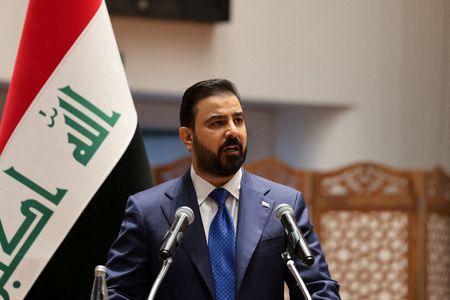
BAGHDAD — Iraq’s newly installed prime minister, Ali al-Zaidi, is making a push for large-scale American investment in his country’s energy sector during a White House visit this week, following the damage the Iran war inflicted on Iraq’s oil output and government revenues.
The visit, scheduled from July 13 to July 18, reflects Iraq’s growing effort to broaden its international partnerships as a way of managing the instability that has plagued the region, according to analysts.
The move marks one of the most direct efforts in recent memory to draw major U.S. investment into a sector that has long been controlled by Chinese, Russian, and European companies. Iraqi officials, however, push back on the idea that Baghdad is pulling away from its close relationship with Tehran in order to grow closer to Washington.
“The Iran war was a turning point,” said Baghdad-based political analyst Ahmed Younis. “It highlighted the risks of overreliance on any single regional partner.”
Younis added that Zaidi “views energy as the fastest route to deeper cooperation with Washington.”
According to Iraqi and U.S. officials, the strategy involves talks with Chevron about major upstream oil projects, backing for U.S.-supported power and liquefied natural gas ventures, security assurances for American operators in Iraq’s semi-autonomous Kurdistan region, and renewed planning for export pipelines that would connect Iraq to Mediterranean markets.
Among the deals already approved by Zaidi’s cabinet is an agreement with U.S.-based HKN Energy to develop the Himreen oilfield in northern Iraq. The government has also given the green light for the Electricity Ministry to finalize a broad cooperation deal with General Electric focused on expanding Iraq’s power generation and transmission systems.
Zaidi has stated that his government intends to “significantly” boost oil production within three years, according to a release from his office. He made those comments while meeting in Washington with Iraqi business leaders and members of the Iraqi Christian community, encouraging them to invest in areas such as education, healthcare, and petroleum products.
These energy deals are expected to be central to discussions between Zaidi — a multimillionaire who took office in May — and U.S. President Donald Trump, who has expressed strong support for the new Iraqi leader.
“We have directed the Ministries of Oil, Electricity and Communications to give priority to reputable American companies working in energy, telecommunications, technology, and development,” Zaidi said in a statement released before the trip.
Despite the optimism, analysts caution that pulling in enough investment to develop oilfields and address long-standing infrastructure problems will be a difficult task.
An internal government document reviewed by Reuters showed that in early June, Iraq’s cabinet instructed the state-run Basra Oil Company to waive certain regulatory requirements for U.S. energy firms currently in talks about energy projects.
“The recent decisions regarding Chevron, U.S. operators in the Kurdistan region, and other U.S. energy projects reflect a deliberate policy shift,” said Mohammed Abbas, a former manager at the state-run Basra Oil Company who now works as an energy consultant. “Zaidi is using Iraq’s energy sector to strengthen ties with Washington and to reverse a perception among some U.S. energy majors that Iraq is a challenging environment for large-scale investment.”
Four Iraqi oil officials who are familiar with the ongoing talks — involving companies including Chevron, ExxonMobil, HKN, and others — said the effort reflects Baghdad’s wider goal of deepening economic cooperation with the United States.
Iraq faces a challenge common to many oil-producing nations: trying to attract investment and grow production while remaining bound by output limits set by the OPEC+ group. Despite holding some of the world’s largest crude oil reserves, Iraq has struggled to raise the revenues needed to support its rapidly expanding population.
Talks with Chevron have become one of the most closely watched parts of Iraq’s strategy. Earlier this year, Chevron entered exclusive negotiations with Iraq over the massive West Qurna-2 oilfield after Baghdad moved to replace Russia’s Lukoil as the operator — a deal that could hand the American company control of one of Iraq’s top-producing assets.
Several Iraqi lawmakers and analysts said the government’s energy push is designed to send a message to Washington that Iraq has become a more appealing place for large-scale investment, after years marked by security concerns, red tape, and legal disputes.
Security conditions have improved considerably since Islamic State was defeated roughly a decade ago, though occasional drone strikes and regional tensions still present risks to energy infrastructure. Iraqi officials say protections around key oil facilities have been strengthened since the Iran conflict, with new measures intended to reassure foreign energy companies.
“Prime Minister Zaidi comes from a business background and understands that winning over American energy companies, especially amid fragile regional security, is no easy task,” said Murad Ismael, a lawmaker and member of Iraq’s parliamentary oil and gas committee.
Travelers should use caution on Valley Road between Lancaster Pike and Evanson Road, where intermittent lane closures are in effect until 6 AM.
The lane restrictions may cause delays for drivers in the area. Motorists are encouraged to allow extra travel time or consider using an alternate route until the closures are lifted.
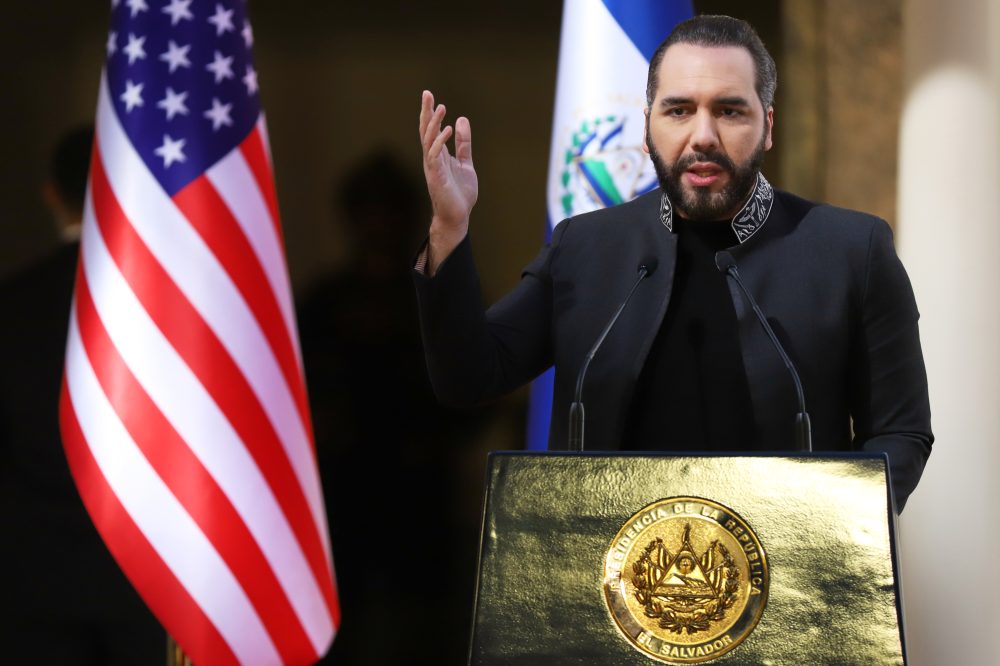
SAN SALVADOR — El Salvador’s ruling party has officially nominated President Nayib Bukele to run in the February 2027 presidential elections, setting the stage for what would be his third consecutive term in office — a prospect that lawyers and human rights advocates say is deeply troubling.
Bukele’s party, Nuevas Ideas, which holds a supermajority in the country’s legislative assembly, conducted its internal elections on Sunday and announced the outcome via Twitter on Monday. Vice President Félix Ulloa is set to join the ticket once again as Bukele’s running mate.
Bukele, who is 44 years old, first took office in June 2019, making him the youngest president in the region at the time. He has maintained strong public approval throughout his tenure.
His February 2024 reelection victory — in which he captured nearly 85% of valid votes — drew sharp criticism from constitutional scholars who argued it violated a constitutional prohibition against consecutive reelection. Critics further allege that Bukele unlawfully replaced judges on the country’s constitutional court and removed the attorney general in an effort to consolidate his grip on power.
A ruling by the constitutional court in September 2021 had permitted presidential reelection, but only for a single additional term.
The legislative assembly, under the control of Bukele’s party, then went further in July 2025, passing a constitutional amendment allowing unlimited presidential reelection. The reform stripped away penalties — including loss of citizenship rights — for those who advocated for presidential reelection, and removed the ban on running for president if a person had served in the previous term.
The same constitutional overhaul also lengthened the presidential term from five years to six and moved the next presidential election up to 2027. Under the prior constitution, a former president could only seek reelection after being out of office for at least 10 years.
Bukele has stood behind the constitutional changes pushed through by the assembly. He argued that “90% of developed countries allow the indefinite reelection of their head of government and nobody bats an eye,” and said that when a small, impoverished country like El Salvador attempts the same, “it suddenly becomes the end of democracy.”
Many Salvadorans have credited Bukele’s hardline security approach — including a four-year state of emergency that has resulted in the imprisonment of more than 90,000 people — with dramatically cutting homicide rates and improving public safety. In 2015, El Salvador recorded one of its most violent years, with 6,656 murders and a homicide rate of 106 per every 100,000 residents.
By the end of 2025, government figures showed the country had reached a historic low of just 82 homicide cases for the entire year.
However, human rights organizations report that more than 500 people have died while in custody since the state of emergency began, with most deaths attributed to health-related causes and some linked to violence inside prisons.
Southbound travelers on Interstate 95 near the DE-896 overpass are facing a temporary lane restriction overnight.
According to Delaware transportation officials, the right lane under the DE-896 bridge on I-95 southbound is currently closed. The closure is expected to remain in effect until 2 AM.
Drivers in the area should use caution, reduce speed, and be prepared for potential delays. Authorities recommend allowing extra time if traveling through that stretch of highway during the overnight hours.
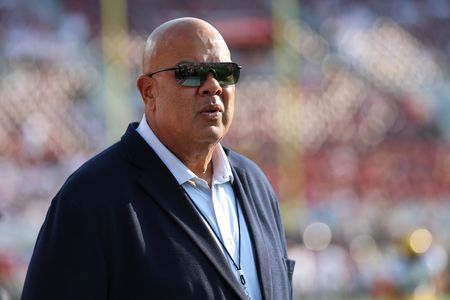
Reports surfaced Sunday suggesting that Michigan athletic director Warde Manuel could be on his way out following an external investigation into the culture within the university’s athletic department — but Manuel himself is telling a different story.
Manuel, who has served as athletic director at his alma mater since January 2016, says he does not expect to be removed from his position when investigation findings are presented at an upcoming Michigan board of regents meeting reportedly scheduled for this week.
“The president and I have had several great conversations over the past couple of days,” Manuel told Yahoo Sports, speaking about his relationship with Michigan president Domenico Grasso. “There are no plans for me not to continue to be the athletic director for the near future.”
The board is set to convene Thursday in Traverse City, Michigan, where members will review the results of a $12 million inquiry into the Wolverines’ athletics program. The investigation stems from a scandal involving former head football coach Sherrone Moore. However, a university spokesman told several media outlets Sunday that there are currently no plans to release any materials from the investigation — conducted by the law firm Jenner & Block — during this week’s meeting.
Manuel, 58, is reportedly weighing his options, which may include retirement, according to CBS Sports. He signed a five-year contract extension through June 30, 2030, back in December 2024, which carries an annual base salary of $1.9 million. Should the university terminate him without cause before the contract expires, he would be entitled to 36 months of severance pay. A termination with cause, however, would allow the school to avoid paying out the remainder of his contract. A mutual buyout agreement is also a possibility.
Michigan president Grasso had previously stated, after the board authorized the investigation in December, that the probe would extend into “an independent evaluation of culture, conduct and procedures throughout our athletics department.”
The investigation follows the firing of Moore on December 10 for cause, after it was revealed he had engaged in a longstanding personal relationship with his then-executive assistant, Paige Shiver. On the same day he was dismissed, Moore allegedly went to Shiver’s apartment, where she told authorities he forced his way in, grabbed two butter knives, and backed her into a corner.
Moore was subsequently arrested and spent two nights in jail. He originally faced charges of home invasion, stalking, and breaking and entering — offenses that carried penalties of up to five years in prison.
In April, Moore was sentenced to 18 months of probation with no jail time. He was also fined more than $1,000 and ordered to have no contact with Shiver and to abstain from drugs and alcohol during his probation period. The sentence came after Moore agreed to a plea deal, pleading no contest to new misdemeanor charges of malicious use of a telecommunications device and trespassing. In return, prosecutors in Washtenaw County, Michigan, dropped the earlier, more serious charges, including a third-degree felony home invasion count.
During his time leading Michigan football, Moore compiled a 16-8 record after taking over for Jim Harbaugh, under whom he had served as offensive coordinator. Both Moore and Harbaugh were also caught up in a sign-stealing controversy involving former staff member Connor Stalions during the school’s 2023 national championship season. Moore ultimately received a two-game suspension in connection with that matter.
In a separate controversy, former co-offensive coordinator Matt Weiss was fired on January 20, 2023, just after completing his second season on Michigan’s staff. Weiss has pleaded not guilty to felony charges of aggravated identity theft and unauthorized access to computers. His trial is currently scheduled for September.
Manuel has not been implicated in any of these scandals. Under his leadership, Michigan has captured national championships in women’s gymnastics (2021), football (2023), men’s gymnastics (2025), and men’s basketball (2026).
Harbaugh departed Michigan for the NFL’s Los Angeles Chargers, while men’s basketball coach Dusty May left following the title run to take the head coaching position with the NBA’s Dallas Mavericks in June. Former Utah coach Kyle Whittingham stepped in to replace Moore in December, and Wolverines assistant basketball coach Mike Boynton Jr. served as interim head coach before being announced Friday as the full-time head coach under a two-year contract.
Tom Herman, who previously served as head coach at Houston, Texas, and Florida Atlantic, is reportedly joining Florida State’s coaching staff in a role that has not yet been publicly defined, according to several media outlets reporting Monday.
Herman, age 51, was once considered one of college football’s brightest up-and-coming coaches. He earned the Broyles Award — an honor given annually to the top assistant coach in college football — while serving as offensive coordinator at Ohio State during the Buckeyes’ 2014 national championship run.
His head coaching career got off to a strong start at Houston, where he posted a 22-4 record over the 2015 and 2016 seasons. That included a 13-1 debut season that ended with a Peach Bowl victory over Florida State. He then departed for Texas ahead of the 2017 campaign, but was let go after four seasons with a 32-18 overall record and only one year in which the team won more than eight games.
After his time at Texas, Herman took on an offensive analyst role with the Chicago Bears in 2021. He returned to college football in 2023 as head coach at Florida Atlantic, but was dismissed following two disappointing seasons that produced just a 6-16 record.
Herman is now set to join a Florida State program that is looking to rebound in 2026. Head coach Mike Norvell is under significant scrutiny after the Seminoles went a combined 7-17 over the past two seasons — a steep drop following a perfect regular season in 2023 that nonetheless saw the team excluded from the College Football Playoff.
Forward Fabian Lysell is getting a fresh opportunity at the NHL level, this time with the Colorado Avalanche after spending the previous season in the minor leagues.
Colorado officially signed Lysell to a one-year contract on Monday, though the financial terms of the deal were not made public.
The Avalanche brought Lysell into the fold on June 27, acquiring him from the Boston Bruins in a trade that sent forward Ivan Ivan to Boston.
At 23 years old, Lysell was originally selected by the Bruins with the 21st overall pick in the 2021 NHL Draft, making him a first-round selection. He got his first taste of NHL action during the 2024-25 season, recording one goal and two assists over 12 games.
Prior to that, Lysell put together a strong campaign with AHL affiliate Providence in 2025-26, posting 42 points — including 17 goals and 25 assists — across 57 regular-season games. He has also represented Sweden on the international stage, suiting up for his home country at the IIHF World Junior Championships in both 2022 and 2023.
China’s Qinwen Zheng entered the Athens Open without a seed and left the first round with a convincing victory, taking down Spain’s No. 6 seed Jessica Bouzas Maneiro by a score of 7-5, 6-1 on Monday.
Zheng dominated the serving department, racking up seven aces compared to none for Bouzas Maneiro. She also showed strong defensive play, saving six of seven break points she faced, while converting four of her seven break-point chances. The match lasted one hour and 49 minutes. Zheng broke her opponent’s serve to seal the opening set, then broke twice more in the second to cruise to the finish line.
A second upset came courtesy of Japan’s Mai Hontama, who defeated No. 8 seed Magda Linette of Poland 6-4, 7-5. Hontama was relentless on Linette’s serve, breaking it three times in each set. Among other first-round winners were Athens native and No. 4 seed Maria Sakkari, No. 5 seed Sara Bejlek of the Czech Republic, American Alycia Parks, Austria’s Lilli Tagger, Elena Micic of Australia, and Great Britain’s Harriet Dart.
At the UniCredit Iasi Open, a clay-court event held in Iasi, Romania, Croatia’s No. 2 seed Petra Marcinko fought off Argentine wild card Nadia Podoroska 6-2, 3-6, 6-4 to advance past the first round.
Marcinko was exceptional under pressure, saving 16 of 19 break points — including all eight in the deciding third set — while converting four of her eight break-point opportunities. Podoroska served three aces to Marcinko’s none, and both players each committed eight double faults.
Elsewhere in Iasi, Hungary’s No. 7 seed Anna Bondar swept Spain’s Sara Sorribes Tormo 7-5, 6-4. Armenia’s Alina Charaeva dominated Andorra’s Victoria Jimenez Kasintseva 6-0, 6-1, and French wild card Clara Burel outlasted lucky loser Varvara Lepchenko 2-6, 7-5, 6-3.
Motorists traveling eastbound on Kirkwood Highway, also known as Delaware Route 2, are facing a right lane closure due to ongoing construction work.
The affected stretch runs between Dillwyn Road and Melrose Place. Drivers in the area should plan for possible delays and allow extra travel time until the lane reopens.
The closure is expected to remain in place until 6 a.m., at which point the lane is scheduled to reopen to traffic.
Drivers traveling southbound on Route 1 between Cave Neck Road and Minos Conaway Road are facing a right lane closure that is scheduled to last until 7 AM.
Motorists in the area should anticipate potential slowdowns and allow extra travel time. Drivers are encouraged to consider alternate routes if possible until the lane reopens.
PHILADELPHIA — Some of baseball’s biggest stars are drawing a hard line against Major League Baseball’s salary cap proposal, though they say there’s still enough time on the clock to prevent a work stoppage from cutting into the 2027 season.
Pittsburgh Pirates pitcher Paul Skenes, who also sits on the union’s eight-man negotiating committee, summed up where things stand. “Both sides kind of have their line that they’re not going to cross,” he said Monday. “Whether that results in missing games or missing a season, we’ll see.”
The current five-year labor agreement between players and owners expires December 1, at which point MLB is expected to lock players out. The more critical deadline, however, falls in late February or early March, when the league would have to decide whether to push back opening day.
Owners have put a salary cap on the table for the first time since the union fought off a similar effort with a 7½-month strike in 1994-95 — a work stoppage that led to the first World Series cancellation since 1904. Baseball Commissioner Rob Manfred has argued that a cap is necessary to reduce the growing gap between high- and low-spending teams.
Juan Soto, who signed a record-setting $765 million, 15-year deal with the New York Mets following the 2024 season, would have seen his contract capped at $265 million over six years under MLB’s current proposal. His reaction was blunt: “Yeah, that sucks. It shouldn’t be there.”
Under the league’s plan, team payrolls would be capped at $245.3 million in 2027, a figure that includes $20.1 million in benefits and a pre-arbitration bonus pool. The proposal also sets a payroll floor of $171.2 million, which would require lower-spending franchises to increase what they spend on players. MLB has not yet outlined how high-spending clubs — like the Los Angeles Dodgers, whose opening day payroll this year reached $415.2 million — would transition to the new system.
Los Angeles Angels outfielder Mike Trout, 34 years old and in the eighth year of a $426.5 million, 12-year contract, acknowledged what the proposal is designed to do. “It’s trying to minimize the years and obviously the totals. For sure, we see that,” he said. “I think baseball’s in a good spot right now and we can’t mess this up.”
Philadelphia’s Bryce Harper, also in the eighth year of his $330 million, 13-year contract, said he couldn’t imagine any situation in which the players’ association would sign off on a cap. “The opportunity for players to get paid is what this is all about,” Harper said, pointing to the union’s long history of fighting for player rights dating back to when Curt Flood helped organize players in the 1970s. “We owe it to the guys that have come before us to do the same thing.”
Harper, who inked his first professional contract at age 17, also took issue with MLB’s proposal to prevent players from signing until they are at least 20 years old by September 1 of their signing year and at least two years past their high school graduation class. The league argues that college baseball offers a better path for player development. Harper disagreed. “If you’re in the top three rounds as a high school kid, I think you should be able to do whatever you want,” he said. “It would really be tough for a guy like Jackson Holliday to not be the number one pick and not get the chance to go to the big leagues at 19 or 18 if he’s able to.”
Formal bargaining got underway in May and is set to continue after the All-Star break. The players’ union has called for expanded free agency rights, earlier access to salary arbitration, and nearly doubling the major league minimum salary.
Pirates pitcher Braxton Ashcraft described the early rounds of talks as “back-and-forth proposals that may or may not be unrealistic.”
Skenes, a 24-year-old right-hander in his second full big league season, stands to lose significant earning potential under the proposed system. He is currently on track for free agency after the 2029 season, earns $1,085,000 this year in the final season before arbitration eligibility, and has collected nearly $5.6 million from the pre-arbitration bonus pool that launched in 2022. Still, he sees the negotiations as early-stage posturing. “MLB is kind of presenting their perfect-world offers and we’re kind of presenting our perfect-world offers,” Skenes said. “So there’s a lot of time before there’s any real movement, I think.”
San Diego closer Mason Miller, considered baseball’s top reliever, also faces free agency after the 2029 season. The 27-year-old right-hander is making $4 million this year and expressed cautious hope. “I still have some optimism,” he said. “The place that the game’s at right now, I think killing that momentum is kind of fruitless for everybody.”
HAVANA (AP) — Four Democratic U.S. lawmakers wrapped up a weekend trip to Cuba, speaking out strongly against the energy embargo placed on the island by President Donald Trump, with one comparing conditions there to a “silent Gaza.”
The energy embargo took effect in January, following the capture of Venezuela’s then-President Nicolás Maduro. The Trump administration also threatened tariffs against any nation that continues selling fuel to Cuba. These measures have deepened a crisis that has already been building for five years, worsened by earlier sanctions and failed economic policies on the island, including a troubled monetary unification effort.
Reps. Mark Pocan of Wisconsin, Teresa Leger-Fernández of New Mexico, Maxine Dexter of Oregon, and Delia Catalina Ramírez of Illinois arrived in Cuba on Thursday. During their stay, they sat down with Cuban President Miguel Díaz-Canel, as well as government ministers, healthcare workers, and business figures. They also walked the streets of Havana before departing Monday. This marked the second congressional visit to the island in the past three months.
When reporters asked whether any progress had been made toward lifting the embargo through diplomatic talks, the lawmakers were clear: there are no current negotiations between Washington and Havana.
“I think (Secretary of State) Marco Rubio is making this personal and not professional,” said Rep. Pocan.
Rubio, whose parents emigrated from Cuba, grew up in Miami and built his political career in part under the influence of anti-Castro exile communities there.
Both governments have acknowledged that some level of contact between officials has occurred, though neither side has provided specifics about when or where those conversations last took place. Adding to the diplomatic backdrop, the grandson of 95-year-old socialist leader Raúl Castro — Col. Raúl Guillermo Rodríguez Castro — recently offered to serve as a go-between with the Trump administration. He held a private meeting with Rubio on the sidelines of a Caribbean Community summit in St. Kitts back in February.
Trump and Rubio have both signaled that they view the embargo as a tool to pressure Cuba’s government, which they describe as inefficient. Cuban officials, meanwhile, have called the embargo collective punishment against the Cuban people.
The effects are visible across daily life in Cuba: power outages stretching beyond 20 hours a day, crippled public transit, canceled flights, declining tourism, shortened work schedules, and a broad slowdown in everyday routines.
Rep. Pocan said someone he spoke with during the visit described the situation as a “silent Gaza” — a comparison he called an “apt description.”
“There may not be bombings, but there are certainly conditions that prevent people from going about their daily lives. They can’t go to work, they can’t preserve their food, they can’t access medical supplies, or live as they did before,” Pocan said.
Rep. Leger-Fernández stated it “doesn’t make any sense at all to force a country to suffer.”
Rep. Dexter, who is also a licensed physician, and Rep. Ramírez announced plans to push for amendments in Congress aimed at reducing the health consequences of the embargo. They also said they would work to block any further unilateral action by Trump — including the military operations he has repeatedly threatened — without first obtaining congressional approval.
SALT LAKE CITY — President Donald Trump announced Monday that he intends to reduce the size of two major national monuments in Utah — Bears Ears and Grand Staircase-Escalante — marking a return to similar actions he took during his first term in office.
Trump’s move reverses decisions made by previous presidents who determined these areas deserved protection under the Antiquities Act, a law dating back to 1906 that grants presidents the authority to safeguard lands of cultural, historical, or scientific significance.
Trump took comparable steps during his first term, but those reductions were later undone by his successor, President Joe Biden. The ongoing back-and-forth highlights how national monuments have become a deeply contested issue in the broader debate over the management of public lands. Trump is not the first president to scale back a monument’s boundaries.
During his first term, Trump made only a limited number of Antiquities Act designations, including the two that cut the size of the Utah monuments. Those sprawling sites contain natural wonders and locations considered sacred by some Native American tribes. Trump also used the act to establish the 340-acre Camp Nelson National Monument in Kentucky, which served as a Union Army hospital, supply depot, and recruitment center for African American soldiers during the Civil War.
When Biden took office, one of his first uses of the Antiquities Act was to restore Bears Ears and Grand Staircase-Escalante to their previous sizes, pointing to their spiritual, cultural, and prehistoric significance. Biden went on to create 10 new monuments during his presidency, including one at the location of a 1908 race riot in Springfield, Illinois, and another honoring Mamie Till-Mobley and her son Emmett — a Black teenager from Chicago who was tortured and killed in 1955 after being accused of whistling at a white woman in Mississippi. Additional monuments were established in the mountains of California and on a sacred Native American site near the Grand Canyon.
Environmental advocates have long argued that the Antiquities Act only allows presidents to create monuments, not shrink or eliminate them. However, history tells a more complicated story. According to a National Park Service database, presidents have issued more than a dozen proclamations reducing monument size since 1912.
Woodrow Wilson cut the acreage of what is now Olympic National Park in Washington state by roughly half. Harry Truman did the same with Santa Rosa Island National Monument. Dwight Eisenhower was the most active in reversing his predecessors’ monument designations, reducing six in total — including Arches in Utah, Great Sand Dunes in Colorado, and Glacier Bay in Alaska, all of which have since been elevated to national park status.
Unlike national parks, which require an act of Congress to establish, most of the more than 100 national monuments were created through presidential action. They are managed by agencies such as the National Park Service, the Bureau of Land Management, or the National Oceanic and Atmospheric Administration.
A monument designation provides broad protections for geological features, artifacts, and the surrounding landscape, prohibiting drilling, mining, and new construction. Supporters of reducing the Utah monuments have argued that the protected boundaries were drawn too wide and were blocking access to critical mineral resources.
The U.S. Forest Service, established in 1905, oversees roughly 300,000 square miles of land across 43 states, including 154 national forests and 20 national grasslands. These lands are managed for renewable uses such as timber, clean water, wildlife habitat, livestock grazing, and recreation — though they can also be leased for extraction of nonrenewable resources like oil, gas, and coal. Some forest areas include specially designated wilderness zones where even bicycles and hang gliders are prohibited because they are considered mechanical.
National parks operate under some of the strictest development rules in the country, governed by a 1916 law called the Organic Act. That law states that the fundamental mission of the parks is to protect their scenery, nature, history, and wildlife and to preserve them for the enjoyment of future generations.
The Antiquities Act itself was signed by President Theodore Roosevelt following years of advocacy by educators and scientists who wanted to stop commercial looting and unregulated collection of artifacts from federal lands. It was the first U.S. law to establish legal protections for cultural and natural resources on federal property.
On September 24, 1906, Roosevelt used the act to designate Devils Tower in eastern Wyoming — a massive rock butte later featured in the film “Close Encounters of the Third Kind” — as the nation’s first national monument. Scientists have long studied how cooled lava formed the tower’s distinctive columns, and Native American tribes, who still hold ceremonies there, have their own accounts of its origins.
All but three U.S. presidents have used the Antiquities Act at some point to protect significant landscapes or cultural resources.
A narrow, elbow-shaped waterway in the Middle East has become the central battleground in an escalating conflict between the United States and Iran. The Strait of Hormuz, long considered a safe and reliable corridor for the world’s oil and natural gas supplies, is now at the heart of a high-stakes power struggle.
Iran has been working to assert dominance over the strait by claiming that an interim ceasefire gave it authority to set the terms for how ships travel through the waterway. It has threatened and fired upon vessels that didn’t follow its preferred route, using that leverage to gain an upper hand in negotiations with the U.S.
On Monday, President Donald Trump pushed back hard. He reimposed a blockade on Iran and declared that the United States controls the strait — even announcing that the U.S. would charge ships a fee for safe passage, a tactic that mirrors what Iran had previously attempted.
Trump posted on Truth Social that the U.S. “will be, from this point forward, known as THE GUARDIAN OF THE HORMUZ STRAIT.”
Iran’s paramilitary Revolutionary Guard, which oversees the country’s ballistic missile program, fired back. “We will not allow a rogue and child-killing army from the other side of the world to continue its illegal interference in it,” the Guard said Sunday.
The back-and-forth comes as both nations have been ramping up attacks against each other in and around the strait, raising fears of a return to full-scale war.
The strait runs along the coastlines of both Iran and Oman. The international community has long viewed it as a free-to-use waterway open to all nations. But after the U.S. and Israel attacked Iran on Feb. 28, Tehran declared sovereignty over the strait — a move that rattled global energy markets and pushed prices higher.
Under the United Nations Convention on the Law of the Sea, established in 1982, no country has the right to claim international waters, and all ships are entitled to unimpeded passage. While neither the U.S. nor Iran has formally ratified that convention, experts say it still applies.
Marc Weller, director of the International Law Program at the University of Cambridge, explained it this way: “That doesn’t matter, because this has become part of universal custom, so all states can rely on it under all circumstances.”
Despite international law, both countries have been using their respective strengths to influence traffic through the strait. Raymond Waid, who leads the maritime industry group at law firm Liskow & Lewis in New Orleans and is a former Navy officer, put it plainly.
“You have two nations, both of which are very capable — the U.S., because it has the most powerful Navy in the world, and Iran, which is geographically well positioned to disrupt commerce throughout the Strait of Hormuz — (and) can exercise a significant degree of control,” Waid said.
The impact on shipping has already been dramatic. Maritime data agency Kpler reported that crossings through the strait dropped by roughly 52% between Friday and Monday compared with the same period the week before. On Sunday, only about 14 ships passed through — a stark contrast to the roughly 130 ships that made the crossing daily before the war began.
Iran exploited its geographic advantage early in the conflict by attacking ships and, in some cases, demanding payment to let vessels through. Even the threat of drone or speedboat attacks was enough to keep many ships away.
After an interim ceasefire was reached last month, Iran required ships to register with a newly created Persian Gulf Strait Authority to have their crews and cargo reviewed. Iran also insisted that ships travel along a route near its own coastline rather than a southern path along the Omani coast, where U.S. military forces had been escorting vessels. The central portion of the strait has been mined by Iran, leaving that route largely impassable.
Tehran is suspected of attacking ships that chose the Oman route. The United Kingdom Maritime Trade Operations Center, which issues maritime security alerts, reported receiving information about six ships attacked near Oman since June 25.
The two countries have been at odds over what exactly was agreed to in the interim ceasefire. U.S. officials say the deal required the strait to be reopened while longer-term negotiations continued. Iranian officials, however, say a clause in the agreement gave them the right to manage ship traffic — and that as long as they didn’t charge fees for 60 days, they could set the operating conditions.
The interim agreement itself stated that Iran would “make arrangements using its best efforts for the safe passage of commercial vessels with no charge for 60 days only from the Persian Gulf to the Sea of Oman and vice versa.” It also called for Iran to “conduct dialog with the Sultanate of Oman to define the future administration and maritime services in the strait.”
On Monday, the U.S. announced it would impose a 20% toll on cargo shipped through the strait to cover “any and all costs necessary to do the job of providing safety and security to this very volatile section of the World.” That position represents a sharp reversal — the U.S. had previously opposed such fees — and experts say any attempt by either country to charge tolls would violate international norms on freedom of navigation.
The U.S. plan closely mirrors an earlier Iranian proposal that Washington had criticized, in which Iran suggested it might charge fees of up to $2 million per vessel.
Weller, the international law expert, said fees for specific services in international straits can be legally permissible under certain conditions. He pointed to Chile, which collects fees in the Strait of Magellan for pilotage and safety services. But he drew a clear line.
“A fee would be possible, but it has to be a fee commensurate with the actual service granted,” Weller said. “So it’s not anything Iran should earn money off. It’s not $2 million per vessel or something like that.”
The International Maritime Organization, the United Nations agency responsible for international shipping safety and security, said it was waiting to learn more details about Trump’s proposal but confirmed its position against passage tolls had not changed.
Late Monday, Iran’s Foreign Minister Abbas Araghchi used Trump’s announcement to mock the U.S. president while simultaneously legitimizing Iran’s own position. In a post on X, Araghchi wrote: “POTUS is absolutely right. Whoever provides secure and safe passage of commercial vessels through the Strait of Hormuz should be compensated for this service … 20% is of course too much. We will be fair.”
DUBAI, United Arab Emirates — The United States launched a fresh wave of military strikes against Iran on Monday, just hours after President Donald Trump announced that Washington is reimposing a blockade on Iran and — in what appears to be a major reversal in policy — plans to charge vessels for safe passage through the Strait of Hormuz.
The announcements come as Iran has claimed it holds control over the vital waterway, and as the renewed fighting raised fears of a return to full-scale war between the two nations.
U.S. Central Command confirmed on social media that American forces had launched the new round of strikes against Iran.
“These strikes will continue imposing a heavy cost on Iranian forces and degrade their ability to attack innocent civilians and commercial shipping in the Strait of Hormuz,” the U.S. military stated.
Shortly after the military’s announcement, Trump described the action as “another major attack.”
“We’re hitting them very hard. And it’ll continue, and we’ll see what happens,” Trump told reporters at the Oval Office. “We’re knocking out all of their offensive capability and we’re controlling the straits. We’re putting the blockade back.”
Trump also elaborated on the administration’s apparent change of direction regarding tolls for ships passing through the strait — a stance that contradicts what the U.S. had previously said it would not do.
“We’re protecting a very rich portion of the world,” Trump said. “We’re spending money. And so, what we’ve done is, we are going to be reimbursed for protection.”
Until now, U.S. policy held that the strait should remain freely open to all shipping without fees — a standard that had been in place before the U.S. and Israel launched attacks on Iran on February 28. Experts say any attempt by either the U.S. or Iran to impose passage fees would violate international norms on freedom of navigation and could trigger broader economic disruption well beyond the Middle East region.
Global oil markets reacted sharply to the news. The price of Brent crude oil — the international benchmark — jumped 7.8% to $81.92 per barrel on Monday, though that figure remains well below the nearly $120 per barrel reached at the peak of the conflict.
Trump Says Iran Failed a Test
Earlier in the day, Trump spoke with conservative radio host Hugh Hewitt, saying the agreement reached last month was “built to test” Iran, and adding that “when you’re dealing with sleazebags” agreements “don’t mean much.”
Trump said he had questioned why the U.S. was pursuing a ceasefire deal rather than working toward a comprehensive agreement first. Last week, he declared that ceasefire “over.”
“They didn’t honor the test,” Trump said.
Recent exchanges of fire, triggered by Iranian attacks on ships, had already cast serious doubt on the interim peace arrangement. As part of that deal, Washington had lifted a blockade it originally put in place in mid-April, and the agreement had called for the strait to be fully reopened to all vessels.
“We are reinstating the THE IRANIAN BLOCKADE,” Trump wrote on social media. “All other countries will have fair and open use of the Strait.”
Trump said the U.S. would be “reimbursed” an amount equal to 20% of the value of cargo passing through, intended to offset “any and all costs necessary to do the job of providing safety and security.”
The U.S. military announced that the blockade of Iranian ports will resume Tuesday at 4 p.m. Eastern time.
California announced Monday that it has retained the law firm Milbank to assist in its legal effort to block the merger of Paramount and Warner Bros., bringing in seasoned antitrust attorneys to match what the state expects will be a formidable legal team from Paramount’s side.
California Attorney General Rob Bonta explained the decision by saying the state hired Milbank, a prominent corporate law firm, because “we need the firepower.” He added that California anticipated going up against “an army of high-powered private attorneys” representing Paramount.
The attorneys joining California’s effort from Milbank include Richard Parker and James Weingarten. Weingarten is a former U.S. government antitrust lawyer who previously worked on the team that attempted — unsuccessfully — to block Microsoft’s $69 billion acquisition of Activision Blizzard.
On Paramount’s side, Jeffrey Kessler of the law firm Winston Taylor is set to serve as lead trial counsel defending the merger. Paramount has also brought on former U.S. Solicitor General Paul Clement.
The lawsuit, filed Monday, involves California and 11 other states. They contend the deal would give the merged company increased leverage to drive up prices across film and television markets, with the burden ultimately landing on consumers and workers.
The case pits California, New York, and other states led by Democratic officials against major media corporations whose merger received approval in June from the Trump administration.
The Justice Department cleared the transaction following an eight-month review, concluding it was likely to benefit competition rather than harm it.
The hiring of Milbank adds an interesting dimension to the legal battle. The firm is among several that reached agreements with President Donald Trump last year to avoid executive orders his administration had issued targeting prominent law firms over issues including their past clients, hiring decisions, and ties to individuals Trump viewed as adversaries. As part of its agreement, Milbank committed to providing $100 million in free legal services for mutually agreed-upon causes.
California and other states had criticized those settlements at the time, arguing the firms were caving to political pressure.
Despite its agreement with the Trump administration, Milbank has continued to oppose the administration in court on other matters. The firm represented small businesses that challenged Trump’s use of emergency powers to impose broad tariffs, ultimately securing a Supreme Court ruling in February that struck down those measures. In June, Milbank and other attorneys also won a ruling defeating the administration’s lawsuit targeting immigration policies in New Jersey cities.
Milbank, the White House, and the Justice Department did not respond to requests for comment.
WASHINGTON — President Donald Trump has formally notified Congress that military hostilities with Iran resumed on July 7, in a letter his administration argues starts a fresh 60-day window during which he can conduct military operations in the region without lawmakers’ sign-off.
“I directed this military action consistent with my responsibility to protect Americans and United States’ national security and foreign policy interests,” Trump wrote in the letter, which is dated July 10 and was reviewed by Reuters on Monday.
The letter walks through a series of events, including Trump’s order of a two-week ceasefire on April 7 — which was later extended — and his administration’s push for a diplomatic resolution to the conflict. The United States first began military strikes against Iran on February 28, acting alongside Israel.
Trump also referenced a memorandum of understanding he signed with Iran on June 17, saying that Iran broke that agreement by launching attacks on commercial ships passing through the Strait of Hormuz. That violation, Trump said, led him to order a new round of strikes against the country.
As the fighting escalated, Trump announced Monday that the U.S. would reinstate its blockade of Iranian shipping in the Gulf and would work to keep the Strait of Hormuz open for international traffic.
Under the U.S. Constitution, the power to formally declare war belongs to Congress, not the president. Even so, presidents have long argued they can order shorter military operations on their own authority when national security demands it.
The War Powers Act requires the president to notify Congress within 48 hours of beginning military action, and mandates that any military engagement launched without congressional approval must end within 60 days. In this case, the first 60-day deadline fell on May 1. However, Trump argued that deadline did not apply because he had declared hostilities over when the ceasefire went into effect — even as attacks continued and U.S. forces maintained a blockade of Iranian ports.
Critics from both parties pushed back on that interpretation. “The president can’t just wish away months of war he said would last only four to six weeks,” said a senior House Democratic aide, who spoke on condition of anonymity.
Last month, both the Senate and the House passed a resolution calling on Trump to pull U.S. forces out of the conflict with Iran. The measure passed despite Republicans holding narrow majorities in both chambers, reflecting widespread unease over the prolonged military engagement.
Trump responded angrily to the votes, accusing those who supported the resolution of giving “comfort” to Iran and making his job “more difficult.”
Defense contractor L3Harris Technologies has been awarded a $955 million contract to build 18 satellites for the United States’ Golden Dome missile defense shield, according to announcements made Monday by both the company and the contracting agency.
The contract was issued by the Space Development Agency, which operates under the U.S. Space Force. With this latest deal, L3Harris has now received orders for a minimum of 70 missile-tracking and defense satellites from the U.S. government — five of which are already in orbit.
Over the past year, L3Harris has been expanding its space and satellite manufacturing operations across the country as part of an effort to support President Donald Trump’s Golden Dome initiative.
The company says the satellites are designed to detect and track advanced missile threats, and that manufacturing will get underway right away.
L3Harris is among the defense contractors that have seen growing business amid record levels of U.S. defense spending and rising tensions in various parts of the world.
WASHINGTON — President Trump told reporters Monday that the United States is actively striking Iran’s military capabilities tied to the Strait of Hormuz, as military operations between the two nations continue to escalate.
Speaking from the Oval Office, Trump confirmed that the U.S. military is carrying out new strikes against Iran. However, he also made clear that he has not closed the door on reaching a diplomatic settlement with Tehran.
The president also raised a separate concern, suggesting that Iran may have positioned drones in Cuba.
“If they do have that, and they might very well have that, we’ll take care of it,” Trump said.
He continued: “We’re not going to have a problem. We’re not going to allow that to happen so it could be that they are storing some. We’re looking into it now.”
Drivers heading onto or off of Interstate 495 should expect slower than normal travel conditions as crews conduct sweeping operations on the ramps in both directions.
Both the northbound and southbound ramps on I-495 are affected, with slow-moving equipment on the roadway as part of the sweeping work. The operations are scheduled to continue until midnight.
Motorists are advised to remain alert, reduce their speed, and allow extra travel time when approaching the affected ramps. Officials urge drivers to use caution around the slow-moving equipment until the work is completed.
Drivers heading northbound on Pennsylvania Avenue should be aware of a lane restriction currently in place due to ongoing construction work.
The right lane on Pennsylvania Avenue northbound, between N Scott Street and N Van Buren Street, is closed. The closure is scheduled to last until 5 p.m.
Motorists traveling through the area are encouraged to allow extra travel time or seek an alternate route to avoid potential delays.
Westbound travelers on B Street between New Castle Avenue and Townsend Street should expect a lane restriction as construction crews have closed the left lane in that stretch.
According to Delaware Department of Transportation, the closure is scheduled to last until 4 p.m. Drivers are encouraged to allow extra travel time or seek an alternate route to avoid potential delays in the area.
Khong Guan Corporation has announced a voluntary recall of select lots of its “Glutinous Rice Balls with Black Sesame Filling” after it was discovered the product may contain peanuts that are not listed on the label.
The concern is particularly serious for anyone with a peanut allergy or a severe sensitivity to peanuts. Consuming a product with undeclared peanuts can lead to dangerous — and potentially fatal — allergic reactions.
Consumers who have purchased this product are encouraged to check the lot numbers on their packaging to determine whether their item is part of the recall. Anyone with a peanut allergy should not consume the product and should follow guidance from the issuing company or the FDA regarding returns or disposal.
PHILADELPHIA (AP) — Don Mattingly admitted to feeling a bit of an odd sensation when he was invited to serve as a coach under Los Angeles Dodgers manager Dave Roberts for this year’s All-Star Game.
When Mattingly departed his position as bench coach under Toronto manager John Schneider following the World Series — which the Blue Jays dropped in seven games to the Dodgers — he gave up a guaranteed spot in the American League dugout for Tuesday’s Midsummer Classic.
A six-time AL All-Star himself, Mattingly believed at that point his days in baseball were behind him.
As it turns out, he’s not only still involved in the sport — he’s now running the Philadelphia Phillies as interim manager and has guided them back into serious contention for a playoff spot.
On Tuesday, he’ll be in the opposing dugout from Schneider and the Blue Jays coaching staff when the All-Star Game is played at Philadelphia’s Citizens Bank Park.
Canadian clothing industry figure Peter Nygard, founder of the once-powerful Nygard International fashion brand, entered a guilty plea Monday to charges of sexual assault and forcible confinement in Quebec — adding to a growing list of legal troubles that have brought down his global empire.
The 84-year-old participated in the proceedings via video from an Ontario prison, where he is currently serving an 11-year sentence handed down after a Toronto jury found him guilty in 2023 of sexually assaulting four women. He also faces potential extradition to the United States on federal racketeering and sex trafficking charges.
Quebec Crown prosecutor Jérôme Laflamme told reporters the guilty plea came as a surprise, arriving just before what was supposed to be a 10-day judge-only trial. “Mr. Nygard’s change of heart was quite sudden,” Laflamme said, noting that the complainant had been ready to take the stand.
Prosecution evidence, which the defense did not dispute, showed that Nygard exploited his status as a well-known fashion designer to lure young women. The victim, whose identity is shielded by a publication ban, was 18 years old when she first encountered Nygard at a bar. She had aspirations of becoming a fashion model.
The two later met for lunch at her place of work to talk about her career prospects. He then invited her to his Montreal penthouse apartment, claiming he had left his keys behind. Once inside, he locked her in the bedroom and sexually assaulted her.
Court documents also reveal that Nygard offered the victim a chance to relocate to the Bahamas, promising a lavish lifestyle — but only if she agreed to have sex with him and other women. These events occurred between November 1997 and November 1998.
Quebec prosecutors filed charges against Nygard in 2022, including one count each of sexual assault and forcible confinement.
Nygard, who came to Canada from Finland as a child, built a worldwide fashion business and was known for hosting extravagant parties at his Bahamas estate, called Nygard Cay. His empire unraveled after a wave of sexual assault allegations triggered investigations in both Canada and the United States.
Judge Nathalie Fafard allowed prosecutors to present evidence from Nygard’s Toronto conviction, citing similarities between the two cases.
Defense attorney Gerri Wiebe explained that Nygard opted not to fight the Quebec charges given his upcoming extradition proceedings to the United States. She also argued that his deteriorating health makes any transfer potentially life-threatening.
American prosecutors allege that over roughly 25 years, Nygard used his fashion company, its staff, and its financial resources to recruit women and underage girls across the United States, Canada, and the Bahamas for sexual exploitation. Nygard has pleaded not guilty to those U.S. charges.
Sentencing in the Quebec case has been put on hold while a medical assessment is conducted. The case is scheduled to return to court on October 2, when attorneys are expected to present a joint sentencing recommendation. Wiebe noted that the United States cannot seek Nygard’s extradition until his Canadian legal matters are fully resolved, meaning the sentencing delay keeps him in Canada for now.
WASHINGTON (AP) — The official U.S. military death count from the war with Iran has climbed to 14 service members, following the death of a Navy pilot whose helicopter went down in the Arabian Sea earlier this month.
The number of American troops wounded in the conflict has also grown, now exceeding 400 as of Monday. Capt. Tim Hawkins, a spokesman for U.S. Central Command, confirmed that the majority of those injuries involved traumatic brain injuries.
The helicopter went down on July 1 in what the Navy initially called an emergency landing. At the time, officials stated there was “no indication the emergency was caused by hostile action.” The three other sailors on board were rescued shortly after the crash.
The Pentagon’s casualty count added this as one non-hostile death in July. Prior to this, the last recorded deaths came in March, at the outset of the war, when 13 service members were killed in a series of separate incidents.
Those earlier deaths included six soldiers killed in an Iranian drone strike on a command center in Kuwait. A seventh soldier died more than a week after being wounded in an attack on Prince Sultan Air Base in Saudi Arabia. Six additional service members lost their lives when a KC-135 refueling aircraft supporting operations against Iran went down in Iraq.
The total wounded count now stands at 414, including a U.S. Air Force member added to the list Monday. While Iran and the United States have resumed trading strikes, it remains unclear whether that renewed activity contributed to the airman’s injury.
U.S. Central Command did not provide specific details about that airman. Traumatic brain injuries — largely caused by nearby missile strikes and explosions — have become the defining wound of this conflict, and their long-term effects on service members are still not fully understood. Along with post-traumatic stress disorder, they have emerged as some of the most common injuries among veterans of the post-9/11 era.
When pressed Monday for updated figures on seriously wounded troops, U.S. Central Command spokeswoman Maj. Emma Thompson said she had no new information to share. She repeated that “almost all” of the injured have since returned to active duty and declined to say how many troops had been wounded severely enough to require evacuation from the region.
President Donald Trump on Monday signed proclamations shrinking two national monuments in Utah, stripping away protections that previous presidents had placed on lands considered sacred by many Native American tribes.
Bears Ears and Grand Staircase-Escalante national monuments, both located in southern Utah, feature ancient cliff dwellings, petroglyphs, and dramatic canyon landscapes. They also sit atop coal and uranium deposits that Utah state officials have long wanted opened up for commercial development.
Trump used authority granted under the Antiquities Act to reduce the footprint of both monuments. He pursued the same course of action during his first term in office, but President Joe Biden, a Democrat, reversed those changes after taking office.
The decision is part of a broader effort by Trump and fellow Republicans to overhaul how the federal government manages vast stretches of publicly owned land, most of it concentrated in Western states. The administration and Republican lawmakers have pushed to expand oil drilling, mining, and logging on federal land, while scaling back protections for endangered species and loosening conservation regulations.
Speaking at a White House signing event Monday, Trump defended the move. “They took the land from the people quite honestly,” he said. “We’re giving it back.”
Grand Staircase-Escalante was established in 1996 by President Bill Clinton, a Democrat, while President Barack Obama, also a Democrat, created Bears Ears in 2016. Both were designated under the Antiquities Act, a 1906 law that gives presidents the power to protect lands deemed historically, archaeologically, or culturally significant.
Davina Smith-Idjesa, a citizen of the Navajo Nation and co-chair of the Bears Ears Inter-Tribal Coalition, said tribal leaders had anticipated a reduction ever since Trump won a second term. She described Monday’s announcement as “heartbreaking” and accused federal officials of bypassing their legal duty to consult with the tribal nations that would be affected.
“From a Navajo perspective, Bears Ears is not simply a piece of federal public land,” Smith-Idjesa said. “This is a living cultural site that holds our histories, our ceremonies, our traditional foods and medicines and our ancestors’ footprints.”
Utah officials have opposed the monument designations for years, arguing that the state should control its own land. During his first term, Trump called the original designations a “massive land grab.” Together, the two monuments cover more than 3.2 million acres — an area roughly the size of Connecticut.
Utah Gov. Spencer Cox stood beside Trump at the White House and praised the action. “This is a big day for Utah,” he said. “These monument designations are supposed to be the smallest area as possible to protect the antiquities.”
Bears Ears holds a unique distinction as the first national monument protected at the formal request of tribal nations. The area contains ancestral villages, burial grounds, and ceremonial sites, and figures prominently in the creation and migration stories of several tribes. Its original designation recognized five tribes — the Navajo, Hopi, Zuni, Ute Mountain Ute, and Uintah-Ouray Ute. The monument is jointly managed through an agreement between those tribal nations and federal agencies and is home to hundreds of thousands of culturally and scientifically significant objects.
Grand Staircase-Escalante features a dramatic landscape of cliffs, canyons, natural arches, and archaeological sites including rock paintings. It holds significant coal reserves, while the Bears Ears region contains uranium deposits.
National monument status provides broad protections for both the notable geological features and artifacts within a monument and the surrounding landscape, prohibiting drilling, mining, and new construction. Supporters of the reduction argue the protected boundaries extend too far and block access to critical minerals.
During his time in office, Biden designated or expanded more than a dozen national monuments and set a goal of conserving at least 30% of U.S. lands and waters by 2030. Trump’s approach is essentially the opposite — he wants to unlock the natural resource potential of more than 100,000 square miles of federally controlled land, as well as offshore areas such as the Gulf of Mexico and waters off Alaska.
That stance has drawn fierce criticism from Democrats and environmental groups, who warn that treasured landscapes are being sacrificed for commercial interests.
Trump’s Interior Secretary Doug Burgum had previously signaled that the administration would review and potentially redraw monument boundaries as part of its push to increase domestic energy production.
Trump has also used proclamations in his current term to lift commercial fishing restrictions within large marine monuments in the Pacific and Atlantic oceans — areas protected under both Democratic and Republican administrations. That move, which has been challenged in court, represents a major shift in federal policy by putting commercial fishing interests ahead of efforts to allow fish populations to recover.
While the Supreme Court has upheld the president’s authority to establish national monuments, the question of whether a president can shrink or alter existing monument boundaries remains legally contested.
Some Republican lawmakers have pushed to sell or transfer federal lands to states or private entities, but those efforts have largely stalled. A House GOP proposal to sell public lands faced bipartisan resistance, and a separate proposal by a Utah senator to sell more than 3,200 square miles of federal land was stripped from Republicans’ major tax and spending legislation. The U.S. Supreme Court also rejected a lawsuit last year in which Utah officials sought to take control of large swaths of federal land within the state.
MADISON, Wis. — Wisconsin Democratic gubernatorial candidate Sara Rodriguez announced Monday that her campaign is holding far less money than she had believed, a discovery triggered when a planned television ad campaign failed to launch due to unpaid invoices.
Rodriguez, who currently serves as lieutenant governor, made the announcement late Sunday night that she had terminated her campaign manager, Kara Spencer, roughly one month before the August 11 primary election. The firing came after an internal review revealed that campaign contributions had been counted twice while expenses were underreported, leaving the campaign in a much weaker financial position than previously understood.
Standing alongside supporters at her campaign headquarters during a news conference Monday, Rodriguez made clear she has no intention of stepping aside.
“This campaign is going to move forward,” she declared at the event.
Rodriguez is locked in a competitive Democratic primary for Wisconsin’s open governor’s seat. Her opponents include democratic socialist Francesca Hong, former Lt. Gov. Mandela Barnes, and three other candidates. The primary winner will face Republican Rep. Tom Tiffany in the general election. Tiffany has only minimal opposition in his own primary.
The financial problems came to light after Rodriguez announced a $1 million television advertising buy last week. When those ads failed to appear on air as scheduled, she began asking questions — and that’s when the accounting discrepancies surfaced.
Rodriguez expressed deep frustration over the situation, directing her remarks at her now-former campaign manager. “I am hurt, angry and deeply disappointed by someone I trusted to run my campaign,” she said. “I was continually getting inaccurate reports from my campaign manager.” Spencer did not respond to a request for comment.
Rodriguez said her campaign immediately contacted the Wisconsin Ethics Commission on Monday and is cooperating with the agency to correct a financial report filed in January covering last year’s donations and expenditures. Her next campaign finance report, covering the first six months of this year, is due Wednesday.
The $650,000 Rodriguez reported raising in 2025 was the second-highest total among Democratic candidates in the race, trailing only Milwaukee County Executive David Crowley, who raised approximately $800,000. Crowley exited the race last week and endorsed Rodriguez — notably after she announced her $1 million ad buy. Former Democratic candidate and ex-state economic development director Missy Hughes also endorsed Rodriguez after ending her own campaign last month.
Rodriguez said the television ads that were supposed to begin running last week will now start airing next week. She declined to give a precise figure for how far off the campaign’s financial reports were, saying the reconciliation process is still underway. However, she disclosed that her campaign has raised approximately $1 million overall and currently has about $200,000 cash on hand.
Democratic rival Joel Brennan, a former top aide to Gov. Tony Evers, called the campaign’s financial errors “disqualifying.” Gov. Evers has not backed any candidate in the primary.
Rodriguez pushed back against any suggestion she was trying to conceal the problems. “If I were trying to hide something I would not be here today telling you about it,” she said. “Most people are not going to stand in front of this many cameras and microphones to talk about fixing an error.”
LONDON — The British government announced Monday that it intends to eliminate a legal loophole that has been standing in the way of deporting a convicted grooming gang leader back to Pakistan.
Shabir Ahmed led a gang based in Rochdale, in northern England, and was sentenced to prison in 2012 after being found guilty of multiple child sexual offenses, including rape. He served 14 years behind bars. His release earlier this month drew sharp criticism from some lawmakers, and at least one of his victims publicly expressed fear for her personal safety following his release.
The so-called “grooming gangs” scandal has roots going back roughly 20 years. It surged back into the national spotlight last year after Elon Musk publicly criticized Prime Minister Keir Starmer over his handling of these cases during his time as director of public prosecutions. Starmer pushed back against those criticisms, though he did not mention Musk by name.
After his conviction, Ahmed had his British citizenship revoked. However, a legal provision barred his deportation to Pakistan, the country where he was born. That provision prevents the removal of citizens from certain countries who arrived in the United Kingdom before 1973.
Interior minister Shabana Mahmood described Ahmed as a “vile grooming gang leader” and confirmed that the government’s proposed legal amendment would allow Commonwealth citizens to be deported if they have been convicted of serious offenses.
Mahmood also noted that Ahmed’s actual removal from the country depends on Pakistan agreeing to accept him.
The grooming gangs scandal centered on organized groups of men, the majority of Pakistani heritage, who deliberately targeted vulnerable children — many of whom were already known to social services — by providing them with alcohol and drugs before sexually exploiting them.
The 2012 trial of the Rochdale gang, which resulted in convictions for Ahmed and eight other men, drew widespread media attention and was a turning point in bringing this issue into public awareness across Britain.
The U.S. House of Representatives’ Democratic Women’s Caucus is pressing the U.S. Department of Agriculture to restore four women to the United Soybean Board after the agency blocked their reappointment — a decision the caucus says is taking the organization and American farmers “in the wrong direction.”
The 96-member caucus sent a formal letter on July 13 to Agriculture Secretary Brooke Rollins and USDA Agriculture Marketing Specialist Sarah Aswegan, demanding the agency reverse course on a move first brought to light by Reuters back in April.
Earlier this year, the Trump administration rejected all four women — along with one man — who had been selected by fellow farmers to represent them on the United Soybean Board. The USDA’s involvement was described as an unusual step, as the agency has historically approved state-level selections with little pushback. No explanation has been offered by the USDA for the rejections.
In the letter, the caucus wrote: “Your decision is not only disrespectful to the qualified women who were nominated, it sends a message to women farmers that their voices do not matter.”
The group added: “We strongly urge USDA to reverse its decision and allow these nominees to serve their rightful terms.”
The removal of those women left the United Soybean Board — which manages more than $121 million in farmer-contributed funds aimed at growing markets for U.S. soybeans — with only five women among its 77 board members. That represents the lowest female representation on the board in at least ten years. Women account for more than a third of all U.S. farmers, though they have traditionally held fewer leadership positions within commodity organizations.
The USDA’s action fits into a broader pattern under the current administration, which has reversed equal pay measures put in place by the previous administration and scaled back federal programs designed to address historical disadvantages faced by women and minority groups. The White House has argued those types of programs violate anti-discrimination laws and undermine advancement based on merit.
Democratic Representative Angie Craig of Minnesota, who serves as the ranking member of the House Agriculture Committee, responded sharply to the situation. “This is the type of targeted discrimination I have come to expect from this administration. These women were nominated by their peers and deserve to be reinstated to do the work that they are capable and qualified to do,” she said.
Argentine power company YPF Electric Energy has filed paperwork for a U.S. initial public offering, revealing a 45.8% increase in quarterly revenue as part of the process. The filing, submitted Monday, comes as a growing number of energy companies look to secure listings on New York markets amid a more favorable investment climate.
Investor confidence in Argentina has been on the rise following President Javier Milei’s market-focused economic reforms and renewed interest in the country’s energy sector. Another Argentine power firm, Genneia, also submitted its own U.S. IPO filing earlier this month.
YPF Electric Energy focuses exclusively on power generation and runs 17 thermal and renewable power plants across Argentina, with a combined installed capacity of 3,764 megawatts.
IPOX CEO Josef Schuster weighed in on the filing, saying, “Given its significant size and role amongst leading utilities in Argentina, I believe there will be significant interest for the IPO in principle.”
Schuster also pointed to recent market activity as a signal for the timing of the move. “The strong debut of Korea’s SK Hynix last week underlines that the IPO window for large foreign companies to list in the U.S. is wide open. This is the motivation for YPF Electric Energy to go public and trade in the U.S. at this time,” he said.
The company’s renewable energy portfolio — which includes both wind and solar facilities — accounted for 19% of the electricity it delivered in the year ending March 31. The remaining power came from thermal generation. YPF Electric Energy noted that renewable output is expected to grow as recently completed facilities begin ramping up.
For the three-month period ending March 31, the Buenos Aires-based company posted revenue of $217.2 million, up from $149 million during the same period the prior year. Net profit climbed to $66.5 million, compared to $43.4 million a year earlier.
Shares being offered in the IPO are coming from stakeholder BNR Power Investments, which is jointly owned by GE Vernova and China’s Silk Road Fund. YPF Electric Energy itself will not receive any of the money raised through the offering.
Goldman Sachs, BofA Securities, and Citigroup are serving as global coordinators for the IPO. The company plans to list American Depositary Shares on the NYSE under the ticker symbol “YLUZ,” with each depositary share representing 10 Class B common shares.
Defenseman Braden Schneider reached an agreement on a one-year contract Monday to continue his career with the New York Rangers, steering clear of what would have been an arbitration hearing.
While the Rangers kept the financial terms private, both The Athletic and the New York Post reported the deal is valued at $5.5 million. According to those reports, Schneider had an arbitration hearing set for July 29. He will enter next offseason as a restricted free agent and will still hold his arbitration rights.
The 24-year-old had an impressive campaign last season, suiting up for all 82 regular season games and recording 18 points, including two goals and 16 assists. He topped the Rangers in blocked shots with 140 and ranked third on the team with 163 hits. Schneider was one of just three NHL players in 2025-26 to reach both the 160-hit and 140-blocked-shot thresholds. The Prince Albert, Saskatchewan native also set a personal best in average ice time, logging 20 minutes and 27 seconds per game.
Originally drafted 19th overall by New York in the 2020 NHL Draft, Schneider made his NHL debut in January 2022. Over 368 regular season games, he has put up 87 points on 20 goals and 67 assists. In 43 playoff appearances, he has added six points, consisting of one goal and five assists.
Authorities in Cape Town, South Africa, have opened a formal investigation after the body of soccer player Jayden Adams was discovered at a residence in the city’s Schotsche Kloof neighborhood. The South African Football Players Union confirmed his passing on Saturday.
Adams, a 25-year-old midfielder who represented South Africa’s national team, had just returned from competing in the World Cup when he was found dead. No cause of death has been made public.
Despite losing his grandmother, Marianna, the day before a 1-1 draw against the Czech Republic, Adams showed remarkable determination and took the field as a starter in that match. He also started in his country’s 2-0 defeat to Mexico and came on as a substitute during a 1-0 victory over South Korea. He was an unused substitute when South Africa was eliminated by Canada on June 28.
His father, Juanito Adams, spoke to South African news service eNCA on Sunday, expressing the family’s grief. “The family is struggling to process it. It won’t be easy to carry on,” he said. “People say it will become easier, but it won’t. You just learn to live with it. So, we’ll see what the time ahead holds for us.”
Juanito Adams also noted the outpouring of support from around the globe. “The whole world is reacting to Jayden’s death. Like I said, it’s very tough. We can see the love the world had for his soccer and for Jayden.”
Before Saturday’s quarterfinal match between England and Norway, a moment of silence was observed in Adams’ honor.
South Africa’s minister of sports, arts and culture, Gayton McKenzie, released a statement paying tribute to the young player, particularly reflecting on Adams’ choice to compete so soon after his grandmother’s passing. “I shall carry forever the humble, appreciative response he gave me,” McKenzie said. “That he chose to wear the national jersey and give his all for his country in that moment speaks to a depth of character and professionalism well beyond his years, and it reflects the caliber of young man South Africa has lost.”
Six members of the University of Delaware women’s golf program have been recognized as 2025-26 Women’s Golf Coaches Association (WGCA) All-American Scholars, the organization announced Monday.
The six Fightin’ Blue Hens earned spots on the prestigious WGCA All-American Scholar Team, joining a group of 1,551 women’s collegiate golfers from across the country who received the honor this year.
Philadelphia Phillies slugger Bryce Harper is pushing back against FanDuel after discovering the sportsbook used a video he recorded through Cameo as part of a VIP promotion — without his knowledge or approval.
In a statement shared on Instagram Monday, Harper made clear he never would have recorded the video if he had known FanDuel’s real intentions. “Had I known FanDuel’s true intent, I would not have made the video,” Harper wrote. “The same is true had I known anything about Terry or his situation, or about any alleged ‘partnership’ between Cameo and FanDuel.”
The customer at the center of the controversy, Terry Thompson, filed a lawsuit in March against FanDuel, his VIP host Bryttanni Morgan, DraftKings, the NFL, and the league’s official data distributor, Genius Sports. Thompson’s suit alleges the sportsbooks fueled his gambling addiction and caused him to lose roughly $2 million in wagers.
Harper said he received the Cameo request back in November 2024, asking him to read a script for what was described as a personal holiday video for someone named Terry. He even shared a screenshot of the original Cameo instructions in his Instagram post, which read: “Hey Terry, Your host Bryttanni from FanDuel wanted to make sure your Thanksgiving was extra special so I just wanted to hop on and wish you and your family a wonderful Thanksgiving. Tell Max (son) I said hello.”
According to the Philadelphia Inquirer, the finished video featured Harper saying, “Hey, Terry? What’s up, brother? Hey, man, your host Bryttanni from FanDuel wanted to make sure your Thanksgiving was extra special.”
Harper noted in his statement that Cameo has a separate category specifically for business video requests, and he was unaware the message to Terry would be used for any commercial or promotional purpose.
“The request included a short script. I read it in good faith. FanDuel then put its own logo on the video and used it as a gambling promotion,” Harper wrote. “I did not know FanDuel would do this. I did not consent to it, and FanDuel had no right to do it.”
Under MLB rules, players are permitted to work with sportsbooks on promotions, provided those promotions do not encourage betting on baseball or involve the unauthorized use of a player’s name, number, image, or likeness.
Harper was direct about his relationship with the company: “I have no affiliation with FanDuel whatsoever.”
Thompson’s lawsuit also alleges that VIP host Morgan encouraged him to place larger bets by offering him gifts and special perks, including tickets and hotel accommodations for the Super Bowl.
In a previous statement to ESPN, FanDuel said its employees “are trained to recognize and flag signs of problem gambling and offer resources and tools,” adding that the company continues to review and strengthen its consumer protection policies.
Harper said he joined Cameo as a way to connect with fans through paid, personalized video messages — not to be used in gambling advertisements. “What happened here went beyond anything I knew about or approved,” he said.
Thomson Reuters announced Monday that it is cutting what it describes as “a small number of roles” in its engineering division, as the Canadian content and technology company ramps up its use of artificial intelligence across its operations.
The job cuts affect employees worldwide and were disclosed during an internal technology staff meeting held earlier in the day, according to an employee who was present at the gathering. That employee asked not to be identified, since the meeting was not open to the public.
According to that employee, Thomson Reuters is looking to eliminate as many as 500 positions. Based on calculations using the company’s 2025 annual report, that figure represents roughly 1.8% of the company’s total global workforce of approximately 27,100 people.
The cuts represent about 5.2% of the 9,400 workers employed within the company’s operations and technology division.
These reductions are part of a broader trend sweeping the technology industry, where the rise of artificial intelligence tools has made writing software code faster and more efficient — leaving software engineers among the first to feel the financial consequences of the technology’s rapid adoption.
In total, approximately 120,000 technology workers have been laid off across 228 companies — including major players like Meta and Amazon — in 2026, according to the job-tracking website layoffs.fyi.
A Thomson Reuters spokesperson explained the company’s reasoning: “As customer expectations across legal, tax, and regulatory workflows evolve, we are focusing our capacity where it matters most to customers.”
The spokesperson went on to say, “We are supporting affected colleagues through the transition. At the same time, we expect to hire more than 250 net-new engineering roles globally over the next two years, the large majority senior and AI-native.”
Thomson Reuters is the parent company of Reuters News.
Motorists traveling along Stein Highway (Route 20) in the area between Atlanta Road (Road 30) and Sussex Highway should expect a lane restriction while crews work in the area.
The lane closure is expected to remain in place through Friday, July 17th. Drivers are advised to use caution and allow extra travel time when passing through the work zone.
Motorists in the area should be aware that a lane closure is currently in effect on Stein Highway (Route 20) between Atlanta Road (Road 30) and Sussex Highway.
Workers are active in the area, and the lane restriction is scheduled to remain in place through Friday, July 17th.
Drivers are encouraged to use caution when passing through the work zone and to allow additional travel time for any delays that may occur.
Northbound travelers on Route 141 are facing a lane shift between Newport Gap Pike and the Exit 4 off-ramp as construction crews work in the area.
The lane shift is expected to remain in place until 3 PM. Drivers are encouraged to use caution while passing through the work zone and to budget additional time for their commute.
No further details about the nature of the construction project were immediately available. Motorists should stay alert for signage and flaggers in the area.
Los Angeles Rams left tackle Alaric Jackson, who was taken into custody on June 9 on suspicion of felony domestic violence, now has a chance to sidestep formal criminal charges.
A spokesman for the Los Angeles City Attorney’s Office, Ivor Pine, confirmed to The Associated Press on Monday that Jackson’s case has been placed into a pre-filing diversion program for eligible individuals. This type of City Attorney Hearing serves as an alternative pathway rather than pursuing misdemeanor criminal prosecution.
While no charges are being filed against Jackson at this time, the case has not been closed. Authorities say it can be revisited if additional developments come to light.
When Jackson was arrested, the Los Angeles Police Department reported that officers responded to his home in the West Hills area of the San Fernando Valley. According to NBC4, Jackson allegedly tried to grab a phone from a woman because he believed he was being recorded, and the woman was found to have scratches on her arm.
Jackson has served as the Rams’ starting left tackle for the last three seasons, appearing in 45 regular-season games and six playoff contests. The former undrafted free agent signed a new three-year contract worth $57 million with the team back in February 2025.
Following the arrest, the Rams released a statement saying the organization was aware of the situation “and we take these matters very seriously. Due to this being an ongoing legal situation, we cannot comment further at this time.”
PHILADELPHIA — Philadelphia Phillies star Bryce Harper is pushing back after discovering that the online sportsbook FanDuel used a personal video he recorded through the Cameo app as a reward for a high-spending customer — without his knowledge or approval.
The Philadelphia Inquirer reported last week that a man named Terry Thompson had placed $18.5 million in wagers with FanDuel and was eventually given a customized video from Harper as a VIP perk. In the recording, Harper called Thompson by name and even referenced his young son.
On Monday, Harper posted a screenshot of the original Cameo request on social media, making clear he had been kept in the dark about who was actually behind it.
“Had I known FanDuel’s true intent, I would not have made the video,” Harper stated. “The same is true had I known anything about Terry or his situation.”
The video itself carried FanDuel’s logo, and in it, Harper said he was reaching out at the request of Thompson’s VIP manager on the site — referring to “your host Bryttanni at FanDuel.”
Harper made his feelings even clearer in a social media post Monday, writing: “I did not know FanDuel would do this. I did not consent to it, and FanDuel had no right to do it.”
He posted those comments just hours before he was set to take part in the Home Run Derby.
According to the Inquirer, Thompson lost $1.5 million, a figure cited in a lawsuit filed in March by the Public Health Advocacy Institute in Common Pleas Court in Philadelphia. The suit names both FanDuel and DraftKings as defendants and was brought on Thompson’s behalf. Thompson is also reported to have lost money through DraftKings.
When asked to respond, FanDuel issued a statement saying the company is “committed to fostering a culture of responsible gaming and protecting our customers.”
“Unlike illegal offshore sportsbooks, FanDuel employees are trained to recognize and flag signs of problem gambling and offer resources and tools, and we continue to review and strengthen our policies to ensure we have the industry’s strongest consumer protection initiatives,” the company added.
Four states will put abortion directly before voters this November, with Idaho joining Missouri, Virginia, and Nevada on the list after election officials confirmed an initiative qualified for the ballot.
Idaho’s secretary of state notified the group behind the effort in a letter Monday that the measure had met the requirements to appear on the November 3 ballot. The campaign, led by Idahoans United for Women and Families, shared that letter with The Associated Press.
If passed, the Idaho measure would permit abortion up until fetal viability — generally considered to occur sometime after 21 weeks of pregnancy, though no fixed point is established. The change would bring Idaho’s law closer to what existed before the Supreme Court’s 2022 decision overturning Roe v. Wade. Currently, Idaho is one of six states with a complete abortion ban that includes no exceptions for the health of the pregnant woman or girl. The ban does allow abortion to save a woman’s life or in cases of rape or incest. Idaho also made history in 2023 as the first state to criminalize helping a minor obtain an abortion without parental consent, a law that has largely held up in court despite legal challenges.
David Ripley, CEO of the anti-abortion organization Idaho Chooses Life, is gearing up to fight the measure. “This is going to have a profound impact on Idaho,” he said, “and will basically invalidate virtually every pro-life law that the legislature has enacted over the last 30 to 40 years.”
Missouri has its own unique history on the issue. It was the first state to begin enforcing a total abortion ban after Roe fell, and then in 2024, it became the first state to use a ballot measure to undo that ban. Even so, abortion access remained heavily restricted due to state regulations until a court ruling this past June blocked enforcement of many of those rules.
Now, in a state where Republicans hold dominant political power, voters are being asked to reverse the 2024 amendment and restore an abortion ban. The proposed ban would include exceptions for medical emergencies, fetal anomalies, and pregnancies resulting from rape or incest. Legal disputes over the ballot language have also played out in the state’s courts.
In Virginia and Nevada, voters are not deciding whether abortion will remain legal — it already is, through at least 24 weeks of pregnancy in both states. Instead, residents are being asked to enshrine abortion rights in their state constitutions. Supporters say the amendments could help drive voter turnout in competitive states where both parties have won statewide races in recent years.
Nevada voters already backed the amendment in 2024 by nearly a 2-to-1 margin, but the state constitution requires amendments to pass in two separate public votes before taking effect, which is why it appears on the ballot again.
Some abortion-rights advocates are pushing for laws that go further than Roe v. Wade by removing restrictions throughout pregnancy. In June, the National Abortion Federation — an organization of abortion providers — stated its opposition to “rigid legal cutoffs that ban or restrict abortion care at viability or arbitrary gestational lines.” The group does not fund political campaigns, but its stance may reflect the thinking of other organizations in the movement.
In 2024, South Dakota voters rejected a measure that would have banned third-trimester abortions, allowed some restrictions in the second trimester, and protected abortion rights in the first trimester. Most national abortion-rights organizations also declined to support it.
Since Roe was overturned, abortion-rights advocates have lost four statewide votes on reproductive rights and won 14 others.
Melanie Folwell, executive director of Idahoans United for Women and Families, had pointed words for national groups that choose to sit out certain ballot fights. “I would encourage them to get out of their bubbles of activism and actually begin to engage with the public on where folks are at,” she said.
WASHINGTON — When Sen. Chuck Schumer saw Sen. Lindsey Graham’s name appear on his phone, he said his heart skipped a beat.
It was shortly after the 2012 presidential election, a rough one for Republicans who had lost decisively to President Barack Obama. Graham was on the line with a bold idea — “getting the band back together” — pitching a bipartisan push for immigration reform.
That kind of move was pure Graham.
Over the years, colleagues gave him many labels: the “bridge,” the “dealmaker,” the senator always at the center of the action. Most recently, he earned the title of “the Trump whisperer.”
Graham brought a kind of energy to the Senate that kept the institution moving — talking, debating, even laughing — through his relentless drive to make things happen when gridlock seemed inevitable.
Following Graham’s sudden death over the weekend, senators on both sides of the aisle are left wondering who will step into that role — if anyone can.
Sen. Chris Coons, the Democrat representing Delaware, was among those paying tribute. He had celebrated Graham’s birthday over dinner following the NATO summit in Turkey just days before the South Carolina senator passed away.
“Few have been able to frustrate and anger, amuse and engage me in a single conversation the way Lindsey could,” Coons said. “I will miss having him as a partner in the Senate.”
While many lawmakers imagine themselves as central players, Graham was one of the rare few who truly was. His ability to adapt to shifting political winds allowed him to champion causes at home and overseas, and he made a habit of pulling others into the conversation.
There was hardly a bipartisan congressional group that didn’t include Graham — from the Gang of Eight he formed alongside Schumer and Sen. John McCain, which pushed immigration reform through the Senate in 2013, to a more recent effort to impose sanctions on Russia over its ongoing war against Ukraine.
At a moment when Congress struggles to carry out even its most basic functions — let alone maintain basic civility — Graham stood out as someone who worked to bring the two sides together.
The outpouring of tributes following his death, from prominent senators to lesser-known House members, spoke to just how wide his network of partnerships had grown.
Sen. Richard Blumenthal of Connecticut, who teamed up with Graham on the Russian sanctions legislation, reflected on the bond they shared. “We talked at all hours of the day or night, and traveled through all kinds of weather, meeting dictators and democracy defenders,” Blumenthal said.
Though their views often diverged, Blumenthal noted that Graham “listened to me and sought to bridge our differences.”
Graham wasn’t always successful, of course. There were plenty of moments when fellow Republican senators walked out of private party lunches simply shaking their heads at his latest attempt to break a legislative logjam.
His political flexibility drew critics, as did his strong support for military action abroad. His bipartisan immigration efforts with Schumer and Democrats left him largely shunned by the anti-immigration wing of his own party.
Perhaps most damaging to his reputation with some potential allies was his decision to reconcile with former President Trump — even after previously declaring their relationship over following Trump’s role in the January 6, 2021 Capitol attack.
Even so, Graham’s close relationship with Trump during the president’s second term kept him at the center of the action. Senators from both parties leaned on him to get a read on the White House’s thinking.
“Many of us consider him the Trump whisperer,” said Sen. Adam Schiff of California, who served as a manager during Trump’s first impeachment trial — a trial that ended in Trump’s acquittal by the Senate. “If we wanted to know what the president’s thinking was, or how he might be moved on something, you would go to Lindsey to discuss it,” Schiff said.
In a chamber filled with large personalities and even larger egos, Graham’s self-deprecating sense of humor helped ease tensions and soften divisions. He had “a wonderful sense of humor that he used to cut through the tension,” Schiff said.
Sen. Amy Klobuchar of Minnesota shared a personal story about seeking Graham’s support for legislation to secure visas for Afghan refugees. “I remember standing outside of a little phone booth in the Republican cloakroom last year as he spoke with the Vice President, holding up a sign that said ‘Save the Afghans’ and he put the phone on hold and said ‘OK OK I will go on your bill even if it gets me in trouble,’” she recalled. “I will miss him.”
CHARLESTON, S.C. — Darline Graham Nordone has never held political office, but she has spent decades standing beside her brother, the late Sen. Lindsey Graham, through speeches, campaign appearances, and even television ads.
Now, following South Carolina Gov. Henry McMaster’s decision to appoint her to fill the Senate seat her brother left vacant when he died over the weekend, Nordone is heading to Washington to serve out the remaining months of his term through January.
A special primary scheduled for next month will determine which Republican candidate advances to face Democrat Annie Andrews in the general election in November.
The story of how these two siblings came to be so deeply connected begins with tragedy. Their mother passed away in 1976 after a battle with Hodgkin’s lymphoma. Just fifteen months later, a then-13-year-old Darline discovered her father after he died of a heart attack in his sleep.
At the time, Lindsey Graham was a young man just starting law school at the University of South Carolina. Faced with the loss of both parents, he redirected his focus toward making sure his sister was taken care of, making regular trips from Columbia to Seneca, where relatives were looking after her, and eventually becoming her legal guardian.
“I can remember the day my father passed away, standing in the living room of that house, absolutely scared to death,” Nordone told NPR in 2015. “Lindsey wrapped his arms around me and promised me he would always be there for me and always take care of me.”
After Graham became a military lawyer in the Air Force, he went a step further and formally adopted his sister so she could receive his military benefits. Graham never married or had children of his own, and during his 2016 presidential run, he once joked that his sister could be part of a “rotating” group of women serving as White House hostess in the role of first lady.
Their close relationship was on full display in March of this year when Nordone stood beside her brother as he filed his candidacy paperwork for re-election, surrounded by her children and grandchildren.
“What have I learned in this life I’ve led? I take nothing for granted. I count every blessing, every day,” Graham said at that event, reflecting on the journey he and his sister had shared. “I understand what a blessing my life has been and the only way I can pay you back for the blessings I’ve received is to be the most thoughtful, relevant, aggressive senator.”
Nordone went on to marry, raise children, and become a grandmother. She has also worked with people with disabilities. Speaking to C-SPAN in 2015, Graham described his sister’s success as “the highlight of it, by far” when reflecting on his own life.
Bob McAlister, a former campaign consultant to Graham, said the hardships the siblings endured growing up shaped who Graham was at his core.
“He grew up with nothing,” McAlister said. “The back of the bar where he and his sister grew up was always kind of top of mind to him. … And I think the way he and Darline grew up just had an indelible impact on him, and for some reason, it gave him the drive that he had to do what he did.”
McAlister added: “A lot of people have different ideas about Lindsey from what they’ve seen on TV and all that, but everything about him can be traced back to his boyhood, the way he grew up, the way he took care of his sister.”
Nordone appeared in a 2014 campaign ad as Graham sought a third Senate term, speaking to the promise he made her after their parents died.
“He never let me down. Never. I don’t see how he did it, to take on the responsibility of raising a little sister,” Nordone said in the ad. “That came from within for Lindsey.”
Hours before Gov. McMaster made his official announcement, President Donald Trump posted on social media that he had personally recommended Nordone for the appointment, describing it as “a fabulous tribute to Lindsey, who loved her dearly!”
Forward Peyton Krebs will stay in Buffalo after reaching an agreement on a four-year, $18 million contract with the Sabres on Monday — sidestepping an arbitration hearing that had been looming just one week after he filed for the process.
The 25-year-old is coming off the most productive season of his career, recording a personal-best 39 points — including 12 goals and 27 assists — while appearing in all 82 regular-season games. He also made his first NHL playoff appearance, chipping in six points (two goals and four assists) across 13 postseason contests.
Krebs had been a restricted free agent heading into the offseason and submitted his arbitration filing on July 5 before the two sides reached this agreement.
Originally selected 17th overall by the Vegas Golden Knights in the 2019 NHL Draft, Krebs became a Sabre as part of the blockbuster November 2021 trade that sent star center Jack Eichel to Vegas. Over six NHL seasons split between the two franchises, Krebs has accumulated 133 points — 42 goals and 91 assists — in 378 games.
WASHINGTON — President Donald Trump declared Monday that the United States intends to strike Pickaxe Mountain inside Iran, issuing a direct warning to Tehran that American military pressure will not let up.
Speaking during an appearance on the Hugh Hewitt Show, Trump said bluntly, “We’re going to take out Pickaxe Mountain. Tell the Iranians to be ready.”
Trump went on to describe the site as something the U.S. is actively monitoring, adding that Iranian nuclear efforts continue to suffer setbacks. “We’re watching (Pickaxe Mountain) closely. We see no activity there. They’re not doing well with their nuclear situation. Every time we hear about it, we blow it up. So they don’t like talking about it. But we’ll probably give Pickaxe a shot relatively soon,” he said.
Pickaxe Mountain sits near Iran’s heavily damaged Natanz uranium enrichment facility. The site is considered heavily fortified, featuring two deeply buried tunnel complexes that military experts say are beyond the destructive reach of even the most powerful bunker-busting bombs currently in the U.S. military’s arsenal.
Earlier in the day, Trump also announced that the United States is reimposing a blockade on Iranian shipping in the Gulf and pledged to keep the Strait of Hormuz open — though he indicated there would be a cost for passage — following an exchange of missile and drone attacks between the two countries.
Trump did not hold back when describing what Iran could expect in the coming hours. “We’re going to hit them very hard tonight and we’re going to hit them hard tomorrow. And there’s not a damn thing they can do about it,” he said during the same radio interview.
Los Angeles Rams starting left tackle Alaric Jackson is off the hook for felony charges stemming from a domestic battery arrest last June, according to a report from ESPN published Monday.
The Los Angeles City Attorney’s Office assigned Jackson’s case to a pre-filing diversion program last week — an alternative path that bypasses traditional misdemeanor criminal prosecution.
Despite avoiding criminal charges, the 27-year-old lineman could still face punishment from the NFL under the league’s personal conduct policy.
According to the police report, Los Angeles officers were called to Jackson’s home in the San Fernando Valley late on the night of June 8. NBC Los Angeles reported that the 6-foot-7, 340-pound Jackson got into a verbal dispute with a woman and allegedly tried to grab a phone from her hand after believing she was recording him. The woman was found to have scratch marks on her arm following the alleged incident.
Jackson was held on $50,000 bail before being released from the Van Nuys jail on bond.
On the field, Jackson serves as the blind-side protector for star quarterback Matthew Stafford. Before the 2025 season, he signed a three-year contract worth $56.3 million. He had previously played the 2024 season on a one-year deal after signing his restricted free agent tender the offseason prior.
Jackson has appeared in 57 career games, making 51 starts, since joining the Rams as an undrafted player out of Iowa in 2021. He was suspended two games by the NFL during the 2024 season for a prior violation of the league’s personal conduct policy.
Additionally, a woman filed a lawsuit against Jackson last November, alleging he recorded her without her knowledge during a sexual encounter, repeatedly refused to erase the footage, and used it to taunt her — a complaint she also brought to the NFL’s attention. A federal court ultimately dismissed that lawsuit in April.
When the National League and American League square off Tuesday at Philadelphia in the MLB All-Star Game, both managers have crafted their batting orders with one goal in mind: exploiting the opposing starting pitcher’s weaknesses.
National League skipper Dave Roberts, who manages the Los Angeles Dodgers, plans to send out as many as seven straight left-handed hitters to open the game against American League starter Dylan Cease, a right-hander from the Toronto Blue Jays.
On the other side, American League manager John Schneider — also of the Blue Jays — has loaded the top of his lineup with right-handed bats, placing them in four of the first five spots to face National League starter Cristopher Sanchez, a left-hander who pitches for the host Philadelphia Phillies.
With Los Angeles Dodgers star Shohei Ohtani sitting out due to a sore knee, Philadelphia Phillies designated hitter Kyle Schwarber will lead off for the NL. Behind him: right fielder Juan Soto of the New York Mets, first baseman Freddie Freeman of the Dodgers, shortstop CJ Abrams of the Washington Nationals, third baseman Max Muncy of the Dodgers, switch-hitting second baseman Ozzie Albies of the Atlanta Braves, and left fielder Brandon Marsh of the Phillies. Dodgers center fielder Andy Pages and Braves catcher Drake Baldwin round out the National League’s starting nine.
In the American League lineup, Los Angeles Angels center fielder Mike Trout — a native of nearby Millville, N.J. — will bat leadoff. Left-handed designated hitter Yordan Alvarez of the Houston Astros hits second, followed by three consecutive right-handed bats: catcher Shea Langeliers of the Athletics, third baseman Junior Caminero of the Tampa Bay Rays, and shortstop Bobby Witt Jr. of the Kansas City Royals. The lineup is completed by right fielder Cody Bellinger and first baseman Ben Rice, both of the New York Yankees, left fielder Riley Greene of the Detroit Tigers, and second baseman Ernie Clement of the Toronto Blue Jays.
Sanchez makes history as the 14th pitcher ever to start an All-Star Game in his home ballpark, and the first to do so since the Dodgers’ Clayton Kershaw accomplished the feat in 2022.
Cease brings his own storyline into the game, having come within just three outs of a no-hitter last Wednesday in San Francisco. He becomes only the fourth Blue Jays pitcher to ever start an All-Star Game, joining Dave Stieb, who started in both 1983 and 1984, David Wells in 2000, and Hall of Famer Roy Halladay in 2009.
JERUSALEM — A United Nations official is accusing the Palestinian militant group Hamas of actively disrupting the delivery of humanitarian aid inside the Gaza Strip, adding to the suffering of civilians already caught in a devastating war.
In a statement released late Sunday, the U.N.’s humanitarian coordinator for the Palestinian territories revealed that relief workers were forced to suspend operations on Saturday after armed individuals entered a food distribution site in northern Gaza and physically attacked two truck drivers at a World Food Program warehouse.
U.N. Deputy Special Coordinator for the Middle East Peace Process Ramiz Alakbarov issued a stern warning about the pattern of behavior. “These incidents are not isolated. They are completely unacceptable and reflect an increasingly dangerous pattern of intimidation, violence and obstruction, including smuggling attempts, targeting and abusing humanitarian operations,” he said.
Alakbarov went on to say: “They are placing humanitarian workers at risk, disrupting the delivery of life-saving assistance, and further constraining the ability of humanitarian organizations to operate at a time when civilians across Gaza continue to face immense and pressing humanitarian conditions.”
Hamas pushed back against the accusations on Monday. The group’s media office stated that its police forces were carrying out a legitimate law enforcement operation after receiving tips that smuggled cigarettes and mobile phone components had been hidden inside aid parcels.
“The incident at the World Food Programme (WFP) food distribution center in the Abu Rashid area of Jabalia Refugee Camp was neither a ‘raid,’ an ‘attack,’ nor an ‘obstruction’ of humanitarian work, as falsely claimed,” Hamas said in its statement.
The conflict in Gaza began more than two and a half years ago when Hamas launched an attack on Israel on October 7, 2023. Since then, Israel’s aerial and ground campaign has left much of the territory in ruins and displaced nearly all of its two million residents, most of whom are now living in tents or damaged structures along a narrow coastal strip that Hamas still controls.
Israeli forces currently hold more than 60% of the territory, including all entry and exit points. Negotiations aimed at disarming Hamas and withdrawing Israeli troops from Gaza have stalled repeatedly over recent months.
A community of Black residents in historic North Nashville, Tennessee, is pushing back against a redistricting plan enacted by state lawmakers — one they say echoes a painful chapter from their past.
The new district boundaries carve up the neighborhood along the very same line where a highway divided the community roughly 60 years ago. Residents argue that just as that road fractured their neighborhood decades ago, the redrawn political map is now doing the same thing — and with the same effect of reducing their power at the ballot box.
For many in the community, the parallel is impossible to ignore. The redistricting, they say, is not simply a matter of political geography — it feels like a deliberate effort to once again dilute the influence of Black voters in the area.
Eastbound travelers on Shawnee Road (Route 36) are facing a shoulder closure between Old Shawnee Road and DuPont Boulevard, also known as Route 113.
The closure is the result of construction work in the area and is expected to last until 6 p.m.
Drivers are encouraged to remain alert and allow extra time when traveling through this stretch of road. Use caution near construction zones and be prepared for possible slowdowns.
Intermittent lane closures are in effect on Quail Hollow Drive between Village Drive and the cul-de-sac as construction crews work in the area.
The lane restrictions are expected to continue until 6 p.m., and drivers passing through the area should be prepared for potential delays or reduced lanes during that time.
Motorists are encouraged to allow extra travel time or consider using an alternate route until construction activity wraps up for the day.
A northbound lane on Turkey Point Road, also known as Road 240, is currently closed to traffic between Ludlow Lane and Plymouth Road due to construction activity.
The lane restriction is expected to be in place until 6:00 PM. Drivers traveling in that direction should anticipate delays and consider alternate routes if possible.
No additional details regarding the nature of the construction were provided. Motorists are encouraged to use caution in the area and watch for workers and equipment near the roadway.
Construction activity on Carsdale Court is causing intermittent lane closures between Arundel Drive and the cul-de-sac, according to traffic officials.
The lane restrictions are expected to remain in place until 6:00 PM. Drivers traveling through the area should anticipate possible delays and consider alternate routes if available.
Motorists are urged to slow down and use caution when passing through the construction zone.
Christina Bluhme was partway up the slopes of Britain’s tallest mountain with her two dogs when one of them suddenly became incapacitated — not from exhaustion, but apparently from cannabis.
Tokyo, a 5-year-old black Labrador retriever, had seemingly consumed cannabis somewhere along the trail on Ben Nevis in the Scottish Highlands. The dog began swaying as though intoxicated and eventually could not walk at all.
“She had a very bad trip,” Bluhme said of the July 5 incident. “It was a very terrifying experience.”
Despite having spent 25 years working as a canine trainer, Bluhme had no idea at the time that her dog might be suffering from cannabis intoxication.
Cannabis toxicity in pets is a growing concern in the United Kingdom, but the problem is even more widespread in the United States, where marijuana has been legalized in numerous states and is permitted for medical use in many others. Marijuana and other drugs appeared on the American Society for the Prevention of Cruelty to Animals’ top 10 list of pet toxins for the first time in 2023. The organization’s poison control center reported a 10% rise in calls related to possible marijuana ingestion compared to the prior year, and those calls have nearly tripled over the past five years.
When Tokyo collapsed, Bluhme, her son, and their two dogs were more than three hours into the climb and close to the summit of Ben Nevis, which stands at 4,413 feet (1,345 meters). The weather had shifted dramatically from clear skies at the start to rain, and temperatures had dropped to 5 degrees Celsius (41 degrees Fahrenheit).
Bluhme told her son, Magnus, that reaching the summit was no longer an option.
“I said, listen, we’ve got to turn around and get her down,” Bluhme recalled Monday. “There’s something completely wrong here.”
Magnus called for assistance, but police indicated they were uncertain whether a rescue team could be dispatched.
Fortunately, a crew from the all-volunteer Lochaber Mountain Rescue Team happened to already be descending from the peak after assisting with a helicopter airlift of an injured hiker. The team placed Tokyo — who weighs 55 pounds (25 kilograms) — onto a stretcher and carried her down the steep, wet, rocky trail, reaching the trailhead in roughly an hour.
“They were almost running,” Bluhme said. “I was clinging on to the stretcher. They were so agile and so fast. It was incredible.”
Police had contacted Crown Vets in the nearby town of Fort William, and a veterinarian was ready and waiting when Bluhme arrived with the dog.
Vets initially suspected a spinal problem, but a senior veterinarian determined the dog had been exposed to some type of neurotoxin, as she was drifting in and out of consciousness. After consulting with a poison control center, the symptoms aligned clearly with cannabis intoxication.
Tokyo was treated with activated charcoal and made a complete recovery by the following morning.
After fearing she might lose her dog on the mountainside, Bluhme said the 1,000 pound (approximately $1,335) veterinary bill felt entirely worth it.
“The next day it was like nothing ever happened,” said Bluhme, who is from southern England. “She recovered so quickly, and I’m the one still hanging a bit.”
The sudden passing of Sen. Lindsey Graham on Saturday night triggered a wave of unfounded conspiracy theories on social media, with many users falsely claiming that his death was the result of criminal activity.
Online posts pointed fingers at several foreign governments — including Russia, Iran, Ukraine, and Israel — accusing them of orchestrating Graham’s death. Other claims suggested his travel schedule made it physically impossible for him to have died in Washington, while some pointed to FBI involvement with local authorities as supposed proof that something sinister had occurred.
However, early findings from a medical examiner tell a very different story.
CLAIM: Sen. Lindsey Graham was killed as the result of criminal actions.
THE FACTS: This claim has no basis in evidence. Graham, who was 71 years old, died from a tear in his aorta, according to a preliminary medical examiner’s finding released by his office. A final, official cause of death will be determined after toxicological and microscopic testing is completed.
The tear — known medically as an aortic dissection — occurred in the inner wall of his aorta and was connected to arterial hardening. Graham’s office had initially described the cause as a “brief and sudden illness.”
Numerous posts on social media blamed foreign nations for his death. One widely shared post on X read: “Graham inspected a drone factory in Ukraine yesterday. Russia blew up that facility today. Then, tonight, it is announced that Graham is dead of a ‘sudden illness.’ No more details. I’d say there is a decent chance that Russia blew up Lindsey Graham.”
Another post on the same platform claimed, referencing Israel’s national intelligence agency: “Most realistic it was Mossad job in order to push Trump to renew full scale war with Iran. It clearly means ‘you are the next’. Lindsey Graham was the shadow of Trump, his black self.”
Graham had been a prominent voice on foreign policy in Washington. On Friday, during a visit to Ukraine, he announced an agreement with the Trump administration to advance a package of Russia sanctions. He was also among the strongest supporters of Trump’s military posture toward Iran, having long advocated for direct confrontation between the U.S. and Tehran. Graham was a staunch ally of Israel, and his stance on the war in Gaza drew criticism from many in the Middle East, including some U.S. allies who favored a diplomatic approach.
Additional social media posts questioned whether Graham could have traveled back from Ukraine quickly enough to have died in Washington, and suggested that FBI activity near his home pointed to a cover-up.
FBI Director Kash Patel addressed the bureau’s involvement in a Sunday morning post on X, writing that “the FBI is assisting local authorities and has made every necessary resource available.” When asked for further clarification on Monday, the FBI responded that it had “nothing to add.”
Misinformation experts say it is not unusual for false narratives to gain traction following major news events. Callie Kalny, an assistant professor of communication at the University of Kentucky, explained why Graham’s death was particularly vulnerable to conspiracy theories: “The sudden death of a high-profile, polarizing figure like Lindsey Graham is especially fertile ground for conspiracy theories in part because it generates intense emotional reactions — shock, grief, anger, even relief or schadenfreude — depending on where someone stands politically. Under these circumstances, a dramatic explanation about Graham’s death — for instance, that a foreign adversary was involved — might simply feel more compelling or more emotionally satisfying than the reality of an aortic dissection.”
Argentina’s run to the World Cup semi-finals is drawing as much attention for refereeing disputes as it is for the team’s play on the field, with critics and former officials raising serious concerns about the fairness of officiating at the tournament.
The defending champions have faced repeated accusations from opponents who believe referee decisions have gone in Argentina’s favor, and social media users have taken to calling the team “VARgentina” — a nod to the video review system at the center of the controversy.
Things came to a head during Saturday’s quarter-final matchup between Argentina and Switzerland. Swiss forward Breel Embolo received a second yellow card for simulation — a call made possible through a VAR protocol — and was ejected from the game. Switzerland’s head coach Murat Yakin did not hold back, describing the rule as “unacceptable.”
Reuters has reached out to FIFA seeking comment on the controversy.
The protocol at issue relates to cases of mistaken identity and is one of several situations where VAR is permitted to step in under rules adopted for the 2026-27 season and the current World Cup. Critics say the largely untested rule has now been thrust into the spotlight at the biggest stage in soccer.
Christina Unkel, a rules analyst for British broadcaster ITV and a former FIFA referee, said the protocol was applied too broadly. “I don’t think it should have been applied in the first place. It was too broad,” she said.
Unkel went on to explain her deeper concern with how the rule is being used. “And where I’m struggling with it is we’re not just changing who gets the card, we’re changing the underlying decision from a free kick going this way to saying no, no, no, it’s actually a decision completely opposite way. So we’re changing the basis of the decision,” she said. “And to me, that is where we are now officially, I think, in the re-refereeing area that VAR has been fighting to try to stay out of.”
The fact that the ruling ended up helping Argentina only intensified the backlash from fans. Unkel described the situation as a ticking time bomb. “This new expansion of the protocol without testing it, without really knowing that that’s what they wanted it to do… it’s just like a powder keg,” she told Reuters. “I’m just waiting for the final lynchpin.”
The controversy did not begin with the quarter-final. During the group stage, Algeria called for Messi to be removed from the game after he appeared to step on the calf of their captain Aissa Mandi. No card was issued, and Messi went on to score three goals. Algeria later filed a formal complaint about the officiating in that match, according to a source who spoke with Reuters.
Argentina’s round of 16 victory over Egypt also generated days of controversy. Egypt scored in the 62nd minute, but the goal was overturned following a VAR review that determined a foul occurred during the buildup. A penalty appeal from Egypt later in the match was denied, and Argentina ultimately won the game with a goal in the 92nd minute. Egypt’s football association stated that multiple officiating decisions affected the result.
Unkel said she did not see clear evidence of poor refereeing in either of those two matches, though she acknowledged that referees are often the first to be blamed when things go wrong. She did note, however, that decisions made off the field have contributed to growing distrust among fans.
FIFA’s handling of two red-card cases drew additional criticism this month. U.S. striker Folarin Balogun received a last-minute reprieve from a one-match ban, while England defender Jarell Quansah was handed a two-match suspension — a contrast that raised eyebrows.
Unkel, who also serves as president of United Soccer League women’s side Tampa Bay Sun FC, said the level of public frustration she is witnessing is unlike anything she has seen before. “I think fan confidence is completely eroded right now,” she said. “I’ve covered major tournaments in this position and or as a referee and I have never seen the level of chatter — not just on social media.”
The U.S. Department of Agriculture’s National Agricultural Statistics Service, known as NASS, has released its latest Crop Progress and Condition estimates.
These weekly reports are closely watched by farmers, commodity traders, and agricultural analysts as a key indicator of how the nation’s crops are faring throughout the growing season.
The report covers crop development stages and overall condition ratings, offering a snapshot of agricultural activity across the country.
A Chinese-born American scientist who conducted U.S.-funded research on detecting North Korean nuclear explosions has spent nearly two years behind bars in China, where he now faces espionage charges — a situation his wife and advocacy groups say amounts to wrongful detention.
The case involves Youlin Chen, a 54-year-old Boston resident who became a U.S. citizen in 2011. His situation, being reported publicly for the first time, adds another layer of friction to an already strained relationship between the two nuclear powers, even as President Donald Trump works to keep diplomatic ties stable in the wake of last year’s trade war.
Secretary of State Marco Rubio officially designated Chen as “wrongfully detained” on March 19, making securing his freedom a top U.S. priority. According to his wife, Yufang Rong, the Trump administration has chosen not to announce this publicly in order to leave room for behind-the-scenes diplomacy.
A U.S. source with knowledge of the case, speaking anonymously to discuss sensitive diplomatic matters, said the administration remains “focused on gaining his release from his unjustifiable detention.”
Rong said she has been informed by both the White House and State Department that during Trump’s state visit to Beijing in May, the president raised Chen’s detention directly with Chinese leader Xi Jinping, who pledged to look into it. However, Rong said Xi’s government has taken no action since then.
The U.S. source did not directly confirm that Trump brought up Chen’s case with Xi, but noted that the two leaders share a “very good personal relationship” and that “this is one of many facets in the U.S.-China relationship. No one issue is defining.”
Chen is currently the only American held in China who carries the wrongful detention designation, according to his wife and hostage advocacy organizations.
In an interview, Rong said she is deeply worried that Chinese authorities have already decided to find her husband guilty before his trial even begins. Espionage convictions in China can carry sentences ranging from lengthy prison terms up to life — or even the death penalty in cases considered especially serious.
“I believe they will convict him no matter what and the trial will be behind closed doors,” Rong said. She is also a seismologist but does not work on her husband’s research.
The Foley Foundation, a group that advocates for Americans held abroad and has been monitoring Chen’s case, estimates that at least 12 Americans are unjustly held in China, including those under exit bans. Elizabeth Richards, the group’s director of hostage advocacy, is among those tracking Chen’s situation.
Deputy White House press secretary Anna Kelly said: “President Trump has been clear that he wants every American detained abroad to return home, and he has reunited over 100 individuals with their families since taking office this term.”
The Office of the U.S. Special Presidential Envoy for Hostage Affairs and the Chinese embassy did not respond to requests for comment.
Questioned More Than 100 Times
Rong said U.S. embassy officials have visited Chen on multiple occasions, but Chinese authorities are always present during those visits, making it impossible for him to speak openly. A Chinese attorney she hired was not permitted to meet with Chen until more than 13 months into his detention.
According to Rong, Chinese officials have interrogated her husband more than 100 times, focusing specifically on his research into the seismic signatures produced by North Korean nuclear test blasts.
Eric Lebson, a former U.S. national security official whose hostage advocacy organization, Global Reach, is advising the Chen family, believes China is attempting to exploit Chen’s expertise to improve its ability to hide underground nuclear weapons tests. The technique in question, known as decoupling, involves detonating a device inside a large underground cavity to reduce the detectable shock waves it creates.
Lebson said nuclear testing experts consulted by his group expressed similar concerns.
The Trump administration accused China in February of using this very technique to conceal a low-yield underground nuclear test conducted on June 22, 2020. China, which has signed but not ratified the 1996 Comprehensive Nuclear-Test-Ban Treaty — as has the U.S. — denies carrying out that test.
Lebson noted that Chen works for a U.S. government contractor and has never held a security clearance or done classified work. His research into the seismic waves generated by North Korean nuclear tests was funded by the State Department and the Air Force Research Laboratory, conducted in partnership with Chinese academics, relied on publicly available Chinese data, and can be found online.
Reuters reviewed a December 2020 paper authored by Chen that analyzed the magnitude of North Korea’s six known nuclear test explosions and explored ways to tell their seismic signatures apart from those of earthquakes. The paper’s cover page states it was prepared for the State Department’s arms control bureau and was “approved for public release.”
Human rights organizations have pointed out that under China’s state-secrets law, authorities have sweeping power to retroactively classify previously public information — such as government statistics — as national security secrets, which could implicate anyone who used or shared that data.
Arrested at the Airport
Chen was taken into custody by Chinese state security agents on November 5, 2024, at Beijing International Airport just as he was preparing to board a flight back to Boston. He had been visiting family and delivering lectures about his research at two universities, according to Rong and Lebson.
Rong said that in the early weeks of his detention, Chen was subjected to “harsh conditions,” including being made to sit on a hard stool all day without being allowed to stand, read, or exercise. He was also unable to get medications he needs for diabetes and other health conditions.
Since those early days, Rong said it has become harder to get information about how he is being held. What she does know is that he has lost between 30 and 40 pounds (approximately 13.6 to 18.1 kilograms), receives inadequate food with little protein, fruit, or vegetables, and is given only low-quality medications.
Chen was formally charged with espionage on May 1, 2025, though his trial has not yet taken place. The case is expected to come up again when Xi visits Washington in September, a trip Trump has said is planned.
U.S. Senator Ed Markey, a Massachusetts Democrat who led two other senators in a December 17, 2025, letter urging Rubio to grant Chen the wrongful detention designation, said he is “deeply concerned about Dr. Chen’s safety and wellbeing.”
“It is my hope that increased attention on his unjust detention will force the Chinese government to do the right thing and release Dr. Chen,” Markey said in a statement.
The Trump administration has handed over a large volume of previously withheld evidence to prosecutors in Minneapolis who are investigating the deaths of two American citizens shot by immigration agents during deportation operations earlier this year, local officials announced Monday.
Hennepin County Attorney Mary Moriarty, the city’s top prosecutor, said the federal government finally provided the evidence after six months of negotiations, disputes over jurisdiction, and legal action. She described the materials as “voluminous.”
The evidence package includes body camera recordings from agents involved in the shootings, additional digital materials, and the bullet-damaged vehicle belonging to victim Renee Good. Speaking at a news conference, Moriarty thanked federal officials for their willingness to “consider changing course.”
“We need cooperation. Our community needs it,” she told reporters. “Our democracy requires it.”
Moriarty said the handover followed conversations with the Minnesota U.S. Attorney’s office and the FBI’s local field office, neither of which responded to requests for comment Monday.
An Immigration and Customs Enforcement agent fatally shot Good inside her vehicle on January 7. Border Patrol agents shot and killed Alex Pretti on a public street during protests on January 24. Both victims were U.S. citizens. Separately, an ICE agent shot Venezuelan citizen Julio Sosa-Celis in the leg on January 14, wounding him.
Moriarty’s office is still actively investigating the deaths of Good and Pretti, and she has not yet announced whether state charges will be filed against the federal agents responsible. However, charges have already been brought in connection with the Sosa-Celis shooting — ICE agent Christian Castro has been indicted under Minnesota law on four counts of second-degree assault and one count of falsely reporting a crime.
All three incidents occurred during Trump’s Operation Metro Surge last winter, a large-scale enforcement campaign in which hundreds of armed immigration agents swept through Minnesota cities in search of individuals to deport.
Democratic leaders in the state publicly condemned the Republican president’s actions, saying constitutional rights of Minnesotans were being widely violated, and pledged to pursue accountability.
The Trump administration had previously refused state requests for the evidence, arguing that only the U.S. Department of Justice and the Department of Homeland Security should investigate the agents involved. Officials also incorrectly claimed the agents had blanket immunity from state prosecution.
Federal law enforcement agencies abruptly stopped their standard evidence-sharing practices shortly after Good’s killing, prompting the state to file a lawsuit against the Trump administration. That legal case is still active, though Moriarty indicated it could potentially be resolved once her office has had time to review the newly received materials.
Pursuing a state criminal case against a federal law enforcement officer is an uncommon and legally challenging process. The U.S. government has the ability to move such a case from state to federal court if the Department of Justice argues the agent was performing lawful duties at the time.
In February, amid public anger over the shootings, the Trump administration announced it was ending the large-scale deportation surge in Minnesota and would instead focus on more targeted enforcement rather than broad sweeps.
In other recent immigration-related incidents, an ICE agent last week fatally shot Lorenzo Salgado Araujo, a Mexican man federal officials said had been living in the U.S. without legal status for decades, during a traffic stop in Houston. On Monday, a separate shooting involving U.S. immigration agents left one person dead in Biddeford, Maine.
Worldwide investment in fusion energy has reached an unprecedented level, with nearly $4.48 billion poured into the sector over the past year, according to a new survey released Monday. Analysts say the milestone reflects growing optimism that fusion power could eventually help meet the world’s increasing appetite for electricity.
Fusion reactors, which remain in the experimental phase, work by forcing lightweight atoms — such as hydrogen — together under extreme heat and pressure. The process releases enormous amounts of energy without producing greenhouse gas emissions or the long-lived radioactive waste associated with conventional nuclear power.
The Washington-based Fusion Industry Association conducted the survey, which found that last year’s investment across 56 private companies was the highest recorded since the annual survey launched in 2021 — and 69% greater than the year before. Cumulative investment since 2021 has now exceeded $14.2 billion.
Industry leaders say the numbers reflect a fundamental shift in how the energy sector views fusion technology. “This report shows that the fusion industry is fundamentally on its pathway to commercialization,” said Andrew Holland, CEO of the Fusion Industry Association. “The thing that’s driving a lot of this is the need for new electricity sources, the long-term identified growth of data centers and artificial intelligence.”
Companies working on fusion reactors believe commercial power generation could begin as early as the early 2030s, though significant technical challenges remain. Among the biggest obstacles are improving the efficiency of fusion reactions and sustaining them long enough to produce more power than the plant consumes. Engineers must also develop materials capable of withstanding the intense neutron bombardment that occurs during fusion reactions.
The United States is home to more fusion companies than any other nation, but those firms rely primarily on private investment. U.S. government funding for fusion research amounts to roughly half of what China spends on the technology.
The record investment figures coincide with two fusion companies moving toward public stock listings. General Fusion, a Canadian firm, announced earlier this year that it plans to go public in the United States through a deal valued at approximately $1 billion with blank-check company Spring Valley Acquisition Corp. III.
Meanwhile, Google-backed TAE Technologies announced late last year that it intends to go public through a $6 billion reverse merger with social media company Trump Media & Technology Group, which is majority owned by a revocable trust belonging to President Donald Trump.
The survey also includes four private fusion companies based in China, including one newly established firm. However, the Fusion Industry Association acknowledged that this represents an incomplete picture of China’s fusion sector, noting that press reports suggest several additional companies there are receiving both government and private backing.
Drivers in the area of Elderon Drive at the Elderon Drive Loop should be aware of intermittent lane closures currently in effect due to construction work in the area.
The lane restrictions are expected to remain in place until 6:00 PM, and travelers passing through the area may experience brief delays as a result.
Motorists are encouraged to use caution when approaching the construction zone and to allow for additional travel time if their route takes them through this area.
Motorists traveling along Carsdale Court between Arundel Drive and the cul de sac should plan for intermittent lane closures due to active construction in the area.
The lane restrictions are expected to remain in place through 6:00 PM. Drivers are encouraged to use caution when passing through the construction zone and should anticipate possible delays.
A crash on Delaware Route 8 westbound has resulted in the right lane being closed near Kenton Road.
Motorists traveling in that direction should be aware of the lane restriction and allow extra travel time. Authorities have not yet released additional details regarding the incident.
Drivers are encouraged to use caution in the area and consider alternate routes until the roadway is fully cleared.
You don’t need a Super Bowl ring to be considered the best in the game — at least according to a panel of Associated Press pro football writers.
Buffalo Bills quarterback Josh Allen has claimed the top spot in the AP’s preseason survey ranking the NFL’s best quarterbacks heading into the 2026 season. It marks the first time in four years that someone other than Patrick Mahomes has held that distinction.
Allen, who took home the 2024 AP NFL Most Valuable Player award, collected five first-place votes from a panel of eight AP pro football writers. The scoring system awarded 10 points for a first-place vote, followed by 5, 3, 2, and 1 point for second through fifth place, respectively. Allen appeared on every single ballot, also picking up one second-place vote, one third-place vote, and one fourth-place vote.
Mahomes finished in second place, narrowly ahead of reigning NFL MVP Matthew Stafford. Lamar Jackson landed in fourth, while Joe Burrow rounded out the top five.
Despite another strong individual performance in 2025, Allen’s Bills saw their five-year run of AFC East division titles come to an end at the hands of New England. Buffalo was eliminated in the divisional round of the playoffs by Denver, a result that ultimately cost head coach Sean McDermott his position.
On the field, Allen threw for 3,668 yards with 25 touchdown passes and 10 interceptions, posting a 102.2 passer rating. He also contributed significantly on the ground, rushing for 579 yards and 14 touchdowns. He earned his fourth Pro Bowl selection and placed third in MVP voting. Allen and the Bills continue to search for their first Super Bowl trip since the 1993 season, despite reaching the playoffs in seven consecutive years.
Mahomes, meanwhile, endured the most difficult season of his NFL career, tearing his ACL in Week 15. Kansas City went 6-8 during the games he played and dropped all three contests without him. Even so, the three-time Super Bowl champion — who was the unanimous top choice in this survey in both 2023 and 2024 — still earned two first-place votes. Before going down with the injury, Mahomes threw for 3,587 yards, 22 touchdowns, and 11 interceptions. He is working toward being healthy for Week 1 as Kansas City looks to bounce back from its first losing season under head coach Andy Reid.
Stafford, in his 17th NFL season, had a career year — earning first-team All-Pro recognition for the first time and beating out Drake Maye for the MVP award. He received one first-place vote and two second-place votes in the preseason survey, appearing on all eight ballots. Stafford led the entire league with 4,707 passing yards and 46 touchdown throws, adding just eight interceptions and a 109.2 passer rating — second only to Maye. His team finished 14-6, won two playoff games, and fell to Seattle in the conference championship.
Jackson, a three-time All-Pro and two-time league MVP, experienced a rough 2024 campaign — his first losing season as a starting quarterback, going 6-7 — as the Baltimore Ravens missed the postseason entirely. He threw for 2,549 yards, 21 touchdowns, and seven interceptions with a 103.8 passer rating, while also posting a career-low 349 rushing yards and two rushing scores. Jackson received two third-place votes and appeared on six of the eight ballots.
Burrow was limited to just eight games due to a toe injury, though he guided his team to a 5-3 record during that stretch. It was the third time in his career that injuries have held him to 10 or fewer games in a season. He threw for 1,809 yards with 17 touchdowns and five interceptions, finishing with a 100.7 passer rating. The three-time Pro Bowl quarterback appeared on five ballots with one third-place vote. Burrow had previously won the AP Comeback Player of the Year award on two separate occasions after returning from injury-shortened seasons.
The latest turkey hatchery figures show steady growth in production compared to one year ago, with several key indicators each climbing 4 percent.
According to the report, the number of eggs sitting in incubators as of July 1 was up 4 percent from the same point last year. The number of poults — young turkeys — that hatched during the month of June also rose 4 percent compared to June of the prior year.
Additionally, net poults placed during June came in 4 percent higher than the year-ago figure, rounding out a consistent picture of modest but steady growth across the turkey hatchery industry.
The Athletics made a coaching change Monday, parting ways with pitching coach Scott Emerson as the struggling club heads into the All-Star break on a sour note.
The team announced that bullpen coach Dan Hubbs will take over as interim pitching coach for the remainder of the season.
The move comes after a 9-1 defeat at the hands of the Chicago White Sox on Sunday, which extended the Athletics’ losing streak to nine consecutive games. The team’s pitching staff has posted a 5.21 ERA this season, ranking second-worst in all of Major League Baseball — only Colorado’s 5.44 ERA is higher.
The Athletics currently sit at 41-55, placing them fourth in the AL West standings.
Emerson first came aboard with the Athletics back in 2014 as bullpen coach before being elevated to the pitching coach role in 2017.
Another brutal week of dangerous heat is bearing down on the United States, and this time the nights aren’t offering much of a break either.
The National Weather Service is forecasting that more than 90 temperature records across the country could be tied or shattered by Wednesday — and the majority of those records are expected to fall overnight, not during the day.
Health professionals warn that high nighttime temperatures are actually more hazardous than scorching daytime highs, because the body never gets the chance to recover.
A long-lasting heat dome has been smothering much of the country, making this one of the hottest starts to summer in recent memory. The extreme temperatures in recent weeks have already been linked to heat-related deaths in New Jersey and have contributed to wildfire activity in the West.
In cities like Fort Lauderdale, Florida; Miami; Tampa, Florida; Galveston, Texas; and Charleston, South Carolina, nighttime temperatures are not expected to dip below 80 degrees Fahrenheit (27 C), according to the National Weather Service.
Even areas of the Midwest and Northeast more commonly associated with harsh winters will see nighttime temperatures stay above 70 degrees Fahrenheit (21 C) over the next several days — including Fargo, North Dakota; International Falls, Minnesota; and Portland, Maine.
The reason overnight heat is so dangerous comes down to basic biology: when temperatures stay high through the night, the body’s core temperature never gets a chance to cool down and reset from the strain of the day.
“That’s where the health outcomes are amplified, particularly for the elderly and vulnerable communities,” explained University of Georgia meteorology professor Marshall Shepherd.
Even a small rise in core body temperature can trigger heatstroke or put dangerous levels of stress on the heart.
Kristie Ebi, a public health and climate scientist at the University of Washington, noted that when nighttime temperatures fail to bring relief, the health consequences often don’t show up until the following day. “Mortality starts the second or third day” because the body is simply unable to cool itself down, she said Monday.
Early warning signs of heat illness include heavy sweating, muscle cramps, and headaches. “It’s hard to know you’re getting in trouble with the heat. This is why we need to be more proactive,” Ebi said.
Cooling down is essential — whether that means stepping into an air-conditioned space or simply wrapping a cold, wet towel around your neck.
Health experts are also urging people to check in on friends and family, particularly those who are elderly, pregnant, or dealing with health conditions that make it harder to cope with extreme heat.
Even for those without air conditioning at home, options are available. Heading to a library or a shopping mall can provide relief. Sitting in front of a fan while misting your skin with water, soaking your feet in cold water, wetting your clothing, and staying well-hydrated are all practical steps that can make a real difference.
JOHANNESBURG — In the span of just one month, South Africa has deported or voluntarily repatriated more than 53,000 African immigrants as part of a government crackdown that has unfolded alongside a series of sometimes violent protests targeting foreigners.
South African Justice Minister Mmamoloko Kubayi announced Sunday that more than 80% of those sent home were citizens of Malawi. Authorities did not provide a breakdown distinguishing between those formally deported and those who chose to leave voluntarily.
Multiple African nations have contributed aircraft and buses to help bring their citizens home amid a sharp rise in anti-immigrant sentiment in South Africa in recent months. The climate has led to attacks on foreigners and left communities across the country on edge.
South African police reported arresting 350 individuals on charges related to public violence, intimidation, and unauthorized immigration checks — a troubling trend in which groups of South African civilians have been stopping migrants and demanding they show documents proving their legal status in the country.
Authorities are currently investigating the deaths of at least three migrants — two from Mozambique and one from Malawi. Nigeria has stated that two of its citizens were killed during anti-immigrant protests, though South African officials have denied those deaths were connected to the unrest.
While immigrants from Malawi, Zimbabwe, and Mozambique made up the largest share of those deported or repatriated, South African officials confirmed that citizens of Nigeria, Uganda, and Kenya were also among those removed.
Last month, South African President Cyril Ramaphosa unveiled new measures to tighten border security and strengthen enforcement of immigration laws in what is considered Africa’s most developed economy. He acknowledged the growing tensions, which were fueled by anti-migrant groups claiming — without evidence — that immigrants are responsible for South Africa’s high unemployment rate and rising crime.
President Ramaphosa also cautioned citizens against taking matters into their own hands following reports of vigilante-style attacks on migrants.
Anti-migrant groups had set June 30 as a self-imposed deadline for undocumented immigrants to leave the country — a deadline the government formally rejected. Despite that, the date prompted thousands of Malawians to gather at a temporary immigration processing site in the eastern city of Durban seeking to return home. Officials said some left voluntarily, while others were officially deported for lacking proper documentation.
An additional 20,000 or more migrants were deported or repatriated through a temporary immigration center established in the northern border town of Musina, officials said.
South Africa has historically drawn migrants from neighboring African nations due to its relative economic prosperity, a dynamic that has periodically sparked tensions. In 2008, more than 60 people were killed in violence directed at foreigners, and there have been other episodes of anti-immigrant violence since then.
Sabina Tadera of the Southern Africa Network for Immigrants and Refugees, an organization that advocates for immigrant rights, said some of the Malawians who gathered at temporary camps were actually in South Africa legally but were fleeing out of fear of being attacked.
The U.S. Food and Drug Administration has given the green light to an at-home starting dose of Leqembi, an Alzheimer’s treatment developed by Eisai and Biogen, opening the door for patients to begin therapy through self-administered or caregiver-administered injections.
The newly approved formulation is delivered under the skin, a significant departure from the previous standard of care, which required patients to receive the drug through intravenous infusions at a clinic. Under the old approach, patients could only switch to a maintenance phase after 18 months of IV treatment.
The injectable version of the drug is being marketed under the name Leqembi IQLIK. The FDA noted that the injection-site version can cause local reactions, such as redness, swelling, rash, pain, or bruising at the spot where the shot is given.
BMO Capital Markets analyst Evan Seigerman suggested the at-home approval could broaden the drug’s reach by making it more convenient for patients, and could give it a competitive edge over Eli Lilly’s Kisunla, a rival Alzheimer’s drug that still requires intravenous infusions.
Leqembi is already approved for adults living with Alzheimer’s disease, a progressive condition that gradually erodes memory, thinking, and the ability to carry out everyday tasks. The drug works by targeting amyloid beta, a protein that accumulates in the brains of people with the disease, forming harmful plaques.
The FDA based its decision on two earlier clinical trials that demonstrated the IV version of Leqembi was effective in patients in the early stages of Alzheimer’s, including those experiencing mild cognitive impairment or mild dementia with confirmed amyloid buildup in the brain. The agency did not require separate large-scale trials for the injectable version, instead relying on data showing it produced comparable results and similar reductions in amyloid plaques as the infused form.
News of the approval pushed Biogen’s stock up 4.5% during afternoon trading on Monday.
SAO PAULO — A Brazilian Supreme Court justice has issued a 90-day ban preventing Senator Flavio Bolsonaro from visiting his father, former president Jair Bolsonaro, according to a court ruling released Monday.
Justice Alexandre de Moraes issued the order after determining that a letter penned by the former president — which the senator then posted on social media over the weekend — violated the conditions of Jair Bolsonaro’s house arrest. Those conditions include a prohibition on using social media, either personally or through someone else acting on his behalf.
The timing could prove damaging to Senator Bolsonaro’s political ambitions. The senator has been positioning himself as a presidential candidate to challenge President Luiz Inacio Lula da Silva in Brazil’s upcoming election, with the first round set for October 4 and a possible runoff on October 25.
The letter from the former president was written against a backdrop of tension between Senator Bolsonaro and his stepmother, former first lady Michelle Bolsonaro. In the letter, the ex-president called on family members to move past their differences, writing that it was time “to set aside any differences, and have everyone commit to supporting” his son’s presidential campaign.
Neither Senator Flavio Bolsonaro nor representatives for the former president offered a response to requests for comment.
Jair Bolsonaro was convicted last year and sentenced to more than 27 years behind bars after being found guilty of plotting to overthrow President Lula following his loss in the 2022 election. He was subsequently moved to house arrest due to health concerns.
Milwaukee Brewers pitcher Jacob Misiorowski is expected to take part in a throwing session on Tuesday as he works to recover from arm fatigue, according to a report from the Milwaukee Journal Sentinel.
The right-hander had recently been selected to the National League All-Star team for the second time in his career, but was unable to participate in the showcase event held Tuesday in Philadelphia. Concerns deepened when he was pulled from a scheduled Sunday start against Pittsburgh Pirates pitcher Paul Skenes.
According to the report, Misiorowski will also sit out Milwaukee’s upcoming home series against the Miami Marlins this weekend. The Brewers are slated to face the New York Mets in their next series, which gets underway the following Monday.
Misiorowski spoke candidly about what he’s been experiencing. “Fatigue would be the best word,” he told reporters over the weekend after his scratching was announced. “Nothing crazy. Just didn’t bounce back. A little quick on the days off between but nothing crazy.”
Despite the current health concern, Misiorowski has put together a remarkable season and is firmly in the conversation for the National League Cy Young Award. He has posted a 10-4 record with a 1.62 ERA across 18 starts this year — already surpassing the 15 appearances he made during his breakout 2024 campaign, when he dazzled fans with a fastball topping 100 miles per hour.
The hard-throwing pitcher has now logged 111 innings this season, quickly closing in on the combined 129 and one-third innings he pitched across both the minor and major leagues last year.
PARIS — French President Emmanuel Macron announced Monday that France will permit Ukraine to manufacture French-made cruise missiles, precision-guided bombs, and air defense interceptor missiles, following Ukraine’s orders for advanced Franco-Italian air defense systems and Rafale fighter jets.
Speaking at a news conference after a gathering of roughly 25 world leaders in Paris, Macron described the agreement reached with Ukrainian President Volodymyr Zelenskiy. “Earlier this afternoon President Zelenskiy and I agreed on a roadmap between our two countries, implementing what had been agreed in principle last November regarding our bilateral defense cooperation,” Macron stated.
The announcement represents a historic first — France has never previously agreed to license military production to Ukraine. The move is intended to help Ukraine boost its weapons stockpiles as Russia continues to escalate its attacks on the country.
The licensed production will focus on three key weapons systems: AASM precision-guided air-to-ground bombs, Aster air defense interceptor missiles, and SCALP long-range air-launched cruise missiles — a weapon that Britain also manufactures.
Macron added that radar systems would also be transferred to Ukraine. He noted that Zelenskiy had placed an order for next-generation SAMP-T air defense systems, which would follow the delivery of an older version of the system along with a batch of missiles.
Additionally, 16 Rafale fighter jets are set to be delivered, with the goal of having them operational over Ukrainian skies by 2028 or 2029, Macron said.
The French president also revealed that Ukraine’s allies have agreed to launch military exercises in countries bordering Ukraine. The drills are part of a broader plan for a multinational force that would be deployed once a ceasefire with Russia is reached.
LONDON — The U.S. military is set to begin enforcing a full maritime blockade against Iran beginning Tuesday, according to an announcement made Monday by the U.S. Navy-led Joint Maritime Information Center (JMIC).
According to an advisory issued by the center, the blockade will take effect at 8:00 p.m. GMT on July 14 and will apply to all vessel traffic approaching or departing Iran’s ports, oil terminals, and coastal waters — regardless of what country’s flag a ship is flying.
The center made clear the consequences for ships that do not follow the restrictions: “Any vessel suspected of entering or departing the blockaded area without authorization is subject to interception, diversion, and capture. Non-compliant vessels may be legally compelled with force.”
Despite the sweeping nature of the blockade, the JMIC noted that neutral ships passing through the Strait of Hormuz on their way to or from destinations outside of Iran will be allowed to continue without interference.
A Heat Advisory is in effect across much of the Delmarva Peninsula and surrounding region, with dangerously high heat index values expected to reach as high as 107 degrees Fahrenheit on Wednesday.
The National Weather Service in Mount Holly has issued the advisory for Kent and Inland Sussex Counties in Delaware, Caroline County in Maryland, and Atlantic, Cape May, Cumberland, and Salem Counties in New Jersey. The advisory runs from 10 a.m. to 8 p.m. Wednesday.
Health officials warn that the dangerous combination of high temperatures and oppressive humidity could trigger heat-related illnesses, including heat exhaustion and heat stroke — conditions that can become life-threatening without prompt attention.
Residents are urged to take the following precautions:
• Drink plenty of water and stay hydrated throughout the day
• Stay indoors in an air-conditioned space as much as possible
• Avoid prolonged exposure to direct sunlight
• Check on elderly relatives, neighbors, and vulnerable individuals
If you don’t have access to air conditioning at home, consider visiting a local cooling center, library, or shopping mall during the hottest parts of the day.
Stay with TV Delmarva for the latest updates on this developing weather situation.
Finding information about Delaware’s public schools just got a lot simpler. The Delaware Department of Education has officially launched a new online resource called Explore Delaware Schools, designed to serve as a one-stop destination for families seeking information about the state’s public school system.
Before this portal existed, parents and guardians often had to visit several different websites just to piece together basic information about local schools. The new platform aims to change that by consolidating school information, attendance boundaries, and school profiles all in one accessible location.
The driving idea behind the launch is straightforward: public information about schools should be simple to find, easy to understand, and consistently available no matter where someone goes looking for it.
A Heat Advisory has been issued by the National Weather Service out of Mount Holly, New Jersey, beginning Sunday, July 13 at 2:45 PM Eastern Time and lasting through Tuesday, July 15 at 8:00 PM Eastern Time.
During a Heat Advisory, conditions are expected to be hot enough to pose a risk to health, particularly for vulnerable individuals such as the elderly, young children, and those with certain medical conditions.
Residents are encouraged to drink plenty of water, stay in air-conditioned spaces when possible, and check on neighbors and loved ones who may be at greater risk. Avoid strenuous outdoor activity during the peak afternoon hours when temperatures are at their highest.
The advisory remains in effect until Tuesday evening. Stay with TV Delmarva for the latest updates on this heat event.
Throughout the month of May, the New Castle County Division of Police teamed up with the Delaware Office of Highway Safety (OHS) to take part in the Preventing Roadside Deaths Enforcement Campaign. The joint effort centered on cracking down on violations of Delaware’s Move Over Law and making roadways safer for those working on the side of the road.
Delaware’s Move Over Law extends its protections beyond just police officers, firefighters, and emergency medical personnel, covering a wider range of roadside workers who face dangers from passing traffic every day.
The National Weather Service office in Mount Holly, New Jersey has issued an Extreme Heat Watch, warning residents of potentially dangerous heat conditions expected to develop in the coming days.
The watch took effect Sunday, July 13 at 2:45 PM Eastern Time and is set to remain in place through Tuesday, July 15 at 8:00 PM Eastern Time.
An Extreme Heat Watch means that conditions are favorable for a dangerous heat event to occur. Residents are urged to take precautions, stay hydrated, limit time outdoors during peak afternoon hours, and check on elderly neighbors and family members who may be more vulnerable to extreme heat.
Additional details and updates are expected as the event approaches. Stay tuned to TV Delmarva for the latest forecast information and any changes to this watch.
Canada’s top banking regulator sent a warning to the country’s largest financial institutions about the cybersecurity dangers posed by Anthropic’s Claude Mythos and other cutting-edge artificial intelligence models, according to an email obtained through an access-to-information request.
The Office of the Superintendent of Financial Institutions — known as OSFI — distributed the message in April to chief technology officers, chief information security officers, and chief risk officers across the financial sector, including major banks and insurance companies.
Cybersecurity specialists describe Mythos as an AI model with an exceptional ability to identify and exploit security weaknesses, posing serious challenges to the banking industry and its older technology infrastructure. Regulators around the world are working to understand the risks that such frontier AI models present.
“Advanced artificial intelligence models, such as Anthropic Claude Mythos, significantly compress the timeframe for effective risk mitigation,” OSFI stated in the email.
“Accordingly, this bulletin is grounded in our existing guidance and outlines sound practices that institutions can adopt to enhance the speed and effectiveness of risk identification, mitigation and response,” the regulator added.
Portions of the email were withheld under certain provisions of the Access to Information Act. OSFI’s recognition of the risks tied to Mythos could push Canadian banks, insurers, and other regulated entities to invest more in technology that shields customers from cyber threats.
After Reuters submitted questions to OSFI last week, the regulator published a public bulletin on generative and agentic artificial intelligence on Monday.
“OSFI takes a technology-neutral, risk-focused approach to emerging technologies, including advanced artificial intelligence models such as Mythos. Our focus is not the technology itself, but how federally regulated financial institutions govern and manage the risks associated with its use,” OSFI said in its written response.
In early April, Canadian bank executives sat down with regulators to talk through the dangers of Mythos — a meeting that followed a similar urgent gathering in the United States, where Treasury Secretary Scott Bessent and then-Federal Reserve Chair Jerome Powell brought together bank CEOs to address cyber risks linked to Anthropic’s latest AI model. OSFI formally sent its email to company executives on April 29.
OSFI oversees the stability of Canada’s financial sector, covering everything from banks to pension funds, and monitors threats stemming from foreign interference, geopolitical tensions, and new technologies.
The cyber capabilities of certain frontier AI systems are viewed as so formidable that access has been restricted in some regions — euro zone banks are currently barred from using Mythos.
Anthropic has also navigated a complicated relationship with the U.S. government. A federal judge blocked an initial Pentagon blacklisting of the company in March, and tensions have since eased following the private release of Mythos.
Three of Canada’s six largest banks — Royal Bank of Canada, TD Bank, and BMO — have laid out plans to generate revenue from their AI investments, having moved beyond experimental projects into practical applications such as customer chatbots, internal tools, and reduced dependence on outside vendors. Bank of Nova Scotia, CIBC, and National Bank have also announced various AI initiatives.
The Canadian government has said it has access to Anthropic’s Project Glasswing, a program that allows companies to use Mythos, though it remains unclear which Canadian banks, if any, are currently using it. Some banks directed questions to the Canadian Bankers Association, which said financial institutions have made significant investments to protect the financial system and are meeting OSFI’s requirements for cyber risk management and incident reporting.
In a June interview, RBC’s chief technology officer Bruce Ross said Mythos highlighted a fundamental shift in how cyberattacks unfold, making it critical for organizations to respond quickly since new attack methods can surface the moment vulnerabilities are discovered.
“The way we’re (the industry) dealing with it is, building our own AI defenses… we’ll continue to do that,” Ross said.
The federal government posted a $120 billion budget deficit in June, a stark reversal from the $27 billion surplus recorded in June of last year, the U.S. Treasury Department announced Monday. Officials pointed to growing refunds stemming from President Donald Trump’s tariffs as a major factor behind the shift.
According to the Treasury, the government collected $23.6 billion in gross customs duties during the month, but paid out $49.2 billion in refunds — resulting in a net outflow of $25.6 billion. Total receipts for June fell by $31 billion, or 6%, compared to the same month a year ago, coming in at $496 billion.
Total government spending for June reached $616 billion — an increase of $117 billion, or 23%, over the reported June 2025 figure. However, the Treasury noted that last year’s June outlay total was reduced by $97 billion due to timing shifts in benefit payments. When adjusted for that calendar difference, the June deficit was $53 billion higher than the prior year’s adjusted deficit of $67 billion, representing a 79% increase.
Interest payments on the national debt were also a significant factor. The Treasury’s gross interest outlays on public debt climbed $41 billion, or 28%, to $185 billion for the month. That figure was partially offset by a $10 billion increase — about 17% — in interest received by federal trust funds, which totaled $70 billion.
Looking at the broader fiscal picture, the cumulative deficit for the fiscal year to date rose $29 billion, or 2%, reaching $1.367 trillion. Revenues for that period were up $143 billion, or 4%, totaling $4.151 trillion, while spending increased $172 billion, or 3%, to $5.518 trillion.
PARIS — Saudi airline startup Riyadh Air is weighing the purchase of an additional 25 to 30 Boeing 787 Dreamliner aircraft by converting the majority of its existing contractual options with the American aircraft manufacturer into firm orders, according to industry sources.
The carrier, which completed its first commercial revenue flight just last month, originally placed an order for as many as 72 Boeing Dreamliners back in 2023. That agreement included 39 confirmed purchases along with options for 33 additional planes.
Industry sources say a formal announcement converting most of those options into definitive purchases could come as soon as next week at the Farnborough Airshow. However, the sources noted that the finer details of the deal are still being worked out.
Neither Riyadh Air nor Boeing offered any comment when contacted about the potential order.
PHILADELPHIA — Philadelphia Phillies slugger Kyle Schwarber will bat first for the National League when the MLB All-Star Game kicks off Tuesday night, stepping into the leadoff spot vacated by Shohei Ohtani. The two-way star is sitting out the midsummer showcase to undergo a knee procedure before the season resumes.
On the American League side, several lineup adjustments were also necessary due to injuries. Detroit Tigers outfielder Riley Greene and New York Yankees players Ben Rice and Cody Bellinger all earned starting spots as replacements.
Rice, a first baseman who ranks third in the major leagues with 29 home runs — trailing only Schwarber’s 32 and the Houston Astros’ Yordan Alvarez’s 31 — gets the starting nod after Toronto’s Vladimir Guerrero Jr. chose to sit out the game to rest a sore back. The original replacement for Guerrero, the Athletics’ Nick Kurtz, then sprained a thumb, paving the way for Rice.
Bellinger stepped in for Yankees teammate Aaron Judge, who has been out of action since May 31 with a fractured rib. Greene replaced Minnesota Twins outfielder Byron Buxton, who is dealing with a hip injury. Bellinger will play right field while Greene takes left field.
Philadelphia left-hander Cristopher Sánchez and Toronto right-hander Dylan Cease were named as the starting pitchers for their respective leagues on Sunday.
Despite Ohtani’s absence, NL manager Dave Roberts of the two-time champion Dodgers still has three of his own players in the starting lineup, joined by two Phillies and two Braves.
The NL batting order behind Schwarber features New York Mets left fielder Juan Soto hitting second, followed by Dodgers first baseman Freddie Freeman, Washington shortstop CJ Abrams, Dodgers third baseman Max Muncy, Atlanta second baseman Ozzie Albies, Phillies right fielder Brandon Marsh, Dodgers center fielder Andy Pages, and Braves catcher Drake Baldwin.
AL skipper John Schneider of the Toronto Blue Jays has Los Angeles Angels center fielder Mike Trout leading off, with Alvarez batting second as the designated hitter. The rest of the lineup includes Athletics catcher Shea Langeliers, Tampa Bay Rays third baseman Junior Caminero, Kansas City shortstop Bobby Witt Jr., Bellinger, Rice, Greene, and Blue Jays second baseman Ernie Clement.
Sánchez will become the 14th pitcher in history to start an All-Star Game at his home ballpark, the first to do so since the Dodgers’ Clayton Kershaw accomplished the feat in 2022. He will also be the first Phillies pitcher to start an All-Star Game since the late Roy Halladay did so in 2011.
As for Cease, his start will make him the first Blue Jays pitcher to open an All-Star Game since Halladay took the ball for Toronto back in 2009.
Eastern Congo is now ground zero for the worst Ebola outbreak ever recorded, and the situation keeps getting harder to manage even as scientists race to find effective treatments for this particular strain of the virus — one that currently has no approved cure.
This week, unpaid workers at an Ebola treatment facility at the center of the outbreak walked off the job, raising fears that similar actions could ripple through other facilities in a region already struggling with poor infrastructure, armed rebel groups, and widespread disbelief that the virus is even real.
Close to 2,000 cases have been confirmed, resulting in at least 702 deaths. Now, suspected cases have appeared in two additional provinces, including one of the country’s largest cities, Kisangani, leaving health officials scrambling to determine just how far the disease has traveled. Experts say the outbreak went undetected for weeks because testing was done for a more common strain of Ebola, and the origin of this outbreak remains unknown.
Here is a closer look at what is unfolding and what is being done to stop it.
This outbreak is caused by the Bundibugyo virus, a form of Ebola for which no approved vaccines exist.
Ebola is highly contagious. It can pass from wild animals to humans and then spreads person to person through contact with bodily fluids — including blood, vomit, and semen — as well as contaminated items like bedding and clothing. Traditional burial practices in which family members wash and prepare the bodies of loved ones have been restricted, a move that has sparked anger among some residents.
The disease is rare but extremely dangerous and frequently fatal. Those infected may experience fever, vomiting, diarrhea, muscle pain, and sometimes internal and external bleeding. Outbreaks typically occur in remote communities in Central Africa, often near rainforests.
Journalists with the Associated Press have documented the aftermath of attacks on health centers carried out by a deeply mistrustful and highly mobile population long battered by armed conflict. Health outreach teams trying to educate communities about Ebola prevention have faced harassment and accusations that the entire outbreak is fabricated.
Part of the outbreak is centered in Goma, a major city and humanitarian hub that rebel forces backed by a neighboring country seized more than a year ago, adding another layer of difficulty to containment efforts.
Now, unrest has emerged among the local health workers themselves. After weeks of dangerous work with little or no pay from the Congolese government, staff at a treatment center in Ituri province — the outbreak’s epicenter — shut down the facility on Monday and blocked entry, burning a tire in protest. Among those striking were epidemiologists, case investigators, drivers, and gravediggers.
Congolese officials say they are in discussions with the workers to reach a resolution. If the strike spreads to other already-overwhelmed and poorly equipped facilities, it could deliver yet another serious blow to efforts to contain the outbreak.
The walkout comes at a particularly sensitive moment. Earlier this month, researchers launched a clinical study of two potential Ebola treatments and began recruiting participants.
One of the drugs being tested is remdesivir, made by Gilead Sciences — a broad-spectrum antiviral that was approved to treat COVID-19 and has shown early signs in laboratory testing that it may be effective against the Bundibugyo virus. The second is an experimental drug called MBP134, developed by Mapp Biopharmaceutical, which uses engineered antibodies designed to target multiple Ebola strains, including Bundibugyo.
The World Health Organization has said patients in the study will be randomly assigned to receive the current best standard of care along with remdesivir, MBP134, both drugs, or neither.
The United Nations health agency has cautioned that it could take months and up to 1,000 study participants before researchers can determine whether either drug is effective.
For now, the study is being conducted at just one Ebola treatment center in Ituri province — not the facility where the strike occurred. Officials say they plan to expand the study to additional sites once conditions allow.
MOSCOW — Russian liberal politician Boris Nadezhdin, who has been a vocal opponent of Moscow’s military campaign in Ukraine and previously sought to challenge President Vladimir Putin at the ballot box, was taken into police custody Monday before being released the same day.
Nadezhdin, 63, shared on his Telegram channel that officers brought him to a police station in Dolgoprudny, a town on the northern outskirts of Moscow where he resides. After being held for several hours, he was let go and told to appear in court later this week. He faces an administrative charge of displaying “extremist symbols,” an offense that could result in a fine or up to 15 days behind bars.
The accusation traces back to a 2023 online interview in which Nadezhdin briefly held up a photograph of the late opposition leader Alexei Navalny, who at the time was serving a 19-year prison sentence on extremism charges that were widely viewed as politically motivated, according to Zona.media, an independent digital news outlet.
Navalny died on February 16, 2024, in a remote Arctic penal colony. Russian officials maintained he fell ill after a walk and died of natural causes. However, five European nations issued a joint statement earlier this year claiming Navalny was poisoned by the Kremlin using a rare and deadly toxin found in the skin of poison dart frogs.
Just three days ago, Russia’s Justice Ministry added Nadezhdin to its list of “foreign agents” — a label that carries deeply negative associations in Russia and subjects those named to heightened government oversight.
A former member of parliament with liberal leanings, Nadezhdin had publicly demanded an end to the fighting in Ukraine and attempted to enter the 2024 presidential race against Putin. He was ultimately blocked from appearing on the ballot after Russia’s Supreme Court ruled that more than 9,000 signatures collected by his campaign were invalid, which was enough to disqualify him from running.
Despite the “foreign agent” designation — which legally bars him from seeking office — Nadezhdin has stated his intention to run as an independent candidate in September’s parliamentary election.
Since Russian forces entered Ukraine in February 2022, authorities have dramatically intensified their suppression of dissent and freedom of expression. Rights organizations, independent news outlets, civil society groups, LGBTQ+ activists, and certain religious communities have all been targeted. Hundreds of individuals have been imprisoned, and thousands more have left Russia altogether.
BUDAPEST, Hungary — Hungary’s Parliament cast votes Monday to approve a constitutional amendment that would force President Tamás Sulyok out of office, as the country’s new leadership works to undo the political framework built by autocratic former Prime Minister Viktor Orbán.
Current Prime Minister Péter Magyar and his pro-European, center-right Tisza party swept to power in a landslide victory last April. With a two-thirds majority in Parliament, the party now has the authority to make constitutional changes and reverse many of the policies Orbán put in place over his 16 years in power.
The amendment, described as a measure to “restore rule-of-law democracy,” cleared Parliament by a vote of 139 in favor and six opposed, out of 199 total seats. Tisza lawmakers rose to their feet in applause following the vote, while members of Orbán’s far-right Fidesz party had boycotted the session altogether.
Sulyok has five days to sign the amendment before it becomes law. He has not yet indicated whether he intends to do so, but Tisza has made clear it will pursue impeachment proceedings if he refuses. Sulyok has previously rejected Magyar’s calls for him to step down voluntarily.
Magyar has maintained that Sulyok failed in his duties as president by not pushing back against what he describes as antidemocratic actions taken by the Orbán government. Magyar made removing Sulyok a central campaign promise and has pointed to his party’s decisive election win as a voter mandate to follow through.
Speaking at a news conference after the vote, Magyar said the passage of the amendment meant his government had “started the transformation of the Orbán legal system.”
“With this vote today, we have closed an era,” he said. “We asked for and received a completely clear mandate from the Hungarian people to do this.”
Beyond removing Sulyok, the amendment also includes judicial reforms, establishes an office to investigate potential financial misconduct during the Orbán era, and sets a 12-year term limit on members of Parliament.
Fidesz has denounced the amendment as an “unprecedented” attack on Hungary’s democratic order. The party organized a protest last week drawing roughly 3,000 people in opposition to the changes, though Orbán himself did not appear.
On Monday, Orbán posted a photo of Magyar on Facebook with the caption “Democratic Hungary: 1990-2026” — referencing the period since Hungary moved away from state socialism. Orbán was traveling to the United States on Monday to attend the final three matches of the World Cup.
Hungary’s presidency is largely ceremonial, but the president does hold the power to sign legislation into law and can refer bills passed by Parliament to the Constitutional Court for review. Supporters of the new government have expressed concern that Sulyok, appointed during the Orbán years, could use that authority to block their agenda.
Since taking office in May, Magyar’s government has moved swiftly to dismantle what he calls Orbán’s “mafia” — removing political appointees and heads of institutions seen as having enabled Orbán’s rule. The government suspended the news operations of Hungary’s public television and radio, which Magyar has described as a “propaganda factory” for Fidesz, and shut down Hungary’s Sovereignty Protection Office, an agency Orbán’s critics viewed as a tool for silencing dissent and independent media.
Before Monday’s vote, Fidesz caucus leader Gergely Gulyás said the amendment “breaks up the legal system, undermines the rule of law and restricts democracy.” Gulyás also announced he would step down as caucus leader, since the amendment’s new 12-year term limit would bar him from returning to Parliament in the next national election.
Fidesz supporters organized a candlelight vigil outside Hungary’s parliament building Monday evening, protesting what they called the “tyranny” of Magyar’s government.