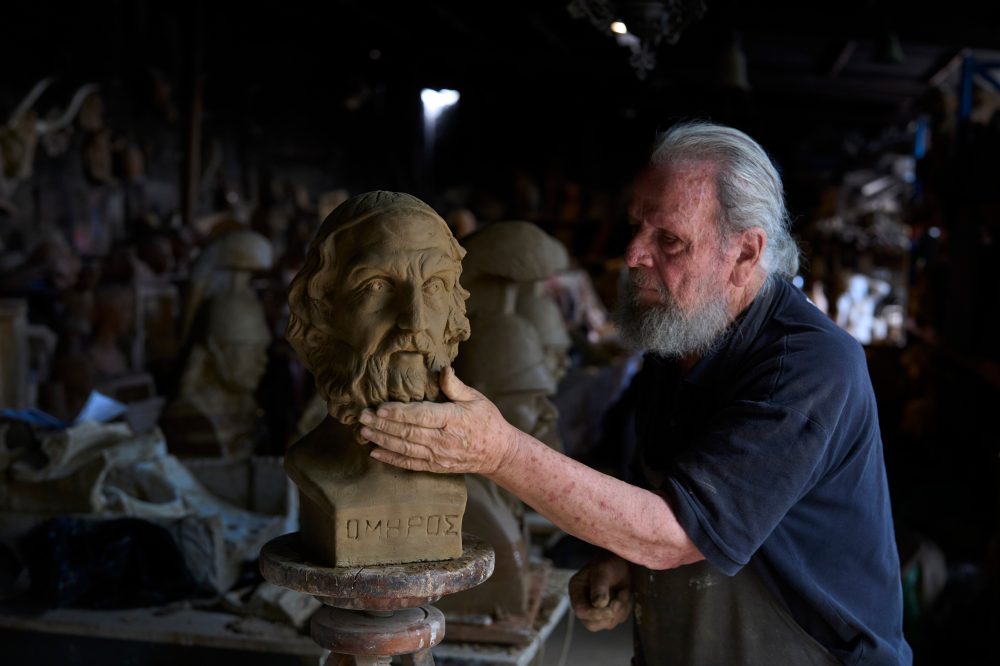

ATHENS, Greece — When Christopher Nolan’s big-screen take on “The Odyssey” hits theaters Friday, it arrives with enormous worldwide buzz — and a fair share of debate over who was chosen to play its iconic roles. But in Greece, where Homer’s ancient epic is a cornerstone of education, the reaction is far more measured.
Discussions about adaptations of classic works often center on how faithfully they stick to the original. Yet in a nation where Homer’s tale is part of every school curriculum, many Greeks point out that the story has survived for close to 3,000 years not in spite of being reinterpreted, but because of it.
“What we want children to understand is that every new creation is exactly that — a new creation,” said Filippos Mantzaris, a teacher who instructs seventh graders on “The Odyssey.”
The film features Matt Damon in the role of King Odysseus alongside a roster of well-known Hollywood performers. It follows Homer’s framework: a king’s long journey home from war, navigating gods and monsters, only to discover his palace has been taken over by rivals vying for his throne.
In Greece, “The Odyssey” is part of the standard seventh-grade curriculum in every classroom across the country.
In Mantzaris’ class, students enthusiastically discuss Odysseus’ clashes with mythical creatures and the various trials he faces. The lessons push students to weigh the hero’s cleverness against his physical might, wrestle with whether revenge can be morally justified, question whether a war-weary king is truly someone to admire, and debate whether his slaughter of his wife’s suitors was right. Through role-playing activities, children are asked to put themselves in Odysseus’ shoes.
“It’s an amazing literary text, with which children can identify, perhaps see Odysseus in themselves, but also see their own homeland,” Mantzaris said.
Twelve-year-old Kyriakos Agapiou, a student in Mantzaris’ class, said the poem taught him “that everything is possible and we should never give up.”
Farm scientist Nikos Varelas took his 4-year-old son to see a stage version of the story after the two had already read youth editions of both “The Iliad” and “The Odyssey” together at home.
“It is our duty as parents, as Greeks,” Varelas said.
Actor Manos Pintzis, who played Odysseus in that local theatrical production, said bringing the story to life on stage helps young audiences connect with mythology in ways that reading alone cannot achieve.
“You don’t tell a child, ‘Just read the story because you have to,’ because the child will resist when something is forced on them,” Pintzis said. “When the child sees all of this unfolding before their eyes — that becomes a valuable step toward learning, to willingly learn what they’re expected to study.”
Back in the United States, particularly in conservative circles, much of the pre-release discussion has focused less on Nolan’s storytelling and more on his casting decisions. Elon Musk declared that Nolan had desecrated “The Odyssey” after Black actress Lupita Nyong’o was announced as Helen of Troy — even though Musk had not yet seen the film. Conservative commentators, including Matt Walsh, argued the movie placed identity politics above artistic merit, drawing comparisons to past backlash over the casting of Black and Latino actors in beloved roles.
In an interview with The Telegraph, Nolan responded that criticism “comes with the territory,” and added that “these conversations that happen before people see the film — they’re always irrelevant, because no one having them knows what the film actually is yet.”
Nolan also told the AP that his goal was to make the film accessible and relatable, and “not look back to sort of past Hollywood versions of how to take on the ancient world.”
“You want to question people’s assumptions about how things should be portrayed in movies and what those are based on,” he said. “There’s a challenge to that and a risk to that. But my hope is that by creating a cohesive world, people understand the world as they watch the movie and they feel they understand it.”
In Greece, however, that controversy has gained little traction. Greeks are well accustomed to seeing non-Greek actors portray figures from their ancient history. Scotsman Gerard Butler famously shouted “This is Sparta!” as King Leonidas in “300.” Oklahoma native Brad Pitt took on the role of Achilles in “Troy.” Ireland’s Colin Farrell played Alexander the Great, with Angelina Jolie cast as his mother. And Anthony Quinn’s portrayal of a Greek character in the 1964 film “Zorba the Greek” remains one of the most cherished screen performances in the country’s memory.
Nolan’s cast continues that tradition, featuring Nyong’o, Damon, Tom Holland, Anne Hathaway, Robert Pattinson, Zendaya, and Charlize Theron, with narration provided by rapper Travis Scott.
One exception to Greece’s general indifference is the small nationalist party Niki, which has spoken out against both the casting and a Greek government decision to provide approximately 6 million euros — roughly $6.9 million — in subsidies to support filming in Greece. The party accused Greek taxpayers of being made to fund what it called the imposition of “woke-type ideology” on Greek history and cultural identity, citing Musk’s comments in support of its position.
Greece’s Culture Minister Lina Mendoni pushed back sharply on that criticism.
“It is not the state’s role to dictate to a creator how they should artistically interpret a work or a myth,” she told the Greek popular culture magazine Lifo. “Can we seriously be having a conversation about whether the state should censor Christopher Nolan?”
Christos Tsagalis, a professor of ancient Greek literature at the Aristotle University of Thessaloniki, said that in the end, audiences will decide whether Nolan’s interpretation succeeds. What truly counts, he said, is whether the film captures something essential about one of the greatest stories ever told.
Homer’s works have lasted through the ages by transcending their origins and becoming part of a shared human experience, Tsagalis said.
“I think it’s wonderful that something that is created at a specific point in time by a given people is shared by so many people across the globe… It’s shared culture,” he said.
“It’s a fascinating story,” he added. “It is like a movie.”