
Congo’s AFC/M23 rebel group has used a small Ebola outbreak within its territory as an opportunity to demonstrate its capacity to govern, building a response operation that runs almost entirely independent of the national government in Kinshasa — and drawing significant support from neighboring Rwanda in the process.
That’s the picture emerging from response teams on the ground and official documents reviewed by Reuters, which spoke with eight sources involved in the Ebola effort in rebel-held areas. Those sources included one AFC/M23 official, two members of the technical coordination committee, and five aid workers. Most requested anonymity, citing fears of appearing to legitimize the rebel group or losing access to the region.
The AFC/M23 controls vast stretches of North and South Kivu provinces following a rapid military advance in early 2025 that included the capture of Goma and Bukavu, the two largest cities in eastern Congo. The United Nations and Western governments have stated the group receives backing from Rwanda, an allegation Kigali denies.
Four Ebola cases were confirmed in rebel-held territory after the outbreak was officially declared on May 15 — one in Goma and three near Bukavu — according to data from Congo’s Health Ministry and the World Health Organization. Late last month, AFC/M23 announced the outbreak had ended in its territory following a 21-day period with no new infections.
Freddy Kaniki, the rebel group’s deputy coordinator for the Ebola response, said 400 contacts had been tracked, with 98% receiving daily check-ins. Documents reviewed by Reuters show 207 samples were tested in rebel-controlled areas of North Kivu as of June 18.
The situation in the rest of Congo tells a very different story. Transmission has continued across government-held areas, with the outbreak infecting 1,873 people and killing 672, according to government figures released Saturday. Congo’s Health Ministry and a government spokesperson did not respond to requests for comment.
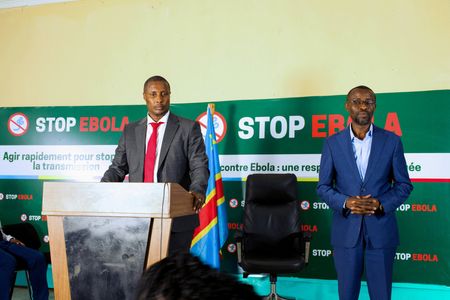
The rebels have actively promoted their response through videos circulated on social media, showing Kaniki and other officials touring laboratories, reviewing operations, and meeting with health workers — all aimed at presenting AFC/M23 as a functioning governing authority.
Kaniki acknowledged that government-held areas faced a far greater challenge, noting dozens of infections were already circulating when the outbreak was declared. He credited his group’s success to greater “discipline” and “anticipation,” particularly when it came to isolating cases and tracing contacts.
Strict containment steps were also enforced, including the suspension of bus routes connecting rebel-held areas to government territory. A journalist who traveled to Ituri told Reuters that he and his colleagues were placed in mandatory 15-day isolation in a town on the Ugandan border after returning to AFC/M23-controlled land.
Outside analysts are more measured in their assessment. “AFC/M23 is keen to demonstrate its capacity to function as a state and manage a public health crisis better than the Congolese government,” said Reagan Miviri of the Kinshasa-based Ebuteli research institute. “But with only four cases recorded, it has been a limited test so far,” he added.
The rebel response has been organized through health administrations that operate parallel to — and separately from — the central government’s health structures. Coordination with Kinshasa has been largely limited to sharing data and laboratory testing results.
Damien Mama, the U.N.’s interim humanitarian coordinator in Congo, said aid organizations have worked to bridge the gap between the two sides, using established disease surveillance systems to help ensure the accuracy of reported figures.
Lacking support from Kinshasa, AFC/M23 turned to Rwanda to fill the void. Kigali sent six specialists to Goma, including experts in surveillance, laboratory work, logistics, and safe burials, according to a response committee member and an aid worker.
As of June 18, the Rwanda Biomedical Center had provided $6,891 worth of medicines and materials, while Gisenyi Hospital — located just across the border — had supplied an additional $85,467 in goods, primarily protective equipment, according to response documents.
Rwanda government spokesperson Yolande Makolo said Kigali’s involvement centered on supporting regional surveillance and preparedness, noting that infectious diseases “do not respect borders.”
Despite that assistance, resources have remained stretched thin. Documents highlight shortages of protective gear, infection-control kits, vehicles, and fuel. The laboratory in Goma had only two extraction kits as of mid-June, significantly limiting its ability to process tests. Goma’s airport has been closed since the rebels took the city, and the banking system in rebel-held areas has also shut down, making it harder to move people, supplies, and money.
“If the outbreak spread into frontline areas and case numbers were to rise significantly, the response could become much more complicated,” Miviri warned.