
Western allies are convening in Paris on Monday with the goal of securing additional air defense pledges for Ukraine, as ammunition shortages have left the country increasingly exposed to Russian ballistic missile attacks — even as momentum on the ground has shown some signs of shifting.
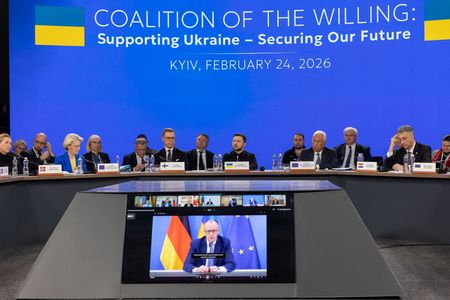
Ukrainian President Volodymyr Zelenskiy is attending the Coalition of the Willing meeting alongside at least 25 other world leaders. The gathering is part of a broader effort that includes developing a unified position that could be presented to Russia, as well as working out security guarantees to support any future peace agreement.
The Paris summit follows closely on the heels of a NATO meeting that sought to demonstrate transatlantic unity and lasting support for Ukraine.
Over the weekend, Russia carried out missile and drone strikes on Ukraine, killing eight people and wounding dozens more, according to officials. Zelenskiy responded by urging allies to speed up weapons deliveries to Kyiv.
French Foreign Minister Jean-Noel Barrot addressed the urgency of the situation in an interview with Ouest-France newspaper on Sunday. “The ballistic missiles launched by Vladimir Putin are deliberately targeting civilian zones and June was one of the most murderous months since the start of the war,” he said.
Russia maintains that it only strikes targets with military significance and denies deliberately attacking civilians.
A French presidency official, speaking to reporters, said the summit’s primary focus would be anti-ballistic missile cooperation. That includes efforts to obtain more U.S. Patriot interceptors, advance the deployment of the Franco-Italian SAMP-T air defense system, and explore how European and Ukrainian defense industries might develop alternative solutions.
One possibility being considered involves multiple European countries working together on a system that would work alongside SAMP-T and/or Patriot, with Ukraine playing a meaningful role in its production.
Ukraine’s stockpiles of munitions for its air defense systems are critically low, and the country has been largely unable to intercept ballistic missiles — which travel at several times the speed of sound — over the past month. Ukraine has been pressing allies for more supplies and has also urged Europe to collaborate with it on developing its own anti-ballistic missile defense system.
As Russian strikes have intensified, Ukraine has also stepped up drone attacks deep inside Russian territory, focusing on oil infrastructure and weapons manufacturing in an effort to weaken Moscow’s economic capacity to sustain the war.
Leaders at the summit will also discuss ways to cut into Russia’s revenue streams, particularly targeting the so-called “shadow fleet” — tankers with murky ownership structures used to ship Russian oil while evading international oversight.
The European Union is also expected to adopt a 21st package of sanctions against Russia in the coming week.
French President Emmanuel Macron has indicated there will be announcements on Monday, some of them bilateral, potentially involving joint arms production agreements.
Macron also said the coalition could announce joint military exercises as part of broader efforts to make the concept of a future multinational force in Ukraine a practical reality rather than just an idea.
“What must be remembered is that the MNFU consists of land, air, sea and training. All of these pillars are intended to be tested continuously, to varying degrees, with all participants in order to guarantee their credibility,” the French presidency official said, adding: “It’s not a question of conducting exercises in Ukraine.”