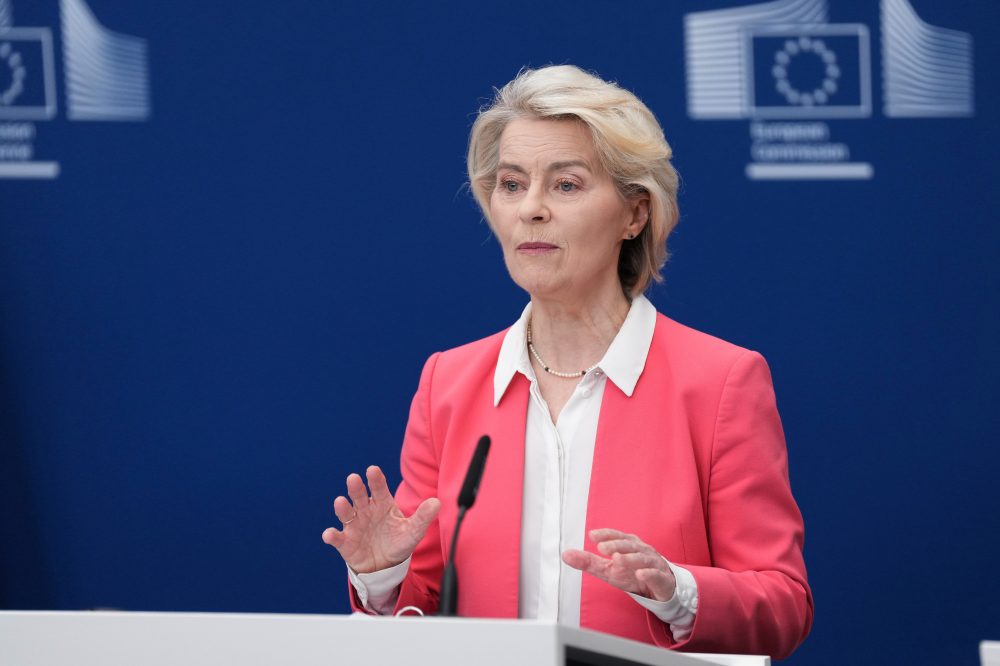

BRUSSELS (AP) — The president of the European Commission spoke out Monday in favor of placing limits on how children can access social media, as a special EU advisory panel released a report recommending that platforms be off-limits to children under 13 until technology companies can demonstrate their services are safe.
Concerns about the impact of social media on young, still-developing minds have been fueling a wave of new laws around the world. Countries including Australia, the United Kingdom, Turkey, and Indonesia have enacted bans preventing children under 15 or 16 from using platforms such as TikTok, YouTube, and Instagram.
European Commission President Ursula von der Leyen, who holds a medical degree, laid out her concerns about children’s exposure to social media and stated that children under the age of 3 should have no screen time whatsoever.
“I believe we need to consider phased and gradual access for different age ranges because childhood won’t wait and once it’s gone, we can never give it back,” von der Leyen told reporters.
She drew comparisons to other age-gated activities: “Just as we don’t give our children keys to the car before they have their license, or we do not let them buy alcohol until they are legally allowed. We need to set the age at which they can, the children can, legally access social media,” she said.
Von der Leyen also singled out infinite scrolling as one of the “addictive” features that technology companies need to address.
While she stopped short of naming specific age thresholds beyond the restriction for toddlers, the European Commission — the EU’s executive body — is expected to put forward a formal proposal for the bloc’s 27 member nations to consider in the coming months. Von der Leyen’s policy positions carry significant weight among EU member countries.
The special panel, which was created to examine child safety in the digital space, delivered its findings to the EU chief on Monday. The report concluded that when it comes to online safety, “the burden of proof needs to be on providers, not regulators, parents and children.”
“Until they demonstrate that their services are safe by design, social media and other digital services providers should have restricted access to children under the age of 13 in the EU,” the report stated. Its findings are expected to play a significant role in shaping von der Leyen’s next steps.
The panel also recommended that EU member countries consider “further precautionary age restrictions” for children who are older than 13.