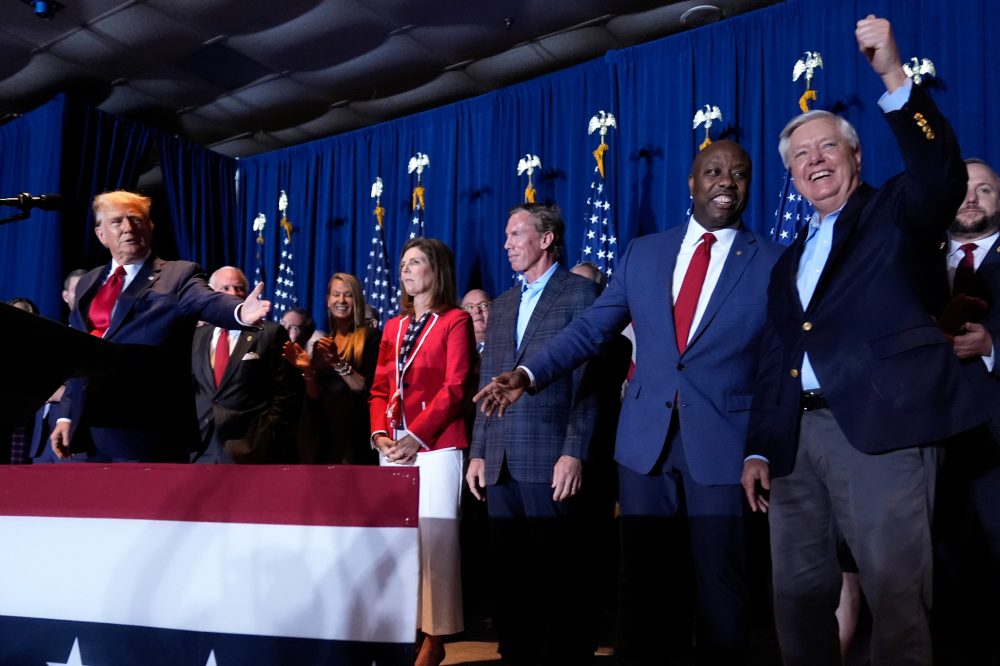

CHARLESTON, S.C. — The passing of Sen. Lindsey Graham over the weekend has thrown South Carolina politics into uncharted territory, coming in a year that has already seen significant political turbulence. Graham had been seeking a fifth Senate term at the time of his death.
As one of the state’s most senior and influential conservative voices and a close ally of President Donald Trump, Graham had been widely expected to cruise to another victory in November.
Now, Gov. Henry McMaster faces the task of naming a temporary replacement to fill the seat through January, while the state simultaneously gears up for a special primary election to let voters choose a new Republican nominee for the general election.
The sudden availability of the Senate seat has sparked intense interest among South Carolina’s ambitious conservatives, many of whom have been looking for an opportunity to advance their political careers.
The state’s Republicans had just wrapped up a hard-fought primary battle to determine who would succeed McMaster, who is finishing his second term as governor. State Attorney General Alan Wilson emerged victorious, defeating a field that included Lt. Gov. Pamela Evette, Rep. Nancy Mace, and Ralph Norman — all of whom are now reportedly considering a run for Graham’s seat.
Under South Carolina law, a one-week filing window for the special primary opens on the second Tuesday following a candidate’s death — in this case, July 21. The special primary itself would then be held on the second Tuesday after that filing period ends, landing on Aug. 11. If a runoff is needed, it would take place two weeks later on Aug. 25.
That would leave the eventual Republican nominee just over two months to campaign before the general election on Nov. 3.
The compressed timeline raises concerns under federal law, which mandates that military and overseas ballots be sent out at least 45 days before any federal election. For the general election primary, that deadline would have fallen on June 27. Officials at the Federal Election Commission had not responded to requests for clarification about how the process would proceed.
Graham died Saturday night. A preliminary report from the medical examiner indicated he suffered an aortic dissection — a tear in the body’s main artery.
Within hours of the announcement of his death, speculation was already swirling within South Carolina Republican circles about who might step into the role. Given how close the November election is, political observers believe McMaster’s appointee could have a significant advantage in the special primary, though it’s also possible the governor may opt to name someone who serves only as a short-term placeholder.
Evette, who spent nearly eight years serving alongside McMaster and had his backing in the governor’s race before losing the June 23 runoff to Wilson, is considered a leading candidate for the appointment. A source familiar with her thinking, who was not authorized to speak publicly, said she has been receiving encouragement from across the state and believes she would be competitive in the special primary.
It is considered unlikely that McMaster would appoint a sitting House member to complete Graham’s current term, given how narrow the Republican majority in the chamber currently is.
U.S. Rep. Joe Wilson, who had been mentioned as a potential replacement, said he told Trump on Sunday that “my goal is to remain in the House to keep his two-vote majority for the American people!!!”
That said, House members may still enter the race for the next full Senate term. A source familiar with Rep. Nancy Mace’s thinking, speaking anonymously, said she is weighing a run. Mace is not seeking reelection to her current House seat.
Another House Republican, Rep. Russell Fry, is also seen as a potential contender. The two-term congressman represents the fast-growing area around Myrtle Beach and has been a strong supporter of Trump.
A spokesman for businessman Mark Lynch, who was defeated by Graham in the primary, did not respond to a message left Sunday.
Treasury Secretary Scott Bessent, who previously lived in South Carolina before joining the Trump administration, has received calls about potentially taking Graham’s seat. However, a source who requested anonymity to discuss private conversations said Bessent has no interest in the position and is content in his current role serving the president.
No Democrat has captured a Senate seat in South Carolina in several decades, and Republican candidates have typically won statewide races by wide margins. When Graham last ran in 2020, he defeated Democratic challenger Jaime Harrison by 10 percentage points.
Despite that history, Republican leaders are keeping a close eye on the political landscape. Charleston pediatrician Annie Andrews, who secured the Democratic nomination last month, has raised more than $8 million in the race and had just under $3 million in cash on hand as of the end of May, according to federal filings. Graham had raised $6 million, with just over $4 million available.
In a statement Sunday, Andrews called on South Carolinians to join her “in setting partisanship aside and offering gratitude” to Graham for his years of service.
Harrison, Graham’s 2020 opponent, reflected on their relationship in a social media post, writing that even though he and Graham “had our share of political disagreements,” he “always appreciated that even in our fiercest political battles, we could still share a conversation, a laugh, and a mutual respect for South Carolina and the institutions we were both privileged to serve.”
Graham’s death leaves a significant gap in the Senate, where seniority carries real weight in terms of influence and committee leadership. He spent more than two decades in the chamber, building up enough standing to chair committees and help shape the legislative agenda.
South Carolina’s junior senator, Sen. Tim Scott, has served since 2012 — a relatively short tenure by the state’s historical standards. Former Sen. Fritz Hollings served 38 years, and Sen. Strom Thurmond held his seat for 47.
Scott, who had co-chaired Graham’s reelection campaign, said his former colleague was “irreplaceable.”
“America lost a statesman, but I lost a friend,” Scott said in an appearance on ABC’s “This Week.”