
Farmers in Italy’s Emilia-Romagna region once only cracked open their barn windows on summer nights to give their cattle a bit of relief from the heat. Now, with temperatures climbing to record-breaking levels, those windows never close — day or night — as producers fight to protect their cows and safeguard the region’s prized Parmigiano Reggiano cheese industry.
“Extreme heat impacts milk’s quality and quantity,” said Nicola Bertinelli, president of the Parmigiano Reggiano Consortium. Bertinelli also oversees the dairy farm his family established in 1895 near Parma.
When temperatures climb past 40 degrees Celsius — about 104 degrees Fahrenheit — cows rest more, eat less, and can produce as much as 10% less milk. Milk is one of only three ingredients in authentic Parmigiano Reggiano, alongside salt and rennet.
The cheese can only legally be produced in five specific provinces, most of which fall within the Emilia-Romagna region. Additionally, the cows must be fed exclusively on grass and hay grown within that same area.
“If it doesn’t rain, grass doesn’t grow, hay cannot be produced and it’s impossible to obtain the milk needed to make the cheese,” said Bertinelli, 54.
To combat the heat, farmers like Bertinelli have added fans and water-misting systems to their barns — but those solutions have come at a steep price, sending energy bills sharply higher.
Those rising costs are also being felt in the climate-controlled warehouses where Parmigiano Reggiano wheels are stored during the aging process, which lasts a minimum of 12 months and can stretch to three years or beyond.
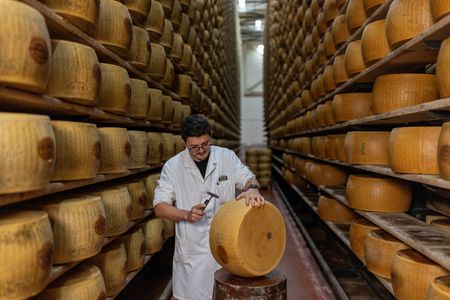
Two warehouses operated by Magazzini Generali delle Tagliate — known as MGT, a unit of Credito Emiliano — hold more than 500,000 cheese wheels across the provinces of Reggio Emilia and Modena. Together, those wheels are valued at over €300 million.
“During this year’s peak heatwaves, our daily energy consumption rose by about 30%,” said MGT director Giancarlo Ravanetti. He noted that the company has worked to offset those costs by improving cooling systems, upgrading insulation, and expanding renewable energy production.
These warehouses have become iconic in the region, collectively referred to as the Bank of Parmigiano. Inside, tradition and modern technology work side by side. Each cheese wheel goes through rigorous quality checks — including X-ray scans — and is inspected weekly by specialists who tap the wheels with small hammers, listening for any signs of defects that may have developed during aging.
“The human factor remains key and is the real strength of the entire process,” Ravanetti said.
Paolo Ganzerli, international sales director at food group GranTerre — which reported consolidated revenue of €1.87 billion in 2025 — shared similar concerns about the financial pressures ahead.
“If extreme events become longer-lasting and more intense, they will certainly have an impact on both the quantity and quality of milk, but above all they will lead to higher costs,” he said.
The stakes are enormous. The Parmigiano Reggiano industry brings in an estimated €4.5 billion — roughly $5.15 billion — in revenue each year, supporting thousands of jobs and anchoring the regional economy.
In 2025, exports made up more than half of the cheese’s total global sales, with the United States standing as its largest international market.
Ganzerli noted that Parmigiano Reggiano “has existed for more than 800 years.”
“We don’t want to be the last generation to eat it,” he added.