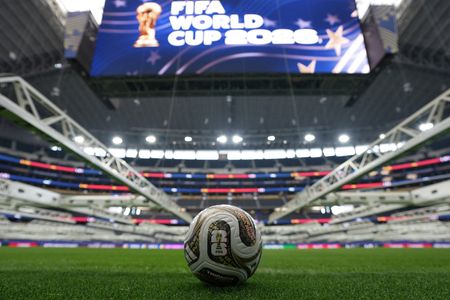

When France and Spain square off Tuesday for a spot in the World Cup final, one notable chapter will come to a close — the life of the Dallas Stadium pitch.
The playing surface, which took five years of research to develop and perfect, will be torn apart once the match concludes and one of the two teams heads to New York to prepare for the championship game.
“What we’re doing here is hosting the biggest football tournament in the world, these are the best players in the world so we want to provide the best surfaces for them,” said Ian Craig, FIFA’s pitch manager for Dallas Stadium.
Creating a consistent playing experience across all 16 World Cup venues — plus training sites for the first-ever 48-team tournament — required turf scientists and groundskeepers to collaborate with the University of Tennessee, Michigan State University, and FIFA’s pitch management team. Their goal was to standardize how the ball rolls and bounces on every surface.
“It’s not just about having green grass. We have to make sure that these pitches play the way that these elite-level players are used to, which is obviously where years of research and hard work have gone into,” Craig explained.
Dallas presented a particularly tough challenge as one of three indoor venues in the tournament. The lack of natural sunlight and the constant use of air conditioning meant that grass native to Texas simply wouldn’t survive. Instead, a variety capable of tolerating cooler temperatures was brought in from Colorado.
To keep the grass alive on non-match days, grow lamps have been hung from the stadium’s roof and repositioned as needed. The entire pitch sits four-and-a-half feet above the artificial turf the Dallas Cowboys normally play on.
“We’re standing four-and-a-half feet above where the NFL field is, just in order to fit this within the stadium, but we have a full soil profile in there,” Craig said. “This is a full football pitch. This isn’t just a temporary installation. This is typical of what would be underneath a standard playing surface. We also have the hybrid elements, so it’s typical of what you would see at the elite level in Europe.”
After hosting nine matches over the course of more than four weeks, the pitch has served its purpose. Craig and his crew will begin tearing it down as soon as the semifinal wraps up.
“This is a very, very busy stadium,” Craig noted. “It has a lot of events, so this pitch has done what it was here to do, and it’s then on to concerts and the NFL again.”