
Oil prices surged and stock markets across Asia fell broadly Monday following a series of military exchanges between the United States and Iran that have reignited concerns about global energy supplies.
Brent crude, the international benchmark for oil pricing, climbed 3.9% to $78.96 per barrel. U.S. benchmark crude rose 4% to reach $74.26 per barrel.
Both oil benchmarks had recently returned to pre-war levels after the two nations reached a temporary agreement to pause hostilities and oil tankers resumed passage through the Strait of Hormuz. That progress was reversed over the weekend when Iran attacked a container ship in the strait, setting it on fire and leaving one crew member unaccounted for. In response, the U.S. launched multiple waves of airstrikes on Iran that continued into Monday morning. Iran then struck back by targeting multiple countries throughout the Middle East.
U.S. stock futures retreated in response to the escalation. The contract tied to the S&P 500 dropped 0.4%, the Dow futures fell 0.3%, and the Nasdaq composite futures slid 1%.
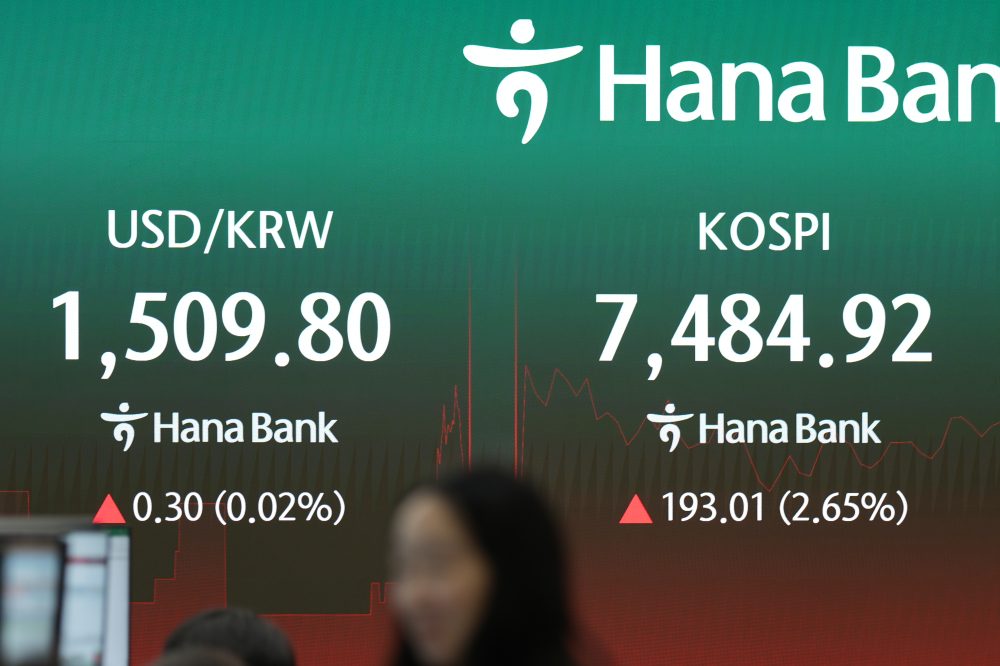
Across Asia, Tokyo’s Nikkei 225 dropped 1.1% to 67,786.86. South Korea’s Kospi fell sharply, declining 5.6% to 7,060.69. South Korean memory chipmaker SK Hynix, which had surged 13% in its Wall Street debut on Friday, tumbled 10.6% in Seoul trading. Its larger competitor Samsung Electronics also fell, dropping 6.7%.
Hong Kong’s Hang Seng bucked the regional trend, edging up 0.1% to 24,202.41. China’s Shanghai Composite index fell 1.2% to 3,947.34, and Australia’s S&P/ASX 200 dipped 0.3% to 8,777.00.
On Friday, U.S. stocks had finished higher, driven by continued investor enthusiasm for companies benefiting from the artificial intelligence boom. The S&P 500 gained 0.4%, the Dow Jones Industrial Average rose 0.3%, and the Nasdaq composite added 0.3%. Nvidia was the biggest single contributor to Friday’s S&P 500 gains, rising 4%.
SK Hynix made its Wall Street debut Friday afternoon after raising approximately $26.5 billion by selling American depositary shares at $149 each. The company’s stock in Seoul had already surged more than 600% over the past year, fueled by surging demand for computer memory tied to the AI boom. However, concerns have grown that AI-related stock valuations may have risen too far and that massive global spending on chips and data centers may not generate enough productivity and profit growth to justify the investment.
Those concerns have caused significant volatility among AI-related stocks, which have become some of Wall Street’s most influential due to their enormous market sizes.
Investors are also turning their attention to the upcoming corporate earnings season, when companies will report their spring profits. Firms across multiple sectors will need to show strong profit growth to support their current stock prices, which remain near record highs. Next Tuesday alone, major banks including Bank of America, Citigroup, JPMorgan Chase, Goldman Sachs, and Wells Fargo are all scheduled to release earnings.
The ongoing conflict with Iran is adding uncertainty to the economic outlook by threatening to push energy prices higher, which could fuel broader inflation. Elevated bond yields have already been pressuring financial markets globally, as rising oil costs and persistent inflation could prompt the Federal Reserve and other central banks to raise interest rates. While higher rates can help bring inflation under control, they also slow economic growth and weigh on investment values across the board.