
HAVANA — Most evenings, 39-year-old Frank Alfonso climbs to the rooftop of his apartment building to escape the stifling heat that comes with Havana’s ever-more-frequent power outages. But when the rain swept in last Friday afternoon at the same moment Cuba’s entire national electrical grid went down, even that small escape was taken from him.
Alfonso lives in one of thousands of aging tenement buildings across Havana called “solares” — structures that have been carved up over the decades into tiny living spaces. Now six months into a U.S.-imposed oil blockade, residents of these buildings are enduring extended stretches without power as Cuba’s worn-out infrastructure struggles to keep the lights on with dwindling fuel supplies.
“We didn’t even realize this time that the whole grid had collapsed, because we were already in a blackout,” Alfonso said.
Over the course of more than 24 hours this past weekend, as the system failure stretched across much of the island, Reuters followed Alfonso and his neighbors through what has become an ordinary part of their lives: existing without electricity.
NO POWER MEANS NO WATER
Just next door to Alfonso’s unit, 51-year-old Yunaisi Durruti sat in an armchair late Friday night, the glowing tip of her cigarette the only source of light in the room. Her biggest worry wasn’t the heat or the darkness — it was water.
Her faucet had been dry for a full week. The pump that moves water from the ground-floor cistern up to her second-floor apartment’s tank runs on electricity, and during the brief windows each day when power does come on, the cistern is typically already empty due to routine water shutoffs.
Durruti originally came to Havana as a young woman to study culinary arts, and later spent ten years working in the kitchen of a beachside resort operated by the Spanish hotel company Melia. That chapter of her life is behind her now. She works as a security guard, and after each shift she travels to her parents’ home in a part of the city that sees fewer blackouts — just to shower, prepare food, and wash her clothes. Her own refrigerator sits empty, since there’s no point keeping food that will only spoil.
Melia has since announced it is pulling out of Cuba following tightened U.S. sanctions imposed this spring.
Durruti noted that Cuba’s deep-rooted tradition of neighbors looking out for one another has helped soften the blow of the shortages — but only to a point.
“Everyone can share a small bucket of water,” she said. “But in this crisis, more than that is impossible.”
A PROPHECY FULFILLED
Cuba’s electrical grid and broader infrastructure have been declining for years, but residents of the tenement building said the power cuts that used to be occasional have become relentless in recent months since the oil blockade took hold.
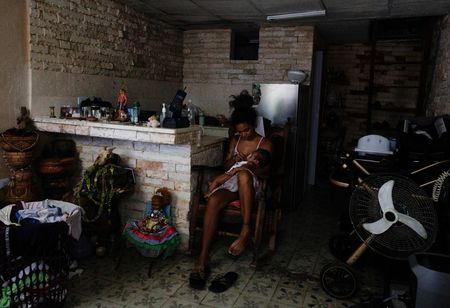
On Saturday afternoon, 28-year-old Thalía Castillo sat nursing her three-month-old son, Thayler, while a small rechargeable fan worked to keep the heat and mosquitoes away from the infant in their ground-floor apartment.
Castillo and her husband, Lazaro Herrera, had been among the lucky ones — for a while. A power station sent by Castillo’s grandmother living in the United States had kept their apartment running for several hours after the grid went down. But the charge eventually ran out. A frozen package of meat — another item made possible by their U.S.-based family — was slowly thawing in the freezer, and every few hours Castillo wiped away the pooling blood seeping into the refrigerator.
Small figurines representing Yoruba deities lined their kitchen. Herrera serves as a priest — called a babalawo — in the Afro-Cuban faith tradition, which is widely observed across the island. Each new year brings a set of prophecies delivered by community elders. This past January, the forecast spoke of upheaval and conflict.
“Everything has come true, so far,” Herrera said.
A BRIEF MOMENT OF LIGHT
Just before 9 p.m. Saturday, Alfonso hurried back to the building. The power was still out — but Argentina’s World Cup quarterfinal match against Switzerland was about to kick off, and he wasn’t about to miss it.
Since the tournament began, Alfonso and Herrera had worked out a solution for the repeated blackouts: they mounted Herrera’s television on a rack outside and ran it off a generator from across the street.
By the time the match started, several dozen residents from the building and the surrounding neighborhood had gathered in the street around the screen. An older woman from the second floor perched on the front steps, scolding younger viewers who wandered into her line of sight. When Argentina scored its opening goal, the crowd erupted in cheers.
The rest of the street — stretching all the way to Havana’s waterfront boulevard — remained completely dark.