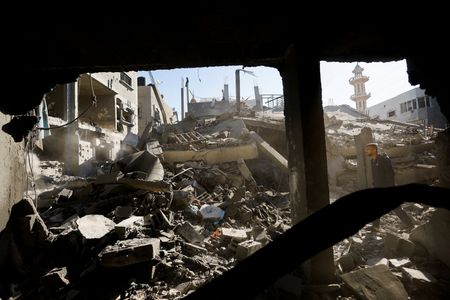
Health officials in Gaza reported that seven Palestinians died in an Israeli airstrike Saturday, including two women, as diplomatic efforts to strengthen a fragile ceasefire resumed in Cairo.
Medical personnel said the strike hit a large tent camp in central Gaza City, killing seven and injuring 15 others, including children.
A military spokesperson for Israel confirmed to Reuters that forces conducted an operation against “terrorists” but declined to provide additional information.
The attack happened while negotiators launched fresh discussions in Cairo with Hamas and other Palestinian groups about reinforcing a troubled ceasefire deal brokered by U.S. President Donald Trump. The agreement has not prevented continued Israeli military operations and has left Israel controlling more than half of the territory following the conflict that started when Hamas launched attacks on southern Israel in October 2023.
Negotiations over the second stage of the agreement, which would include disarming Hamas and withdrawing Israeli forces, have reached an impasse.
Egypt started hosting renewed ceasefire discussions Saturday with Hamas leadership and other Palestinian faction representatives, with talks expected to continue for several days, according to Hamas and sources familiar with the negotiations.
Hazem Qassem, a Hamas spokesperson in Gaza, said the discussions would concentrate on how Israel implements the first stage and finding agreement on moving forward to the second stage.
Hamas communicated to mediators from Egypt, Qatar, Turkey and representatives from Trump’s Board of Peace that stopping Israeli military actions in Gaza remains crucial for any advancement, according to group sources and officials involved in the talks.
Hamas is demanding Israel cease its attacks, permit increased humanitarian aid into Gaza and pull back to ceasefire boundaries.
Gaza health officials report approximately 950 Palestinians have died in Israeli strikes since the truce took effect. Hamas typically does not release detailed information about casualties among its fighters.
Israeli military officials state that four Israeli soldiers have died from militant attacks during the same timeframe.
Israel maintains its strikes target imminent threats and that it permits aid and supplies to enter Gaza.
Gaza health authorities report nearly 73,000 people in Gaza have died since fighting began, with most being civilians.
Israel reports that militants led by Hamas killed 1,200 people and captured 251 Israeli and foreign hostages during the October 7, 2023, attacks.
MONACO, June 6 – In a dramatic qualifying session Saturday, Mercedes driver Kimi Antonelli claimed pole position for the Monaco Grand Prix, narrowly defeating Max Verstappen in the final moments.
The 19-year-old Italian driver, who currently leads the world championship following four consecutive race wins, posted a time just 0.043 seconds faster than Red Bull’s Verstappen, who will join him on the front row for Sunday’s race.
Ferrari drivers, who had been widely expected to perform well at the Monaco circuit, will occupy the second row of the starting grid. Lewis Hamilton qualified third, finishing 0.228 seconds behind Antonelli’s pole time, while local driver Charles Leclerc, who claimed victory in the 2024 Monaco race, will start fourth.
Isack Hadjar secured fifth place in the second Red Bull entry, while Antonelli’s Mercedes teammate George Russell managed only sixth place in what was considered a disappointing result.
The reigning world champion and defending Monaco race winner Lando Norris will begin Sunday’s race from the fourth row, starting alongside his McLaren teammate Oscar Piastri.
General Rudolf Haykal, who leads Lebanon’s military forces, departed Saturday for Pakistan following an invitation from Pakistan’s top military official, according to a statement from Lebanon’s army.
The trip takes place during a period when Pakistani officials are working to facilitate diplomatic solutions to the U.S.-Israeli confrontation with Iran, a conflict that has expanded to affect Lebanon as well.
Military officials confirmed the visit was arranged at the request of Haykal’s Pakistani equivalent, though they did not release additional information regarding the specific objectives or timeline of the trip.
Air New Zealand’s leadership revealed Saturday that the carrier has managed to counteract just one-quarter to two-fifths of the financial impact from rising fuel expenses through protective hedging strategies and ticket price adjustments, according to Chief Executive Nikhil Ravishankar speaking with Reuters.
During the International Air Transport Association’s yearly conference in Rio de Janeiro, Ravishankar indicated the airline is preparing for jet fuel costs around $150 per barrel based on Singapore Jet Index pricing through the company’s 2027 fiscal year. While fuel availability isn’t an issue for the carrier, he emphasized that price volatility continues to be their primary obstacle.
The company has already implemented two separate rounds of ticket price increases and may consider additional targeted fare adjustments in markets where passenger demand stays strong, according to Ravishankar.
“You can’t just infinitely keep raising prices. The market will respond and demand will soften and then you fly less,” he said in an interview.
The chief executive stated that Air New Zealand doesn’t anticipate needing to seek additional funding from financial markets, noting that the company’s financial position and collection of debt-free aircraft provide sufficient resources to weather prolonged periods of high fuel costs.
Should fuel expenses remain at current levels, the airline would employ a mix of expense reductions, vendor contract renegotiations, fare adjustments and flight schedule cuts, he explained.
The carrier is also working to recover from mechanical issues with engines and delayed aircraft deliveries that previously left up to 20% of its planes unable to fly. Ravishankar reported this figure has dropped below 5%, with the majority of aircraft anticipated to return to service within the coming two to three months.
While financial settlements from Boeing, Rolls-Royce and Pratt & Whitney have provided some relief, he noted these payments have only partially covered the economic losses sustained.
American military forces intercepted Iranian ballistic missiles and attack drones targeting Gulf partners on Friday, while also conducting retaliatory strikes against Iranian coastal radar installations, marking another escalation in the fragile ceasefire with Tehran.
This military exchange occurred as the Trump administration continues increasing diplomatic pressure on Iran to negotiate an agreement ending the ongoing conflict.
According to U.S. Central Command’s Friday evening social media statement, Iran launched seven ballistic missiles targeting Kuwait and Bahrain. American forces successfully intercepted six missiles, while the seventh failed to reach its intended target. Military officials reported no injuries to U.S. personnel.
These ballistic missile attacks followed earlier U.S. interception of four Iranian drones heading toward the Strait of Hormuz.
“The attack drones posed an immediate threat to regional maritime traffic,” U.S. Central Command stated on social media.
Kuwait’s military confirmed their forces were intercepting incoming missiles and drones targeting their territory, while Bahrain activated emergency sirens and instructed citizens to seek shelter and follow official guidance.
Iran’s Revolutionary Guard claimed responsibility for targeting the Ali Al Salem airbase hosting U.S. forces in Kuwait and the U.S. Navy’s 5th Fleet stationed in Bahrain, according to state-run IRNA news agency reports.
American military forces are currently maintaining a blockade of Iranian ports as Tehran continues restricting the vital shipping corridor for global oil and natural gas transport, causing energy price increases and creating political challenges for President Donald Trump’s Republican Party before upcoming midterm congressional elections.
U.S. Central Command confirmed striking radar installations, including one located on an island within the strait, “to defend against further attacks.”
Trump promises a quick end to US-Iran conflict
These latest confrontations represent continued back-and-forth hostilities straining the unstable ceasefire and complicating diplomatic efforts to extend the truce. Earlier this week, Iranian drone attacks severely damaged Kuwait’s primary airport passenger terminal, resulting in one death, multiple injuries, and temporary airport closure.
Despite these attacks raising fresh concerns about potential ceasefire collapse, Trump informed reporters Friday that “the situation with Iran seems to be going quite well.”
“We’re going to come out of Iran very quickly and it’s going to be very strong one way or the other, whether it’s a piece of paper or the very tough way,” Trump stated during a Wisconsin farmers event. “The very tough way is maybe the easier way, but we’re going to come out, and your fertilizer prices are going to go way down, just like they were four months ago.”
When questioned Friday about the prolonged timeline, Trump told NBC’s “Meet the Press” it was because “it’s a very hard thing for them,” referencing their “great independence” and noting “they’re strong, they’re proud.”
“There are things they never thought they’d be doing that they’re going to have to do. They’ve got no choice, and it takes a little while,” he explained during the interview.
Trump indicated the Iranians maintain 21% to 22% of their missile arsenal.
Israeli strikes on Lebanon continue
His administration has also promoted the recent ceasefire agreement reached this week between Lebanon’s government and Israel following U.S.-mediated negotiations in Washington. However, the Iranian-supported Hezbollah militant organization has refused the agreement, and continued attacks threaten its viability.
Israeli military forces conducted Friday strikes across multiple southern Lebanon areas and issued evacuation orders for nine villages, including one sheltering thousands of displaced civilians. These strikes resulted in nine fatalities across six southern Lebanon locations, according to state news agency reports.
Israeli military officials reported two soldiers wounded, one critically, during Friday’s encounter with militants in southern Lebanon.
The Lebanese conflict, where Israeli forces have captured significant portions of the south, also jeopardizes efforts to conclude the Iran war and reopen the Strait of Hormuz, as Iran has insisted any permanent truce must include Lebanon.
Beyond the Strait of Hormuz drone interceptions, U.S. military forces earlier Friday boarded a sanctioned oil tanker connected to Iran in the Indian Ocean as America continues preventing Iran from profiting through oil and other commodity sales.
The U.S. also imposed additional energy sector sanctions targeting individuals, companies and tankers.
PARIS (AP) — During D-Day anniversary commemorations in France on Saturday, U.S. Defense Secretary Pete Hegseth drew parallels between current European migration patterns and the historic Allied invasion, suggesting that the liberty secured by World War II forces might be fleeting without proper defense.
At the Normandy American Cemetery in Colleville-sur-Mer in northwestern France, Hegseth addressed the 82nd anniversary of the June 6, 1944, Allied landings, stating that in present times, “different European beaches are stormed by different dangerous ideologies.”
“Beaches in Spain and Italy and Greece and Bulgaria. Boats and men arrive,” he said.
“When will European capitals do something about that invasion? Or is it too late?” he added. “I pray not, and I believe not.”
While the Defense Secretary avoided directly mentioning immigration, his comments reflected the current administration’s broader critique of European handling of migration issues, border security, and what American officials characterize as suppression of nationalist and far-right perspectives.
The same day, the office of British Prime Minister Keir Starmer criticized U.S. Vice President JD Vance for connecting immigration to the death of Henry Nowak, an 18-year-old British student who was fatally stabbed in Southampton, despite both the victim and perpetrator being British citizens.
Last December, the current administration’s national security strategy document cautioned that Europe confronts the “prospect of civilizational erasure” and risks becoming “unrecognizable” over the next two decades.
PARIS – Nineteen-year-old Russian tennis sensation Mirra Andreeva secured her first Grand Slam championship on Saturday, defeating Poland’s Maja Chwalinska 6-3, 6-2 in the French Open women’s singles final.
The eighth-seeded player from Russia achieved a historic milestone, becoming the first Russian woman to capture a Grand Slam title since Maria Sharapova’s French Open victory in 2014.
Tournament Performance
Andreeva’s championship run included victories over France’s Fiona Ferro (6-3, 6-3) in the opening round, followed by a comeback win against Spain’s Marina Bassols Ribera (3-6, 6-1, 6-1). She then defeated Czech Republic’s 27th-seeded Marie Bouzkova (6-4, 6-2) and Switzerland’s Jil Teichmann (6-3, 6-2) to reach the quarterfinals.
In the quarterfinals, she dominated Romania’s 18th-seeded Sorana Cirstea 6-0, 6-3, before advancing to the final with a semifinal victory over Ukraine’s 15th-seeded Marta Kostyuk 6-1, 6-3.
Tennis Journey
Andreeva began playing tennis at age six and reached the Australian Open girls’ championship match in 2023, where she fell to Alina Korneeva in three sets.
Her professional journey started on the ITF circuit in 2022, where she claimed six championships. She gained international attention in 2023 by reaching the third round at the French Open in her Grand Slam debut, followed by a fourth-round appearance at Wimbledon.
In 2024, she advanced to the French Open semifinals, losing to Jasmine Paolini, and earned an Olympic silver medal in women’s doubles as an individual neutral athlete alongside Diana Shnaider. She also captured her first WTA title at the Iasi Open.
At just 17 years old in 2025, she made history as the youngest WTA 1000 champion by defeating Clara Tauson at the Dubai Tennis Championships. She followed that success with another WTA 1000 title at Indian Wells, defeating world number one Aryna Sabalenka.
In 2026, she added titles in Linz and Adelaide to her resume while also reaching the Madrid final before claiming her breakthrough Grand Slam victory in Paris.
PARIS, June 6 – Nineteen-year-old Mirra Andreeva of Russia claimed her first Grand Slam championship Saturday, defeating Polish qualifier Maja Chwalinska in straight sets 6-3, 6-2 at the French Open.
The eighth-seeded Andreeva’s victory marks the first time a teenager has claimed the Roland Garros championship since Pole Iga Swiatek accomplished the feat in 2020.
A Palestinian infant who died in an Israeli military shooting was buried Saturday in the West Bank city of Hebron, one day after the deadly incident that also wounded his parents.
Seven-month-old Sam Fahd Abu Haikal was interred following funeral services at a local mosque, his small body wrapped in white burial cloth and draped with a Palestinian flag. The baby died Friday when Israeli forces opened fire on his family’s vehicle in the Tel Rumeida area south of Hebron, according to relatives who witnessed the incident and the Palestinian Health Ministry.
The child’s father, Fahd, rejected suggestions that the shooting was unintentional during Saturday’s burial proceedings.
“What happened to us is not a matter of an apology. What happened is not that shots were fired by mistake and led to this tragedy,” the grieving father stated.
“To say it happened by mistake, that ‘I didn’t know you were coming here,’ or that the bullet passed through by accident — no. There is no such thing as ‘by mistake’ in this case.”
Israeli military officials have stated that troops discharged a single round after they “perceived a vehicle accelerating toward them.” The military has admitted that “uninvolved civilians” sustained injuries and indicated the matter is being investigated.
The infant’s grandmother, Firyal, described how the family had brought their car to a halt upon spotting Israeli troops in the area. She said gunfire erupted afterward, with a bullet striking their vehicle and fatally wounding Abu Haikal while injuring both parents.
“Immediately after the presence of the occupation forces, a soldier holding his weapon opened fire on us. The bullets struck the car,” Fahd recounted.
“The soldier that shot at us was 10 metres away. The bullet penetrated the front windshield, went through my arm, and then struck my son in the head and my wife in the face.”
Military authorities have not revealed the identities of the troops involved in the shooting or indicated whether those personnel remain on active duty during the ongoing investigation.
The first American pope is planning to cheer on his home country’s soccer team during the upcoming World Cup competition.
Pope Leo, who left his Chicago roots behind for the Vatican’s papal residence, shared his tournament loyalties with a reporter during his Saturday flight from Rome to Madrid. The pontiff confirmed he’ll be backing the United States when the 48-nation competition kicks off Thursday.
“I would certainly support the U.S.,” the pope stated. “I don’t know how many games I’ll be able to see but I wish them all the best.”
The United States will face Paraguay, Australia and Turkey in Group D competition. The Americans are serving as co-hosts for the tournament alongside Canada and Mexico.
The pope’s allegiance wasn’t always guaranteed for the U.S. squad. Pope Leo, who hails from a south Chicago suburb, spent many years as a missionary and bishop in Peru before ascending to the papacy. During a previous interview last year, he indicated he would favor Peru over the United States in any soccer matchup.
However, with Peru’s failure to earn a spot in this year’s competition, the path cleared for papal support of the American team.
During his current week-long visit to Spain and the Canary Islands, Pope Leo also addressed his preferences regarding Spanish soccer. When questioned Saturday about his allegiance between rival clubs Real Madrid and Barcelona, the pontiff, whose birth name is Robert Prevost, took a moment before responding.
“The pope is for all teams,” he answered. “Prevost is for Real Madrid.”
New Castle County police investigators have taken a 35-year-old man into custody on several felony charges stemming from an alleged sexual assault of a young child.
Jose Martinez-Salinas faces multiple serious charges after law enforcement officials conducted an investigation into the reported assault of a child younger than 12 years old.
Police officers were called to respond to the sexual assault report on June 4, 2026, in New Castle County. The incident prompted detectives with the New Castle County Division of Police to launch their investigation that ultimately led to Martinez-Salinas’ arrest.
The suspect is now facing multiple felony counts in connection with the alleged crimes against the minor victim.
LAS VEGAS (AP) — Following hostile crowds and chants of “no means no” in Carolina, Vegas Golden Knights netminder Carter Hart returns to the comfort of his home arena for Game 3 of the Stanley Cup Final on Saturday.
The T-Mobile Arena crowd has embraced Hart throughout the playoffs, with support growing stronger each game as he helped lead the Golden Knights to the championship series. The series stands even at one game apiece.
“Just really fortunate to be here in Vegas,” Hart said. “It’s a great culture of people.”
The hostile reception in Carolina related to Hart being among five players from Canada’s 2018 world junior team who were acquitted of sexual assault charges last July. The NHL determined these players could sign contracts starting Oct. 15 and return to play beginning Dec. 1. Hart subsequently inked a two-year, $4 million deal with Vegas.
Ironically, Hart might have been playing for the opposition. The Hurricanes explored signing both Hart and Michael McLeod — another of the five players involved in the case — but ultimately chose not to pursue that path.
Hart’s stellar postseason performance had positioned him as a candidate for the Conn Smythe Trophy, awarded to the playoffs’ most valuable player.
He brought a 12-4 playoff record into the opening game, along with a 2.22 goals-against average and .924 save percentage. However, against the Hurricanes, his numbers have dipped to a 3.90 GAA and .855 save percentage.
The struggles haven’t been entirely on Hart’s shoulders. Vegas’ defense committed several uncharacteristic mistakes in the opening two contests, forcing Hart into challenging situations. Still, according to Natural Stat Trick, the expected goals against Hart and the Golden Knights reached 4.47 at five-on-five, while Carolina managed six even-strength goals.
Vegas coach John Tortorella stood by his goaltender when questioned about how Hart was managing the circumstances.
“Carter’s played very well,” Tortorella said.
Hart appeared poised to extend his postseason winning streak to eight games Thursday evening, carrying a shutout into the final 9:40 of Game 2. However, the Hurricanes found the net three times in regulation and once more in overtime for a 4-3 victory.
The Golden Knights must now regroup from this setback. They’ve faced similar situations before, dropping Game 2 in three of their four playoff series this year, including the first two at home before defeating Utah and Anaheim in six games each.
However, Vegas hasn’t experienced this type of collapse. While they’ve typically stolen victories from opponents, this time they watched one slip away.
Game 3 will reveal where Hart and his teammates truly stand.
“It’s in the past,” center William Karlsson said. “There nothing we can change, so now we just look ahead.”
Economic conditions, rising prices, and their potential effects on American families took center stage during the previous week. Visits to supermarkets and fuel stations have become more expensive compared to last year, with increasing costs affecting choices made by both families and companies.
Below is an overview of significant economic information and developments from the past week and their possible implications for consumers.
American companies hired an unexpected 172,000 workers in May while the employment sector demonstrated continued strength despite increasing expenses from the Iran war.
Friday’s report from the Labor Department showed employment growth decreased modestly last month compared to a revised figure of 179,000 in April. The jobless rate remained at a low 4.3%.
Employment has recovered this year following a difficult 2025, displaying surprising durability amid economic uncertainty and severely elevated energy costs resulting from the Iran war.
The jobless rate held at a low 4.3% during May.
Available positions in the U.S. increased during April, suggesting to some degree that Americans became more confident about quitting their current employment to seek better compensation elsewhere.
American companies advertised 7.6 million open positions in April, according to Tuesday’s Labor Department announcement, rising from 6.9 million in March and representing the highest figure since May 2024. Economic analysts had predicted only 6.8 million openings.
The department’s Job Openings and Labor Turnover Survey (JOLTS) revealed that workforce reductions decreased while the count of Americans leaving their positions voluntarily also declined. The report’s measurement of total hiring also fell in April, indicating that businesses are avoiding significant layoffs but also not pursuing aggressive recruitment.
Americans applying for unemployment assistance reached their peak level in four months during the previous week, although weekly employment statistics can experience significant fluctuations.
U.S. unemployment benefit applications for the week concluding May 30 rose by 13,000 to 225,000, the Labor Department announced Thursday. This represents the highest total since early February, prior to U.S. and Israeli military actions against Iran, though it remains at a historically low point. Experts polled by FactSet anticipated 211,000 new claims.
Weekly unemployment benefit filings serve as an indicator for U.S. workforce reductions and provide nearly immediate insight into employment market conditions.
The standard long-term U.S. home loan rate decreased this week from its peak level in nine months, offering some relief for potential home purchasers.
The standard 30-year fixed rate mortgage dropped to 6.48% from 6.53% the previous week, according to Thursday’s announcement from mortgage purchaser Freddie Mac. The current rate stays below 6.85%, last year’s level, but represents double the pandemic-era rates.
Declining mortgage rates provide home purchasers with increased buying capacity.
Rates have generally moved upward since the conflict with Iran started, interfering with oil tanker movement from the Persian Gulf to global customers. This disruption has driven oil prices significantly higher, serving as a major inflation factor.
Stock markets concluded the week with declines on Friday as major technology corporations experienced sell-offs and pulled down the overall market.
Simultaneously, bond yields increased as positive employment data continued reducing expectations that the Federal Reserve would lower its primary interest rate this year.
Nvidia and Broadcom posted losses. These companies were among the largest negative influences on the broader market, offsetting wider gains. More securities increased than decreased within the S&P 500. Many larger technology stocks have experienced dramatic value increases and can significantly impact the overall market.
Authorities in Britain announced Saturday that six additional individuals have been arrested and charged with violent disorder stemming from protests over the December killing of a college student who was restrained by police while fatally wounded.
During Tuesday’s demonstration in Southampton, a coastal city in southern England, law enforcement officers faced a barrage of projectiles including chairs, beverage containers, stones and flares from some participants among the hundreds gathered to protest the death of 18-year-old Henry Nowak.
Widespread anger erupted across Britain and internationally after police body camera footage revealed officers placing handcuffs on Nowak just before he lost consciousness and died from his injuries.
The student’s death has ignited intense discussions regarding law enforcement practices, racial issues and knife violence throughout the United Kingdom. The perpetrator, 23-year-old Vickrum Digwa, who is Sikh, provided false information to responding officers, claiming he had been the target of a racially motivated attack by Nowak, who was white. Upon arrival, police initially considered the injured victim a suspect before discovering his wounds and attempting life-saving measures.
This week, Digwa received a murder conviction for fatally stabbing Nowak with a Sikh dagger and was sentenced to life imprisonment with a minimum 21-year term. However, anti-immigration advocates and political figures have used the incident to argue that the justice system shows prejudice against white individuals.
Prime Minister Keir Starmer described the street violence following the case as “disgraceful and completely unacceptable.” Officials have encouraged the public to respect the victim’s family’s request not to exploit his death to incite violence and civil unrest.
According to police reports, a total of 11 individuals now face disorder charges related to this week’s Southampton demonstration.
On Friday, Starmer’s office issued criticism regarding statements made by U.S. Vice President JD Vance, who attributed Nowak’s death to immigration policies. In a post on social platform X, Vance stated there should be “righteous anger” regarding the murder, which he partially blamed on “the mass invasion of migrants, many of whom despise the West and the people who love it.”
Responding to Vance’s remarks, Starmer’s office released a statement condemning those “trying to interfere in our democracy and seeking to stir up division on our streets.”
Officials at Ukraine’s Zaporizhzhia nuclear facility announced Saturday that electrical service has been reestablished to the plant following successful repairs to the Ferrosplavnaya-1 transmission line.
“All systems and equipment at the ZNPP are operating normally,” the management said via its Telegram channel.
The repair work was made possible through a brief local truce arranged on Friday by the International Atomic Energy Agency (IAEA), the U.N.’s nuclear watchdog organization.
Hours after the repair incident occurred, the Russian state nuclear energy corporation Rosatom claimed Ukraine had intentionally broken the ceasefire by launching a drone strike that wounded at least three individuals.
Russian forces captured the Zaporizhzhia facility, which stands as Europe’s biggest nuclear plant with six reactors, during the initial phase of Moscow’s military campaign in Ukraine. Since then, both nations have blamed each other for conducting military operations that threaten nuclear security.
While the facility currently produces no electricity, it requires external electrical supply to prevent nuclear fuel stored there from overheating.
This recent ceasefire marked the sixth such agreement arranged since late last year to enable power line maintenance work.
Armenian law enforcement officials detained six candidates from a pro-Russian opposition political party on Saturday, just hours before the nation’s general election was set to begin, according to state media reports.
The candidates belonged to the Strong Armenia party, which is headed by Russian-Armenian billionaire Samvel Karapetyan. Karapetyan is currently under house arrest facing allegations of attempting to incite government overthrow, charges he maintains are driven by political motivations.
The country’s ties with longtime ally Russia have become a major campaign issue in this election cycle. In recent weeks, Moscow has imposed trade restrictions on Armenian goods as a response to the nation’s increasingly closer relationship with Western countries.
Approximately 2.4 million Armenian citizens are registered to vote in Sunday’s election, which will also serve as a referendum on Prime Minister Nikol Pashinyan’s peace-building initiatives with Azerbaijan, Armenia’s historic adversary.
Recent polling data indicates Strong Armenia commands between 6% and 11% of voter support, placing it as the second-largest party behind Pashinyan’s governing Civil Contract party, which leads significantly with 24% to 32% support.
Civil rights organizations in Armenia have expressed concerns about what they describe as Russian government-backed misinformation campaigns targeting the election. Moscow consistently denies involvement in foreign electoral processes.
The state news service Armenpress reported that the Central Election Commission granted permission for investigators to pursue criminal charges against the six candidates, though specific details were not provided.
Armenia’s state Investigative Committee, responsible for the arrests, had not responded to inquiries about the reasoning behind the detentions as of Saturday.
Strong Armenia, which advocates for preserving the nation’s economic and political connections with Russia and has criticized Pashinyan for potentially provoking conflict with Moscow, had not issued an immediate statement regarding the arrests.
Earlier this week, Armenia’s Interior Ministry announced it had documented at least 78 instances of pre-election violations and arrested 44 individuals, according to local media reports. The reports did not identify which political organizations the detained individuals were associated with.
Opposition to Strong Armenia has intensified as Sunday’s vote approaches. During a special session on Friday evening, the Central Election Commission turned down a legal challenge from another opposition faction seeking to prevent Strong Armenia from participating in the election due to allegations of voter bribery and illegal campaign financing.
Strong Armenia largely rejected the lawsuit’s claims, with the party’s spokeswoman telling Armenian media outlets that the organization was “ready for all scenarios” heading into Sunday’s election.
Pharmaceutical company Pfizer released trial results on Saturday revealing their experimental weight-loss medication designed for monthly injections produces side effects comparable to competitor Novo Nordisk’s weekly Wegovy treatment.
The pharmaceutical giant hopes their compound berobenatide will become the first monthly GLP-1 weight-loss medication available, helping distinguish it from popular treatments like Wegovy and Eli Lilly’s Zepbound.
Earlier this year in February, Pfizer announced the medication demonstrated weight reduction of up to 12.3% in non-diabetic patients during their mid-stage VESPER-3 clinical trial.
Industry experts are examining the drug’s adverse reaction patterns to determine its potential market success.
Company representatives reported that most trial participants experienced minimal or moderate side effects, with digestive issues primarily occurring during initial doses and shortly after injection administration. These findings were shared at the American Diabetes Association conference in New Orleans.
“Because of the very long half life here, you get a very smooth profile compared to weeklies,” Pfizer Chief Internal Medicine Officer Jim List said in an interview. “When you give it monthly … it’s very front-loaded. It does not persist through the month.”
List noted that researchers observed increased negative reactions when participants transitioned from weekly to monthly dosing during testing, prompting the company to plan more gradual dose increases in future late-stage studies.
Saturday’s data presentation revealed the average nausea occurrence across all VESPER-3 study groups was approximately 38%, while the average vomiting rate reached about 23.3%.
In May, JP Morgan analyst Chris Schott indicated that investors would be monitoring whether the medication’s vomiting rate stayed “20-25% or lower.”
Approximately 25% of participants taking Novo Nordisk’s Wegovy experienced vomiting in that company’s weight-loss study, while roughly 44% reported nausea symptoms.
This investigational medication represents the cornerstone of Pfizer’s obesity treatment approach following their $10 billion Metsera acquisition in the previous year. The purchase provided the pharmaceutical company with a fresh pipeline of metabolic treatments after being required to halt two of their own weight-loss drug candidates due to liver safety issues.
Pfizer believes monthly berobenatide dosing will set their drug apart from current weekly injection options, maintaining that less frequent administration could enhance patient compliance and appeal to different patient populations.
OSLO, Norway (AP) — The Norwegian Royal Court announced Friday that Crown Princess Mette-Marit has been added to a lung transplant waiting list due to her deteriorating medical condition.
The 52-year-old princess received a diagnosis of pulmonary fibrosis in 2018, a condition that progressively damages lung tissue and creates scarring. The disease leads to severe respiratory difficulties and has no available cure.
According to the Royal Court’s Friday statement, she will halt her official royal responsibilities, and medical updates will only be shared once the transplant surgery occurs. Following her hospital release, the statement noted there would be “a longer period of rehabilitation and training” with “initially no updates” provided during that time.
Lung specialist Are Holm from Oslo’s University Hospital told Norway’s public broadcaster NRK that “The Crown Princess has had a significant worsening of her pulmonary fibrosis over the past six months. We see in the pictures that much more scar tissue has developed over the past year.”
Holm further explained, “The rule of thumb for who should be put on the list for lung transplantation is that the patient should be so sick with lung disease that we have reason to believe that the patient only has one year left to live.”
The medical specialist noted that hospital protocols determine waiting list priorities and stated it was impossible to forecast when the transplant might occur, as it depends on when a “suitable organ becomes available.” Holm mentioned current waiting periods are brief and emphasized they “follow protocol exactly in this case.”
In February, Mette-Marit issued an apology regarding the difficulties she created for the royal family amid criticism over her interactions with deceased sex offender Jeffrey Epstein, which was part of a broader statement of regret to all those she has “disappointed.”
The Crown Princess’s communications and relationships with Epstein have drawn public attention, contributing to royal family controversies as her son, Marius Borg Høiby, faced trial in Oslo in February on various charges, including rape allegations.
Høiby, 29, is Crown Princess Mette-Marit’s oldest child from an earlier relationship and holds no royal title or performs official royal functions.
Female Navy officers are expressing concern about their career prospects after Defense Secretary Pete Hegseth removed all women from a recent promotion list to admiral rank.
The Navy had originally selected 31 sailors to advance from captain to one-star admiral, but Hegseth stepped in to remove nine individuals from that list, including three women and two Black men, according to a defense official who requested anonymity due to restrictions on publicly discussing the information.
This intervention means no women will receive promotion to one-star admiral this year, despite women representing approximately 25% of all Navy officers and nearly one-third of mid-level positions, based on 2024 military statistics.
The Associated Press interviewed eight female Navy officers across different ranks and experience levels following Hegseth’s decision, which The New York Times first reported. All requested anonymity due to concerns about potential retaliation from leadership.
Junior officers described viewing this development as evidence their careers could become politically influenced if they advance too high, with some expressing they now perceive limits on their promotion potential. Several said the action made them feel undervalued within the military structure and questioned whether this was intentional.
Defense officials have provided no explanation for removing the women or the other six individuals from the promotion roster.
Pentagon spokesperson Sean Parnell stated on social media this week that “military promotions are given to those who have earned them” and emphasized the Pentagon “will never consider the color of a service member’s skin or their gender as a factor in promotions.” The Pentagon did not respond immediately to requests for additional comment.
The Navy’s selection process for one-star promotions has maintained consistency and transparency historically. The service assembles a promotion board of officers who review eligible candidates’ records and select the most qualified individuals.
The board that chose the original 31 officers operated under direction from then-Navy Secretary John Phelan, a President Donald Trump appointee, to “recommend for promotion the best qualified officers within their respective competitive category.”
Phelan’s directive, issued before his sudden departure in April, instructed the board to evaluate officers based on performance, competence, character, and other qualifications.
The order also specified that given China’s significance in the Trump administration’s National Defense Strategy, “special consideration shall be given to officers who have excelled in their knowledge of the political military affairs and U.S. strategic interests in the Indo-Pacific region, and operational contingency planning for Indo-Pacific war plans.”
Hegseth has consistently argued, without providing supporting evidence, that women in military service receive preferential treatment and lack suitability for combat positions.
“For too long, we’ve promoted too many uniformed leaders for the wrong reasons based on their race, based on gender quotas, based on historic so-called firsts,” Hegseth addressed hundreds of military leaders in September.
He claimed this approach rendered the Pentagon “less capable and less lethal.”
Phelan’s guidance explicitly stated the Navy cannot discriminate based on factors like race and gender, specifically noting “this guidance shall not be interpreted as requiring or permitting preferential treatment of any officer or group of officers on the grounds of race, religion, color, sex.”
The complete roster of 31 promotion candidates received approval from Phelan, other Navy leadership, and Joint Chiefs of Staff chairman Gen. Dan Caine before reaching Hegseth, who decided to modify the list, the defense official explained.
Although Hegseth possesses authority to alter such lists, “it’s just not the norm,” according to Katherine Kuzminski, a researcher focused on military recruiting and retention at the Center for New American Security think tank.
Kuzminski observed that “this is a decision that’s not being made by the U.S. Navy — it’s being made by the secretary of defense” and noted Hegseth’s increasing involvement in operational military matters like promotions creates “tension” regarding future expectations of “normal” procedures.
Senior Navy officers who spoke with the AP voiced worries about the message this sends to younger sailors entering the service.
Beyond blocking the recent promotions of three women to admiral, Hegseth dismissed Adm. Lisa Franchetti shortly after assuming office. Franchetti served as the service’s top officer and was the first woman in that role. He offered no explanation for her removal.
Subsequently, he has also terminated two other female three-star admirals without providing reasons.
Officers interviewed by the AP said that while they continue encouraging female sailors to remain with the Navy, they recognize this message comes during challenging circumstances.
Kuzminski explained that rhetoric and actions concerning women in military service “affects individual service member decision-making and it also affects family unit decision-making,” including whether people pursue military careers.
Following the extended hold on military promotions by Sen. Tommy Tuberville, R-Ala., during the Biden administration, surveys indicated that partisan politics entering troops’ daily lives influenced their decision-making, Kuzminski noted.
One officer indicated this impact extends beyond women alone.
In discussions with fellow sailors in her unit, she reported that male service members expressed reluctance to navigate what appears to be increasing politicization of simply executing orders from previous administrations.
WASHINGTON, June 6 – Donald Trump is encountering growing pushback from within his own political party as Republican members of Congress, who have historically been hesitant to oppose him, are demonstrating increased readiness to challenge the U.S. president.
In recent days, various groups of Republicans across both chambers of Congress have emerged to criticize his Iran policies, deny $1 billion in funding connected to his White House ballroom, compel a reversal on his $1.8 billion “anti-weaponization” fund, and prevent his domestic surveillance legislation from advancing.
Congressional representatives also went against Trump’s wishes Thursday by approving legislation to deliver assistance to Ukraine while implementing additional sanctions on Russia, though the president appears likely to veto this measure.
While both Republicans and Democrats remain doubtful that Trump confronts a genuine uprising, an expanding group of Republicans is demonstrating readiness to oppose him, including individuals Trump has personally worked to remove from office, potentially threatening his most significant policy goals leading up to Election Day.
Republican Senator Thom Tillis, who declared his retirement from the Senate last year following his opposition to the president’s so-called One Big Beautiful Bill, explained the shift: “I think what you’re seeing as you get closer to the election is that people are going to vote the way they think their constituents want them to.”
Democrats mostly rejected this notion, arguing there has been no proof that the party broadly will stand against him on significant matters.
Senator John Fetterman, a Democrat who occasionally backs Trump-supported initiatives, stated: “The people that are breaking with him are ones that were put out by Trump. That actually demonstrates his absolute control over the party.”
A White House official, speaking anonymously, attributed Republican opposition to “election-year politics.” The official noted: “Not every single member will absorb the political cost on every single issue.”
White House spokeswoman Abigail Jackson responded: “While the media and Democrats attempt to sow nonexistent divisions, we look forward to continuing this close relationship to continue fulfilling President Trump’s agenda.”
For years, Republican legislators have demonstrated public loyalty to Trump through supporting controversial cabinet nominees, offering minimal resistance to his executive actions, and backing his key legislation despite concerns about increasing deficits and reductions to the Medicaid healthcare program for low-income Americans.
Legislative members and staff indicate that frustration and bitterness have intensified since Trump challenged the reelection campaigns of Republican Senators Bill Cassidy and John Cornyn and jeopardized the Republican legislative agenda through poorly timed public statements.
The turning point occurred around the U.S. Memorial Day holiday, when Trump’s opposition to Cornyn’s reelection and his announcement of the “anti-weaponization” fund compelled Senate Republicans to drop a $70 billion immigration enforcement funding measure and depart Washington feeling angry and frustrated.
“That was kind of like a perfect storm of events,” commented a Senate Republican aide.
The Senate eventually approved the immigration enforcement funding measure on Friday, with Republicans rejecting a Democratic proposal to eliminate the fund, despite concerns it might finance January 6 Capitol rioters and other Trump political supporters.
Trump appears committed to nominating loyalist Bill Pulte to succeed Tulsi Gabbard as temporary Director of National Intelligence, despite reservations from important Republicans.
Senator Mitch McConnell clearly stated he would not support Pulte for permanent DNI, explaining that the law demands nominees with substantial experience. In a statement, he declared: “No nominee who falls short of this requirement will earn my vote.”
Republican resistance in both chambers has remained largely symbolic thus far.
Three electorally at-risk Senate Republicans – Susan Collins, Jon Husted and Dan Sullivan – participated in a Democratic effort Thursday to eliminate Trump’s “anti-weaponization” fund through a measure that failed, alongside two additional Republican attempts to terminate the fund.
Republican Senator Jim Banks, a Trump supporter, said during the voting: “This whole exercise is to pass President Trump’s top agenda item to secure the border, fund ICE. What’s happening on the floor right now shows the solidarity that we have with the president.”
Trump’s upcoming major test will likely involve his anticipated nomination of former attorney Todd Blance as permanent U.S. attorney general, a decision that may encounter significant Senate opposition. The initial review would occur in the Senate Judiciary Committee, which includes Trump retribution target Cornyn, who indicated his support would depend on Blanche’s responses to specific questions.
Cornyn told reporters: “The attorney general is not the president’s private lawyer. I want to make sure he understands the difference and is committed to making sure that the law is enforced.”
Members of Britain’s royal family came together Saturday in a small English village to witness the marriage of Peter Phillips, Princess Anne’s son, to Harriet Sperling, who works as a nurse.
The wedding ceremony occurred at All Saints Church in Kemble, located near Cirencester in southwestern England. Princess Anne attended alongside her spouse Timothy Laurence, while her brother King Charles was present with Queen Camilla. Prince William and his wife Kate also participated in the private celebration, along with other prominent royal family members.
The guest list included Princesses Eugenie and Beatrice, who are the daughters of Charles’ younger brother Andrew Mountbatten-Windsor.
Phillips holds the distinction of being the late Queen Elizabeth II’s oldest grandson and currently sits 19th in line for the British throne. He makes his living as a sports management executive and does not participate in official royal responsibilities. His bride, Sperling, works as a pediatric nurse.
This marks Phillips’ second marriage, as his previous union with Autumn Kelly concluded in divorce during 2021.
PARIS, June 6 – During commemorations marking the 82nd anniversary of D-Day in Normandy, U.S. Defense Secretary Pete Hegseth delivered controversial comments on Saturday, drawing parallels between modern immigration patterns and what he termed dangerous ideological threats facing Europe.
Speaking at the Normandy American Cemetery in Colleville-sur-Mer, Hegseth connected contemporary migration issues to the historic Allied landings that began the liberation of Western Europe from Nazi control.
“Sadly, today, different European beaches are stormed by different, dangerous ideologies. Beaches in Spain, Italy, Greece and Bulgaria, boats and men arrive,” Hegseth stated during his address.
“When will European capitals do something about that invasion or is it too late? I pray not, and I believe not,” he continued.
These statements reflect broader criticisms frequently voiced by President Donald Trump’s administration regarding European policies. The administration has consistently argued that Europe struggles with inadequate defense capabilities, ineffective immigration management, excessive bureaucracy, and what it characterizes as “censorship” targeting far-right and nationalist political movements.
Immigration control has become a recurring point of tension between U.S. and European officials, with Trump and Vice President JD Vance – as recently as Friday – repeatedly condemning European nations for their handling of migration issues.
Last year’s U.S. National Security Strategy document contained stark language about Europe’s future, suggesting the continent risked “civilizational erasure” and needed significant policy changes to maintain its status as a dependable American partner.
These official statements and commentary from high-ranking Trump administration figures have fundamentally challenged long-standing assumptions about transatlantic cooperation, prompting European leadership to urgently consider reducing their dependence on American defense systems and technology.
PARIS, June 6 – Alexander Zverev’s quest for his first Grand Slam championship brings him to another crucial moment at the French Open, where the German player will battle Italian surprise contender Flavio Cobolli this Sunday.
The 29-year-old has been consistently thwarted by tennis legends Roger Federer, Rafa Nadal and Novak Djokovic, along with rising stars Carlos Alcaraz and Jannik Sinner, but now faces his fourth opportunity to claim a major title and achieve his long-awaited breakthrough.
Following defending champion Alcaraz’s pullout and unexpected early exits by Sinner and Djokovic that altered the tournament bracket, the second-seeded Zverev has taken advantage with a steady progression through the competition to reach his second championship match in Paris within three years.
“The only thing I can control is that I play good tennis,” Zverev stated to media following his dominant victory over Czech 26th seed Jakub Mensik in the semifinals.
“I mean, I’ll try to show my level. I’ll try to do the right things. That’s the only thing that matters to me.”
The French Open has represented both opportunity and heartbreak for Zverev, from the devastating ankle injury that ended his 2022 semifinal match against Nadal to falling to Alcaraz in last year’s championship.
Zverev enters this French Open final carrying another recent disappointment after losing to Sinner in the 2025 Australian Open final, though he now possesses an excellent opportunity to finally achieve victory with a favorable matchup against his friend Cobolli.
“I look forward to playing him in the final. Of course, it’s his first final, so I’m happy for him that he reached it,” said Zverev, who leads their previous meetings 3-1.
“He’s a great player and a great guy. I like him. I like his dad a lot. Two very good people, just generally.
“We got closer at the Laver Cup in 2024 in Berlin … he’s just a nice person. He has a good heart. He’s extremely funny if you get to know him.”
The 24-year-old Cobolli secured his championship opportunity after Italian compatriot Matteo Arnaldi withdrew from their semifinal match due to viral illness, leaving the 10th seed as the more rested competitor entering Sunday’s showdown.
“Sometimes it helps. Sometimes it doesn’t,” Cobolli commented.
“Maybe having almost four days off is a lot, so you lose the rhythm, but I think also during the warm-up I played well.
“I think I’ll be ready for the final, for sure, but I also know that I’ll be fresh. Maybe it’ll help, maybe not. I’ll tell you after the final.”
Cobolli presents a legitimate challenge on clay courts, having defeated Zverev on German soil in Munich earlier this season, demonstrating his capability to upset the German’s game plan on tennis’s slowest playing surface.
Zverev quickly responded to that loss by winning their next encounter in Madrid, maintaining his edge in their rivalry and solidifying his position as the heavy favorite in Paris.
However, carrying painful memories including his stunning collapse after leading by two sets against Dominic Thiem in the 2020 U.S. Open final, Zverev understands the pressure of championship moments.
Sunday’s final between 2-Alexander Zverev (Germany) and 10-Flavio Cobolli (Italy) is scheduled for Court Philippe Chatrier beginning no earlier than 1300 GMT.
Drivers should expect delays on Pennsylvania Avenue/Kennett Pike as construction crews have closed the left lane in both the northbound and southbound directions.
The lane restriction is in effect between Greenhill Avenue and Centre Road on Route 141, with work expected to continue until 5 PM today.
Motorists are advised to use caution in the construction zone and allow extra travel time when using this route.
Drivers traveling on Route 113 northbound should expect delays today due to ongoing construction work near Bridgeville.
The right shoulder is currently closed on the northbound side of Route 113 between W North Street and Route 404 (Bridgeville Road) while crews complete road work in the area.
The shoulder closure is scheduled to remain in effect until 5 PM today. Motorists are advised to use caution when traveling through the construction zone and allow extra time for their commute.
When the band she loved most stepped onto the stage, Kristin Shires positioned herself right at the front barrier.
The moment Misterwives began their performance, thundering percussion and brass instruments echoed from the massive sound system. Shires absorbed every note — but during her trip home, an unwelcome noise filled her head.
“The half hour after the show my ears were like, ‘Are we okay?’” said Shires, a social media coordinator from Houston. “There was some ringing going on.”
Live music events provide that unique, powerful chance to experience beloved songs performed in person — at maximum volume — while singing along with devoted fans. Using earplugs to lower the sound might appear to defeat the entire purpose.
However, medical professionals explain that earplugs reduce volume levels rather than eliminate them entirely. Growing numbers of younger attendees — including Shires — are adopting this practice, implementing a straightforward measure to safeguard their hearing for countless future shows. To address worries about appearing overly cautious, stylish alternatives featuring attached jewelry and decorative elements help the protective devices blend better with concert outfits.
“People think that we are young and invincible, and that’s true to a certain extent,” said Asia Pon, an audiologist at Keck Medicine of the University of Southern California, who goes to concerts — and wears earplugs at them. “But repeated exposure over time can certainly accumulate and lead to permanent damage in the long run.”
Hearing damage occurs through a mix of excessive noise and duration, medical experts explain. Beginning around 85 decibels — comparable to urban traffic — extended listening over several hours can harm hearing. Sound levels at live performances — from massive amplifiers and cheering audiences — typically exceed this threshold significantly. Higher volume means shorter exposure time needed for ear damage.
Delicate, microscopic hair cells fill the inner ear, transforming sound vibrations into electrical messages transmitted to the brain.
Pon said to think of the those cells like a field of grass. If trampled once, the blades bend over but eventually stand back up. “But if you keep walking across that same area again and again, eventually that grass doesn’t bounce back,” she said.
Hair cells that suffer irreversible harm can cause lasting issues including tinnitus and reduced hearing ability.
Ear ringing occurs when these cells experience temporary strain from excessive noise. However, the absence of ringing doesn’t guarantee no harm has occurred.
Numerous concert halls and music festivals provide complimentary earplugs through their customer service areas, and various non-prescription choices are available at retail outlets and pharmacies.
When selecting earplugs, seek a noise reduction rating, usually marked as NRR on the package, ranging from 15 to 30 decibels. This range provides an effective compromise between musical enjoyment and ear protection.
Proper fit is essential for effectiveness — ensure you find a tight-fitting pair. For foam earplugs, Pon recommends straightening the ear canal by pulling the ear upward and backward. Compress the plug and squeeze it small before inserting it as far as possible. Then, hold the plug in place with your finger until you feel the plug expand.
Once inserted, check a mirror to ensure no large portions are protruding. Test the sound quality by playing music or television at home.
If finding properly fitting store-bought earplugs proves difficult, concert attendees can visit an audiologist for custom-fitted options. Though more costly, these usually feature adjustable filters suited to different venues and can be used repeatedly. Foam varieties should only be used once.
During Shires’ initial experience wearing earplugs at an alternative pop band Valley concert, she felt uncertain about what to anticipate. The adjustment period was brief, but soon everything felt natural and she could distinguish the music clearly while some audience noise was reduced.
“After the first few songs, it’s like they weren’t even there. I was just enjoying the show,” she said. Now, she keeps them in a case attached to her keys and has worn them to see many of her favorite artists including Hayley Williams and Taylor Swift. Many of her concert-going friends wear earplugs too, and she gets asked about them by the friends who don’t wear them.
Should your ears feel blocked or muted, or if ringing continues for days or weeks after a performance, consider consulting an audiologist for a hearing evaluation. Additionally, seek medical attention for more serious symptoms such as dizziness, discomfort, or fluid discharge from the ear.
A minor adjustment to how concerts sound today can maintain hearing capabilities for years ahead. Audiologist Meaghan Reed with Massachusetts Eye and Ear frequently treats patients who report that music no longer sounds as crisp or authentic as before.
“It might have a temporary impact of your enjoyment of the music right now, but it’s offset by saving your ability to hear music in the future,” Reed said.
President Donald Trump has granted a complete pardon to Stephen Buyer, a former Indiana Republican congressman who completed nearly two years in federal prison for conducting illegal stock transactions using confidential information after leaving Congress.
Buyer received a 22-month prison sentence in 2023 for trades he executed while working in consulting and lobbying roles. The court also required him to surrender more than $350,000 in unlawful profits and pay a $10,000 penalty. He was released from custody in 2025.
When issuing the “full, complete, and unconditional pardon,” Trump highlighted Buyer’s military service as a judge advocate general in the Army and his congressional career as “distinguished and highly productive.” The White House released the pardon, which bears Thursday’s date, on Friday evening.
Buyer stated the pardon “corrects a politically motivated prosecution” and described his experience as “horrific to be imprisoned for a crime that I did not commit.” He continues to assert his innocence.
On May 31, Trump used his Truth Social platform to post two letters advocating for Buyer’s presidential pardon. Buyer, an attorney and Gulf War veteran, concluded his congressional service in 2011. He participated as a House prosecutor during Democratic President Bill Clinton’s 1998 impeachment proceedings and joined Trump’s 2016 transition team working on veterans’ affairs.
More than 40 former Republican Congress members signed a letter claiming Buyer was “targeted by the deep state” due to his role in Clinton’s impeachment trial.
“Like you, Mr. President, Steve has been the victim of lawfare conducted by the Biden Administration,” they stated in their April 2025 correspondence.
Five sitting House Republicans authored a separate letter arguing that pardoning Buyer would deliver justice in his case. The June 2025 letter bore signatures from Tom Cole of Oklahoma, Ken Calvert of California, Marlin Stutzman of Indiana, Jack Bergman of Michigan and Pete Sessions of Texas.
The 67-year-old Buyer faced conviction for insider trading connected to the $26.5 billion T-Mobile and Sprint merger announced in April 2018, plus illegal transactions involving management consulting firm Navigant when his client Guidehouse planned to acquire it in a deal revealed publicly weeks afterward.
The Constitution provides presidents with extensive authority to issue pardons for federal offenses. While pardons don’t eliminate a person’s criminal history, they can represent acts of compassion or justice.
ANTALYA, Turkey — Iran’s national soccer squad departed from Turkey on Saturday, heading to their Mexican training facility before competing in three World Cup group stage matches on American soil later this month.
Iranian state television reported that several Iranian Football Federation members who were scheduled to travel with the team have not yet obtained entry visas for the United States.
The television broadcast indicated that federation secretary-general Hedayat Mombeini and vice president Mehdi Mohammad Nabi were part of a group of 14 support personnel and administrators still lacking US visas before matches in Los Angeles and Seattle.
Whether federation president Mehdi Taj received visa approval remained uncertain.
The squad’s World Cup involvement has faced challenges due to Iran’s conflict with Israel and the United States. Visa processing difficulties previously forced Iran to relocate their training facility from Tucson, Arizona, to Tijuana on Mexico’s California border.
The federation criticized the US for “vindictive behavior” in denying visas to “key managerial and administrative members” of the squad.
This action has “effectively denied the Iranian national team the opportunity for a level playing field and a competition free from discrimination,” according to a statement carried by Iran’s semiofficial Tasnim and Mehr news agencies. The federation announced plans to address the issue through FIFA, soccer’s global governing body.
A US official previously informed The Associated Press that Iranian team players received visa clearance, while another official confirmed visas were granted to players, coaching staff, trainers and certain support personnel. A third official indicated some team-affiliated applicants were denied for seeking visas “under false pretenses.”
These officials requested anonymity as they lacked authorization to publicly discuss visa matters.
The team has been training at a facility in Antalya, Turkey, for World Cup preparation. The squad confirmed receiving visas from Mexico’s Embassy in Ankara.
Iran faces New Zealand on June 15 in Inglewood, California, for their opening match, followed by Belgium six days afterward, before traveling to Seattle to meet Egypt on June 26. Iran and the US could potentially clash in the round of 32 on July 3 in Arlington, Texas, should both teams finish second in their respective groups.
President Donald Trump discouraged Iran’s tournament participation in March, stating he found it inappropriate and expressing concerns about players’ “life and safety.” Iran’s national team responded the following day, declaring “no one can exclude” them from competition.
Iran announced their final roster Monday, featuring 17 domestic-based players whose clubs haven’t competed since February due to the ongoing war. Star striker Sardar Azmoun was removed in March, reportedly over a social media post that upset Iranian authorities during the conflict.
Iran’s sports minister stated in March that team participation would “not be possible,” but the soccer federation announced in May they would proceed with a squad. The federation demanded visa approval for all players and staff, including those with military service in the Islamic Revolutionary Guard Corps.
A major Brazilian airline is implementing additional flight reductions as soaring jet fuel costs continue to impact operations amid ongoing international conflict.
Azul’s chief executive John Rodgerson announced the carrier will expand its capacity reductions beyond initial cuts made earlier this year, citing fuel price increases connected to the Iran war. The airline is taking steps to preserve cash flow during the uncertain period.
Speaking with Reuters ahead of a gathering of international airline executives in Rio de Janeiro, Rodgerson explained that major carriers across the industry are scaling back operations to better match demand with elevated operating costs.
“When we made our initial cuts, we thought the war would be over by now,” Rodgerson stated during Friday’s interview. “But it’s continuing, so we’re going to continue to opportunistically cut some frequencies, make sure that we’re only flying things that make sense.”
The airline focused most of its second-quarter reductions on international service, according to Rodgerson. Future adjustments will target domestic flight frequencies rather than eliminating service to entire cities.
“Do you fly to Curitiba six times a day? Maybe with these fuel prices, it should be four,” he explained. The company is concentrating resources on its primary hub operations in Campinas, Belo Horizonte and Recife.
“We’re yet to pull cities, but that’s always on the table. But you first start with utilization and cutting frequencies,” Rodgerson said. “You don’t want to be utilizing an aircraft 13, 14 hours a day when fuel prices double.”
The CEO noted that Azul’s financial position following a significant debt restructuring gives the company advantages over some competitors in adapting to current conditions. The airline completed Chapter 11 proceedings in February with support from United Airlines and American Airlines.
While Azul anticipates continued pricing pressure during the traditionally slower second quarter, Rodgerson sees potential for higher ticket prices to hold as travel demand increases in the third and fourth quarters.
Lithuania’s governing Social Democrat party decided Saturday to expel the populist Nemunas Dawn from their coalition government following the antisemitism conviction of the party’s leader.
The Social Democrats, who have been leading a three-party coalition with a narrow parliamentary majority, plan to approach the centre-right For Lithuania party as a replacement partner to preserve their governing majority, according to leader Mindaugas Sinkevicius.
“We were patient… but we see that the (Nemunas Dawn) chairman is getting more radical, while the country needs stability,” Sinkevicius stated to reporters following a Social Democrat leadership gathering.
In December, a Vilnius court convicted Nemunas Dawn founder and chairman Remigijus Zemaitaitis of inciting hatred toward Jews and minimizing the Holocaust through social media content. Zemaitaitis has maintained his innocence, characterizing the ruling as politically driven and submitting an appeal.
While the Social Democrats initially agreed to retain his party in the coalition during the appeals process, Nemunas Dawn opposed a government proposal in May to create new military facilities along the Belarus border. Additionally, financial crimes investigators searched Zemaitaitis’ property as part of a fraud probe, though Zemaitaitis has again proclaimed his innocence and holds no ministerial position.
The cabinet, which includes the Farmers and Greens Union as well, may undergo significant restructuring during forthcoming negotiations, Sinkevicius indicated. He hinted at potentially assuming the prime minister role from deputy Social Democrat leader Inga Ruginiene.
Stray Ukrainian drones have heightened tensions with Russia, the NATO and European Union member’s larger neighboring country, during a period when U.S. dedication to NATO’s mutual defense principles faces uncertainty.
For Lithuania previously participated in the Social Democrat coalition from 2004 through last year, when it compelled the departure of former Social Democrat leader and Prime Minister Gintautas Paluckas, who now faces illegal enrichment charges.
Inside a Gaza repair facility, workers are transforming small recreational boats into fishing vessels using salvaged materials including door frames and wood pulled from destroyed buildings.
These smaller boats, once used by families for leisure activities, have become essential for Gaza’s struggling fishing industry as crews work to maintain their diminished fleet.
Fishermen report that Israeli limitations on importing fiberglass and similar repair materials have made fixing their traditional, larger fishing boats both challenging and costly.
Fisherman Mohammad al-Hissi explained the dramatic price increase to Reuters: “A kilo of fibreglass in the era before the war was 50 or 60 shekels (approximately $17 or $21).” He noted that the current price has jumped to around 800 shekels.
The Israeli military agency that oversees Gaza access, known as COGAT, explained to Reuters that prohibited items include materials that could serve both civilian and military purposes. The agency did not specifically address fiberglass restrictions.
Prior to the conflict that started with attacks on southern Israel in October 2023, Gaza’s fishing crews already operated under severe Israeli limitations on their distance from shore.
Currently, fishermen report staying even closer to the coastline to avoid gunfire that they say has persisted following last year’s ceasefire agreement.
When asked about these incidents, Israel’s military stated that naval forces were implementing “maritime security restrictions” in Gaza’s coastal waters and that violations result in soldiers acting “in accordance with the rules of engagement.”
Gaza health officials report that over 900 Palestinians have died in Israeli attacks since the truce started, though these numbers don’t separate fighters from civilians. Israeli military sources confirm four of their soldiers were killed by militants during this same timeframe.
According to Gaza Fishermen Syndicate member Zakaria Baker, the local fishing industry now brings in less than 15 tons monthly – an amount that previously represented a single day’s catch before the war began.
Before the conflict, fishing provided a crucial food source for the territory.
While the hunger emergency in Gaza has improved since famine conditions were declared in portions of the densely populated area before last year’s ceasefire, aid organizations report that most children still lack proper nutrition. The United Nations documented 3,500 children receiving malnutrition treatment in April.
“We repair and maintain boats, and serve fishermen in any way we can,” said repair shop worker Musab Baker. “But we are unable to do anything apart from the small boats.”
Young people seeking seasonal employment this summer are encountering a difficult job market. However, experts say the advantages of landing work during the summer months can be substantial for teenagers.
While the competition for available positions remains intense, career counselors emphasize that the experience and skills gained from summer employment provide lasting value that extends well beyond the paycheck.
Hidden within Phoenix’s sprawling urban environment of pavement and buildings lies a narrow stretch of the Salt River that showcases lush, moisture-rich wilderness.
President Trump made a trip to Wisconsin with the goal of convincing agricultural producers that his policies are benefiting their industry, even as they face challenges from elevated fuel costs and additional obstacles resulting from conflict in Iran.
Independent gas station operators nationwide are confronting serious economic challenges as fuel price volatility continues amid the ongoing Iran conflict. NPR’s Eyder Peralta conducted an interview with Jivtesh Gill, an owner of multiple gas stations located in California, to discuss the financial pressures facing small station operators during this period of market uncertainty.
Spectacular peony blooms are currently at their most vibrant stage at the University of Michigan’s W.E. Upjohn Peony Garden. NPR’s Eyder Perala recently interviewed two garden specialists about the impressive display – David Michener, who serves as the garden’s curator, and Doug Conley, the facility’s horticulturist.
Demonstrators in Seoul continued their second day of protests on Saturday, calling for local elections to be held again following voting problems earlier in the week.
An estimated 10,000 people assembled at the SK Olympic Handball Stadium by 5:30 p.m. local time, according to Yonhap News Agency, which cited unofficial police figures. The stadium served as a vote-counting location for Wednesday’s municipal and local assembly elections.
Reuters was unable to immediately verify the crowd size estimates with representatives from Seoul Metropolitan Police Agency.
The demonstrations were sparked by insufficient ballot supplies that blocked some qualified voters from participating nationwide, leading to the National Election Commission chief’s resignation.
Election officials reported that 50 out of 14,300 voting locations exhausted their ballot supply, while 22 additional sites had to halt voting temporarily due to delayed deliveries.
In a televised address, Seoul Mayor Oh Se-hoon called the ballot problems unacceptable and a breach of voting rights. He called for dissolving the election commission and launching a special prosecutor investigation.
Live broadcasts from YTN and Yonhap News showed demonstrators, including conservative YouTubers, shouting demands for an “election re-run,” performing the national anthem, and displaying South Korean flags.
Several protesters positioned themselves at the stadium entrance gates, preventing National Election Commission staff from departing.
The commission workers, who had remained inside the facility since Friday morning, finally managed to leave on Saturday, according to Yonhap.
The election commission has not yet responded to inquiries about their staff’s departure from the site.
The former first lady of France, Bernadette Chirac, has passed away at the age of 93, leaving behind a legacy of political influence and charitable work that spanned more than five decades.
French President Emmanuel Macron announced her death on Saturday, expressing that he and his wife Brigitte learned with “great sadness” of the loss of a woman who left her mark on French history alongside Jacques Chirac, who passed away in 2019, and transformed the lives of countless patients through her humanitarian efforts.
“A great lady of the heart has departed,” Macron said.
Throughout more than 50 years, Chirac served as the steady anchor during her late husband’s ambitious political journey — from his time in Parliament through two stints as prime minister, nearly two decades leading Paris as mayor, and ultimately winning the presidency in 1995.
Official photographs captured her distinctive presence with raised chin, perfectly styled blonde hair, and small purse in hand, projecting an image more institutional than spousal.
However, the public persona only told part of her story.
Her signature style — designer suits, dark sunglasses, distinctive voice, and sharp commentary — became woven into France’s cultural fabric.
Behind this image stood a tireless professional and shrewd political strategist who, unlike most French presidential spouses, established her own independent power base.
Born Bernadette Thérèse Marie Chodron de Courcel on May 18, 1933, in Paris, she came from a family of wealth, noble heritage, and strong Catholic values.
Her paternal lineage featured military officers, business leaders, and diplomatic figures; one uncle had worked alongside Charles de Gaulle during the war years in London.
However, her most significant life chapter began at the renowned Sciences Po university in Paris, where she encountered Jacques Chirac, an attractive and popular young man whose political ambitions would shape both their destinies.
Their wedding took place in March 1956. The marriage endured for 63 years and became, in her own words, an extended exercise in perseverance.
Jacques Chirac gained recognition for his charisma, energy, and natural ability to connect with the public. Bernadette possessed different strengths, according to political observers.
She demonstrated self-discipline, social commanding presence, religious devotion, high standards, and occasionally sharp wit.
Catholic philosopher Jean Guitton dubbed her the “last queen of France,” a characterization she seemed to embrace rather than reject.
Her husband’s well-known reputation for extramarital affairs became a public matter she eventually chose to address through sardonic humor, following considerable personal anguish.
When photographers surrounded her in Corrèze in 1998 — following speculation that Jacques Chirac had been unreachable the evening Princess Diana died because he was with an actress — she emerged from her vehicle and remarked dryly: “Calm down. I’m not Claudia Cardinale. Or Lollobrigida.”
“At first, it was hard. I was very heartbroken, and then I got used to it,” she said years later in a television documentary.
“I told myself that was how things were and that I had to accept it with as much dignity as possible.”
While assigned to maintain her husband’s rural political base in Corrèze as he pursued power in Paris, she accomplished far more than simple caretaking. She won election as municipal councilor in Sarran in 1971. Eight years later, she secured a general councilor position in Corrèze and retained that seat until 2015.
Her political clout expanded after Jacques Chirac assumed the presidency in 1995. Though France’s first lady role carries no constitutional authority, she transformed the Élysée into a venue where her endorsement carried weight.
She demonstrated loyalty, sharpness, and an unforgiving nature, recognizing that political campaigns depend not only on speeches and polling data but also on obligations, insults, and grudges.
Nevertheless, she also established a domain for female leadership within a male-dominated political environment that showed little willingness to share authority — making it subtly understood that she would not be diminished to merely “the wife of.”
Her most profound sorrow remained largely hidden from public view.
The Chiracs’ older daughter, Laurence, developed serious anorexia following adolescent meningitis and made multiple suicide attempts. She never completely recovered and died in 2016 at age 58.
This family crisis directed Chirac toward the charitable activities that transformed her public reputation.
In 1994, she assumed leadership of a medical charity that gathered donations for hospitalized children. For millions of French television viewers, the woman previously criticized for arrogance became the representative of sick children and families camping beside hospital beds.
She maintained control of the organization until 2019, when she transferred leadership to Brigitte Macron, the current president’s wife, while accepting the honorary president title.
By that point, she had established herself as a political power under her own identity.
“My husband no longer does politics, but I do,” she told reporters after Jacques Chirac concluded his presidency in 2007.
She memorably gave Dominique de Villepin, the Élysée official she mistrusted, the nickname “Nero,” while also allegedly orchestrating her husband’s reconciliation with Nicolas Sarkozy, the former ally who had politically betrayed him.
Her 2001 autobiography, “Conversation,” co-written with journalist Patrick de Carolis, achieved sales of hundreds of thousands of copies and revealed to the French public a more candid, humorous, and autonomous woman than many had previously recognized.
Following Jacques Chirac’s departure from the Élysée, his health deteriorated and his public presence diminished. Her voice stayed clearer for a longer period. When asked about his condition, according to French media reports, she responded in her characteristic flat, recognizable tone: “He keeps the dog.”
Advancing age and personal loss eventually pulled her away from public life.
When Jacques Chirac died in 2019, she had become too frail to participate in the public memorial ceremony where France and international leaders paid their respects.
MELBOURNE, Australia (AP) — Authorities in Australia report that a spearfisher died Saturday in what marks the country’s third deadly shark encounter within a four-week period.
The victim, a 35-year-old man, was underwater fishing with relatives near Michaelmas Island close to the port city of Albany in Western Australia state when the attack occurred before midday, according to a police statement.
Family members transported the man by watercraft to Albany where emergency medical personnel were standing by, but efforts to save his life were unsuccessful, police reported. Officials believe a 4.5-meter (15-foot) white shark carried out the attack.
This cluster of three deaths represents an unusual pattern for a country that typically records approximately three shark-related fatalities annually over recent decades.
The most recent previous death happened on May 24 when 39-year-old spearfisher Michael Jensz sustained fatal head trauma during an attack along the Great Barrier Reef off Australia’s northeastern coastline. Bull sharks had been spotted in that area.
Seven days before that incident, on May 16, a four-meter (13-foot) white shark killed 38-year-old spearfisher Steve Mattabonni in waters northwest of Albany near Rottnest Island.
Earlier this year in January, Australia recorded its only other fatal shark incident when a 12-year-old boy passed away at a medical facility several days after being attacked by a bull shark in Sydney Harbor.
PARIS, June 6 – Marcel Granollers and Horacio Zeballos captured their second consecutive French Open men’s doubles championship on Saturday, defeating Harri Heliovaara and Henry Patten in straight sets, 6-4, 6-2, to secure their third Grand Slam victory as a team.
The Spanish-Argentine partnership of Granollers and Zeballos, who first began competing together in 2019, earned French Open and U.S. Open championships last year and lived up to their number one seeding by completing their 2026 Roland Garros run without losing a single set.
Heliovaara from Finland had difficulties with his service game during the match, while the second-seeded team, who have also captured two Grand Slam tournaments together, found it challenging to match their rivals’ precisely executed shots from positions near the net.
“I’m 41 years old (and) this is one of the best moments of my career. So it’s never too late for anybody,” said Zeballos, whose partner, Granollers, is 40.
The defending champions secured their first service break in the third game when Heliovaara committed a double fault. While the second seeds managed to break back and level the score at 3-3, Granollers delivered two forehand winners to break serve in the following game, shifting momentum back toward the top-seeded pair.
Patten from Britain started the second set with two unforced errors and a double fault, allowing Granollers and Zeballos to break serve again. The Argentine player then struck winners throughout the court to build a 3-0 advantage that their challengers could not overcome.
“Sorry guys, wasn’t the best, but thank you,” Patten, 30, told his family and friends in the stands. “Harri, thanks for being my partner. We’re going to bounce back stronger, we know that,” he said of the 37-year-old Finn.
Emergency responders have successfully contained a warehouse fire that erupted in the early hours of Saturday morning in Anderlecht, a suburb of Brussels, according to Belgian public broadcaster VRT.
Brussels fire brigade spokesperson Walter Derieuw confirmed the blaze had been brought under control, though the origin of the fire remains unknown at this time.
Thick smoke blanketed the neighborhood as law enforcement officers equipped with protective gas masks established a perimeter around the warehouse and nearby roadways. A Reuters correspondent witnessed the evacuation of some area residents.
Derieuw advised local residents to maintain closed windows and doors due to ongoing smoke in the vicinity.
Spanish rider Marc Marquez overcame an early qualifying crash to secure pole position at Saturday’s Hungarian Grand Prix, edging out countryman Pedro Acosta at Balaton Park.
The Ducati rider’s earlier tumble during qualifying initially appeared to give Acosta the advantage for pole position, but the KTM rider’s slow finish in the final sector allowed Marquez to recover and claim the top starting spot with authority.
Fermin Aldeguer from Gresini Racing rounded out the front row, while Marquez enhanced his pole-winning effort with a blistering lap time of one minute and 36.785 seconds, delivering a strong statement to his competition.
“It’s true that this morning I tried to be aggressive on the bike, I tried to use a lot of energy. Yesterday I was riding in ‘eco mode’ and just trying to flow, trying to save energy,” Marquez said.
“Today I give everything … Starting in pole position will help but our target, at the moment, fighting for the victory will be difficult for all the laps. But let’s see if we can fight for the podium, it depends a lot on the start.”
The pole position represents a stunning comeback for Marquez, who had dual surgeries on his shoulder and foot just one month ago. The Spanish racer had also dominated both practice sessions.
“We know that one lap is not a problem, the race is another story. His body needed time to recover,” said Ducati’s team manager Davide Tardozzi.
Fabio Di Giannantonio from VR46 Racing, who also went down at turn one in the same location where Marquez lost control, finished fourth in qualifying.
He will start alongside an entirely Italian second row featuring Ducati’s Francesco Bagnaia and Aprilia’s championship leader Marco Bezzecchi.
Jorge Martin, Bezzecchi’s teammate who sits second in the championship standings, managed only eighth place in qualifying.
The West African archipelago of Cape Verde resonates with the melancholic sounds of morna, a traditional folk music filled with yearning and emotion. The genre’s most celebrated piece, “Sodade,” pays tribute to countless emigrants who departed these 10 islands scattered off West Africa’s coast seeking employment and better prospects elsewhere.
The song’s verses express: “If you write me, I’ll write you. If you forget me, I’ll forget you.”
In the coming weeks, residents of Cape Verde anticipate their feelings of longing will transform into jubilation. They’re focusing on their national football squad, which features numerous players whose families departed Cape Verde generations ago yet still regard the islands as their homeland.
Known as the Blue Sharks, the squad represents one of the unexpected teams to secure a spot in the 2026 World Cup. Housing under 600,000 residents, Cape Verde ranks as the third-smallest nation by population to ever qualify for the globe’s premier sporting competition, following Iceland in 2018 and Curacao, also qualifying for 2026.
Cape Verde’s squad blends domestic players with numerous foreign-born athletes, such as defender Roberto Lopes, born in Ireland to an Irish mother and Cape Verdean father, and Logan Costa, born in France to Cape Verdean parents who currently plays for Villarreal in Spain.
This mix of homegrown and international players has delivered remarkable results. Cape Verde secured seven victories in their 10 World Cup qualifying matches, suffering only one defeat while achieving a stunning home victory against African powerhouse Cameroon.
The World Cup presents an entirely different challenge. Currently ranked 69th globally, the Blue Sharks will encounter tournament favorites Spain, two-time World Cup champions Uruguay, and Saudi Arabia, a smaller nation but still ranked higher at 61st, in group play.
However, residents maintain optimism.
“I’m very proud,” expressed Anton Delgado, 25, following a recent Sunday afternoon with companions at a Mindelo establishment on São Vicente island. “It’s a marvel. I’ve been waiting years for this. We have real hope that we can win a game or even two.”
This optimism spreads throughout Cape Verde. The small nation’s dining establishments and entertainment venues typically overflow with performers playing morna for visitors and residents. Now they’re preparing for World Cup festivities.
At the Café Royal, a hospitality venue in Mindelo, employees are organizing for large gatherings. The Royal displays an extensive artwork depicting morna legend Cesária Évora, who remains Cape Verde’s most internationally recognized figure 15 years after her passing. However, the nation’s football players currently dominate conversations.
Noaela Delgardo, 22, employed at the Royal’s bar, described the World Cup as an exceptional chance for fellow Cape Verdeans to excel and for their country to achieve “more visibility in the world.”
Despite expanding tourism, the archipelago’s remoteness from major centers remains evident. European flights are available, but the sole direct route to America arrives in Providence, Rhode Island, reflecting 19th-century whaling connections between the regions and the substantial Cape Verdean population residing in Providence currently.
The World Cup offers an opportunity to bridge that gap, explained retiree Jorge Goncales, 69, relaxing with companions one morning in a tree-lined Mindelo plaza. “The whole world comes to us. Now we go out to the world.”
Head coach Pedro Leitão Brito, who received Africa’s Coach of the Year honors last year and goes by his nickname Bubista, also recognizes an opportunity to showcase Cape Verde globally.
“We want to make an impact on the tournament for our people,” he shared with CNN recently. “We want to show everyone watching that, yes, we’re a small country, but we can play against the big teams. We know it’s hard but we want to show that nothing is impossible.”
A historic cattle operation in West Texas that has been feeding livestock since the 1950s now faces potential shutdown as empty pens stretch across its property.
Lubbock Feeders, operating for seven decades in Lubbock, Texas, teeters on the edge of closure after federal authorities banned Mexican livestock imports last year to prevent the spread of New World screwworm, a dangerous flesh-eating parasite that Mexican officials have been unable to contain, according to one of the facility’s owners.
Federal officials shut down cross-border livestock movement twelve months ago to block the entry of New World screwworm, a destructive pest that has proven difficult for Mexican authorities to eliminate. This week marked the first confirmed screwworm case in Texas in six decades, creating additional obstacles for the U.S. beef sector already facing supply shortages, trade policy challenges under President Donald Trump, and ongoing drought conditions.
The situation presents a stark contrast in Mexico’s northern Coahuila state, where ranchers previously shipping live animals northward now export processed beef to American markets. Rancher Enrique García’s facilities recently housed numerous black cattle awaiting their evening meals. He has expanded his workforce by 100% for both cattle fattening and beef processing operations, with goals of reaching U.S. consumers.
The border shutdown has forced the $100 billion U.S. beef sector to shrink in Texas, America’s leading cattle-producing state. Meanwhile, Mexico—where screwworm has affected nearly 28,000 animals—has leveraged this challenge to develop domestic feedlots for extended cattle raising and slaughter preparation, plus expanded processing capabilities. This supply chain advancement proves profitable, with Mexican beef shipments to the U.S. jumping dramatically in early 2026.
“If they end up feeding and processing them in Mexico, how are we winning?” said Kyle Williams, manager and part owner of Lubbock Feeders. “We’re giving this to them on a silver platter, the feeding industry. That’s work, that’s labor, that’s people that are not getting to do it here in the U.S.”
American beef costs reached unprecedented levels this year as domestic cattle availability fell to a 75-year minimum due to the Mexican import prohibition and drought conditions that sparked wildfires throughout the Plains region, forcing U.S. producers to reduce their herds significantly.
America previously brought in over one million cattle annually from Mexico, representing approximately 4% to 5% of all cattle sold for domestic beef production, industry statistics show.
Mexican livestock was traditionally fattened at American feedlots before processing at U.S. plants, creating employment throughout the process, feeders explained. These positions included transport drivers moving livestock, crop farmers feeding the animals, and meatpacking employees processing cattle into steaks and ground beef.
Currently, those cattle remain primarily in Mexico for raising and slaughter.
“They’re building infrastructure in Mexico,” Williams said. “They’re forced to figure it out.”
The USDA could safely restart imports through cattle inspections and treatments at entry points, he noted. “Those protocols are in place. There’s been training on both sides of the border. Let the cattle move.”
Screwworm consists of parasitic flies that can infest any warm-blooded creature when females deposit eggs in wounds. Early detection allows for treatment. During a 20th-century outbreak, the U.S. released trillions of sterile flies over affected areas from a Texas production facility now being rebuilt. The massive elimination campaign ended the epidemic, but cattle industry recovery required 30 years, U.S. Agriculture Secretary Brooke Rollins stated last year when justifying the Mexican border closure.
Halting cattle movement can reduce pest transmission, Rollins said this week.
Lubbock Feeders ceased bringing cattle to its facility months ago because elevated prices for animals from U.S. ranches meant potential losses exceeding $200 per animal, Williams explained. The feedlot can accommodate up to 40,000 cattle but current numbers have declined to approximately 4,000.
Bobby Swift, the facility’s 57-year-old assistant manager, now starts work later due to reduced responsibilities. Checking cattle, one of his main tasks, requires only 22 minutes because of the small numbers, he said.
“When you’re as slow as we are, mentally it takes an effect on you,” said Swift, a 30-year employee whose father and grandfather also worked at Lubbock Feeders.
Increasing beef costs have created affordability concerns for consumers before U.S. midterm elections while they also face higher fuel expenses. President Donald Trump has attempted to address this by encouraging cattle producers to reduce prices, directing the Department of Justice to investigate meatpackers, and permitting reduced-tariff imports from Argentina. However, a larger U.S. cattle herd would more effectively lower prices.
American meatpackers await domestic cattle producers expanding their herds to increase beef production, a process requiring two years.
Producers indicated Trump’s promotion of larger low-tariff Argentine beef imports complicated efforts to convince them to rebuild herds. The decision angered ranchers but failed to reduce consumer costs.
Producers have also hesitated to increase production due to dry weather risks and profit uncertainty.
In Tulia, Texas, 72 miles north of Lubbock, farmer Eddie Womack said he may reduce his herd from about 600 to 200 cows unless summer rainfall relieves severe drought that eliminated crops for feed. He purchased feed at higher costs instead.
“We go through another devastating year and we’ll have to say, ‘We’re gone. We’ve got to sell,’” said Womack, 63.
García represents many beef producers expanding in Mexico.
He started small-scale cattle fattening four years ago to diversify his business after previously exporting approximately 900 head annually to Kansas. The U.S. border closure accelerated his transition and increased his income by 8% to 10%, García said.
With screwworm now present in the U.S., the border will likely remain closed, which García said this week encouraged him to expand his beef production business.
“In the end, we are going to get to the United States just the same, but now with meat,” he said.
Mexican exports to the U.S. increased by 23% in early 2026, according to Mexico’s main meat producers council, which targets doubling shipments next year.
Coahuila, among Mexico’s primary beef-exporting states, promotes expanding federally and U.S.-certified slaughter and packing capacity to support exports with Mexican government assistance, said Isaias Montemayor, the state’s deputy minister of livestock and rural infrastructure.
“The passing of the months has taught us that if these producers add value,” Montemayor said, “they can obtain a profit equal to or even greater than what they would get if they exported live calves.”
Rollins stated that suspending Mexican cattle imports successfully delayed screwworm’s entry into the U.S. and that entry points would remain closed to Mexican cattle indefinitely.
The White House directed questions to the USDA, which stated: “Efforts at the federal, state, and local levels have been focused on containing the pest and implementing protocols.”
Rogelio Perez of Mexico’s National Confederation of Livestock Organizations said the border closure forced Mexico’s industry to adapt, ultimately strengthening it. “The profit from producing meat now stays in Mexico with a consequent impact on the American industry,” he said.
The border closure has pressured U.S. meatpackers, along with some cattle feeders, by worsening already limited domestic supplies. Processors like Tyson Foods have reported significant losses in U.S. beef operations as cattle costs exceeded beef price increases.
American meatpacking executives stated they require more cattle for efficient plant operations and that resuming Mexican imports would have the greatest supply impact over the next 12 to 18 months.
Tyson Foods reduced operations this year at a beef plant in Amarillo, Texas, about 120 miles north of Lubbock, and permanently closed a large beef facility in Nebraska. The company said it made these cuts, eliminating thousands of jobs, to improve competitiveness.
Competitors JBS and Cargill have experienced unusual labor disputes at U.S. beef plants, resisting workers’ demands for increased wages.
Darin Parker, president of global meat distributor PMI Foods, said USDA should reopen the border.
“It’s quintessential Americana to be in the beef industry,” Parker said. “We need to really protect this industry.”
The expansive playing surfaces at World Cup venues represent a massive undertaking, though the teams responsible for creating them hope spectators won’t give the grass a second thought.
Despite requiring tremendous engineering expertise to develop suitable turf for various stadiums and maintain flawless conditions throughout the competition, success means the playing surface remains invisible to viewers.
Nothing disrupts gameplay more than irregular areas, holes, and deteriorated sections that can compromise player stability when attention should remain focused on the matches.
“We want to give credit to the pitch managers who do an amazing job to get these canvases presentable, to be beautiful, but also play perfect, and people see it and admire it. But then they go on and say, ‘Oh, what a great goal that was, and what a great header that was,’” said John Sorochan, professor of turfgrass science within the Department of Plant Sciences at the University of Tennessee.
For approximately eight years, Tennessee and Michigan State have collaborated to develop ideal hybrid turf systems for the 16 venues across Canada, Mexico and the United States scheduled to accommodate World Cup matches.
FIFA maintains stringent standards for playing surfaces, requiring predominantly natural grass that performs uniformly to ensure competitive fairness. This tournament presents particular challenges for maintenance teams due to the expanded format featuring 48 nations and 104 total games.
Eight World Cup venues — seven in the United States and one in Canada — typically feature artificial surfaces. All eight locations, except Vancouver’s BC Place, serve as home fields for NFL franchises. Five facilities have complete, partial, or retractable roof coverage.
Seattle’s Lumen Field, home of the NFL’s Seahawks, became among the initial stadiums to transition from synthetic to natural turf in preparation for the tournament beginning Thursday.
The conversion required installing a crate-style drainage and air circulation framework above the current field, adding over 10 inches of sand on top, laying locally cultivated sod, and reinforcing everything with synthetic fiber support.
Seattle will accommodate six games. Grass installation began in March, with the U.S. women’s national team testing the surface in April.
U.S. captain Lindsey Heaps provided exactly the evaluation turf specialists wanted to hear.
“I didn’t notice it at all, so that means it was a good thing,” Heaps said.
SoFi Stadium in Los Angeles received grass among the final venues, with sod from Washington state arriving May 13, just 30 days before the stadium’s World Cup debut featuring the United States against Paraguay.
Beyond converting artificial playing surfaces, turf professionals also had to address the tournament’s geographical scope and varying weather conditions. Monterrey, Mexico experiences greater heat and humidity during summer months, while BC Place sits in a cooler northern location.
Consequently, they developed two distinct mixtures. Bermuda grass will serve warmer regions, while perennial rye combined with Kentucky bluegrass was placed in cooler areas and enclosed facilities. Turf for both stadiums and practice locations was cultivated and collected at 10 specialized farms throughout the three participating nations.
AT&T Stadium, temporarily called Dallas Stadium for the competition, will accommodate nine contests, exceeding any other location.
The Dallas Cowboys’ venue received new sod installation in early May. The grass was cultivated in Colorado and transported in climate-controlled vehicles to the Arlington facility.
One significant obstacle emerged: the stadium features a retractable roof that blocks natural sunlight from reaching the field. Engineers responded by suspending pink growth lighting from the ceiling to maintain grass quality. The outcome resembles a fusion of Barbie aesthetics with World Cup soccer.
“They’ve never been hung from the ceiling before, so basically, what’s fantastic out of that is that typically these systems have a set of wheels that they’re wheeled on in and out of the facility, and so these are able to be lifted up, and it means that we’ve just got one less thing on the field,” said Ewen Hodge, the World Cup’s head of pitch infrastructure.
Sorochan developed his interest in turf maintenance during the United States’ previous World Cup hosting in 1994. As a Michigan State student, his responsibilities included helping install sod and cutting grass on match days.
Following the tournament’s conclusion, he examined the grass from atop the Pontiac Silverdome.
“We moved it in, it was inside for 30 days, and we didn’t have the grow lights, we didn’t have all the technologies that we have today with the hybrid reinforcement, so those 30 days with no sunlight, it just kind of deteriorated and went down,” Sorochan said. “It held up for those four games they had and practice sessions, but you could definitely see the wear and tear on the field, and I thought, How do we make that better?”
The turf technology and management expertise that Sorochan and his team developed for this World Cup’s playing surfaces enables venues to accommodate more diverse programming.
The grass system allows for rapid installation and removal, permitting stadiums to host packed schedules including tractor pulls, NFL games and premier soccer competitions. The innovation also has municipal applications.
“We can now develop hydroponic systems where we grow grass and recycle water below, and instead of watering from above, and we can use the same water back and forth, and we can have a pitch that’s going to be more sustainable, and really a benefit to the community,” Sorochan said. “So that’s kind of some of the cool stuff coming out of this research that’s just starting to explode over the next five, 10 years. It’s gonna be an unintended game changer.”
TAIPEI, Taiwan — Taiwan’s capital city zoo has taken in two endangered red pandas from China on Saturday, marking the first animal transfer between the regions in more than ten years amid ongoing political tensions.
The new arrivals include a 3-year-old male and a 2-year-old female, both of which will spend a month in quarantine before adjusting to their environment at the Taipei City Zoo prior to public display.
Zoo officials have not yet chosen names for the pair. According to the Taipei Zoo, the male panda quickly began investigating his surroundings and started eating, while the female took a more reserved approach and chose to watch from a distance.
The last time Taipei received red pandas from a Chinese zoo in Fujian province was in 2014, the Taipei Times reported. These animals naturally inhabit China, Nepal, Laos, Myanmar, and other regional countries.
As part of this exchange agreement, Taipei will provide white-handed gibbons to Shanghai, according to the Taipei Times.
Despite ongoing political strain between China and Taiwan — the self-governed island that Beijing considers part of its territory — and the absence of formal government communication, exchanges at the municipal level have persisted.
An investigation by NPR has documented the cases of Filipino maritime workers who maintain they were wrongfully accused of possessing child sexual exploitation material, leading to their deportation from the United States.
According to the news organization’s tracking of these cases, the vast majority of the deported sailors were never formally charged or prosecuted in connection with the allegations that led to their removal from the country.
The Filipino workers claim the accusations against them lacked any supporting evidence, raising questions about the circumstances surrounding their deportations and the process by which these cases were handled.
Three Lebanese military personnel died Saturday when Israeli forces struck their vehicle along the Khardali-Nabatieh road in southern Lebanon, according to the Lebanese army.
The Israeli military later stated it had attacked the vehicle after spotting what it characterized as a threat to its forces and obtaining intelligence suggesting Hezbollah was getting ready to launch attacks on Israeli troops from that location.
Israeli officials said a preliminary investigation revealed that two Lebanese army officers and a soldier were in the vehicle when it was hit, and that the matter is currently being examined.
Throughout the ongoing conflict, the Lebanese army has generally remained neutral in the hostilities between Hezbollah and Israel and has not participated in the combat operations.
Good morning, Delmarva! We’re looking at another hot summer day across the peninsula with mostly sunny skies and temperatures climbing to around 93 degrees. Those southwest winds at 5 to 10 mph will provide just a gentle breeze, so make sure to stay hydrated if you’re spending time outdoors today.
The weather story changes tonight as we’ll see our first chance for some relief from the heat. Scattered showers and thunderstorms are possible this evening with lows dropping to a more comfortable 71 degrees. While we’re not expecting severe weather, keep an ear out for any rumbles of thunder if you’re planning evening activities.
Sunday shapes up to be absolutely beautiful! We’ll see plenty of sunshine with highs around 91 degrees – still quite warm but a touch more bearable than today. Sunday night looks fantastic with mostly clear skies and pleasant lows near 67 degrees.
Perfect weather for any weekend plans you might have! Stay cool out there, Delmarva, and have a wonderful Saturday!
During his flight to Spain on Saturday, Pope Leo XIV candidly admitted he faces tough competition for attention from an unexpected rival: reggaeton superstar Bad Bunny.
The Puerto Rican music icon is scheduled to perform two concerts in Madrid as part of his 10-show tour across Spain, creating what the pontiff acknowledged as a clash for audiences.
During his conversation with journalists traveling on the papal aircraft, Leo XIV referenced informal accounts of growing spiritual interest among Spain’s younger generation when discussing the entertainment competition.
The American pontiff reflected on how young people today appear to be searching for greater purpose in their lives, suggesting his Spanish visit could help “awaken” something meaningful within them.
“If they are confronted with the question ‘Do you want to go see Bad Bunny or do you want to go to see the pope?’ I think many will see Bad Bunny,” Leo said. “But I think there will also be a few here to see the pope. And that says something, you know.”
The pontiff’s seven-day Spanish journey begins Saturday in Madrid before continuing to Barcelona and concluding in the Canary Islands. His mission focuses on promoting national healing in a nation divided by political turmoil and church-related controversies.
When reporters asked about recent developments regarding his cherished Chicago Bears potentially relocating to Hammond, Indiana, Leo XIV offered a lighthearted response. Team leadership approved advancing plans for a new stadium project in Hammond earlier this week.
Regarding whether he had encouraging words for Illinois residents, the Chicago-native pope joked: “That’s out of my pay (scale).”
On other sports topics, Leo XIV confirmed his support for the United States in the forthcoming World Cup competition. However, when pressed about choosing between Real Madrid and Barcelona during his time in Spain, he revealed his personal preference.
“That’s easy,” he said. “The pope is for all teams, but Prevost is Real Madrid,” he said, referring to his birth name.
Airline industry leaders from around the world convened in Rio de Janeiro on Saturday for their yearly conference, confronting intensified challenges to the sector’s recovery from the pandemic as conflict in Iran pushes fuel prices higher and disrupts flight paths while carriers attempt to offset costs through increased ticket prices and reduced capacity.
The International Air Transport Association’s annual gathering, running from June 6-8, takes place as rising fuel expenses intersect with another issue airlines struggle to resolve quickly: a lack of available new planes.
Delivery setbacks from Boeing and Airbus have compelled numerous airlines to operate older, less efficient aircraft for extended periods, increasing both maintenance expenses and fuel consumption as oil prices have risen.
IATA, representing over 370 airlines that handle approximately 85% of worldwide air travel, had projected record industry profits of $41 billion for this year prior to the war. Industry leaders and experts anticipate this forecast will be revised downward during the conference.
A Deloitte study of 21 international airline CEOs released this week revealed that fluctuating fuel prices and inflation top the industry’s list of concerns, prompting carriers to emphasize cost management and financial stability more heavily.
“Together, they’ve turned what was supposed to be a record year into a fight for margin,” the survey said.
Airlines face two main expenses: fuel and personnel costs. Unexpected fuel price spikes are difficult to manage since many tickets are purchased weeks or months ahead of departure. Extended routes also consume more fuel and reduce aircraft and crew productivity.
The key question is how much of the recent fuel cost increase can be transferred to passengers before elevated fares begin to reduce demand.
Until now, travel demand has remained strong in multiple major markets, particularly among premium and business travelers, providing airlines greater flexibility to increase prices.
In the United States, domestic published ticket prices as of May 25 demonstrated solid demand and effective transfer of higher fuel costs, with fares for departures one week out rising 35.8% compared to the previous year and four-week advance fares climbing 39.4%, according to Raymond James data.
“The willingness to pay over the past few years, crisis and no crisis, from the premium side has been really strong, and we see that strength continuing,” Alexandre Lefevre, Air Canada’s vice president of network planning and global sales, told Reuters.
However, limitations exist. While higher fares can help airlines recover portions of their fuel expenses, they also risk deterring travelers with limited budgets. This risk increases in areas where local currencies are weak, consumer spending faces pressure, or airlines lack the pricing advantages of major network carriers.
Some carriers continue planning expansion. Singapore Airlines is discussing potential orders for at least 50 large wide-body aircraft, while Qantas is considering purchasing approximately 20 Airbus or Boeing wide-body planes, Reuters reported this week.
The leader of China’s securities regulatory agency delivered a message Saturday calling on the nation’s massive $13 trillion investment fund sector to back homegrown innovation while cautioning against risky speculation and market hype.
Wu Qing, who heads the China Securities Regulatory Commission (CSRC), addressed a conference where he emphasized that investment managers should avoid making reckless wagers on specific industries or creating new funds during market peaks to generate quick profits.
The remarks arrive during intense technology rivalry between China and the United States, alongside worldwide investor enthusiasm for artificial intelligence developments.
“China’s booming emerging and future industries urgently needs capital support,” Wu said in a speech posted on the watchdog’s website.
According to Wu, the nation’s fund sector should concentrate on national priorities while working to “improve global competitiveness and the ability to cope with external shocks.”
Wu delivered his address one day following the CSRC’s decision to strengthen monitoring of the nation’s $3.4 trillion private fund sector, coming weeks after Beijing restricted “illegal” international investment activities.
At the same time, market instability is growing worldwide. U.S.-listed semiconductor companies dropped sharply Friday, eliminating approximately $1.3 trillion in market capitalization.
“External uncertainties are rising, global financial markets are fluctuating at high levels and global assets are undergoing a major rebalancing,” Wu said.
“At the same time, a new wave of technological revolution led by artificial intelligence urgently needs a more compatible financial system.”
Wu called on the country’s private equity companies to assume a more “strategic and fundamental” position in backing innovation, while increasing long-term investments in early-stage, advanced technology startups.
Investment managers should also adopt emerging technologies like AI to enhance their operations, Wu noted. However, he cautioned against market hype, complex investment frameworks and excessive speculation.
Oversight agencies will also strengthen monitoring of automated program trading to establish fairer market conditions and prevent improper technology usage, Wu stated.
The chief executive of Russia’s state oil company Rosneft accused American energy firms Saturday of profiting from the blockade of a critical Middle Eastern shipping route.
Igor Sechin made the comments during the St. Petersburg International Economic Forum, claiming that Washington is attempting to restructure worldwide energy markets for American benefit. The Strait of Hormuz has been closed since Iran blocked the waterway following U.S. and Israeli attacks that killed Supreme Leader Ayatollah Ali Khamenei in February. The United States has also imposed blockades on Iranian ports.
The strait normally handles approximately one-fifth of global oil shipments along with essential commodities like fertilizers. Its closure has disrupted international markets, driving oil costs to multi-year peaks while fueling worldwide inflation and hampering economic expansion.
“The closure of the Strait of Hormuz is an attempt to reshape global energy market regulations to benefit the United States. The measures taken to block the strait were aimed at Iran, but backfired on the entire world. The strategic risks were underestimated,” Sechin said.
“The main beneficiaries, of course, were American companies, who gained non-competitive advantages and the ability to secure high-cost supplies,” he added.
Sechin, a longtime associate of President Vladimir Putin, cautioned that other major international shipping lanes including the Malacca, Bad El Mandeb and Gibraltar straits might face similar disruption risks.
The Russian executive also criticized the OPEC+ oil producers’ alliance, arguing it has weakened following the United Arab Emirates’ departure and earlier exits by Qatar and other nations. Sechin has previously expressed doubt about Russia’s partnership with the Organization of the Petroleum Exporting Countries.
“As a result, the alliance’s production has fallen from 58 to 37 million barrels per day over the past ten years,” he said.
He noted that while most major OPEC+ members have boosted output since the 2016 agreement, Russian oil production dropped by 1.5 million barrels daily.
“This is a 15% decline that will need to be offset by necessary investments of at least ten trillion rubles. We expect that investment cooperation between the alliance’s member countries and our country will also expand,” Sechin said.
Listen to the Morning Delmarva Farm Report Update — June 6, 2026
DELMARVA — Federal agriculture officials confirmed yesterday that a young calf in Texas has tested positive for New World screwworm, marking the 2nd documented case of this parasitic infection. The Agriculture Department’s announcement raises concerns for livestock producers nationwide as officials work to contain the outbreak.
Regional Crop Conditions
Delaware wheat farmers are bracing for a challenging harvest after Monday’s agricultural assessment tour revealed significant weather damage. An extended dry spell and late April freezing temperatures are expected to reduce production in many non-irrigated operations. Preliminary harvest projections varied widely, spanning from the upper 60 bushels to more than 100 bushels per acre.
Virginia’s situation is even worse. Fields that normally remain green and immature in late May looked ready for harvest. Yield samples there averaged just 47 bushels per acre in the Middle Peninsula and 69 in the Northern Neck.
Markets
Yesterday’s close showed July corn down 7 cents to $4.17 1/2. Soybeans fell 8 cents to $11.21 1/2. July wheat dropped just under 2 cents to $5.80. Cattle futures gained ground with August live cattle up 12 cents to $241.65. August feeder cattle rose 52 cents to $353.90. July lean hogs dropped $2.80 to $98.80.
Forecast
Expect mostly sunny skies today with a high of 86°F. A chance of showers and thunderstorms is forecast for tonight. Tomorrow looks sunny with a high near 87°F.
This article is based on the Delmarva Farm Report Update Morning Edition, June 6, 2026. Hosted by Tom Bradley.
BEIRUT (AP) — Multiple Lebanese military personnel died Saturday in an Israeli airstrike in southern Lebanon, with the Lebanese army confirming that a high-ranking officer was among those killed, just days following a newly established ceasefire agreement between the two nations.
The Saturday morning strike targeted the roadway connecting Nabatiyeh city to Marjayoun town. Military officials declined to provide additional information or identify the deceased soldiers by name or military rank.
Television news outlets in the region reported that the attack claimed the lives of two military members, with one being identified as a brigadier general.
The most recent ceasefire agreement emerged from negotiations facilitated by the United States between Israel and Lebanon’s government, which holds Hezbollah responsible for pulling the nation into conflict and had attempted to disarm the group prior to the current fighting. The Lebanese militant organization has rejected the ceasefire terms.
Hostilities commenced on March 2 following Hezbollah’s rocket attacks on northern Israel, occurring two days after Israel and the U.S. initiated their offensive against Iran. Israel subsequently launched a ground offensive into Lebanon and conducted extensive military operations that have forced over 1 million people from their homes. Israeli military actions have resulted in casualties among dozens of Lebanese military personnel.
Israeli forces have captured approximately one-fifth of Lebanese territory, advancing deeper into the country’s southern regions than at any point since Israel’s 1982-2000 occupation concluded.
The conflict has resulted in more than 3,500 deaths in Lebanon since fighting began. Israeli casualties include at least 29 soldiers and three civilians.
A seven-month-old Palestinian baby died after Israeli soldiers opened fire on his family’s car in the occupied West Bank, Palestinian health officials reported.
Sam Fahd Abu Haikal lost his life Friday night when troops shot at the family vehicle in the Tel Rumeida region near Hebron City, the Palestinian health ministry announced. Both parents sustained injuries in the incident.
According to the Palestinian news agency WAFA, the baby suffered critical wounds when a bullet struck his jaw – the same round that wounded his mother. He succumbed to his injuries at a medical facility. His father, Fahd Abdul Aziz Abu Haikal, who teaches at Bethlehem University, was shot in the hand. The family was traveling from Bethlehem to see relatives in Hebron when soldiers began shooting, the agency stated.
Israeli military operations in the West Bank have intensified following the October 7, 2023 Hamas assault that resulted in approximately 1,200 deaths and 251 hostages, sparking the current Gaza conflict. Israel’s military response has led to over 72,900 Palestinian fatalities, Gaza’s Health Ministry reports. The ministry operates under Hamas leadership but is considered credible by United Nations organizations and independent analysts.
United Nations officials stated last month that more than 1,000 Palestinians have died in the West Bank and east Jerusalem since fighting began, with at least 240 being children. Forty-nine people have been killed since January, according to the organization.
The baby’s burial service is scheduled for Saturday.
Military officials said preliminary findings indicate the wounded were uninvolved civilians and the matter remains under investigation.
Israeli forces stated Friday that troops fired at a car they believed was speeding toward their position in the Hebron vicinity. They reported using targeted shots, injuring three Palestinians who received medical care.
Last March, Israeli troops shot at a family vehicle in the northern West Bank, resulting in four deaths including two minors, the Palestinian Authority’s Health Ministry reported.
Israeli personnel accused of harming Palestinians face prosecution in less than 1% of cases, with indictments occurring in under 1% of 2,427 misconduct allegations filed between 2016 and 2024, Israeli rights organization Yesh Din found.
Over 700,000 Israelis reside in the occupied West Bank and east Jerusalem, areas Israel seized from Jordan in 1967 that Palestinians seek for their future nation.
Officials in St. Petersburg warned residents to remain indoors Saturday morning following what they described as an extensive Ukrainian drone assault on Russia’s second-most populous city, highlighting Ukraine’s expanding capability to strike targets far within Russian territory.
St. Petersburg Governor Alexander Beglov urged citizens to avoid going outdoors and cautioned that mobile internet services might experience interruptions.
Regional Gov. Alexander Drozdenko reported that 141 drones were intercepted over the surrounding Leningrad region. Russia’s Defense Ministry claimed its air defense systems destroyed 376 Ukrainian drones.
While no immediate injuries were reported, this fresh assault on St. Petersburg delivers another humiliating setback to Russian President Vladimir Putin’s attempts to portray the war as a remote situation that doesn’t impact ordinary Russian citizens.
Saturday’s strike follows a Ukrainian drone operation that ignited an oil facility in the city and struck a nearby naval installation Wednesday, occurring just hours before the St. Petersburg International Economic Forum began – Putin’s yearly platform for attracting investment.
During his forum address, Putin announced Thursday that Russia would bolster its air defense capabilities to combat recent Ukrainian drone operations, which have penetrated far into his nation and overshadowed the event in his birthplace of St. Petersburg.
As the battle lines remain largely static while drone swarms impede military progress, both nations have pursued advantages through long-distance strikes.
In Ukraine, Russian forces killed one person and injured three others overnight in the Dnipropetrovsk region, striking three districts almost 30 times using drones and artillery, regional head Oleksandr Hanzha reported Saturday.
In Zaporizhzhia, five individuals required medical treatment following a Russian drone attack that ignited a fire in a parking area, according to regional head Ivan Fedorov.
Ukrainian air force officials said Saturday that Russia launched 272 attack drones against Ukraine overnight, with air defenses intercepting 249 of them.
These recent strikes occurred one day after Putin dismissed on Friday a suggestion by Ukrainian President Volodymyr Zelenskyy for direct discussions about the four-year war, stating he found “no point” in such a meeting.
Thursday’s correspondence, marking the first public communication Zelenskyy has addressed directly to Putin since Russia deployed troops into Ukraine in 2022, contained an extensive criticism of the Russian leader’s 26-year rule, along with some remarks about his age.
Emergency warning sirens wailed across Bahrain on Saturday as Iranian forces launched a coordinated missile and drone assault on Gulf nations, according to officials from the island nation’s government.
Bahrain’s foreign ministry announced that Iran had launched ballistic missiles and unmanned aircraft targeting both Bahrain and Kuwait. Officials confirmed the projectiles were successfully intercepted and demanded Iran halt its aggressive actions against neighboring Gulf states immediately.
The Saturday announcement followed Friday’s military engagement where American forces destroyed Iranian ballistic missiles and drones aimed at the Strait of Hormuz and regional allies, while simultaneously attacking several of Iran’s coastal radar monitoring stations in retaliation. This military exchange has further weakened an already fragile ceasefire with Iran.
These latest strikes occur amid intensified efforts by the Trump administration to pressure Iran into negotiating an agreement to resolve the ongoing conflict.
According to U.S. Central Command’s Friday evening social media posts, Iranian forces launched seven ballistic missiles targeting Kuwait and Bahrain. American military units successfully intercepted six missiles, while the seventh failed to reach its intended destination. Officials reported no injuries to U.S. military personnel.
The missile barrage followed an earlier incident Friday when U.S. forces destroyed four Iranian drones heading toward the Strait of Hormuz.
“The attack drones posed an immediate threat to regional maritime traffic,” U.S. Central Command stated on social media.
Kuwaiti military officials confirmed their forces were actively intercepting incoming missiles and drones targeting their territory. Meanwhile, Bahrain activated emergency warning systems and instructed citizens to seek immediate shelter at the closest safe locations while monitoring official communications.
Iran’s Revolutionary Guard claimed responsibility for targeting the Ali Al Salem airbase hosting U.S. personnel in Kuwait and the U.S. Navy’s 5th Fleet stationed in Bahrain, according to reports from the state-operated IRNA news agency.
American military operations include enforcing a naval blockade of Iranian ports as a response to Iran’s control over the vital shipping lane for worldwide oil and natural gas transportation. This situation has caused energy costs to surge and created political challenges for President Donald Trump’s Republican Party before upcoming midterm congressional elections.
U.S. Central Command reported striking the radar installations, including a facility on an island within the strait, “to defend against further attacks.”
This represents the most recent escalation in a series of retaliatory strikes that have weakened the fragile ceasefire and complicated diplomatic efforts to extend the temporary peace agreement. Earlier in the week, Iranian drone attacks severely damaged a passenger terminal at Kuwait’s primary airport, resulting in one fatality, multiple injuries, and temporary airport closure.
Even as these attacks raise fresh concerns about potential ceasefire collapse, Trump informed reporters Friday that “the situation with Iran seems to be going quite well.”
“We’re going to come out of Iran very quickly and it’s going to be very strong one way or the other, whether it’s a piece of paper or the very tough way,” Trump stated during a Wisconsin event with farmers. “The very tough way is maybe the easier way, but we’re going to come out, and your fertilizer prices are going to go way down, just like they were four months ago.”
Trump appears increasingly constrained by a conflict that has reached a stalemate. American and Iranian negotiators achieved a preliminary agreement one week ago to extend the ceasefire for 60 days and begin fresh discussions regarding Iran’s nuclear program. However, Trump has requested undefined modifications while Iranian leadership has not publicly endorsed the proposed deal.
When questioned Friday about the delayed progress, Trump told NBC’s “Meet the Press” it was because “it’s a very hard thing for them.”
“There are things they never thought they’d be doing that they’re going to have to do. They’ve got no choice, and it takes a little while,” he explained during the interview.
Trump indicated that Iranian forces retain 21% to 22% of their missile arsenal.
His administration has also highlighted the recent ceasefire agreement between the Lebanese government and Israel following U.S.-mediated negotiations in Washington. Nevertheless, the Iranian-supported Hezbollah militant organization has refused to accept the agreement, and continued attacks have placed it in greater jeopardy.
Israeli military forces conducted strikes Friday across multiple areas of southern Lebanon while issuing evacuation orders for nine villages, including one housing thousands of displaced residents from the conflict. The attacks resulted in nine deaths across six southern Lebanon locations, according to the state news agency.
Israeli military officials confirmed two soldiers sustained wounds, one critically, during Friday’s confrontation with militants in southern Lebanon.
The Lebanese conflict, where Israeli forces have captured significant portions of the south, also jeopardizes efforts to resolve the Iran war and reopen the Strait of Hormuz since Iran has insisted any permanent ceasefire must include Lebanon.
Beyond intercepting drones in the Strait of Hormuz, U.S. military personnel earlier Friday boarded a sanctioned oil tanker connected to Iran in the Indian Ocean as part of American efforts to block Iran from generating revenue through oil and other commodity sales.
The United States also imposed new sanctions targeting Iran’s energy sector, affecting multiple individuals, companies, and tankers.
A handwritten notice posted at a California public library cautioned visitors about elevated noise levels. That advisory turned out to be quite modest as costumed wrestlers burst into the quiet reading area with loud music, leaping into a wrestling ring surrounded by towering bookshelves.
Children and their parents responded with enthusiastic cheers and shouts at the Benicia Public Library in Benicia, California.
This scene represents “Lucha Libro,” an energetic and dramatic story hour bringing professional wrestling entertainment to libraries nationwide as a way to encourage reading habits. Established in 2024, “Lucha Libro” draws inspiration from Lucha Libre, the well-known Mexican wrestling tradition. The Spanish word “libro” translates to book.
While libraries traditionally maintain quiet atmospheres, these performers delivered full-intensity action. The wrestlers executed body slams against opponents and delivered flying kicks to each other’s torsos.
One muscular performer called “Llama Jack,” wearing a black mask adorned with fuzzy ears, began reading “Llama Llama Time to Share” before competing wrestlers stormed the ring to interrupt him. He quickly defeated the intruders and completed the story.
More than 40 performances are scheduled this year at libraries spanning from California to New Jersey. A particularly beloved performer in the touring group is “Richard Shhnary,” who portrays a combat-ready librarian.
The concept originated in 2024 when Jerry Rocha, who serves as Lucha Libro’s CEO, and Victor Dwight, the co-founder, received an invitation to stage a performance at a neighborhood library, according to Rocha’s email statement. Dwight performs under the wrestling persona “Victor Von Richter.”
One year following that initial concept, Lucha Libro made its first appearance at the Benicia library.
According to Rocha, two completely different environments that seemed incompatible have now merged in an extraordinary fashion.
The San Francisco Giants unleashed an offensive explosion on Friday, crushing the Chicago Cubs 18-3 behind a seven-homer barrage at Wrigley Field.
Matt Chapman led the assault with both a grand slam and a three-run blast, while Willy Adames and Casey Schmitt contributed two home runs each. Chapman recorded a personal-best eight RBIs, Adames crossed home plate four times while driving in four runs, and Schmitt collected four hits with three runs scored and three RBIs. The offensive outburst marked San Francisco’s second-largest run production this season and their first seven-homer game since April 2023.
Robbie Ray (4-6) capitalized on the 19-hit attack to earn his first victory since May 8, cruising through five scoreless frames.
The Cubs, fresh off a dramatic ninth-inning comeback victory against the Athletics on Thursday, remained scoreless until Carson Kelly delivered an RBI single in the sixth inning. Chicago starter Edward Cabrera (3-3) was hammered for eight runs on eight hits in just 3 2/3 innings.
Dodgers 1, Angels 0
Roki Sasaki struck out a personal-best 10 batters while Freddie Freeman delivered a walk-off homer in the ninth as the Los Angeles Dodgers edged the visiting Los Angeles Angels.
Blake Treinen (3-1) earned the victory with one out in the ninth as the Dodgers maintained their perfect 4-0 record against the Angels this season. Freeman connected on a 3-2 fastball from former Dodger Kirby Yates (0-2) for his 10th homer, sending a 404-foot shot over the right-center field wall.
Sasaki scattered two hits and two walks across a career-high-tying seven innings. Angels starter Reid Detmers matched him with six strong innings, allowing just two hits while walking two and fanning six. Mike Trout struggled, going hitless in four at-bats with three strikeouts as the Angels dropped their fourth game in five contests.
Red Sox 5, Yankees 3
Sonny Gray dominated one of his former clubs over 6 1/3 innings while Willson Contreras homered to power Boston past New York on the road.
Gray (7-1) captured his first victory as a visitor at Yankee Stadium, surrendering three runs on eight hits to extend his record to 5-0 across six starts since returning from a hamstring injury. Contreras went deep for the second consecutive game, finishing with three RBIs for the Red Sox, who also received a homer from Andruw Monasterio.
Ben Rice connected off Gray just two batters into the opening frame, and Trent Grisham added a fifth-inning blast. Spencer Jones, called up to replace the injured Aaron Judge (right rib cage), highlighted his first three-hit major league performance with an RBI double in the fourth. Ryan Weathers (2-4) surrendered five runs on seven hits across six innings.
Nationals 14, Diamondbacks 1
Luis Garcia Jr. launched two homers and recorded a career-best six RBIs while James Wood also went deep and scored three times as Washington demolished Arizona in Phoenix.
CJ Abrams and Daylen Lile (3-for-6) each homered and scored twice for the Nationals, who lead the majors with 345 runs. Washington’s Foster Griffin (7-2) limited Arizona to one run on two hits over five innings.
Aramis Garcia hit his first major league homer since 2022 for the Diamondbacks’ only run. Merrill Kelly (5-4) was battered for seven runs and six hits in five innings.
Phillies 8, White Sox 6
Kyle Schwarber racked up four hits while Brandon Marsh belted a two-run homer to lead Philadelphia past Chicago at home.
Alec Bohm contributed two hits and two RBIs for the Phillies, who have captured eight of their last 10 contests. Bryce Harper also recorded two hits, while Adolis Garcia homered for the second straight game.
Randal Grichuk went deep twice for the Cubs, who have dropped three of their last four. Derek Hill also connected, while Luisangel Acuna added two hits, an RBI and a run.
Tigers 7, Mariners 3
Kerry Carpenter and Spencer Torkelson each launched two-run homers as host Detroit stretched its winning streak to four games with a victory over Seattle.
Gleyber Torres collected three hits and drove in two runs for the Tigers, while Riley Greene added two hits and a run. Framber Valdez (3-4) allowed one run and five hits across five innings.
Seattle shortstop J.P. Crawford exited in the third after taking a 96 mph Valdez pitch to the hand. Mariners manager Dan Wilson reported that X-rays came back negative and Crawford is listed as day-to-day. Bryan Woo (5-4) was tagged for five runs and nine hits in 6 1/3 innings, while Colt Emerson hit a solo homer.
Orioles 13, Blue Jays 3
Adley Rutschman went 4-for-4 with a homer, two doubles and five RBIs as visiting Baltimore demolished Toronto.
Coby Mayo contributed a two-run shot to highlight a five-run sixth inning as Baltimore won for the fifth time in six games. Jeremiah Jackson, who entered for the injured Samuel Basallo in the sixth, added two RBI singles. Brandon Young (4-1) pitched 6 1/3 innings of three-run ball.
Brandon Valenzuela hit a two-run homer for the Blue Jays, who have lost five of their last six. Trey Yesavage (2-3) gave up six runs on five hits in 5 2/3 innings.
Astros 5, Athletics 1
Isaac Paredes homered for the third straight game, propelling Houston to victory over the visiting Athletics in the series opener.
Paredes gave the Astros a 3-0 first-inning lead with a three-run blast, finishing with a season-high four RBIs. Houston right-hander Peter Lambert (5-4) maintained a shutout into the sixth, allowing five hits and four walks over 5 1/3 innings.
Brent Rooker broke up the shutout with a solo shot. Athletics starter Jack Perkins (2-3) gave up five runs on five hits over four-plus innings.
Rangers 3, Guardians 2
Corey Seager smashed a go-ahead two-run homer in his return from the injured list, guiding Texas to victory over Cleveland in Arlington, Texas.
After the Rangers tied it on Kyle Higashioka’s leadoff homer in the sixth, Wyatt Langford doubled before Seager’s decisive blast. Josh Jung recorded two hits for Texas, which has won six of its last seven games. Peyton Gray (2-0) threw 1 2/3 scoreless relief innings.
Travis Bazzana went 3-for-4 with a triple and homer while Steven Kwan had two hits and a run for the Guardians, who have lost four of their last six. Parker Messick (6-2) surrendered three runs on five hits in 5 2/3 innings.
Braves 6, Pirates 3
Mauricio Dubon homered for the third consecutive game to help Atlanta defeat visiting Pittsburgh.
Dubon went 2-for-4 with a home run, double, two runs and three RBIs. He is 5-for-11 with seven RBIs over his last three contests. Former Pirate Martin Perez (4-3) worked five innings and gave up three runs on three hits.
Mitch Keller (5-3) lasted 4 2/3 innings and allowed six runs on seven hits. Nick Gonzales and Marcell Ozuna each delivered an RBI single for Pittsburgh.
Cardinals 10, Reds 3
Alec Burleson homered and scored four times while Jordan Walker doubled twice among his three hits, leading St. Louis to a rout of visiting Cincinnati.
The Cardinals sent 12 batters to the plate and plated six runs in the sixth off three Reds relievers to break open a one-run contest. Hunter Dobbins (1-0) scattered four hits over five scoreless relief innings.
Cincinnati starter Brady Singer (2-6) fell victim to poor defense and a disputed replay review while losing his fifth consecutive decision. Singer was charged with four runs (one earned) and four hits over four innings.
Brewers 9, Rockies 7 (10 innings)
Jake Bauers collected three hits, including a tie-breaking two-run double in the 10th inning, as Milwaukee rallied to defeat Colorado in Denver.
Sam Frelick had two hits and two RBIs while Trevor Megill (1-2) earned the victory for the Brewers, who managed just one hit through eight innings but recovered to end a two-game losing streak.
Hunter Goodman homered while Sterlin Thompson had three hits and two RBIs and Jake McCarthy added two hits for the Rockies, who carried a 3-1 lead into the ninth. Starter Ryan Feltner set down the final 13 batters he faced and surrendered one run on one hit over six innings.
Rays 6, Marlins 0
Tampa Bay starter Drew Rasmussen was dominant over seven brilliant innings, yielding just one hit as the Rays began a three-game road series by shutting out Miami.
Rasmussen (5-2) allowed one run on one hit while striking out nine and retiring 21 of 22 batters to end Tampa Bay’s four-game road losing streak. Junior Caminero collected two doubles, two runs and two walks. Ryan Vilade and Richie Palacios each knocked in two runs.
Javier Sanoja and Esteury Ruiz managed the Marlins’ only two hits, both singles, as Miami suffered its first loss in four games. Opener Ryan Gusto (0-1) surrendered three runs over two innings.
Mets 5, Padres 0
Jared Young and Luis Torrens homered while Christian Scott sailed through 5 2/3 solid innings as visiting New York shut out San Diego.
Scott (2-0) scattered three hits to win his second straight start after going winless in his first 15 major league starts dating back to 2024. Three relievers completed the shutout, holding San Diego hitless for 3 1/3 innings.
Michael King (4-5) allowed six hits and four runs over six innings for his third straight loss and the Padres’ sixth consecutive defeat. San Diego has managed only 14 runs during that stretch and just 26 over its last 11 games, losing 10 of them.
Twins 5, Royals 3
Brooks Lee homered and drove in two runs as Minnesota held on for victory over Kansas City in Minneapolis.
Josh Bell doubled home a run for the Twins, who evened the four-game series at one victory each. Minnesota starter Zebby Matthews (2-3) surrendered two runs on five hits over seven innings. Travis Adams recorded his second save despite allowing a run in the ninth.
Vinnie Pasquantino and Jac Caglianone (two hits) each doubled in a run for the Royals. Michael Wacha (4-4) gave up five runs (four earned) on eight hits in 5 2/3 innings.
The NCAA has rejected Texas Tech’s request to reinstate quarterback Brendan Sorsby’s playing eligibility, multiple news outlets reported Friday.
Sorsby became one of the most sought-after signal-callers in this year’s transfer portal after departing Cincinnati. On April 27, he enrolled in a treatment program to address a gambling addiction.
The NCAA declared him ineligible after he acknowledged placing wagers on college football and other sports. The organization’s rules forbid student-athletes from betting on any sport for which it sponsors competitions, whether at the professional or college level.
This appeal rejection operates independently from Sorsby’s legal challenge against the NCAA, which had its initial hearing Monday before Lubbock County (Texas) District Court Judge Ken Curry, who listened to arguments from lawyers representing both Sorsby and the NCAA.
Judge Curry has yet to announce his verdict in the matter, which could grant Sorsby a temporary court order allowing him to compete while litigation proceeds, or could support the NCAA’s eligibility ruling through the judicial system.
Sorsby’s legal representative, Jeffrey Kessler, asked for a decision by June 15. The quarterback faces a June 22 deadline to enter the NFL’s supplemental draft if he remains barred from college competition.
Following the NCAA’s initial rejection of Sorsby’s eligibility petition last month after he completed his rehabilitation program, various news sources reported that legal documents filed by Sorsby’s attorneys revealed he made no fewer than 40 wagers on the Indiana football program during his time with the Hoosiers in 2022 and ’23.
Overall, the court filings show that Sorsby placed approximately $90,000 in bets using multiple sportsbook accounts registered under friends’ and a family member’s names across a four-year span.
Sorsby, ranked as ESPN’s top transfer prospect in this year’s class, compiled 5,613 passing yards, 45 touchdown passes and 12 interceptions during his last two seasons at Cincinnati. He additionally rushed for 1,027 yards and 18 touchdowns across 24 contests.
In 2025, the Bearcats began 7-1 but dropped their final five contests.
Texas Tech captured its inaugural Big 12 championship last season and earned a College Football Playoff berth as the No. 4 seed, falling to No. 5 Oregon 23-0 in their quarterfinal contest.
A 35-year-old man lost his life Saturday following a shark attack while spearfishing with relatives off Western Australia’s coastline, according to police reports. This tragedy represents the third deadly shark encounter across Australia within a three-week period.
The victim was spearfishing Saturday morning near Michaelmas Island, located close to Albany and approximately 388 kilometers (241 miles) south of Perth, the state’s capital city, authorities confirmed. Emergency responders transported him to shore where paramedics provided treatment, but he succumbed to his wounds.
State officials reported that a member of the public observed a 4.5-meter (14.8-foot) shark of undetermined species in the waters around Michaelmas Island on Saturday. The location serves as a nature reserve with minimal visitor traffic.
The recent fatalities began on May 24 when a 39-year-old man was killed by a shark while fishing at the Great Barrier Reef. Ten days prior to that incident, a 38-year-old person was fatally attacked near an island close to Perth.
Conservation organizations report that Australia experiences approximately 20 shark encounters annually, though the overwhelming majority do not result in death. Drowning incidents at the nation’s beaches claim significantly more lives than shark attacks.
Taiwan’s maritime authorities reported Saturday that Chinese vessels conducted what they described as the first joint operation designed to challenge Taiwan’s control of remote islands in the South China Sea.
According to Taiwan’s coast guard, a Chinese coast guard vessel and an oceanographic research ship worked together near the Pratas Islands, which Taiwan controls as a national park in the northern South China Sea. The lightly defended islands have become a new focal point in China’s expanding military and quasi-military activities around Taiwan as Beijing seeks to reinforce its territorial claims.
Security analysts view these islands as particularly exposed to potential Chinese action because they sit more than 400 kilometers (250 miles) from Taiwan’s main island, positioned between southern Taiwan and Hong Kong.
Taiwan’s coast guard reported that after a Chinese coast guard vessel approached the Pratas on Friday, a Chinese oceanographic survey ship moved toward the islands on Saturday.
“This is the first observed instance of Chinese coast guard and survey vessels acting in coordination to provoke Taiwan,” the coast guard stated.
China’s Taiwan Affairs Office had not responded to requests for comment at the time of the report. Beijing views both Taiwan and the uninhabited Pratas atoll as Chinese territory, while Taiwan’s government disputes these claims, maintaining that only the island’s residents should determine their political future.
“These acts are highly provocative. The PRC is a sick bully, causing trouble across the region,” Taiwan National Security Council Secretary-General Joseph Wu posted on his X account, sharing a map that tracked both vessels’ movements.
The Chinese coast guard ship transmitted messages stating it was performing law enforcement duties and declaring that “Taiwan’s future lies in national reunification,” according to Taiwan’s coast guard, which sent its own ships to respond.
Taiwan’s vessel responded by broadcasting: “Stop undermining peace. You should return and pursue democracy — that is the proper way to serve your country.”
Taiwan’s coast guard accused China of attempting to establish a “false illusion” of authority over the waters, declaring that “Taiwan’s maritime sovereignty brooks no provocation.”
LOS ANGELES — Japanese pitcher Roki Sasaki is beginning to show the talent that originally caught the Los Angeles Dodgers’ attention when they scouted him overseas.
The 24-year-old right-handed pitcher held the Los Angeles Angels hitless for more than four innings Friday night, striking out a personal-best 10 batters across six innings in the Dodgers’ 1-0 win.
For the first time in his 19-start career, Sasaki completed a shutout performance. He delivered 98 total pitches with 72 strikes, achieving a 73.5% strike rate that ranks as his second-best in any start. His fastball reached 100.4 mph during the outing.
“He went through some tough times and some doubts,” manager Dave Roberts said, “but he’s gotten to the other side.”
Roberts decided to test Sasaki’s composure by sending him out for the seventh inning in the tight contest. The young pitcher responded by retiring all three batters, including two more strikeouts.
“He was on the attack, he didn’t run,” Roberts said. “That shows a lot of growth.”
High expectations surrounded Sasaki’s arrival from Nippon Professional Baseball, but his rookie campaign got off to a rocky start when he couldn’t secure a spot in the starting rotation. Television cameras in Japan captured his emotional reaction during his initial U.S. appearance, leading to criticism on social media and within baseball circles.
“We all felt sorry for him,” Roberts recalled.
Opposing batters could sense Sasaki’s struggles through his dejected body language on the pitcher’s mound.
A shoulder injury then sidelined him for four and a half months before he returned as a relief pitcher during the team’s championship playoff run.
Spring training brought new challenges when Sasaki issued 15 walks, once again casting doubt on his ability to handle starting duties and further damaging his self-confidence.
Recent weeks have seen marked improvement, however, as Sasaki has developed consistency through a more powerful splitter that reaches 90 mph, working effectively alongside his fastball and slider while showing better control.
“There is an adjustment with the ball that he had to make with his grip,” Roberts said. “You can see his demeanor on the mound. There’s just no more doubt and uncertainty.”
Sasaki’s earned run average dropped to 4.03, and he has posted a 1.48 ERA across his most recent four starts.
“I’m just doing small things all the time, and I just keep building on it,” he said through a translator.
The Dodgers secured victory on Freeman’s sixth career walk-off home run in a game where both teams managed just three hits each.
“Roki has really turned the corner here and it’s fun to watch,” Freeman said, “especially after last year grinding, coming back as a bullpen guy. He just looks great out there.”
Freeman and catcher Will Smith join their teammates in supporting Sasaki’s success on a roster that includes fellow Japanese players — two-way superstar Shohei Ohtani and Yoshinobu Yamamoto — who have established high performance standards.
“You can see the care factor, the drive he’s got,” Smith said. “It’s good to see the benefits right now.”
Individual investors throughout Europe are rushing to secure positions in SpaceX’s highly anticipated stock market debut, though financial experts caution that everyday buyers may face significant challenges that large institutional investors can better navigate.
The space company is contemplating dedicating up to 30% of its offering to regular investors — an exceptionally high percentage for retail participation — with shares being made available across the UK, Germany, Denmark, France, the Netherlands, Norway, Spain, Sweden and Switzerland.
Across Britain, eight digital investment platforms have started accepting applications from UK residents for shares in the $75 billion fundraising effort, which some view as the most important retail stock offering in the nation since Royal Mail’s privatization in 2013, potentially reviving sluggish investment participation.
“The retail interest here is unlike any other deal, investors want to be part of the dream,” said Ygal El Harrar, BNP Paribas’ global head of equity capital markets, technology.
New stock offerings in Europe have declined dramatically since 2021, and household financial securities ownership stands at merely 17% according to European Union data, significantly trailing the 43% rate in the United States.
Four experts including three academics and one consumer advocate recommended proceeding carefully given SpaceX’s elevated $1.75 trillion valuation despite ongoing losses, while the limited float size under 5% and absence of voting rights could create additional hazards.
SpaceX declined to provide comment when contacted. Company founder and chief executive Elon Musk stated Thursday that he felt “pretty good” about the company’s revenue projections and that revenue had become “much more predictable.”
Discussion across investment forums and platforms like Reddit shows divided opinions, with some showing excitement while others express concern about the steep valuation or Musk’s management style.
Hargreaves Lansdown reported that 35,000 clients have signed up for IPO notifications since SpaceX’s potential offering first emerged in April rumors.
Revolut’s specialized British webpage for the stock sale, designed to attract new customers, displays a full-screen SpaceX rocket launch video before detailing risks including the possibility that applicants might receive no shares whatsoever.
Meziane Lasfer, Professor of Finance at Bayes Business School in London, explained that while institutional investors possess databases and financial analysts to assess a company’s actual worth, retail investors would face a “very big risk.”
“It is a company that is making huge losses and at the price it’s coming to market, it’s at 100 times price to sales, which is extremely high…Normally about twice to three times is very good.”
The CEO of JPMorgan, part of the extensive banking syndicate handling the IPO, stated the goal was treating “individual investors the same way institutions are treated.”
UK-based Marex Financial operates a public offering platform where the eight retail platforms — including AJ Bell, CMC Markets, eToro, Freetrade, Interactive Brokers and interactive investor — can submit potential investors’ orders.
Mike Coombes, chief operating officer of British retail investment platform PrimaryBid, indicated this innovative approach might establish a model for other international companies seeking UK purchasers.
One executive from a participating retail platform noted the positive aspect of ordinary investors gaining early IPO access instead of only purchasing shares on the secondary market.
eToro announced in a press release that its platform requires a minimum $750 application, while Hargreaves Lansdown requests £1,000 ($1,334).
BNP Paribas’ El Harrar observed that retail involvement in IPOs has become a new focus for technology companies, which have moved from allocating perhaps 15% maximum of their order books to such investors, to doubling that amount.
Although UK regulations have been modified to simplify retail investor IPO participation, available deals remain scarce amid a worldwide decline in new listings.
Among the 15 largest UK IPOs in 2021, only one included retail participation according to Coombes. Deliveroo offered regular investors a 50 million pound portion of its £1.5 billion IPO through PrimaryBid. The shares dropped as much as 30% during the first trading day.
Minnesota Twins center fielder Byron Buxton sustained a right shoulder contusion during Friday night’s game and will undergo further evaluation on Saturday to determine the extent of his injury.
The star outfielder was hurt when he collided with the outfield wall while making a spectacular leaping catch, forcing him to leave the contest just half an inning later.
“I think we’ll see how he is tomorrow,” Minnesota manager Derek Shelton said after the Twins’ 5-3 win over the Kansas City Royals in Minneapolis. “That’s the biggest thing. The fact that he jammed the same shoulder that he had the issue with before, there’s always concern there. But how he comes in tomorrow, I think, will be a good indicator.”
The injury occurred when Buxton pursued a deep fly ball hit by Carter Jensen to start the third inning in straightaway center field. He made a spectacular backhanded catch before slamming face-first into the padded outfield barrier. Despite appearing to be in significant pain, Buxton initially stayed in the game after being checked by the team’s medical staff.
However, when it was time for his turn at the plate in the bottom half of the inning, the team opted to use pinch hitter Tristan Gray in his place.
The 32-year-old Buxton, who has earned two All-Star selections and a Platinum Glove award, is currently hitting .257 this season with a team-best 18 home runs and 28 RBIs across 55 games.
Throughout his career spent entirely with Minnesota, Buxton has compiled a .248 batting average with 188 home runs and 464 RBIs over 953 games.
A major defense technology company is facing mounting safety questions following a series of drone accidents, including a May incident that seriously injured a Romanian Navy official during training exercises off the Texas coast.
The Romanian official suffered two severed fingers and a fractured third digit when her hand became caught in the propeller of a V-BAT drone manufactured by Shield AI during a May 12 training session. Romania’s Ministry of National Defence confirmed the accident to Reuters, marking the second such finger injury involving the company’s aircraft.
The injured official underwent surgery at University Medical Center New Orleans on May 12 and May 16 to reattach her fingers. When her condition worsened, she was transferred to Walter Reed National Military Medical Center in Maryland, where she remained hospitalized as of May 25, according to the ministry.
This latest accident follows a previous incident where a U.S. Navy official’s fingers were partially severed during testing of the same drone model. Ryan Tseng, who previously led Shield AI, had claimed the company addressed safety issues with improved landing gear and warning labels.
“(The) aircraft is, tip to tail, just a radically better airplane,” Tseng told Forbes last year following the earlier incident.
However, Reuters investigation reveals the V-BAT has crashed more than 50 times over the past 18 months, according to interviews with 21 former employees, industry executives and investors. The news organization also reviewed a whistleblower complaint and lawsuit documents detailing workplace environment concerns.
Among the troubling incidents was a near-miss involving a Cessna aircraft carrying a Shield AI employee and his child, which had to take evasive action to avoid colliding with a V-BAT drone during testing.
Shield AI acquired the V-BAT technology when it purchased Martin UAV in 2021. The vertical takeoff and landing unmanned aircraft, designed for military applications, carries a price tag of approximately $1 million.
In response to the latest incident, Shield AI attributed the May 12 accident to “a violation of established safety procedures, not from a product defect,” though the company declined to specify what safety protocol was breached.
The company defended its overall safety record, stating that “operational mishaps are common” for drones like the V-BAT. Shield AI emphasized the aircraft “remains one of the most operationally proven VTOL aircraft in service today,” noting it has logged 18,000 flight hours since 2019.
Romania’s defense ministry said it continues investigating the incident and considers it premature to determine fault or whether the accident could have been prevented. Despite the injury, Romania’s Naval Forces confirmed their $30 million contract with Shield AI for V-BAT drones remains active.
Shield AI has positioned itself as a leading defense technology company, achieving a $12.7 billion valuation in a March funding round co-led by JPMorgan. The company markets itself as a crucial supplier of drones and autonomous software to modernize Pentagon capabilities amid ongoing conflicts in Ukraine and the Middle East, plus rising tensions with China over Taiwan.
The company’s profile received a boost in February when U.S. Vice President JD Vance toured Armenia and was shown the latest V-BAT model, recently sold under Washington’s first arms agreement with that nation.
“Holy shit. Look at this thing!” Vance exclaimed in a LinkedIn video, walking around the drone in an ornate hall. “It’s going to do great things for you guys.”
However, former product manager Jacob Miller has filed both a whistleblower complaint and lawsuit alleging he was terminated after raising air-safety concerns. Miller claims Shield AI adopted a “Silicon Valley mindset, that ‘fake it ’til you make it’” approach that proves dangerous when “being applied to equipment that can cause severe immediate harm to people and war fighters.”
Miller’s whistleblower complaint, submitted in May to the Department of Labor’s Office of Administrative Law Judges, alleges the company concealed technical problems with the V-BAT to secure military contracts. He claims Shield AI misled the Greek military about a drone’s autonomous capabilities and manipulated crash reports to present favorable performance data.
According to Miller’s allegations, the falsified information helped secure deals with Naval Air Systems Command and militaries in Greece, Japan, Norway, Taiwan and Ukraine.
The company has experienced numerous crashes during testing and training. In February, Shield AI suspended flights for several weeks following a particularly severe series of accidents, including one that sparked a grass fire in Texas consuming more than 40 acres before firefighters contained it.
During a NATO demonstration in Portugal last September, a V-BAT crash-landed on a runway, according to witness accounts and video footage reviewed by Reuters.
Shield AI acknowledged only 10 “operational mishaps” by customers since early 2025 when it upgraded the V-BAT, without providing details about these incidents.
The company has also faced internal workplace challenges. At least three employees who raised safety concerns over the past 18 months have been fired or left the company, according to sources familiar with the situation. Shield AI hired law firm Littler Mendelson to investigate claims of hostile work environment and air safety concerns, though the investigation’s findings remain unknown.
Founded in 2015 by Ryan Tseng, a tech entrepreneur who previously sold a phone-charging company to Qualcomm, and his brother Brandon, a former Navy SEAL, Shield AI emerged among the first venture-backed startups challenging traditional defense contractors like Lockheed Martin and RTX for Pentagon business.
Despite ongoing V-BAT issues, Shield AI is advancing development of its X-BAT, a larger drone expected to cost around $30 million and designed to operate as a “loyal wingman” alongside fighter jets. The Pentagon’s Defense Innovation Unit recently awarded the company a contract for X-BAT development.
According to an April pitch deck, Shield AI requested $500 million from the Pentagon to develop four X-BAT prototypes by 2029, with additional company investment bringing total costs to $1.3 billion. The X-BAT is expected to utilize the same flight control systems as the problematic V-BAT.
When asked about concerns regarding X-BAT’s reliance on V-BAT technology, a Pentagon spokesperson said the department “recognize[s] that risk is inherent to technology development and innovation, viewing it as a critical learning process essential to fulfilling our Department’s mandate to embrace risk, break things, and deliver capabilities at speed and scale.”
The New York Knicks had little reason to feel confident during the closing minutes of Friday’s Game 2 of the NBA Finals in San Antonio.
However, after watching a comfortable 14-point advantage slip away, the Knicks managed to escape with a narrow 105-104 victory over the San Antonio Spurs when the final horn sounded.
The victory gives New York a substantial 2-0 advantage in the best-of-seven championship series, with Game 3 scheduled for Monday.
A weary Jalen Brunson supported himself against his teammates following the victory, managing only a tired grin. His crucial steal with 9.5 seconds remaining and the ensuing free throw became the game-winning sequence in a physical battle where persistence ultimately triumphed.
“We could have folded a few times, but our guys just kept fighting,” New York coach Mike Brown said. “They kept fighting, and you work on connectivity throughout the course of the year for moments like these.
“No matter what run (San Antonio) went on, no matter what time of the game, our guys just kept uplifting one another. It’s an amazing feeling as a coach to know how mentally tough your team is no matter what the situation is in front of them.”
Brunson opened the game by netting New York’s initial five points but then struggled offensively, reaching the fourth quarter with only 13 points while shooting 4-of-16 from the field.
San Antonio forced the Knicks’ star point guard to battle for every opportunity, leaving him physically drained and collapsing onto the bench during New York timeouts in the final minutes as he searched for energy to push his team across the finish line.
“We have to do a good job of staying composed in those situations,” said Brunson, who ended with 20 points and just as many bruises. “Not (folding) in situations like that is key to winning games like this. At this stage of the season, things aren’t going to be pretty. It’s going to be ugly. It’s going to be grinded out. It’s simple as that.”
The path to victory proved challenging. San Antonio trailed 97-83 with 6:04 remaining before unleashing a 14-0 run that culminated with Dylan Harper’s floater knotting the score at 2:59.
The Spurs grabbed their first lead at 104-102 when Victor Wembanyama completed a three-point play with 57.3 seconds on the clock. Brunson answered immediately, sinking a fadeaway jumper with 39.3 seconds left to tie the contest.
After Brunson’s missed jumper with 13.5 seconds remaining, Wembanyama secured the rebound. The Spurs center attempted to find Stephon Castle with a pass, but Castle wasn’t prepared, and the ball deflected off his back directly to Brunson. Wembanyama’s subsequent foul on Brunson created the opportunity for the decisive free throw.
“That’s the most frustrating thing, to throw it away after putting in all this work,” said Wembanyama, who also misfired on a 20-foot attempt in the closing seconds. “I messed up. We didn’t play great as a team. We needed to win that game. This game was ours.
“But at this point, it’s done. Yes, am I going to regret it? Yes, of course. Am I going to use that to fuel me and to fuel us next game? Absolutely.”
Spurs coach Mitch Johnson emphasized that his team must maintain the same energy throughout entire games that they displayed during their fourth-quarter rally. With an inexperienced roster experiencing their first Finals appearance, maturity and closing ability remain essential elements.
“We showed tremendous desperation, urgency and competitive response (late in the game),” Johnson said. “We don’t feel like we played well, or up to our standard at least, in the last two games. New York has played very well, and that’s a part of that.
“But we’re going to go into Game 3 — if we play our brand of basketball up to our standard, we’ll be just fine.”
While San Antonio may possess the league’s emerging superstar as the foundation for a promising young roster, New York counters with Brunson and a championship-tested group that continues finding ways to win.
The Knicks extended their postseason winning streak to 13 games, placing them second in NBA history for consecutive playoff victories behind the Golden State Warriors’ 15-game streak in 2017.
“I don’t know if you could say it was a rough shooting night (for Brunson),” said New York’s Karl-Anthony Towns, who paced the team with 21 points and 13 rebounds. “I see ‘Captain Clutch’ doing what he’s always been doing since I got here. When it comes down to winning the game, No. 11 can’t be messed with.”
PRISTINA, Kosovo (AP) — This weekend marks Kosovo’s third parliamentary election within an 18-month span as citizens grow increasingly frustrated with an ongoing governmental stalemate in the small Balkan nation seeking closer ties with the European Union and NATO.
Sunday’s early election became necessary when Kosovo’s leading political parties could not reach consensus on a successor to former President Vjosa Osmani, whose term concluded in late March.
Prime Minister Albin Kurti’s center-left Vetevendosje party has maintained a solid parliamentary majority following December’s early election. However, presidential selection in Kosovo requires support from at least 80 members of the 120-seat Parliament, a threshold neither Kurti nor opposition forces could achieve.
As political leaders point fingers at one another for the crisis, their failure to find common ground has deepened frustration among Kosovo’s approximately 2 million voters, who prefer their government concentrate on economic issues and improving living conditions.
Vlora Kryeziu, a businessperson from the capital Pristina, laments that “the same scenario is being repeated.”
“We will for sure have the same result,” Kryeziu, 52, said. “As a citizen, I have a lot of dissatisfaction, and I think that we as a society are not doing enough to change these things.”
An inconclusive February 2025 election initially left the nation without effective governance for most of the previous year, necessitating December’s second vote.
Kosovo ranks among Europe’s newest and most economically challenged nations. The country, with a predominantly ethnic Albanian population, proclaimed independence from Serbia in 2008 after a 1998-99 conflict that concluded with NATO airstrikes compelling Serbian withdrawal.
While the United States and most EU nations have acknowledged Kosovo’s independence, Serbia and its allies Russia and China have not. Both Pristina and Belgrade have been instructed they must repair their relationship to advance their respective EU membership applications.
European Council President Antonio Costa this week urged Kosovo to end the political stalemate and unite over the goal of EU integration.
“The European Union can support Kosovo, but it cannot do Kosovo’s own homework,” he said in Pristina. “Kosovo needs strong, stable and functioning institutions capable of delivering reforms and seizing the opportunities the European Union offers.”
Prime Minister Albin Kurti has urged voters to give him another chance at Sunday’s ballot. He accused the opposition parties of creating an “artificial crisis” and forcing repeated elections despite “the strong and clear will of the people.”
Two opposition parties, the Democratic Party of Kosovo and the Democratic League of Kosovo, in turn have accused Kurti of seeking to impose complete control over all political institutions in the country.
Ex-president Osmani is now running on the LDK party list against Kurti, her former ally, after he refused to back her for a second term in office.
Political analyst Artan Muhaxhiri still does not expect a “tectonic change” compared to the previous election, when Kurti’s party won more than 50% of votes.
The political deadlock will also resume, Muhaxhiri predicted as “there are no indications that political leaders are willing to change their actual stances and narrow the existing gap.”
The prolonged crisis already has affected Kosovo’s economy that has been hit hard with the global energy crisis and rising fuel prices. The institutional vacuum also has delayed access to the EU and other international funds available for the country.
SAN ANTONIO (AP) — Following Friday night’s conclusion of Game 2 in the NBA Finals, Victor Wembanyama characterized his mental state in an uncommon manner.
“Very blurry,” Wembanyama stated.
However, the San Antonio Spurs’ predicament is crystal clear. They face significant difficulties. Major difficulties. Wembanyama directed the blame entirely toward himself.
San Antonio experienced both a remarkable rally and a catastrophic collapse within the same final period, losing to the New York Knicks 105-104 — following a conclusion that Wembanyama will likely remember for years to come. San Antonio trailed by 14 points at the midpoint of the fourth quarter, then mounted a 14-0 scoring surge to even the contest, subsequently taking a brief advantage when Wembanyama converted a three-point opportunity with less than 60 seconds remaining.
With approximately 14 seconds left and the game deadlocked, it became a matchup between elite talents: New York’s Jalen Brunson versus Wembanyama, the unanimous Defensive Player of the Year.
Brunson attempted a shot from roughly 16 feet away. The 7-foot-4 Wembanyama extended his arm upward, forcing the Knicks’ guard to add extra arc to clear the Frenchman’s elevated reach. The ball struck the back iron. Wembanyama secured the rebound. The crowd grew excited. He spotted Spurs teammate Stephon Castle and delivered a pass in his direction. The issue was that Castle wasn’t paying attention and the ball deflected off him. Brunson recovered possession and Wembanyama committed a foul.
“I need to have more poise,” Wembanyama stated. “More control over the game.”
Castle explained: “I was looking at him when he first got the rebound. I just started to take off to try to give him some space to dribble up the court. I didn’t see him throw it to me.”
The mistake was significant but not decisive. Brunson converted only one of two free throws, giving New York a single-point advantage. San Antonio requested a timeout. The final possession featured a pick-and-roll play, with De’Aaron Fox locating Wembanyama for a jump shot from essentially the identical position on San Antonio’s side of the court where Brunson had attempted his shot moments before.
“He’s made that shot a thousand times,” Castle commented. “He has a game-winner with that shot this year. Yeah, I’ll take that shot every day.”
However, the attempt was unsuccessful.
The contest concluded. New York players rushed onto the court in triumph. Wembanyama walked toward the far tunnel, questioning how everything went awry.
“I threw that one away. I messed up,” Wembanyama acknowledged. “We didn’t play great as a team. We needed to win that game. This game was ours. But at this point, it’s done. Am I going to regret it? Yes, of course. Am I going to use that to fuel me and to fuel us next game? Absolutely.”
San Antonio will require all available motivation moving forward. The Spurs are down 2-0 and will travel Saturday to New York for Game 3 on Monday and Game 4 on Wednesday. They must capture one of those contests to extend their season, and they’ll need to secure two victories at Madison Square Garden before the series concludes if they hope to claim the championship.
Historical precedent suggests this outcome is unlikely.
San Antonio established an early advantage and even employed the Hack-a-Mitch approach — deliberately fouling New York’s Mitchell Robinson, who posted the league’s worst free throw percentage (among players with at least 100 attempts) during the regular season and has performed even more poorly in the playoffs — during the opening quarter, attempting to disrupt New York’s offensive flow.
Even this tactic proved ineffective. Robinson had converted just one of his previous 10 free throws before Friday’s game; he made 3 of 6 attempts during the Hack-a-Mitch sequence in the first half, which likely felt like bonus scoring for New York.
Those three points proved valuable at night’s end. Robinson was also the defender who contested Wembanyama’s final attempt, an ironic development in the view of Knicks coach Mike Brown.
“It started with Mitch and it ended with the other four guys boxing out,” Brown commented. “So just a heck of a job by Mitch guarding the most iconic player in the world.”
While Wembanyama leads all scorers in these finals, his performance hasn’t been commanding. He’s posting 27.5 points per game while shooting just 41%. From beyond the arc, he’s connected on 4 of 15 attempts, or 27%. Though he’s recorded seven blocks, New York hasn’t hesitated to attack him directly. He managed a sluggish opening half Friday evening, attempting only four shots in the first two periods.
Monday will demand more. San Antonio’s top performer must establish himself as the court’s premier player if the Spurs hope to re-enter this series.
This reality is unmistakable.
“We don’t feel like we played well or up to our standard at least in the last two games,” Spurs coach Mitch Johnson stated. “New York has played very well and they’re a part of that. But we’re going to go into Game 3 (and) if we play our brand of basketball up to our standard, we’ll be just fine.”
Samira Bou Saab anticipated witnessing the execution of her son’s killer, who received a death sentence. However, the convicted individual may walk free under Lebanon’s proposed comprehensive amnesty legislation, which highlights the nation’s intricate web of allegiances and disputes.
Parliament is expected to pass Lebanon’s most extensive prisoner amnesty since the conclusion of the devastating 1975-90 civil war within the coming weeks, pending presidential approval.
The proposed legislation would eliminate death penalties, shorten life sentences, and ultimately result in the freedom of convicted extremists and narcotics traffickers. However, it excludes offenses including sexual assault, human trafficking, corruption, terrorism financing, and first-degree murder. Individuals found guilty of murdering Lebanese military personnel may receive shortened prison terms.
Despite Israel’s current military operation in Lebanon targeting the Iranian-supported Hezbollah militant organization delaying legislative elections, parliament members indicate they’re moving forward with the amnesty due to prison overcrowding.
More than 3,000 inmates from nearly 8,600 total detainees would gain freedom, including individuals imprisoned without trial for a minimum of 14 years.
However, opposition to the amnesty exists within Lebanon. Families of deceased soldiers recently demonstrated by arranging numerous empty military boots outside parliament in Beirut.
Bou Saab’s son George, an army first lieutenant, was among 18 military personnel killed during confrontations with supporters of extremist Sunni Muslim cleric Ahmed al-Assir in the southern city of Sidon in 2013.
Bou Saab questioned whether al-Assir, who has completed 11 years under a death sentence, would gain the right through the amnesty to visit his children and family “while my son is buried under the sand and his children don’t know him.” Should the legislation pass, his death sentence would be eliminated and he would serve 10 additional years.
Al-Assir’s wife criticized the amnesty, claiming her husband is an innocent casualty of a conspiracy organized by the Shiite Muslim Hezbollah, which she alleged sparked conflicts between the cleric’s followers and the Lebanese military.
“He is being executed slowly,” Amal Shamseddine stated regarding her husband’s sentence, adding, “Had there been justice in our country, they (detainees) would have been released and gone home long time ago.”
Lebanon’s previous major amnesty occurred in 1991, designed to promote reconciliation following the civil war that claimed 150,000 lives. The conflict involved numerous militias, many religiously motivated, plus Palestinian groups. Syria’s military became involved, and an Israeli invasion in 1982 reached Beirut.
Following that amnesty, most militia commanders joined Lebanon’s governing elite who were subsequently held responsible for decades of corruption and poor governance that led to economic collapse in 2019.
During the drafting of the current amnesty legislation, the nation’s profound sectarian splits became evident in the legislature. Sunni representatives demanded freedom for Islamists, while Shiite members sought release for drug dealers primarily from Lebanon’s eastern, cannabis-growing Baalbek area.
Christian lawmakers requested amnesty for hundreds of citizens who escaped to Israel following its military withdrawal from Lebanon in 2000. Many maintain connections to the Israeli-supported South Lebanon Army militia that disbanded when Israel departed.
“The draft law has entered the road of political bargains,” said lawmaker Nabil Badr, a strong supporter of the amnesty, adding that many legislators are using it to make political gains.
Maryam Younnes was 5 when she escaped with her family to Israel in 2000. She hopes the amnesty will enable her return to Lebanon, where she can reunite with her grandmother and visit her father’s grave. He had served as an SLA commander and his remains were transported to his hometown for burial after his death in 2013.
However, political factors persist.
“We will return once Lebanon is cleared of (Hezbollah), illegal weapons, and once there is peace between Lebanon and Israel,” Younnes said. Hezbollah, which formed in southern Lebanon in 1982 responding to Israel’s invasion, was permitted to retain its weapons after the civil war to combat Israeli occupation forces.
Following Israel’s withdrawal, hundreds of SLA members remained in Lebanon and received prison sentences, with some subsequently freed.
The proposed amnesty legislation states Lebanese citizens residing in Israel would be handled according to a 2011 law indicating members of the pro-Israel militia will be detained upon arrival in Lebanon and provided “a fair trial.”
But Younnes declared: “Our people are no criminals.”
As Lebanon and Israel conduct their first direct negotiations in over three decades while a new conflict develops, Younnes hopes for an eventual peace agreement with open borders.
“I am confident the situation will change and I want to return to my country,” she said.
At the Mpondwe crossing between Uganda and Congo, merchant Leah Masika watched helplessly as her plantain shipment began deteriorating in a miles-long line of stalled trucks. Water was seeping from her produce, which would become worthless within hours without movement through the checkpoint.
The businesswoman found herself waiting for official approval to move cargo through the border facility on Thursday, after authorities blocked vehicle passage as part of intensified efforts to halt Ebola’s spread across international boundaries.
“Our things are here rotting,” she said.
Following Congo’s announcement of an Ebola outbreak in eastern Ituri province on May 15, Uganda shut down its western frontier on May 28, citing mounting concerns about disease transmission. Officials permitted limited exceptions for emergency situations, including outbreak response activities, humanitarian missions, freight transport, or security operations.
However, as the epidemic in eastern Congo has seemingly accelerated beyond containment efforts, local authorities in Uganda’s border district of Kasese have imposed even stricter controls.
Business operators express irritation with the sluggish pace of truck processing. Several merchants at the Mpondwe crossing told The Associated Press that while they understand the harsh restrictions stem from Ebola concerns, they believe delaying cargo movement is unnecessarily severe.
Clearing agent Sylvia Asiimwe gestured toward a truck line extending more than a mile on Uganda’s side of the border. No fewer than seven vehicles carried fish imported from China, bound for the Congolese municipalities of Beni and Butembo.
Asiimwe emphasized that those Congolese destinations lie within North Kivu province, not Ituri where the Ebola outbreak is centered. “The fish is going to spoil,” she said. “So much money.”
The Uganda-Congo frontier spans several hundred miles and includes numerous informal crossing paths beyond official checkpoints. Commerce typically thrives along the route leading to Mpondwe, and family connections exist between the Bakonzo community on Uganda’s side and the Banande people across the border.
Mpondwe serves as Uganda’s primary checkpoint for unofficial exports, which reached an estimated value of $131 million in 2023, according to the Uganda Bureau of Statistics.
Following the recent border shutdown, some businesses closed their doors while unemployed young men sat dejectedly on stools, unable to find temporary work.
“The situation is bad,” said Ismail Mumbere, who typically sells roadside snacks on Uganda’s side. “A lot of people earn from here, in many businesses. But now the government has told us there is Ebola. Ebola has wasted our work.”
The ongoing Congo outbreak is believed to have affected more than 1,000 individuals. Confirmed case numbers remain significantly lower because many suspected patients die outside medical facilities without definitive Ebola diagnosis.
The World Health Organization declared the current outbreak a public health emergency of international concern while discouraging border shutdowns. However, the U.N. organization also recognized that adjacent countries face elevated contamination risks.
“With movement of cargo, and maybe trucks, is mobility of people, and we want to reduce that,” said Arafat Bwambale, a surveillance officer for Kasese, justifying the protective measures.
Authorities were working to prevent Congolese citizens from entering Uganda through more than two dozen footpaths along the Mpondwe frontier, he explained.
Existing vaccines and treatments for Ebola prove ineffective against patients infected with the uncommon Bundibugyo strain circulating in Congo, making this outbreak particularly concerning.
Uganda has documented 15 Ebola cases, all connected to the neighboring country’s outbreak after some Congolese individuals sought medical care in Uganda’s capital of Kampala before the epidemic was publicly known.
Health officials believe the disease had been transmitting for days or weeks before the May 15 outbreak declaration.
Uganda has experienced several Ebola outbreaks since 2000, when the illness claimed more than 200 lives.
Ebola, named after a Congo River tributary, was initially identified in 1976 during concurrent outbreaks in Congo and what is now South Sudan. Epidemics typically begin when the virus jumps from infected animals like fruit bats to humans. These species-crossing infections frequently occur when people handle and consume wild game, according to health experts.
After infecting an initial person, the virus spreads through direct contact with bodily fluids from ill or deceased patients, including sweat, blood, feces, or vomit.
Contact tracing and isolation are considered essential for controlling Ebola transmission, along with providing healthcare workers appropriate protective gear.
Bwambale, the surveillance officer, noted that the closest major hospital in Kasese maintains an isolation facility and laboratory capable of processing test samples within six hours. Recently, specimens from 41 individuals in the Kasese region tested negative for Ebola, which presents as hemorrhagic fever.
Nevertheless, officials appeared to be considering additional limitations.
An upcoming local Ebola task force meeting would likely produce “a more restricted way on how both the cargo or the trucks get into the country in a systematic way,” Bwambale said.
This prospect worries merchants who depend on the Mpondwe crossing for their livelihood.
Masika, the plantain trader, indicated she would halt new orders from Congo until the current epidemic ends. However, she faces financial ruin if her current shipment fails to reach various destinations in and around Kampala, where the fruits, whether deep-fried or boiled, are breakfast staples at local restaurants.
Masika said she cannot afford losing 50 bags, each valued at approximately $44.
“We are begging them to help us and open (the border),” she said. “We will not go back to Congo.”
Pope Leo XIV is currently conducting a seven-day journey through Spain, visiting a nation where Catholic influence has significantly diminished and political turmoil has recently engulfed the governing Socialist Party.
During his travels, the pontiff is anticipated to emphasize themes of solidarity during times of division, peace while conflicts persist globally, compassion for immigrants, and optimism for Spain’s youth navigating the artificial intelligence age.
Demonstrating that clerical sexual abuse scandals remain a persistent concern during papal visits, Vatican officials announced Friday evening that Leo would conduct meetings with abuse survivors throughout his stay. Spain’s Catholic leadership is finally confronting years of abuse incidents and institutional concealment in this historically Catholic nation.
The papal journey from June 6-12 marks the first such visit to Spain in a decade and a half, featuring three separate segments across Madrid, Barcelona and the Canary Islands, with each location having distinct objectives.
However, Leo won’t be the sole celebrity creating traffic disruptions in Madrid this weekend. Puerto Rican music sensation Bad Bunny is performing two concerts as part of his 10-show series in Spain’s capital during the pope’s presence.
The most significant moment of Leo’s Madrid visit will occur June 8 when he delivers remarks to both legislative chambers of Spain’s parliament. Despite St. John Paul II’s five visits to Spain and Pope Benedict XVI’s three trips, no pontiff has previously spoken before Las Cortes Generales, the parliament’s official designation.
These parliamentary addresses are uncommon occurrences and frequently become defining moments of a pope’s tenure. The most recent instance of a pope speaking to a foreign legislative body occurred in 2015, when Pope Francis addressed the U.S. Congress in joint session.
Leo will encounter a deeply divided legislature, where Prime Minister Pedro Sánchez’s ruling Socialist Party faces intense scrutiny from multiple corruption allegations, while far-right organizations like Vox severely condemn the Socialists’ immigration policies.
The pope will also conduct meetings with Spanish royalty and lead a prayer gathering for young people, echoing the previous papal visit to Spain in 2011, when Madrid served as the host city for World Youth Day under Benedict’s leadership.
Leo’s arrival in Barcelona coincides with the June 10 centennial commemoration of renowned Catalan architect Antoni Gaudí’s death.
The pope will conduct Mass within Gaudí’s incomplete architectural marvel, the Sagrada Familia, and will officially open its main spire, the Tower of Jesus Christ, which has elevated the basilica to become the globe’s tallest church structure.
Although Catalonia’s cherished native son is progressing toward potential sainthood, officials expect no canonization declarations during this visit.
Leo will additionally visit Our Lady of Montserrat abbey, another spiritually significant location for Catalans, situated on the sacred mountain beyond the city.
Through his journey to the Canary Islands, Leo is honoring Pope Francis’s desire to serve the numerous migrants who reach the Spanish island chain after endangering their lives traveling from Africa to Europe.
Leo will remain two days in the Canary Islands, which lie geographically closer to Africa than mainland Spain, touring two of the seven islands and meeting with immigrants and humanitarian groups providing assistance.
Spain’s Socialist-controlled government has defied prevailing European and American trends by declaring plans to provide legal documentation to potentially hundreds of thousands of undocumented immigrants currently living and working within the country. Sánchez has emphasized legal migration’s economic advantages for Spain, citing the nation’s aging population and declining birth rates.
Immigrant arrivals to the Canary Islands reached their highest point in 2024 at approximately 47,000, but have declined significantly, with slightly more than 2,000 individuals arriving during the initial four months of 2026.
The American pontiff Pope Leo XIV has arrived in Spain for what marks a historic week-long journey to a nation where Catholicism once dominated but now faces significant challenges in a increasingly secular society.
The papal visit commenced Saturday in Madrid, where King Felipe VI and Queen Letizia provided an official welcome. Leo’s opening day concluded with a prayer service featuring young attendees, many experiencing their first encounter with a pope visiting Spanish territory.
Vatican officials announced Friday that Leo will conduct meetings with abuse survivors during his stay, highlighting how sexual misconduct scandals within the clergy continue to cast shadows over papal journeys. Spain’s Catholic leadership is now confronting years of abuse cases and institutional cover-ups in what was historically a deeply religious nation.
This marks the first papal visit to Spain in a decade and a half, representing Leo’s renewed focus on European Christianity’s traditional strongholds. His predecessor Pope Francis typically avoided established European Catholic centers, choosing instead to visit smaller faith communities in distant regions.
Leo’s European tour includes the Spain visit alongside planned trips to Monaco in March, San Marino in August, and France in September. These journeys aim to deliver messages about peace, unity and human worth to a continent dealing with Russia’s conflict in Ukraine, consequences from the U.S.-Israeli war in Iran, and concerns about artificial intelligence.
Vatican spokesman Matteo Bruni outlined the trip’s focus, explaining that Leo’s Spanish message would particularly target young people to help them “envisage the future, even in an age of strongmen, where the church seeks to foster holy men.”
Leo’s most significant moment will occur Monday when he becomes the first pope ever to address Las Cortes Generales, Spain’s Parliament. Previous popes St. John Paul II and Pope Benedict XVI visited Spain multiple times but never spoke before the legislative body.
These parliamentary addresses are uncommon events that frequently become defining moments of a papal tenure.
However, Leo will encounter a deeply divided legislature where Prime Minister Pedro Sánchez’s ruling Socialist party faces intense scrutiny over multiple corruption allegations. Opposition groups including the Popular Party and far-right Vox are demanding Sánchez’s resignation ahead of 2027 elections while criticizing his administration’s immigration approach.
Madrid has embraced the papal visit with extensive promotional displays. Leo’s image appears throughout subway systems, on billboards, and in metro station advertisements across Spain’s capital. Souvenir stores feature papal memorabilia including posters and magnets, while bakeries offer special pope-themed cakes and pastries.
The pontiff will share Madrid’s spotlight with Puerto Rican music sensation Bad Bunny, who is performing two concerts as part of his 10-show series during Leo’s visit.
Despite anticipated protests and the visit’s 15 million euro ($17.2 million) price tag, Leo’s parliamentary speech represents a significant achievement for Spain’s Catholic Church. The institution has struggled with credibility issues following decades of clergy abuse revelations and cover-up scandals, while also bearing historical scars from anticlerical violence during the country’s 1936-1939 civil war.
Spain experienced dramatic religious transformation following Gen. Francisco Franco’s death in 1975, which ended his dictatorship that concluded the civil war. Franco, a devout Catholic, considered his rule a religious campaign against Spain’s anticlerical anarchist, leftist and secular movements.
During Spain’s democratic transition, Catholic identification among Spaniards dropped from 90% in the 1970s to 55% in 2025, based on data from Spain’s state opinion agency. Among current Catholics, only 19% report regular Mass attendance.
Nevertheless, sociologist Narciso Michavila Núñez, who leads the GAD3 consulting firm and studies young people’s faith perspectives, observes growing spiritual interest across various traditions, particularly among young Spaniards.
Recent polling indicates renewed faith engagement among Spanish Gen Z individuals, Michavila noted. He and other researchers point to Spanish pop artist Rosalía’s spiritually-themed new album “Lux” as evidence of this trend.
“The truth from a common view is not that God is in fashion. What is new in this moment, in this visit of the pope, is that God in the Spanish society is not a tattoo anymore,” he explained.
Following Madrid, Leo will travel to Barcelona midweek for Mass at the Sagrada Familia basilica, commemorating the centennial of renowned architect Antoni Gaudí’s death. While Catalonia’s beloved figure is being considered for possible sainthood, Bruni indicated no canonization announcements are expected during this trip.
Leo will dedicate the basilica’s towering central spire, the Tower of Jesus Christ, during the June 10 Mass. This addition, installed earlier this year, has made Sagrada Familia the world’s tallest church structure.
The papal visit will conclude with a two-day stop in the Canary Islands, fulfilling a goal of Francis. This Spanish island chain sits closer to Africa than mainland Spain and serves as a primary destination for West African migrants.
Leo plans to meet with migrants and humanitarian groups supporting them. He will place a flower wreath in the ocean to honor migrants who died during dangerous Atlantic crossings, performing this tribute from the Las Palmas port that gained the “Dock of Shame” designation in 2020 when thousands of migrants slept outdoors for weeks during an arrival surge.
Francis prioritized migrant and refugee outreach throughout his papacy, and Leo continues this emphasis by advocating for respectful migrant treatment, especially in his native United States.
“For those of us who are immigrants and find ourselves in this situation of having family far away, someone like the Pope — who is an important figure for the entire world — coming here is truly something that makes me say ‘wow,’” said Constantina Nchama, an immigrant from Equatorial Guinea in Madrid before Leo’s arrival.
“It’s something that happens once in a lifetime,” she continued. “I’m very, very excited about that, truly.”
Spain’s Socialist-led government has diverged from European and U.S. trends by announcing plans to provide legal status to potentially hundreds of thousands of unauthorized immigrants currently living and working in the country. Sánchez emphasizes legal migration’s economic benefits for a nation facing workforce aging and declining birth rates.
Stadium employees at SoFi Stadium have given their union the green light to call a strike just days before the venue is set to host World Cup soccer matches.
UNITE HERE Local 11, which represents over 2,000 stadium staff members, held the authorization vote on Friday. The union membership, primarily made up of food service employees, backed the potential work stoppage by an overwhelming margin.
Contract talks between the union and Legends Global, the company that operates the stadium, have reached an impasse. The workers’ current contract has already run out, and several rounds of bargaining sessions failed to produce a replacement deal.
Eight World Cup games are set to take place at SoFi Stadium. Among these are two group-stage contests featuring the United States team – one against Paraguay on June 12 and another versus Turkey on June 25. The venue will also host three elimination round games, including a quarterfinal scheduled for July 10.
In a Friday statement, the union announced the results of their vote: “SoFi Stadium cashiers, dishwashers, cooks, bartenders, concessions workers, and food attendants have voted 96 per cent in favor of authorizing a strike, meaning workers could walk off the job at any moment if their demands are not met. Negotiations are scheduled to continue Monday ahead of the USA vs Paraguay match on June 12th.”
Should contract discussions remain unsuccessful, a worker committee from the union will decide the timing of any potential strike action.
According to The Athletic, the union has already informed FIFA about the potential disruption. FIFA mandates background screenings for all stadium personnel during the tournament, meaning any substitute workers brought in during a strike would lack the required clearance.
The union has also requested that FIFA prohibit U.S. Immigration and Customs Enforcement (ICE) personnel from entering the stadium during World Cup events, citing worker safety concerns.
The union’s statement emphasized this point: “Workers must have the right to walk off the job if federal immigration enforcement enters the stadium and creates a reasonable fear for their safety — no worker should have to choose between their job and their freedom.”
NEW YORK moved one step closer to their first NBA championship in five decades Friday night, defeating San Antonio 105-104 in a thrilling Game 2 that came down to the final seconds in San Antonio.
With 9.5 seconds on the clock, Jalen Brunson intercepted an errant pass and sank the decisive free throw that put the Knicks ahead for good. Victor Wembanyama’s 20-foot attempt fell short as time ran out, giving New York a commanding 2-0 series advantage in the best-of-seven championship round.
The victory marked the Knicks’ 13th consecutive postseason win, surpassing the 1999 Spurs for the second-longest playoff streak in league history. New York also extended their road winning streak to eight straight games.
Brunson finished with 20 points and recorded his fifth theft of the game when Wembanyama’s pass deflected off teammate Stephon Castle near midcourt. Though Brunson made just one of two free throws after being fouled, it proved enough for the one-point triumph.
Karl-Anthony Towns led the Knicks with 21 points and 13 rebounds, while Mikal Bridges also contributed 20 points. OG Anunoby chipped in 17 points and Landry Shamet added 13 for New York, which nearly let a 14-point fourth-quarter lead slip away.
For San Antonio, Wembanyama posted a game-high 29 points along with nine rebounds and four blocks. De’Aaron Fox contributed 20 points, while Dylan Harper provided 15 points off the bench. Castle and Devin Vassell each scored 14 points in the losing effort.
The series now shifts to New York for Game 3 on Monday, with Game 4 scheduled for Wednesday at the same venue.
San Antonio appeared poised for a dramatic comeback after Wembanyama’s three-point play with 57.3 seconds left gave the Spurs their first second-half lead at 104-102. Brunson quickly responded with a jump shot to level the score at 39.3 seconds, setting up the dramatic finish.
New York connected on 41.6% of their field goal attempts and made 15 of 38 three-point shots for 39.5%. San Antonio shot slightly better at 47.4% overall and went 11 of 29 from long distance for 37.9%.
The Spurs mounted a furious rally after falling behind by 14 points midway through the final quarter, scoring 14 unanswered points to tie the game at 97. Fox scored five consecutive points during that surge, and Vassell connected on a straight-on three-pointer to cut the deficit to two. Harper’s short jumper with 2:59 remaining completed the comeback and knotted the score.
The Knicks entered the fourth quarter with an 84-75 lead that quickly grew to 12 points after Shamet’s three-pointer. San Antonio responded with seven straight points to close within 87-82, but Shamet’s second three-pointer sparked a 10-1 New York run.
Brunson added a driving score, Miles “Deuce” McBride hit an open three-pointer, and Anunoby dunked over Wembanyama’s defense to push the Knicks’ advantage to 97-83 with 6:04 remaining.
Towns dominated the first half with 17 points and seven rebounds as New York took a 56-52 halftime lead. Fox paced San Antonio with 12 first-half points. After the Spurs built an early 12-point advantage, the Knicks claimed their first lead on Shamet’s basket for a 49-48 edge with 3:39 left in the second quarter.
LOS ANGELES — Baseball history was quietly on display Friday evening when Jen Pawol took her position behind home plate for the matchup between the Angels and Dodgers.
Pawol broke new ground last season when she became the first female umpire to officiate major league games. During Friday’s contest, Dodgers star Shohei Ohtani acknowledged her presence with his typical greeting to the home plate umpire as he stepped into the batter’s box to start the bottom of the first inning.
The 49-year-old official participated in spring training for her third consecutive year but was not selected for a permanent position on MLB’s umpiring staff. She currently serves on the league’s call-up roster.
Earlier this season on April 17, Pawol officiated her first contest featuring the new automated balls and strikes challenge technology when the Giants played the Nationals.
Her groundbreaking debut in the major leagues occurred on Aug. 9, 2025, and she completed five games at the highest level during that season. The previous year marked another milestone when she became the first woman to work big league spring training contests since Ria Cortesio accomplished the feat in 2007. Pawol has officiated minor league baseball since 2016 and advanced to Triple-A level in 2023.
Friday’s game featured some early excitement that could have led to more historic moments for Pawol.
Angels pitcher Reid Detmers kept the Dodgers without a hit through three complete innings before Freddie Freeman broke through with a single in the fourth frame.
On the other side, Dodgers starter Roki Sasaki maintained his no-hitter through four innings until Nick Madrigal connected for a double in the fifth inning.
Sunday’s parliamentary elections in Armenia will serve as a referendum on the country’s international alignment as current Prime Minister Nikol Pashinyan pursues stronger connections with the European Union and United States while facing criticism for distancing the nation from its traditional Russian ally.
Political experts predict Pashinyan’s Civil Contract party will likely maintain parliamentary control, though numerous opposition groups campaigning on pro-Moscow platforms have made the Caucasus nation’s global positioning a central campaign issue.
Leading up to the vote, Russian President Vladimir Putin and other Moscow officials have cautioned Armenia that European Union membership could result in severe economic harm by severing trade relationships with Russia and its partner nations.
“These are the first elections in Armenia’s history where geopolitical orientation has become a decisive issue,” Mikayel Zolyan, an analyst and former member of the Armenian Parliament, told The Associated Press from Yerevan. “Until now, Armenia has remained within Russia’s sphere of influence, and this was taken for granted, but now, for the first time, this is being called into question.”
The relationship between Moscow and Armenia deteriorated in 2023 following Azerbaijan’s seizure of the complete Karabakh region. Ethnic Armenian forces supported by Armenia had maintained control over the mountainous territory for decades as part of an ongoing dispute between the two neighboring nations.
Armenian leaders blamed Russian peacekeepers stationed in the area for not preventing Azerbaijan’s offensive. Moscow, occupied with the Ukrainian conflict, has dismissed these claims, stating its forces lacked authority to intervene.
“It turned out that Russia’s image as a guarantor of Armenian security was not based in reality, and it all collapsed after the Karabakh war,” said Alexander Iskandaryan, director of the Caucasus Institute in Yerevan.
Pashinyan has gradually distanced his country from Moscow, becoming a member of the International Criminal Court in 2023 and halting participation in the Moscow-led Collective Security Treaty Organization in 2024.
Armenia has also formally announced its EU membership goals and served as host for the European Political Community summit in Yerevan during early May.
A decisive parliamentary victory would provide Pashinyan with the authority to advance this direction and complete negotiations with Azerbaijan.
Western countries have demonstrated potential benefits of strengthened relationships.
During August, U.S. President Donald Trump brought together Pashinyan and Azerbaijan’s President Ilham Aliyev to execute an agreement ending their multi-decade conflict and establishing provisions for a new transit route connecting Azerbaijan to its Nakhchivan territory. A February agreement could enable a U.S. company to construct a nuclear reactor in Armenia.
European Commission President Ursula von der Leyen has also stated that Europe stands prepared to fund Armenia’s energy sector and its “booming digital scene.”
Trump has supported Pashinyan, describing him as a “great friend” and a leader making his nation “strong, wealthy, and very secure!”
Armenia’s opposition remains largely controlled by pro-Russia factions, with many opposing normalized Azerbaijan relations. Leading opposition voices have demanded Pashinyan’s resignation following the Karabakh loss.
Nineteen political entities, comprising two blocs and 17 parties, are participating in the elections.
Pashinyan’s primary challenger is the Strong Armenia Party, which seeks enhanced business connections with Russia and claims Pashinyan is trying to provoke conflict with Moscow. Armenian-Russian billionaire Samvel Karapetyan leads the party while facing trial for allegedly inciting government overthrow, charges he disputes.
Additional competitors include former President Robert Kocharyan, who heads the Hayastan bloc and has accused Pashinyan of “seriously undermining” Russian relations.
Russia, maintaining a military installation in Armenia, has warned that Yerevan’s Western shift could bring severe political and economic repercussions.
Putin has drawn comparisons between Armenia’s path and Ukraine’s in barely concealed warnings, suggesting Russia’s Ukrainian conflict began with EU membership attempts.
Recently, Russia has imposed new limitations on Armenian products citing health violations, prohibiting Armenian flowers, specific cognac and wine varieties, eggplants, potatoes, dried fruits, fish and additional items.
Armenia’s participation in the Eurasian Economic Union, a Russian-controlled customs alliance, faced formal examination during a Kazakhstan meeting in May, with threats of complete suspension by December.
At the Kazakhstan gathering, governments of Russia, Belarus, Kazakhstan and Kyrgyzstan also required Armenia to conduct a referendum on remaining in their organization or pursuing EU membership. Pashinyan has dismissed the necessity for such a referendum.
Armenian government data indicates 38% of Armenia’s exports traveled to Eurasian Economic Union countries in 2025, with most destined for Russia. Comparatively, only 8% of trade reached the EU.
The Russian actions led von der Leyen to announce Thursday that the 27-member bloc would provide 50 million euros ($58 million) to assist Armenia. In her statement, she said Russia is “weaponizing” economic relationships and its import prohibition represents “nothing short of economic coercion.”
Russia maintains additional leverage over Armenia through its control of substantial portions of the country’s energy and infrastructure while providing affordable gas.
“It’s completely unrealistic to say that Armenia can somehow overcome Russian influence in a short period of time,” analyst Zolyan said.
Armenia’s civil society has also expressed concerns about what they characterize as Russian-supported disinformation efforts before the election. Moscow denies any meddling.
Daniel Ionnisyan, head of the Union of Informed Citizens, an independent election watchdog, told the AP that his organization has documented instances of Russian interference through social media campaigns, cyberattacks, vote buying and bribery of journalists.
These findings align with observations from a Parliamentary Assembly of the Council of Europe delegation that visited Yerevan in May, reporting foreign interference including illegal political funding, cyberattacks, economic pressure and direct electoral manipulation attempts.
“These hybrid tactics aim not only to sway public opinion but to secure long-term geopolitical leverage over Armenia,” the delegation said.
NEW DELHI (AP) — A satirical political movement known as the Cockroach Janata Party, which started as an internet joke but has gained millions of followers throughout India, faces its most significant challenge on Saturday when its creator is expected to spearhead a demonstration in New Delhi.
The demonstration, organized at Jantar Mantar in India’s capital city, represents the movement’s initial venture into on-the-ground political action following weeks of controlling social media platforms and capturing news attention, drawing millions of digital supporters and extensive backing from India’s youth.
Participation numbers remain uncertain. However, the demonstration will serve as an initial indicator of whether the movement can transform its digital success into wider community backing amid increasing dissatisfaction among India’s young people regarding education, employment and financial opportunities.
Abhijeet Dipke, who created the digital movement, is set to reach the capital from the United States on Saturday for the demonstration. Authorities positioned metal barriers at New Delhi’s international airport arrival areas.
The Cockroach Janta Party, known as CJP, started just three weeks earlier and became an unexpected platform for dissatisfaction among supporters who embrace the “cockroaches” label.
India’s Chief Justice Surya Kant compared critics and certain jobless young people to cockroaches during a May court session, creating anger among dissatisfied young Indians. Dipke, who studies political communications strategy at Boston University, transformed the slight into motivation for a satirical political organization. Within seven days of creating a website and social media presence, CJP’s Instagram account had gathered over 15 million followers.
The organization has transformed the cockroach into a sardonic symbol of persistence and political expression. Content and internet humor mocking joblessness, corruption and governmental failures have received millions of online views. Satirical CJP profiles have also embraced the cockroach as their political emblem, utilizing internet humor, fake campaign messages and comedic analysis.
The movement’s ironic approach combines self-mocking comedy with governmental critique. Followers jokingly characterize themselves as jobless, constantly online and excluded from significant power. Under the comedy exists wider criticism of Prime Minister Narendra Modi’s administration, with CJP followers claiming that regular Indians, especially younger citizens, face diminished prospects.
India’s youth represent over one-fourth of the nation’s population but encounter restricted employment options, increasing joblessness and growing disappointment with established politics. Many younger voters also criticize Modi’s governing Hindu nationalist Bharatiya Janata Party, expressing worries about increasing religious division, expanding inequality and growing financial strain.
The movement’s doubters, especially Modi’s party supporters, reject the occurrence as merely a social media stunt. They contend the movement’s digital success might not convert to street organizing and that its quick growth will probably be temporary.
The organization’s emergence reflects a comparable pattern throughout South Asia where youth movements created through social media have central positions in anti-government demonstrations, including uprisings in Sri Lanka and Bangladesh and disturbances in Nepal.
CJP leaders utilized social media during the week to gather supporters for Saturday’s march, calling for Education Minister Dharmendra Pradhan’s resignation. The request originated from an exam irregularity dispute in May that rapidly became a wider platform for dissatisfaction regarding India’s educational system and restricted employment prospects.
Attendees received encouragement to carry India’s national flag and a book, which leaders stated represented educational rights and equal opportunities for everyone. Leaders also encouraged demonstrators to stay peaceful and prevent any conflicts with authorities.
“Time to turn this tiny joke into a revolution,” the official CJP account on X posted Friday.
The movement continues to encounter substantial obstacles. During the last ten years, Indian officials under Modi have attempted to eliminate protests opposing his administration, including demonstrations against disputed citizenship laws and year-long farmers’ protests.
Certain protest movements have also encountered legal proceedings against leaders and activist detentions, which represents part of what critics characterize as a wider attempt by officials under Modi to silence opposition.
While the former president won’t appear on ballots this November, three key figures from his administration are seeking gubernatorial seats in what could serve as a measure of his political influence two years after departing office amid declining approval ratings.
Two former Cabinet officials — ex-Interior Secretary Deb Haaland from New Mexico and former Health and Human Services Secretary Xavier Becerra from California — won their primary elections this week. They’re joined by Keisha Lance Bottoms, a former senior adviser, who claimed the Democratic gubernatorial nomination in Georgia last month.
These campaigns unfold as tensions flare among the former president’s supporters, including former White House staff, regarding the Biden family’s return to public attention just months before crucial midterm elections. The former president’s son has been active on social media engaging with both supporters and detractors, while the former first lady discusses the previous presidential campaign in her new book. The former president also plans to release his own memoir later this year.
Whether these White House connections will benefit or damage the Democratic candidates remains uncertain as they transition to general election campaigns.
“I will put my experience to work for the people of our state,” Haaland declared to enthusiastic supporters while accepting her party’s nomination.
However, she omitted any reference to the former president while outlining her background as a single mother, congressional service, and Interior Department leadership.
Former White House staffer Rodericka Applewhaite indicated that some Democrats running this fall are deliberately avoiding requests for campaign assistance from the former president.
Applewhaite has joined other Democratic strategists in publicly criticizing the Biden family’s recent public appearances, particularly the former first lady’s book promotional tour.
“The Bidens are burning a lot of good will that they built up over a very long time in what seems to be days,” she stated, directing a sharp recommendation to the former president and his family. “Step aside and let us have the battles that we need to have today.”
Across California, Georgia and New Mexico, former Biden administration members are handling their White House associations differently.
While Haaland and Becerra emphasize President Donald Trump in their campaign messaging, neither mentioned the former president in their primary victory addresses. Their official campaign websites also exclude his name from their biographical sections.
The former president didn’t publicly endorse candidates in New Mexico or California before Tuesday’s primaries. Democrats have concentrated on attacking Republicans regarding Trump’s presidential tenure.
“It’s laughable that Republicans have become so desperate to avoid talking about Donald Trump that they are now trying to go after our candidates for advocating for their states and getting results when they served in the executive branch,” stated Kevin Donohue, a spokesperson for the Democratic Governors Association. He said Democrats “are focused on affordability” while “Republicans are all in on Trump’s cost-raising agenda.”
Republicans aren’t deterred from emphasizing both candidates’ former supervisor.
Republican strategists plan to highlight Democrats’ Biden administration connections as vulnerabilities in coming weeks, according to Kollin Crompton of the Republican Governors Association.
“Deb Haaland turned her back on New Mexico to push Biden’s failed policies and the Green New Scam. New Mexico deserves a leader, not a career politician who forgot where she came from,” Montana Gov. Greg Gianforte, who leads the campaign organization, declared.
Georgia presents a different scenario.
Lance Bottoms features her Biden administration service on her campaign website. She sought and obtained his formal endorsement before Georgia’s primary, sharing it extensively across her campaign’s social media channels. She also expressed willingness to have the former president campaign alongside her this fall. “As I am moving around this state, people are missing Joe Biden more and more each day,” she told CNN.
Bottoms became the first of two candidates the former president has endorsed since leaving office, and he contacted her with congratulations following her May 19 primary victory.
Yet even Bottoms hasn’t emphasized her administration tenure during campaign events. Her standard speech references her mayoral service in Atlanta and prosecutorial background before shifting to topics like affordability and Trump administration policies.
“I spoke with him this morning, so he called to congratulate me,” Bottoms said regarding the former president after her primary win. She then quickly changed subjects. “At the end of the day, we all want the same things. We want to live in great neighborhoods, we want great schools, we want access to health care.”
Public opinion polling showed Americans held less favorable views of the former president’s tenure when he left office compared to the conclusions of Trump’s first term or Barack Obama’s second presidency, according to The Associated Press-NORC Center for Public Affairs Research.
Approximately one-quarter of American adults described him as a “good” or “great” president at that time, with fewer than one in ten considering him “great.”
This data highlighted how damaged his legacy had become, with many from his own party viewing his Democratic presidency as simply adequate.
Americans showed similar likelihood to characterize both him and Trump as “poor” or “terrible” — roughly half applied these descriptions to each president’s service — but about three in ten called the former president “average,” while fewer than two in ten said this about Trump.
The Biden family has encountered renewed examination recently, sometimes from former staff members.
The former president’s son faced criticism for recently appearing on a podcast hosted by far-right conspiracy theorist Candace Owens. He has drawn attention through online posts about his addiction struggles and media critiques.
Former first lady Jill Biden has surprised some Democrats with remarks made during promotional events for her memoir, “View from the East Wing,” released Tuesday. She told CBS News she felt “frightened” by her husband’s performance during the notable debate against Trump. The aftermath ultimately led to his withdrawal from the race.
In her book, she reveals that his senior staff “insisted he needed to run” for reelection. The memoir recounts her husband’s decision to end his candidacy and the family’s response to the former president’s cancer diagnosis last year.
During her book tour, she has fielded difficult questions about the former president’s health and mental capabilities while in office, plus her influence in encouraging his reelection bid despite widespread public doubts.
She called it “heartbreaking” that the Democratic Party turned away from her husband during an appearance on ABC’s “The View.”
“That’s why Joe had to decide to get out, because he had lost the support of the Democratic Party,” she explained.
These statements have triggered disputes among supporters, particularly after former Biden spokesperson Andrew Bates questioned to the New York Post “why that painful conversation for the party needed to be publicly re-opened now.”
The former first lady responded sharply, “I want to say to Andrew, call me up and say it to my face.”
WASHINGTON (AP) — In an unexpected private meeting, OpenAI’s chief executive reached out to Sen. Bernie Sanders this week for discussions about artificial intelligence ownership.
The conversation occurred shortly after the Vermont lawmaker unveiled his proposal requiring the American public to hold a 50% ownership share in AI corporations like OpenAI, with those stocks funding a public wealth program to distribute profits from major AI companies.
During their discussion, the OpenAI leader expressed his own support for public equity in artificial intelligence firms. While the executive indicated he couldn’t back Sanders’ proposed 50% ownership level, he showed interest in collaborating on the broader concept, sources familiar with the talks revealed.
The almost hour-long discussion in Sanders’ Senate office this week, initiated by the OpenAI chief, underscored growing friction between artificial intelligence giants and lawmakers as citizens face mounting costs from AI development while questioning its direct advantages. The situation has also formed unusual political partnerships driven by populist sentiment, with figures ranging from Sanders to President Donald Trump supporting public participation in AI profits.
During remarks to media aboard Air Force One on Friday, Trump outlined a possible collaboration “where the American people can benefit from the success of AI” and announced that top AI company leaders would meet at the White House “probably next week” to explore this concept.
“There’s something very interesting about it, where it almost becomes a partnership with the American public,” Trump, a Republican, stated Friday.
When journalists mentioned to Trump that Sanders, a self-described democratic socialist, had suggested public ownership of AI firms, he highlighted similarities between their supporter bases. The economic perspectives of Trump supporters and those who backed Sanders for president, Trump noted, “aren’t that far apart.”
Trump has supported government investment in private enterprises during his second term, reshaping his party’s political stance. His administration previously obtained a 10% ownership in the struggling Silicon Valley firm Intel, and explored a government acquisition of Spirit Airlines earlier this year, though the airline couldn’t finalize an agreement and eventually shut down.
The stances taken by prominent leaders like Trump and Sanders emerge as AI concerns spread well beyond Washington.
In Michigan, Democrats recently disagreed over Gov. Gretchen Whitmer’s public appearance with the OpenAI executive at a major data center construction site. Political candidates such as New York Democratic House candidate Alex Bores have also campaigned on AI oversight by addressing voter concerns about the technology.
“This is a real change to society,” the OpenAI leader told media this week. “I think it’s possible both that people can use AI a lot and like using it and also have anxiety about what it’s going to do for the future.”
Data center developments nationwide have faced resistance from communities worried about power usage, water needs and environmental effects. Some states previously eager to welcome these facilities, including Ohio and Virginia, have begun reconsidering tax benefits.
“We need to pass legislation right now that says there’s not going to be any further data center development until they agree to pay for their own electricity, build their own grids and pay for their own water supply,” Missouri Sen. Josh Hawley, a prominent Republican critic of Big Tech, told The Associated Press.
Prior to his Washington visit, the OpenAI executive traveled to Michigan on Monday to join Whitmer, a Democrat, at the construction location of a 1.65 million-square-foot data center. Whitmer’s administration stated the development would generate over 2,500 union construction positions.
However, the project also faced criticism from local advocates and some Democrats, including Michigan Rep. Rashida Tlaib, who described the project as “disgusting.” She expressed being “so disappointed” in Whitmer.
“It’s a very controversial topic right now and it’s coming from the ground up,” Michigan Sen. Elissa Slotkin, a Democrat, said regarding the grassroots opposition. “People feel very strongly about it.”
Whitmer, however, told reporters following the event that “one thing’s very clear, everyone has a cellphone in our pocket.”
“We are all, more and more, consuming technology and data and these data centers are going to get built. So, my thought is if we can hold them to a high standard and do it in Michigan, that’s the best way to do it,” she said.
The disputes go beyond data centers. At university campuses, graduation speakers have faced interruptions and criticism when addressing artificial intelligence topics. Approximately 70% of college students view AI as threatening their employment opportunities, based on a 2025 survey by the Institute of Politics at the Harvard Kennedy School.
The OpenAI executive recognized these worries. He noted that while “the impact on jobs has been less than many people in our field expected,” he comprehends “that college students have a lot of anxiety about the future.”
The belief that AI’s growth cannot be stopped is increasingly accepted by officials across political divisions, despite sharp disagreements about oversight approaches.
This understanding was central to the OpenAI leader’s Washington meetings. Beyond Sanders, he met with Trump administration figures such as Michael Kratsios, the White House’s chief science and technology adviser, and legislative leaders from both parties.
Sanders’ staff stressed that the two did not reach consensus on the senator’s key points presented to the OpenAI executive, including the 50% ownership requirement to ensure public decision-making authority. Sanders also voiced opposition to increasing election expenditures by the AI sector.
“Unfortunately, Sam Altman did not commit to any of those,” said Sanders’ spokesperson Jeremy Slevin.
The OpenAI leader, following their discussion, characterized it as “great,” noting that the two “obviously don’t agree on everything.”
Congress this week unveiled a bipartisan plan that would create the first comprehensive federal AI regulation approach while temporarily overriding numerous state laws.
Anthropic, one of OpenAI’s main rivals, has suggested methods for coordinating development halts on advanced AI if systems become too powerful.
The Trump administration has also started building its own monitoring framework, issuing an executive order to create a review process for national security threats from advanced AI systems before public launch.
Sanders noted the administration’s action was significant after years of warnings that regulation might hinder American innovation.
“Even these guys are beginning to catch on that there are legitimate concerns that have to be dealt with,” Sanders said.
As warm weather draws boat enthusiasts to the water, rising fuel costs are forcing many to reconsider their summer plans on lakes and waterways across the nation.
Brothers Malik Amine and his sibling faced this reality recently while preparing their family’s pontoon boat at Portage Lake in Michigan. Standing on a narrow wooden dock with their boat’s 52-gallon tank to fill, they had to decide how much gasoline to purchase with prices significantly higher than last year.
Boat owners nationwide are experiencing the same financial pressure affecting drivers at gas pumps. According to motor club AAA, regular gasoline averaged 34% more per gallon on Friday compared to the same time last year, while diesel fuel prices have jumped 53% annually. The conflict involving Iran has contributed to these elevated costs.
Marine fuel presents an even greater expense. Ethanol-free gasoline, preferred by many boat operators, classic car enthusiasts, and lawn equipment users, costs between 20 cents and $1 more per gallon than standard fuel, according to the National Association of Convenience Stores. Near Portage Lake, located 60 miles west of Detroit, one gas station is charging $7 per gallon for ethanol-free fuel.
Amine decided against filling his boat’s tank completely before Memorial Day weekend. “The cost is going to be a lot more than it was last year,” Amine said. “I think it’s probably a little bit smarter to do what you need and fill it as much as you need, because who knows when this conflict’s going to end.”
The National Marine Manufacturers Association reports that 100 million Americans participate in boating annually, supporting a $230 billion industry. The trade organization, representing boat manufacturers, marine engine producers, and equipment suppliers, indicates that while most boaters still intend to enjoy the water this season, fuel costs are influencing their activities.
“There were a number of people within that who said, ‘I am going to have to change my behavior’,” said Ellen Bradley, the association’s chief brand officer. “I may not go as far. I may not as fast. I may spend more time anchored and swimming. I may spend more time at the dock.”
Neil and Kathleen Donohoe have made boating their lifestyle, selling their Colorado home to live aboard their 50-foot diesel vessel named Granuaile, after the Gaelic name for Grace O’Malley, a 16th century Irish sea captain known as Ireland’s pirate queen. For seven years, they’ve navigated the East Coast and traveled to the Bahamas.
While boat maintenance typically represents their largest expense, Neil Donohoe explains that fuel costs have become shocking. Their vessel holds 1,500 gallons, and they now research other boaters’ recommendations and use marine applications to locate the most affordable fuel options.
“It’s not driving us not to cruise, but it’s making a difference,” he said.
This summer, the couple plans to remain in the Chesapeake Bay region rather than traveling further north. Having previously visited Maine and Canada, they don’t feel compelled to return while fuel prices remain elevated.
“It seems a little gross to spend that kind of money when so many people are struggling,” Kathleen Donohoe said.
Marine businesses are also feeling the impact. The Seattle Sailing Club, offering instruction, chartered excursions, and rentals, reports a 10.7% increase in fuel expenses since the conflict began.
Lindsey Brown, the club’s office manager, explains that while their 30-boat fleet primarily uses wind power, all vessels have gasoline or diesel backup engines. In April, the marina charged $6.50 per gallon for diesel, rising to $7.99 per gallon by late May.
“We are just heading into our busy season, so we may see a more dramatic effect on our business if the price of fuel doesn’t change or continues to increase,” Brown said. Brown, who resides on a sailboat at the marina, noted that her wastewater pumping service recently added a fuel surcharge.
The busy season is also beginning for Melissa Kunnert, owner of NautiMi On the River, an ice cream and gift shop near Portage Lake. She operates a tiki-themed pontoon boat for parties and conducts three-hour evening cruises for $50 per person starting after Memorial Day.
Despite higher fuel costs for her pontoon, Kunnert chose not to increase prices this summer. She speculates whether elevated gas prices affecting all travel might actually help her business by encouraging potential customers to stay closer to home.
“I’m interested to see if we’ll have the same amount as previous years (or) if we will have more because people don’t want to use their gas, they want ours,” Kunnert said.
In Traverse City, Michigan, several hours north of Portage Lake, Robert Hinds added a $50 fuel surcharge to fishing excursions offered through his business, Central Coast Angling. As owner and operator, he transports his 22-foot boat between Lake Michigan ports depending on fishing conditions, requiring fuel for both his truck and boat.
Hinds reports multiple trip cancellations as customers calculate their own gas expenses. One regular customer from Nebraska skipped their usual spring visit.
“It’s really tough. People do want to get out and I still believe people will,” he said. “But everybody comes from different walks of life.”
Hinds recently canceled his own fishing trip to Wisconsin after calculating $400 in diesel fuel costs for his truck.
As Major League Baseball faces potential labor tensions, President Donald Trump expressed strong support for team owners on Friday by endorsing the implementation of a salary cap system.
During remarks made while traveling on Air Force One, as reported by USA Today, Trump commented on MLB’s situation, saying “If you don’t have a salary cap, you don’t have a sport, because they can’t help themselves. Football has a salary cap. (MLB) should have done it a long time ago.”
The president also referenced the 1994-95 work stoppage, when team owners previously attempted to establish salary restrictions, stating “It’s shocking, frankly, that they didn’t put a cap on many years ago. They had a chance to do a cap but they blew it.”
The league’s current collective bargaining agreement is set to expire on Dec. 1, while the MLB Players Association maintains strong opposition to any salary cap proposal.
Team owners recently revealed their negotiating position, which includes a proposed $245.3 million salary cap combined with a $171.2 million salary floor. USA Today reports that while the proposed cap falls below the current payrolls of eight teams, the floor exceeds the present spending levels of 12 franchises.
Trump brings personal experience as a former team owner, having operated the New Jersey Generals in the USFL from 1983-85, a franchise that included prominent players such as Herschel Walker and Doug Flutie.
Seattle Mariners infielder J.P. Crawford has been listed as day-to-day following an injury to his right hand after being struck by a pitch during Friday’s matchup with the Detroit Tigers.
The shortstop was hit by a 96-mph sinker thrown by Detroit’s starting pitcher Framber Valdez during the third inning. Crawford remained in the game initially after being hit, but was substituted by Patrick Wisdom in the bottom half of the inning following his turn on the basepaths. Colt Emerson shifted from third base to shortstop to fill Crawford’s position.
The substitution enabled Crawford to receive x-rays on his wrist, which returned negative results, according to manager Dan Wilson’s postgame comments to media following Seattle’s 7-3 defeat.
Crawford had also seemingly suffered a leg injury earlier in the contest, showing signs of discomfort while returning to the dugout after a feet-first collision with Tigers backstop Dillon Dingler during a slide at home plate that produced the game’s first run in the opening frame.
Any time missed would come at an inopportune moment for Crawford, who has posted a .333 batting average (14-for-42) over his previous 11 contests, including four home runs during that stretch.
The 31-year-old Crawford is batting .228 this season with 10 home runs and 23 RBIs across 55 games.
Cuba’s leadership announced plans to allow Cuban nationals to take over hotel management operations after major international hospitality companies decided to pull back from the Caribbean nation.
The policy shift comes in response to Spanish hotel company Melia’s announcement on May 26 that it would end operations at 15 of its 34 Cuban properties. This decision followed new U.S. sanctions and continued energy restrictions that have worsened the island’s economic struggles. Cuban officials have attributed widespread power outages, water shortages, supply chain disruptions, healthcare system problems, and daily life challenges to the U.S. blockade.
Other international hotel operators, including Canadian company Royalton and Spain’s Iberostar, have made similar decisions to reduce or halt their Cuban operations, creating significant challenges for the crucial tourism industry that has declined sharply since reaching its highest point in 2018.
In a televised interview with a Spanish reporter aired Friday on the government’s presidential channel, President Miguel Díaz-Canel outlined the new approach.
“There will be hotels that we will have to operate more with Cuban management than with shared management with foreign entities,” Díaz-Canel said. “We are proposing different business models. We are open to Cubans who want to invest and manage hotels.”
“We have also offered these business opportunities to Cubans residing abroad,” he added.
The Melia withdrawal occurred following U.S. President Donald Trump’s executive order that broadened sanctions against Cuba. The measures primarily focused on Grupo de Administración Empresarial S.A., a business conglomerate run by the Cuban Revolutionary Armed Forces, citing national security concerns.
The executive order also impacts foreign companies by freezing assets, seizing U.S.-based accounts, and banning travel for shareholders, investors, and staff members, effectively cutting off access to the U.S. financial system.
GAESA, established in the 1990s as a Cuban business conglomerate, controls various enterprises including vehicle rentals, retail outlets, and transportation services. The organization partners with Meliá in hotel operations through its subsidiary company, Gaviota.
Meliá represented a major tourism partner for Cuba, managing approximately 14,000 hotel rooms before reducing its presence.
Cuban tourism, which peaked at 4.3 million visitors in 2019, experienced a sharp decline in early 2024 visitor numbers, dropping 48% compared to the same timeframe in 2025.
Government statistics show only 298,000 tourists visited Cuba from January through March, compared to 573,300 international arrivals during the corresponding months the previous year.
During the interview, Díaz-Canel criticized Trump and U.S. Secretary of State Marco Rubio for characterizing Cuba’s government as ineffective while simultaneously strengthening the existing embargo, calling their approach “cynical.”
The Cuban leader suggested the U.S. actions might aim to pressure Cuba enough to “provoke a social explosion that would give (Trump) a pretext for humanitarian aid to intervene in the country.”
Alternatively, he said the measures could seek to “pursue a coercive dialogue with Cuba, employing maximum pressure to economically occupy the country,” or potentially prepare for military action.
Despite earlier discussions between U.S. and Cuban representatives this year, relations have deteriorated. In late May, former President Raúl Castro faced charges in a U.S. legal filing related to his suspected involvement in the 1996 destruction of two civilian planes operated by Miami-based exiles in Cuban territorial waters.
The San Diego Padres placed outfielder Ramon Laureano on the 60-day injured list Friday following surgery to repair a torn labrum in his right hip, effectively ending his season.
The injury represents another setback for San Diego’s offense, which entered Friday’s games ranked dead last in Major League Baseball with a .216 team batting average and just 235 runs scored.
Laureano had been dealing with hip discomfort throughout the season while posting career-low offensive numbers, batting just .203 with seven home runs and 21 RBIs across 53 games.
“It’s a big loss,” Padres manager Craig Stammen said Friday. “It was a guy we were counting on a lot coming into the season, and the guy that we had batting leadoff for a while. He’s been in a little bit of (an offensive) funk lately. Maybe that’s a reason for it, but unfortunate that he had to go have surgery and have it taken care of.”
The outfield loss marks the second for San Diego this week, though for different circumstances. The team also officially released struggling veteran Nick Castellanos on Friday after placing him on waivers earlier in the week.
The 31-year-old Laureano has compiled a .236 batting average with 16 home runs during 103 games over his two seasons with San Diego. Throughout his major league career, he has maintained a .250 average with 113 homers and 349 RBIs while playing for the Athletics (2018-23), Cleveland Guardians (2023-24), Atlanta Braves (2024), Orioles (2025) and Padres.
The injury may signal the end of Laureano’s time in San Diego. Acquired from Baltimore at last season’s trade deadline, he becomes a free agent when the current season concludes.
A high-ranking American diplomat urged Taiwan on Saturday to make more strategic investments in its military capabilities, emphasizing the importance of drone technology in maintaining defense balance against China.
Taiwan’s legislature, controlled by opposition parties, recently approved just two-thirds of the $40 billion additional defense funding requested by President Lai Ching-te last month. The administration has made unmanned aircraft and other asymmetric defense systems central to its military upgrade efforts.
Officials are now working to secure approval for the rejected funding, which was designated for domestically produced systems including drones and missiles, as part of efforts to strengthen deterrence against China, which considers the democratic island part of its territory.
The United States has expressed strong support for Lai’s defense spending proposals.
At a conference in Taipei, Raymond Greene, director of the American Institute in Taiwan, emphasized America’s interest in continued military investments.
“It is critical that Taiwan not only spend more on its own defence but also spend smarter. And there is no smarter way Taiwan can deliver deterrence right away than by investing in unmanned systems,” he stated.
“The conflicts in Ukraine and the Middle East have demonstrated that drones are changing the character of warfare, offering enormous opportunities for Taiwan to re-establish the cross-Strait military balance,” Greene added.
America has historically served as Taiwan’s primary international supporter and weapons provider, despite the absence of official diplomatic relations.
However, U.S. President Donald Trump has created uncertainty for Taiwan following his recent meeting with China’s Xi Jinping in Beijing last month, stating he remains undecided about proceeding with a proposed $14 billion arms package for Taipei.
The United States, legally obligated to provide Taiwan with defensive capabilities, has maintained its policy toward the island remains unchanged, a position Greene reinforced.
“Maintaining peace and stability across the Taiwan Strait is absolutely critical for the economic well-being of the United States, Taiwan, and the entire world,” he declared.
“The United States has made clear that we oppose any forced, compelled, or coercive change to the status of Taiwan,” Greene continued.
Taiwan’s administration disputes Beijing’s territorial claims, maintaining that only the island’s residents have the authority to determine their political future.
Soccer icon Lionel Messi is on the mend from a left hamstring injury and may take the field during Argentina’s exhibition games leading up to the World Cup.
Team manager Lionel Scaloni provided an update Friday on the star player’s health status before Argentina’s upcoming friendlies – Saturday’s match against Honduras in College Station, Texas, and Tuesday’s contest versus Iceland in Auburn, Alabama.
“Leo is doing well,” Scaloni stated. “Leo trained for a part (of the Friday practice) with the group, which is important. He’s not fully separated. He’s coming along. He may be part of the friendly matches, getting some minutes in these two friendlies. We’ll see if it’s the one (Saturday) or the next one. But he’s doing a lot better and that gives us tranquility.”
The 38-year-old Messi sustained his injury during Inter Miami’s May 24 game, which was the team’s final contest before Major League Soccer paused for two months because of the World Cup.
Argentina holds the current World Cup title, with Messi earning the Golden Ball award as the tournament’s top performer at the 2022 competition in Qatar.
In 14 appearances for Inter Miami this season, Messi has netted 12 goals while contributing eight assists. On Friday, he earned selection to the MLS All-Star squad for the July 29 game in Charlotte featuring top talent from Mexico’s Liga MX.
Messi’s international career spans 198 appearances for Argentina, during which he has scored 116 goals – the second-most in global competition history. Portugal’s Cristiano Ronaldo leads with 143 international goals.
Messi holds the record for most World Cup appearances at 26 games, surpassing Germany’s Lothar Matthaus by one. Both Messi and Ronaldo will participate in their sixth World Cup, establishing a new record.
At the upcoming World Cup, Argentina will compete in Group J with games against Algeria on June 16 in Kansas City, Missouri; Austria on June 22 in Arlington, Texas; and Jordan on June 27 in Arlington.
Tampa Bay Rays outfielder Chandler Simpson departed during the third inning of Friday’s road matchup with the Miami Marlins due to what team officials described as left thumb discomfort.
This marked the second occasion this week that Simpson had to exit a game prematurely. Earlier on Monday during Tampa Bay’s contest with the Detroit Tigers, Simpson suffered an unusual injury while attempting to steal second base with a headfirst slide. His batting helmet came loose during the play, bounced off the ground and struck him in the face.
The impact caused Simpson’s lower lip to split open, requiring a trip to the hospital where he received stitches. Despite the injury, he returned to action the following day and participated in all remaining games of the Detroit series.
During Friday’s game, Simpson managed no hits in two at-bats before Victor Mesa Jr. took his place in the lineup. The performance continued Simpson’s recent offensive struggles, as he has collected just one hit in his last 21 at-bats across six games.
The 25-year-old Simpson is currently hitting .276 through 59 games this season. Known for his speed on the basepaths, he has successfully stolen 14 bases this year after recording 44 steals during his rookie campaign last season. His four triples lead all American League players.
Simpson wasn’t the only Rays player dealing with injury issues this week. Shortstop Taylor Walls also departed Monday’s game due to hamstring tightness. After missing the remainder of the Tigers series, Walls returned to Tampa Bay’s starting lineup on Friday.
The NBA has conducted interviews with Kawhi Leonard as part of its continuing probe into allegations that the Los Angeles Clippers violated league salary cap regulations to compensate their star player, according to ESPN’s Friday report.
ESPN also reported that interviews have been conducted with Leonard’s uncle and business adviser Dennis Robertson, Clippers owner Steve Ballmer, additional team executives, and leaders from the now-closed company Aspiration.
ESPN contributor Pablo Torre obtained documentation that allegedly bears Kawhi Leonard’s signature from when he joined the Clippers as a free agent. The paperwork indicates the six-time NBA All-Star was set to collect $28 million in cash payments from Aspiration across four years spanning 2022 through 2025, contingent upon his continued employment with the Clippers.
Torre’s investigation revealed that Ballmer provided $50 million in financial backing to the sustainability company Aspiration in 2021. The business has been accused of fraudulent practices, and its co-founder Joseph Sanberg entered a guilty plea in August for deceiving multiple investors. Additionally, the Clippers established a $300 million partnership with Aspiration in September 2021, designating the company as the “first founding partner” of the Intuit Dome.
The league’s investigation has been underway since September, with NBA commissioner Adam Silver stating Wednesday evening before Game 1 of the NBA Finals that the inquiry is approaching a stage where it must be concluded.
Both Ballmer and the Clippers organization have repeatedly rejected any allegations of misconduct.
The NBA’s existing collective bargaining agreement outlines potential sanctions for teams found guilty of salary cap violations, which may include monetary penalties reaching $7.5 million, forfeiture of draft selections, contract nullification, and suspensions for involved team staff members.
ESPN’s reporting suggests other franchises would likely object if the NBA penalizes the Clippers without clear evidence of wrongdoing.
“I certainly hear and read things all the time about the perception of what really happened or didn’t happen here, and I think my only reaction is: I wouldn’t be doing my job if ultimately I issued a determination based on perception,” Silver said Wednesday.
“My job is to follow the facts. What essentially happens here is that the factual report, together with findings, will be made by this independent firm. That’s presented to me. It’s then, ultimately, my role to determine what the appropriate discipline, if any, should be meted out based on their findings.”
A traffic accident has forced authorities to shut down all northbound lanes of Interstate 95 just south of the welcome center.
The complete closure is causing major delays for motorists traveling north on the busy interstate corridor. Traffic officials are working to clear the scene and reopen the roadway.
Drivers are advised to seek alternate routes or expect significant delays while emergency crews respond to the incident.
Motorists traveling on southbound DE-896 should expect altered traffic conditions this morning due to an active lane shift.
The lane adjustment affects the stretch of roadway between Welsh Tract Road and Ramp H, with the modified traffic pattern scheduled to remain in place until 7AM.
Drivers are advised to use caution and allow extra travel time when navigating through the affected area.
ARLINGTON, Texas — Texas Rangers shortstop Corey Seager broke out of a career-worst 0-for-29 hitting drought with a two-run home run in his return to action Friday night, marking his first game back after missing 19 contests due to lower back inflammation.
The five-time All-Star’s sixth-inning blast against Cleveland rookie Parker Messick followed a double by Wyatt Langford, who was also returning from the injured list. Seager’s eighth home run of the season gave Texas a 3-2 advantage.
Langford, playing left field, had been absent for 39 games since landing on the injured list April 22 with a right forearm strain. The duo occupied the first two spots in the batting order against the Guardians, and their back-to-back extra-base hits occurred during their third plate appearances of the contest.
Prior to the series opener against Cleveland, Seager was mired in an 0-for-27 stretch that featured 11 strikeouts. The two-time World Series MVP had gone hitless across his last seven games, also a career-high drought, dating back to an RBI single on May 6 at Yankee Stadium following a home run earlier in that same contest.
“I’m excited to see, really for the first time in some time, our group together. Still missing (second baseman) Josh Smith, but beyond that, we have not had our group together in a long time,” Chris Young, the team’s president of baseball operations, said before the game.
“Look at the past week, 10 days, and there have been a lot of positives with the way we’ve played,” Young said. “And now getting Corey and Wyatt back in this lineup, I think will be very big for us. I’m excited to see what that does for everybody.”
Prior to a defeat at St. Louis on Wednesday, the Rangers had compiled a five-game winning streak that represented their longest of the season.
Utility man Cody Freeman and outfielder Alejandro Osuna were sent to Triple-A Round Rock to create roster space. Utility player Sam Haggerty was designated for assignment after being activated from the bereavement/family medical emergency list.
Both Langford and Seager participated in two rehabilitation games together this week at Double-A Frisco. Langford had previously appeared in two contests with Round Rock.
“Definitely feel great. I feel like I’m in a really good spot,” Langford said before the game.
Seager, who was not available to reporters in the clubhouse before the game, had not appeared in a major league contest since May 13. At that time, the 32-year-old shortstop had started 42 of the Rangers’ initial 43 games. He indicated then that physically he felt “completely fine” after participating in all 24 games during a 27-day period.
The Rangers had a scheduled day off following that stretch and intended for Seager to receive additional rest by sitting out the series opener at Houston. However, he missed the entire series after experiencing back spasms upon waking one morning.
When Seager was placed on the IL, his batting average stood at .179 with seven homers and 20 RBIs. His 50 strikeouts represented 27.5% of his 182 plate appearances. He had managed just 6 hits in 61 at-bats (.098) with 23 strikeouts over his final 16 games.
During his initial rehab appearance Tuesday night, Seager recorded one hit in two at-bats with a single and handled two ground balls at shortstop. He went hitless in three at-bats on Wednesday.
Langford had posted a .238 batting average with one homer and four RBIs across 20 games for Texas before his injury designation. He went 2 for 10 with five walks during four rehab appearances.
HONG KONG (AP) — Humanoid robots manufactured in China are capturing attention with their capabilities to perform backflips, manage traffic control, and prepare coffee beverages, as manufacturers seek methods to grow and control the marketplace.
Chinese robot manufacturers report receiving thousands of purchase orders from government agencies and private companies for humanoids capable of tasks like package sorting at mail facilities, as the nation addresses challenges from an aging workforce and increasing labor expenses. Nevertheless, industry analysts suggest that consumer interest in humanoids falls behind manufacturing capabilities.
Both China and the United States lead research in what Morgan Stanley projects as a $5 trillion humanoid robotics industry.
In certain areas, America maintains advantages in creating artificial intelligence systems for advanced computational functions, or the “brains” of these machines. However, as the global manufacturing hub, China excels in large-scale production abilities, hardware component supply, and data collection for robot training purposes.
Matrix Robotics, a Shanghai-based company, produces AI-powered humanoid robots. Their primary model, called the “MATRIX-3,” measures approximately 5.6 feet (1.7 meters) in height and features hands capable of precise movements. Each unit sells for roughly $99,000.
Buyers for the company’s approximately 1,000 orders include coffee shop chains and hospitality businesses, according to founder and CEO Allan Zhang, a former Tesla employee, speaking at a robotics exhibition in Macao.
Matrix has manufactured only several hundred robots thus far, although the company states it can deliver 5,000 units this year based on order volume.
EngineAI, a company located in Shenzhen in southern China, reports its full-size humanoid robots serve as security personnel and museum tour guides. The robots also entertain through dance and boxing demonstrations.
Their basic humanoid model costs 180,000 yuan ($26,600). “The next step will be to move into more real-life scenarios,” said Issac Li, EngineAI’s head of brand and marketing.
Many humanoid robots remain demonstration-focused rather than practical, unable to operate effectively in chaotic, unpredictable settings, according to Samm Sacks, a senior fellow at the New America think tank focused on Chinese technology.
“The use cases of these robots are still so limited,” said Chibo Tang of the venture capital firm Gobi Partners, which invests in technology startups including robotics companies. “Without the demand and without that scale from the market, these companies are not able to really go into mass production.”
China operated more than 140 humanoid robot manufacturers producing over 330 models in 2025, per the Ministry of Industry and Information Technology. The Chinese government issued public warnings last year about potential industry speculation given slow commercialization and application progress.
Research institutions and corporate laboratories purchase humanoid robots for study purposes. In China, much of the more than 2 billion yuan ($295 million) in orders during 2025 originated from government-owned companies for deployment in power facilities, data centers, or entertainment venues, Morgan Stanley reported.
“The economics are tough: humanoid robots remain expensive to produce, fragile in operation, and dependent on highly structured environments to function,” Sacks explained. There’s “a long way to go to get to a level of functionality where people will actually feel comfortable having them in their homes providing care for elderly or children,” she said.
Industrial and logistics environments offer more realistic commercial opportunities, Sacks noted. However, numerous factories in China and other countries already utilize non-humanoid robotic arms for repetitive individual tasks and may not require additional humanoid robots.
Humanoid robot companies in Japan and the United States also face difficulties locating industrial and workplace customers.
Despite these challenges, real-world humanoid robot deployment in China has gained momentum over the past year.
Chinese citizens are comparatively “used to this rapid change in terms of technology,” said Ye Tian, an ex-Apple engineer and founder and CEO of the Chinese startup RoboScience, which focuses on developing the systems behind AI-powered robots.
With technological advancement, humanoids may handle heavy lifting and routine tasks in storage facilities, manufacturing plants, and shipping ports, according to Lian Jye Su, with the technology research group Omdia.
Humanoid robots can also address gaps in dangerous or repetitive work environments, Matrix’s Zhang explained. He envisions a “very large household market” for managing domestic tasks in hundreds of millions of Chinese homes.
In Beijing, freelance social media content creator Yang Ning recently tested a cleaning service featuring a helper robot with mechanical arms and hands. The machine handles basic tasks like shoe organization, clothing folding, and trash bag replacement, but works alongside a human cleaner.
Observing the robot arrange shoes at her entrance was “amazing,” she reported. However, she found the helper robot inefficient and “a bit too big and difficult to move around in a small house.”
Chinese humanoid robots represented approximately 85% of global production last year, per a recent Barclays research analysis.
Chinese companies benefit from substantial government backing, consistent with the ruling Communist Party’s 2026-2030 five-year strategy targeting technological frontiers, including humanoid robot development.
Among the more than 13,000 humanoid robots delivered in 2025, AGIBOT and Unitree, two leading Chinese robotics firms, each shipped over 5,000 units, while American competitors like Figure AI and Tesla shipped several hundred or fewer, according to Omdia.
Morgan Stanley anticipates China’s humanoid sales will more than double this year to approximately 28,000 units. Omdia predicts annual advanced robot shipments could exceed 1 million units by the early 2030s.
Several robot manufacturers claim profitability. Unitree reported 1.7 billion yuan (around $250 million) in revenue last year, earning over 278 million yuan ($41 million) in profit.
Manufacturers contend that increased humanoid robot production will reduce costs. Greater use of domestically produced components has made Chinese robots 20% or more less expensive than international alternatives on average, Morgan Stanley noted. The firm estimates average pricing could decrease to approximately $21,000 by 2050, down from $46,000 last year.
Some Chinese humanoid robots carried price tags below $6,000.
A Mercator Institute for China Studies report stated that while Chinese humanoids cost less than foreign-made versions, they remain “far too expensive for widespread deployment.”
Manufacturers face another obstacle in gathering sufficient quality data for robot training.
Wang Xiaogang, co-founder of Chinese AI software company SenseTime and chairman of ACE Robotics, said his organization collects extensive human-centered data from manufacturing, retail, and office environments to guide advanced robots in performing complex tasks.
For humanoid robots to master multiple functions, data from diverse scenarios in public and private locations with appropriate difficulty levels is required, explained Eric Guo, founder and CEO of Shenzhen-based AI² Robotics. However, massive scaling could require years to achieve.
“The mass production capability in (the) robotic area is still at the very early stage,” Guo said.
SEOUL, South Korea (AP) — North Korean leader Kim Jong Un inspected sea trials of a newly repaired naval vessel and promised to rapidly expand his nuclear-armed maritime forces, according to state media reports Saturday. The military demonstration occurred just before Chinese leader Xi Jinping’s upcoming visit to the country.
According to North Korea’s official Korean Central News Agency, Kim visited the 5,000-ton destroyer Kang Kon on Thursday during capability testing operations. Images distributed by the agency showed him joined by his increasingly visible teenage daughter, who South Korean officials believe may be named Kim Ju Ae and could be preparing for a future leadership role.
Kim Jong Un urged “rapidly developing” maritime forces that could enhance the nation’s nuclear deterrent capabilities and deliver a “deadly blow at the enemy any moment under the water or on the water,” according to KCNA. He described naval expansion as a central component of a new five-year defense strategy endorsed at a ruling party congress this year, which involves constructing larger 10,000-ton-class destroyers and creating unspecified “underwater secret weapons.”
The news agency did not include any direct statements from Kim regarding Washington or Seoul despite ongoing tensions surrounding his nuclear programs and stalled diplomatic efforts. The announcement followed confirmation from North Korean and Chinese state media that Xi would arrive in North Korea on Monday, demonstrating Beijing’s continued efforts to strengthen relationships with its nuclear-armed ally. Recently, Kim has emphasized connections with Russia, particularly by providing troops and military equipment to assist Moscow’s conflict in Ukraine.
Xi’s visit was revealed one day after North Korea displayed what South Korea’s military identified as a new uranium-enrichment facility for nuclear bomb fuel production. During Kim’s visit to the undisclosed location, he promised to grow the country’s nuclear arsenal “at an exponential rate,” which analysts believe demonstrates his goal to solidify North Korea’s nuclear weapons status before Xi’s arrival.
Kang Kon represents the second destroyer North Korea revealed last year, following the Choe Hyon, whose construction Kim praised as significant progress toward extending his nuclear-armed military’s operational reach and preemptive strike abilities. State media reported these vessels are equipped to carry various weapons systems, including anti-aircraft and anti-ship armaments plus nuclear-capable ballistic and cruise missiles, although some analysts doubt their combat readiness.
Kang Kon suffered damage during a failed launching ceremony in May last year at the northeastern port of Chongjin, prompting an angry response from Kim, who described the incident as “criminal.” North Korea announced Kang Kon was relaunched in June following repairs, but international experts question whether the vessel is completely operational. Kim has requested construction of two additional 5,000-ton-class destroyers.
President Donald Trump issued a presidential pardon Thursday for former U.S. Representative Stephen Buyer, who had received a 22-month prison sentence for insider trading violations.
Buyer’s conviction stemmed from illegal stock transactions he conducted in 2018 while serving as a consultant to T-Mobile US Inc during the company’s $23 billion acquisition of Sprint.
The White House made the pardon announcement on Friday.
A former world championship silver medalist in the 100 meters has been handed a 12-year ban from competition following his third violation of anti-doping regulations, according to an announcement Friday from the U.S. Anti-Doping Agency.
Marvin Bracy-Williams, the 32-year-old American who earned silver at the 2022 World Championships, was penalized for three instances where he failed to properly report his whereabouts to testing officials. These violations took place on July 1, 2025, February 24, 2026, and April 1, 2026.
Anti-doping whereabouts rules mandate that athletes provide authorities with information about where they can be located for at least one hour each day to allow for surprise drug testing outside of competition.
Initial violations of whereabouts requirements typically result in suspensions lasting one to two years, with the exact length determined by how much fault the athlete bears. Since this marked the American runner’s third offense, he faced enhanced penalties ranging from eight years to a lifetime ban from the sport.
The 12-year suspension will begin after Bracy-Williams completes a 45-month penalty for separate anti-doping violations that he agreed to in November 2025.
USADA officials said Bracy-Williams informed the organization Friday that he plans to retire from competition. His suspension will remain in effect indefinitely unless he decides to return from retirement and complete the remaining portion of his penalties.
All competitive results achieved by Bracy-Williams on or after April 1, 2026, have been invalidated, resulting in the loss of any medals, points, and prize money earned during that period.
The American sprinter participated in the Enhanced Games earlier this year, a competition that permits athletes to use performance-enhancing substances prohibited in traditional events. He placed third in the 100 meters at the first Enhanced Games held last month in Las Vegas.
Milwaukee has placed southpaw pitcher DL Hall on the 15-day injured list following a left pectoral strain, announcing the move Friday along with other roster changes.
The 27-year-old Hall was among two Brewers relief pitchers who sustained injuries during Thursday’s 12-9 defeat to the San Francisco Giants at home.
During the fifth inning, Hall was seen hopping after delivering his 27th pitch of the contest. Following a consultation with Brewers manager Pat Murphy and Milwaukee’s medical staff, the southpaw was removed from the game.
This season, Hall has posted a 2.03 ERA across 24 outings, including one starting assignment. According to Murphy, Hall’s expected recovery period ranges from four to six weeks.
The second player hurt Thursday, Grant Anderson, who was struck by a line drive on his right forearm, received negative X-ray results and was observed participating in pregame activities before Milwaukee’s Friday contest in Colorado.
Milwaukee also placed right-hander Jake Woodford on waivers, while promoting left-hander Brian Fitzpatrick and right-hander Craig Yoho from Triple-A Nashville.
The 29-year-old Woodford has registered a 6.94 ERA through 16 outings. Fitzpatrick, 26, has made four big league appearances in his career, all during this season, posting a 1.59 ERA. Yoho, 26, previously pitched for Milwaukee last year, recording a 7.27 ERA across eight contests.
LOS ANGELES — During their annual Pride Night celebration on Friday, the Los Angeles Dodgers revealed a lasting tribute to two pioneering LGBTQ+ athletes, Glenn Burke and Billy Bean, who made history as the first Major League Baseball players to publicly acknowledge being gay.
The unveiling ceremony included family members of both former players and took place on the team’s 13th Pride Night, just before the Dodgers faced off against the Los Angeles Angels in their crosstown rivalry matchup.
“It’s brave of them in this day and age to spotlight someone in our community when other organizations are trying to erase us,” said Greg Baker, Bean’s husband.
Family members gasped with delight and clapped as organizers pulled away a blue covering to reveal the memorial beneath the left-field stands close to the team’s bullpen area. The tribute features both players’ uniform numbers — Burke’s No. 3 and Bean’s No. 40 — displayed on framed jerseys against a colorful rainbow backdrop. Burke’s section includes a colored image of his baseball card plus an action shot in black and white, while Bean’s portion shows two color photographs. Information panels detail their playing careers and lasting impact on the sport.
“He would be smiling, he would be so happy, he probably would be giving a high-five,” said Joyce Burke Henderson of Vallejo, California, one of Burke’s three sisters present at the event.
Burke broke barriers in 1982 when he became the first MLB athlete to reveal his homosexuality, making the announcement following his retirement. His professional career spanned from 1976 to 1979 with the Dodgers and Oakland Athletics. Burke and former Dodgers player Dusty Baker are commonly recognized for creating the high-five celebration after their hand-slapping gesture during a 1977 game.
Burke Henderson remembered how her brother initially concealed his sexual orientation before eventually deciding “he just didn’t care.”
“Nowadays the world is different and we need to conform to what’s going on,” she said. “As long as everybody is safe, they’re healthy, we don’t have the right to tell people how to live their lives. That’s up to them, but just respect that decision.”
Burke passed away in 1995 at 42 years old due to complications from AIDS.
Bean followed Burke’s example four years later, becoming the second major league player to disclose his homosexuality after retiring from professional baseball for four years. In 2014, Bean received an appointment as MLB’s inaugural ambassador for inclusion and eventually advanced to serve as the league’s senior vice president for diversity, equity and inclusion.
Bean received a diagnosis of acute myeloid leukemia in 2023 and died the next year at 60 years old.
“It never stops being emotional,” said Baker, who became visibly moved while speaking to attendees. “It’s so well-deserved. I’m so proud of him.”
Baker continues maintaining relationships with Bean’s relatives, including his mother and father Ed and Linda Kovac and three siblings who were present.
Baker expressed little surprise that more professional athletes haven’t publicly come out.
“I still think there’s a lot of work to do and I think that work is not necessarily like within the sports community. I think it’s within our community as a whole,” he said. “There’s always going to be homophobia, just hopefully there’s going to be less and less of it.”
Family members alternated taking pictures in front of the memorial wall and capturing their own photographs of the display.
“We still love him,” Burke Henderson said. “We just appreciate the Dodgers honoring him and Billy Bean, too. We knew Billy Bean. They were both great guys.”
CHICAGO (AP) — Third baseman Matt Chapman put together a historic offensive performance Friday, driving in eight runs to match an elite group of San Francisco baseball legends including Willie Mays.
The 33-year-old veteran delivered his fourth career grand slam along with a three-run blast and a sacrifice fly, setting a personal record for RBIs in San Francisco’s commanding 18-3 victory over the struggling Chicago Cubs. Chapman’s eight-RBI showing matched the franchise record for the San Francisco era, a mark first achieved by Mays on April 30, 1961, following the team’s move from New York in 1958.
Five other Giants players have reached the eight-RBI milestone: Orlando Cepeda in July 1961, Brandon Crawford in July 2019, Joc Pederson in May 2020, and Wilmer Flores in May 2025.
“I feel like I’ve been doing a good job with runners in scoring position and I’ve been having a lot of opportunities with guys on base,” said Chapman, who is in his 10th major league season and third with the Giants.
Chapman’s grand slam came during San Francisco’s six-run fourth inning rally, connecting off Edward Cabrera despite light rain conditions. The ball just cleared Wrigley Field’s left-center basket.
His sacrifice fly contribution came in the fifth inning.
The second home run highlighted San Francisco’s explosive seven-run sixth inning. Chapman connected on Ethan Roberts’ sweeper down the middle, launching the ball 432 feet to left field where it collided with an electronic advertisement sign above the bleachers.
The grand slam marked San Francisco’s second in consecutive games and sixth of the season — all coming within the team’s most recent 18 contests. According to the organization, the Giants became just the sixth MLB franchise in history to record six grand slams within a 20-day span or shorter.
Chapman noted that his two homers at Wrigley completed his quest to homer in every major league stadium.
“I got Sacramento (the Athletics’ temporary home) in Triple-A, so we’ll count it,” he said. “But this was my last one, so that’s cool.”
Willy Adames and Casey Schmitt also contributed two home runs each, while Jonah Cox added a solo shot after coming in as a pinch hitter. The Giants secured their third consecutive victory with a 19-hit offensive explosion, following Thursday’s 20-hit performance in a 12-9 triumph at Milwaukee.
Chapman’s season statistics now include four home runs and 31 RBIs with a .241 batting average. His career-best campaign came in 2019 with the Athletics when he earned All-Star honors with 36 homers and 91 RBIs.
“I haven’t been doing anything different over the last week,” Chapman said. “We went to Milwaukee and I hit that home run (on Monday) and then got a few more hits yesterday, so I felt like I was starting to feel more comfortable in the box.
“I feel like I’m on time, getting good swings off and then today just showed up and just kept trying to repeat it and, you know, the power showed up a little bit.”
Despite the offensive surge, San Francisco remains at 26-38 and sits deep in the NL West division standings.
“We didn’t have many guys swinging the bat early and it seems like everybody’s kind of come alive at a similar time,” Chapman said. “The quality of at-bats have been really good.”