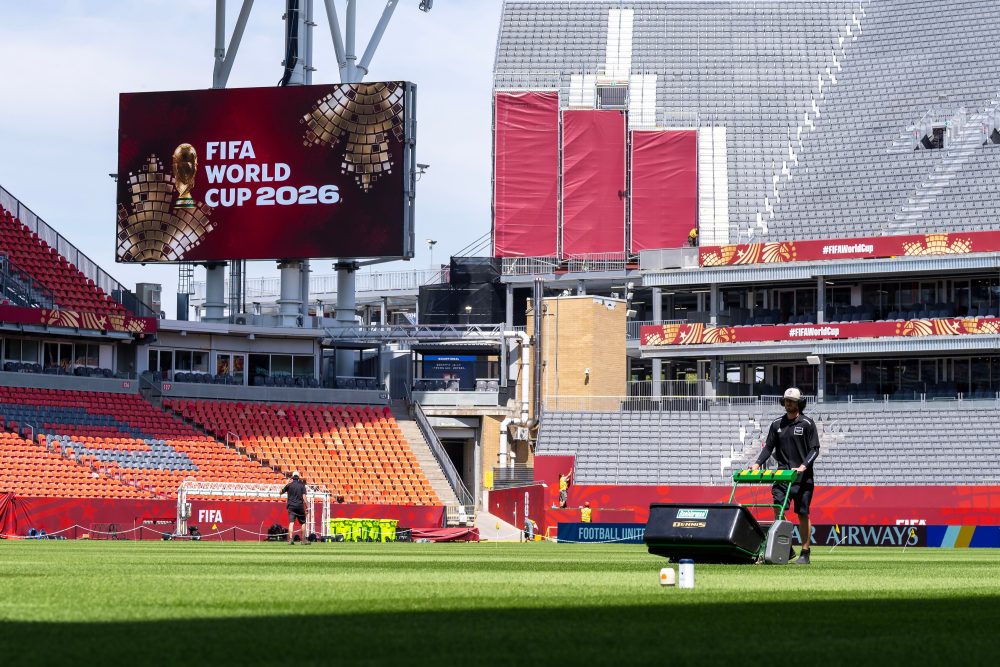

The expansive playing surfaces at World Cup venues represent a massive undertaking, though the teams responsible for creating them hope spectators won’t give the grass a second thought.
Despite requiring tremendous engineering expertise to develop suitable turf for various stadiums and maintain flawless conditions throughout the competition, success means the playing surface remains invisible to viewers.
Nothing disrupts gameplay more than irregular areas, holes, and deteriorated sections that can compromise player stability when attention should remain focused on the matches.
“We want to give credit to the pitch managers who do an amazing job to get these canvases presentable, to be beautiful, but also play perfect, and people see it and admire it. But then they go on and say, ‘Oh, what a great goal that was, and what a great header that was,’” said John Sorochan, professor of turfgrass science within the Department of Plant Sciences at the University of Tennessee.
For approximately eight years, Tennessee and Michigan State have collaborated to develop ideal hybrid turf systems for the 16 venues across Canada, Mexico and the United States scheduled to accommodate World Cup matches.
FIFA maintains stringent standards for playing surfaces, requiring predominantly natural grass that performs uniformly to ensure competitive fairness. This tournament presents particular challenges for maintenance teams due to the expanded format featuring 48 nations and 104 total games.
Eight World Cup venues — seven in the United States and one in Canada — typically feature artificial surfaces. All eight locations, except Vancouver’s BC Place, serve as home fields for NFL franchises. Five facilities have complete, partial, or retractable roof coverage.
Seattle’s Lumen Field, home of the NFL’s Seahawks, became among the initial stadiums to transition from synthetic to natural turf in preparation for the tournament beginning Thursday.
The conversion required installing a crate-style drainage and air circulation framework above the current field, adding over 10 inches of sand on top, laying locally cultivated sod, and reinforcing everything with synthetic fiber support.
Seattle will accommodate six games. Grass installation began in March, with the U.S. women’s national team testing the surface in April.
U.S. captain Lindsey Heaps provided exactly the evaluation turf specialists wanted to hear.
“I didn’t notice it at all, so that means it was a good thing,” Heaps said.
SoFi Stadium in Los Angeles received grass among the final venues, with sod from Washington state arriving May 13, just 30 days before the stadium’s World Cup debut featuring the United States against Paraguay.
Beyond converting artificial playing surfaces, turf professionals also had to address the tournament’s geographical scope and varying weather conditions. Monterrey, Mexico experiences greater heat and humidity during summer months, while BC Place sits in a cooler northern location.
Consequently, they developed two distinct mixtures. Bermuda grass will serve warmer regions, while perennial rye combined with Kentucky bluegrass was placed in cooler areas and enclosed facilities. Turf for both stadiums and practice locations was cultivated and collected at 10 specialized farms throughout the three participating nations.
AT&T Stadium, temporarily called Dallas Stadium for the competition, will accommodate nine contests, exceeding any other location.
The Dallas Cowboys’ venue received new sod installation in early May. The grass was cultivated in Colorado and transported in climate-controlled vehicles to the Arlington facility.
One significant obstacle emerged: the stadium features a retractable roof that blocks natural sunlight from reaching the field. Engineers responded by suspending pink growth lighting from the ceiling to maintain grass quality. The outcome resembles a fusion of Barbie aesthetics with World Cup soccer.
“They’ve never been hung from the ceiling before, so basically, what’s fantastic out of that is that typically these systems have a set of wheels that they’re wheeled on in and out of the facility, and so these are able to be lifted up, and it means that we’ve just got one less thing on the field,” said Ewen Hodge, the World Cup’s head of pitch infrastructure.
Sorochan developed his interest in turf maintenance during the United States’ previous World Cup hosting in 1994. As a Michigan State student, his responsibilities included helping install sod and cutting grass on match days.
Following the tournament’s conclusion, he examined the grass from atop the Pontiac Silverdome.
“We moved it in, it was inside for 30 days, and we didn’t have the grow lights, we didn’t have all the technologies that we have today with the hybrid reinforcement, so those 30 days with no sunlight, it just kind of deteriorated and went down,” Sorochan said. “It held up for those four games they had and practice sessions, but you could definitely see the wear and tear on the field, and I thought, How do we make that better?”
The turf technology and management expertise that Sorochan and his team developed for this World Cup’s playing surfaces enables venues to accommodate more diverse programming.
The grass system allows for rapid installation and removal, permitting stadiums to host packed schedules including tractor pulls, NFL games and premier soccer competitions. The innovation also has municipal applications.
“We can now develop hydroponic systems where we grow grass and recycle water below, and instead of watering from above, and we can use the same water back and forth, and we can have a pitch that’s going to be more sustainable, and really a benefit to the community,” Sorochan said. “So that’s kind of some of the cool stuff coming out of this research that’s just starting to explode over the next five, 10 years. It’s gonna be an unintended game changer.”