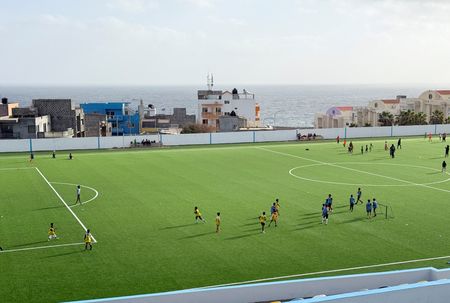

The West African archipelago of Cape Verde resonates with the melancholic sounds of morna, a traditional folk music filled with yearning and emotion. The genre’s most celebrated piece, “Sodade,” pays tribute to countless emigrants who departed these 10 islands scattered off West Africa’s coast seeking employment and better prospects elsewhere.
The song’s verses express: “If you write me, I’ll write you. If you forget me, I’ll forget you.”
In the coming weeks, residents of Cape Verde anticipate their feelings of longing will transform into jubilation. They’re focusing on their national football squad, which features numerous players whose families departed Cape Verde generations ago yet still regard the islands as their homeland.
Known as the Blue Sharks, the squad represents one of the unexpected teams to secure a spot in the 2026 World Cup. Housing under 600,000 residents, Cape Verde ranks as the third-smallest nation by population to ever qualify for the globe’s premier sporting competition, following Iceland in 2018 and Curacao, also qualifying for 2026.
Cape Verde’s squad blends domestic players with numerous foreign-born athletes, such as defender Roberto Lopes, born in Ireland to an Irish mother and Cape Verdean father, and Logan Costa, born in France to Cape Verdean parents who currently plays for Villarreal in Spain.
This mix of homegrown and international players has delivered remarkable results. Cape Verde secured seven victories in their 10 World Cup qualifying matches, suffering only one defeat while achieving a stunning home victory against African powerhouse Cameroon.
The World Cup presents an entirely different challenge. Currently ranked 69th globally, the Blue Sharks will encounter tournament favorites Spain, two-time World Cup champions Uruguay, and Saudi Arabia, a smaller nation but still ranked higher at 61st, in group play.
However, residents maintain optimism.
“I’m very proud,” expressed Anton Delgado, 25, following a recent Sunday afternoon with companions at a Mindelo establishment on São Vicente island. “It’s a marvel. I’ve been waiting years for this. We have real hope that we can win a game or even two.”
This optimism spreads throughout Cape Verde. The small nation’s dining establishments and entertainment venues typically overflow with performers playing morna for visitors and residents. Now they’re preparing for World Cup festivities.
At the Café Royal, a hospitality venue in Mindelo, employees are organizing for large gatherings. The Royal displays an extensive artwork depicting morna legend Cesária Évora, who remains Cape Verde’s most internationally recognized figure 15 years after her passing. However, the nation’s football players currently dominate conversations.
Noaela Delgardo, 22, employed at the Royal’s bar, described the World Cup as an exceptional chance for fellow Cape Verdeans to excel and for their country to achieve “more visibility in the world.”
Despite expanding tourism, the archipelago’s remoteness from major centers remains evident. European flights are available, but the sole direct route to America arrives in Providence, Rhode Island, reflecting 19th-century whaling connections between the regions and the substantial Cape Verdean population residing in Providence currently.
The World Cup offers an opportunity to bridge that gap, explained retiree Jorge Goncales, 69, relaxing with companions one morning in a tree-lined Mindelo plaza. “The whole world comes to us. Now we go out to the world.”
Head coach Pedro Leitão Brito, who received Africa’s Coach of the Year honors last year and goes by his nickname Bubista, also recognizes an opportunity to showcase Cape Verde globally.
“We want to make an impact on the tournament for our people,” he shared with CNN recently. “We want to show everyone watching that, yes, we’re a small country, but we can play against the big teams. We know it’s hard but we want to show that nothing is impossible.”