
A major defense technology company is facing mounting safety questions following a series of drone accidents, including a May incident that seriously injured a Romanian Navy official during training exercises off the Texas coast.
The Romanian official suffered two severed fingers and a fractured third digit when her hand became caught in the propeller of a V-BAT drone manufactured by Shield AI during a May 12 training session. Romania’s Ministry of National Defence confirmed the accident to Reuters, marking the second such finger injury involving the company’s aircraft.
The injured official underwent surgery at University Medical Center New Orleans on May 12 and May 16 to reattach her fingers. When her condition worsened, she was transferred to Walter Reed National Military Medical Center in Maryland, where she remained hospitalized as of May 25, according to the ministry.
This latest accident follows a previous incident where a U.S. Navy official’s fingers were partially severed during testing of the same drone model. Ryan Tseng, who previously led Shield AI, had claimed the company addressed safety issues with improved landing gear and warning labels.
“(The) aircraft is, tip to tail, just a radically better airplane,” Tseng told Forbes last year following the earlier incident.
However, Reuters investigation reveals the V-BAT has crashed more than 50 times over the past 18 months, according to interviews with 21 former employees, industry executives and investors. The news organization also reviewed a whistleblower complaint and lawsuit documents detailing workplace environment concerns.
Among the troubling incidents was a near-miss involving a Cessna aircraft carrying a Shield AI employee and his child, which had to take evasive action to avoid colliding with a V-BAT drone during testing.
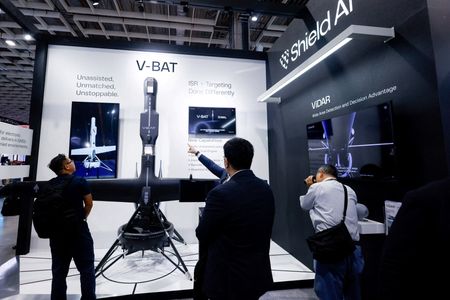
Shield AI acquired the V-BAT technology when it purchased Martin UAV in 2021. The vertical takeoff and landing unmanned aircraft, designed for military applications, carries a price tag of approximately $1 million.
In response to the latest incident, Shield AI attributed the May 12 accident to “a violation of established safety procedures, not from a product defect,” though the company declined to specify what safety protocol was breached.
The company defended its overall safety record, stating that “operational mishaps are common” for drones like the V-BAT. Shield AI emphasized the aircraft “remains one of the most operationally proven VTOL aircraft in service today,” noting it has logged 18,000 flight hours since 2019.
Romania’s defense ministry said it continues investigating the incident and considers it premature to determine fault or whether the accident could have been prevented. Despite the injury, Romania’s Naval Forces confirmed their $30 million contract with Shield AI for V-BAT drones remains active.
Shield AI has positioned itself as a leading defense technology company, achieving a $12.7 billion valuation in a March funding round co-led by JPMorgan. The company markets itself as a crucial supplier of drones and autonomous software to modernize Pentagon capabilities amid ongoing conflicts in Ukraine and the Middle East, plus rising tensions with China over Taiwan.
The company’s profile received a boost in February when U.S. Vice President JD Vance toured Armenia and was shown the latest V-BAT model, recently sold under Washington’s first arms agreement with that nation.
“Holy shit. Look at this thing!” Vance exclaimed in a LinkedIn video, walking around the drone in an ornate hall. “It’s going to do great things for you guys.”
However, former product manager Jacob Miller has filed both a whistleblower complaint and lawsuit alleging he was terminated after raising air-safety concerns. Miller claims Shield AI adopted a “Silicon Valley mindset, that ‘fake it ’til you make it’” approach that proves dangerous when “being applied to equipment that can cause severe immediate harm to people and war fighters.”
Miller’s whistleblower complaint, submitted in May to the Department of Labor’s Office of Administrative Law Judges, alleges the company concealed technical problems with the V-BAT to secure military contracts. He claims Shield AI misled the Greek military about a drone’s autonomous capabilities and manipulated crash reports to present favorable performance data.
According to Miller’s allegations, the falsified information helped secure deals with Naval Air Systems Command and militaries in Greece, Japan, Norway, Taiwan and Ukraine.
The company has experienced numerous crashes during testing and training. In February, Shield AI suspended flights for several weeks following a particularly severe series of accidents, including one that sparked a grass fire in Texas consuming more than 40 acres before firefighters contained it.
During a NATO demonstration in Portugal last September, a V-BAT crash-landed on a runway, according to witness accounts and video footage reviewed by Reuters.
Shield AI acknowledged only 10 “operational mishaps” by customers since early 2025 when it upgraded the V-BAT, without providing details about these incidents.
The company has also faced internal workplace challenges. At least three employees who raised safety concerns over the past 18 months have been fired or left the company, according to sources familiar with the situation. Shield AI hired law firm Littler Mendelson to investigate claims of hostile work environment and air safety concerns, though the investigation’s findings remain unknown.
Founded in 2015 by Ryan Tseng, a tech entrepreneur who previously sold a phone-charging company to Qualcomm, and his brother Brandon, a former Navy SEAL, Shield AI emerged among the first venture-backed startups challenging traditional defense contractors like Lockheed Martin and RTX for Pentagon business.
Despite ongoing V-BAT issues, Shield AI is advancing development of its X-BAT, a larger drone expected to cost around $30 million and designed to operate as a “loyal wingman” alongside fighter jets. The Pentagon’s Defense Innovation Unit recently awarded the company a contract for X-BAT development.
According to an April pitch deck, Shield AI requested $500 million from the Pentagon to develop four X-BAT prototypes by 2029, with additional company investment bringing total costs to $1.3 billion. The X-BAT is expected to utilize the same flight control systems as the problematic V-BAT.
When asked about concerns regarding X-BAT’s reliance on V-BAT technology, a Pentagon spokesperson said the department “recognize[s] that risk is inherent to technology development and innovation, viewing it as a critical learning process essential to fulfilling our Department’s mandate to embrace risk, break things, and deliver capabilities at speed and scale.”