
Emergency warning sirens wailed across Bahrain on Saturday as Iranian forces launched a coordinated missile and drone assault on Gulf nations, according to officials from the island nation’s government.
Bahrain’s foreign ministry announced that Iran had launched ballistic missiles and unmanned aircraft targeting both Bahrain and Kuwait. Officials confirmed the projectiles were successfully intercepted and demanded Iran halt its aggressive actions against neighboring Gulf states immediately.
The Saturday announcement followed Friday’s military engagement where American forces destroyed Iranian ballistic missiles and drones aimed at the Strait of Hormuz and regional allies, while simultaneously attacking several of Iran’s coastal radar monitoring stations in retaliation. This military exchange has further weakened an already fragile ceasefire with Iran.
These latest strikes occur amid intensified efforts by the Trump administration to pressure Iran into negotiating an agreement to resolve the ongoing conflict.
According to U.S. Central Command’s Friday evening social media posts, Iranian forces launched seven ballistic missiles targeting Kuwait and Bahrain. American military units successfully intercepted six missiles, while the seventh failed to reach its intended destination. Officials reported no injuries to U.S. military personnel.
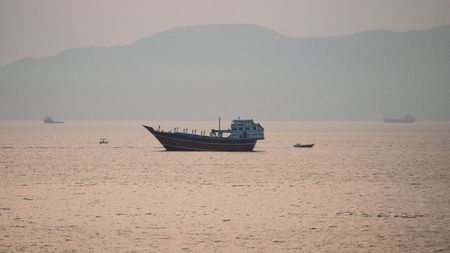
The missile barrage followed an earlier incident Friday when U.S. forces destroyed four Iranian drones heading toward the Strait of Hormuz.
“The attack drones posed an immediate threat to regional maritime traffic,” U.S. Central Command stated on social media.
Kuwaiti military officials confirmed their forces were actively intercepting incoming missiles and drones targeting their territory. Meanwhile, Bahrain activated emergency warning systems and instructed citizens to seek immediate shelter at the closest safe locations while monitoring official communications.
Iran’s Revolutionary Guard claimed responsibility for targeting the Ali Al Salem airbase hosting U.S. personnel in Kuwait and the U.S. Navy’s 5th Fleet stationed in Bahrain, according to reports from the state-operated IRNA news agency.
American military operations include enforcing a naval blockade of Iranian ports as a response to Iran’s control over the vital shipping lane for worldwide oil and natural gas transportation. This situation has caused energy costs to surge and created political challenges for President Donald Trump’s Republican Party before upcoming midterm congressional elections.
U.S. Central Command reported striking the radar installations, including a facility on an island within the strait, “to defend against further attacks.”
This represents the most recent escalation in a series of retaliatory strikes that have weakened the fragile ceasefire and complicated diplomatic efforts to extend the temporary peace agreement. Earlier in the week, Iranian drone attacks severely damaged a passenger terminal at Kuwait’s primary airport, resulting in one fatality, multiple injuries, and temporary airport closure.
Even as these attacks raise fresh concerns about potential ceasefire collapse, Trump informed reporters Friday that “the situation with Iran seems to be going quite well.”
“We’re going to come out of Iran very quickly and it’s going to be very strong one way or the other, whether it’s a piece of paper or the very tough way,” Trump stated during a Wisconsin event with farmers. “The very tough way is maybe the easier way, but we’re going to come out, and your fertilizer prices are going to go way down, just like they were four months ago.”
Trump appears increasingly constrained by a conflict that has reached a stalemate. American and Iranian negotiators achieved a preliminary agreement one week ago to extend the ceasefire for 60 days and begin fresh discussions regarding Iran’s nuclear program. However, Trump has requested undefined modifications while Iranian leadership has not publicly endorsed the proposed deal.
When questioned Friday about the delayed progress, Trump told NBC’s “Meet the Press” it was because “it’s a very hard thing for them.”
“There are things they never thought they’d be doing that they’re going to have to do. They’ve got no choice, and it takes a little while,” he explained during the interview.
Trump indicated that Iranian forces retain 21% to 22% of their missile arsenal.
His administration has also highlighted the recent ceasefire agreement between the Lebanese government and Israel following U.S.-mediated negotiations in Washington. Nevertheless, the Iranian-supported Hezbollah militant organization has refused to accept the agreement, and continued attacks have placed it in greater jeopardy.
Israeli military forces conducted strikes Friday across multiple areas of southern Lebanon while issuing evacuation orders for nine villages, including one housing thousands of displaced residents from the conflict. The attacks resulted in nine deaths across six southern Lebanon locations, according to the state news agency.
Israeli military officials confirmed two soldiers sustained wounds, one critically, during Friday’s confrontation with militants in southern Lebanon.
The Lebanese conflict, where Israeli forces have captured significant portions of the south, also jeopardizes efforts to resolve the Iran war and reopen the Strait of Hormuz since Iran has insisted any permanent ceasefire must include Lebanon.
Beyond intercepting drones in the Strait of Hormuz, U.S. military personnel earlier Friday boarded a sanctioned oil tanker connected to Iran in the Indian Ocean as part of American efforts to block Iran from generating revenue through oil and other commodity sales.
The United States also imposed new sanctions targeting Iran’s energy sector, affecting multiple individuals, companies, and tankers.