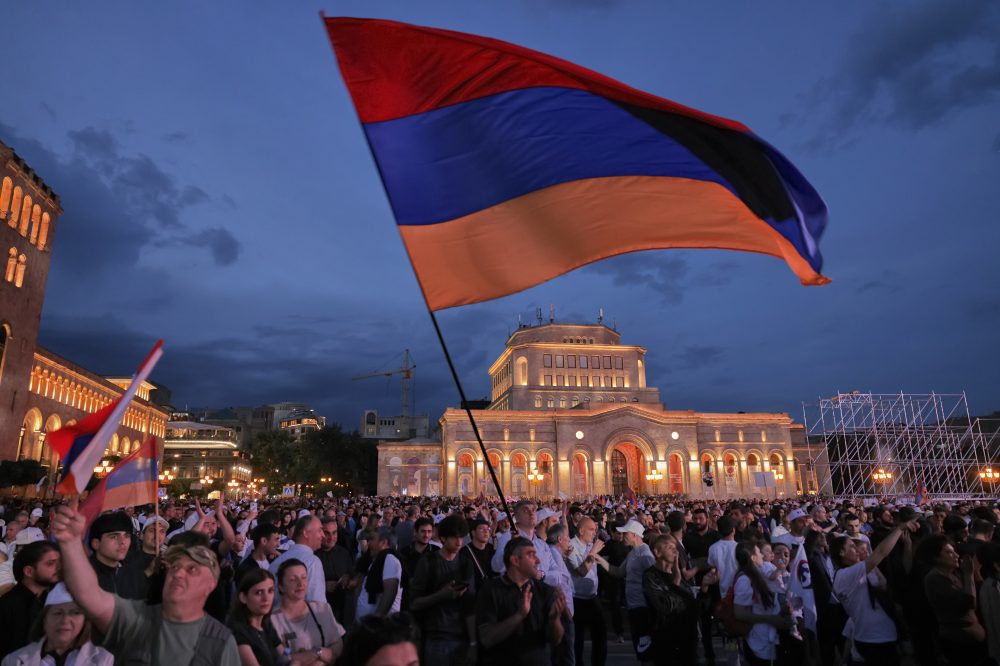

Sunday’s parliamentary elections in Armenia will serve as a referendum on the country’s international alignment as current Prime Minister Nikol Pashinyan pursues stronger connections with the European Union and United States while facing criticism for distancing the nation from its traditional Russian ally.
Political experts predict Pashinyan’s Civil Contract party will likely maintain parliamentary control, though numerous opposition groups campaigning on pro-Moscow platforms have made the Caucasus nation’s global positioning a central campaign issue.
Leading up to the vote, Russian President Vladimir Putin and other Moscow officials have cautioned Armenia that European Union membership could result in severe economic harm by severing trade relationships with Russia and its partner nations.
“These are the first elections in Armenia’s history where geopolitical orientation has become a decisive issue,” Mikayel Zolyan, an analyst and former member of the Armenian Parliament, told The Associated Press from Yerevan. “Until now, Armenia has remained within Russia’s sphere of influence, and this was taken for granted, but now, for the first time, this is being called into question.”
The relationship between Moscow and Armenia deteriorated in 2023 following Azerbaijan’s seizure of the complete Karabakh region. Ethnic Armenian forces supported by Armenia had maintained control over the mountainous territory for decades as part of an ongoing dispute between the two neighboring nations.
Armenian leaders blamed Russian peacekeepers stationed in the area for not preventing Azerbaijan’s offensive. Moscow, occupied with the Ukrainian conflict, has dismissed these claims, stating its forces lacked authority to intervene.
“It turned out that Russia’s image as a guarantor of Armenian security was not based in reality, and it all collapsed after the Karabakh war,” said Alexander Iskandaryan, director of the Caucasus Institute in Yerevan.
Pashinyan has gradually distanced his country from Moscow, becoming a member of the International Criminal Court in 2023 and halting participation in the Moscow-led Collective Security Treaty Organization in 2024.
Armenia has also formally announced its EU membership goals and served as host for the European Political Community summit in Yerevan during early May.
A decisive parliamentary victory would provide Pashinyan with the authority to advance this direction and complete negotiations with Azerbaijan.
Western countries have demonstrated potential benefits of strengthened relationships.
During August, U.S. President Donald Trump brought together Pashinyan and Azerbaijan’s President Ilham Aliyev to execute an agreement ending their multi-decade conflict and establishing provisions for a new transit route connecting Azerbaijan to its Nakhchivan territory. A February agreement could enable a U.S. company to construct a nuclear reactor in Armenia.
European Commission President Ursula von der Leyen has also stated that Europe stands prepared to fund Armenia’s energy sector and its “booming digital scene.”
Trump has supported Pashinyan, describing him as a “great friend” and a leader making his nation “strong, wealthy, and very secure!”
Armenia’s opposition remains largely controlled by pro-Russia factions, with many opposing normalized Azerbaijan relations. Leading opposition voices have demanded Pashinyan’s resignation following the Karabakh loss.
Nineteen political entities, comprising two blocs and 17 parties, are participating in the elections.
Pashinyan’s primary challenger is the Strong Armenia Party, which seeks enhanced business connections with Russia and claims Pashinyan is trying to provoke conflict with Moscow. Armenian-Russian billionaire Samvel Karapetyan leads the party while facing trial for allegedly inciting government overthrow, charges he disputes.
Additional competitors include former President Robert Kocharyan, who heads the Hayastan bloc and has accused Pashinyan of “seriously undermining” Russian relations.
Russia, maintaining a military installation in Armenia, has warned that Yerevan’s Western shift could bring severe political and economic repercussions.
Putin has drawn comparisons between Armenia’s path and Ukraine’s in barely concealed warnings, suggesting Russia’s Ukrainian conflict began with EU membership attempts.
Recently, Russia has imposed new limitations on Armenian products citing health violations, prohibiting Armenian flowers, specific cognac and wine varieties, eggplants, potatoes, dried fruits, fish and additional items.
Armenia’s participation in the Eurasian Economic Union, a Russian-controlled customs alliance, faced formal examination during a Kazakhstan meeting in May, with threats of complete suspension by December.
At the Kazakhstan gathering, governments of Russia, Belarus, Kazakhstan and Kyrgyzstan also required Armenia to conduct a referendum on remaining in their organization or pursuing EU membership. Pashinyan has dismissed the necessity for such a referendum.
Armenian government data indicates 38% of Armenia’s exports traveled to Eurasian Economic Union countries in 2025, with most destined for Russia. Comparatively, only 8% of trade reached the EU.
The Russian actions led von der Leyen to announce Thursday that the 27-member bloc would provide 50 million euros ($58 million) to assist Armenia. In her statement, she said Russia is “weaponizing” economic relationships and its import prohibition represents “nothing short of economic coercion.”
Russia maintains additional leverage over Armenia through its control of substantial portions of the country’s energy and infrastructure while providing affordable gas.
“It’s completely unrealistic to say that Armenia can somehow overcome Russian influence in a short period of time,” analyst Zolyan said.
Armenia’s civil society has also expressed concerns about what they characterize as Russian-supported disinformation efforts before the election. Moscow denies any meddling.
Daniel Ionnisyan, head of the Union of Informed Citizens, an independent election watchdog, told the AP that his organization has documented instances of Russian interference through social media campaigns, cyberattacks, vote buying and bribery of journalists.
These findings align with observations from a Parliamentary Assembly of the Council of Europe delegation that visited Yerevan in May, reporting foreign interference including illegal political funding, cyberattacks, economic pressure and direct electoral manipulation attempts.
“These hybrid tactics aim not only to sway public opinion but to secure long-term geopolitical leverage over Armenia,” the delegation said.